Leveraging Podcasts for Audience Growth With Andrew Hong
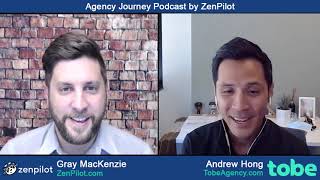
Greg MacKenzie interviews Andrew Hong, CEO of Toby Agency, about how agencies use podcasts to grow their audience and engage clients. They cover content marketing, SEO, and different ways to package podcast content for internal and external audiences.
Welcome to the Agency Journey Podcast, where we connect with agency leaders to uncover the hidden systems and processes that drive their success. Now let's dive into today's show. Hey, it's Greg. I want to let you know that today's episode of the Agency Journey Podcast is brought to you by Around. What is Around? It's a video calling tool that's lightweight, it's playful, it doesn't take up your whole screen. It has saved me so much CPU usage and I was a super early adopter of round back in early 2020 and I'm so thrilled that they're sponsoring the show. We're still using it. It is the coolest internal communications tool that we've added in the past 18 months here at Zen Pilot. We absolutely love it. It's made our meetings a lot more enjoyable. The GIPHY integration is absurd and really fun. And, um, yeah, I think everyone's kind of gotten used to here in the post Covid environment, the fact that people are working from home, but they have some super cool tech that's baked in. Everyone talks about being AI based. They actually have AI based noise removal, camera framing and background cropping. So basically you're not seeing a big square or rectangle of what your camera would be. It's a circle that centers on your head and it cuts out a lot of the background stuff. And then if you get people screaming in the background, I've got four kids at home. It's going to cut out a lot of that noise. It's absolutely awesome. So you can try around for free. Go to Around Co agencyjourney if you sign up. If you like it, shoot me your favorite filter. Ask me for a link to my secret room. I love to hear from other agencies who are using it. I think this is an awesome tool for internal agency teams. All right, let's get back to the show. All right. Welcome into another week's episode of Agency journey. I'm Gray MacKenzie from Zen Pilot. This week I've got the pleasure of bringing on Andrew Hong, who is the CEO and co founder of Toby Agency. And Andrew is no stranger to the podcasting game, so I'm excited to dive in. Andrew, thanks for joining me.
Yeah, thanks, Greg. Excited to be on here. Heard the podcast a few times already, so pretty cool to be a guest on it now.
Awesome. Well, I appreciate you still coming on after listening, so it's. I'll take that as a good sign. So, Toby Agency, let's get the quick kind of 30 second overview of the agency and backstory.
Yeah, so we're primarily a HubSpot agency. We're a diamond tier HubSpot agency based in Los Angeles. For all the agencies out there, we provide the typical kind of suite of inbound services. Right. So the growth marketing side, we do a lot of sales enablement because we work with a lot of B2B companies primarily in the real estate, education, health care education and mortgage verticals. So we work with companies that provide services to real estate agents, provide services to mortgage companies and whatnot. And yeah, we have a very pretty big media component to our agency. And that's actually one area where we've made a pretty significant investment over the past couple of years because we sort of see this transition where if you're blogging and doing the typical like inbound content stuff. Well now, like if you have video content or audio content, it can now be indexed.
Right.
Just like written content can be.
Right.
On YouTube. There's even SEO for like Apple Podcast, for example. So the media component of us is really where we focus a lot on the media of our company and really on audio and video in the form of video podcasting.
So great overview. There's a lot that we could dive into there. But where did the podcasting? I mean, so for us, we started this podcast in 2015 and it was like I'd had a year before of wanting to start a podcast. I don't know what to start a podcast about. Okay, we've got a great excuse here. We can use it for business.
Yep.
Where did the podcast drive and the media drive come from?
Yeah, so we wanted to find a way to differentiate ourselves from other HubSpot agencies. Really. There's no secret out there that HubSpot as a platform is just really growing. And they're going up market, you know, they're, they're going across small and medium sized businesses. They're going into enterprise now. And so naturally there's been a lot more agencies that have entered the space. Right. The partner program, perhaps Spot, has been pretty big and very successful. But for us it's like, hey, look, there's a lot of the services that we were offering. Look, there's a lot of agencies that offer the similar kind of inbound retainer. And for us it was like, okay, the inbound retainer, it's a core service, but how do we expand on that?
Right?
And that's where we started to think about video work. And when we actually started our agency in the beginning, we're like, oh, we're going to be a video production agency. Do Live action, do all that kind of stuff, you know, and sure enough, you create this, you know, five to $7,000 video about us, video, culture, video, whatever lives on the website. It's outdated after two years, and it's like, okay, what's the next video content or asset that we have to create? So really, the podcasting came in because we saw it as a quick and easy way for people to get involved in video. Because basically you are recording audio, you're recording video. You now have a video interview, basically that you can put on YouTube or any of the other video hosting platforms. But more importantly, you can actually take that video content and clip it into micro content.
Right.
So taking hot outtakes from the podcast, you can use that for social content, for email content. Heck, we even use a lot of that micro content for outbound sales.
Right.
Where they're trying to nurture people with some of that stuff. So really, the podcasting came as a need for us to differentiate ourselves, but also kind of see like, hey, look like it's going to be a pretty critical component of a content strategy moving forward to produce a lot of video content. And that can be very unwieldy if you're doing, like, very custom type of projects.
Makes a lot of sense. I just did a podcast earlier this morning and there's. I don't know if you ever come across a tool called Avoma.
I have not, no.
But there. It's like a competitor in the marketplace too. I think Gong and Chorus are the two main platforms that they're going after.
Yep.
So we're using this tool. It records it sucks in your zoom transcript or shows up as a note taker on the call and then transcribes it all like an otter AI or a tool like that.
Yep.
But then also gives you the ability to comment back and forth, great snippets and stuff like that. The cool thing is, so we're on this podcast, a past customer who worked with us, you know, a couple months ago and talking about some of the story and gave a great shout out to us in the podcast around, hey, here's the services, the transformation that we went through on Streamliner operations and ClickUp. So super cool in Avoma, just to take that snippet afterwards to, hey, we'll clip this. Here's a sales asset for the sales team. Right away to use that.
Exactly.
He's already said publicly, and I was like, hey, can we use that right afterwards? Yeah, absolutely.
And that's the best testimonial.
Right.
It's like so much more powerful than just a bunch of text on like a static webpage, right? Like having an audiogram or a video asset or whatever on video.
In the state of a podcast, in.
A natural, you can read the body language. Like the person's a little like the authenticity, I think comes through a little more. And you know, a lot of times we kind of talk about like, build like, you know, you as an owner of your organization or your agency or whatever. Our personal brand and our company brands are so like intermixed now, you know what I mean? Like, it's almost like, hey, if we're posting on LinkedIn for the company profile, we gotta post on the CEO or CEOs or whoever's profile as well. And I think a lot of times like the podcast format becomes a way for your personality to really shine, you know what I mean? The intonation in your voice, your body language, like all that kind of stuff, it's just very different from like reading like a static book blog post that came out, you know, from the company owner or whatever the case is. So. Right, yeah, I think that's, that's a, that's a really. And in fact there's a piece of software that we used and for anyone out there that is looking for kind of like an all in one platform, we use a piece of software called Casted. And basically what it allows you to do is it allows you to record audio and take your audio and video, load it in, it'll transcribe for you, it'll pull all the show notes out for you, and it gives the ability for marketers to like clip audio and video content directly from the podcast. So now you don't even have to have a post production person get involved in the micro content. And that's something that our agency does, is that sometimes the client has got a team that can produce the podcast, that can clip all the content from it and everything. And sometimes they just need us to get involved from a content strategy standpoint, right? Just like, as you well know, like, hey, if you're going to go plan a bunch of blog posts that you're going to spend some time writing on, there's gotta be a content strategy to that. Same thing with the podcast, right? You gotta think about, okay, like, what are the topics, what are the guests like? If I'm posting this stuff on YouTube, what keywords am I using to make sure that that micro content gets shown up in search and that maybe I'm getting some more awareness of my brand. So like having those tools and putting them in the hands of marketers. Kind of like what HubSpot did.
Right.
And was made like, I think podcasting a little bit easier and there's a lot less technicality to it these days where maybe you don't have to have a full production team doing it for you. Maybe you just need some help on the strategy side.
Right, Right.
So it's worth mentioning and we'll include this in the show notes that you guys have a full course which is a lead gen tool for you. And I want to talk a little bit more about that in a second. Uh, first things is it's just called build your branded pod. Is it the build your branded podcast or build your branded podcast 101? I don't.
Yep. Build your branded podcast 101.
Yep.
Okay.
Um, awesome. What's the URL for that? Do you know, off the top of your head?
I don't have it. It's a teachable page. I'll, I'll, I'll send it over to you to put it in the show notes for sure.
So we'll make sure, we'll make sure we include it. If you'll go to Adobe Agency co. Yep. You can get there from, from there as well. But so in that which I'm enrolled in and have gone through, you can see my, you can check my progress because you guys are using teachable how far I'm actually through it. But there's lots of possibilities and lots of, hey, how do you think about how you design it? I'm going to try and push you to say, hey, for the average company out there who you guys are working with, do you have a favorite content mechanism? Should it be guest based or do you like to push people to do solo episodes or mix the two kind of time format? What are some of the things that you're seeing working well in podcasting right now?
Yeah, that's a great question. So you first touched on that there's so many different formats to how you can do a podcast. Right. Generally speaking, the easiest, like lowest level of effort is going to be an interview style podcast.
Right.
We're kind of like we're doing right now. We're interviewing each other. Yes. There's probably some prep work and a little bit of pre production that has to happen beforehand, but it's relatively easy to produce and find the guests. There's also. We've done narrative style podcasts as well. I don't know. You've. The New York Times puts out a podcast called the Daily every day and it's basically kind of like they take interviews and intermix a narrative. But it's a very produced podcast. Right. There's a lot of pre production that has to go into it. Like, okay, from minutes one to three, what are we telling? We have to record the narrative after the fact, which includes a script. Right. So the level of complexity just starts to shoot up significantly. So I, you know, typically I actually like the guest format, like interview style podcasts like this for brands that are just starting out with podcasting. Mainly because you're trying to prove the concept. Is this working for you? Are you getting that kind of top of funnel awareness that a podcast should be helping you get? Or is the podcast helping engage your existing prospects or your customers? Right. So I like taking the guest approach. The other thing too is that the guests themselves can become a distribution channel for you.
Right.
So for example, like when you publish this podcast, I'm going to share it to my network.
Right.
I send out a newsletter monthly to all of our clients, our previous clients, our employees, our contractors, previous employees, folks that are just like part of our family basically.
Right.
And I like to highlight content that I've been involved in and things like that to promote it. So you have kind of like a mini distribution channel through that guest themselves. And if they have particular reach, like you could actually get a lot more awareness of your podcast than that. So I think that the other part too is that on if you do more of a narrative style podcast, you. You probably need to hire a producer to do that.
Right.
So the budget and all that stuff kind of comes in a little bit. But I would say typically if you're B2B, the, the podcasts that are more of the interview style, where there's like thought leadership, you're bringing in a guest that knows a lot about a specific topic. I think those will work really well for B2. A lot of the beat. In fact, we've worked with funny. We work with Stanford University and do a podcast for them. And this is really around. The basic idea was like they were trying to get people from different political affiliations to come into a room together to talk like real people do, instead of sitting behind a keyboard like, you know, flaming each other basically.
Right.
And so we actually, we did this podcast with them and it became more of a narrative style podcast and we're trying to tell a story basically, you know, through the episode. And so I think for like some B2C brands out there, like, there's a really cool story component that you can Use with a more narrative piece, but there's a bigger piece of production that's involved. But in our experience, at least on the B2B side, and that's like the core kind of clients that we work with. We definitely find that the interview style ones work a little bit better, not only in terms of distribution, but for production. And I think a lot of times when people are going to B2B content, they're just like looking for thought leadership or how can they do their job better in a lot of ways?
So I want to make one point on top of what you had. And then I've got a question to ask you about one of the challenges with Interview Style podcast.
Yeah.
When we were starting, so we were at the time we were running a software company called Do Inbound Project Management Software for agencies before we said, hey, trying to teach, do consulting and build the software at the same time is really, really hard.
Sure, yeah, yeah.
But we were, uh. It was called Do Amount because it was specifically targeted towards inbound agencies. And so HubSpot partners were main. That was our. Our world that we were in. So a piece of what you touched on was really a key point in that you get distribution through the guests that you bring on and you tap into their network. And then there's this element in the world that's unfair, but part of reality, which is you get credibility based on who you're associated with, that, you know, there's a saying around you are the average of the five people who you spend the most time with or your five friends. So part of our growth strategy early on was, hey, we'll have all the largest HubSpot partners on now we're building relationships with all of them. But also there's an element here where we're being seen in the same room with all of these people. There's some credibility that's. That's pulled in from that. And that wasn't a. Wasn't as cold and calculating at the time as it sounds like afterwards. But that was actually a really active, kind of blindly stumbled into it. And it was actually a really effective marketing tool for us back then. So anybody running any brand, you can do the same thing, go to the influencers in your space, and you become seen as one of the influencers in the space.
Yeah. And it's all about those micro communities, right? Like building these small little niche communities where everyone kind of has these very common denominators and all these common threads. And actually like in looking at my journey and meeting you and then Pilot, like I was referred to you, I heard your podcast and I was like, okay, the things they're talking about, these are all the operational project management ClickUp challenges that we're facing right now. We got to talk to this guy. We're still in the process of trying to figure out how to work together, but I think we both see that there's value there. But I think for me, hearing other agency owners talk about some of the problems and challenges, and again, to your point, some of the larger ones, for that matter, right? The ones that we see on the first or second page of the HubSpot Partner Directory and stuff like, hey, like, that guy or that girl actually has the same problem that I have as an agency that's maybe like a third or even less of the size. And they're investing with zenpilot to make sure that they are setting up their ops and their project management systems and their teams to scale. So that gave me, like, more like confidence to have further conversations with you and to continue the conversation with you to this day.
Right.
About us working together. So, yeah. And actually we tell a lot of our B2B clients, like, another strategy for podcasting is like, hey, you're prospecting, you've got. You're connected with an SQL and maybe there's an opportunity or a deal on the board. They're not ready yet, though. They're just like, hey, you know what? Like, I really like what you guys offer. I think we need it. It's not time yet.
Right.
So we. We know that as part of, like, sales professionals, we got to continue to nurture that folk. That person, stay warm with them, continue to build that relationship. So we tell a lot of these folks, book your prospects on podcasts.
Right?
It's a way for them to get to know you a little bit better. And a lot of people are kind of flattered when you get. When they ask you to put them on their podcast. So it's not as big of an ask as you think it is. Right. So I think that's something to think about too. Yeah.
One thing that you mentioned around the narrative side, I think one of the pros of that anytime that you're controlling the content is if you're trying to do SEO as well, and you've got a specific topic that you want to rank for. Do you have any mechanisms or systems that you. So going into this conversation, I have themes. I've got a handful of prepared areas that I want to ask you about, but I also want to stay curious and understand hey, Andrew said this thing that's really interesting. I want to be able to have flexibility to go jump into that. So I can't pre write, here's a 2000 word article based on what Andrew's going to say because I don't know. And so I could go for what's the piece that comes out of this? It's not how to podcast if you're an agency. That doesn't help our business at all, though it might be helpful content in the ecosystem. But that's a term that you guys should own. So I could dig in and we could find something like the process for producing something that's tied back the process that's maybe beneficial for us and we're not overthinking the keyword research side right now. We probably should be doing more from an optimization perspective. How are you if you're inviting guests on, do you care much about what the SEO is? And how are you writing show notes or titles to articles and podcast episodes, both for keyword optimization and trying to rank for things, but also be true to what the content is itself?
That's a great question. It's very difficult to do to marry both of those things up entirely. And in fact, a lot of times when we engage with a client, during the proposal process itself, we're asking them, what's your goal for this podcast? Is it more of a brand play and a brand awareness sort of play? A lot of times even clients will say, you know, what for? In the mortgage business, for example, a lot of folks, after you close a loan, you want to stay connected with that person for refinance down the road, for example, right? Or for a referral. And so like, if you want to get back in front of someone and say connected with them, like, having a podcast might be a good way to stay connected with like previous customers. If you know, and this is where you're not talking about mortgage financing, you're talking about home improvement and things kind of related to it. You know what I mean? So in those cases, a lot of times we don't really care about SEO. It's really about how do we create cool, interesting quality content that people are going to like, Are they going to spend an extra 30 minutes out of their day to look forward to this show? On the flip side, there are some clients where we ask them, like, okay, well, what do you want to do with your podcast? We need to grow awareness. And there's some very specific metrics. YouTube subscribers, podcast subscribers, email newsletter subscribers. We always try to link a lead magnet into like the YouTube description or into the show notes to try and get some sort of conversion opportunity if there is one there.
Right.
And usually it's like trying to grab an email address from someone who subscribed to your podcast. In those cases, we usually have to prioritize SEO first. And so what will typically happen is when we engage with a customer client there they'll be like, we want to get more awareness and like, okay, do you have a YouTube channel? We don't have one. Okay, well let's start talking about, let's build a YouTube strategy for you first. And that's usually like an upfront engagement, usually like 5 to 7K or something like that.
Right.
Where we're analyzing their YouTube channel, we're analyzing their competitors channels, we're looking at keywords. We have. There's some software out there and we've actually switched a couple of times and I'll, I'll find out what those softwares are and send them over to you. But we use some software to actually do. It's like semrush basically for YouTube.
Right.
And so what we're doing is we're actually finding specific keywords that we can title our playlists with, that we can title our individual video titles with and in the descriptions as well. And then what we'll do is we'll take, we'll basically use that research to figure out like, okay, what kind of episodes do we need to come up with now? And then we'll go look for the guests.
Right.
So that is a lot more work, right, than just, hey, what, what are some really interesting guests or whatever that we want to like put in front of our folks. And we don't really care about performance versus we got to do SEO research. We got to make sure all the titles of the videos are optimized. And we all know that SEO is not a one and done thing. We're constantly re optimizing things, looking at performance, that kind of stuff. So I would say like, it's not easy to marry both up. And like, with most things, if you try to kind of toe the middle line, you're not going to get results either.
Right.
So I would say you got to ask yourself, is this more of a brand type of podcast? And we just want to put it out there. We want to, you know, we've got an audience already that will probably engage with it. Or am I using this podcast to grow? I will tell you, it is very hard to use a podcast to grow from scratch if you don't have a built in audience already. I've. We've declined a number of projects where they're like, oh, we've got a lot of money to produce a podcast and our expectation is we want to start generating leads from it within the first six months, like now. It's probably not going to happen.
Right.
Usually what we tell them is you got to see the podcast in a way that you use your existing audience to promote it, to kind of like get some SEO juice within like Apple podcasts and Spotify. And once they start to see external people coming in to like link into those and download the show and the listen times and things like that, it'll actually start to prioritize your ranking as long as you pick like the right category. So it'll naturally happen. But it's not like written SEO in a lot of ways where, hey, you just found that right little niche and you start to get that traffic right away. It's usually not a good idea to start a podcast if you are just looking to grow like to build a brand new audience. There are a million podcasts out there probably. There's probably tens of millions that are out there. I can't remember what the last statistic was, but it's very hard to get found out there. So if you're looking to start a podcast just to like completely dominate and find a brand new audience, probably not the best place to start.
Right. Right now. It's great for kind of audience maturation and building.
I think so, yeah. I think so. Yeah. You got prospects that you're trying to nurture, things like that or customers that you just want to stay top of mind with.
Great.
But it's still very difficult from an awareness standpoint to, to get that kind of ROI of the podcast. That makes sense.
So the other piece I had down here was around kind of the podcasting strategy for the agency itself.
Yep.
So I would assume you're using it in a lot of the same ways where you are and continue to build relationships with prospects and with leads. But in terms of the podcast that you're producing, maybe you can walk us through real quickly kind of the, the profiles of what you're producing and then what the. What the impact. What impact that's had.
Yeah. So we have two like agency podcasts and we're actually starting to build what we refer to as a podcast network out of it. So eventually, you know, I think every brand can probably have multiple podcasts because you have multiple Personas. You might have a B2B side of your company, you might have a B2C side of your company. So I envision a future where companies that are really serious about podcasting, you're probably going to have multiple podcasts. So what we did was we piloted that idea with our company. And so we have podcasts, we have a podcast called Lights Camera Grow and another podcast called Run with Toby. So the Lights Camera Grow podcast is all about bringing on kind of like marketing influencers, if you would.
Right.
Like they're CMOs of organizations, they're VPs at bigger companies like HubSpot. They might be the owner of another agency, for example. We talk a lot about how to use rich media or really multimedia content, audio and video content in your content marketing. So that's why I call it Lights Camera Grow. It's the whole idea of video and growing.
Right.
So our approach to that is just, you know, we kind of actually had to take a sales approach to that, an outbound sales approach. So I actually, when at the time we had an SDR and we were, as the SDR was like prospecting and reaching out to leads on the sales side, I actually asked him to, hey, find us guests on our podcast to reach out to, to pitch. So he was pitching like, you know, you know, we're, we're, we were, we're pretty, we're shooting for some pretty up there guests, right? Um, and we ended up getting some pretty good ones. And ultimately like, we got like a couple of VPs from HubSpot and things like that. There was some interesting content. So that has been a really good way for us to kind of show to our clients that, hey, look like this is what a podcast would look like. That is more of an interview style podcast that's centered on growth, right. So that became kind of a proof of concept that we use to go sell our first podcast clients. Right. And we started that podcast probably about three years ago. Now we have another podcast called Run with Toby and that's kind of gone through a couple iterations of it. And what it recently has become, has become an internal only podcast for our clients, our previous clients, our employees, or previous employees and contractors. And a lot of that we decided that we want, instead of sending like a newsletter, we wanted to produce a podcast. It's like a 30 minute podcast where we're highlighting one of our clients or one of our employees. So really what I wanted our other clients to find out about was to learn about more about the other side of our employees, but also to learn about some of the projects that we're doing with our other clients. That podcast is not public. We don't publish it on Apple podcasts. We don't put it on Spotify. We host it on the casted platform, basically. And basically we send that email out to only that group of a couple hundred. A few hundred folks. And our goal there is just to get those folks to listen to it and to learn more about our agency. So really two approaches to podcasting for our agency. One that's more publicly facing for growth purposes and we do execute a YouTube strategy and there are things like that. But on the other side, we have more of an internal podcast that we use to just get more engagement and just to be top of mind with our clients and kind of our network, if you would.
I'm on lcg. Lights Camera, Grow.
Yep.
Toby Agency co right now.
Yep.
This is hosted on casted.
Yep.
That's awesome.
Yep.
That's what powers the page.
Yep.
This is, this is super cool. And you've had a bunch of good names on the podcast. I've got a couple episodes of this podcast. One of the ones I remember at one point, I think I'm not seeing it on the page right now. I thought you had Jay.
Yeah, Jay was on there. Yep, yep.
The.
The podcasting guru, man. He's great.
Yeah.
Yeah.
That's awesome. Cool. What from on the internal side, I've only talked to one other agency who's got a private podcast stream.
Oh, cool. Yeah.
Right now. And that's. I think that's a cool angle that I'm excited to see kind of grow. And there'd be these inside tracks at companies where there's kind of our own internal podcast.
Yeah. And for something that came. Came to light during COVID or the Pandemic actually was a couple companies reached out to us to produce internal company podcasts. Like hr.
Right.
So like I never thought that HR would be a Persona that we would sell into, but I certainly started having a lot of like technology companies where everyone was kind of work from home. I think they're more forward thinking companies too in terms of people culture as well. So like they're. I got a random inbound from someone like the head of HR at a technology company, basically saying, hey, we're thinking about producing a podcast, but I have no idea how to do it. Like, can you help us produce it? It's like we've never done an internal podcast before, but the production process is generally the same. So what they did was they just interviewed like all their executives. In fact, there was a big Corporate social csr. Corporate social responsibility initiative the company was doing. And One of the HR department's goals, or OKRs, was to bring more awareness of what the executives were doing in this corporate social responsibility program.
Right.
Because they realized it was a very important thing for this company. But no one knew all the training the executives were going through. So they had the consultant that was providing the CSR training to the executives be the host of three episodes of the podcast and ask questions to the executives and what they were learning about. And it was actually very well received by the company. The feedback they got was like, oh, wow. I never knew that our executives were actually learning about some of this stuff. And it helped with culture and morale and that kind of stuff. So that was another use case for a podcast that I never thought about until someone reached out to me about it.
That's wild. It's cool to see the case studies. Okay, so I've got just a couple things here as we're wrapping up. We mentioned the build Your Brand Podcast 101 course. I know you guys are growing right now and you're hiring or strategists, so maybe you can touch briefly on the openings. I guess there's two things here where you're growing right now, what roles you're hiring for. I think that's an interesting touch point in terms of where people are sure trying to recruit. And then secondly would be kind of directionally for the agency moving forward. Any major initiatives that you're excited about, kind of tail end of 20, 20, 21 and into 2022.
Yeah. So on the recruiting piece, I swear I'm trying to hire the unicorn, like strategist that every agency owner is always looking for. This combination of a person who gets client management, gets the marketing strategy piece, gets the project management piece right. And can roll the punches basically right. All the weird client issues that kind of come up. So that's an area where, I'll be honest with you, it's been very difficult to find someone from the outside to fill that role because we have some unique processes to our agency that I think lend well to like promoting someone internally into that role. But that's certainly that kind of marketing strategist, like slash account manager role is an area where we're looking for. And this is someone probably like four to six years of experience. You know, they've led engagement teams before and that kind of thing. So that's, you know, that's probably one area where we're actually growing pretty significantly in terms of work is really around content. And specifically we sell, we have a specific service around building a pillar page and then building like associated blog content with that pillar page. And then we actually build a podcast using the content from the pillar page to inform the content strategy for the podcast is all the SEO research has already been done. So that's an area where it kind of requires like a content. An SEO focused content strategist. It requires a pretty heavy, like work from a copywriter. And there's a lot of development work that has to happen there too, because we're building out pillar pages and there's a bunch of technical SEO stuff that we have to consider in doing that. And so that's probably an area where we're winning a lot more work lately. And I would say to all the agency owners out there, we had always provided some form of a pillar page and like writing blog posts for folks, but we never packaged it the right way. We never packaged it as we're going to get you an outline, a fully written pillar page, blog posts for that pillar page, and dev for that pillar page all in one package. We tried to do it like piecemeal. In some cases the client's like, oh, I've got a developer that will build this. But then we find out after the fact that the developer needs all kinds of tips and tricks to figure out how to do it from an SEO perspective. The stupid things like submitting the sitemap to Google and getting it to index and all those little things that you got to tick and tie the box on to get the SEO juice. So we just realized, you know what, let's just pitch the whole thing altogether and not let them pick things a la carte. And when we started doing that, they're like, oh, we don't have to think about anything great. So that was like more revenue for us, better margins, easier to manage the project, like less client management because we were not working with the developer. And I think that's been a big reason why we started to see like an influx of work on that side.
So how are you, are you packaging it then as a project? It's a standalone. Hey, or zf.
It's basically a project that. It's a project that kind of feels like a retainer in a lot of ways. So It's a high dollar value project that's usually spread out over 6 to 8, really. And so we just bill them by the month. We kind of take the total project cost divided by the number of months that we're going to do it. Sometimes we'll require like, because the project is a little bit front loaded. Because there's a lot of work that happened on the strategy side up front. We might require like a little bit more of an upfront payment to help us on a cat from a cash flow perspective, because we're investing a lot of dollars up front, but we try to treat it like a retainer in a way. So they were invoicing the client monthly. I think the client likes it better that way because it helps them manage cash flow a little bit better as well. But yeah, I would say it's like a quasi project, kind of like hybrid retainer kind of model for us.
Well, and I'm assuming. So these are. There's probably a mix, some existing customers and new customers, but this is primarily things being sold to new customers as well.
Yeah. So now when we get inbounds, they're like, oh, we need you to write blog content for us. We're like, well, what's your SEO strategy behind that blog content? Like, what keywords are we writing to? But we don't have one. Well, okay then if you haven't flushed out a strategy yet, the only way we'll actually work with folks on a blog project, if they want organic traffic out of that blog, is we will sell this whole package to them. We won't do the project. We won't just write an individual blog post relative to their SEO direction, because we have no idea. And then we're on the hook basically for all the results for it with net new customers. That's basically our approach to it. And it's been so much easier to sell it that way too.
Right.
You're not like, okay, like, let me interview your developer, make sure they know what they're talking about, or let me talk to your cop. Because sometimes they'll be like, oh, we got a copywriter who will do it for you. And I talked to their copywriter. They've never written anything for SEO before.
Right.
So it's like, ah, this is not going to work because the outline we give them, they're not going to write. They're not going to write it the right way. Right, right.
That's cool. And then so on the back end of that, then are you going into, hey, let's do another pillar page, or I guess you.
That's exactly it. It's usually like, let's go after the next Persona or let's build a pillar page that's maybe a little bit further down the funnel, if you would.
Right.
So it's usually A natural conversation. Because a lot of what we do, and this is for any agencies out there who are doing pillar pages, try to launch the pillar page itself first because that's going to start getting traffic. And as you start producing the individual blog posts, you'll just internally link them in one by one. So don't wait to produce everything. We usually want to try to show some results to our clients because generally speaking, doing the research, if we wrote it right, we did the SEO research correctly, you'll start to get some organic traffic and you'll start to rank within the first couple of weeks.
That makes a lot of sense. I like the model of. I think there's been this rush partially fueled by the ecosystem that we both participated in. HubSpot. Hey, let's lock into a 12 month retainer slot. Lock into a retainer relationship. And I just am a big fan of trying to make that happen organically. Hey, if there's not a clear plan and there's not a clear purpose for what we're doing for 12 months consecutively, then we don't need to commit for 12 months consecutively. Let's bite this off into a clear sensical relationship and then in all likelihood, if that goes well, it's going to make a lot of sense. Like there's not going to be a point where there's not work for us to do. There's always stuff to be done.
Yeah, exactly. And I think it's, to be honest with you, man, the retainers are a bear to manage.
Right.
You're basically an outsourced marketing team at that point. And I think expectations are kind of hard to align from time to time with and actually I'll share some knowledge, like since the pent. So before COVID I would say we were probably tracking like 70, 80%, like 12 months, 4K to 12K, 15K, whatever a month. Retainers. Right. And then when Covid rolled around, nobody wanted a retainer. Everybody's like, I got work to do, but I don't know what's going to happen six months from now. So I can't commit to anything. No problem. So what we did was we kind of scoped out and to get kind of creative with how I proposed, but we would scope out these three to four month projects and then as we got into the second or third month of the project, okay, so like, hey, there's some follow on work here. And those are really, they're easy to manage because there's a defined start and stop date to that project and generally Speaking like they're like, okay, there's another follow up component to it. If you're a really good account manager, you're kind of like reading between the lines. Hey guys, let's start to go this way now and get ready for this one. And generally speaking, the client. Okay, let's go. That's another six month engagement. So there's a little bit more biz dev that has to happen. I'm writing a lot more proposals these days, to be honest with you, which has forced me to templatize a couple more things. Right. And get a little bit more efficient. But I think ultimately being able to take that approach, it really helps you solidify delivery and stop the retainer fatigue. I think there's a lot of retainer fatigue that happens out there sometimes. And I'll be honest with you, our projects have become more profitable because I'm now like focused a little bit more on the project level and I've dug into them the metrics a little bit more. And again, this is part of the reason why we're looking to work with you is the retainers. It was hard to, we weren't set up in a way where we could really kind of have like job costing and project level profitability because our systems weren't set up correctly like ClickUp, was it integrated into our time tracking system correctly? And that's kind of where we started our conversation.
Right.
And so I think eventually like with the project based work, there were some ad hoc processes we had to put in place to make sure that we were scoping the projects.
Right.
And all that kind of stuff. But yeah, I think for us like taking that approach and some of those like 46 month things have just naturally turned into okay, we'll just do the 30 day or the one year retainer and I don't know how other agencies do it, but for us we give them an out of the one year contract. We don't want to stay involved in a relationship that's gone bad. We just ask them to give us like a 60 days heads up just for cash flow purposes to say, hey, look like you can, you can get out of this retainer if you want to, but you got to give us like a courtesy heads up so we can plan around things like that. Yeah. So yeah, I think we've seen a little bit more retainers kind of come, but I, I think us taking these like four to six month project approaches and kind of trying to get renewals has actually worked really well for us and we've become more profitable as a result.
So see that pretty consistently with agencies. I mean it's very common. You are more project driven in general are probably have a higher profit margin now. There's also the highs and lows that come along with that.
Definitely. Yeah.
We've had some kind of divergent thinking on the podcast recently where we Todd Taskey who's a M and a broker for agencies and he helped coord the recent smart bug acquired worth E Commerce so.
Oh, I saw that. Yeah. Okay. I didn't know that. Okay. Yeah. That was a big. That's a Clano partner they acquired.
Right?
Yeah, yeah, exactly. So Todd is a big advocate of listen get as much of that revenue like to. From a. From a buy side. I want to see as much recurring revenue as possible which gives totally understandable as an acquirer. I want to know that this revenue is going to be as sticky as possible. It's not all going to disappear because you just had great relationships with people who kept coming through. Then we had Remington beg from impulse on and in his mind he's shooting for 60, 70% of the work to be retainer work. But to have a good chunk of project based work so that you don't get stuck in an unprofitable relationship or you don't get overextended if you've got team turnover or whatever else.
Yeah. That's the worst is when you have turnover on a retainer.
Right.
There's a whole bunch of backpedaling and conversation that have to happen with your client there.
Right.
Yeah. So I love the way that you're setting up and I think and when you press Todd a little bit and ask what happens here if we've got repeat business but it's not necessarily recurring. He said that's the difference between recurring and reoccurring where reoccurring or repeat business that can work back in your favor. You just need to have a story to tell that makes sense. And so what I love about that approach is hey, we've got a clearly scoped. It's not this nebulous 12 month engagement where we just hand you whatever we need done on the marketing side and you do it, you've got a better strategy, you've got a clear scope, you can be more profitable on the project itself.
Yeah. I think it forces the client to get much more precise with what they want their agency to do. And we all know sometimes the client has no idea what they want their agency to do.
Right.
And so a lot of times as account managers we're like, okay, what's the scope of work for the next quarter? What's next month? What are we working? How many email campaigns, how many blogs, how many social posts, like, all that kind of stuff. And it kind of feels like a hamster wheel a little bit sometimes. And there's certainly some downsides to the project thing. Don't get me wrong, but we love the recurring revenue. Don't get me wrong, but there's upside. Just like everything. Zero sum game.
Right.
There's some positives to have a retainer. And I always thought I wanted to always be on retainer. Exactly. For that recurring revenue model. But I realized, like, hey, if we got really good client relationships and we're delivering value to them, they always have more work that they need us to get involved in.
Right.
So I think, you know, if you're doing good work, you're probably getting more work for sure. It's pretty simple, right? Yeah. Yep.
Andrew, this has been a blast. And I just realized I let us go over time here, so I appreciate you sticking on with us.
Cool, man.
Toby Agency Co. Is the website anywhere else you'd like to point people, though, if they want to follow along with the Journey?
No, check out our websites. You know, my LinkedIn is Andrew and Hong, so LinkedIn is a great place to follow. I post a lot of our content on there. But yeah, our websites, my LinkedIn and all of our socials are unwithtoby, so you can check us out there as well.
Awesome. We'll link all that up in the show notes. But Andrew, thanks for coming on and being generous with your time. This was a blast.
No, it was great. Thanks for having me.
Greg, thanks for listening to the Agency Journey podcast. Visit agency Journey Insiders.com to join the podcast community and be sure to subscribe for future episodes.










