Managing Everything View | ClickUp Tips for Team Leaders
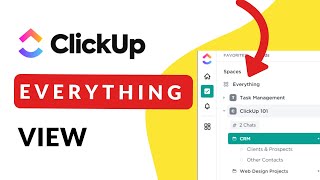
Learn how to use ClickUp's Everything View to monitor your team's work without micromanaging. Filter and group tasks to spot overdue items and balance workloads across team members.
If you are someone managing a team in ClickUp, you might have noticed it can be a little bit hard to keep track of what's going on. Now, I've released a bunch of videos about how to start your day in ClickUp, how to keep an eye on your team in ClickUp, and in clicking up my ClickUp learning community, I have a whole module about managing a business in ClickUp that includes things like how to onboard your team to ClickUp. But once your team's in ClickUp, the role of a manager, a typical supervisor really looks a little bit different in ClickUp than it does in a more traditional work environment. How ClickUp is collaborative, it's open, it's flexible. And with that, flexibility becomes a little bit of a shift in responsibility for a manager using ClickUp. Rather than trying to make sure that the right things get done, the manager's job is more so to oversee and make sure that each person has what they need to get the job done. In this particular video, I'm going to be taking a clip from office hours, the Q and A I have each week with my clients and members of ClickingUp community to actually talk about how a manager can use everything View in ClickUp to monitor their team. And monitor not so much in that big brothery way, but monitor in a kind of coaching way, making sure that you're clearing the path for your people to do their best work. Because the more. The clearer the process that we put into ClickUp, the more we're freeing up humans to do the things humans are good at, which is collaborating decision making, not storing information and remembering processes. Right? So we're kind of dividing labor between what the technology is good at and what the people are good at. And managing is one of those people tasks that we can really lean into using ClickUp. So without further ado, let's get into the answer to this question in office hours. We're just going to dive right into the first question today. And this first question is how can I use views to manage my team from everything? And this is specifically referring to everything view, which let me actually open up click up here and we'll do a little side by side. So let's zoom in because I know that's tiny. Everything is this guy up here. And a lot of the times I like to have teams use everything when they're trying to simplify their workspace. This particular team, I know some members of the team enjoyed having things more compartmentalized by departments. But leadership, as with most companies, they want to have a Bird's eye view of the entire company. And really when you would have a bird's eye view, when you want to have everything pulled together, you have two ways you can do that. You can either have things pulled together by a dashboard where you pull in different blocks and different pieces of the ClickUp workspace into these customizable reports, or you use a more simplified pre made summary which is Everything view that's up here at the top of the screen that we see here. So I'm actually going to go to Everything View and let's talk about views. Now I am due to create a YouTube video deep diving all about what views are and all that good stuff. But for now let's just leave it to say that views allow you to see your data in different ways. If you use airtable, it's the same exact thing as their views. If you use Excel, it's a lot like filters that you can save. Here we have just a list of all the tasks in this demo workspace. It's pretty generic and this team is looking to have more of a management level reporting happening at the everything level. To do that, what we want to do is create some views of data that filter down to cut through the noise. Because if I just look at every task that exists in my workspace in Everything view, if I see everything, I really am seeing nothing because it's just so much stuff. So if I was a manager trying to manage my team in ClickUp, what I would probably start with is creating might leave some of the default options on here, but I would probably start with a list view and I would probably look first at overdue because I think that's a pretty important category in ClickUp. So I have this in here. I'm going to make sure all my subtasks are actually separate tasks depending on how you subtask in your workspace, just so that they're all expanded, they're tracked separately. So if any of the subtasks are overdue, I really see them with good visibility here. But I'm going to filter Due date is overdue. There it is. So any tasks, including subtasks, where the due date is overdue, I want them to come into this report here and I'm going to click save. You always have to click save and actually zoom in a little bit more. You always have to click save here in order for your view to save. And we want to probably save this for everyone, meaning anyone who clicks on this word overdue, they're going to see this exact layout that I'm designing here. Here we go. Right now it is overdue and it's still grouped by the list. I could keep it that way or I could maybe group it by something else like assignee. So what this is going to show me. And most of these are blank, but let me just assign a few to me so you can see what it looks like. This is going to show me overdue tasks grouped by person. Or in theory it is at least show everyone. It's hard when I'm the only person in the workspace. There we go. This is getting buggy. Hold on. We're going to do a screen refresh here and hope it catches back up to us. But what I'm doing is I am filtering to cut out any due dates that are done. There we go. It's back to normal. Just needed a refresh. And then I'm grouping by assignee versus most typically you'll see things grouped by due date or grouped by status. By default I'm grouping it by assignee. Here we go. Now I can save this view and anytime I click in everything and I can click on this overdue view, I'm just going to see everything overdue by person. And maybe I even want to change the name of this to be overdue by person. Now I can narrow this down even further if I wanted to say things are, let's say before a certain date or maybe I want to add an additional filter. So when due date is overdue and priority is high, I don't know if any of that's going to apply, but oh, look, there we are. So those are the really bad ones. We can even keep it as overdue. We could not group by assignee and we could group by priority. This would be another way to look at it. And we could save this this way if we prefer to see overdue by priority level to help us kind of triage what we should be hounding people for. But as a manager in a ClickUp workspace, everything is so collaborative, but everything is, you know, there's a lot of stuff happening in ClickUp. So one of the jobs of the manager leader is in a ClickUp driven workspace is to kind of follow up. So in this case I'd look at this and I said, wow, this was due in March. Oops, I'd probably come in here and I'd say, hey, is this done? What's the status on this? Now you might think, wait, why am I asking what the status is when it clearly says revision? One thing that I've found, especially for teams that are new to ClickUp and it doesn't seem quite intuitive, but nonetheless it's true, is that people sometimes forget to mark things complete. I know you get the dopamine rush from checking the box, but for some reason, new people to the team, especially if there's different statuses that they don't know, you know, who is it my authority to do it? Is it someone else's? You'll find that people just, they finish it and they'll respond to you, say, yeah, yeah, yeah, it's done. I just never marked it off because I wasn't sure. I hear that a whole lot. So by being the supervisor, if you start going through here and looking at overdue things, most of the time you're going to be finding things that are actually done but were never marked off. And if you find those moments, you might want to take a moment to say, go ahead and mark this off. And by the way, and by the way, in the future, if you finish it, mark it off. Or by the way, these design projects, you have authority here. If you're the assignee, mark it off. This is one reason to turn off the Qlik app for multiple assignees. Because if you have multiple assignees, that's most often where we have this. I'm not sure if I should check it off. I'm not sure if I should check it off because both people have email equal authority versus having one assignee. It's very clear if you're the assignee, you're the one that checks it off. So there you go. That would be one view that I would definitely be using for, for team management, trying to think what else. Direct reports. Okay, so another thing we could do is just go into the default everything where it's literally just every task that exists. And people often let me go back, people often know about me mode, this guy that just cuts down things to show just things that are assigned to you. And a lot of the time that's how you navigate through your ClickUp. But people don't realize that this everyone view creates a sidebar. And as a manager, if I want to check in on the status of how people are doing, whatever, I might just go into my ClickUp workspace. Maybe I'll group it by due date, save that for everyone. And now I can get you to go shopping in different people. I can click on this Layla and see what she's got on her plate. I could click on the other Layla and see what she's got on her plate. I Could click on unassigned and see what unassigned has on their plate. This would be how I would kind of overview by person to see how people are doing, what's overdue, what has no due date. If you are a workspace that wants to make sure things are done on time, enforcing that everything must have a due date if it actually wants to get done, policy can be good to do. And to actually enforce that, you want to be checking, you know, what doesn't have a due date. Maybe we create a view for things without a due date. Maybe we're just checking in on folks this way. So that would be another. I think a good view to just have is just the default view, but then filter it down by people using this everyone and then the sidebar that appears here so you can actually see what's going on here. Excuse me. Which is pretty nice. So I'm trying to think what else would be a good kind of. I mean, you could look at activities, see what people are doing. I don't find that particularly helpful. Yeah, I don't think there's a whole lot more here. I guess box could be another good one. This is. Oh, I'm on a demo plan so I can flip over to a enterprise one. But basically this will show you kind of the overall status of things people have that they're working on. I actually prefer to look at this in a dashboard where you have a dashboard of maybe cumulative status, cumulative flow, where it shows, you know, over time are more things getting done or you're just starting a lot of things. That would be another place to kind of manage the team, either through this box view or through a dashboard report where you're showing like statuses by person. Does Label have a lot of things in progress or does she only take on things that she can finish quickly? Making sure things actually get done is a very important process in ClickUp, especially because as I talked about before, people will finish things and then not check them off, at least until they get their brain wired in that kind of ClickUp task management way. So there we are. Let's go. Hopefully that answers your question. I might be missing things, but I'm trying to think of anything else. I would just say, like keep creating views based on common things you're checking for, you're commonly checking for what's up next. Maybe it's a board view grouped by due date and you kind of look at things that are going on here. However your brain is wired, however you typically evaluate the success of your team. I would go ahead and do that in ClickUp now. Hopefully that answer was helpful to you guys. If you have some follow up questions about this, do not hesitate to leave them in the comments below. And while you're there, give this video a thumbs up and be sure to hit subscribe. If you'd like to be involved in office hours, ask your questions. Get me to chime in on your specific ClickUp use cases. Definitely go to the description of this video and look for the link for clicking up. That is my ClickUp learning community where these office hours are housed and you can actually join that community to get not only ClickUp Learning resources but also to get access for a full year into these ClickUp office hours. Now that was my quick tips about how to navigate the managerial role in ClickUp. Now I would love to hear your tips in the description below. What do you think? Do you think there are some better things we could be doing to manage our work? Would you rather see dashboards than Everything View? Is there anything that you've learned about Everything View from this video that you'd like to share? Definitely put your pro tips in the comments below so that way everyone else can learn from your experience. Otherwise, I think that's it for this video. Thank you guys so much for joining me for another video about ClickUp. And if you haven't already, be sure to subscribe to see more videos like this twice a week, every week, so we can learn ClickUp better together. Till next time, keep enjoying the process.










