Maximizing ROI from LinkedIn Ads with AJ Wilcox
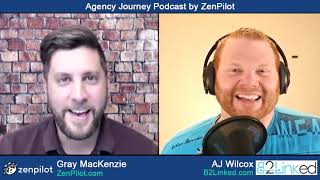
AJ Wilcox, founder of a LinkedIn ad agency, talks through how to get better returns from LinkedIn ads. He covers what kinds of clients work best, how to structure campaigns, and why most people waste money on the platform.
Welcome to the Agency Journey podcast, where we connect with agency leaders to uncover the hidden systems and processes that drive their success. Now let's dive into today's show.
Hey, as we're diving into today's episode of Agency Journey, let me tell you real quickly about our sponsor, Aribi. Aribi is a super cool on one marketing analytics tool. They've got Google Analytics squarely in their sites right now. And I can remember setting up Google Analytics as a sophomore in college and thinking this was just the coolest platform. And as it's matured, it's still super powerful, but it's become so complex to deal with. And Aribi has a value prop totally aside from this. But what I absolutely love about my experience plugging Aribi into zenpilot.com is I didn't have to mess around with setting up what events I wanted to capture and tracking all my changes. And if I messed up a view, then it would, it would delete all the data that I had. I just plugged it in, it crawled it, captured all our. All of our events, made it super easy to see our funnel, and it just works. I love being able to see, for example, how many people read the definitive guide to click up for agencies, a blog post that I wrote, I don't know, six months ago. See where those folks come from, how that influences the buying process, the funnel, the way that it works out. So super excited to have Aribi as a sponsor. You can check it out. Go to Aribi IO AgencyJourney. It's all one word. If you spin up a free trial there, use the coupon code. AgencyJourney. Same thing, all one word. That'll give you 20% off any plan, which is super generous of them. And remember, they can track all of our conversions, so check them out. That's a reb IO. We appreciate their sponsorship. Let's get on with the episode. All right. Welcome into another episode of Agency Journey. I'm your host, Gray MacKenzie. I'm excited to have you here tuned in along with us today. I'm excited. I've got AJ Wilcox on the podcast and AJ is a LinkedIn ads pro. He founded beatilinked.com, which is a LinkedIn ad specific ad agency and he started back in 2014. So official LinkedIn partner hosted LinkedIn Ad show podcast. He's managed among the world's largest LinkedIn ads accounts. And side note, couple side notes. Ginger Triathlete, which we'll have to dig into. Located out in Utah, four kids, so we're in the same boat there. Things are crazy all the time. And his company car is a wicked fast go kart. Aj you gave a lot to dig into there. Welcome to the podcast.
Graham. Super excited to be here. Thanks for the invite.
So you're a fellow podcast host as well. You run the LinkedIn AD show podcast, Obviously. How long have you been running the podcast?
Just a little over a year.
Okay.
And it was a long time deciding to start because I'm a huge podcast fan. I've been listening to shows. I've got like 30 that I subscribe to and listen to it at two and a half times speed, like just trying to get through the content. But it wasn't until about a year and a half ago when I finally decided to take the leap, realized that there's probably room for a tiny little niche show about LinkedIn ads.
There definitely is. Well, and we've not. That's why I was excited to have you on. We haven't gone deep on LinkedIn ads. We had Stephen Perchakoff from the Art of Sales Academy, I wanna say maybe episode 199, we had him on. He does a lot of cold outreach or LinkedIn outreach. So more of the organic side of LinkedIn. And I was talking this morning with Jeremy Wise, who we had on the podcast here recently, episode 216 from Rise 25 podcast production agency. And I mentioned your name and he knew who you were right away, and the LinkedIn ads guy. So, anyways, I'm excited to dive into the. The paid side of LinkedIn because I think there's for different. It's funny to talk to different agencies who are looking at breaking into that area, and some are like, oh, no, it's just too expensive. And then other people are like, this works great. But there's. There's a whole kind of range of experiences that agencies have had with it. So let's start with the background here. You've had beta linked since 2014. What was the start? What was the jumping in point?
Jumping in point for me was getting fired from my last job. It's embarrassing to say because I hate to admit that I've been fired before, but at my last company, that was where I discovered LinkedIn ads. Got to spend huge budgets there, got to learn and test. And then after I got laid off, I was like, well, I know more than anyone else on the planet about this ads platform, and no one seems to be taking it seriously or talking about it. Maybe I should do something with that. So that was the genesis of it.
And then so breaking in, who were the types of clients who you were getting Right out of the gate?
Right out of the gate. I was charging too little and having two linear of contracts, so I was charging hourly. I used to do SEO consulting and so I just was like, oh well, whatever I was charging for SEO, I'll do the same thing for LinkedIn ads. And I had a close rate of a hundred percent. So that tells you something. Yeah, probably not asking enough, but because there was no commitment, everyone wanted to try. And so I was getting lots of small companies, lots of the wrong ones. But the only experience I had with LinkedIn ads was this one SaaS company. So it was really good for me to go and work with a ton of different kinds of companies to see like what works and what doesn't.
Right, right. That makes sense. So today you run an agency somewhere between 15 and 20 people right now who are the types of clients who you're working with? Or I guess maybe another way of asking the question. I guess there's two parts to the question here. One is who's LinkedIn ad? Who is the right fit for LinkedIn ads? And then two is there's probably a subset of those people who are also the right fit for you.
Yeah, I think for a long time they were one and the same. It was if LinkedIn ads are going to be good for your company, then we're the right partner to work with. And the ones that we found that work especially well, most of it, I would say 80% of our clients are business to business, lead generation, types of objectives, and any kind of B2B where they want to target a specific kind of user. And if they have a large enough lifetime value, let's say it's $15,000 or more, then LinkedIn ads is a total home run. So that's the biggest. And then there's a little bit of recruiting and financial services that are technically B2C activities, but they also work quite well on LinkedIn.
Right, that makes sense. So in terms of the way, let's talk through, because this is all agency owners, we're all agency owners here, listening to the podcast and in the conversation. And so one of the things that people are always curious about is the way that the team is structured. So as you went from running it all yourself as a freelancer doing hourly work to the team you have now, how are you guys structured? Is it a conventional agency where you've got account managers and then you've got media buyers on the back end, or what's the Team structure.
Yeah, we've. This has been fairly recent. We've kind of switched into this because I've never run an agency before. I'd never run a company before. And so I was just trying to run as lean as I could. And so what it was was I was managing all of the direct media buyers, and our media buyers, we call them account managers, they do everything for the client. So they are communicating with the client, they're running reports, they're writing ad copy, they're designing, you know, the ad imagery, they're publishing the. Publishing the actual ads. So it's a lot to ask of someone to do all those things. And just having me up above them, I couldn't manage them all effectively. I didn't have the time. And so I promoted a director above all of them. And just in the last year, we brought on a growth consultant who was like, no, it's time to become a real agency. So we, we promoted three directors, and now we have pods of three to four account managers under each director. Now we're actually a big boy company.
I think that makes sense. What are you doing from a client reporting perspective?
So much.
Okay, so tell me a little bit about what that looks like.
Yeah, every client has different objectives, different needs, so it's really hard to create just like one dashboard where it's like, hey, this will work for everyone. So, so initially what we do is we find out, we'll send probably a report or two showing what we think is the most valuable data, and then we'll ask the client, what else do you want to see, or what would you want to see instead? And then we start customizing all the future reports for them. We've got a really cool backend database for reporting. And so we collect all the data and then it's just as simple as throwing together a pivot table to find out anything we want, we want to learn. So we present those to the clients and then have them lead us what they want to see.
Yeah, that's super cool. And those are mostly. Is that mostly monthly reporting?
Yeah, we do like a weekly report that's kind of a. Here's what we did last week, here's what we're going to do next. But then our monthly reporting is a deeper dive.
Yep. Yeah, that makes sense. So in terms of. I've talked to a couple people recently who've been playing around the LinkedIn game, both organically and a little bit on the ad side. And LinkedIn's obviously making some changes. And I say that like I know what's happening, but actually it's all fuzzy to me. Like I know a couple things with connection limits and a couple specific pieces that people have pointed out. But what would have been the big shifts that you've seen on the LinkedIn platform here in 2021 as we're recording this halfway through the year and then how's that impacted your business?
Yeah, the biggest change for ads that we've seen, LinkedIn actually pushed it out pretty quick during COVID and it was a feature I've been waiting for for a long time, which is event based retargeting. So it used to be that you'd only be able to retarget people when they came to your website, but now we can retarget people who opened a lead generation form or watched 25% of a video ad or visited the company page. There's just a lot of different ways that we can retarget people that aren't relying on the cookie because as I'm sure most of us know, cookies are their days are numbered. So that's the big one. And honestly, since that release that was kind of like mid 2020, LinkedIn have released quite a few things that are little here and there, but nothing that's monumental, nothing that I think is even worth listing.
Yeah, that makes sense. And are you guys. So outside of the LinkedIn ad side of things, is that the only service line that you have? Do you have some other smaller service lines as part of the agency?
We run retargeting across Facebook and Google just because they, they augment what we do on LinkedIn so well. But it's a very small subsegment of clients who we've offered that too. So we're trying, at least for right now, to sticking to what we're best in the world at, which is just the LinkedIn ad side of things.
The cool thing about that focus that I think a lot of agencies overlook is that it makes you very non threatening to bring in as a partner. So if there are, there's a million and one agency consultants out there and if, you know, if we were a generic agency consultant and not hyper focused on ops, we'd be a huge threat. There would really be no partnership opportunities. But we've got great partnership relationships because 90% of the marketplace is focused on growth and it's easier to sell growth services than it is to sell operation services. But it makes us really easy to slide in and say, hey, you need to go fix your operations or get your processes and systems in place. Talk to Zenpilot. They're not going to come encroach or infringe on our business on the growth side of things. And we don't have to deal with all the technicalities of your project management and your process development and all that, all those ins and outs. And so you're in that same boat, uh, I'd imagine where hey, we're super tightly focused on LinkedIn ads. Most of the agencies that we're working with, even if they're looking at it, they're like, I don't really want to have to touch one more ads platform. One more ads platform. So has that been a good partnership channel for you, is working with other agencies?
Yeah, it's great because when we go into a new client that they might say, oh, here's this agency who's running Facebook and here's an agency who's running search. We go in and they're, they always have their guard up. They're always worried that a new agency is going to come and edge them out. But when they find out that LinkedIn ads is all we do and we're not after their slice of the pie, more often than not they have a really good experience working with us just because we're very good at what we do. And then we end up having that agency refer us into more deals in the future because they liked working with us and we won't steal from them.
That's awesome. How do you normally structure this? If you're comfortable answering this on the podcast, I think it'd be helpful for people to hear. Are you normally doing a. So if you get referred in by another agency pulls you in, are you doing like a one time commission fee? Is it a recurring structure? Is there no structure? How have you handled that to this point? You might still be figuring that out, but always curious people are handling that.
Always working on the partner channel for sure. But the method that we've used and found a lot of success in is recurring for the first year. So we'll give 10% of our revenue that we get for the first year. Basically after the first year we figure if they're sticking around, chances are we've done something right. And so we cut that payment off.
Right, right. Yeah, that makes sense. Well, there's always the tracking challenges of how are most of your engagement structured? Is it month to month? Is there a 12 month commitment or a 6 month commitment?
We ask for a 3 month commitment upfront and then after the initial 3 months I. If they're sticking around cause they're seeing a lot of success, then we'll usually want to lock them into a year contract.
Sure, that makes sense. Yeah. I think lining up, sometimes lining up those commission structures with what the term of that initial engagement is makes a lot of sense as well. So on the podcast side, this is one thing, and it's in town talking to an agency owner who's also running a podcast. I'm always curious about what the purpose is, what the format is, but also how it's running. So there's a couple main strategies you can pull there. One is obviously to target, hey, the direct prospects that you have or kind of your dream prospects. Let's get them on the podcast. Then there's, let's talk to their influencers. What's been your approach with the podcast in terms of how it's structured?
That was one of the biggest things that kept me from launching a podcast because I wanted it to be really good and informative. I hate when I join a webinar and you get to the end and you're like, wow, they shared nothing of value. That was just a sales pitch. I didn't want my podcast to be like that. So I want it to be ultra meaty. And if I try to think of, okay, who out there is really good at LinkedIn ads that I could have as a guest? The list is small. It's like five or fewer of people that I would trust to bring on. So I decided early on it was going to be a solo show. And the whole point of it is I imagine that the person I'm talking to is one of my employees that I'm training. And this may not be the optimal podcast strategy, but it's something I sure feel good about, is all the episodes. I think there's 50ish out right now. They're all a masterclass on LinkedIn ads. I don't hold anything back. And the few interviews that we do have, it's usually a LinkedIn employee or someone who adds something to the LinkedIn ecosystem that would benefit advertisers.
That makes a lot of sense. How do you hold yourself accountable to actually produce the podcast?
Oh, man. For quite a while, it was just my. Just my reputation was enough. Like, when I commit to something and I call it a weekly podcast, I want to release it weekly. And then back in November, I had knee surgery and that totally derailed me. I went for weeks without releasing an episode just because I was struggling to keep things up. And then I had a whole bunch of crazy stuff happen in my Home life. And so for the last six months, there's probably only been like three or four episodes that have gotten out. So I'm off the bandwagon at this point. But that's one of the first things I getting back into now that I'm kind of getting some semblance of a real life.
Right, right. Jumping back in. That makes sense. I know for me, we've kicked around myself and Andrew, my business partner, hey, would we launch another podcast at some point doing the same thing? Because that has some appeal to it. I love the podcast because I get to learn from people who are way smarter than me. But there's also an element where if we can just give people a condensed, hey, here's the roadmap from what we can work and try that out. I think there's some value there, but, boy, it's nice and I'm a pretty disciplined person. But it's much easier to get stuff out. Hey, I've got to go get on at 1 o' clock and I'm talking with AJ and we're going to have a podcast and then there's going to be a podcast episode that's going to get out after that. Definitely some help and accountability.
Yeah, when it's on the calendar, it's.
Going to get done for sure. What's the story with this go kart?
Oh, man. Ever since I was little, I love cars, I love driving, but when you're little, the most that you can drive is a four wheeler or a go kart. And so I dreamed of go karts the whole time I was growing up. And I even this was in the hot Arizona summers my parents would take me on. I'd be on rollerblades to deliver phone books. We did that all summer long to earn up enough money so I could get a go kart. And then at the end of the summer, I walked in, cash in hand, ready to get this. It was a dual engine. 10 horsepower would go 45 miles an hour. It was so awesome. I took it into the dealership and they said, oh, that model just got discontinued for safety reasons or whatever. Not important. My dreams were dashed as a little kid. So obviously now I'm a grown man, I own a car and I can legally go wherever I want. But probably about 10 years ago, I saw an ad for a racing go kart in the classifieds near us, and I was like, I'm a grown man, but I have to have that. So I got a pretty wicked go kart.
How fast will this thing go?
Actually Funny story, the first one I got would do about 45 and. And then I ended up getting a shifter one that'll do like 120. So that's.
Goodness. Yeah. Where do you live in Utah?
I'm about 30 minutes south of Salt Lake in an area called Lehigh.
So, I mean, the only place you can drive it that you have to go to a track, obviously.
I actually, I have a good enough relationship with my neighbors that they won't call the cops on me. So this might be incriminating evidence.
Right.
Anyway, yeah. But I do, I write it around the neighborhood and I give like neighborhood kids rides and stuff. And I will take it to the track. Cause that's where you can really ring it out.
Right. Oh, man, that is awesome. One of my best buddies growing up had go karts. But I mean, they were like, we had the little junkie go karts that we would drive through the woods and constantly be caught on stumps and go, you know, knock them over and beat them up and. And then figure out how to fix them.
I'll trade your childhoods. That sound. That sounds way cool.
Oh, that's awesome. Cool. So I want to throw this at you first. A couple. A couple of things that people should take away from this for sure. One is if they want to learn more about LinkedIn ads, the LinkedIn ad show podcast. You've got the solo cast rocking with a lot of awesome info there. And then if they're interested in white label partnerships reaching out directly to you. But if they're looking at running LinkedIn ads campaigns in house or for clients, what are the key components of. You talk through some of the pieces that make somebody a fit or not a fit for running LinkedIn ad campaigns. But in terms of the how or the how to, what are the key components of the campaigns that actually convert?
Yeah. So there's four things that I really care about when I'm like approaching a campaign. The first is I want to make sure that my audience is there on LinkedIn because it's expensive compared to especially other social channels. So if I can reach that audience a different way, it's probably going to be cheaper. But in B2B, we care about people by their title and their seniority and company size and industry and all that. So as long as that's good, that's step number one. Step number two is they've got to have a significant enough budget to make a dent. We find that after someone spend about $5,000, if they're targeting North America, they generally have Enough data to know whether it's going to work or not and have a pretty good idea of how well it's working. So I suggest, even if you have to spend less later on, start with a budget of 5k a month. The third I already mentioned, which is make sure you have a high lifetime value or large deal size, because you're going to pay 8 to $12 per click for LinkedIn ads. So you have to make that up in the deal. And the fourth is you have to have something of value to advertise, because if you're just saying this is what we do, click here to talk to our sales rep. No one is going to click that ad and it's going to cost a bundle for anyone who does. So starting with some sort of a lead magnet, a valuable piece of content that people are willing to give their contact information for. If you've got all four of those things, you're golden. So an agency or a company looking to do this in house, line up those four things, make sure you're a good fit, and my best advice is work on a really interesting asset that your ideal customer is going to love and it'll convert at 45%. That's what you want.
What have you seen from this higher converting assets is that, I mean, for a while there we all made 20 page ebooks and then the thing that actually converted better became the two page checklist and their video series and email courses. Is there any favorite type of stuff? Is it interactive tools, I think still have a lot of potential and have gone in and out of popularity.
Yeah, tons of potential for anything dynamic and interactive. There just hasn't been enough out there for me to get a good view on it. But we love checklists and cheat sheets just because even a busy executive is going to look at it and go, well, I've got time to check out a one pager when you start calling something an ebook. Guides are kind of a good middle ground, but an ebook people are going, I don't have time to consume that Something we've noticed webinars are kind of old hat, but boy, so many of our clients have success with them. Because initially someone's going to look at a webinar and go, ah, 45 minutes in the middle of a busy day. I don't know if I can make the time for it. But the ones who do, they watched and listened to your expertise for 45 minutes and now they're going to be infinitely more likely to respond to a sales invitation or want to hop On a demo. So we find lower signup rates but much higher close rates.
Yeah, that makes sense. And then in terms of. So the budget is helpful. Having a range of budget in mind to get started and I assume that's where the three month initial commitment with you guys comes in and say, let's test this out for three months. We're going to know for sure by the end of three months whether this is going to work for you or not going to work for you before you jump in from there. Totally off the back end of that. Are you often plugging your clients into like is it mostly. Hey, the folks who are working with are large enough that they've got their in house marketing team and they're rolling. Are you often plugging them into other agencies to do hey, here's your marketing agency or here's your whatever other agency you'd pull them into?
Yeah, I get asked pretty regularly just as an agency owner. You have a lot of friends who are agency owners and you're pretty well connected, obviously. So yeah, I get asked pretty regularly like hey, who do you recommend for SEO or who do you recommend for ppc? And so it does. It gives good opportunities to kind of cross pollinate a little bit.
Right, right. That makes a lot of sense. Awesome. Cool. Well aj, I appreciate you being willing to come on and bounce all over the place with me here and share what you found works. So folks who want to check out more be the linked com, be the number two and then linked L I N K E D dot com is the site the LinkedIn ad show. I think I know. I had looked this up there. This is on the site as well, right? Or is there a separate URL?
Yeah, yeah. And then any podcast player you listen to. If you search for LinkedIn ads, this chubby ginger will be the first thing that shows up.
That's awesome. Anywhere else you want to point people, A.J.
You know, if you want to connect to me on LinkedIn, just make sure you customize the connection request. Just say you heard me on Gray's show. That way I'm sure to notice it and accept. I basically don't accept any sort of connection request in case it could be a. A sales pitch. So yeah, customize it and I'll. I'd love to be connected.
Awesome. Cool. Well, I appreciate you coming on and sharing, aj. This is really fun.
Anytime, Gray. Have me back anytime.
Thanks for listening to the Agency Journey podcast. Visit agencyjourneyinsiders.com to join the podcast community and be sure to subscribe for future episodes.










