Mindfulness in the Workplace | Admin HUG | July 04, 2023
Lori Loaderson, a licensed mental health counselor and yoga teacher, shares mindfulness techniques for the workplace. The session covers practical exercises for stress reduction and mental health awareness, with interactive Q&A and resources to help professionals improve well-being and productivity.
So, hi all.
Welcome to the HubSpot admin hug. If you're just joining for the first time. Hi there. I'm Deanna Giloff, HubSpot advocate and admin. When I'm not wrangling amazing speakers like Lori for the HubSpot hug with Kyle Jepsen, I do operate my own HubSpot partner agency, Stratsmark, offering fractional HubSpot and strategy services. And in honor of HubSpot's global week of rest, I wanted to do something a little special and a little off of our normal content this week, but I felt it was very important, a very important reminder for us admins. Today's hug is mindfulness in the workplace with Lori Loaderson from Spirents. Today, Laurie is going to help the hug learn the benefits of practicing mindfulness at work. And as admins, we do spend a ton of time making sure our systems are in tip top shape. So we might as well focus on making sure our own personal system, our mind is as well. So, Laurie, I'm going to let you take it away.
Thank you so much. So I'm going to ask for forgiveness right away because HubSpot is somewhat new to me. So if, if I have technical difficulties, forgive me. We're going to pull up a presentation here. Okay. It looks really small for me. Hopefully it's. It's visually big enough for you guys, but a lot of it's going to be me talking and practicing. Oh, it's really interesting is I can't flip pages from here with me. One second here.
You had an option on where it had pages on the bottom left so I wouldn't try to make it too super big and just go ahead and go with that.
No, I mean, it doesn't let me move screen from the HubSpot screen, so I have to do it from the other one, which is interesting. Let me see. This is why I apologized ahead of time. Right. So I can figure it out. You're fine, you're fine.
We all deal with Ben on a weekly basis. We know it is not the most cooperative system, so.
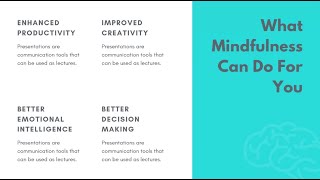
Okay, now I can't see you guys at all. Here we go. I'm gonna have to split screen because I haven't. This is telling me I should probably get a second screen because I don't do second screen. But maybe that's an indication to start. Okay, so mindfulness for work and life. Because I think I was saying to Deanna, I think it's kind of the underpinning of everything, you know, unless everything else kind of falls into place. So the things we're going to talk about is a definition of mindfulness, the benefits of mindfulness, the goals of mindfulness skills. And then we're going to do some practicing and you'll have a list of some tools and exercises. It is by no means an exhaustive. Lots of ways to do that and I trust. Let me know if we. Or some kind of weird technical difficulty that I'm not seeing. So hopefully we'll be all good there. All right. This is a licensed mental health counselor, master certified addictions professional and a yoga teacher. I've been practicing almost 20 years and I love blending science and holistic practices to help people heal mind, body and spirit. I am one of Spence's speakers. I help them with retreats and different things like that. And we'll talk about that a little bit more at the end. But a passion of mine. And that's really what this comes down to. And it can be simple. All right, so what is mindfulness? This is where I usually like to get feedback on that. So you got your definition. I'm happy to. I would love to hear that perspective. Mindfulness is not just about being in the present moment. It's about being in the present moment with kindness and compassion. You know, because we can be in the moment and we can be judging ourselves about what's happening or we can be in the moment and have a level of compassion both for ourselves and for others. And I think that's one of the really big keys in being in the present moment. When we have anxiety or depression or when we're just in our negative thought process, we tend to be in the past or in the future. Right. So being in the. With that kindness and compassion allows us the opportunity to see things from a different perspective and to respond as opposed to react, which is. There's a big difference there. Alright, so just a little. Just because it's a business discussion, right. Give you a little bit of statistics. So when you practice mindfulness statistics. But one of them is that there's a 40% reduction in your perceived stress and it's a way to calm your central nervous system. A lot of us are really in a place that even if we're functioning really well, we tend to be in a place of just a little bit of heightened stress. Right. Not in that rest and digest system that our body wants and our mind wants to be on a regular basis. So mindfulness is a way to kind of bring that down, bring that back into balance. And of course, when you do that you're more effective at work and at home. All right, cool. So these are some of the other for you. Enhanced productivity, improved creativity, better emotional intelligence, and better decision making. Talk about the skills and the goals of mindfulness. We will get a little bit more into what that means. So one of the important things about mindfulness is that can be done any, anywhere, no matter what's going on. And it's most effective part of your daily life. And I really like to stress the importance of making mindfulness part of what you're doing as opposed to making it some extra thing that you have to do. Right. We already have this, this perceived lack of time in life, which is a whole other discussion. But it's really important to be able to do this as part of your experience. So it might be something as simple as, you know, being present when you're washing the dishes. Notice, you know, the warmth of the water in your hands, notice the smell of the soap and watch the water running off the dish. You know, simple things like that. And let's. I want to start with a practice right now. So we're going to shift gears for a moment so that we've got a little bit of an idea and then we're going to do some practice and then we'll do a little bit more talking. So this can be done with eyes open or closed. When we close our eyes, it gives us an opportunity to shut out the outside world. This can be done in a minute, this can be done in five, 10 minutes. We'll maybe do five. We'll see how it goes. For this one, I might suggest you try closing your eyes. And this is a little bit of a blend of a yogic and a scientific practice here. So in a yogic perspective, we have four bodies and we're going to take a moment to just close our eyes and connect to those four bodies. So let's take a nice deep breath together. Inhale, fill the belly, fill the lungs and exhale. Open mouth, sigh, Inhale, fill the belly, fill the lungs and exhale. Side out. One more time. Deep breath in and let it go. Good. And as you do that, I want you to take a moment to check in first with the physical body. Maybe take a mental scan, noticing any places of constriction or tension. You might already notice a difference after those three breaths. Notice any places of softness or relaxation. And then shifting the awareness on the next breath to the emotional body. Are you feeling emotionally in this moment? Perhaps there's more than one. Where do you feel that emotion in your Body continuing those deep, slow breaths, shifting the awareness to the mental body, the mind, the thoughts, the quality of the thoughts, the pace of the thoughts. The subjects perhaps even imagining your thoughts as waves coming into shore. They come in and they go out. They come in and they go out. Perhaps as they come, they bring something to you. And as they go out, they take something that's no longer serving and then finally connecting with the spiritual body, the wise mind, the true self, higher self, perhaps something greater, that connection between mind and heart. Taking a breath there, perhaps asking, what do I most need right now? And breathe into that space. Taking another breath here, allowing for that. Any messages or anything that might show up for you there. And when you're ready, you can allow the eyes to open. So if anything showed up for you, feel is important, this would be a nice place to jot it down so that you can remember it. I always tell my clients, I might say something profound, so it's always a good idea to have a piece of paper. So that was only about two and a half, three minutes. So just. I think that's really important to recognize that you can do it very quickly and very quickly address lots of different things. All right, so now we'll shift a little education. So I like to talk about mindfulness from both. An eastern philosophy, dialectical behavior therapy standpoint. Dialectical behavior therapy says that, or the dialectic itself says that two seemingly opposing forces can exist at the same time, where both are true. So we can experience joy and sadness. We can experience pleasure and pain. And true healing. And true experience in life is about being able to integrate those things, being able to integrate all parts of ourselves, all parts of our experience. And that fits a little bit with the goals of mindfulness. So I really like to talk about why. Why are we practicing this? You know, why is this important? And the three goals of mindfulness from a. From a dialectical behavior therapy standpoint is one, to reduce suffering and increase happiness. Everybody wants that, right? Reduce suffering and increase happiness. Again, going back to that, you know, being in the past or the future, we're thinking about maybe mistakes that we've made or worrying about mistakes we might make or whatever the case may be. And we're not present, right? So reduce suffering and increase happiness. The second goal is to take hold of the mind instead of letting it take hold of you. There's a lot of things in this life we don't have control over. Our mind is something that we can shift. I don't like to use the word control, because control means Gripping. It's really actually about releasing that a little bit and being able to gently remember that kindness and compassion gently shift the mind when it's going in a direction that's not so helpful. But first we have to recognize it, and that's where the mindfulness helps us to recognize what's going on. And then the third is what I like to call mindfulness 2.0, and that's to experience reality as it is as opposed to how you want it to be. And that's that next layer of, you know, being able to accept things as they are gives you the opportunity to then change them. But we can't change them until we accept as they are. So if you're stuck in a. In a problem at work or at home, you know, continuing to grip, right? Continuing to fight that or resist it is going to continue that issue. One of the metaphors that I use a lot is the Chinese finger trap. I wish I had a visual for you guys, but it's this little bamboo kids toy, right? You stick your fingers in it, and then hopefully you guys remember it. I would love to hear if you do. When you stick your fingers in it, if you start pulling away, it gets tighter, right? That bamboo is all braided, and it just gets tighter and resists. And the more you resist, the more it resists. So we don't get anywhere, right? And the way to get out of it is to relax, to release the resistance, and then you can take it off. So that's. That's really purpose there. That's really the idea of experiencing reality as it is, so that we're not continuing to have that power struggle, regardless of what it is, whether it's an argument with a spouse or maybe it's a discussion with your boss. You know, when you resist in that moment or when you power struggle, nobody gets anywhere, right? So allowing yourself to be centered within yourself allows you the opportunity again to react. Okay, so there are three core mindfulness skills from this perspective. First one is wise mind. And you'll see as I talk about these skills, that we already did all of them in just that one practice that we did. So wise mind, and we'll talk a little bit more about what that is, the what skills or what are we doing when we're practicing mindfulness? And the how skills or how do we practice mindfulness? All right, so wise mind is the combination between reasonable mind and mind. If you can see this diagram here, we have reasonable mind, which is more logical, it's more linear. Probably a lot of where we are when we're doing this work, right? It's more problem solving, focused, that intellectual piece of the mind. I call it work mode, right? And then there's the emotion mind, which is, tends to run hot, tends to be very mood dependent, reactionary. So being too far in either one of those can be not so helpful. Right. If we're so stuck in our logic that we're not connected to our emotions, we might hurt somebody's feelings, right? Or we might be blocking out things that are a helpful part of what we're doing. And if we're too far in emotion mind, then we might react in a way that's not so helpful for us, for others, all of those things. So wise mind says that both reasonable mind and emotion mind are important and we need to take them both into consideration. That's that connection between mind and heart. Okay, so we're going to take just a moment and practice a wise mind exercise here. So I want you to, again, you decide, close your eyes, maybe find a spot on the floor and just take a couple deep breaths thinking about even right now, practicing that shift from the intellectual listening to the heart space. So maybe you imagine as if you're standing in front of a clear mountain lake. You're standing on the edge, you take a breath, there's a bunch of pebbles around you, nice smooth pebbles. Imagine as if you are one of those pebbles, or maybe it's a bigger rock. So when the lake is clear, you can see perfectly the reflection of the mountains above. As you drop this pebble in, it gently floats, knowing that you can breathe perfectly well. And then it begins to get quieter as you float towards that clear bottom. When the mind is unclear, right? When we shake up that water, it can be very difficult to see the mountains above, to see the bigger picture. So as that pebble settles to the bottom and that silt begins to settle, perhaps things become a little quieter, a little clearer. Maybe you can hear something or see something, or know something that you didn't recognize before. And if there's something in particular that you're looking for right now, this would be a place, as you drop into that quiet space, that wise mind space, ask what creative solutions do I have here for me? Or again, the question asked earlier, what do I most need right now? And breathe. And when you're ready, you can again allow the eyes to open. Certainly you can stay in that space and continue to listen from that wise mind space where you can have that logical intellectual understanding and also the experience, right? The emotional. So the what Skills. What are we doing when we're practicing mindfulness? We're observing using all of our senses. So as many senses as possible observe what's going on around me. It's always nice to do that in nature, right? Because it's an easier way to do that. So even if it's taking a moment to step away from your computer and go outside and maybe notice something that you haven't noticed before in the environment that you're in. And we can do this in many, many ways. And we did a lot of that just like we did in the beginning exercise, right? Where we looked at the different bodies and we observed internally. That was a more internal observation, but there's also more external observation, depending on where you are. And then describe. Describing what you're experiencing. Perhaps you described a sensation in your body as we were doing that exercise, or describing the thoughts that you were having. From a place of factual acknowledgement, right? Not from a place of judgment, which we'll talk about next. And then fully participating in the moment. How many times have you been in even like the most lovely place, maybe even on a vacation, and you're thinking about when you have to come home, or you're thinking about something that you didn't finish, or who knows, whatever it is, or even just at the end of your day, maybe you're at the park with your kids, you know, and you're thinking about something else or you're on your phone, right? So fully participating in the moment, no matter what it is, obviously that's a lot easier when it's a pleasant moment, right? But fully participating in the moment, those are what we're doing. There's lots of different ways to do that. And then there's the how skills. How do we practice mindfulness? So we practice mindfulness non judgmentally. And then when we do judge, because we're human and we do, we don't judge the judging. So being able to acknowledge, oh, I just judged myself because I was thinking about all those other things while I'm trying to practice this and then notice, okay, I judged myself because I had that. And then maybe there's several layers, right? Okay, I'm having that thought, I'm having that judgment, maybe breathing, coming back to that kindness and compassion. One mindfully, this one's really hard for the work crowd. No multitasking. So there's nothing wrong with having many different projects at a time. And I'll try not to get on my soapbox about the hustle culture, but so many projects is fine. But when we are multitasking. We are not giving our full attention to any one thing. So we're not giving our full capacity, which means that we're not as active, which means that we're. We could do a better job if we are fully present in what we're doing. So one mindfully. So when the mind wanders, because it will when you start trying to do several different things at once, because you will gently bringing yourself back. Okay, what do I most need in this moment? Right, and that's where effectively comes in, only what you need right now. So what do I need to complete this step in this project right now? Right. Breaking it down into smaller, more achievable steps. This is where I talk about smart goals with clients sometimes. Hopefully you guys have heard of that. But I'll give you the quick rundown. And that's specific, measurable, attainable, realistic, and time sensitive. And it's just a way to break down what's going on and what do I need in this moment. And one of the ways that I think about effectively and how do we describe that, how does that make sense? Is I'm sure nobody here has ever brought up the past in an argument with someone that they care about. But just for the sake of argument that you did, it's not super effective, right? Because if we're talking about all the other times you did that thing, then they're not hearing you in that moment, right? So what do I need to address right now? And same thing with whatever work issue. We've all got a long to do list, right? And I don't know about you guys, but sometimes I'm thinking about that whole to do list. So much so that it keeps me from starting, right? Or it keeps me from being fully focused and present in what I'm doing. So reminding myself, okay, what do I most need right now? What's going to help me be most effective in this moment? And sometimes what that means is I need to go outside. I always use the example of I work a lot from home as well. I don't know if I'm sure many of you do as well, but I have. My mailbox is a little bit down the block. So if I find myself get gripping in my head and getting into that thinking resisting place, I'll get up and walk to my mailbox. Even if I've already checked the mail, I'll just walk in that direction. And then when I'm outside, I look, maybe I notice something that I haven't before. There's lots of beautiful Trees around and birds and things like that. So I will bring my attention a little bit more to one of those things and then when I come back, I can be more focused and more present. I could talk about this for a long. Try to keep to the 10. Okay, so let's practice. Well, actually, yes, I was gonna say this is a good time for questions and if you want to jump on screen and ask me directly, I'm. I'm up for that. I love to see Yalls lovely faces.
Andreas, would you like to do that or do you want me to just go ahead and ask her on your behalf? Okay, no problem. What can be done when emotions can't really be reached because there's too much negativity and it's too painful to go there?
Okay. When emotions can't be reached because there's too much negativity and it's too painful. So when there's a lot of energy. I'm actually glad you brought this up because I meant to talk about it and I didn't. When there's a lot of energy, we tend to be in that fight, flight or freeze space. So I like to describe it as the lid coming off of the brain. So hopefully you guys can see this, right? So this is our emotional centers of our brain, the lower parts of the brain, right? And this is our thinking or executive function part of the brain. So when we're too heightened in our emotions, we kind of blow off that lid, right? So that means there's not a whole lot of logic happening, right? We're in that, in that emotional, just reactionary kind of space. So hopefully we don't wait till we get to that place, right? We. But you know, life happens and sometimes we've got a lot of. If you have a lot of big stressful events going on, or if you, you've had a lot of trauma recently or things like that, you can kind of be living up here. So for me, what that comes down to is moving the body, right? Because our. If you think about it, when we get into that fight, flight or freeze place, our body does. And our brain doesn't know any different between perceived danger and real danger. So even if we're just thinking about something that stresses us out, our brain goes into that space of I have to react so that I can run, I can fight or I can freeze. So all of the adrenaline, all of the cortisol, the stress hormones, all of those things that we need to get turn on those big muscles of the body like the legs and the arms so that we can do those things like duke it out if we need to or run really fast or whatever shows up. So movement can be a really big part of that. Okay. And so that's something that I teach quite a bit. We did the three cleansing breaths, so we're going to skip that one for now and we'll come back to it. And we're going to start with a little smile breath. Okay. And progressive muscle relaxation, because I think both of those will be helpful for you. And then also remember that as we practice this on a regular basis, it's going to bring that overall stress level down so that you're less likely to get to that full blow the lid off place. At least not right away. Right. So you'll be creating new neural pathways in your brain so that your brain knows when I feel this way, this is what I do. Whether it's just taking a couple deep breaths or whether it's doing some type of movement or something like that. So that's, that's a simple answer. Some of the other answers is sometimes we need to talk it out, write it out, you know, all of those different kinds of things as well. Because once we get to a certain height and level, sometimes we need a little extra support. And certainly if there's a follow up question to that, hopefully that answers it a little bit. No follow up.
I want to remind everyone this is being recorded. So if you want to go back to any of these techniques, you are absolutely welcome to do that as many times as you need. If you just need to pause it in that one spot and go back and go back, please do so.
Absolutely. And I'll give you some ways to contact me and things like that later if you need a little bit support with that. And I do also have a YouTube, so some of these are on there as well. Okay. Any other questions before? I know that was a lot of information. So like Deanna said, you can go back to it. Right. But I would love to know if you have any thoughts or comments on that before we do a little bit more practicing, like a little bit more of the logical piece before we experience. Right. Because I think that's the most important piece is experiencing it so that you know that it's effective so you know that it can work when you need it.
I don't. I will interject and just say, personally, I know for me I am a huge multitasker and just reminding myself to be focus on one thing at a time. Especially even like now I'm. I'm attempting to multitask and be present. Can't do those two things at the same time.
Right, right. And we've convinced ourselves that maybe we can. Right. And again, going back to don't judge yourself when it happens because it's gonna happen. Right. And. But the more often we practice this, the easier it gets and the more our brain is going to go into that automatic slowing down place. That's something that I've practiced so much so that I can just take a deep breath sometimes and my whole body just sinks. My whole body slows down and then it's like, okay, here I am. But for those of you. And I have a tendency towards this as well, where I have that tension and that anxiety place. Right. I tend to build things up in my mind and so the movement for me is really important. I said this in the beginning, but I'm also a yoga teacher. So we're going to do some yogic versions of some of these things too. So some of these maybe not sitting in front of, you know, all your other friends or co workers and maybe. So it depends on how comfortable you are, right? I'm pretty comfortable. I don't care if I look weird, but. But we'll do a few of these. So smile breath is one of them. Smile breath is a really great seated yoga posture as well for if you're sitting all day. It's also really great for depression and anxiety because it creates movement in the heart space and stimulates those feel good chemicals. So I'm going to ask, hopefully you guys are trying it with me. Maybe Deanna will try it with me so that I can see that somebody's doing it. Right. So you're going to bring your hands to heart center. We'll start here. And then on the inhale, the elbows come wide, the chest moves forward, and then maybe you look up. And then on the exhale, the hands come to heart center, the head bows slightly in the corners of the mouth, come to a small smile. Good. Inhale, open up, maybe look up, exhale, bow and smile, moving back and forth a few times with your breath. So we're creating an opposite action because when we're anxious, we tend to close the body. So we're opening the heart opening. And then when we smile, just like the perceived danger, our brain doesn't know any difference if we're smiling because we're happy or smiling because I told you to. Good. One more time. Next time, hands are at heart center. Pause here and just notice. Maybe there's a subtle shift and change sensation Energy and then you can release the hands. As we're doing these, I'm going to encourage you to jot down ones that stick out for you. And of course, if you have any questions on them, because they can be strong together, especially if you're like I like to call lizard level. If you're like that super heightened emotional state, sometimes we have to put a bunch of tools together or they can be done on their own. Progressive muscle relaxation is the next one we're going to talk about a little bit. And again, what I like about this is it includes movement. So this can be done before bed in a longer version where we're engaging and releasing each muscle of the body. Really great. To help you sleep. There's lots of guided ways to do that. There is also Insight Timer, which is my favorite app for that. There's lots of guided meditations and things on there. It's called Insight Timer. But for our purposes, we're going to do a real simple version that you can do sitting at your desk or you can do it standing as well. But I'm going to imagine because I have arms on my chair, I know you guys can't see them, but I have arms on my chair. So I'm going to suggest you take your hands to the arms of your chair, to your seats, or maybe you put them on your lap. So we're going to engage the arms as much as we can. So you're either squeezing your chair or you're making a fist with the arms. And maybe you even reach them out in front of you and engage all the muscles of the arms. So whichever position you choose, you're gonna squeeze, squeeze, squeeze, feeling that engagement, feeling that resistance, feeling that tension. And then release the engagement. But keep the arms so they're either in your lap or on your chair. And just notice the shift in energy, shift in movement and breathe. Good. Now if you don't have both feet on the floor, I'm going to suggest you put both feet on the floor. In this moment, doesn't matter if you have shoes on or not. I want you to press your feet as hard as you can into the floor, into the earth. Press, press, press. Feel that engagement. Be careful. If you have a rolly chair so you don't move your chair. Squeeze super tight. Feel that resistance, feel that tension. Notice any sensations that show up there and then let it go. Take a deep breath. Noticing any sensations here? Maybe there's a shift, a movement, maybe tingling or a heaviness. Really great one to do. If you have A tendency to shake your leg and actively soften. And again, you can continue doing that a few times if need be. You can do one body part at a time. So maybe press one foot, maybe you squeeze one arm. You can yourself, you can squeeze your face and purse your lips like a lemon and then release it. Also really good to move your face around. Anyway, so when we're staring at a screen, so the idea is to really lean that engagement, lean into that resistance. Because when we're stressed, when we're thinking too hard, we have a tendency to tense something. So it allows us the opportunity to lean into the tension instead of resisting it and then be able to let it go. You can also do that with your shoulders. So you can squeeze the shoulders up to the ears and then release it and let it go and breathe. I would love to hear if anybody noticed any difference in any of those or in that one in particular.
I have a standing desk, so I'm. When you said pushing to the floor, I'm like, oh, gosh, I'm going to.
Go through the floor.
But I'm pushing. Like, I feel like I'm pushing really hard. But it felt so good to release and like it was nice and warm and comforting feeling afterwards.
Nice. Very cool. Okay, so now we're going to do one of my absolute favorites. This is like the. If. If we're going to say weird, this is the weirdest one, right? But most people really, really love it. And I think it's. It's so awesome. It combines all of the yogic philosophies and then the scientific piece of that. So sound. We're going to use sound. Okay. So, Deanna, if you want to turn your sound on and do it with me, you're welcome to do that. No pressure, though. So we're going to use sound. And sound is very calming for the central nervous system. And it connects directly to that vagus nerve, that vagus nerve that's responsible for that rest and digest the parasympathetic nervous system. We're also going to add hand gestures, and we're going to do this piece at a time. So hand gestures, or mudras, are really powerful because we have lots of, like, this is a really grounding energy, right? Touching to the fingers or touching anything, right. That tactile sense. And we have about 70,000, I think is the number nerves in our fingers and our hands. So it has a way of really calming, again, calming the nervous system. This one's really great, particularly for anxious energy and those kinds of things. So if you're already tired. It might make you more tired. So keep that in mind. And smile breath is considered energizing. So if you need more energy, smile breath breath is more innovative. So you're going to take your tongue to the roof of your mouth. And we're just going to start with the sound here. So you'll take a nice deep breath in. Lips are soft, and on the exhale make the sound ng like a b it. If your eyes were closed, go ahead and open them so you can see. We're going to add the gesture. So your thumbs go to the tragus or those little flaps that stick out by your ears. You can even plug your ears. Your pinkies go to your chin. Ring fingers underneath your nose. Don't plug your nose. Middle fingers rest over the eyes and pointer fingers over the eyebrows. It's a little bit of a sensory experience here. So we'll do that same thing. Tongue to the roof of the mouth. Take a nice deep breath in. Deep breath, deep. Release the hands. Just breathe for a moment. Any sensations in the feet, the hands, maybe the face. And when you're ready, allowing the eyes to open. And again, this can be. You can do this a little bit more if you need to. Six breaths is a good amount. If you. You're really anxious, maybe 12. Yeah. And if you're. Another practice that we're not going to do today. But if you're really anxious, bouncing is one of my favorite ones. If you just can't sit still or this is just. You're feeling very emotionally heightened and overwhelmed, it can be done standing or seated. That one's also on my YouTube. So if you guys have any questions about that one, make sure you have that. So love to hear any thoughts, feedback. I'm gonna move on to the next. Yeah, go ahead.
Yeah, no, I was just. I'm gonna put the event feedback form the survey into the chat for anyone. I'm gonna share all of the resources that Lori is talking about. I'll share her YouTube channel and everything. But I just want to make sure that if you guys enjoyed the event, like, let us know, because I will share the feedback with Lori. I will take it to heart, too. You know I do. If you tell me you loved it and it's something you want to do on the regular, I will absolutely find a way to make something like that happen. But go ahead and put your feedback in the survey and I'll let Lori continue.
There's lots of different ways to practice. Those were meant specifically enforcement. I'll go Back for a second. So the four bodies exercises, the one we did in the beginning, I talked about taking a mindful walk. One of my other favorite things to use is aromatherapy. So if you guys have questions about that, certainly we can talk about that. But aromatherapy has a really great way of connecting directly to the emotional centers of the brain and to bring us back into balance, to calm, to focus. So that's a really great way to bring us into the present if we have a harder time with the more mental exercises. Those three mindful breaths that we did, especially the sighing it out because it releases that physical tension. Meditating yoga, just noticing your thoughts. The progressive muscle relaxation we talked about. And then that wise mind exercise. Let's see. I'll make this available. There's not anything proprietary necessarily on here for me. So you guys are welcome to have that do. And I really wanted to say first speaker experience. I still feel like I'm saying it wrong.
Me too.
Experience and spirit. Right? Something like that. Anyway. They do such an amazing, amazing job of doing some of the same things that I do as well with coaching and webinars. And they have this wealth of mental health resources library, one of which is this presentation in like a 15 minute version, so or like three 5 minute increments or something like that with me. They also offer retreats which I am a part of and corporate retreats and things like that and many, many other things that Jennifer could talk. He wants to. But of course we'll, you know, we'll make sure you have that information to share with everyone. As.
I went ahead and invited Jennifer on. Jennifer's a colleague of mine from a million years ago.
Right. Jennifer.
Connected and I just have her, have her experience come up.
Yes.
So Spirits has a. Currently eight different offerings. Lori mentioned some of them like our library, our wellness reach. A lot of it is very proactive. And then taking men.
Did we lose Jennifer? I think we might have. Oh no, I'll finish what I can. Is that taking mental health seriously? Right. And. And having a healthier workspace. Right. And that's part of what things like mindfulness will help to do is having that healthier workspace. They do coaching and some other things as well. So definitely having her information so that you guys can get in touch with them about that as well. These are ways to get in touch with me. I offer a free consultation. So even if you just wanted to, you know, get these in a. These skills in a more concrete way, certainly you can reach out to me anytime. I also do individual and group therapy workshops and speaking myself. I do yoga therapy and local. My YouTube is on my phone number, my email, and my website. I hope you guys enjoyed it. I really, I did. I love speaking about this topic and and any thoughts or comments would be appreciated. I'm gonna leave that up for now.
Yeah. And you said, sorry, Jennifer, we lost you. So we let Lori go ahead.
And I appreciate that.
Thank you, guys. I appreciate everyone coming. And I know this was a little out of our norm for content, but it was something that I useful for myself. How I pick the content for you guys. Have a wonderful day. Practice some of these techniques, and I will see you all next week.
Thanks, Lori. Thank you.
Thank you.
Thank you.










