Ready fot the HubSpot Taylor Swift Help Line?
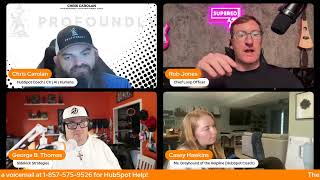
Transcript of a HubSpot Helpline episode (conversational video) where hosts Rob, George B. Thomas, Casey Hawkins, Chris and others discuss HubSpot features, 'loop marketing' (express, tailor/amplify, evolve), AI-assisted iteration in marketing, and reactions to cultural items (Taylor Swift, brand redesign examples). The conversation mixes practical questions about applying the loop across marketing, sales and service with examples (mini-golf tech, brand/logo missteps) and emphasis on speed vs. direction when using AI and iterative workflows.
Chapters
Hello, you've reached the HubSpot Helpline. Helpline, helpline, helpline.
It's Rob, it's George, it's Casey and Kyle. Come with a problem and leave with a smile every Friday at 3. Come and join us as we help you with HubSpot. Open up your LinkedIn. Just make sure you call in and leave a voicemail about HubSpot. Make your Friday divine with the HubSpot helpline.
Okay, we are back. It is Friday at 2 Central. I'm here joined by a entire room full of Swifties celebrating the launch of the Orange era. And yeah, to name them. Chris. Carolyn, we need to change the song. By the way, take Kyle out for a minute. I just added that to my to do list. It's Rob, it's George, it's Casey, it's Chris. Here's one show that you don't want to miss. Every Friday at 3. So. So that'll be for next week. But we do also have George. This is what I do for a living. We also have George V. Thomas, who celebrated his 21st birthday again last week, I believe. And we have Casey, greyhound of the Helpline Hawkins, who has been pulling her hair out and putting it back in backstage because of some of the Swifty comments. How are we today, guys? Casey, I'm gonna let you go last. We know how you are. This is a monumental day for you. But, Chris, how are you?
I'm doing great, man. Just trying my best to contain all of this Swifty excitement, you know?
Yeah, it's. It's been hard for me too. But I actually unfortunately found out I was not a Swifty earlier in a very bizarre way, if you have to ask, means you're not one. So got some bad news earlier, but I'll make it.
Oh, interesting. Who is Taylor Swift again? I'm sorry.
Unbelievable.
I'm not trying to trigger anybody out there. I'm just kidding. Listen, yeah, I'm doing great. I'm. I'm doing good. You know, I was just talking to my son who lives in Oregon about. It's been a week, but sometimes HubSpot admins have weeks. And how I'm looking forward to. In roughly about two and a half, three hours, I will be on the back porch of a friend's house drinking a root beer beer and smoking a stogie and going, now, will we be listening to Taylor Swift songs or not? I don't know.
Tbd.
I thought you were gonna say no.
Yeah, that's what he was saying inside his head, trying to be nice. Right now, he said he wasn't trying to trigger anybody.
Remember? That's what he said. He actually led with that and inserted it as like a mid cta. Just don't, don't be mad at him. Send all complaints to Chris at. What is it again? Yeah, Chris, yeah, but look, I think the, the Taylor Swift news is only, you know, one of the things on Mount Rushmore. What are some, what are some of the topics, some of the problems, some of the voicemails? Did the dog eat our voicemails again? Or has that situation been resolved? Mr. Carolyn?
Yeah, the dog ate all the voicemails again.
Yeah.
Are we really not asking Casey how she's doing? You said she's go last and she doesn't even get to go.
I was seeing if she'd noticed that.
And I just thought, I thought he answered for me. Then he was like, we know that you're doing well. So I thought he just, he decided, he like didn't need to ask.
Like, I think we should, I think we should give her like a 30 second spotlight just to be exuberant, happy maybe. I mean, I assume the album is great. I, I, it's just an assumption. But what are your thoughts?
Okay, so, I mean, here's one thing about me. One of the first things I ever told Rob about myself was Swift and greyhounds. And so I've never seen a Taylor Swift album I didn't like. So this was going in just, just a good day. We're going. I thought all day yesterday I would have random moments in time where I would just think, wow, tomorrow I'm going to have a whole set of new Taylor Swift songs to listen to. And now here I am today and.
You couldn't sound any more excited. I would just try to tone it back just a little bit for the viewing audience.
Yeah, I mean, if this isn't, if this isn't a world of abundance, I don't know. It is another set of Taylor Swift songs.
Well, I think updates. Let's go.
That's, that's what we were talking about before the show went live. And speaking of somebody that has learned how to iterate as Taylor has done over the course of her musical career, from country singer to pop star to now a new album. George was talking about iteration and the power of iteration earlier before. George, I will give you the floor because you'd mentioned adding comments back to your blogs that you're doing. I'll let you, let you dive right in because you were going to set the stage for this one.
I mean, yeah, I mean I don't necessarily know. I meant that that was a conversation for this show. But since we're having a show and since I'm here, you know there, there is a superpower that I think is happening in this HubSpot Breeze powered AI partner. I'm using my words, intentional, whether it be in chat, GPT, Claude, Perplexity. Pick your, your AI tool. There, there is a superpower that is quickly being born of people who are willing to start the creation and then iterate. Iterate, Iterate, iterate. Like there's a molding mentality that I am seeing and embracing to get you to a place and I'm talking largely with like creation at this point.
Right.
There are other types of AI but with, with creation this idea of get an idea started, iterate and mold until you can get it to a point of like final draft, humanization, publish. And there are tools in HubSpot like Knowledge Vault, like being able to build agent with like basically custom instructions where this is now not just a other outside of HubSpot platform mindset or superpower. I think it is quickly going to be absorbed into the orange HubSpot ecosystem as we think about how do we make these tools smarter, faster to be able to augment humans to iterate and.
Mold Iterate and make them smarter, faster.
Yeah, more valuable Six Million Dollar Man. But like I think this is at.
The heart of loop marketing, honestly, like the loop that we're seeing isn't. It is designed to be an iterative loop. Right. So not only is it important to get iterative on the way to creation, but as soon as we get pieces of feedback like we're ready to iterate now we have the tools. So we had been talking earlier in the week that I don't think we'd spend any time on loop marketing on this show. So we are seeing a lot of conversation about it out there. So I think it makes sense as something people are struggling with in many cases to understand the what and the why. But I think what George is talking about is at the heart of it and maybe one of the most important capabilities that between our humans and HubSpot, most organizations need to. Need to step up to.
Yeah, it would be cool to have a graphic of loop marketing up on the screen so that I can make some weird point I'm trying to make. So we went from, you know, attract, engage, delight. Right. Flywheel. And it is now Express Amplify. Express Taylor Amplify Evolved. There's an overlay I think of what George is saying and what what we at super are kind of leaning into. That's like all four of those. There's an implied. Not training or learning or whatever, but executing, doing. Like you have to execute an expression which is making content or putting something out there. You have to create. Then there's executing, tailoring, not learning how like AI helps supplement the training. To your point about what it is required there. But it's very much now because we're talking about. This is where the topic came from. Doing is. Is the iterative part. So if Taylor Swift had just thought of and had penned however many albums she has now, but it never produced one, it would. She wouldn't be who she is. But being able to execute and do that a bunch of times over again. All four of these parts should have an overlay that has something to do that's very action oriented. Build, create, do execute, not as much learn, theorize, that type of thing. So wanted to get thoughts on that. Spellbound. I know. Speechless. It's generally the impression I leave on people. I don't know what this looks like, but there's not a direction. It goes top left to down right to top right to bottom left.
Well, that's the thing. I don't always want to go first. Like I. I like to hear what other humans have to say. So I could give context to like what, what they're saying. But. But here's the thing. Can. Can I rewind? Because there was fundamentally a thing that you said that I was like, oh good. Which by the way, if, if you're watching this or listening to this and you want a deeper dive in like this loop marketing, we're literally covering it in depth on Hub Heroes podcast. So the plan is we started last week we released the kind of beginning episode because here's I see everybody trying to talk about this and they're trying to cover it in one video. Ain't no damn way happening. And so we did an episode to kind of kick it off. Next week we're doing an actual HubSpot tool. We're going to talk about what used to be campaigns and mark now marketing studio and stuff like. But then we're going to circle back around. We're going to spend a week on each one of these Express, Amplify, Evolve and Taylor a week where we're going to dive in at like six to seven different layers of business and design and like what. What it really means in these areas. But you said something. It used to be attract, convert you like engage like, and now it's fundamentally, I say no, fundamentally. I am definitely the guy that is like, can we stop that Taylor Swiss song for a hot second and just talk about it's not this or that. Like, the funnel didn't really get replaced by the flywheel. The loop is not really replacing the flywheel. The inbound methodology, which was like, more about the human journey is not being replaced by what is an internal system mapping. See, express, amplify, evolve. Taylor. Is an internal mapping of what we as marketers need to do to try to be successful in the crazy ass loop. Like journey, like spaghetti bowl, like whatever.
Thing this happened here. Nonlinear is the word you're looking for.
Non linear. I don't like that. Anyway. Anyway. Yes. Non linear journey. And so like all of those things, the foundations that we've used and had along the way, do not.
Please.
By all that is holy, do not throw those out and be like. And now here's the four steps to take.
It's just four. Every time the same exact way. Right?
Yeah, I'll shut up. But like, this is why I don't always like to go first. Because I want other people to have like a voice or thoughts around. Like these things versus me coming in. Like, what I feel like I was just a damn bulldozer. And like, I even. I even scratched my new Taylor Swift album, which I'm sure people are pissed at me.
Okay. I have, as I mentioned, as I mentioned this morning, George, I have three copies.
So if you have an issue, you're good to go. I'll.
I'll retract. I'll agree. George, you said you don't like to go first. Neither do I sometimes because. And you were well into your rant at this point. I didn't. I didn't necessarily. And you were exactly right. I did say that. But I meant the graphic. Like, they're. What they're putting out as the. No, both still exist. And I would even say there's other components of that that are more research and like surround yourself be. So. Yeah, 100. But I say that it's like one doesn't necessarily replace the other. This is more. Yeah. So I wanted to. Before you jump through your screen and strangle me on an orange arrow launch day. I did want to say that. You. You caught me. That was fair. And. Yeah. So now Chris can talk or somebody else can go first.
Now I feel bad because I wasn't trying to, like, hang you out to try. It's just that my brain works in this really weird way. Where I hear something and I immediately have these like gut wrenching, knee jerking responses to like, shoot, somebody's gonna hear that. Know that Rob maybe didn't mean that, but is gonna run that thread. And so I, I'm immediately like, I got, I gotta just throw my two cents into the ring. And by the way, trying to prevent.
Me from getting clipped.
Somebody could have heard what I said and Rob, they could have been like, yeah, I'm gonna go back to what Rob said because George, they could, they.
Could, they would be making a mistake if they chose to do that. I, I, most of the challenge that I see out there is the way it's been presented. Like when you talk to people about what it actually means, like there's agreement all over the place. And that's why when, when I heard Liz talking about it on your show, the way it was presented made it easy to like it's loop marketing playbook as if it's only for marketing, which most all everyone knows that's not gonna work. It doesn't map to the usual journey that we talk about. So that makes it hard. And because you need AI so much to execute this, it makes it looks like, it makes it look like HubSpot created a new playbook that was product focused. Like get us to get people to use our product. How are we going to do that when in reality. So that makes, so I think that's what leads, you know, wonderful content practitioners like Liz to think that they're trying to solve a, an internal product problem. And what is there a problem that they're actually solving out in the market or are they trying to solve a problem that didn't exist to George's point, like people don't know how to iterate quickly right now. They don't know how to show up every day. And that's what, that's the problem that this thing is solving. Right? It takes a lot of work to get it right and it would help if it wasn't delivered in the way that it was. But I think that just if I'm trying to, you know, have some empathy for the company that's looked to, to lead the way in marketing best practices, there's no way they could have executed this and like made everybody happy. I think I've mentioned before, like what, what I've seen it clearly do is help people frame requests in a way that's more than help me get more out of HubSpot or help me get my data clean. Right. It gives them something to grab onto that's Honestly, a little bit more prescriptive than, like, inbound even. Right. And the flywheel. So there. There has definitely been some positive signals as, like, once you understand the details of it, it's. It's resonating. It's just getting past a couple of big hurdles up front.
Well, and let me circle back around too, because, by the way, let me. Let me take this moment to talk specifically to HubSpot and especially to the team, like, Kip Bodner and, like, because I know it was released on their podcast and then they did it on stage. Like, let me talk directly to those people. I'm happy as pig in mud that they did what they did. Because, listen, the telltale sign is that they're creating something. You go to that website and it says, sign up for more information, which I translate to, we're iterating on a great idea and there's some cool coming your way. And so, like, did they have limited amount of time to wrap their brain around what they had, saw the data, and what doing this at HubSpot had provided?
Sure.
They had limited time because Inbound has a specific date. Yo, you better be ready to go on stage on this date with this information. Sweet. Okay, let's ship the idea in the. The maximum way we can. And we're going to iterate the crap out of this because we've got more data coming in than maybe God himself on the way that people use the Internet. So, like, I'm. I'm. I'm. No means, like, hating on the system. What I'm trying to do and what we're doing at Hub Heroes and even on the show right now is, like, I need to help amplify and dig in deeper because I don't know if Kip listens to me or not. I don't know if HubSpot cares, if I'm even on the planet. But if I happen to say one thing that sparks a human in HubSpot to say, hey, I heard George B. Thomas say this, have we? And it does a chain effect. I'm good. I'm good.
So is it. Is it more depth specifically or more tactical of, like, what does this look like in practice or just more information? It does seem like something this big couldn't, you know, just four steps that are very short. That's what I feel like you're saying, are you going deeper or more tactical or both?
Like, yes, I think there has to be more depth. And depth equals. What are the strategies? Well, actually, depth equals what are the layers in each Stage. What is the strategy for each layer in each stage and what are the tactics to apply that strategy for each layer in each stage? And now do that four times over.
I mean I could do this pretty, pretty quick right now, right? Express who you are. I am Rob. Tailor your approach. I am Ra. Amplify your reach. I'm Rob and evolved. And then I turned into a monster.
No, no, no.
You did it.
Loot Marketing playbook executed. There we go.
Oh my God.
I think this, this sounds like he doesn't want to be called mayor of loop marketing.
Oh yeah.
Say yeah, I'm a loyalist. I even have the look the mayor mug that I need to drink out of more. I did have a serious question though because my, you know, whether this is good, bad or provokes George that maybe Casey can take this one first. I getting even beyond surface level for this. I thought this worked better. And maybe it's just because I see a lot more of John Dick's content on LinkedIn and, and anyway, I thought this could work equally well as a framework for customer success with a slight POV shift. Right? Have them express who they are by feedback, by interactions, by their digital footprint. Tailor your approach, amplify the value delivery to the customer and evolve how you solve for them. This framework of the loop figure that's basically a representation of being constantly iterative and nonlinear to me could be applied in theory to, to customer success, maybe to sales. But customer CS is the one that I really thought at every stage also work for.
Yes, at every stage of the journey.
Like Yep.
And that's the thing, like when an organization is marketing led and marketing owns the communication everywhere, they're going to crush it. With loop marketing, they're probably already doing some element of loop marketing because everybody counts on them to lead the messaging, lead the content. And my favorite definition of marketing is any two way communication between your business and your customers. Companies that embrace that, this works easily. Nobody questions how to apply it. But in every other space, and this is coming from personal experience. When you're brought into a business and then asked to lead digital transformation and then you don't have any jurisdiction over the rest of the life cycle, it doesn't work. Right. So.
I think, yeah, I think there's two problems. One is the marketing piece and like the fact that that's what a lot of us are stuck on is does this just live in marketing? And to everyone's point, this is larger, this is larger than marketing. And I mean I think the whole point of the like evolve piece Is that in. In theory, you are getting that feedback from customers, from sales prospects and everything, and then you're adapting based on that. One of the. The problems I have with loop marketing is that I think those words are almost too simple. Like, like, to your example, Rob, you were like, express who you are. I'm Rob. And like, you can do all that, but if you just look at those words alone, it doesn't. I don't think those words give you enough detail on what the pieces of the loop mean. So when we're seeing these, like, pictures of the loop with these just express, tailor, amplify, evolve, I don't think people are like, okay, cool, let's just do that without knowing what any of that means.
Yeah. To George's point, the strategy, the depth of tactics, what different use cases look like, all that. I think I sent George into a. Not to reference the loop, but a spiral of sorts with the translation to cs.
Well, I think, like, if we could just. HubSpot has a massive opportunity here and a great case study out of the gate to drink their own champagne. And one of Dharmesh's posts and some in spots on the pages that talk about loop marketing. They sometimes refer to it as the Loop Playbook for Growth. It's right there. HubSpot always evolves to get to some, like, growth suite, like growth instead of just marketing. And they could show. I guarantee they could show data about how marketing. The word marketing was problematic for a bunch of. It's in almost everybody's feedback about their challenge with us. And they could be their own best case study of, like, this is how we executed loop marketing. Like, welcome to the Loop Playbook for Growth. Like, that's what we've decided. And like, will they do that? I don't know. I think they're. They have great positioning. Like, again, they're not. All the resources aren't available. Right. It's not like, I don't know, like, I think they could. They could show us what it looks like, like, right out of the gate.
I think they could. Yeah. Reading more of this is to see about George. Get early access. Ask for more. This does go a little bit deeper and have more examples just for people like me. I need to see something tangible or exam metaphors work really well. So the examples help a lot. And George, you said you were gonna. You were covering this, like, each section at a time with content to really be able to dive in and do that instead of just going five minutes on each part and that'd be it. That Seems to be the biggest problem, or not even problem because you did compliment everybody associated with this. But it seems like the thing that you feel like is missing the most. It.
Yes. And I am, I'm. I'm feverishly looking for something to share because by the way, you didn't break my brain on service. I, I think that what happens hopefully in the future is that. And I know that it can't just happen at inbound, but it's like imagine inbound 2026 is loop sales. Inbound 2027 is like loop service that it has to happen faster than that. But I. But the loop, the four things. Because by the way, I may not like the fact that it's a loop, but I love the four things and I love what the four things represent. I think that it ends up being organization wide instead of just marketing because HubSpot is not just a marketing tool anymore. It's a customer platform, which means we have all sorts of humans working in it to help all sorts of humans around the business. And, and so I'm again, I'm looking for what I want to, I visually want to show like this is where my brain went. This is what I'm trying to map out. This is what I want to talk about on Hub Heroes and the level of granularity that I want to present to like the world when it comes to breaking these down. And I am doing a really bad job at finding the thing that I'm trying to show right now. And it's frustrating. So if I find it before this episode is over, I will share like, here are my thoughts.
A great job of continuing the conversation while also multitasking. By the way, I think there was a comment from Crispy that said loop also he said negative connotation. But I agree like the I think of loop and I think stuck right now. There's feedback loops and there's fruit loops. I had some. Here he is, George. So I grandstanded long enough for George to find what he needed to find. But there's. And maybe this is a little too weird and philosophical but. But just that connotation of the word loop is odd. So I kind of agree with that. I wouldn't say negative, but it is confusing to me. It feels more like, you know, non linear is what the word you were looking for. And Chris said earlier to talk about the customer journey if the loop just if you imagine this loop functionality, whatever, that also moved on an X and Y axis with customers as they grew. To me that would make more sense it's almost like orbital marketing, right? Be in the presence of customers more and hear their feedback to be able to have an opinion and perspective to express. There's an element of motion that this animated loop gif does not really bring in because it could dictate proximity or geo. It could dictate differences in who the ICP or Personas are. It could also dictate time, like from 2020 to 2025. So that's, that's the visual I get that would make it make more sense along with the weirdly worded loop. All right, George, Sorry, go ahead.
Well, let me, let me apologize because this is just how my brain works. And if this breaks anybody's brain, know that this is not a fully baked out idea. But Chris, if you can share my screen. Like, when I think about loop marketing, stage by stage breakdown, and what I'm talking about is these layers and these tactics and these strategies, right? When I talk about this, stage one, express, define and differentiate your brand. There's human tasks and skills, right? So you got to break this down and you got to start having conversations around leadership, marketing and subject matter experts. You got to start talking about research and mind reviews and call transcripts, right? Unstructured data. You've got to start to talk about Personas and ideal customer profiles. Get that out of here. Like so, right? And you can see, like, things that. Because I'm doing research in this. But past human tasks and skills, it's business objectives. What's the tools and technology like? What's the design and content portion of this? What's the data and metrics? What about additional considerations that we haven't talked about? And so I literally have this thing that for each episode I want to talk about. Taylor. Human tasks and skills and key points, business objectives, tools and technology. Designing content, because it's a holistic thing for humans who have to be paying attention to a metric button of stuff. And so like this for HubSpot to like, do the granularity of like, anyway.
Well, and that's why the AI is important here. Like, humans can't, they can't pay attention to all of this stuff all the time, but they can be. And again, I guarantee this is how we got to loop. They can be the human in the loop that drives this, empowers it, right? With the other humans that they're interacting with. Right? But the scale required is, is not, you know, we can't do it without the help and scalability of AI.
Well, I'll, I'll ask this since I am, by the way, I forgot to change my headline. So I'm just host. I don't have anything cool or just says Rob. Joel, since I am the host, I'll. I'll bring this up. Chris, you just said the scale required. What about the speed required? Like what, what is an appropriate speed? I think too fast is. Is not. It doesn't build trust, familiarity, relationships. It feels more transactional. I think too slow is ineffective because people need like, so what, what would the appropriate speed be in. In juxtaposition or in, you know, you, you said scale. What is the speed supposed to look like?
It's as fast as possible. Like and. But it matters. Like what we're seeing on profoundly, specifically is price is not. Is so far from, from what's winning and closing proposals. It's trust and it's speed. Like, and that's where like if you're doing loop, trust can be being built without you, without you needing to have the one to one conversation so that when you do show up, like right away, they already know there's already trust. So if you're building that trust already, I don't think there is a too fast like that overtook price as the most important thing that buyers want, like speed of response.
Years ago. Hang on, George.
Hang on. Okay, Chris, I love you and I believe in so much of what you just said, but I wrote an article earlier today and I'm going to ask a question. Is HubSpot at this point an AI tool? Yes or no?
Yes.
Okay, thank you. So let me read a little piece out and I'll try to do the best I can to it not being boring because I know when I say the word read, some people like, oh God, here we go. I want to just read a section out of what I wrote and published earlier today that. Rob, I love the question, so I'm going to say AI tool, but I want you to think HubSpot now as an AI tool as well. So the way most humans use AI tools, here's the honest picture. Most humans open an AI app, ask a quick question, skim a quick answer and close the tab. It's a transaction. Fast, frictionless, yet shallow. The habit creates three traps that people are falling into. The transaction trap. You treat AI like a dispenser. You put in a prompt, you take out a draft. No context, no relationship, no growth. Problem number two, the generic brain trap. You accept answers that sound polished but lack your voice, values or vision. Speed replaces originality. Your work starts to blur with everyone else's Problem number three, the speed trap. You move fast in the wrong direction. These are the words that I wanted to get out to everybody. Acceleration without direction multiplies, confusion, not clarity. Behind those traps sits a quiet cost. You outsource your thinking before you fully formed it. You stop wrestling with ideas and you let output set your direction instead of using them to test your direction. Ladies and gentlemen, that could be ChatGPT. That could be perplexity. That could be Claude. That could be HubSpot with all of it AI tool like, be careful. Speed is important. But speed with direction, like, listen, it's a loop. Or is it a racetrack? If you go fast on a racetrack, you have two outcomes. One, you win, or two, you crash and die. Which one will you choose?
No, in between.
On the HubSpot marketing loop, if you.
Ain'T first, you're last. I mean.
Bobby, what's it?
Bobby, whoever's Ricky Bobby.
Ricky Bobby. If you gave birth, you last. Yeah.
Oh, man.
Anyway, so this is all. I think it's speed of. Of what too? And. And I wrote this down as the quote, and maybe you could correct me, but it was beautiful. Speed without direction is. Is confusing. What did you say?
It's the speed trap. You move fast in the wrong direction. And the words that I want everybody to jot down in their notepad as you move forward. Acceleration without direction multiplies. Confusion, not clarity.
Sorry, let me just take this notes. Acceleration without direction multiplies.
Confusion, not clarity.
I should know. This is. The chief loop officer made a quick little headline change. Yeah. So I'm glad you did that. And again, for people like me who are not. I understand things better with examples. So let's do a quick case study breakdown. This was national news. It's speed of. Of what? And I think iteration is the thing. Not going to say the name of this company, but it rhymes with stacker. Gerald. Right? One of America's beloved brands that brought basically the story, they brought in a new CEO, changed their logo, the customer. Like, the response was horror, horrifying. Both to the stock price, to the. To the viewpoint of the customers and clientele that would go there. And what did they do? They changed back in the other direction. So. So is that what is being described here? So we talked about scale and speed and what's appropriate, but it's also speed of the iterations that you're. That you're making towards all of that. It's not. Am I thinking of that correctly?
I. I think you are. Like, as long as you have your direction by the way nothing new under the sun strategy, then the tactics that you're applying can be iterated on quickly to get the outcome that you're looking for. By the way, for I am fundamentally hungry for chicken pot pie or biscuits and gravy right now and I'm not sure why, but crazy. Here's the thing, at the end of the day, humans make mistakes. Those mistakes sometimes are not completely visual and other times are world news. I'm curious if there was any type of AI partner in the background or any type of conversations or any looking at data inside of their HubSpot portal if said company used such a tool to say is this a good idea or a bad idea? And actually run through the possible iterations of the conversations in the swatting out. By the way, one of the things that I can't wait to talk about on the Hub Heroes podcast, and I swear to God I'm not trying to promote a podcast, is I did a SWOT analysis of the current standing of loop marketing. I wonder if that other organization did a SWOT analysis of even the dang idea before it launched to the world. Like, you see what I'm saying? Like, you have the ability to go deeper, more poignant, more strategical, quicker because you can ask the questions that before you had to get a thousand people in a room and ask them 18 questions. No, like I need you to act like a blah, blah, blah. And I have these seven questions. What are the synopsis of these questions? I want to know if that even happened or I looked at this data over the last forever years that this has been working.
That's.
So should we change stuff?
There you go. In a loop or in a racetrack, right? Talladega, Indy, whatever it is, right? There's the, there's the actual turns, but then in almost everyone I've ever seen, right. There's a straightaway. So that to me, this stacker Gerald, you know, don't want to get sued copyright. That's like Chris said earlier, the speed and scale and Chris and. And the conversation was like iterate as quick as you can. Like really fast. What to your point, what in the world caused them to think they needed to change direction and apply speed at all? Like, oh, here's.
Here's the thing. I. I don't know the answer to that, but I want to stay with your race analogy. I want to stay with your race analogy. You know what they forgot to do? They forgot to take a pit stop.
There you go. I was going to say that we're on the Same wavelength now, baby, stop.
And they forgot to talk to their. You know, the little guy in the headphones that tells you, all right, there's a piece of tire on turn four. Like go low, go low. They forgot to pay attention to that little guy, whoever he is. Most likely he's the dishwasher that has worked for the organization for 57 freaking years and nobody talked to that guy.
Yeah. Yeah. So there's a lot of good questions that come with that. But I think that's part of why you're saying. And we're gonna get Casey in here on that was speed or acceleration without direction causes more confusion, not clarity. Right. But there, There are times I feel like. And just maybe that's a. Maybe that. That is an outlier and just a weird example. It's just very top of mind. And I'd like Stacker Gerald as the thing it rhymed with. But at. At what point do you notice that it's working? And you. And you pause iteration for a minute or you double down on what's working. Right. This to me, there's a. There is a slight connotation that you will always be changing period and iterating period. Without really paying attention to the strategy or the results of is this working? And. And what like that. That is the angle that I think the, the Stacker Gerald like once again brought in. They didn't talk to the customers or the people that worked there for 57 years. Or maybe, maybe they. Maybe the analysis or SWOT analysis they did was wrong. And so, so is the speed of iteration always needed whenever things are working to a percentage of what's intended. Right.
I think your specific example, there's Stack Roger, part of their brand is old timey ness. So like if you're. If express who you are. Sacroj is old timey ness.
And so wait, is that marketing? Express yourself.
Yes.
And if old timeliness is your thing, then like tailor your approach. Don't change the stupid thing.
And then amplify where you don't piss everybody off, please. What now?
They evolve quickly. Yeah. Yeah.
So.
But I think where they might be evolving. My best guess, most restaurants have like seasonal menus. I'm guessing they might introduce seasonal items, but there. I think there's a difference. For based on your audience tailoring your approach. Number two in the loop, Taylor Swift approach. Taylor Swifting your approach. I'm just trying to see how many times I can say Taylor before you guys start cutting me.
Taylor, your approach, lean into it, please.
Like Casey, I'm so Proud of you right now how you actually have been able to use all four of the words that should have been in that conversation. So it is, it is amazing right now.
So I, I mean, I think the loop still works there. I think it's really just those first few sections that. What's your company called?
Rob.
Stacker Gerald, I believe.
Yeah.
I think they didn't, they didn't do the first two steps. They started with maybe step three, Amplifier reach. Definitely. Maybe they stepped forward and then tried to backwards loop.
I don't know.
They drove down the racetrack the wrong way. I think you're right, Casey. I think that they tried to evolve that did amplify their message but oh golly gee, was that not tailored to what. See, here's the thing you got to remember about racetracks. There's two really important parties. There's the racers and the people in the stands. And I just don't think that they were too in tuned with the people in the stands when they decided to start turning right instead of turning left. And that's not a political thing, that's a NASCAR thing. Hate mail goes to Chris at, not me.
I'm just marketing.
But here's the thing. Like fundamentally, did the audience do anything wrong? No. Did the racers do anything wrong? Let's call them employees. No. Did the pit crew chief who said now turn right and go the opposite way on the racetrack do something wrong?
Well, well here. So I would ask this question and I'll give it to Chris then since he has been so loud and opinionated. I want to hear from Chris on this one. Coming is in this, in this full breakdown totally real stacker Gerald Case or for some companies contextually, is evolve an optional step?
No.
Is it? I mean Casey said that their thing was old timeiness and tradition and all of that. Why would you evolve away from that? Why would you evolve the messaging to something different? If it were working now, you could go back and iterate your expression. Because in express is like your point of view. So if their point of view and their messaging is we're about, you know, tradition. So whatever it is, do it is evolved. Could it be optional in some of these or no.
Can I, can I say something and then I'll shut up. I sort of got. I'll shut up. Rob, why would you jump in a barrel with a charcuterie board with meat and crackers to go over the Niagara Falls? I don't know. But you got your crackers and you're in your barrel and hold on baby, we're going for a ride. I don't know. Why do they do that?
Go ahead, Casey. Sorry.
I mean, Chris could answer, but I just think evolving looks different. Like, I mean, I think that's the whole thing. The whole loop is the first step is express who you are, tailor your approach. I mean, so the loop looks different and it's going to depend on your audience, on your brand and your risk. So I went, I went to a rollerblading roller skating rink this weekend. My daughter went roller skating. She's eight. She fell down constantly, kept getting back up, kept going. I did not step foot on this rink. But the risk to her of falling down is way lower than my risk of falling down where I'm going to break something. But I think, like, I think that's the same with any business, the risk that you take. There's plenty of brands that change their logo and everyone survives it. Everyone just moves on. But the problem is if you're not address expressing who you are, if you're not acknowledging like our brand is dependable and reliable and the same, then you're.
I would say that's categorically not evolving. So I mean, this is intended to be kind of to have discourse and convo. So Chris, I'll give you a, I'll give you a better example. I think this may have been where Casey was going and it's something that I saw recently had my mind blown away. Right. Mini golf. Putt, putt. Think about old school mini golf. George B. You probably were around when this was invented back in the day. But, but the little. This was invented in 1985. No, George just turned 22 again. That's what I was saying earlier.
Take this punishment from my wife and kids. I don't need it from you.
I'm evolving, man. I'm tailoring my messaging as we speak.
There you go.
Testing, testing.
Yeah, this. I just made a stacker. Gerald. Error.
Miniature golf.
So miniature golf, look, miniature golf forever has been. You grab a thing, you pay 10 bucks, you might have a popcorn or drink, you have a ball, you put it in the whole hole. That's it. I went to one recently where the ball kept the score inside of the golf ball. The score was kept with some sort of SIM card or whatever that was GEO based. So when you hit it in, it knew how many shots you had taken and how many times it had been struck. It transmitted that to a monitor around the indoor course. And there you go. Now, mini golf looks different. So the, the, the what I'm prompting you with is should the messaging evolve or should the methodology, the product or whatever, something else evolve? To me that's an example of putt putt golf. Saying putt putt golf is fun. You should have hobbies, you should enjoy yourself. And then getting to the evolve part, not being about the concept or the messaging, but how they, how they actually interacted with and engaged with their audience, they had a better product. They had, they, they put something out there that was quite literally evolved from a stick and a ball and that's it.
Chris, after you go. I have thoughts. I mean, I have thoughts.
I think that's exactly right. Like let's assume, let's. Can we make some positive assumptions about who's leading this brand that's very successful has stood the test of time. And let's say there was some signal like maybe aging demographic or the way that people are changing, the way that they go out and eat at places and how they interact and all these, you know, quality of life upgrades that are happening in, in the restaurant space. Like something is telling them that like their traffic in restaurants is going down. They probably like brought in some, some, some pros that tried some things in some other spaces. And what I wouldn't want to see is, what we usually see is like, okay, we're going to bring you in, but we're super traditional here. So it's going to take like I need you to spend six to 12 months. We have a date, we have a problem right now, but we need you to go through all these motions and then prepare something and deliver it 12 months later when the data is going to be different, the world's going to be different. And if this means that they're evolving how they respond to market data in that they don't have to take 12 months because they don't have 12 months. They need to move fast because the world is moving fast. And if that's how the evolution works, like looking at the diagram right. I think the biggest problem that most organizations have is that they cannot do this part quickly or at any kind of scale because we want to sit in meetings and we haven't reviewed the data ahead of time. We don't trust the data because it's messy. We trust our brothers uncle's sister who had some success doing it this way. We find every reason in the world not to do this part. And I mean their ability just to switch gears quickly, like clearly some signal was given that they needed to make a change. And knowing that brand and who they serve, I'm not Surprised that they've got that signal. Right. And it was a swing and a miss. Well, if you don't swing, you can't hit home runs.
I think the granularity is needed because you could evolve messaging, you could evolve the product, you could evolve the distribution system or channel. Like, I know it's more part of Taylor, but there are different things that you could choose to evolve from the feedback loop, which is what it is. So George, you, you said you had a spot to jump in.
Just one more thing. One more thing. Like, and this is the challenge of we need it to be a linear framework as humans to help us understand is not a linear journey. None of this is linear. So if it's express, you spend some time on express and then you hit Taylor like and immediately hit the wall. You're like, all right, back to evolve. We're doing this again. Like that's the speed and the chaos of the, of the market right now. The reality of what's happening out there. And if they have to lean in and say, all right, well we did the work and now we're going to make good on all these deals with the amplifiers and just, we're just going to ship this logo and hope it gets better and then we'll look at the data like, no, that's not going to work anymore. Right. So we need to be able to go back and forth on these things based on the signals that we're getting from the market.
Yeah.
From our customers and from our employees, like all of the stakeholders that are constantly giving us this feedback. And we've created systems that make it go through this, you know, linear path with no hope of moving any kind of quickly. That's why one person, two person, three person organizations with AI partners are just going to crush. They already are crushing because they don't have this organizational overhead that will get in the way of most people trying to execute loop.
Mark, I think, I think what you're just the nonlinear part. Like loop can be nonlinear too. So in the stacker general, just to put a pin in this and let George go, because I know close on time, they expressed something different. They then they tailored. Right. And amplified. And that was a massive problem. So they had to back up to Taylor and then re. Express. So you're saying even those, the, the, the emblem, the symbol. Right. You can pause and go in reverse at some points. You don't have to go through the whole cycle if, if that type of speed is required. That's what I got from it.
Agility.
Yep.
All Right. I'll try to make this short. I'll do my best. Sometimes I'm becoming senile in my old age, but I will do the best I can. Chris, first of all, I love that you went with positive intent, and I love everything that you said. And I'm done with charcuterie boards and waterfalls. I want to go back to Rob's mini golf thing. Listen, the reason that that mini golf story is amazing is because. And by the way, I want to know where you went, where you live or how I go there, because, George.
That was in Boston. You could probably go there. I mean, it was an inbound. It was an indoor mini golf thing. Yeah.
Next. Next year, 2026, Rob, you, me, the crew, we're going mini golfing. Now, listen, the reason that that story is so amazing is because if you stop and think about mini golf, what is the major friction point of any mini golf that you've ever done? Is that there's one person that always has to do the card because they're the math human. And their fun is sucked out because they've got to do all the calculation of the numbers. So somebody said, what's the major friction point of mini golf? And somebody said, man, I hate math. Brother, sister, whoever you were, I agree with you, too. It is not my favorite thing. But here's the thing. How do we remove that? We create the game. We evolve the game in a way where we allow all the humans to just do what's supposed to be happening. Be human, have fun, and have conversations with a little drinking popcorn. And we remove the friction. And what does it do? It amplifies the gamification of what it originally was supposed to be. Because now you're more into the actual game. You're looking at the TVs, you're looking at the score. You're trying harder because friction was removed. Like, that's what makes. So I ask you, when you are doing this with your organization, when you're using HubSpot, are you paying attention to all the voices, audience, racers, pit crew chief, Are you paying to what are the major friction points and where you need to apply more force and let humans be humans? Or are you making rash decisions because somebody told you that this is the way that it's supposed to be? Make it happen today.
Wait till I tell you about darts next week. They can track your exact flight pattern, and they also have games built into them. Thanks for tuning into the HubSpot helpline. Have a great weekend, everybody. We will see.
Enjoy the Taylor Swift album everyone.
Yeah.
Hello, you've reached the HubSpot Helpline. Helpline.
Helpline.
It's Rob, it's George, it's Casey and Kyle. Come with a problem and leave with a smile Every Friday at 3 come and join us as we help you with HubSpot. Okay, open up your LinkedIn. Just make sure you call in and leave a voicemail about HubSpot. Make your Friday divine with the HubSpot helpline.










