Say What? Value First Humans What is That Anyway? #value
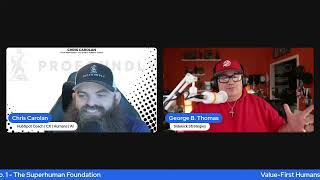
Chris Carolyn and George B. Thomas introduce Value First Humans, a framework built on George's four cornerstones (purpose, passion, persistence, love) and ten H pillars. They critique how sales and marketing systems dehumanize buyers and employees through leads, MQLs, and KPIs, then propose practical fixes: shorten time-to-first-value, have one-to-one conversations before scaling, rename CRM objects to reflect humans, and use AI to augment rather than replace.
Chapters
Good afternoon, LinkedIn, friends, value First Nation. Happy Tuesday here for our first episode of Value First Humans. I'm Chris Carolyn. And we have our favorite happy, helpful, humble human with us today, George B. Thomas. How you doing, man?
Chris? I am doing good. I'm super excited to have this be the last thing that I'm doing today, except for my internal meeting with my team and to hopefully, no pun intended, but add value to anybody who stumbles across this or happens to be watching it live or in the future. It's definitely a conversation or set of conversations that I think needs to happen in our space and in many other spaces around our space.
Agreed. And I thank you for, you know, taking up the mic yet again. Last time we got close to this topic, we were talking about, you know, the leads trap, you know, is very focused on, you know, how just this dehumanization of the process that we managed to achieve in business.
Yeah.
It's really at the heart of a lot of the traps that we talk about throughout this framework. But I wanted to set a foundation with you today because it's really started from doing content with you. Yeah. Outside of learning some vibes over the years of working in different companies and feeling like this friction, but you can't really put your finger on it. I was so bought in to the Superhuman framework last year.
Yeah.
And then I don't know if it was episode 12 or 13 where we were finishing up the cornerstones and I was just like, man, is this another like, human centered, super obvious. Why in the world wouldn't you do this kind of framework that leaders were going to be like, Yep. Oh yeah, that sounds great. And then they're just going to look back at their organization, be like, yeah, I don't know how to do that. So we'll just, we'll just carry on with our day.
Yeah.
So I went into the tank a little bit, you know, with the help of Claude, and said, I can't, like, I can't abide good people like George B. Thomas doing the work, putting it right on a platter for people only to have things like KPIs, sales, compensation, structures. Just the way we've been doing things forever, just get in the way. Just not allow people to make common sense decisions. And I don't know if we've ever had a deep conversation about it, but you're pretty gung ho too, at the time.
Yeah.
About what it, what it could do and still, still could do.
Oh, yeah.
Like, but what maybe you could share. Does any of what I just said Resonate with you?
Well, it resonates with me. I. I live a little bit differently. I think it's because the way that I was raised though, I, I live and believe a little bit differently than maybe the, the average human. So growing up, I heard the phrase or the saying, you can lead a horse to water, but you can't make him drink. Because I grew up in Montana, literally, we were leading horses to water and we could make them drink, right? And that just became a thing that I understand about humans. As much as I want to be a happy, helpful, humble human, as much as I want to put stuff out there, I have to realize that I can lead people to a thing, but I cannot make them embrace the thing. And so for me, that was something that I wouldn't allow myself to not do. Meaning I was going to put the superhuman framework out in the world. No matter if I led a horse to it and it drank the whole, you know, thing, or I led a horse to it, meaning a human, by the way. And they're like, it's not for me. Because I fully realized there are some parts and pieces of the superhuman framework that from a business standpoint, you might immediately go, huh, what the flip is that doing there? But again, the reason that they're in there is because again, I live a little bit differently. Meaning I don't believe there's life and work. I believe that they are one and the same. I, I don't believe that I put a human hat on in a marketing hat. I believe I live in a world where I can have both of them. And again, this comes back to Chris. I think in the original, like superhuman framework is like, I've worked a long time to be able to show up and say, hey, I'm going to show up as a whole ass human. The parts of me that I don't like, the parts of me that I like, the parts of me that I love, I just am who I am. And I need to put these things out. And whoever grabs on to individual elements, then fine. But I do realize that I'm putting something out in the world. Still talking about it, by the way, still, you know, referencing it with people that sometimes they're going to just have to get over a massive hurdle before they're going to be able to get the benefits or rewards of it. By the way, what everybody watching this or listening to this needs to know just fundamentally about the superhuman framework. It is a reverse engineered framework, meaning I was able to go from a place where I should have been nothing To a place where people now tell me I'm something, even though I have a hard time, like, putting myself on that shelf. And so I reverse engineered, well, what makes me me or what made it possible for me to become me. And that's how the framework was born. Because I kept getting. And I say this humbly, I kept getting. People ask me, like, how do I get George B. Thomas is in my agency? Like, that's a hard question to answer. Like, it's all of these things, and they have to think all of these ways, and they would have to make all of these choices and actions. And so.
So it wasn't a dollar amount, just to be clear.
Yeah, no. Like, now I listen. If somebody came to me and said, hey, how much could I pay you to get you in my agency today as we stand. This is not why we're here, Chris. But today as we stand, I don't know if there's an amount.
Right.
But I can help create more people.
Kind of like more good humans.
Yes, good. Yes, yes, yes.
They don't even create just, like, help, like, so much of what we see right now is create new and, like, strive for things that don't already exist or you don't already have. Right. Mold.
Maybe it's nurture. Right. Instead of create.
Right. So much of this is, like, uncovering natural. He. Like, literally superhuman, you know, stuff going on right inside of businesses, right inside of the work environment.
Yeah, that's.
I mean, I loved it. It was one. It was my favorite series, you know, that I did last year. And it was. It really power moved me enough to then feel pain about how, like, just seeing these infrastructures in place to just not allow it to transpire. So, like, before we keep going, I'd love for you to kind of just give however deep you want to go. Overview of the superhuman framework.
Yeah. So superhuman framework. It's pretty simple, impactful, but it all starts with four cornerstones. And these are the four cornerstones that I've seen. When aligned in the right way, together in the right mix, a human becomes unstoppable. And so they are purpose, passion, persistence, and love. Now, you talk to a business about purpose. Yeah, yeah, yeah, yeah, yeah. You talk to a business about passion. Oh, let's get it.
Let's.
Let's rock and roll. You tell them that they need to help their teams and themselves be persistent. Double down. Let's go. And as soon as you say that word, love. Wait, what? Some people mask it as caring, compassion, but I'm not. No, love. Love. And I mean love for yourself, love for others, love for what you do. So, like, love, like, love should not be a dirty word in business. It. Love isn't touchy feely. Like, love is a dope strategy. And, and there's so many things, Chris, where, like, if I'm, if I can take a minute or so and just talk about wise humans other than me in history, right? Like, and I'm just going to give you the quotes, not necessarily the humans that said them, but like, I have found that if you love life, life will love you back. In business, we talk about reciprocity, we talk about trust. If you love who you are and who you do it for and what it is and yourself through the process, it's a reciprocity engine that, that love will come back to you. Let the love you give come back and find a place in you. Is another quote. Love is not about property, diamonds and gifts. It's about sharing your very self with the world around you. We talk about in business, hey, you gotta show up. Got it? Yeah, but you got to show up as yourself and you can do that through love, right? And so, like, listen, the only thing we never, this one is painful, by the way. The only thing we never get enough of is love. And the only thing we never give enough of is love. So, like, why is it a dirty word in business, right? So purpose, passion, persistence, and love. And so those are like the four cornerstones. Now, the 10H pillars, I consider those the gauges. Like if you were to get in a cockpit or a nascar, you know, you've got the like, thermostat and the like, RPMs and the what, whatever. And so the 10H pillars, those to me are literally just like the gauges for me to pay attention to during the day in, day out of what I'm doing. And so the first four of these came from, like, I used to end my HubSpot tutorial videos that I used to do with don't forget to be a happy, helpful, humble human and do some happy hub spotting along the way, right? And it was because this is how I wanted to have the community show up, but it was also a constant reminder of this is how I wanted to show up for the community. And so we took those and we kind of extrapolated those out. And so the 10H pillars are happy, hungry, helpful, humble, humorous, honest, healthy, holistic, human, and holiness. And for most of those, like, businesses, like, yeah, yeah, yeah, yeah, you get to that holiness one like screeching Hall. What do you mean? Holy. Well, I'm not talking about like we do prayers at, you know, 12 o' clock on a Tuesday. I'm just talking about the like deep understanding of importance to the thing that it is that you're doing like this. So many times there's been so many humans that they are just, it's, it be, it just stays very surface level, especially in business. Ladies and gentlemen, if I could challenge you one thing over the next coming, like pieces of content or conversations that Chris and I have is like challenge yourself to get off the surface level of life and dive in deeper and realize there's more to you than there's more to life. Which means there's more to the business that you either own or work in anyway. So that's the, that's the 10H pillars. And so when you think about the four cornerstones that drive you and the pillars or gauges that you can pay attention to, by the way, this could be for just you, the human, or as a business, like, think of it from a marketing strategy. Okay. Is what we are doing, putting out to the world going to make them happy? Are we going to be helpful? Are they going to find it humorous when it needs to be? Is it going to make organizations or humans healthy? Is it a holistic actual strategy? Because we're not just focused on our website because that doesn't work anymore. We're focused on LLMs and websites and social and like in person events and like, man, should we go back to the, you know, commerce luncheons? Because like, things are changing, like humans are being different. So like you see how you can kind of plug those in as you would need. And the fun part about this too is I'm using market examples. But the fun little thing about this superhuman framework is I've put it towards the light of sales, I've put it towards the light of marketing, I've put it to the light of HR even and individual humans. And if you put it in the right context, these same things, these gauges in these cornerstones, these pillars and these cornerstones, they work. So that's, that's my lowdown on the superhuman framework and what we talked about last year, which by the way, ladies and gentlemen, I'm sure you could probably Google and find those conversations and be able to go and see what the, the precipice of Chris creating what has come after that thus far.
Yeah, thank you for that overview. Wow. Makes me want to go back and do it all over again, I guess. And that's what was, was frustrating at the end of last year. It's like knowing that because this is also in the face of AI, you know, showing up and people being concerned for their value and what role are they going to play. Yeah. Meanwhile, it's like literally pick one of these pillars. Like, you could find value in every single one of them. And that was, you know, my understanding what you're trying to do is like, hey, like, it's not all 10 at once.
No.
Right.
First of all, they pair like a good steak and wine together. So you could literally pick like two or three and kind of like. Or it's like, what am I completely full of? What am I empty of? Okay, let me fill that tank of this. Right. I might be low on the tank of humor, so let me fill that. Or holiness. Let me feel that. Like whatever, whatever it is. But they, they should be. And you can use them at different times. Like one week it might be like, we gotta over index on this the next week, it's like, oh, I better hang on to that. That's what's gonna make me get through. Like, I need persistence like a mother this week. Because it's the week after vacation. It's not really. I'm just using that example. But you gotta stay persistent on those weeks.
Right?
Especially in business. And Chris, can I just back up for a second? Because, like, I know I'm no Gary Vee. Okay, Gary Vaynerchuk, for those of you that don't know who that is. But Gary V. I know I'm no Gary Vee, but the superhuman framework is like my attempts of helping humans be as human as possible. And I was watching a clip that he put out, this might have been a week ago, where he was talking about the world that we live in and this, that, you know, the speed at which things are happening and the AI, you know, that is going on. And out of his mouth came and so in the future, the most human humans will win. And I'm like, I've been preaching this for like the last like years.
This is what I mean. It's all over the place, right? Yeah.
And I'm like, okay, so I guess I was ahead of my time or something. And thank you, world for like catching up. Or maybe I'm in the right spot. I don't even know how to position it, but it's like I'm more than willing to talk about how to be the most human of humans and especially how to do it in like the context of business. Like, anyway. So like, again, the superhuman framework is it's like, those are the elements. That's the piece. Like, to me that. That's the unlock.
It is like. Because guess what, folks? Like, we're trying to do work for AI right now. AI knows that humans like other humans. So. Yeah. Yeah. Gonna highlight the most humans. Human. Humans of them all.
Yeah.
Right. There's no more game. Like. And when I keep running into stuff like this, it's like, okay, what is the game? Like, what I just had to dig in to be like, what is actually getting in the way here? And when. So I put it to cloud and I said like, pretend marketing, sales service. Like, those things didn't exist.
Yeah.
Like, what would an organization. Like, how would you Claude, as an A.I. n.A. Like, if you never knew this stuff existed, how would you organize a business? And I knew I was on the right track when it came back was. I'm like, I don't know what the hell you're talking about, dude. And then as we went through it, it's like this constellation model where you have these basically roles or people around the business and everything is designed around the flow of value. Right. Like, don't put anything in the way of value.
Yeah.
And then when you start to like, pull back from that, we do everything in our power to get in the way of the value, to create control. And it was easy to relate it to because if you're a consultant and you haven't experienced this, like, either good luck or maybe try a little harder. Because when you see really smart leaders, understand the contact, understand the value, and then they look at their organization literally, like, they just get sad because they have no idea how to move the mountain that is in front of them. And it's things like. It's not. I'm not about to describe easy things like to move. None of this is easy. Right. But it's. It's years. It's like a hundred years of progress.
Can you.
That has been built into our companies and SaaS has kind of sped it up over the last 25 years. But things like sales team compensation plans.
Yeah.
Rewarding closed deals and not relationship development. Right.
Yeah.
Marketing, getting measured on MQLs. Does the audience even understand who we are as a business?
Yeah.
The board reviews focused on quarterly revenue and not. Is our. Is our customer base building? Do we have loyal customers? Is the customer value going up? And KPIs across the board, across the teams that at best don't align, at worst, cause competition within the organization. So you can watch somebody get real excited about something new and then they see one of those things like, oh, yeah, maybe next year. Maybe like, get back to me next year. We can think of. And it's like, it's not that they don't want to honor these 10 pillars, let's say. Right. Because this is about. We're complex beings, in case you didn't know. It's not about consuming all 10 pillars at the same time. Understanding they exist.
Yeah.
Need to be served at different times.
Yeah.
But when you build systems, like, literally the way that we talk about sales and marketing, and it's a factory and it's got a, you know, data in and then inputs and then hand off, hand on, hand off, and I get paid, it's built for this industrial efficiency that inherently gets in the way. And that's why this pillar relates to the lead trap specifically, because it's very easy to draw a line when you think about leads. And when the way people approach leads, it literally dehumanize the process so that we treat each other as humans differently because we see leads, we see prospects, we see dollars, and we got to hit our numbers this month.
We got to see humans. I'm going to explode. Can I unpack something? Because I'm just. I'm mentally going to explode. If you're watching this, listening to this, please get a notepad, a pen, an iPad, your phone, prick your finger, write it on the wall. I don't give a crap what you. What you need to do. There is a metric that you need to pay attention to that. Yeah, I'm just gonna say it. You need to pay attention to the metric of time to first value. Time to first value. Let me explain also, Chris, in that last thing that you were talking about, you talked about systems. You have to be able to be willing to break systems to chase time to first value. Let me explain what I mean. For the last two weeks, I've had meetings with a particular client, and during the meeting with the client, multiple sales professionals were having issues with HubSpot templates and sequences. And I don't mean the bebop boop, here's how you press the buttons portion of it. I mean the actual. How do we communicate like a human? How do we actually add value? Like, how do we not sound like we're spamming the crap out of. And by the way, they weren't terrible, but they knew that it could be better. And so I got to like the second week of this, and I said, enough is enough. I. And my brain immediately went, you know what? I'm gonna write a Blog article about this. And then I was like, screw that. What I'm going to do is I'm going to just put my thoughts down, I'm going to create a document and I'm going to. Because here's where my brain went. Let's start with one to one. Let's start with one to one, give value. And then if I find value or that one to one value, then I can extrapolate it out one to many. And so I put it. Put, you know, pen to paper and keyboard to AI assistant and put my brain thoughts down. And I came up with this Google Doc that was like basically, if I were just to paraphrase it, it was like HubSpot templates and sequences for sales teams that don't suck. And I literally sent it to the leader of the organization for the sales team and I said, hey do, before I send it to the team. Do you think this would add value to the journey that they're trying to get through that I've been helping for the last two weeks? I got a slack back. Yes. I think they'd find it very valuable. I then emailed it to everybody that had been in those meetings where we had talked about these things and I gave it to them, which within minutes, maybe 15, 20 minutes, one of the sales reps. This was very helpful. Thank you. I now will I write a blog article maybe. I know it's valuable. I have the proof in the pudding. But my, my thing was like I felt this pain that an organization was facing. Scratch that. I felt this pain that humans were facing. And so I needed to figure out how can I get time of first value to be as short as possible so that they can start creating the thing they need to create in the way that they need to create it and so that the pressure of the organization is lifted off of them because now they can actually do what they're trying to do to hit the numbers they got to hit. But in a human way, like, we got it. We gotta be able to break systems. We gotta think time to first value and we gotta think one to one before we extrapolate it out to one to many. From a content or sales perspective, it's.
Interesting to watch that happen like real time. Right. Like people are literally, they cannot resonate with this. They know it's not doing anything in the best interest of anything, anybody involved. But they're being told to do this thing because we need 17 touches.
Yep.
Right. Like instead we inherently know what will work and what won't.
Yeah.
So I Mean, obviously, I haven't done much significant work outside of just think about this at length and write about this at. At length. But the only way it starts to make sense is when you apply lead labels. Like leads. Like the thing on the other side is not a human, because otherwise nobody in their right mind is going to do something that the answer to will this build trust is going to be no, or will this add value is going to be no. Yet they do it every day. And I remember back at inbound in 2024 when the prospecting agent just got, just got released and we were talking about it, and it's like, in what other part of your life is it okay to remove the human being? Would you prefer to remove the human being from a first impress with another human being? It doesn't make any sense.
Depends on the human. Just kidding.
Just kidding.
But no, I hear what you're saying. I hear what you're saying.
And we, we've created these systems and these processes where it's like, okay, we just got to get enough of these. And then it goes like this and like this and like this. And then everybody gets value. And that's just not how humans behave. That's not how they grow. That's not how they think. There is a little. There is no linearity to it. And then when you think about trying to build genuine connection, like in these situations where we literally. Like some of my favorite people at HubSpot that have ended up being my favorite people started with a conversation where I could not get them to go off script.
Yeah.
From a discovery call, I could see right away they're looking at a playbook. And the system will not let them move to the next question until I answer it, to which I tell them I'm not going to answer that question because it's irrelevant. It doesn't add any value to this conversation. And if I can't get you to move off the script, this conversation cannot be valuable. Like, what are we doing here? Right. You know it's not right. I know it's not right. Like, can we have a valuable conversation meanwhile, outside of these situations? People constantly say things like, oh, well, we gotta. Gotta create value. We gotta add value. We just gotta connect with more people. You know, my best relationship starts with good conversations. Yeah, right. It's right there staring you in the face. Connection, conversation, relationship. And this cycle, like, it's the easiest flywheel in the world if you just show up and accept it.
You said conversation. Shoot, I'm trying to. You said relationship.
Connection. Conversation.
One more word that I want to throw in there. Care. Care. Like you've, you've got to care. In other words, you've got to love. Right? If I didn't care about the humans in my example, document never gets created. Time to first value never happens. I still get paid at the end of the month because I did the minimal that I needed to do. But the minimalist shit. If you're in business to do the minimal, get out, go be a dishwasher, go be a cook, go become Amish and live on a farm. And I don't, I don't care, by the way. And I'm not saying that as a negative. Just get out of business. If you're in business to do minimal, if you're in business to make the maximum impact, to create a tsunami tidal wave of goodness on the planet. Here's another video that I saw just recently on LinkedIn. Dan Tyer used to work for HubSpot for a ton of years. He was doing an interview and in the interview he goes, my goal is to put the most good into the world. That's what your focus should be in business. How do we as a business put the most good in the world and get to the time of first value the fastest? Because we're doing the maximum amount of love that we can forget the humans that we're helping. Okay, I'll stop.
It's that simple. And when you talk to enough people across the organization, they want to do it. So that's, that's why I started digging in. I wanted the help of AI because we need some help on this one, folks. Yeah, like 25 years into SAS and we got 50% adoption rates, 70% digital transformation failure. Like, how long do we do this for? Meanwhile, AI is coming and it. None of this stuff makes any sense to it. Like, if you talk about leads and MQLs and SQLs and like, of course it has a tough time. Like, which, which acronym is it going to pick today? Which industry is it talking about? And it's built to fail. And a lot of it's just the natural language that we're not using to describe. Very easy to describe things. Yeah, right. So I started working with Claude just to try and like find some patterns, dig into, you know, like what George shared about starting from his experience and the 10 pillars and just like, what makes him who he is. Like, a lot of this is just being inside of organizations. Like the feeling that I would get when we start talking about leads. Right. That's where I started I was just like, okay, why? Help me understand why I dislike these conversations so much, right? As soon as somebody brings up that word, irrational things start coming out of people's mouths, right? Like, we forget there's humans involved. We think there's a sliding, so what can we do? And we started there, developed some traps, and it just started to make so much sense in terms of so value first, humans is one of the, one of the pillars of 10, but it really started with these traps in that, like when I think if you understand how this transpired, you'll have a very hard time arguing the fact that we have dehumanized this process, like successfully to profit at the cost of buyers everywhere. When you think about the struggle with integrations, the struggle with data maintenance, the struggle with now worrying about our jobs because AI is coming to do things better, right? It started with a conversation with perplexity, actually, where I was like, okay, where. Who made the lead? Like, where did that actually come from? Of course, Salesforce in the year 2000, introduced the lead object into the CRM and we treat that object differently than we treat the contacts object. So guess what? We need a lot of those. They're not really humans. They're just, you know, we need a thousand of them every month. Okay, we're good. We need more. So let's, let's do some ads. Let's send out a bunch of ads and create lead magnets and do all these things to get more. Oh, they're not. There's some not. Not so good ones in there. We're getting a lot of low quality stuff, but there's some good ones in there. So we just do the work and we bring in this team of SDRs to do all this qualification, weed out, and then hand off the good ones. Okay, man, this is getting kind of complex. I guess we need a system to be, to be implemented to support this. Okay, now we can see it, but wow, this is so complex. There's no way we can maintain this ourselves. So let's hire an agency, a managed services firm that we will pay in perpetuity because we'll never be able to maintain the system ourselves. And they are incentivized to make sure that stays the case. And like, if you've been lucky enough to just chill inside the HubSpot ecosystem, you haven't felt most of this, but the soon, as soon as you step outside, you feel it immediately. And for me, I met Salesforce before I met HubSpot and it was so easy to tell the difference between the ecosystems where any level of help from anybody in the Salesforce ecosystem, the suggestion of it like, oh, yeah, I can help you out, always followed by a quote that I would have to sign and pay for to get the help. When I stepped over to help, almost never. The first version of help always came like, yeah, oh, wow, this place does care about the people. And the community was so different. Right. Meanwhile, it would clash against these systems. And, you know, as I implemented it inside of organizations, I was like, all right, maybe let me just use HubSpot as like, the Trojan horse of transparency and forcing. Yeah, that didn't work. It worked inside, like, my little marketing team that I got to build out. But, you know, sales service, the rest of the organization, they were just walking to a different beat. Meanwhile, you could tell customers weren't. Weren't enjoying the experience. And on top of that, every leader you talk to, they're on board with, yeah, customer experience. We gotta improve that. We gotta. We gotta make that better. But I think recently there was a shift in 2022 where customers and buyers started caring more about speed, as you mentioned, speed to value time, to value. More about that than price. Yeah, right. And as we talk about system, to why this is a tough nut to crack, and we need AI's help to crack it, and it's here to help you crack it. You just got to say, I want to crack this nut. You got to save that part. Like, it will help you.
Yeah.
But when it's price, that is number one. I don't need any systems to help me with that. I can be like, oh, you know what, George? I like red. I'm gonna give you a 25 discount today. How about that?
Yeah, right. Yeah.
No, but if I. But if I see you over there and I'm like, oh, George wearing red today. Let me go into my ERP to find all of the red, like, products that will. No, that doesn't. Our system. You need a system to help you with that speed, and it's not something you can just turn on and nobody's. Nobody's ready for it. Right. Meanwhile, the buyers are like, okay, we're just gonna keep going there. Like Amazon. Sorry, guys. Amazon can give it to us. Why can't you? Right?
Yeah.
So meanwhile, we're introduced to things like HubSpot, where it's like, it's here. Like, you could do it inside of HubSpot.
Can we swing into a couple things? Like, a couple things that come to my mind. First of all, there. These are mindsets. All right, so like, let's talk about HubSpot for a second. If. And you know this, Chris. So this is less for you and more for the actual audience that might watch this or listen to this. If you swing into most HubSpot portals, you're going to see contacts, companies, deals, tickets, leads. Like, that's going to be the main objects. If you swing into my portal, and I believe Chris's as well, you're going to see things like humans instead of contacts, you're going to see organizations instead of companies, you're going to see opportunities instead of deals. And when HubSpot gives me the ability to rename leads, my lead objects will be conversations, because it literally is the conversations that leads me to the next thing. And so that's one. Like these small naming of the things that we use on a daily basis sets the foundation for the mindset of how we're actually going to show up when we have the systems that we use. So the other piece of this, you said system and I thought about my time to first value example. I have an AI assistant that is like no other. I would, I would challenge you to put your assistant up against mine to try to like, create content within like fractions of a moment that it used to take. The only reason I could get that document and get it so good so quick is because of the system that we've built, the assistant that we've created, the time that we've taken to care about building a machine in HubSpot and a system with AI to allow us to go to time to first value in rapid rates. I go back to HubSpot because you started to list all these things and like Salesforce were like, and then you needed a pipeline and then you needed stages and then you needed stage automation. And yes, these are all things that you can do or you can get on the first call and just start adding value to a human's life. You can get on a first call and they just fall in love with you. Why? Because you're a good human and you're actually not trying to sell them a gosh darn thing. You're trying to figure out if they're a right fit and more importantly, if you're a right fit for the thing that they're actually trying to do. And when you can figure out, fit, add value and become loved in the first 30 to 45 minutes of a conversation with somebody, guess what? The sales process, because it's founded in service, becomes real easy because it's, it's.
Based, it has a Foundation of value.
Yes.
Right. And we talk about this value exchange all the time. It's like it's the goal in business, yet we don't do that. Right. It's constant value extraction. Value extraction, value extraction. And so trying to kind of spread this on the mat similar to how you did, you know, the ten pillars. Because there's nuance to this. Like, this is a lot. All those layers I mentioned, that's just like the first half. Right. And this was me, like evolving from kind of like it's so easy to say, well, it's a leadership problem or a culture problem. Like, you almost always get there in these times of transformation. Right. But what I was seeing is that I don't see anybody suggesting that it's even okay for a leader to stop thinking about, like industrial age, you know, structures and the quarterly report and like the board always bang on the door, what are these numbers? Where are these numbers? Right. So trying to break it down from that perspective. I'm gonna list the 10 real quick and then as we wrap, I'm gonna focus on humans again. Yeah, but the first one and I. This was some recency bias, if I'm being honest. Like, humans needs to be number one. But I didn't put it number one because I was like, all right, I'm not going to be another guy coming out with a human centered framework that everybody's just going to be like, oh, yeah, more human stuff. Okay. AI, The AI replacement trap was the first one because we constantly hear people talk about that. Meanwhile, AI can be.
Yep.
Wow. Like literally Iron man suit Jarvis, like the suit to your superhumans. It just takes a mindset shift. Right. So AI Replacement trap instead, we're doing value first AI instead of leads trap. We're doing value first humans instead of the advertising trap. Like, are we communicating? Can we just communicate better with the market instead of trying to get them to convert over and over and over? Right. How do we get those leads? We use lead magnets. So instead of focusing on that, we focus on value first content. And when you position, like, of course you're not getting it right. Like you're trying to add value to their journey. Got the qualification trap. Right. When we, when we've got too many numbers to go through and we're not seeing them as humans, it's like in or out, in or out, in or out. Meanwhile missing great opportunities. And that one's called Value First Partners. Because so many times like, oh, great, you might not be a fit for what we do, but let me tell you what? My buddy George over here, like, he's gonna. He's gonna take care of you. And they do the same things, right? When you just create value on that journey. Number six, we've got the managed services trap. We flip that into Value first delivery. Number seven, we've got the ERP trap. We flip that into value first platform. Yes. It's possible to build systems that enable your people to do great things and that they like. Okay, we've seen it. It's rare, but we've seen it, right? Number eight, we've got the measurement trap. And there's no, no different way to slice this. There's value first measurement. On the other side of that measurement trap. You just gotta figure out what matters to your business. And then we get to the conformity trap and value first culture and the authority trap and value first leadership. Now, of course, if we're building the business from scratch, we're starting with that leadership, you know, pillar, right? Making sure we're leading right. And then going back up. Right? But since so many people are stuck in where they are right now, everybody's reaching for AI, like, oh, man, like, get me out of this. Nothing's working anymore. Come on, AI agents, just solve it for us, right? And that's. We're already. This how fast it's going. First, we're already seeing people laying off and then hiring back, applying agents, getting. Not seeing the results that you want and suffering for all the invested time and energy that goes into that. And it's a trap. Like, meanwhile, your best resources are the people on the front lines working with your customers day in, day out. And if they even get a sniff or thought like that, there's replacement happening. Which, by the way, if you don't say it's not happening, there's a good chance they. They feel like it might be. If all you're talking about is efficiency and time saved and all these things Right. You need to handle that upfront. We don't like uncertainty.
Yeah.
As humans.
One of the things. Chris, on that. And then I'll shut up, I promise. One of the things on that, that I know that I feel like we did right, is when we started rolling out AI for other people in the organization to use. And don't get me wrong, I know I'm a small or small organization, but I think that the truth holds true, is when we rolled it out, we said, listen, you need to know right now, this is to augment you as a human. It is not to replace you. I want you to Become or be able to become the best you that you can be with an assistant that we once could not afford and now we can afford it, because assistant in history would have been another human. Now, it doesn't have to be, but that doesn't mean I'm replacing any of the humans that were in the organization.
So as we go through this series, I really see, like the Superhuman framework is just a great destination. Like anybody could pick that up right now and say, all right, we want to make this space possible for our humans to be like this and on all cylinders and in all these places because it really shows what human centered business looks like. You don't have to overthink. It provides those principles and the foundation for flourishing and can be taken at an individual level, organization level. There's team stuff. Like we were having some fun last year, if I'm being honest. I just got to review it and like, man, what better way to start using AI than just to layer it in all these nuanced situations? Right. That's also how, you know, these frames work, works, these frameworks work when no matter what, what lens you put on top of it. Yeah, yeah. Still works.
Yeah.
So then value first stuff is really the escape routes. So trying to identify traps that are preventing implementation. Highlighting Industrial age thinking. And I keep on highlighting industrial age. I haven't talked about the other side of that, but that's the AI age. Like we're in the age of AI. Industrial mechanisms are breaking right in front of us. And the cool thing is it's 100% mindset because AI is right there to help you catch up.
Yeah.
Whenever you're ready. But hopefully this framework will provide some transition pathways because you got a lot of people that aren't sure what's happening. I mean, how like we do content every day, we're not sure what's happening like tomorrow. So as we wrap up this, the rest of the series, you know the seven value first humans commitments are honor human wholeness, not partial utility. Right. If you ever seen severance, right. Like we, we not separate who we are at home versus work. You know, George said it well at the beginning of the episode. Enable natural growth, not forced process. Number two. Number three, align with purpose, do not manipulate with incentives. Number four, build genuine connection and don't manage transactions. Number five, remove barriers, do not add pressure. Number six, recognize signals, not manufacturing leads. And number seven, enabling, enable multiplying value. Do not extract from diminishing returns. And number six, like, let me just highlight an example. Like recognize signals instead of manufacturing leads. A perfect example of why we're not in the best place is that you cannot get people to agree on the definition of hand raiser.
So can I say something stupid?
Always.
Let's go out of business for a second. And I don't mean out of business. I just mean out of business. I'm gonna go out my door, I'm gonna walk down my sidewalk, and I'm gonna yell out to my community, anybody want to come over? Anybody want to come over? Ollie ollie oxenfree. I'm gonna walk back in my house, and nobody's gonna come over. Or I sit on my couch, I do what I need to do, I spend time with my family, and then all of a sudden, you hear ding dong. And the door rings and my friend walks in because it was the right time for somebody to come over. This is the exact game I play with the way I sell HubSpot. I wait for somebody to come and ring my doorbell, and then I talk to them about HubSpot because they are in need of a conversation to move forward. This is the way that I help people who need help with almost anything in life Because I get the most random meetings on my calendar of like, hey, I'm dealing with XYZ Ding dong. Hey, I've got this challenge with ding dong. If you'd spend more time putting value into the world, your doorbell would ring.
More and you'd have time to be there when it does. As we wrap up for this week, one challenge for you. Identify one place where your systems prevent common sense is an easy one. This is like softball, folks. Identify one place where your systems prevent common sense. Human focused decision making. Not where people are failing. Where the structure makes honoring human wholeness. Showing up as a human, like, caring about the people around you difficult or impossible. Some examples to get you started. Qualification requirements that reduce people to data points. Staging gate processes that assume linear progression. Compensation plans that reward extraction over relationships and automation that removes human judgment from critical moments. Next week, episode two, honor human wholeness. We'll explore the value first commitment and how it directly challenges the leads trap. Showing where systems fragment people and how you can escape it. So thankful that you're able to start this series with me, George. I wouldn't want to do it with anybody else. Any. Any last thoughts before we wrap for this week?
You know, Chris, I also am happy that you are the human who have taken charge of this and that we can pair kind of the value first in the superhuman framework in these conversations. I love your challenge. I think we leave it at that. Other than find one way in the next seven days to be a better human and put good in the world.
We'll see you next week, everybody.










