Speaking at #INBOUND24 Late Night Show Night 2 with George B Thomas + Friends
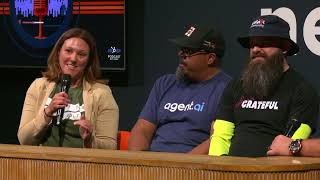
George B. Thomas hosts a late-night panel at INBOUND24 with Danielle, Nico, and Chris discussing HubSpot's AI tools like Breeze and Copilot, how AI is changing business workflows, and what the inbound marketing approach has meant for their careers.
Check, check. All right, we're here, we're live. And we are. Oh, we've got a live one in the crowd. Ladies and gentlemen, welcome to Late Night Inbound with Georgie Thomas and friends. Friends is the more important. Let's get them a round. APPLAUSE. There you go. I like that. So let me start out with the most difficult question because I'm sitting here and I am just sort of weird. If you could pick one of the four places to be on that wall. Bogota, New York, London, or Tokyo right now, which one would you pick?
Well, I'll actually be in Tokyo in about two weeks.
Oh, nice.
I'll pick that one.
There you go, Nico.
I was going to go for Tokyo, but London, actually, because I have always wanted to go to England.
Okay, there you go. And Chris, you're probably like, why are you asking me this dumb question?
Wife's from Colombia, so I gotta say Bogota.
Bogota, awesome. How about I just go to all of them and meet you there? There we go.
All right.
So we are not here to do dumb questions. We're here to talk about Inbound and HubSpot. And so I'm super curious. This is day two. Well, if you're at partner day, it's day three, but most people did not go to partner day that are probably watching this. So we're day two, and I'm super curious. Let's start with the question of. And I know this is dangerous with some of the people that I have on today's show, but. Yeah, maybe all of them, actually. But what's the most positive, important thing that you think that you've seen today? And we'll start with ladies first.
Yeah, definitely a hard question. I think the most. One of the small features that will have the biggest impact that I saw is the record updating via AI. So I was in one of the product demos and they were showing off how, from emails, it's just going to sort of scan what's there and offer up suggestions for updating properties. And that takes away so much admin work from the sales team that should be focused on selling.
Oh, I like when you can take away admin work that a human might have had to do that they probably hate doing. So that's a good thing. I love that, Nico, positive impact thing that you saw today.
It's possible there are some positives.
It is.
Okay, So I think the. The best thing that I saw was actually yesterday, but I'm sure that they showed it today as well with the new HubSpot co pilot. I think I'M the only one that's got the clip, but I was there to be able to see them go from inside a blog, select text, open up Copilot, and then ask Copilot to build a nurturing workflow based on the blog that they were already in. So from your blog editing page, you can actually go create a workflow, have all the details in there. And we're not talking about like the workflow, you know, trigger builder. Right. This is a much more advanced version. It actually built out multiple steps, put in a notification, put in some additional properties, is all ready to go inside of a minute.
First of all, I know how your brain works and I know how technical you are and the fact that that excites you. I'm officially excited. I'm just going to throw that out there.
I've been waiting for the workflow, AI in particular, to get much better so that it can make all of our lives a lot easier. So I am very happy to see that it's finally picked up and I'm.
Happy that you're happy. Chris, what was your positive thing today?
I love me some smart CRM. George and Kathryn Mann and Jeff Vincent demoed all the cool stuff that's been happening, including the object library, bringing four new objects down to free and above. So really going to be not just focusing on customization of the tool anymore, but making a place for different, like, data sets that all the businesses have out there to be able to customize it around your business, you know, much easier without, again, without code, without having to connect to all these other systems, the object library is going to be a big deal.
Yeah. I think in the future that gets built out more and more. I don't even know if we all understand what the potential it has, what it can become, and also what it means to like folks that we're not yet even thinking about. So here, here's the thing. What's funny about the answers is everything you gave was about how it might make somebody else's life easier or better. And so I actually, with this crew, I saved this question, didn't ask it last night because I was, I'm super curious. There's. There's this thing that always fascinates me with what I like to call the inbound journey, the high HubSpot journey. So the question I'm going to ask you now is like, how has either inbound or HubSpot changed your life? Like pre HubSpot and inbound to sitting here today, Talk me through that transformation. And again, we'll go ladies first.
This is such a great question. I feel like I grew up on Inbound and HubSpot, so back in the day, like 2011 or so, I was standing in the HubSpot offices for HubSpot TV. So, like, huge throwback. So I really started my career with HubSpot when it was just what's now marketing Hub. So I was here for the announcement of CRM and it's been really great to kind of see all of those acquisitions come together into different products, and I just love where it's at right now. It feels like we have so much available to us, and I'm focused mainly on marketing ops. But it really touches so many pieces of a business that you can pull together. And that's really exciting to have a tool that can do that.
Did I hear 2011? You are an OG. Like, I know. Oh my gosh, I'm impressed.
My first job out of College at HubSpot, I was on the phone almost every day with support.
Oh, wow. That's very awesome. Nico, how. How has HubSpot or Inbound changed your life?
Quite literally? Would not be sitting here without it. Got here from being a end user on the client side and got scouted at inbound in 22 by new breed. And now I am here working with the goat of all partners. 3 time top partner of the year and very, very happy. Blessed. I wake up thankful every morning that I even get to do this for a living. I'd still be in the AI space, but probably not this deep if I wasn't this close to it.
You know, a little bit about AI.
Tiny, tiny bit.
Tiny bit.
Tiny little bit.
We might circle back around to that here in a hot minute because I have a question that I really wanted to ask you for a long time and it's like almost like taxi confession type thing. So we'll. We'll talk about that in a minute. Chris, how has HubSpot or Inbound impacted your life?
I'm at HubSpot in 2017 and it was right about the time that Sales Hub was coming out, Service Hub was coming out. And I've been trying to do a bunch of stuff using QuickBooks and Salesforce to manage customer customer data. And it didn't work out for me, so I was ecstatic to use all these new tools. But I've always seen, I think because that's when I came in, I've always seen it as a full customer journey situation and never just a marketing tool. So every time I've implemented it's always been all the hubs, you know, now that I'm on the partner side of things, helping, like, during this transition towards customer platform, it's just a definitely felt like I came in at the right time and everything.
Continuing on that journey inbound in HubSpot can be transformational. I've been part of the journey of 2012 to now and what's been able to happen because there's this software that decided to be a philosophy company that decided to educate humans, that created a community and partnerships. And it's just fascinating to sit here and be like, man, we're all grown up. Like, this is pretty dope. So, Nico, I'm going to ask you a specific question, then we'll go back to the group for a second because you are the brains behind Hub Helper Harry, which is awesome. Which, by the way, when I was saying, you know a little bit about AI now, the people who are watching or listening know I was totally joking about AI But I've always wondered, like, what's the weirdest question that somebody has reached out to you and been like, can I do this with him?
I think the most complicated one that I've had was somebody. This was early on when it wasn't really as easily possible as it is now.
Right.
And when I say early on, I mean, last year somebody had asked me whether or not it would be possible for them to take what they had in their room and see if they could actually, like, reorganize or what they could do with their room to try to make it better. They were terrible, but they weren't really great at interior design. So I said, all right, well, I haven't actually seen and or heard of that use case yet, but I think what you can do is take a picture. You can put that into chat4 or chat4, upload it, and then give it a little bit of context about your room and where you live and what you have available and your budget.
Yeah.
And then ask it for some ideas about redecorating your room. And yeah, they were pleasantly surprised. And it is actually pretty cool. Pretty cool room design. So.
So interior decorating.
Yeah, with interior decorating with A.I.
Yeah.
Yes. Yesterday I talked to somebody about how easy it is to take a picture of your refrigerator and have it do all your meal planning for you for that week.
Oh, I like that. Meal planning. I just like meals. That's why I say that.
And that's the thing is we're all sitting there like, oh, there's nothing to eat. You open up the fridge.
Oh, my God. Have you met my kids? Oh, my. There's nothing in this house. It's, like, cool.
Anyway, now you can handle your phone and be like, no, just take a picture and figure out what you're doing.
Yeah, here, let AI help you figure out how to take the rest of my money and put it in your belly. Okay, So I brought up AI because. And I kind of asked this, but I'm going to ask it in a different way last night. I'm going to ask it tonight. Obviously, the big thing this year was the launch of Breeze. And so it's a lot about AI and copilot and assistants and all of that. Give me the good, the bad and the ugly of, like, I love this, but I struggle with this. And I hope humans are thinking about this. And again, we'll go ladies first.
Yeah. I think last year there was so much talk about AI. Like, you couldn't get through five minutes without hearing AI, and it felt a little all over the place, literally. And so this year, to have it kind of pulled together and have that all under one roof and really have more of a cohesive strategy is really exciting. But I think that we all need to remember that one communication should still be personal. Chris and I were just talking about you still need to build relationships, and you can't have AI do that for you. I think in some cases you feel like you can, but it's really not authentic, like, just generally. And then the other piece is, this is probably just a me thing, but I don't trust reports unless I can build them myself and know how they're built. No one has clean data. I have never come across a client that has clean data. So if you're going to have AI build reports for you, you have to know what it's pulling from in order to trust it.
Interesting. Nico.
I would say that the coolest thing, obviously, is what they're doing with the content creator, content remix, and being able to pull all of that into one place and start to sort of put a little bit of heat on a lot of the other content platforms to either keep up or, you know, shove off. And the only thing that I am a little. A little afraid of is the intelligence factor. And I've raised a couple concerns. We'll see what happens. I'm sure it'll roll out very quickly, but essentially the ability for somebody who maybe not may not be the most seasoned admin to be able to go in and overwrite customer data by accident by trying to enrich it yeah, that was one thing where guardrails are coming.
That's okay. Yeah. Chris, what are your thoughts? You have many, right?
I have thoughts, yeah. I think there's going to be a lot of focus on, like, the agents and kind of doing things that you've always wanted to do and couldn't make time for. Nobody had time to focus on it. But in almost all those, there's this step that they kind of skip over real quick whenever they kind of demo it. And it's like the confirm your strategy piece.
Yeah, right, yeah.
Like, well, it's going to be very powerful if you take time to do that. We know that that can also be a struggle for businesses. But I think beyond that, there's a lot of little things. Like, I just sat in a great session with Brenna. I realized I got tricked into sitting in like an Academy course, live session. As I was listening to her and she's. And I was like, I'm listening to Brenna on a video in the Academy right now. She's a machine. But as she was just going through the basics, it's gonna be a huge win for anybody that takes the time to learn, like, you know, where they use it, where they don't, where they're gonna monitor how it's working for their portal. And hopefully, you know, most of the people can understand that responsibility that comes with this power.
I love the idea of responsibility because one of the questions I'm super curious of, like, if you're talking to, you know, CEO, C suite or owner of a business, and they're sitting here, they're looking at this launch, they're thinking about AI. Is it dive feet first? Woohoo, let's go. Is there a level of like, well, you should probably pause and wait or maybe it's too early and it's still Heisman. Like, where do you guys fall on the scale, the meter of AI usage in your organization or not? I'll let you guys randomly figure out who wants to answer that one.
You gotta go, like, just dive in.
I knew that's what you were gonna say. I think you're the, like, let's run.
Was it Kieran said earlier? Watched a session with Kieran and Dylan. Once you realize it's just an accelerated learning tool, then why wouldn't you dive in? The problem is when you expect it to do all these things for. For you, you get afraid of those initial outputs because you're not learning. You just want the easy button, right?
Oh yeah.
And if that's the approach, it's not going to work out. And you just, I mean, we've seen it with HubSpot a hundred times. We think everybody's telling us to do this thing. We try it without strategy, without understanding how it works and it doesn't work out. So then it's the tool's fault. Right. So I'm going to stop using the tool. AI is broke. It's not going to work for me. Our business is special. You know all the things. Yeah, you got to dive in now. Like, you got to dive in, figure it out. You got about six months left to figure it out. Maybe before you just start, you'll never catch up.
So we got a dive in guy, Nico.
I am somewhat on the same page. Definitely a dive in type person, but with a bit of guidance, maybe example only. Because the number one thing that I get asked often enough is, but what can I do with it? So even if you do dive in, even if you do distribute the tools, even if you do tell everybody everything's available, Breeze is online. I've flipped all the switches. You might not see any productivity because okay, but what do I do with it? And yeah, there's suggested prompts, but they're kind of basic. Yeah, basic can kind of get you going. But if you want your people to actually get something out of it and understand how to leverage it, then you need to teach them how to speak to the model in their language, how to actually work with it, so they can get some insight based on what it is that they're looking for and teach them how to talk to it. Like a person, like the assistant.
Let's go, let's go. So hold your thought for a second. So I'm going to come back to you, but I have to ask you a secondary question on what you just said. It's always been important, yet it has been difficult for organizations to focus on taking the time to do documentation. How important is documentation in a world of AI and things like Breeze?
Documentation in that world is important when it comes to. It comes to use from your org and how you're going to use it with your clients outside of that, in terms of trying to keep documentation on like best practices, here's prompts that we use things of that nature.
Yep.
That is more of a. I see it as being more of a technique, something that you teach as part of what you can do.
Yeah.
As opposed to it being templated. That's about the only thing that I've heard in the last couple days that's a little bit contradictory is that we want a human personal touch, but we want to templatize some stuff too. So there is some balance there. And I don't like the idea of everyone using the same prompt because you end up with templated answers. And if you are a sales rep who is working with a client that you know, then your information is what should be garnering and what should be guiding that model as opposed to using somebody else's generic stuff.
Love it, love it. Danielle. Head first, feet first. Heisman, where do you land?
I. I'm wading in slowly. So I'm. I'm a one person shop and I. The first time that I hopped on Chat GPT, I have two small kids who don't eat anything. So I tried to get Chat GPT to tell me, you know, if I have this person in my family that eats this way, this person that likes to eat this way, this one only eats Mac and cheese, then how do I make dinner for my family? And it came back with this is your example where like you do it once and you, you back off. It came back and told me to make two dinners every night. And I was like, yeah, wrong. But I did come back and I found that in my work life, you know, I'm a one person shop and I don't have a dev background but I'm slowly trying to learn to get up to speed. So using AI to help me in dev context and like help me understand code and explain it back in plain English has really just skyrocketed my skills and my learning and that is so exciting for me. But in my clients, it's funny because none of them really have a organization wide AI strategy yet. But the individuals that I interact with are using it in different ways and it's very much influencing how they work and how they approach new problems and assign tasks. So I'm excited to see where it goes next. I think for guidance I would really look to Christopher Penn of Trust Insights. I missed his session this morning cause I was stuck in that God awful traffic, but I'm looking forward to that recording. And he runs a slide Slack group that's really insightful and he's always coming out with new stuff.
So yeah, anybody who's watching this, listening to this, if, if you do not know who Christopher Penn is, he is one of the smartest dudes I've ever met on the planet and just a good overall good human. Good human. Speaking of which, we've talked a lot about AI. I want to ask this question and I don't know where it's going to go. But it excites me that this could be potentially a roller coaster over the next couple minutes here. What's the most important human trait that you think businesses should be focusing on? Inserting into their culture or making sure that their teams are focusing on to produce great customer experiences? The. The human side of it all?
Meaning.
Explain. What do you. When you say meaning, what do you mean?
Nico, people should know who. Who you are before they got to you, but not because you advertised to them, because you created meaning for them. Right? So there's the idea of creating value, there's the idea of solving a problem, and then there's the idea of giving somebody what they want, even if they don't know if they want it. Right? Yeah, but where is the idea of, hey, you know what? I am just going to be the developer or I'm just going to be the company that I am. I'm going to put my information out there. I'm going to try to be a leader on my own in my industry, and then other people should find me and be able to garner business that way as opposed to trying to throw click ads at people and, you know, sift through a bunch of leads. And whenever I see it, I don't like it. I just want it to be, if I'm shopping with you, if I'm working with you as a brand, there is a meaning to that. There's a reason why I'm doing that. And that's what brands need to focus on. They need to focus on actually creating a meaning between what it is that they do and their clients that they work with so that there's value there automatically as opposed to having to create the value for it.
Yeah, bro, if I own these mics, I tell you to drop it, but I don't, and I don't want to, Bill. So don't drop it. Because I love everything that you just said, Danielle. Like the humanness of it. Where are we at?
Yeah, I think we've simplified these things. And I've even said to some friends, it feels like we can, we can make a robot BDR now. Like with the new breeze tools and the new sales tools that came out of Inbound, we can see that you truly can automate that spray and pray method. And so when that is done, then what do we have left that actually breaks through that noise? Because it is just noise in a lot of cases. Hopefully not anymore with all of the information gathering. But I still, I feel like that human aspect of relationship Building and understanding and personality is you just can't replicate that with AI.
I love the idea of personality. The interesting thing that you unlock in my brain when you say personality in relationship is like, you kind of need to know who you are before you can have the personality to display outward to the. Anyway, we're not at a therapy session. We'll continue on. Chris, what are your thoughts? The human side of it.
I mean, we might as well be at a therapy session. I think this is going to be, like, figuring this out is going to be a rude awakening for a lot of people. A lot of people are still sleeping on all the impacts, like awareness of process, awareness of the current state. Because something just clicked for me as, like, I'm trying to figure out why none of this sits well with me.
Whoa, whoa, whoa, whoa, whoa, whoa. Hold up. You need to back up. And when you say why none of this sits well with me, what's the none of this that you're talking about?
Like bdr, right?
Yeah.
Like the word development in that, like business development, sales development, partner development. That generally means we're trying to move something along based on a relationship.
Yep.
Right. And that's the part where AI is going to do the work.
Oh.
Like, meanwhile, the salesperson has to be there at the close. Like, are we building any relationships at the close? If marketing is doing their job and convincing and educating and sales is supposed to help the person buy, we need sales on in relationship mode. Right. So why would we try to replace that? Because. Because it's hard. Yes. That is the hard part. That's why the humans need to be involved. There's no easy buttons there.
You're breaking my brain. Just so you know, because you were literally like, run. And then you're like. But.
But he's not wrong.
Like, there is, though, right?
There is a stop. Go to that. Right? So I'm sitting here and. And what he's saying is 100% true. What you're saying is 100% true. Her use case needs your solution. But if you create your solution for her use case, you put his business out. Right? So creating really awesome autonomous agents that have a human feeling to them. It's awesome. Okay, we'll pass it off to Danielle. Now she can build her business. She's one person, but now she only needs maybe two or three people.
Yeah.
Plus all of these agents working for her, Right?
Yeah.
Okay, that's cool. But now Danielle manages to eclipse this, like, SMB out of nowhere. Right? Like, just no problem. And she's got Great overhead. She's got great roi. It's no big deal, right?
Yeah.
Okay, well, now, why am I not going to adopt the same technology and get rid of my overhead so that I can start competing on the same level?
Oh, I'm glad we're recording this because I really want to rewind it right now and figure out what you just connected together and did I need help? Okay, you get that? I mean, I was. I was. I was tracking with you, but I was like, I wonder how many people are tracking right now. But that was. Yes, Chris, you raised your mic.
I mentioned to him when we were sitting in the AI session. Like, we keep on comparing it to head count. This thing does the work of 700 reps. And it's just like, first of all, you're just gonna scare the shit out of everybody if you keep doing that. And second of all, like, maybe you needed 700 reps because your process is not good. And when you had to fix that to get the AI to work, maybe you could have gotten down to 200. And it's not apples to apples.
So you're saying there's a lot that people should be thinking about as they're moving into this new world. Speaking of things to think about, the last question as we close out, because believe it or not, that was a half an hour and it flies by. I know, right? It's like we entered the Twilight Zone or something. Although I may have just aged myself. Does everybody know what the Twilight Zone is? Okay, beautiful. What are you most excited. Excited about tomorrow, Danielle?
Well, I mean, Ryan Reynolds, but, like.
Tomorrow and beyond the go to. Right there.
I'm a huge Wrexham fan. I love. Very excited to hear about that.
Now you're getting context to why.
But no, I think, like, tomorrow and beyond. The things that I'm excited to take back to my clients are a lot of these AI things that simplify their lives. So I can't wait to go back and be like, I've already referred Hub helper Harry to a lot of my clients because they send me really ridiculous emails about things that they should be able to Google. So, like, here's your. Here's your first line of defense. And then you can email me. But just taking more of this to them, that's like, here's something built into what you're already using that is here to help you do your job. Better not replace headcount. And I think most of them will adopt it pretty quickly and get excited about it.
I like that. Nico, what are you most excited about.
I am excited to try and get five minutes with DoorMesh. It's the last day. It's my last chance. Gonna see what I can do.
That's literally the day. The goal for tomorrow is the mission. Five minutes.
Five minutes with Dharmash, with Dharmesh. I know that's what it is.
I realize it. Let me know if you achieve it, because I will. Yeah.
Yeah.
Because then I want to hear about it.
How'd you set up that escalator thing last year?
I didn't. Dude, that was serendipity. It literally was like he was going up, I was going up. We shook hands, we talked, and then we just went on our way. He probably thought I was gonna try to hug him, but I didn't because I know Dharmesh. Anyway, Chris, what are you excited about tomorrow?
There's a couple of meetings that I'm in that will give a good opportunity to kind of debrief the week from a number of different perspectives. And that's something I've always needed help with. You know, it's easy to just. Just fly through the week, and then we show up on Monday and it's back to work, and maybe we'll get some of that new stuff in. Maybe we won't. So taking the time to reflect on what we learned this week is. I'm excited about.
Awesome. Well, ladies and gentlemen, thanks for joining us. This has been the inbound late night show. Remember to be a happy, helpful, humble human and do some happy hubspotting along the way. Good job, guys.










