Systematized Networking, Quick Revenue Wins, and Becoming the Hub and Spoke with Kurt Schmidt
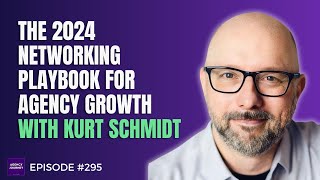
This is a YouTube video titled "Systematized Networking, Quick Revenue Wins, and Becoming the Hub and Spoke with Kurt Schmidt" published in May 2024. It features a detailed interview conversation between host Kuba Greitzer and guest Kurt Schmidt, an experienced agency founder, author, and coach. The discussion covers topics such as effective networking strategies, client re-education for business growth, referral systems, and building communities within professional services agencies. The content is a single-speaker interview format without any participation from George B. Thomas.
Hello, hello, hello, everyone, and welcome back to Agency Journey. I'm your host, Kuba Greitzer, and with me on the call today is Kurt Schmidt, agency founder, podcast host, and author, agency coach, with 25 years of experience in the agency world, author of the Little Book of Networking, and a few more things besides that we might learn about on this episode. Kurt, how are you feeling today?
I'm doing so great. Thank you so much for the opportunity to chat with you today.
My pleasure. Kurt and I can't wait. It's like I'm dealing with a curse of abundance in your case. We just chatted about what we could steer into in this episode, and let's find out where we end up going, so to speak. So, first of all, we're both podcast hosts. You know that a good icebreaker question is key. Let me try and hit you with my favorite icebreaker question of late. Not super complicated, but what is the most fun thing you've done this year?
Oh, this year? Yeah. Well, so. So recently my wife and. And I bought some raw land up on the north shore of Lake Superior in the middle of the US here. And I would say the most fun I've had is up there clearing trails with and using heavy equipment and chainsaws and axes and all sorts of things, just being outdoors. And we. This raw land, like, we. It has no power going to it, no water going to it. So we're. We're. We're off the grid. And it's just been, I would say going up there this year has just been my favorite thing. You know, you're really checked out from the, you know, the Internet and digital world.
Yeah, that's so interesting. It seems like a lot of actually hard physical work, but I can totally relate. And unplugging and getting to do something like that would be fun. You would also be my 2 year old's very favorite person right now. He's so into all of that sort of equipment. Chainsaws, lawnmowers.
Yep.
Yeah.
Oh, yeah. It's big boys toys is what it is.
Exactly. And he is a small boy, but he likes the big toys already. He's got a whole catalog, you know. It's so sweet. Okay. Awesome. Awesome. Wow. That puts such a big smile on my face already. Thank you for that. Okay, Icebreaker, successful tick. Next up, Kurt, can you tell the watchers and listeners of the show a little bit more about you? Your background, your experience for the people who are not familiar?
Yeah, sure. So I started out my career as a designer and developer and I worked for a very large insurance company early on in my career and realized that I wasn't really meant to join the Navy. I was always meant to be a pirate. So I moved to a small agency very quickly and really enjoyed the atmosphere there and helped grow that agency from about five to 30 people in a few years. And then I moved to another agency that was just under about 50 people and we grew that to about almost 600 people in about six years. And then from there I went and started my own agency, which was a UX UI design and development, full stack sort of agency. And we grew that. We doubled in size every year. And now right now that agency that I'm still an owner of, we just focus on design, just user experience and UX and ui. And along that journey I've been doing a lot of book writing, I've been doing the podcast. I've just been putting myself out there more because of what I've found is, is that the more that I put myself out there, the more opportunities I have to learn. And so I'm kind of addicted to it now. I'm, I'm not interested in being Internet famous or anything like that, but what I found is doing the podcast and doing the books has just been such great learning experiences for me. And that's how I, that's how I've always learned as best is through experience versus school or books. You know, I was never very good in school.
So I hear you. Wow, that, that is quite a journey that you're telling us about here. So I've got some questions about that lined up definitely. But my traditional thing is to ask you the question that everybody gets from the get go at a on agency journey. So I'm not going to break with tradition. Now, before we jump into anything else, what is your number one tip for agency operators?
Ooh.
Right now I would say that over the last 18 months, a lot of agencies have struggled with new business development. It's been, it's been an issue for a lot of folks. And I have one, one immediate hack that can help you get some revenue starting right away. So the thing is, is that if you need money and you need revenue very quickly, the best way to get it is through people who have already given you money. So current clients and past clients. And the best way to get that revenue up is to go back and mine those clients for more work. Because I promise you, I guarantee you, 90% of those clients do not know the full offerings that you provide. They, they sure you in the first Meeting. You went through a capabilities thing. You went through a deck. You explained everything. But they. All they heard was that one thing that you were going to solve a problem for which was build a website or something, and they don't know you do SEO and paid search and these other things. Or, or they came to you specifically for paid search, but they don't know that you refactor and redesign websites and workflows and things, even though it's all over your website. Like, your client isn't going back to your website after they've hired you. What reason would they have to go back to it and learn more about you?
Right.
So my tip is that make sure you have an initiative in your agency, a re education initiative with clients in progress and past clients, and you're running this initiative at least once a year to make sure that people are up to speed on the service offerings you provide.
That sounds awesome. And I would love to stay here for a second. Seems like there's a ton of merit to that kind of strategy. But the question, as with anything, is, you know, in the how so, you know, imagine that, okay, an agency founder is listening to this, an agency owner, and they're thinking, okay, that's. That sounds like something we should totally do. How would you steer them in the direction of. What's the first step?
Yeah, what's first step? So, first step is obviously do a audit of all the clients that you. That you're currently working with. Put them in list in a spreadsheet, make another tab, and put all the clients you've worked with in the past. I don't care what capacity, I don't care if they paid you $5 or $5 million. Put them, put their names in that list, and then go through and determine which of these companies are in a growth stage.
Right.
And that's what we'll prioritize them by. So how do we find out if they're in a growth stage? Well, you could start by going to their careers pages. Are they hiring? If they're not hiring, they're probably not in a growth stage. So I'd move them a little further down. And then what I would do is I would create a very specific deck or presentation for your salesperson or for yourself. If you're the salesperson and you're the owner that you are contacting these people and saying, hey, as part of being one of our clients, we do this. Capabilities check in annually, every year. I don't know if we mentioned that during our initial sales call. Oh, no, we Didn't. Oh, okay. Sorry. Well, yeah, we do that once a year. And so I'd love to just get 15 minutes of your time because I want to walk you through some recent work and some recent projects that we've done, and then also ask you a couple of questions about how your current work is going and, and, and, or how you, how our work was for you in the, in the past. And most people will totally agree to it because you, you just tell them it's like 15 minutes, but schedule 30 because they'll chat. And then you go through the deck and you're like, here's some recent problems we've solved. You don't do just your typical case studies, like, here's an app, right? You've got to go through and you've got to change the narrative to, well, this company was losing money and we did a thing that helped them make money. And if that thing was an app, great. If it was a website, great. What doesn't matter is the executable or the deliverable. What matters is the story about how you transformed a business, how you helped them, what the problem is you solved. Because then what people will do is say, oh, I have that problem too, or I have a problem like that, or I know somebody who has a problem like that, and, and they will identify and attach themselves more and more to it. So where agencies are making the biggest mistakes these days, they're just focusing on case studies that show off work, like their portfolio.
Right.
But that's not what clients are looking for these days. They're looking for places that solve problems for them. And so what they want to see is, hey, this person had this problem and I have that problem. I should contact these people. So we've got to be much more intentional with that. And so a great way to test that is with current clients, because it's a way safer place to do it.
Right.
They already kind of like you. They're already giving you money. You're not going to lose them if you show them something that they're like, oh, that isn't for me. So it's a great testing ground for things as well.
Okay, yeah, that sounds very relevant and it's interesting. This is the second time today I'm hearing about this. Let's call it a problems first approach. You know, the previous time was more oriented towards content, but even there, I think it was Jay Clouse. He runs a podcast too, that was talking about, you know, I like Jay Claus.
I like, I follow him.
Yeah, yeah, yeah. He's Doing good work. So he's talking about building a problems database based on input from his audience, you know, and then pushing his content. Yeah. Towards these problems. Seems like it works further down the funnel too, huh?
Absolutely, yes. Works with our clients all the time. So, for example, you know, I would go instead of. When I meet with a new client, instead of just saying, like, oh, we do work with this big company. This big company. This big company, like I would do 10 years ago. And that would. That would work 10 years ago.
Right.
Because they'd be like, oh, I want to be like those big companies. So I'll hire you because you seem like you know what you're doing. People don't care anymore. Social media and things have really flat, flattened sort of the barrier to entry. So. So the. The idea is, is that what they want is, I know you can solve this problem for me. You've solved it before, right? So we used to have clients that come to us and say, oh, I don't. Have you guys done an app like this before? And we'd be like, no, but I mean, we do tons of app. We've done like 20, 30 apps. So, you know, your app is not that a beautiful, unique snowflake, you know, and they. But to them, it is. It is a beautiful and unique snowflake to them. And if they don't see that exact app in your portfolio, they won't hire you. So how do you combat that? The only way you can combat that is saying, well, all these people had the same problem as you did. They had this unique problem that nobody else was solving. And here's how we solve unique problems. And here's an example of a unique problem and how we solved it and presenting it that way versus saying, look, we. We've done a bunch of apps, and that's why a lot of agencies are struggling right now, because they're following the same thing they did five, 10 years ago and just pitching work and being like, look, look at our fancy portfolio. Don't you want something fancy like this? And that people are like, no, no, what I need is. I need this. I need to not be struggling with this thing anymore. And we've got to change how we're pitching our work.
That makes a ton and a half of sense to me. So now, thinking about this process of reaching out to your clients for this, what did you call it? Capability, presentation, Is there anything particular that happens as the kind of next step there? You've invited them to the conversation, you've done the pitch deck. What happens Next to try to actually secure that business.
Yeah. So my hope is that during that call, we are asking them questions about, in a, in a, in a, in a slight way to say, have you, have you experienced any of these problems and getting from them? No, we don't have that problem. But usually what people will say is, I don't have that problem, but I have this problem.
Right, okay.
So that's what we're doing. We're leading them down this path of letting us into what they're doing. So my hope is, is that on that call, one of the goals should be, is hearing some of the problems they are currently dealing with and figuring out, does my company provide those resources to be able to help do that. Now, if your company, if, if they do say, well, it's actually I'm having an accounting problem or something, My hope is, is that you've got a great referral network built up as part of your agency that you can send them to your accounting partner, and you're getting 5% of the first years of billable work for that referral. And so our agency ended up being kind of a hub and spoke model for many years, where we were, you know, somebody would come to us for marketing things, and we'd be like, we don't. We don't do marketing. We don't do any of that stuff. But we have two different partners that work specifically in your industry. I'd love to make an introduction to you. And then we would get, you know, 5 to 10% of that referral fee for the first year's invoices. And it was great. And so our clients kept coming back to us as a source of information, not just a developer or a designer, you know, and that's how we grew so quickly.
Yeah, tell me more about that. That's how we grew so quickly. This stood out. When you were doing the, you know, the intro and kind of background on you, I mean, man, this guy's grown a lot of agencies. Seems like quite fast. And is that the key being that hub and spoke. Is there more to it? Tell me more about that.
Yeah, so again, in professional services, in any professional services you work in, again, think about lawyers or something. For example, there are many different types of lawyers. There's trial lawyers, there's lawsuit lawyers, there's real estate lawyers. There's all these things. Right. But us, as, as general knowledge people, like when somebody says, oh, you better get a lawyer, we just call somebody whoever's got lawyer in their name or whatever. Right.
Like, right.
And that Lawyer might say, oh, well, yeah, I mean, I do help people like you, but I mostly help businesses. You probably want to deal with my colleague Bill over here, who does this. And then guess what? The guy you called is going to get a referral fee from Bill because he actually does the type of lawyering you need. This is not a new technique, but it. But the problem is, is that agencies in the digital space, a lot of them were founded by people who do the work. They're not necessarily business people by trade. A lot of them don't have your typical MBA or type of type of thing.
They.
They bootstrapped themselves and they made it happen. And with that, what can happen sometimes is you build up these sort of walls around you where you're not taking in as much information from how other people are being as successful. And that's something I learned early, was learn from other professional service industries, not just more digital industries. Learn from lawyers, accountants, all these different people. How are they growing? How do they grow their businesses? They've been around a lot longer than these digital agencies have been. And so the techniques that they use are very similar to what I'm talking about. And they become kind of that hub and spoke. And so now people are showing up all the time with different types of questions. So let's say you more and more of your clients start showing up saying, I want SEO, and you keep referring them off to these other people. Well, at some point, you're going to be like, you know what? I should put on my roadmap to start offering SEO and start being known for that. And it'll also help you sort of figure out how you scale your services, which services you add on. You know, it even helped me early on decide on what kind of agency to acquire.
Right?
Because people were looking for this type of thing, right?
So, okay, awesome. And that gives me so many ideas of avenues to further explore here. One thing stuck with me, from what you said, is these types of agencies that were created by the doers and grown by the doers, putting up walls. I wanted to speak to those. This kind of person listening to the podcast right now, who is hearing what you're saying and thinking, oh, gosh, I should. I should do something about this. You know, open myself up a little bit, try to build a network. I mean, you published a whole book about this, the Little Book of Networking. Right? Let's talk about that for a bit then. You know, for somebody who's fairly new to this, what's the technique? What's the framework? What do you recommend as again, step one, two, three to try and get there?
Well, step one, thank you for asking it that way. That's a really good question. Because step one is a different mindset about networking is what you've got to frame first. Start with. A lot of people think networking, you're kind of taught it's a very transactional thing, but that's not real networking, that's not modern networking and not what I talk about in my book. You want to approach it as a community builder. And when I say that, I mean in all aspects. You're building a community around you or around initiative or something you're passionate or care, care about. So that could be. You're very passionate about bringing up younger, the next generation of developer or designer or something. And that's something you're very passionate about. So networking with other people that are passionate about that as well and finding ways to help that community and build that community. And as you're doing that and you're sharing with those folks about what your passions and your interests are, it's just going to be natural that you start sharing like what you're looking for and what you're doing.
Right.
Because that's the other thing. Part two to this would be, is be very intentional about why you're networking. Like tell, you know, when you meet people, you're like, hey, so I used to have this pitch every time, I would say it dozens of times a day, hey, my name is Kurt. I'm the president and partner at Foundry. We help businesses with user experience, design and custom software applications for their business. What are you looking for? And I would just go immediately, I would just get it right out of the way. This is who I am, this is what I'm looking for, this is what I do. And then move right into how can we start finding value together.
Right?
And there's times, yeah, you're going to run into times where people, there isn't value there. Maybe it's not there today, but maybe it's down the road, right? So, for example, I used to do a lot of mentorship stuff early on in my career. And people would be like, why are you spending all this time with these students? You know, isn't it annoying? And blah, blah, blah and all this stuff. And I was like, no, number one, I wish I would have had access to a mentor early on. And I didn't. And so I'm kind of paying, paying it forward, paying it backward, I don't know. However you want to say it, the other Thing is, is that these people are going to go out and get jobs. They're going to go out, guess what? In three or four years, they might hire you.
Right.
So you better invest your time wisely in where you put it. And so to me, it's like investing in a startup.
Right.
Is investing that time mentoring a very talented youth. As they're coming up in these, in these areas, at some point somebody's going to hire them and guess who they're going to say was really a lot of help to them early on. Or when you go to them and say, wow, you've been. Wow, you've been at Meta for a couple of years. I'd love to come in and meet some of the folks there that work in the innovation area. And do they hire outside agencies? Oh, you know what, let me check. And guess what? They actually will check because. Because they feel like they're part of your community now.
Right.
And to me, my father taught me when I was very young that a rising tide lifts all boats. So what you want to be is that person that's helping raise that tide and bringing that to other people. And I promise you, as you're helping other people raise their boats, your boat will get raised too.
Yeah. Wow. You're reminding me of a conversation I had a few years ago, not even on this show, on my previous one, where there was somebody who was like, you big on mentorship? And he mentioned it, he called it the, I'll never forget how he called the concept engineered serendipity. You know?
Yeah, I love that.
Yeah. You can really build your own luck once you, you know, you build up enough, you know, call it good karma, call it, you know, sending out positive energy into the world through these, you.
Can call it whatever you want.
Yeah. But it really does, does come back.
So it does it and it works and it, and it works because you, you have to, you can't continue doing it unless you're sincere.
Right?
Yeah, exactly. And so you will. And don't worry, like, during the thing, you'll, you'll get, you'll get some downers because you will run into some transactional people that are just takers and trying to take stuff from you. But, like, of course you're gonna, you're, you know, you got to ride a bike, you're going to skin your knee at some point. Like, just don't let it get you down. Just get back up and keep going.
Exactly. So could we talk a little bit about the tactics related to this? I'm thinking even about my own situation. You know, yes, my career in marketing is coming up on like a decade in the space, you know, close to that. And, you know, I worked for one company, another company. Now I'm here at Zenpilot and I'm already thinking, you know, what you're saying, ironically enough, is making me feel a little bit guilty. The, you know, team members I was in contact with or, you know, previous managers, I feel like behind in terms of keeping up with them. You know, as a person who leaned on this, wrote a book on it, you must have some sort of workflow or framework or.
I do, and I'm glad you bring that up because that, that is really why I wrote the book, because there's lots of books on networking out there and they are very focused on mindset and how to approach networking as a human. But very few of them are very tactical. My book is very, has a very tactical. The whole latter half of the last third of the book is basically a system I use to run, manage my networking. And, and it's nothing fancy. It's. It's a spreadsheet. So what I, what I do is that when I, when I get to meet people or individuals, they go into specific categories in the spreadsheet. So this is a co. Past co worker. This is a, this is a former boss. This is a business owner. This is a potential prospect. This is a student. And I'll have different tabs for all these different people. These are recruiters, these are professional service providers, whatever the case may be. And I just have a real simple, like it's their name, their contact information, and then what are they looking for? This person's looking for a job. This person's looking for clients. This person's looking for a manufacturing firm that, that can do cnc, laser specific things. They can't find the right partner. And then there's a. I put in the date of the last time I talked with them. And then next to it is a box. And that box, if it goes past 90 days, it turns red and that's it.
Okay?
And so every day I get up and I look at my spreadsheet and I look, is there red in my ledger or not? And if there's red in my ledger, I look at it and say, all right, it's time for me just to do a quick check in with Mike here. But if I look and I look and I look at it and it's red. And Mike and me, the last conversation was, is. He was like, you know what? I'm Taking some time off. I'm gonna, I'm gonna go backpacking around Europe for a couple of months or something. I'll move him to a different tab that I call like the archive tab of like, I'll check in with him in like six months or something, you know. Yeah, we don't have anything active where we can help, you know, raise that tide together right now. So. But I don't want to lose them, so I'll move them to a more casual tab than an active networking tab. And, and so what I do with those things is, is just real quick, I'll send, I'll shoot them a quick email in a reply to another email saying, hey, our last conversation, you know, you mentioned, you know, you were taking your dog in to get checked. How's, how's things over there? Like, boom. And then that's it. Yeah, you know, oh, we should get together in the next couple weeks. Great. Here's my calendly link, which is a very specific networking link which only allows me to have like two or three, sometimes four meetings a week if it's virtual and maybe one a week if it's in person. So I use the calendly to also help me locked down. And so I don't get overwhelmed very quickly. But it's a whole system that I'm, I'm running through and then every single meeting I'm meeting with people, guess what I'm doing. Well, let's go back to the beginning of our conversation. I'm explaining to them how I recently solved some problems for people. I'm not explaining them what I'm looking for and what I'm doing. I'm explaining to them that I recently solved some, some problems for them. So for example, I coach a lot of agencies right now and so people know, oh, if I have an agency or a firm or an IT services or something like that, any professional service firm, I can go to curt and get some, get some coaching. But I don't go and pitch the coaching. What I'll say is, oh, I just recently helped an agency decide on which project management software they should be upgrading to because they're running a three and a half million dollar business on basecamp right now and they need to upgrade. And um, and so I helped them with that. Another one, I helped them figure out how to do cold outreach on LinkedIn to be very successful and how to build authority and thought leadership. So I'll tell those stories instead of saying, oh, I help them with operations or I help them with sales.
Yeah, or with content or whatever. Yeah, I hear that.
Exactly. So that networking piece is the key, is follow up. Because that's again, if you, if you and I don't have anything to help each other out with right now, it doesn't mean in three months we won't, or in three years, you know, and too many people think like, you either have, like, people you invite to your wedding or people you used to work with and there's nothing in the middle.
Right.
Like, it's like. No, it's all gray. Like, we're professional. We're professional colleagues. So that doesn't mean I'm going to invite you to my daughter's wedding. And it also means we might not ever have a job together, but we work in the same space, we share similar values and we care about the same things. Like, we should find ways to help each other.
Yeah, yeah. And you never know where the overlap is going to be between somebody who might have been at your wedding dealing with a problem, that you've got somebody in their professional network to help deal with it. I've heard of cases like this, definitely. So a few more things come to mind and I feel like I would like to tap you a little bit more in the networking area if we can stay here for a little bit.
Yes, sir.
So what comes to mind is, first of all, on what you said on the spreadsheet, I mean, being part of zenpilot, I can't not mention that I'm already envisioning like a ClickUp board and, you know, automated tasks to reach out to people. I feel like that.
I know lots of people that use everything from Asana ClickUp in Monday and they use HubSpot and notion. Notion's a big one, of course.
Yeah. So that sounds like a video we might produce on the zenpinal channel. Second, this might be going even a little bit too far, but I'm going to say it anyway. Think of it. If you start building that spreadsheet now, or if you have it already in place, it used to be you would have to match people kind of manually problems to solutions. Now you punch that in into ChatGPT and it'll find it for you. Right? There you go.
Boom.
Right?
I could see you nautically before I.
Finished that with your spreadsheet.
Yeah, exactly. And that is such a huge value add there. So, yeah, it really opens my mind up to possibilities. So here's another thing.
You're thinking that way because again, that's how we get stuff done. Because everybody I talk to, they're like, oh, I can't go out and be networking, I've got a family, I'm too busy, or, you know, I gotta take the kids to baseball and things like that. You do have time. You do, you're just not prioritizing this. And on top of that, you don't have a system that's helping you manage that. In all aspects of your work and your business, you have Systems. You're using QuickBooks for your accounting, you're using Asana for your project management, you're using Notion for this. But why this thing, this thing, networking, which is just as important as any one of those singular things, are you not managing with such ferocity?
Yeah, yeah, exactly. And I don't think it takes much time at all. You know, you're making all of these LinkedIn connections every day, every week to just shoot them a quick message, you know, what are the problems you're dealing with, how things going?
You working on anything cool? That's it. Like, hey, you work on anything cool recently? No, no, I've actually, I'm in between jobs. Oh, really? What are you looking for? Oh, well, you know, I was a marketing person at this place. Oh. You know, I just talked to a guy last week. They're looking for a marketing person. You want an intro?
Yeah. Awesome, that's great. And it can work just like that, so. Exactly.
And then people start to realize and start to look at you as like this is a go to person to help solve problems.
Right?
Yeah.
And once you, then when you go out and you're providing your thought leadership around which specific problems you solve, at some point one of those things is going to click, you know, and then there you go. Like I've had, I've had multimillion dollar projects come through in just that little tiny sequence that I explained to you just now.
And you gave me a perfect segue to my next question, actually, because I wanted to talk about money a little bit. You mentioned earlier in the conversation that, you know, as the connector, there's a little bit of something in it for you as well. But here's the hurdle that even I'm personally dealing with is, you know, sometimes I feel like I am delivering that value. I've made the connection. But how do you actually open up the conversation of okay, I'm glad that this worked out for you? You know, is there, what's your approach towards actually bringing money up in this?
My approach is I bring it up the, I bring it up right away. So if somebody says to me, you know, I'M looking for this very. I'm looking for the. Like, I just had breakfast with a good old buddy of mine this morning, and he's working at an agency and he's like, yeah, we're really looking for enterprise level ERP sort of clients and stuff. And I was like, oh, I run into that on occasion. You know what? Usually what I do is a finders fee for something like that, you know, about 5 to 10% of the first years of invoices. Would, you know, would that be acceptable to you guys if I brought something in? Oh, I'll go talk to the bosses and whatever, and then, boom, it's done. So. So. But if I. To your point, you're talking about maybe something a bit more active. Right?
Right.
So it really depends if. If I feel like. If I feel like I'm. If it's one, you know, small agency to another, like, a lot of times I just do them a solid and I'm like, here you go. And I don't take any. Anything from it. You know, buy me. Take me out and buy me a steak or something, you know, like, maybe for thank you, you know, or I've had people, like, show up and just, you know, bring something nice, a nice present or something as a thank you later. And, and that's fine, you know, because once you're in those sort of, like, you're, you, you're. You don't have any time to have those discussion formally. It's best just to probably hand them off.
Right.
But after you hand them off, then I would go back to them and say, you know, in the future, I'm starting a little referral program at our company. And that's how you refer to it as you, you call it a. You know, this is a, this is a part of our policy.
Okay.
This has been like. Because I want to charge you money, this is what our company is doing. And so our company's policy is that when we do these referrals and they equal over US$10,000 of income for you, that we will then retain 5% of the first year's invoices from you as part of that referral network or whatever, and you just, again, you go to it in a business discussion, not in a bro, sort of wink, wink, nudge, nudge discussion.
Okay, yeah. Okay, that's pretty clear. And thanks for sharing that. Okay, great. Is there anything else? I had some additional questions, kind of not related to networking maybe, necessarily. And we'll use that to kind of tie a bow on the conversation in A moment. But before that insurance question about networking, anything I failed to ask about that is like very key to this. That would be worth adding here.
Yeah, I would say, again, I want to stress the intentionality of networking, and that's where people fall down. Be very intentional when you're going out and telling people, hi, my name is Bob and I am looking for this. What are you looking for? And then recording that information being intentional. Okay. This person is looking for leads for their, you know, graphic design business, and they're looking for specifically these types of businesses. And you're going to make a note of it and you're going to, you're going to check out, do I have somebody in my network that's a good. You're going to spend a little time doing that. And I do that all the time. Like my wife and I might be watching a Netflix show at night. I've got the laptop there and I'm just doing a couple of skims through my thing, like, who should I connect to Heather this week? You know, oh, and Bill's looking for this. And then what I do is if I start to find that there's a big network around a certain type of thing is that then I start to build a. I literally build a community around it. So what I might do is say, every quarter I'm going to have a zoom call with all of you that are looking for the same thing, and I'm going to host it. And then we're all going to get together and talk about what are, what's working, what's not working, what's seeing what's happening. And then we're going to share info and introduce ourselves to each other. So what hens. What people end up doing is they start doing these onesie twosies things, and then all of a sudden the onesie twosie things start turning into these big, like, oh my gosh, I'm meeting so many people all the time. What you now need to do is then, then corral that certain groups into like a monthly meeting or a quarterly meeting where now, now it's not just you and this person exchanging thing. It's you and your community, right? That we're building, right? We're all now getting together and helping each other out. You were just the catalyst to say, you know what? Instead of us having like six meetings separately, why don't we just have one big one every quarter?
Okay.
And it's great, it's fantastic, and people love it.
And how do these get coordinated? Is there, like, I, I imagine it's not necessarily an email chain or like, what's the.
No, it's not. No. Usually I would. I might start a slack specifically around it or something.
Okay.
Or a Discord, you know, depending on how techno, you know what their age is. Right. Because if they're over 40, Discord is not. They're like, what? Even though, like me, I'm. I'm. I just, I'm just over 50 and I use Discord all the time. So I, I'll sometimes start a channel around those things, but sometimes it's just. I put a reoccurring meeting every third Tuesday of the third month, every three months, you know, and if people show, they show. If they don't, they don't. Like, no big deal, you know, but again, if they follow up with me a month later and like, oh, man, I'm sorry I missed that meeting. Oh, that's great. Well, another one's coming in a month, so show up for that one.
Yeah. And there's a predictable rhythm. People get used to that. I can see how that would work out.
It's predictable for you. You can manage your time better. Plus it'll allow you to manage different sorts of avenues you might be interested in.
Right.
So you might not just be interested in the marketing aspect. You might want a accounting or business focused kind of mentorship. And these are like little masterminds. You know what I mean? You're not building a presentation and doing all that crap. It's not a webinar.
Yeah.
You know, it's people exchanging things. So.
Okay. Yeah. So it's like they're opening up a market of. I've got this. Anybody be willing to take. Anybody willing to. I can see that working out. Okay. So, Kurt.
And it's a lot of fun.
I can imagine. I can really imagine that. You know, so thanks for sharing that. I mean, I'm smiling. Just imagining kind of people helping each other that way. But then again, great.
You don't have to build a giant Instagram following. You can just have three or four other business owners like yourself meeting once a quarter. And sometimes it's just a bitch session where you're just venting about stuff.
Oh.
And that's, that's. That can be super healthy, therapeutic.
I can imagine.
Yeah.
Okay, so I got one final question for you that's not going to be related to what ended up being the main body of our conversation. Networking, thinking of the agency journey audience. A lot of the people in our audience are in marketing agencies specifically. And you mentioned something like half an hour ago that really stuck with me is that the different types of agencies can learn from each other. You mentioned specifically in the software design space, ui, ux, et cetera, there's some overlap, but here's a stab in the dark. What can marketing agencies learn from agencies in this software design space? What should they be looking at?
Yeah, I would say number one is how are you doing billing? Are you doing productized services? Are you doing retainer based? Are you doing hourly building? What's working for you? What's been profitable, what hasn't been profitable? You can learn a lot. Again, back to my point about, you know, different industries learning about how they bill, how they charge for their work because you get different ideas for things. Right. So the past few years we've seen a bigger push towards outcome based billing or retainer based billing.
Right.
Whereas 10, 15 years ago everything was just hourly.
Right.
And nowadays people are trying to create more productized services, for example. But you're an agency who's never done a productized service and you're going to start doing it. Well, where are you going to learn about success from it? From a book?
Sure.
Like you can get some ideas from a book.
Right.
But you're never going to learn as much as talking with other people who have actually productized a service and launched it and tried it. And so the closer they are to you in the type of work you do in the digital space, the more it's easily going to translate to the type of work you're doing. So as you're growing and scaling your business and meeting your customers where they are at, having that network of other businesses to be able to lean on, to learn about different approaches, especially around billing.
Right.
And then from billing goes to like account management and project management. How are you doing delivery? You know, years and years ago at agencies we were at, we used to do all the hosting for our clients.
Right.
We would do all the web hosting was done by us. And then over the years it's changed and everybody goes on AWS mostly or whatever the case may be. And so all those places lost that hosting thing. Well, because of ransomware and all these other things that are happening, a lot of people are pulling stuff back on prem. So I know a few agencies that are offering that as a service to say, hey, you've got sensitive information. We will provide you locked down servers that are not on aws and we will, we'll charge you an extra fee and, and we'll get that hosting money back. I never learned about that. People Were doing that until I was in a networking group with some other agency owners and they were mentioning they're doing this and I was like, oh, wow, that's okay. I haven't thought about that. I should look back at some of the services we used to provide and see if there's some value there. Because what's old is new again, you know, especially when it comes to AI.
Right.
We used to have, many years ago, the clients would have lots of copywriters in their, in their businesses. And then they all got rid of the copywriters and just started hiring outside agencies and brought in copywriters. Well, now we've got AI coming in, which they're like, great, now we've got this AI that's going to do all our copywriting. Oh wait, it sounds like a two year old. This isn't going to work for us. But we've already gone down this road.
Yeah.
What can, what can agencies offer to help clients with their AI? Maybe they don't need a copywriter, but they need a copy editor. So maybe you are using AI for some of these things. But how would you like a real great set of eyes on that copy before it goes out instead of your people doing it? So how are you learning these types of services and systems? Again, number one, you're going and you're talking to your current clients. What are the challenges and things that you're dealing with? And number two, you're going out and you're meeting and talking with other people either in the same industry or in an adjacent industry.
Right.
So I've got a networking group that I talk with that has a bunch of security professionals in it. We don't provide security stuff at all, but we're in the same business and we have a lot of the same clients.
Yeah, I hear you.
So if I'm charging the client differently than the services, place is, that might be weird for that client.
Right?
Yeah, yeah.
So if I can find some community with them and say, oh, you're charging them a monthly retainer and I'm charging them hourly. Oh, we should, we should, we should talk about what work, what would work best for this client and then for our businesses and team up together and go to the client and present a new package. So again, lots of opportunities there.
I can absolutely see that. Interesting how you touched upon copy. This mixed in my mind with what we were talking about before, you know, in terms of thinking about problems. Here's a problem that I feel a lot of organizations might have right now. I don't need a copywriter, I don't even need a copy editor, but I need somebody to build my, my brand bot. You know, my writer agent. I've heard that it can be done, but I can't do it myself. Could somebody come in and you know, train a ChatGPT agent? We've got all this existing content, you'll have tons of data to work off of, but it needs to bring consistent results and like you said, not sound like a two year old. Right. That would be such a huge problem for somebody to solve right now and I think that would be a huge, a killer service, to be honest.
It would be a great service. But again, to that point I can't just come in, in the way that generative AI, at least right now is working. It still will need to be trained for six months to a year. So that's a year to six month contract that you've got with this client to help them build this brand, brand bot over time because it needs to go out on training wheels and then it needs to go out and be in a fenced in area to cul de sac and, and then eventually you can let it out on the main road at some point, but it's going to take time. I have people approach us all the time because we do custom software and we've done some LLM stuff. When I immediately when the clients are like, yeah, I want interested in this, great, it's a year long to start teaching the bot the, the service on your stuff and they're like, oh, oh, I thought it was like you just plug it and go, oh no, no, no, no, no, no, no, not no, no. Like if you want to just plug in and use ChatGPT certainly can. But you know, you're probably going to open yourself up to some lawsuits and plagiarism and things like that. So, so AI is not as plug and play as, as YouTube videos and other things. Would like you to think when it comes to a real business like a manufacturing or a healthcare company.
Yeah, definitely. I mean you can plug in.
So there's still that consulting piece, right?
Exactly. You can plug and play. But what comes out the other side if you don't put in the work, it sounds like everybody else.
Yeah. As I used to have a boss, old boss that was really, really intelligent would say that sounds like a solution to create a problem.
Yeah, yeah, that's a nice one. I'll be stealing that one. Alrighty. Well, Kurt Darnell, this was such a rich conversation. I can't wait to publish this one to put it out there, and I personally learned it.
Thanks for the thoughtful questions, too. It was a real pleasure.
Thank you. Thank you very much. I don't know if you're aware, but I only recently took over as host from Gray MacKenzie for agency Journey.
I follow this podcast. I love this. I love the work you guys do, and I love the product. And I'm super honored to be here. So thanks for having me on.
Thank you. Thank you, Kurt. So it means a lot to hear that from you. And now, of course, I would love the watchers and listeners to hear a little bit from you about where they can follow you, what you've got coming up, tell them where they should go.
Oh, great. Well, so I'm most active on LinkedIn, obviously. I do a lot of LinkedIn stuff, so you can find me there. Kurt Schmidt with a K. And I host a weekly podcast called Schmidt List, which is meant to inspire and educate intrapreneurs and entrepreneurs. So both the internal innovator and the external innovator. I have the little book of networking that's out and then I have a new book coming out called the 10-10-10 blueprint. If you follow me on LinkedIn, you can learn more about that. But it's basically how to design your future according to your personal values with strategic precision. So I'm very excited. I think it's the best thing I've ever produced and I'm. If you follow me on LinkedIn, you can learn more about that. But it's basically how to design your future according to your personal values in with strategic precision. So I'm very excited. I think it's the best thing I've ever produced and I'm really excited to get it out the door. I've been working on it for three years, so. And then. Yeah, and then I'm. Like I mentioned, if you follow me on LinkedIn, I put out a lot of content for agencies, agency owners and founders, and I work with a number of agencies all across the world on helping them better operate and better provide better client service.
Yeah, awesome. Awesome. And definitely I'll be checking out the books in more detail myself, and I encourage all of you Agency Journey watchers and listeners to do so as well. Awesome. All right, so this will be a wrap for this episode of Agency Journey. Kurt, thank you again so, so much for coming on A bombshell of an episode, really. And yeah, to you all watchers and listeners, thank you for joining us here today. Don't forget to subscribe Rate follow zenpilot on YouTube as well because the video versions of this are coming out on there as well. Leave us a comment, send us an email and all of that good stuff stuff, and I'll be seeing you in the next episode. Bye, everyone.










