The Missing Piece of Your SEO Strategy with Josh Elkin
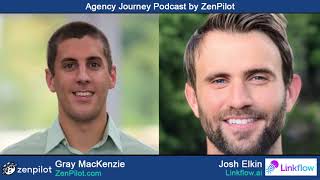
Josh Elkin, founder of Linkflow, discusses how his B2B tech and SaaS link building agency grew by shifting strategy and improving sales. He covers team expansion, partnerships, and the operational lessons that changed how his agency works.
Welcome to the Agency Journey podcast where we connect with agency leaders to uncover the hidden systems and processes that drive their success. Now let's dive into today's show. Hey, as we're diving into today's episode of Agency Journey, let me tell you real quickly about our sponsor, Aribi. Aribi is a super cool on one marketing analytics tool. They've got Google Analytics squarely in their sites right now. And I can remember setting up Google Analytics as a sophomore in college and thinking this was just the coolest platform. And as it's matured, it's still super powerful, but it's become so complex to deal with. And Aribi has a value prop totally aside from this. But what I absolutely love about my experience plugging Aribi into zenpilot.com is I didn't have to mess around with setting up what events I wanted to capture and tracking all my changes. And if I messed up a view, then it would, it would delete all the data that I had. I just plugged it in, it crawled it captured all our, all of our events, made it super easy to see our funnel, and it just works. I love being able to see, for example, how many people read the definitive guide to click up for agencies, a blog post that I wrote, I don't know, six months ago. See where those folks come from, how that influences the buying process, the funnel, the way that it works out. So super excited to have Aribi as a sponsor. You can check it out. Go to Aribi IO AgencyJourney. It's all one word. If you spin up a free trial there, use the coupon code agencyjourney. Same thing, all one word. That'll give you 20% off any plan, which is super generous of them. And remember, they can track all of our conversions, so check them out. That's a reb IO. We appreciate their sponsorship. Let's get on with the episode. Hey, welcome back to another episode of Agency Journey. This is Gray Mackenzie here from Zen Pilot, and this week I have the pleasure of bringing on Josh Elkin, who is the founder of Linkflow. It was super cool, high quality, white hat link building agency, and Josh and I have known each other for. We're coming up on a year, I think. So, Josh, I'm excited to have you on the podcast. This is well overdue. Thanks for joining us.
Thanks, Gray. Super excited, super excited to be on here. I've actually been listening to this podcast for about six years, since I just started out launching my own agency. So it's definitely an honor to finally be on and it's exciting for me to finally get to talk to you guys on the podcast instead of just listening.
Right. I'm excited. Made six years. So you've been with us almost since the podcast started.
Yeah, yeah, yeah, Totally.
Cool. So your story's pretty cool. We've had a chance to work together and to see you kind of focus in on a specific niche and really grow very quickly here, especially over the past year, year and a half, two years. Doing a specific service is. That's the type of story that I love highlighting. So why, if we just went kind of real quick, agency background, what was the evolution to get to this place where you guys are just doing link building?
Yeah, great question. So when I started out, like most people, sort of a little bit of everything, so we were doing some content marketing, I was doing some paid ads, was doing some email marketing, and consistently kind of just realized, like, there was one problem that clients consistently kept having and that was the ability to build backlinks repeatedly. So. So after a few years of kind of actually just flailing around and trying different things and trying to find something that would be sticky, realized, hey, there's this one consistent challenge for companies, and it seems that, like something that no one really knows how to do well and they know they need to do it. It's important. But they maybe made a sporadic attempt at it, but it's hard to do consistently. It's hard to do in a scalable way. I think I just read the book Built to Sell around that time, which emphasizes focusing on one very specific service and just doing that well. And it all kind of clicked to me, like, hey, this is a service that is hard to do, so there's value in offering it. Most companies don't do it in house, and it's something that if I learn to do it well, then it's definitely going to be valuable for a bunch of companies. So decided to shed everything else that we were doing as an agency about two and a half years ago and just learn the ins and outs of link building and go all in on that.
Right. And on top of that specialty, which is already pretty niche, then you guys, at least from a client acquisition perspective, really focused in on technology SaaS businesses. And so getting to that piece, is that still the primary, at least from a growth perspective? Not necessarily that you wouldn't take on a customer who came outside of those specific industries, but is that still the main vertical that you guys are targeting?
It's still the core focus. It's still, I'd say 70% of our clients fall in that kind of B2B tech SaaS world. We've picked up a few clients that are also kind of online education. And so really it's anything where there's online is the bulk of their presence and how they generate business. For some reason, E commerce has not been a great niche for us. We've kind of left that one aside. But yeah, online education has been big for us. And then, yeah, we're still very focused on B2B tech and SaaS. They just seem to be good clients and so we've stuck with them. We do have a few that are just kind of oddball clients that are not in those verticals, but yeah, for the most part we try to stick to those.
Yeah, that makes sense. So as you guys have gone, kind of bring us up to the present day in terms of agency, kind of like team size, any main focuses or initiatives that you've got going on right now. And then I want to jump back in time a little bit to some of the lessons that you guys have learned of growing things out. But what does the team look like today? Where's the agency at?
Yeah, so today we're a team of 12. It's me, I brought on a partner, Ben, about a year ago and we can talk more about that in a bit. And then we have a four person link operations team. We have client success and we have a three person SEO team that just helps ensure that our link building is moving the metrics for our clients in the right direction. So we've definitely beefed up our overall SEO strategy piece and going back to sort of like our evolution. So when I started this about three years ago, it was purely, hey, you want links? We can build links. Tell us how many you want per month and we'll go out and do outreach and build those links. And what we kind of learned early on, or what I learned early on, because it was really mostly just me at that point, was clients that didn't have a great SEO strategy. We would do the same quality link building, but the results wouldn't be there because we weren't focused on the right pages or maybe the content was weak. So it's sort of been in the back of my mind for a while that that's something that we need to, we'd like to get a little more involved on the strategy side as well. So to that end, we kind of beefed up our SEO chops and hired some SEO folks. And I think the biggest evolution in our business kind of came During COVID actually. And so we were a year ago now, I think it was still. I had just brought on Ben and I think we had one other person kind of doing the link outreach and operations. And around that time we just realized, hey, if we want to grow, we really need to improve our operational processes, Just get everything squared away in such a way that it wasn't us just kind of. It felt a little house of cards issue in a way. So we really needed to just shore up the foundation. And that's around the time we found you guys. And that was sort of the, the catalyst for changing a lot of things in our business.
And you guys made a lot of shifts in terms of kind of going to market, bringing on the team, reworking what the team was like, and a huge investment that you guys made in terms of streamlining your processes. You guys moved on to ClickUp from a project management perspective. Kind of took all that stuff really seriously in the build out phase. But you made a decision. I'm trying to think. No, about a year ago, right when you, I think, was the original conversation with Ben. So this is. We've seen this a handful of times, but most of the time it's either solo founder or it's founders who came into the business as partners. One of the pieces of your story that I wanted to hit on was you brought Ben on and then into the business as a partner. And I think, if I'm remembering this right, he maybe started as a contractor initially and then moved into that co founder, business partner role with you guys. So I'd be curious to hear, because I hear that from some folks who are like, man, I wish I had. I know I'm the visionary. I need somebody to be the integrator or I'm really good at the details. I need to sell someone who can come in and sell for me. Um, what was the impetus for that? How did that relationship come about, bringing Ben in?
Yeah, so I, you know, from when I started in this agency world about five years ago, I'd always wanted a business partner. And I had sort of done trial runs with five different people over the years doing, you know, various different agency models, and none of them worked out. And so I was sort of resigned to the fact that, okay, you know what? This business, I'm going to, I'm going to do it alone. And that's okay. And then I think it was last, it was last year during COVID I was just like, I had this epiphany moment of like, you know what, what do I really want. And it was three things. One of them was I wanted a dog. One of them was I wanted a better workstation from home. And one of them was I wanted a business partner. And I just focused on those three things and I think I actually got the business partner first. That was surprisingly the easiest of the three. I put an ad in a marketing agency owner group on Facebook of all places and basically said, look, I've grown this agency from zero up to. I think at that point it was like 40, 40 grand a month. Mrr. Yeah, I'm looking to take it. You know, I'm looking at 5x that. I really am kind of tired of doing it alone. It was, it was more of like a. You want someone to share, share the experience with for me. To me, like I'd rather have a little less equity and share. Share in the experience with someone else who I like. And I just had a gut feeling that would be a good, the right move. So I put that, I put that post up on Facebook and Ben was actually the first person to respond. We had a quick chat. I could immediately. He was running his own agency at the time, but he didn't love running his own agency and he was also looking to team up. It just worked out well that way. The way we structured it first was just kind of a trial basis where for this first six months I paid him a fixed salary and kind of said this is like the dating phase before we get engaged, so to speak. So let's see how this goes. And if after six months we still like each other and want to work together, then we'll talk about equity and how to make that work. So we did that, that dating phase for six months. To be honest, I probably under underpaid Ben during that time and no, he was, he was great about that and sort of said, look, as long as I, as long as we kind of make this right on the back end, I'm. I'm cool with that. And yeah, it just worked out well. We have, you know, similar. We think about things similarly, but we have very different styles. I tend to be more of kind of like the big picture idea guy, whereas he's more of like the, he's more of kind of the integrator type personality. But also he's just fantastic with people and kind of managing the team as well. So we complement each other in a few ways and that's been just a great partnership and it just really infused a lot more energy and really joy back into my day to day. And that Is kind of an inflection point for the business. Taking off I think was bringing in Ben.
That's a really cool story to hear. I think the piece that kind of joy piece or the motivation piece that side of that. That's like the priceless part of running a business. I think most agencies. An agency is not a super complicated business model run. It's like hey what's something that we're good at that people care about? It's an expensive problem to solve and we can go find a way to acquire customers and deliver a good service there. And the ones that fail. And it's probably true for any business but particularly for agencies just because that's where I've seen it the most. It's rarely a failure because hey, we actually couldn't make it work. It's usually a motivation issue like someone got burned out. It does take a little while for most agencies to really get off the ground and get things dialed in. And a lot of agencies just die during that period or go through trauma somewhere along the way. Every agency goes through it. You lose key people or big clients leave or whatever happens. There's stuff that comes up and kind of motivation. Your desire to continue doing it disappears or that that's a stronger desire than the desire to keep running your own thing and building an agency. So I think that's the piece. It's a piece here that you're kind of highlighting that's an important piece is you recognized as would be. I really want to share this experience with somebody else. And that means enough to me that I'm willing to give up a chunk of this business to somebody and then went out and went through the trial period and found someone. I think that the six month trial period is a good timeline in terms of who you find and how you find them and how that that all gets structured. There's a lot for every agency to figure out for themselves kind of what. What works best in that situation. But I like the way that you guys approach that. So it's cool to hear the. Hear the story firsthand. Especially at this point a year later looking back on it.
Yeah. And it's. It's just. Yeah it was. It was just a game changer. It made like I was actually unhappy about a year and a half ago running the agency on my own. And I wasn't even sure if I wanted to continue on Even though it was doing 40k a month which is decent for one person. But I was just not happy. And the people element is such a big Part of it. And so bringing Ben on. And then as soon as I brought Ben on, we just started making all these changes and improvements and it kind of just took off from there and we can get to that kind of next, I guess. Yeah.
So you just kind of went through that. You went through streamlining how you were selling, and so you guys made some shifts. This is one of the first things that we worked together on was shifting a little bit of how you settled to clients and away from just directly into retainers, or here's a flat pay X per per link and into kind of a discovery project on. And strategy project on the front end, which allows you guys to be more influential in terms of saying, oh, here's what you actually should be building links towards or give more input.
Yeah.
Are you. Has that model stuck? How has that shift worked out for you? Or have you changed anything from. From they're selling on the front end?
No, it's. It's absolutely stuck. And it was. It's funny when. So we went through your foundations program and you guys are pushing us in that direction of, hey, you know, why don't you sell kind of a. An upfront strategy piece? Because at the time I was just speaking to clients and, and kind of saying, all right, let's do a 10 link a month retainer. But each sales pitch was kind of very customized to their situation, and it felt like no two sales calls were exactly the same. And so I was kind of like adjusting it on the fly each time. So when we worked with you guys and you pushed us to create kind of an entry level product offering, that was the strategic roadmap that we now do. I was very hesitant at first. Ben was all about it, and I was skeptical. I said, oh, are people really going to find value in this strategy project where we're not actually building any links for them? And it was just kind of a leap of faith there where I had to trust what you guys were telling us. And I'd say, to our credit, we implemented that quite quickly. We didn't deliberate on it long, and Ben pushed hard on this as well. Like, all right, we're switching this new model. Let's just start selling it this week and let's just go with it. And to my surprise, it immediately resonated with people and it worked and it just made everything much smoother as far as the rest of the sales process. So the foot in the door offer, it did take some time to refine it and get it right. But now we're at a Spot where clients love that piece, they find a lot of value in just that. And on top of that, 90% of them go on to do a retainer with us. So that's been a game changer for multiple reasons. One is allowed us to price our services higher, I think because we come in with better positioning at the front end. Two, it's just an easier product to sell. So instead of me having to come in and really analyze their business and then give them a custom proposal, this allowed us to hire a salesperson who could then sell that roadmap because it's just a much easier sell, It's a smaller amount of money, it's a one time fee, it's more bite sized and approachable for companies to do. And the beauty of it is then our SEO team gets involved and, and that project kind of becomes the sales proposal for the bigger engagement. So I recommend this to anyone who has an agency. The foot in the door piece is huge. And yeah, you guys are the ones who pushed us in that direction and it's been awesome. We still do it.
I think that piece out of that, I mean there's, there's a couple different pieces I think if you got. And to be honest, I had, you know, like I, I wanted you guys to move in that direction, but at the same time you were, because of being so niche. It's, you know, it's pretty easy to do if, if you do gutter installation to come out and do a free estimate for somebody.
Right.
There's only so many variables involved and the more complex a service gets, the, the more thinking and the more important the strategy on the front end to even understand what should we be doing here becomes. And so at least internally for me there's a little bit more hesitancy saying, I don't know, maybe backlinks and selling X links for X dollars. Maybe this just is the right way to package this specific service. My gut was like, I don't think so, but maybe this is simple enough that it should go. But what you guys did was you jumped in, implemented it right away and iterated off of it. And I was just listening to this week in Startups and DEZ Trainer, one of the co founders of Intercom was on and he had this quote, he just said fast gets good before good gets fast. And I like that, like very quick one liner for, hey, you went in and put it in. And because of, I feel like a lot of the success that you guys have had has come from taking action and shipping things quickly and saying it's definitely not going to be right. Like, we'll definitely make mistakes the first, first shot at it. But because we're moving fast, you guys have gotten good very quickly from the, from the at bats. And same thing I was telling our team this week. We've got an awesome service for agencies right now, but that's not the fact that we've got a good product or a better, you know, a better service for agencies who are trying to streamline their operations in kind of have the project management piece right. At the same time, our big competitive advantage isn't that we're there today. Our big competitive advantage is that we just get more at bats at this and we ship more work than anyone else does. And that's our edge that we need to keep pushing and constantly kind of improving in the specific area that we're focused on. And that's what's cool for you guys is now you're just getting so many at bats at link building and doing it better and doing it more efficiently, the service just gets better and better and better. And same thing happened with your, with your roadmap process.
Yeah, no, exactly. Yeah. We brought in kind of a, a whole SEO team in Q4 last year to look at our roadmap process and say, all right, how can this be better? How can it kind of naturally feed better into the engagement? And yeah, they were great at that. And, and yeah, it was worth doing all that investment on the front end to figure that out, because now we're in a much better spot as a business.
Yep. And then one of the things that you guys did that I thought was unique and that you're still doing is kind of the agency partnership side. And what makes Linkflow awesome in terms, there's agencies who can partner with other agencies and play well in the sandbox together, and agencies who struggle with that a lot more. And what you guys have that's unique is you're so niche in terms of we're not doing all SEO. Like, we're touching one specific piece of it with the link building side. And so you've done both agency partnerships and kind of referrals coming in, which I think you get a standardized program for, but then also white label work for other agencies. And it's super nice because if I'm an agency who I know that link building would have benefits for my clients, but we don't have the team to go in house and do it. I can bring you guys in. Whether it's white label or done as a referral partner and I don't have to worry about, hey, they're gonna go take my inbound client and take all the inbound components or PPC pieces. So tell me a little bit about how you guys are operating with agencies and kind of growing that segment of the business here moving forward. How does that, what are the, what are the options there in terms of white label versus referral partnerships?
Yeah, so the white label thing is something we've gone back and forth on a bit. We, we used to do it and then we kind of stopped because we were kind of taking our full, you know, roadmap approach and trying to shoehorn it into an agency setting. When an agency, let's say it's an inbound agency. Right. They might already have a good SEO strategy. So they don't want the foot in the door. They don't want that level of kind of SEO strategy that we usually provide that goes along with the link building. All they want is they want links. They know the keywords they want to focus on, they know the pages they want to go to. And so I think for us it was a bit of a shift to figure out, all right, how can we provide our service in such a way that it fills their need without kind of stepping on their toes and without having too many cooks in the SEO kitchen, so to speak. And we're moving, we're in the process of moving to this kind of a la carte model whereby say it's an inbound agency, again, has a client where they think, okay, our SEO is good. We know we need five links a month for this client. They can just come to us. And we're working on building out an actual order portal on our website for sort of a self serve pick. You know, here, you know, we want five links, here's the anchor text we want, here are the pages we want that to go to. And then on our back end, we still do our same process of going through finding the high quality publications that are going to be a good fit, vetting the links thoroughly so all that quality is still there and all those checks. The difference is we just don't. We're not as involved on the SEO strategy side, so we're able to offer it at a lower price point than if we're working with a direct client that needs a little more handholding on the SEO side. So, yes, that portal is in the works, but in the meantime, we're just doing it via a form where if there's an agency that wants links, we'll send Them a form that says, all right, who's the client? What are the pages? We're focused on how many do you want? And then it's kind of a no contract, no monthly commitment. We're not even doing a monthly minimum. It's just take as many as you want this month. If you want to stop that next month, that's fine. And yeah, there seems to be pretty good demand for that, having spoken to a bunch of agencies. So we're going to spin that up again on the website very soon.
Yep, that makes sense.
And then, sorry, you asked about the referral program as well. So this is, I guess, a better fit for an agency that is in a different space. So say it's. It doesn't touch SEO. So say it's like a pay per click agency, a Facebook ads agency. We do offer a referral program where if someone becomes a client that they refer to us, we just pay a flat fee back of $5,000. So it's pretty kind of straightforward on that end. Yep.
That's awesome. What's Josh, for any agencies who are listening who might be a good fit to explore that conversation, Linkflow AI is the website, right?
Exactly. It's Linkflow AI. We're rebranding this week. So by the time this airs, I think we will be live with that new website.
Awesome. And then. Okay, so last question. I'm gonna. We'll wrap up with this. I appreciate your time on the podcast.
Yeah, for sure.
Looking back now, especially over the journey here in the last last couple years, any major takeaways we've hit on? Obviously a couple things, but anything else that are kind of key learnings that you've had that you'd point people back to, to, hey, if I knew this 18 months ago, we would have gone a lot faster.
There are so many. One is, as a founder, try to take yourself out of the day to day operations as soon as you can. I was kind of forced to do this because about six months ago I had some health issues and I could no longer take all the sales calls myself. I could no longer be on all the team meetings myself. And so it kind of forced my hand to say, all right, how can we. We've got to bring in someone else to close deals now. Fortunately, we had the roadmap product at that time, which was easier to sell. And so we did bring in a salesperson and it was just much easier to train that salesperson than I. Than I expected it would be. And they were closing deals within a few weeks. And I Didn't think it would be that fast. So I guess I over estimated how valuable I was in the sales process, which is a bit of an ego thing for sure, when in reality you could train someone up pretty quickly to do almost as good a job as you can, and then you can train them and guide them, but it's just a much better spot to be. So for any agency owner that's still doing all the sales themselves, that's something that you can offload far quicker than you think, especially if you have a foot in the door product. So I guess that kind of goes into the second thing that I wish we had done earlier, which is that foot in the door. That foot in the door offering that paves the way for just everything just makes everything much easier. Third thing, Gosh, there's so many things I've learned. I could go on and on. One interesting thing that we do every week that was Ben's idea, is we do a employee feedback survey every Friday. And it's a basic jotform and we ask a bunch of questions like, you know, what's one thing that you're proud of this week? What's one thing that frustrated you this week? What's one, you know, one way that leadership could do better? What's a crazy idea you have for improving the business that might be a little out there? And we do these every week. And at first I thought, this is going to be overkill. We get so many ideas from reading those chat forms and Ben and I go through them every Monday, that it's been invaluable for the business. So I'd highly recommend anyone who's listening to this and has an agency. It just gives you a window into how everyone's feeling in the company. What things are on people's mind, Are they happy? Are they frustrated? This week we had someone who was frustrated because they felt their ideas weren't fully heard in a meeting, and we wouldn't have known about that if it weren't for the forum. So we read that and we were able to quickly address it. Hop on a call with was frustrated because they felt their ideas weren't fully heard in a meeting, and we wouldn't have known about that if it weren't for the forum. So we read that and we were able to quickly address it, hop on a call with them, and kind of get to the bottom of things before it festered. So that's just one thing that I would highly recommend to all agencies to start doing.
That's an awesome tip. We use 155 for that internally.
Okay.
Yeah. Whether it's a form that you've got set up internally or using engagement tool like 55 or.
Yeah, I haven't checked that out, but yeah, that sounds cool too. And lastly, not just to boost you guys up, but switching over to ClickUp and getting a project management system in place was an absolute game changer for us. So to the point where now when we have a new client instead of, you know, there's no back and forth over slack, everything's just automatically created and deployed and everyone knows what they have to do when there's someone monitoring to make sure, hey, if someone's got an overdue task, are they on it? They let it slide for more than a few days, they'll call them out on it. And it's just been, it's been awesome. So having some sort of project management tool, I, you know, we love ClickUp. We love the way that you guys helped us implement ClickUp. That's absolutely like one of the things that we should have done sooner as well. The last thing, I know I have a lot. The last thing is raise your prices. I was, I was scared to do this. Ben pushed me on this. And it just makes obviously a huge impact on your margins. You can probably price higher than you think you can. And I kept hearing that advice and not taking it and we raised our prices and it didn't seem to make any impact on whether or not people signed up. And in some ways we're, it's, it's almost easier because we're working with better clients now. So that's the last thing I would, I'd wish we'd done sooner.
That's awesome. I didn't expect you to have all five ready to go, but those are.
Those are all I can keep. I could, I could keep going. I mean, I know there's like a.
12 days of Christmas coming up here from.
Yeah, it's just been a massive learning journey. I mean, this whole thing. But, but it's been great. So also we, we implemented eos. Yeah. And I'm sure a lot of these listeners familiar with that and that's been great. So just kind of giving framework to quarterly goal setting to what a meeting looks like. It's just, you know, the more kind of systems and frame frameworks you have in place, the easier everything gets. So. We love eos. It works well with ClickUp. And yeah, team seems to like it. So, yeah, I think I'll stop there because I could just keep going and going.
That's awesome. Well, I appreciate you bringing those Dems and sharing them. I think the hidden piece with raising prices is every time you raise prices, you're also putting more pressure internally on yourself to deliver on that value. I think it's one of the fastest ways to improve customer experience. Or what you're delivering to people is charging more money. I'm sure there's not a one to one alignment between that. I think a lot of it also has to deal with people's personal relationship to money. And what's expensive to one person is not expensive to another person. So it doesn't always directly align, but 90% of the time there's a deal with people's personal relationship to money. And what's expensive to one person is not expensive to another person. So it doesn't always directly align, but 90% of the time there's a clear alignment. If you tell somebody, what would you do if you had to double the prices on this? What would you do differently? Yeah, that's kind of a good way to say, hey, what are the things that they know they ought to be doing that they're not doing right now and are justifying it because the price tag doesn't at least mentally allow them to.
Yeah, no, absolutely.
Alignment. If you tell somebody, what would you do to, you know, if you had to double the prices on this, what would you do differently? Yeah, that's kind of a good way to say, hey, what are the things that they know they ought to be doing that they're not doing right now?
Absolutely. And sometimes you can just raise the price on your current service because you're underpricing without having to change much at all too.
Oh, there's, there's almost always room to, to increase what you're. What you're currently charging people and the market will tell you or justifying it because the price tag doesn't at least mentally allow them to.
Yeah, no, absolutely. Pretty quickly Mark in the market will tell you. Yeah, that's very true.
Awesome. Well, Josh, I appreciate your time coming on. Folks want to follow along? Obviously we mentioned linkflow. AI reach out if you're looking for a white label link building partner or someone to refer to and get a generous kickback on that side. Any other places we should point people?
Absolutely. And sometimes you can just raise the price on your current service cause you're underpricing without having to change much at all too. Oh no, that's pretty much it. Yeah, that's where to find us.
Awesome. Josh, thanks for coming on. I appreciate your time, man.
Thanks Gray. It's been great to finally do this after listening for so long. Thanks for listening to the Agency Journey Podcast.
Visit agency Journey Insiders.com to join the podcast community and be sure to subscribe for future episodes. There's almost always room to increase what you're currently charging people, and the market will tell you.










