The Power of Enriched Data in HubSpot: Why AccountScout is a Game-Changer #HubSpot
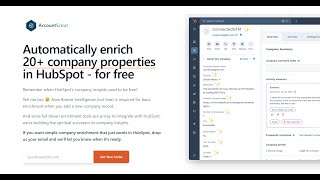
George B. Thomas and Stuart Stewart discuss how AccountScout enriches HubSpot company data with 22 key properties, solving the gaps in HubSpot's native Company Insights. They cover practical applications for better account targeting and data hygiene in marketing and sales.
All right, ladies and gentlemen, here's the real deal. Holyfield. Every now and then you're searching the Internet, you find something. It intrigues you, and you're like, should probably check into that later. And then all of a sudden, you're like, in another part of the Internet, and you see the thing again and you're like, well, wait a minute, this is like the second time I've seen this. And then a third and a fourth and a fifth, and finally, you're on your way to vacation to catch a cruise ship, and you say, I need to talk to this person. I need to understand what this human's doing. And that LinkedIn, YouTube, wherever you're watching this, wherever you're listening to, that's why we're here today. I'm your boy, George B. Thomas, and I'm here with Stuart Stewart. I've been waiting, anticipating to have this conversation with you. First of all, though, before we dive into the conversation, how the heck are you doing? And how are you feeling about the fact that we're about to have a conversation?
I'm doing good and I. I'm excited for this. It's been a little while since we've chatted face to face. Always great fun chatting. And I think what we're going to talk about. I'm sure you'll enlighten me as to what you're very curious about, but I have not talked about this on video yet.
Well, there we go. So I. I get to be the first. So what we're talking about is. We're talking about Account Scout, right? It's. I kept bumping into it. I kept hearing it. Literally, some of it was on the Internet. Some of it was, like, in meetings with people, and they're like, there's just been this chatter. And anytime I find something in the HubSpot ecosystem, whether it's a HubSpot release or somebody builds a new ebook guide, whatever, and there's a chat around it. I'm like, yeah, I'm going to be that guy. I got to create a video. I got to have a conversation. And so here's the thing. I've got about seven questions. I may ask some more along the way, but I've got about seven questions that I think when we layer them together, might help us tell a story of kind of the problem, the consequence, the solution. Like, okay, so let's just start at the very beginning. Let's start with the problem and why this conversation is happening, why it matters. And Stuart, I'm just going to start with like, what problem does Account Scout solve that many HubSpot users might not even realize that they have right now?
Yeah. So Account Scout very simply enriches 22 data points on company records and HubSpot that previously or maybe currently in your account, depending on the status of your account, when you created the account, all that good stuff that were previously enriched by Company Insights, the free HubSpot product that every new company created in HubSpot would get enriched. You know, you probably see things like company name gets updated from the domain name, a logo gets added, and then I guess 21 of the data points besides those get added when you create a new company in HubSpot. I think March 27, that all goes away for every account in HubSpot. And so that is, that was sort of the, the starting point and the actually like me going and making something around this was really on a whim. Like I sort of seen this, like the HubSpot community was kind of ticked off a little bit that not really about Company Insights broadly, but that company names were not being updated in HubSpot.
Right.
Like you would add a domain or add a company with a domain name and then your name would just be blank for the company and you would look at your company list page and there'd be no names. You would have no idea which company was which. Right. So a lot of people posting about that. And then Ryan Gunn one Friday, kind of randomly, I'm sure for him was like, hey, like this seems like a thing that somebody, you know, somebody could just go build this.
First of all, I love that your brain works that way. And really the ecosystem is just this value first. You know, I've been preaching this for years or teaching this for years in all of my videos. Be happy, helpful, humble, human. And you're being helpful. Right? That's one of the H pillars that you're diving into. Because in a world that we live in, company names shouldn't be a problem. Right. And company name shouldn't be a problem. And even HubSpot Insights kind of going away. Like if you're watching this and you're new to the ecosystem or you haven't even got HubSpot yet. Like, it. It used to be pretty cool that there was like this thing, but now there's not this thing because HubSpot's changing a thing. Anyway, that's not why we're here.
Clarify really quick. So HubSpot did walk back that they are going to that company name updates are going away. So HubSpot will continue to update company name and company logo, which is really important because you can't do it via API on records beyond the end of March. But the very first version, like I posted this, the very first thing that I posted was literally like update your company names. It's beyond that because HubSpot rolled that.
Back and see that there too. I love. Because HubSpot's listening and Hubs. My HubSpot is not against pivoting or transitioning or like you said, walking back. So I love that. Now, Stuart, I want to dig into. You said 22, basically 22 properties because I want to talk about the consequences because we're talking really broad picture account scout, but data enrichment and kind of what happens without it. So what are the biggest risks that companies face when relying on incomplete or even worse outdated company data?
Yeah, I mean I think it really comes down to what are you going to do with that data? Like just saying like, hey, we have X number of companies that are enriched this much, you know, doesn't really help you, right? The things that I'm seeing and this is the question that I'm asking everybody who I send an invite to, it's like, what are you going to do with this? Like what are you already doing ideally in your HubSpot account that uses this data that will break or that you won't be able to continue to do or extend if you don't have this data. And generally those things fall into sort of a couple of big buckets. ICP definition account qualification is a big one, right? Like however you're doing that, there might be, there's a number of properties there that you might be using for that. On the Accounts Gap website, which I'm sure we'll talk about later, there's a list of all the properties, but I would say the most popular for ICP definition, company size, like number of employees, annual revenue, location. There's all sorts of different ways that you could be segmenting your icp. And all these data points are pretty demographic, right? Like there are plenty of other much more advanced, much more sort of context or signal based ways that you might be defining your icp. But that's sort of one broad bucket of ways people use this data is ICP definition. Let's not talk to or not prioritize the accounts that are not aligned with the best people that we serve or the people that we serve best. Location based marketing campaigns has been a big one, right? Like we want to specifically. Either we want to target people specifically in a location or we want to reference their location in some way in our campaign. Right. Like this campaign is for people in Milwaukee. Well, you need to know that this company is based in Milwaukee in order to do that. So that's a, that's a big one. And then I would say the third sort of big one. And there's, there's plenty outside of this. But like the third bucket is almost like operational type needs. Right. Like we want to send a quote on that quote. We want to include the address of a company. If we have the address of that company, we can just verify it rather than having to go look it up or ask for that information. We're able to save time in check the box type activities. I think the thing that's important to note across all three of those things is that whatever way you're doing that, whatever your specific case is, you want to be able to do that within HubSpot. You want to be able to do that in a workflow with a filter based trigger. You want to be able to report on all these different things. Like you know, when we get a new, when we get new inbound signups, like where are they? Like what's the distribution of those across company size? Like all these kinds of things. So having that information in properties in HubSpot makes it actually useful in HubSpot is kind of the, the point versus just using a disconnected.
Yeah, connected in HubSpot versus your little spreadsheet there in the fourth tab to the right of your Chrome or whatever browser you're using is way I also love there's words that I hear when I'm talking to people. Save time. Right. So it's a, it's a helpful tool. You're going to save time. I also heard in that, by the way, ladies and gentlemen, you might want to rewind that section. But if you're a B2B marketer or if you're doing location based, you know, marketing or sales initiatives, this might be a solution. Which by the way that leads me to. We've talked about the problem, we've talked about the consequences or the way in people might be using it or what they might be missing out if they're not. And so let's enter the solution. You're right, it didn't take me long to get there. You may want to talk about the website or how they can get access. But enter Account Scout. And so Stuart, how, how does Account Scout and some of this you might be able to share some, whatever, whatever. But I'm going to at least ask the question like how does Account Scout source and verify the company data? And maybe if you want to get a little bit more granular into that data. But, but what makes it different from other enrichment tools that are kind of out there and why somebody might choose this versus something else?
Y so I guess the. I'm just gonna start with this. It's free. It's like the, like it's a free replace, free direct replacement for Company Insights. And that's today. Like there will definitely be a pro tier and like more stuff beyond that. But the intent here is that parity with HubSpot Company Insights will always be free as a product. What Account Scout does is whenever you create a new company, it enriches those data points 22 that we mentioned. They're listed on the Account Scout website. And so you can both. When you create a new company, you can also go to an existing company. There's a UI card where you can click a button, it'll update the properties. How it does it is. There's sort of. There's a couple of different ways that enrichment tools work. One is they have a very big database of company records, company data that sort of, you know, working away on in the background. Like it's how Breeze works. For example, there's a database which is Updated based on HubSpot's data based on a lot of different data sources. And then when somebody requests a domain with that name, it just pulls from the database and gives you the data. And then the other way, which I guess is newer is you say, okay, somebody is requesting information about a new company that we haven't seen before. Or maybe generally enrichment tools have some refresh rate on the data. We haven't had a request for this company in the last 30 days, in the last six months, whatever. The refresh rate obviously matters more for some data points than it does for others. But then they go out to either other data providers or to publicly available information, say hey, what is the current state for this company? And then pull that back. So Account Scout today uses a mix of both. We use. I might as well just be transparent here. We use the Company Enrich API, which is a little different than most or than many. I'm going to call them legacy. That's maybe not fair. But the biggest big box enrichment providers in that their data is agent based, sourced from across data providers, across publicly available information with a pretty good refresh rate. It's a 30 day refresh rate. There's like 30 million companies or something. I think their website has data. There they have a big data set and the refresh rate is good. The reason that I chose that as the starting point was, was speed here. Right. Like I wanted to get to parity with what was going away in HubSpot as quickly as possible with as high data accuracy as possible quickly. So far reports are good. So far people are making positive comparisons against Breeze, for example, which is good. I'm also doing additional enrichment from publicly available sources and sort of validation that you mentioned, which is of course important over the top of that data. And the thing that I think people may look at and be like, well, why don't I just go use that API directly? There is a fair amount of transformation that has to happen to go from what you get back from any. And this is true. I think if you've plugged in any other data enrichment provider to HubSpot, you've probably found this, that what you get back from a data enrichment provider provider and the way that you want it to work in HubSpot are not the same thing either because it's like an open text thing, you could get anything back and you want to put it into a structured property. HubSpot Industries is a great example of that. Basically anything that has predefined options you have to match. There's a mapping process. So yeah, anyway, all that to say that's the primary data source today. We layer additional data from public sources on top of it and then transform and map it to the default properties and HubSpot. So that's one of the big things here is like there is literally zero configuration because the mapping happens in account scout to properties that already exist. Like HubSpot out of the box has the properties that we enrich.
Yeah, I love how detailed and thought out this is as far as what you're going to give and even the fact that there's maybe a future upgrade path that will be available. But listen, let's go back to Free is Free, ladies and gentlemen. Like, come on. And the reason I'm bringing up Free is free is because I want to kind of go into. After talking about the problem, the consequence and the solution being Account Scout, I want to go into practical application and you kind of alluded to some like examples, but I want you to kind of put your HubSpot user hat on for a second and, and really if you can maybe walk us through how a typical HubSpot user would integrate Account Scout into there and I'll use the word workflow, but I don't mean like automated workflows. I mean more like process. Like when I say workflow here, like what is that kind of what are you envisioning that that changes in their daily life if they don't have that enrichment or account scout happening yet?
Yeah. Or I mean even if you do and you're just not using it right, like you might already have it with company insights and you haven't been leveraging it. I mean I think from like I have been a marketer for the last however many years and like use case for me is like we want to know how many of the accounts that are signing up or that we are having some level of communication with actually the people that we think are a good fit for our product. Right. Like are we spending marketing dollars to acquire? And obviously companies get created when new contacts are created. So there's sort of a trickle down effect. And if you're in B2B accounts are probably who you're selling to rather than people or companies are who you're selling to rather than people. But that's sort of the starting point for me is like make an active list in HubSpot that has filters for your ICP definition. Right. And that could be as simple as company size as locate. Like do you, I mean I'm going to use a really weird example here but like if you're RB2B, right? And if you know they've been big on LinkedIn but like they're a signals tool but they only work in the US like they explicitly do not comply with gdpr so you can only use them in the US So it's probably important for them to know is this account that's signing up based in the US and there's plenty of other businesses that are like that too, right? Like if you don't want to ship, you know, I don't know, you sell something big and you don't want to sell it, you don't want to sell it across the world, then location is maybe a critical filter. But I would say that's the first thing is go to lists in HubSpot, build an active list with as many filters as you would like and then once you have that list and you can, there's multiple ways to create that list, right? Like you could be create the starting point for most companies is going to be take our existing accounts in HubSpot and create a filtered list that is a subset of that which is the ones we think are a good fit. You can then also go find who are other companies that match these same filters. Let's add them to HubSpot and then think like, how do we, how would we reach those companies? How would we do run marketing campaigns that engage with those companies? Like there's all sorts of sort of say at least I think a relatively new term, but it shouldn't really be new to anybody. But it's like ICP marketing, right. It's just make sure that we're actually speaking to the people that we think are good fits for us to be speaking to and make sure that we're spending our time, money on the right people. And once you have a list, you can do all sorts of things with it, right? You can send email to that list, you can surface that list to your sales reps for, you know, to go and engage directly, whether it's on LinkedIn or email or wherever. Right. If they're already in your CRM, you make sure that you check that you have opt in and permission to contact in different circumstances. But if they're in your CRM, you know who they are, you can go and find the people at that, that account who presumably are again already there in your CRM and start engaging with the right accounts. So that's, that would be the first step.
Yeah, I, I love this, I love this so much because, and I love that you dove into list because we have something in Sidekick strategies that we call the Needs to Know and it's literally like a couple different folders and based in those folders are certain lists and I can totally see like a Needs to Know enrichment folder that has then the certain list that we want to be able to kind of combine and use together. And so I love that. By the way, I think HubSpot lists are probably one of the unsung heroes for segmentation, communication, personalization, if you really know how to leverage it and harness it as you move forward. It's funny because I think you're almost leading into the next thing that I want to talk about or ask and I'm super curious about. And that's kind of the optimization of this, which again, if we're talking to marketers, you know, sales reps, listen, if it don't get measured, it don't make sense. Right. And so Stuart, when you think of like Account Scout and this enriched kind of data, are there any certain metrics or KPIs or like what should the user be tracking to measure the impact of the data that's being enriched? Using Account Scout for the activities they're taking?
Yeah, I mean, I think that the thing that I would look At I mean, most of these things are going to come back to what is the effectiveness of the thing that we did against this data? Right? Like is the ROI of a campaign. I'm just going to use campaigns in a marketing context. But like the ROI of this activity better when we do it in a more focused, more segmented, sort of tighter way that's enabled by the data, by the enriched data than when we don't. Right? Like if we send an email to everybody, to only people in New York, does that email perform better than if we send an email to Everybody in the U.S. right. Like. Or do we open up more interesting options to be relevant? I mean, I think everything in 2025 is going to come back to relevance in marketing. Do we open up more options to be relevant to the people that we're talking to if we have better data about them? And don't get me wrong, like the data that is in, that is made available by Account Scout is scratching the surface of what's possible from an enrichment perspective and from a. The perspective of having data that helps you be relevant to your accounts. There is definitely more stuff that will be coming in Account Scout around that. But that's ultimately being able to match. I want to say this to. Or not even like, I want to say this but like, because I'm sending a message and using message very broadly here, right? It could be whatever channel, it doesn't really matter. It could be on your website, who cares? Because I'm talking to these people or these accounts. This is the message that is relevant. Having that data allows you to sort of flip that right? Like and start with the people and the message becomes obvious rather than like, hey, I want to shout about my product. I wonder who will listen.
So you're talking my love language right now, by the way, is because I heard you say start with the humans and then figure out the messaging to go around them, which is amazing. Also I am a big believer that relevance or being relevant will trump noise and nonsense every day of the week. So I, I just love how this is kind of going in that direction of it's. It's a way to kind of be more human in the communication based on the enrichment and therefore the strateg easily we can take based on that. So loving this, I'm going to ask you a question. I'm going to have you, you know, get your. What is that crystal ball out or your futuristic glasses, whatever you want to throw in there. But I want to ask you about the future and my question is Going to say five years in it, but I know it could be five months. Heck, in the world we live in, it could be freaking five days, to be honest with you. But I want to talk to you about. And it kind of goes back to some of the how you said things are changing and the way that data might be brought in. And, and so I'm just going to ask the question, where do you see the intersection of AI? Because there's a lot of like breeze intelligence and AI tools. But where do you see the intersection of AI and company data enrichment heading in the next five days, five weeks, five months, five years? Like you don't have to answer all those. I'm just giving you any time frame in which you want to talk about.
Yeah, I mean I think it's a good question. It's a really important question and I think it's to a large degree shape it. And this is again like coming together very quickly. Like we are less than two weeks into Account Scout having users which the numbers have been kind of wild. But anyway, yeah, we, we've now in I think we're like 12 days since the first account created like 100. We just crossed 150 installs today like 20,000 companies enriched, which the way that it works is a good number. But I think in terms of the future, I think you have to look at what are people doing in. I'm going to like another tool which is not an enrichment tool, which I think is critical here is it's. This is not an enrichment tool. If you look at what people are doing in clay today and the types of, the types of, the types of way people are bringing context about companies, people accounts together, I think that's the direction that everything's going to go. The cost of actual data enrichment is going to go down. Agents are going to make this. Anything that is publicly available is going to be basically free to go get. There is definitely data that is not publicly available and you want to make sure is as verified as you can, like somebody's email address or somebody's phone number. Like it is expensive to not have correct and accurate data about those kinds of things. So the cost of that will not go to the floor. But anything else, anything that's public, the cost to get it is going to be basically zero. I think that the future is going to be in the transformation and context building around that data for a specific company, like matching the context to your company. Right. Which is what everybody is doing. Or if you look at the claygencies and the Folks who are pushing the edge in clay, what they're doing is pretty complicated or complex. A lot of it driven by AI, like prompting of AI to go get very, very specific data for specific companies. And the way that that works today is that it is entirely custom, right? Like you have to, you have to be an a. You have to be an expert in a bunch of different things to go figure out how to go get that data. I think that at least, I think this is the direction that I'm sort of pushing with accountscale, at least on their is okay, how do you take the things that are maybe not like the most cutting edge thing that you can do that is going to have to be custom and is going to have to be entirely different for every company. But what are the things that you can do when you apply that kind of model of like we need to apply our business context to the way that we go to, to the type of information and the way that we go find that information and make it much more accessible, right? Like how like a. They're a very obvious that. And it's interesting seeing the feedback on like breeze workflow actions. This week has been like, this is great, I can do a lot of stuff, but what do I do? Which is sort of the problem in any like HubSpot always has this problem, right? Like HubSpot serves, you know, 220,000 accounts like across a lot of different industries, a lot of different things, a lot of different features. Like the problem is always going to be like they're going to have a more general. They're going to have to generalize the solution. So that's going to be sort of one end is you have a very generalized solution and then you have a very customized solution or customizable solution in like a clay or something like that. And I think Account Scout's goal would be like be pretty opinionated about like here's a piece of data that you probably want to go get or like might be very interesting to go get. Here's a really sort of plug and play way to go get it directly inside HubSpot. But I guess I should give some examples of things like that would be like simple examples that are. One that's available in Account Scout is like is this company public or private? If they're public, we want to go look at their 10k and figure out what do they talk about in the last earnings report that we might want to surface to sales so that they can have better context about how to communicate or you know, like this is a company that is currently hiring for three or you know, they're hiring for sales, which is a growth signal at that company. Like, this is a company that we might want to prioritize because they potentially have more budget to go spend on our solution. So I think that's the future is going to be in, not in the stuff that is static. Like, what's the location of this company? What's the, you know, founded year of this company? Which is like, good to know but not super helpful, super actionable, but much more sort of context specific and like to the point or to the point of things that are like, this is the current state of this company, this is our product offering and our positioning. What is the best angle to take with this specific account in order to start a conversation there? Like, how do we. Again, back to that like, relevance piece. Like, how do we be most relevant based on our company and what that company currently has going on?
Yeah, our company. What we got going on in the strategy and goals that we hopefully have in place that we're going to leverage us for. It's, it's fun, Stuart, because you leaned into like now what, what should I do? Which by the way, leans me to my last question. Well, almost last question. Because I do have another question I'm going to ask after this question, but it isn't a question that I had planned on asking anyway. Not why we're here. I want to get into the actual takeaway, right? So if everybody's paying attention, we've talked about, you know, the actual problem, we've talked about the consequences, we've talked about the solution, we've talked about the practical application, we've talked about optimizing it, we've talked about the future. And so now I want to talk about the actual takeaway. If HubSpot users are watching this or listening to this and they can only do one, just one thing today to improve their company data hygiene, what would you, Stewart, recommend they do?
I mean, I'd be remiss if I didn't say, go sign up for Account Scout. Account Scout app is the place to do that. It will be in the marketplace soon, currently in early access, but new invites go out each day, so I don't do that. But even I would just look at your existing data and like go build that ICP list. Like, if you haven't done that already, if you don't have that in your account, even just going through the thought exercise, even if you don't have the data to populate that List effectively, like a. You'll find out like, oh, we don't have the data to go populate the list that we want our team to be talking to and communicating with, which may be a flag that should fix that. But just going through that exercise of like, who do we actually want to talk to? Who do we actually want to sell to is going to be helpful. And I would definitely, I would start by filtering to companies that have a closed one deal in the last six months, 12 months, whatever, and then start adding your filters and see how many fall off your list. Because what you'll find is, oh, the companies that we think we're a good fit for are not the companies that are buying our product. Or actually there is a much higher. Like, there is a. Like every company that we sell to has this thing that is true. Which means that the inverse of that then is, well, if a company that comes in and we're talking to doesn't have that thing, they're probably not going to be a good fit. Right? And obviously like closed one data in HubSpot is going to be the easiest to get. But ideally you're able to look at, well, who actually renewed if you're selling a recurring service or product, who actually renewed, who expanded? Like, who are the customers that we want more of because they are the best for us long term rather than just the ones that we were able to slam into our quota in the last quarter. In the last quarter.
I love that you leaned into like do this thing to gain some insights so that you can take smart action after the fact. I also love that you slipped in there and it might have been like a set spike type scenario here. Go to AccountScout app for that. But my final and last question is if people have questions, if they want to connect with you, maybe Stuart, after this amazing conversation, they just want to buy you a steak dinner. Where do you Want to send?
LinkedIn honestly is probably the best place to connect with me. I'm pretty active there. Feel free to connect. DME generally responsive there or stuartonnectedgtm.com is my email. I really should have an account scout email, but that is the, the one that I will actually reply from.
There you go. Well, ladies and gentlemen, there you have it. A authentic conversation based on my human curiosity around all the chatter that I was hitting on the Internet or hearing on the Internet. Until next time, until we do another video, until we see you at the next event. Remember to be a happy, helpful, humble human and of course do some happy hub spotting along the way.










