Time to talk about AI
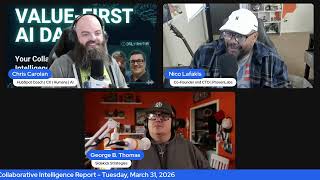
Chris, George B. Thomas, and Nico built a custom live-stream setup using OBS, Video Ninja, and Gemini to automate scene transitions and pull in AI agents. They argue AI's real value is freeing people from minutiae to focus on higher-order work, not replacing thought. The bigger challenge is cultural: getting teams to stop being allergic to asking for help.
Chapters
Good morning, LinkedIn friends. Value First Nation, welcome to another episode of Value First AI Daily, your collaborative intelligence report. It is Tuesday, March 31st, 2026. Nico, George, how we doing?
Doing good.
Yeah, yeah, doing very well too. Excited.
Yeah, I'm doing great. Uh, it's been cooking this morning. Uh, another one of those mornings where I get up, take a walk, and, uh, yeah, never make it out the door unfortunately. I'll work on getting, getting better at that. It's always that, oh, let me just trigger this daily ops skill to get that running and they'll be done when I get back from the walk, and then I start clicking on other sessions and it's all over.
No, see, you got to put barriers in place. It's walk and then think. So, and by the way, I'm speaking from experience because as soon as I start to look at my email in the morning, look at my calendar in the morning, look at whatever in the morning, it's over. Hence why it's for me, personal decision. Devotion before anything, then I move into the day. So for you, it's the walk. Do your walk first. The rest of the day will be there waiting, Chris.
Yes, indeed it is. The general rule is don't touch the desk, like, before you want to do anything. Um, but since I did, uh, you know, succumb to that Uh, I'm gonna— I've got some, some cool stuff to show, uh, that is prepping us for tomorrow to be, um, to be streaming not through StreamYard. Uh, started working on it yesterday and, uh, like I do, a little bit last minute, and I realized, you know, oopsie. Video Ninja and having all these separate things to go into to manage the stream. And I can't see George unless I'm, unless I'm also in there, but that's a special screen. Uh, you can hear me but can't see me, video quality, you know, all this stuff. Uh, so 5 minutes before, it's like, all right, let's go, let's head over to StreamYard. Um, uh, So end of the day yesterday, I start talking to Gemini about this. Mm-hmm. And, um, but from a separate, like, context, you didn't know none of the build context of what's already been done. I was just like, hey, um, you know, I wanna— we're moving off StreamYard and trying to stream, but I don't want all these screens to go into— it's, you know, I don't want to have the production burden, I think is the way I said it. Yeah. Like, what, what can you do for me? Oh, also, I work from, from Quad Code all day. And he suggested the first two things that were already in place, which was OBS and Video Ninja. But then the third thing, just basically local a local app to manage the director situation of being able to manage everything from one place.
Nice.
And been working on that this morning. And here's what we got. So as I was doing that with Gemini from the couch, I ended the conversation with a, like, give me a handoff prompt so I can bring it into my Cloud Code and then start to plan from there, right? And this is where we're at so far. Of— we've got all the shows up here. You can see like these things are changing. Um, there's assets. It's just like managing. So OBS is basically like— I don't— trying not to touch it ever. So in theory, if you guys can click on the Video Ninja links and and like get, get ready from that perspective. All of this, um, is starting to be managed from there, from here. And, um, I don't think I had to turn off OBS so that the cameras work over here, right? Yeah. But, uh, just that moment of like, you know what, man, it's gonna be hard. I don't want to do that thing. Like, Gemini, what can I do here? There, you just build this. That sounds amazing. Let's do that. And yeah, I was testing it out before the show, down to the level of, you know, being able to pull in agents, some of the agents' team, like, hey, we need Pixel to come in here and start to get pixel perfect on all these scenes and these transitions and frames and all this stuff. Oh man. And it's a local, you know, HTML file. Uh, so all of the iteration on it goes much faster, right? Not waiting for it to publish. Um, but yeah, I, I just had to ask, ask for help, uh, on the thing that I didn't like about the process because I was literally thinking about it all day. Yesterday, like, man, I'm out to figure out— oh man, I'm about to go figure out OBS again. I'm about to figure out Video Ninja. Like, I don't want to do that.
I don't want to get involved. Like, I just want the thing.
Yep.
Right. And that's— if you can develop that habit right now of just like, if you're feeling friction, and just need help trying to get whatever you want to do, get that done. And you can ask that first question to AI, like, help me out with this.
And yeah, and listen, I think I've been saying this for months, the power of the question. I might have been saying it for years. You know, the is it possible, the curiosity, the— and Chris, what I love about your story is the ability to be curious. By the way, in this case, you're curious out of necessity. There's being curious out of just I wonder, and there's being curious out of I feel like I'm being done wrong and now I need to fix that wrong, right? And so to watch this journey of you like, I'm going to figure out how to do this. And then for the, the precipice of the story that's gonna hopefully happen tomorrow morning, as somebody who was on yesterday morning and was like, uh, hearing Chris say, I'm heading over to StreamYard in disappointment, I was like, okay brother, I'll see you over there. Like, to see that tomorrow potentially will be the day where we're actually doing something out of necessity based on your curiosity and the the hump to get there was just a question, asking for help. And so many of us humans, for some reason, we're allergic to asking for help, whether it be from a human or it be from an AI assistant. And I don't know, like, that has to die moving forward. Like, you cannot be allergic to questions moving forward. I agree.
That's true. Curiosity is definitely what's going to drive people to do more, right? And that's, it's kind of nice that that will become, you know, in thinking about what you were saying, like you just want to do the thing. And it's just like the way in which programming is becoming now. And I, you know, I'm sure there are plenty of people out there that think and say to themselves like, yeah, but What about the skill? What about the time, the effort, the learning? You're just doing without learning, right? And in reality, it's not so much doing without learning, it's that you don't want to have to learn. And I know that it isn't because other people spent their entire lives doing it as a career. I get it. I really do. If you just look at jobs over time, that's the way that jobs evolve, right? Industries just change. People just do things differently. Things that were complicated become very easy, right? That's, that's the way it goes. So, you know, yeah, we're living in an age with, you know, the most efficiency-driven technology. And it is a case where you're just like, I don't want to have to learn what we regard as like basics. Or like, I don't want to have to learn this, this busywork in order to get to this final output that I want, because the final output is the catalyst for something greater, right? I need the final output to actually start doing something greater. Than what all of the minutia is, right? Or what, what comes across as minutia. So yeah, I, I find it, uh, I find it interesting. You know, it is, it's a blockade, I think, for now. Not necessarily, because I wonder if you had gone with like either computer use or maybe like co-work, it if it would have been possible to actually do and take all those steps for you, right, without having to do anything. And I've been talking to a lot of people about that same question lately, uh, you know, what, what does it look like 3 or 6 months from now? And that's what it looks like to me. It looks like 6 months from now, you basically laugh at the problem that you were having, you know, yesterday. The same way that we laugh about the programming issues we were running into, you know, 3 months ago, right? Like, we're doing stuff now that 3 months ago wasn't possible, right? And 6 months from now, we'll be doing stuff that— I mean, we'll look back and be like, wow, I can't believe that was a stumbling block, because now I just do whatever, right?
Um, yeah, I totally agree with you. And I think that there's something that people are going to have to deal with along the way, and that's that they're going to have to make decisions that they don't want to have to make to enable themselves to do the things that they want to do. And again, it's easy to get stuck in old ways. It's easy to get stuck in patterns. I've always hosted my website on HubSpot CMS. I'm always going to do that. Really? Well, what if the pain becomes so great and the things that you wanna be and do could be so awesome that sticking in your old ways isn't, but it's a hard decision. And so like, listen, there's been a messy middle that Chris has had to go through to show us what he showed us this morning. There was a change of mind. There was a, I can't stick in my old ways. By the way, thanks, uh, StreamYard for the extra bill money to get Chris not to be stuck in the old ways and to actually take this journey. But for many of us, it won't be that. It will be something internal that will make— and Chris is giggling because he knows why I'm saying this, and it'll all make sense in about a week. But there's just tough decisions you're gonna have to make moving forward. When it comes to the unlock of the things that you can do with AI as an assistant in your world.
Yeah, and it's happened yesterday. Like, if you're out there probably maybe using AI and not feeling it, um, a couple of things were said to me yesterday in a couple different calls from, from colleagues. You know, one was, I feel like I'm losing my ability to think and that I'm just moving dishes around all day. And for that person, I think that's a signal that you're not getting stuff done that you actually want to be doing. Right? Like, it's the minutia. Like, you're getting help getting the minutia done instead of removing it. Like, like, yeah, I can do completely. And this person has said in the past that their goals are doing other stuff, right? And this transition, right, is, is what I think you're referring to, George, in terms of like figuring out what makes you happy. And asking those questions, like if you're getting this, if using AI to get things done more efficiently, higher quality is somehow causing friction like that, where it, which can happen, right? Like reducing your value, like is how you might think about it. Like, well, what am I here for if AI can just do this stuff? You're here to do the human stuff. Like, that's what you're here to do.
So I don't know. I don't want people to get this bent because I don't know if this is about happiness. Like, do I enjoy working with AI as an assistant? Absolutely. Does that bring me happiness or joy in life? No. For me, I would say the decisions that I'm making and the hard decisions that I'm making are less about me and my happiness and more about the user experience and value that I can provide for others in the rate in which I can provide it. Like that, again, and I know not everybody is baked this way, but I come from a level of it's about the servanthood. It's about the, the happy, helpful, humble human, helpful human. And so when I can look at one way and be like, wow, we could do this, this, and this, and this in 1/32 of the time that we can't even do this and this over here, and that would open up these things for the humans that We serve.
Yeah.
Um, okay, time to get in the chair. Well, for me, I stand all day at a standing desk, but time to get— trying to get work done. Time to— time to change the mindset. Time to— time to plug into the model and start to use Whisperflow and dream and ask questions and build. I don't feel like I'm moving dishes around. I feel like I'm erecting brand new buildings.
Yeah. The other moment yesterday was the comment was made, you know, a few humans on a call trying to solve complex problems. And on that call, which was in a Google Meet, and we're talking about a topic that I don't have as much experience with, and I'm just trying to facilitate like solutioning and like thinking about it from different directions. And I click on the Gemini in the browser and start asking questions about what we're talking about. It can see the meeting on the screen, which has some HubSpot interface in it, and starts making some suggestions for how you could build the thing out that we're talking about. And when I share that, like, because I'm like psyched up about how, how this is happening, right? Like, uh, the ability to do this, um, And so I'm sharing this moment, and then I share the outcome, like, would you like to hear what the suggestion is from over here, knowing that there's not a ton of context, we didn't build up any kind of knowledge base to support this, but from a generalized principle perspective, sometimes it can be helpful to go down that level. And the response was like, I'm wondering if I should just, instead of asking Chris, I should just go ask Chris's AI now because it's always going to be an AI answer. And it's like to be able to take that kind of moment and like turn it into, you know, a negative like that was kind of like it. Yeah, if Chris wasn't on the call and was just shipping you like some random AI you know, slop stuff. Like, yeah, fair, fair call. But when we're live on a call and we're using that, we're using AI to help facilitate conversation when we're clearly stuck trying to solve a problem, that— yeah, we wouldn't get as far if we didn't have, you know, basically another, another intelligence on the call with us to find those gaps. And those are the questions that we got to be willing to ask, like, what are we not seeing? The whole reason that you want somebody else to talk to you about problems like this, right? Right. Uh, and that just brings an idea to mind right now, like, maybe I open up my own, like, Google Meets, uh, or you know, screen share sessions and, and then pull in the AI with me and start just talking through things out loud with screen sharing. And something I hadn't thought about yet, uh, but now I know it's an avenue. And instead of dragging in screenshots and— it's just, yeah, any point of friction, like, you can get help with now. You just You just got to ask. But the collaborative experiences that can happen with it now, like starting to unlock some of that stuff instead of, you know, thinking about it of just, you know, every additional person is not 2x, right? It's like 10x, 100x. Like, when you can move at the speed and everybody's aligned and you get to use, you know, the intelligence of AI, some big things are happening.
Um, yeah, and it's changing quickly too. And I don't know, like, I mean, I know people are, uh are adapting. I'm starting to see like a really huge wave of people getting into it and people getting into Claude code especially. Claude is doing a great job. Anthropic is doing a great job. I've noticed this week there's a pop-up banner now if you're in a conversation, even— I don't know if it's just normal conversations too, or if it's just like conversations that involve code. But there's a banner that pops up now that's just like, yeah, you can do this in, in Cloud Code if you want, and here, click this button to install, right? Um, I think it's very, very cool that they're trying to get more people onto the platform. From what I understand, I looked at it yesterday, and I think they, they were saying that since the Pentagon issue they've onboarded a million users a day, and that even at a million users a day, it's only a fraction of what OpenAI has. So I don't know, good news and bad news as far as I can see, because, uh, if you do follow this stuff, you know that Anthropic does not get anywhere near the amount of compute that they need, and it's very difficult to get compute right now. OpenAI clearly has a huge grip on that market. So it's nice to see so many people migrating and getting into it, but it's also like hair-raising for me because it's like, all right, well, it's gonna be like increased downtimes and, uh, limitations might, might get even stricter. We'll see, I don't know. But it was definitely— it was nice having the, uh, open 2 weeks while I don't say that much.
Yeah, yeah. And Codex just, uh, uh, decided to support Cloud Code. Uh, I don't know how that works. Uh, I think we should talk about it tomorrow because I got one— I got a cap here, uh, to the end of the story of today. Um, and like, again, Once you start using these tools and you can learn them with the, like, the back of your hand, like you would your phone, uh, like we're on this show and I've also been building front end. So like I showed the director backend, right? And when I go to show and get excited about the front end, I, I see a problem on, on the website, right? And so this is the screenshot of that problem. Uh, we've got different show title at the top. So this is a live page on the website and the show versus the stream was mismatched, right? So this is the screenshot that I then gave to that session that I was working in to build out this, this experience on the website. And said, look like we got a mismatch. And now it's live and we don't have a mismatch anymore. So yeah, just start using this stuff, folks. Learn, learn and love.
Well, and I think too, Chris, I know we're ending the show, but I think too what you just showed is like you can be doing stuff while you're doing stuff. And that's been magical for me as well as somebody who is pretty much always doing stuff. Meaning like right now we've been on this show, and Chris, one of the things that I knew that I wanted to do moving forward is to be able to show like an audience that I do this show and the next show that we're gonna go do in a, in a like before I'm doing it way. Right now it's like they get a thing that I just went live. Wee! But what if there was an events page? And what if one of the events or two of the events was the shows that we do together? And now people can proactively say, oh, they do that? Let me go ahead and— and that whole system that populates 2 weeks out and auto-archives 30 days after and make sure that when I publish the article, like, links to the thing before it archives has been being built this entire episode.
Until tomorrow, folks. Everybody have a great day.
Peace out.










