Time to talk about HubSpot with Kyle Jepson and the rest of the crew!
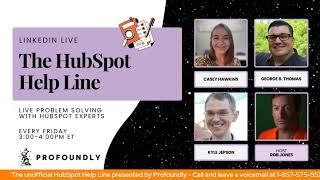
YouTube episode (HubSpot Helpline) featuring George B. Thomas, Rob, Kyle Jepson and Casey Hawkins. The conversation covers recent HubSpot product updates since Inbound (hundreds of small fixes and quality-of-life features), the role and limits of AI in HubSpot tooling, and the new Loop Marketing playbook — plus practical perspectives on adoption, trust, and human-first use of AI.
Chapters
George. Hello, you've reached the HubSpot Helpline.
Helpline.
Help behind Helpline Helpline.
It's Rob, it's George, it's Casey and Kyle. Come with a problem and leave with a smile every Friday at 3. Come and join us as we help you with HubSpot. Open up your LinkedIn. Just make sure you call in and leave a voicemail about HubSpot. Make your Friday divine with the HubSpot helpline.
Ladies and gentle admin. It is. Yeah, it is. I was trying to launch into your exorbitantly long intro. I'll start over. Ladies and gentle admin, after a brief hiatus for I believe it was baby number five, Kyle Jepson is back. Everybody. We're here with Kyle. We're here with George, as we usually are. And Casey, thank you for being here. Chris, thankfully, is somewhere in the background and we cannot summon him without the summoning music. George, remind us. Yeah, that brings. That brings Chris on stage. But how's everybody doing? And Kyle, I'll start with you first, man. We haven't seen you in a while. I know you've been working with the new model. I think you had a post the other day about it's compatible with the other models. It's having some learning stuff. How have you been?
Good. It's good to be back. I'm trying to figure out what has happened since inbound. So if anyone's watching and has thoughts of things that have happened, post inbound. Drop it in the comments, let me know. I'm. I'm trying to get my feet under me still.
George is already shaking. You know, this is only one hour for the show, so I don't know if we'll be able to get to all of it. Yeah, we can. Whoever talks the fastest can launch into that and do a hyperspeed version like you got a loom on 1.75. Go ahead, George.
That's.
Yeah, they launched that.
Good.
It's about time.
Yeah.
I'm telling you, I done it better myself.
Sheesh. It's like rap God or something, but HubSpot style.
Yes. So in all seriousness, the time off was good. You're back. You sound like you're interested in the updates and what has happened. Yeah, just as a. As a quick thing because we've, interestingly enough, we've done this before where you came back after a minute and. And how is this time any different? Is there. Are there more changes? Is it because it's in the holiday season? Is it less? I mean, how is it.
I Came back. So I. Hubs a lot, gives very generous parental leave. And I came back for just three weeks, couple of weeks leading up to Inbound and one week of Inbound. And the thing that, the thing about that is it was inbound. All of HubSpot was prepping for the launches and the announcements and the event, and it was pretty easy to just like, okay, what, what are the talking points, you know, for Karen on stage? What, what, what did we launch? What didn't get out the door yet? Now it's just mid November, right? You ask people what's happened since Inbound, they're like, that's not something we track, right? We, we have not been prepping for this November 21st HubSpot Helpline episode. And so it's just, it's been trickier with, with Inbound. It's like, okay, I've got two weeks to, to learn this stuff, to prep my presentation, to give it, and then to disappear. Now it's just like, hey, guys, what's going on?
And everybody's like, I don't know, Updates as usual. I'll go ahead and put. Let's put Casey on the Hub spot. On the spot first since Inbound. I mean, you've been around and, and been here on this show and been doing other shows with Chris and with people. If you could. I'm going to try to spin a couple metaphors and things into one. If you could tell Kyle that since Inbound at something that's. That is a HubSpot feature or update that you're most thankful for, what would it be?
Interesting. Interesting. Form submissions on company records.
So, like, the new form builder now supports company things or.
No, the form submissions will show on the company timeline. So if you submitted a form on my website, it would show up on HubSpot's timeline. So then I could see all of the form submissions that HubSpot submitted on my website. It happens a lot for me. A lot of HubSpot employees.
So it still shows on the contact record, but now also shows on the company record, similar to like how calls do and other things that are logged across records. That's great.
So. So by the way, I know probably Rob, you might be coming to me, but before you do, I did filtering in the product updates from September 6th to today and then had to pan through 26 pages.
Okay, that's not bad.
26Th page only has four on it. So 10 times 25. 250. Easy math. Thank you. HubSpot. 254 updates since inbound.
All right.
Yeah, well, I. So I keep the A list of every update that we cover each day. George. As you know.
I know.
So I, I knew Rob was going to ask, so I was scrolling through my like list since inbound.
Exactly right. I am coming to you next. But first, just to give Kyle a chance to level because this made me feel good. Was that something that you knew of or is this new? Like, I imagine when you come back, there's 254, 64 updates. It's a lot, it's overwhelming. But your experience in being able to get up to speed really quickly is that one that you were already aware of and knew and kind of had like functional performance thing? Yes.
No, no, that was news to me. So I, I did indeed skim the many, many pages of updates, but it is not the case that my eye is drawn to the ones that are most noteworthy or that I even remembered one per page. Right.
Well, and I will say, like, I don't think that like, I don't know. And this is just like me as a person probably, but it's not like the flashiest update necessarily. But it is one that I all HubSpot. Not all, but like a lot of HubSpot users are going to like see and notice and use.
Yeah, I wonder, I wonder if it's one that. Oh, okay, thanks. I wonder if it's why they do that. Didn't land in the, in this section, but it looks like it did indeed. Because something I've been noticing on, on LinkedIn people are finding like someone asked, hey, since when can you merge options in a drop down select property?
I don't know.
And someone's like, hey, since when can you enroll companies into workflows? Since on the company's index page. And like, I don't know. HubSpot has a new head of product. His name's Duncan and he is really emphasizing like smoothing out the wrinkles and filling in the cracks and like helps us great at shipping stuff. We gotta fully bake things. And so I suspect there will be a lot of little updates for the foreseeable future just trickling in where things work the way you always hoped they would. And I think they won't always show up in that product updates tab. I think teams are just really being encouraged to listen to customer feedback.
Round.
Off the sharp edges and make everything smoother. And I think, I think we're already seeing evidence of that, which is really exciting to me.
Yeah, I wasn't definitely not trying to quiz you or put you on the Spot but more to level with people that are like oh, if Kyle doesn't know about it then I feel better. Also not real about. Yeah, 200 and something plus updates. George, I'll go to you next. Most thankful since you know of the 254 you can only pick one. I know that's various.
Have you met me? It's hard. Yes, but. But I will say I don't believe we had before inbound flexible index pages and so that's a big one for me especially when we start to talk about table view, map view, chart view, like all of those things.
Yeah.
One that's not the one I'd pick. If I had to stick to one if I had to pick one, I might pick the one that is where you can actually like copy workflows to different accounts. Yeah, but that's not the one I pick either. I'm just kidding. I'm just kidding. I'll stop. I'll stop.
The multi account workflow stuff is cool. I haven't had a chance to play around with it yet. There's the ability to copy stuff from like copy a workflow from one account to another if you've got them connected. But there's also the ability to have one workflow updating data across multiple accounts, which is wild. I've not had a chance to really dig into it, but that sounds incredible.
Yeah.
Trying to. We're going to go to Chris in a minute but there's been three things that I wrote down that are interesting especially since I have somewhat of a sales background that was my initial foray into the HubSpot ecosystem and so things the since when concept. Right. It's fascinating to be able to almost be a feature within HubSpot or HubSpot updates itself because let's. Let's say that there are two or three features like a. Well, I'd really like for the index pages to be more flexible or I'd really like for there to be a submission timeline form and maybe that's not the reason but a contributing factor to why you maybe lost the deal either from a HubSpot or partner standpoint. Do you think that would be able to help? So you could just go back and create outreach maybe or create guides that that were closed loss deals or people that are in pipe to be able to say hey, that thing that you said was for some reason a deal breaker or that you really had to have it exists now and it exists since this date and be able to kind of offer people that.
Who is that is that question for me.
I mean, you're the. You're the VIP today. You're better.
Okay.
Yeah.
Yeah.
I was gonna hop in. I just want to make sure it wasn't stealing someone else's space. It's interesting. I. I think. I think that is a thing that. That definitely happens a lot of times. There will be. Especially, like, if we look historically. You want to go five years ago. Yeah. HubSpot had some pretty significant gaps in its feature offering, and we would lose deals over it. And I think there were lots of times sales reps, you know, would able to, you know, a year later or something, contract renewal times coming up, be like, hey, you know, we didn't have before. We have it now. Can we talk again? And I suspect that is maybe becoming less common just because, like, I feel like HubSpot's feature gaps are. They're not as dramatic now. Right. I. I feel like every year at Inbound, I'm like, wow, now we've arrived, HubSpot is fully baked. And then the next year at Inbound was like, whoa. It never occurred to me I wanted that, but I love it. Right. It's not really the case that we're launching Hubs that people are like, why has HubSpot never offered this before? We've been waiting all these years, you know, but these smaller updates, like, like the form submission on the company record for Casey and all her many inquiries from HubSpot, I. I think these aren't necessarily things where we're losing deals, but it is places we may be losing renewals. Right. Like, people just maybe for reasons they can't even articulate, are just like, I feel weary when I use HubSpot. I just feel like this is harder. The repetitive thing I have to do every day or every week is not as easy as I would like it to be. And so letting them know, like, hey, now it's going to be much more pleasant, I think is going to be a very new sort of motion for us. We will continue having the product updates page, highlighting the big, exciting, splashy features that we think will get us new customers. Right. But the things that are going to relieve existing customers from some of the. The pain and frustration they've experienced. Oh, you know, we're not gonna have a PR release announcing, hey, this thing doesn't suck anymore. Right? Like, I wonder if that's like a place this group and like me with what I do on social can. Can provide value. Just as people say, like, wow, hey, have you noticed this? There's this cool New little feature and exactly what Casey said. Right. Like it's never going to be headline news, but it means the world to me amplifying that.
I think that's where it came from. George. I'm just going to mention that and then I know you want to talk. Yeah. That Casey said it may not mean anything to anybody else, but for me, this is a massive deal because of. So that was where it was. If there's 264 things that are minor but add up and aggregate to like a better user experience when you're comparing two platforms. To me that. That was where the question came from. Go ahead, George.
Yeah, so where my brain goes is like, yes, five years ago there were gaps because of other softwares. If I look at it today, it's gaps inside of the software. Let me explain. Right. One of the things that happened recently, which I was literally like, I'm on the call with a client and I figure out that we can do this and it was hallelujah moment. Right. It was just like, yeah, let's go. The fact that meetings can now be an object and you custom properties with meetings. Okay. So not important to everybody, but to a particular conversation, to a particular client, huge in what they're trying to do. Especially when you start to allow your mind to navigate into like synced properties on other records based on like this thing was scheduled and now you can do this thing. Okay. So I would say go past closing a deal. Go plat. Go past like a renewal of a current customer. These little things that Kyle's talking about, these things that are like closing the gap inside of HubSpot. I would say that it's the word we're looking for is trust.
Yeah.
Your trust in the actual platform that is HubSpot. Trust in the way that I can manage my data in. Out of trust in the process that I can build now because HubSpot is paying attention to kind of ironing out the pieces. That's where my brain goes is like, like, I have another update that happened where now you can actually bi directionally sync owners with Salesforce and HubSpot. That was huge for another client. Right. It. It built trust for them in the process. That's where I think we're at. We're in a world where. Where every little thing that could happen is dependent upon like a group of individuals that then can have the right conversations.
Yeah. Yeah. And I think HubSpot is big enough now that even, you know, it used to be an update that made the day of 1% or a tenth of a percent of our user base affected like five people right now. That's, that's a big chunk of people. Right? It really matters. Even though it's a small percentage of our users, maybe it's a large number of individual human beings. And I think it's really exciting that HubSpot's starting to pay attention to these things.
Well, you know that I'll still a. Georgism. Words are important. And HubSpot's motto has always been solve for the customer, which is singular, by the way. Customer is a singular of customers. So if they can do something that is impactful to one or two people like Casey Hawkins, now that they're at this level and so big, that may not be five people like you said anymore, but like 500, a thousand people that, that for whatever reason this, these one or two little things bi directional sync from that that could move the needle, right. And, and restart the conversation or the thought process about moving over. Chris, if you are listening to this, same question to you, buddy.
I like the idea. Like he's not gonna come on screen. He's just gonna say.
He's like, I'm too good for that.
This one, when I came back, this was, this was all over LinkedIn and I was like, man, I gotta make a video about it. And it's, it's a private beta. Like it is making a huge splash while still in private beta. So that is, that is pretty impressive.
Thanks for the zooming in and highlighting of.
Without having to say we didn't get.
It, we didn't do. We almost didn't get it.
I say to you, fine, sir, yeah, I'm on stage next time I don't know.
He's an accomplished 21st century mime.
That was brilliant. That we won't know for sure he's here, but there will be signs like the screen sharing itself and zooming in all the way.
HubSpot Poltergeist.
Yeah, very much so. I have some other questions I'm not sure if I can ask, but since you are back, you know you, you had mentioned in. Well, I mean you can share them or not and then we can move on. But it may be too recent of you having been back, but I know with, with that mention of it's in private, private beta, but everybody's freaking out about it. And you referencing for inbound it was different because we had a bunch of stuff that would either get fully done ready and Karen would talk about it and give like the spotlight on it or not. Is there anything that you can talk about or hint at that is slated for March or the or 2026 that people should be excited about.
I have not heard a thing not I, I will say Spring Spotlight is happening, but that is as much as I know. And, and I, I, I don't know what, what that will be like. I, I wonder though, like this last Inbound, it is, it is kind of wild to me, sort of dizzying how many things HubSpot launched. Like, I really believe that compared to previous Inbounds, it was, it was easily double. But if you look at Karen's presentation, if you look at like the, the marketing materials from Spotlight and stuff, you don't get that sense. And there are a lot of things that I thought were very exciting that didn't get a lot of airtime. Like, I don't know if they talked at all about like the CRM is now a standalone sku, right? You can buy professional CRM and have workflows without buying a hub. Like enterprise version gives you custom objects and it's, it's pretty cheap. Like, you know, data enrichment is now included in your paid subscription. There, there, there are a lot of little things like that that in some ways are like, yeah, it's just a packaging and pricing update, but in other ways they're like, this is pretty crazy and I can't believe more people aren't excited about it. So I think there's probably a lot still to digest from Inbound. I don't know what the conversations have been like because I wasn't here, but I would be shocked if everyone's fully up to speed on everything that came out because it was just a ton of stuff.
I would say it's been fast and furious, my friend. And other than some people behind the scenes and on this screen, it's probably been very hard to a digest what was given to us at Inbound because there was no stopping with what. Now all of a sudden we've been getting post inbound, right? Like, how do mere mortal humans keep up? It's getting to the point where it's very difficult. But it's funny because I think about Spring Spotlight and I'm going to go out on a limb here. I could be wrong, but I'm going to imagine that we're going to talk about AI.
Just maybe it's a good guess.
I wasn't sure.
Yeah. Yeah.
Are people. So I've seen AI Bootcamp and I know that a lot of the updates were around Breeze and around customer agent and all that. And I just asked you a question that you answered fairly which was, I don't know, haven't been back long enough. But I'll ask you this one anyway. It's kind of a two parter. Are our updates, features, improvements like quality of life to the product now like lumped into those two categories which would be AI versus non AI improvements Or do you not think about it like that at all? Because most, I asked that because most of the stuff that I've seen especially on LinkedIn and with the wave of new like AI improvements and optimizations has been AI first. Is that just like what we should expect from HubSpot moving forward with kind of their positioning of leaning into AI like that or, or no, George's face looks like it's about to punch me, which I, you haven't been here. But that's how he normally looks at me. So I'll let Kyle answer that one first.
So I, there, there is a, I would say, I don't want to use the word tension, that's probably because that, that implies the wrong thing. But there is a, a balance that I think is very tricky to, to hit right now, which is every software company in the world right now feels like they have to be headlining AI to stay relevant. And for a publicly traded company like us, we have to be talking about AI to the street or else they'll be thinking we're falling behind. Right. And HubSpot has invested here hugely in AI and I think we're doing really remarkable things. But as, as just a, a, a pragmatic sort of lay person here in the real world, I am delighted that near as I can tell, HubSpot has not taken its foot off the gas with non AI updates at all. And if, if you look at like the structure of our product team, it is not the case that there's like the AI group and the non AI group. That's not how it's operating. I found it so fascinating. We acquired Frame AI which was all about like they had built incredible AI tools to process and use unstructured data. But we didn't make that team came onto HubSpot and they are a product team but they're not like shipping products in the way that the sequences team is shipping products and the CMS team is shipping products. Right. They are an internal resource to other teams. So if the sequences team for example was like, hey, we have an idea for how we could use unstructured data, they would sort of like consult with that team and that team would give them internal enablement to bring AI features into sequences. But the sequences team's main header is still just make sequences great. Right. And so I think we're going to continue to see great updates that have nothing to do with AI. I think we will of course continue to talk about AI. I'm sure George is right that whatever we're, we're bragging about at Spring Spotlight will be like, and this is, we're in the AI age and we're still doing the AI thing. But like, I don't know, I, I, I think we'll continue to see a lot of great updates that just there won't be AI for the sake of AI. Right. Like you won't, you won't have AI doing things it doesn't need to do. And that to me is, is a relief that HubSpot is not falling into that trap.
Yeah. Speaking of updates, here's one I think I learned how to ask questions that triggered the George to come out of George and have his robot voice come on. That may have been one of them because I saw the reaction. But if Casey or George wanted to address that, it was, it was intentionally framed like that. Not necessarily because the people on this call feel that way, but out in the ether and on LinkedIn where that's the prime, the majority of the types of updates and news and, and whatever that you're seeing. I just, I wanted to get it out there.
So, so first of all, what triggered me, just so you know, is you use the word AI first.
I know, I know what I said.
It's got to be, it's got to be human first. Okay, and, and so Chris, can you share my screen? Like the world is yelling about things that like AI, AI, AI. Now I'm in one of maybe potentially the most boring places of HubSpot. I'm in the file manager. And I want you to realize I have this image here that is Lord Lack number three. Okay. That's the title of this image. Okay, I'm gonna go ahead and upload a file and I'm gonna upload LordLak33 because that's not Lord Lack3, that's a different file name extension. And HubSpot's gonna be like, hey, wait a second, I know this is a different name, but it's the same file. Do you wanna keep uploading this or do you wanna just use the original one? Now you could talk about AI all you want, but I'm going to talk about the hundreds of thousands of people who aren't going to have a big fat turd in their file manager anymore moving forward. Like, that's, that's the thing. Like, there's so many things that are happening that have nothing to do with AI that are just as impactful, if not more from a, like, structural, organizational process standpoint that, like, we. So, like, first of all, AI assisted. Yes. Keep going, HubSpot. Like, the fact that I now have memories in Breeze Assistant app on my mobile phone is the bomb diggity.com but the fact that I can't upload Lord lack 33 over Lord lack 3 is pretty dang dope as well. And there has to be this, like, happy medium because here's what's going to happen, like, if you continue to do this, like AI, AI, AI, AI. What people translate to credits, credits, credits, credit scripts. And you're going to burn people out. But if it's like, here's a little dash of AI that just makes life magical. But then there's these five to seven other features that have almost nothing to do, which, by the way, almost every feature could have AI behind it, but not need to say anything about that.
It is AI or similarly could be done without AI. A story on that front. Was it. When was. It was 2023, the year of AI. Is that when, like, ChatGPT made a big splash and HubSpot and everyone else went all in on. On AI. Whatever year that was, the importing team came out with the feature where if you import a spreadsheet that has a column that's mapped to an enumeration property, like a dropdown select, and if there are things that don't, like, they're misspelled or something, there's like this magic button you can push that'll do fuzzy matching and be like, oh, yeah, that should have two T's in it or whatever. And clean it.
I love this update.
It's fantastic. And I was talking to Alex, who leads the import team, and I was like, you know, this is one of my favorite uses of AI so far. It's so elegant. And he was like, that's not AI. I was like, what? But it's. It's got like a little lightning bolt symbol. He's like, yeah, no, we did not need AI for that. It's just a simple fuzzy matching, same as we've been doing for, in technology for years, right? And for me it was just like, okay, awesome. That's great. Because. And, and I think if we want to talk about like a, a business justification for this, which I don't think we need to do. But like, AI is, is resource hungry, right? It's expensive. And like, I am delighted that we're not falling in a trap. You know, what is it people say when all you have is a hammer, everything looks like a nail. We could do everything with AI, right? We can make every feature an AI feature, but we shouldn't and we're not. And so that's great.
Preach that. That'll preach all day long right there. I'm just saying not everything should be AI.
Yeah.
Human first, Rob.
Yeah, I know. Well, I'll let Casey elaborate on this, but as a point of anybody tuning in or is not as familiar as we are with George B. Thom, the fact that you can speak to the human first part of this as one of, I don't know, one of the top 1 or 2% of AI users and people that have, I mean, you have a clone like you. There's a difference in somebody like me that hasn't invested hours upon hours and made practical use of this and has. Has as much HubSpot expertise as you do, saying, oh, AI's first AI is great, or, or vice versa, versus somebody that has intimate in depth knowledge of both and still has the opinion that no human first.
Right.
You literally Dikembe Mutumboed me right here.
Exactly.
I did it like this.
Humans.
I.
Human.
I spoke this week with a friend of yours, Rob, Caleb King. And I was talking to him because, um, my friend Tricia and I have been doing a series on AI and HubSpot, and we recently kind of shifted the series to talk about how sales reps are really using AI. Like just from like a fully, like, practical standpoint, like, what are they using AI for? And we started the show and Trisha said to Caleb, she said, you know, we wanted to have you on Caleb because you're one of the most human sales reps we know. And he was like, oh my God, thank you so much. And I was like, weird, weird. That saying you're human is a compliment. Like.
Man. Yeah, he is, he is, he is fantastic.
Quite human. 100% human.
In business, isn't that weird? In business, being human is a differentiator. What world do we live in right now? I'll stop, I'll stop.
Well, the, the human portion of that, like what that looks like in practice, he had, I guess the long and short of it is he, he had somebody that shared a prospecting video on LinkedIn about his outreach process. It was a loom that was a minute 40. He, he used a specific framework and she just thought that was the most like it literally was said be like Caleb. And in that there might have been things that were AI that were supporting some of what he was doing and how he got the list and how he enric. Whatever that is. But the fact that he specifically because I did a story on BSTN on Caleb as being the closer of the week. The fact that he kept the non like the verbal filler words in and didn't edit, didn't use like a send spark or automate like an avatar. The fact that he was self aware enough that the video is too long and they were and he may have been wasting her time. And that wasn't the intent. The fact that he left those, I mean we can call them human, we can call them errors, like maybe intentional errors in there was part of that selling point that was so attractive or so you know, phrased as one of the best outreach that that person had ever gotten. So that's a really interesting talking point about like when did, when did being called a human register as a compliment? But you're, you are right.
And he told me, which really surprised me. He doesn't really use AI to write outreach. He'll use it to summarize calls and then he'll edit the summary. But he doesn't use AI in his, in his outreach. And that, I mean truly surprised me one because I have said not as a joke that I haven't written an email in years but, but. And I'm not even a salesperson so I it. But I think that's what when I say like he's human, I, I think that's what I mean. And yeah that's, it's interesting to see how. What pieces people want to keep with them. Kyle, I think I, I think it was you. I heard there's an app that you can create videos of people. Why am I not thinking of the app's name right now? Are we talking about hey Jen, hey Jen. Hey Jen. You can create a, you can like make an avatar of yourself. You can create a video saying whatever. And I remember when it first like when I first heard about it being like that's amazing. That's crazy. Blah, blah blah blah blah. And I pretty sure it was you, Kyle, who was like I'm not going to use that. I like making videos.
That's yeah.
My whole thing.
Yeah. It was Inbound. A year ago they announced HubSpot had a hey Gen integration. And so many people at Inbound were like, hey, you're going to use that now it could save you a lot of time. You make a lot of videos. Like, no, it slow me down. And like, this is what I do for fun, right? Like, I'm good at this. Have AI do the stuff you're bad at. Have it do the stuff you don't enjoy. But for me, like, to have to write out my videos and then let some avatar say them instead of me just turning on the camera and saying whatever pops in my head would be, I, I would not like my job anymore. That would not be as fun.
I mean, I literally made the conscious decision to not turn my clones video feature on.
Yeah.
I was like, that's, that's a big fat turd. That's a big no for me. Like, I'm the guy who rolled through like 2014, the year of video. 2018, the year of it. Like, I've been doing videos since 2013. And it's like, why would I stop now? Like, and by the way, I'm saying that in a guy who has gone to, hey, gen, has built my avatar, has thrown in my, like, done all the things and then I sit and watch it and I go, no, you're not seeing the light of day.
No, you're also the guy who just said, I decided not to enable the video feature on my clone. I don't have a clone.
You can call it, you can type it, but no, I'm not turning the video feature on.
No.
Speaking of human, I have one that maybe is for a little bit later. Unless Chris wants to throw a call or a Reddit mailbag in. But I had an experience, Casey, as somebody that has identified themselves as like an email marketer, you know, by where you started. I, for the first time recently, I got something that was, I just have to assume after the end of this story that it was an AI based outreach and it was the first one that I have responded to. It was incredibly well done. It referenced something from LinkedIn recently. It had a metaphor in there. There was like, it was really well done. So I said, like, I don't know what this is, but I'll bite. Like, I'm interested. Send a response back the next day from the same person. I got a different, lesser value quality of email that had completely disregarded. Didn't even see the response that I sent at all. It would have been like me saying, yeah, I'm good. And then, hey, Rob recently saw something on like, so that there are, there are components and almost steps within the AI integration process, if you will, that make a lot of Sense. And then there are ways you can completely destroy that veil of intimacy by. By one thing being off. And that was it for me.
Rob, you should have replied and been like, HubSpot sequence was have a switch for that. That's what you should have replied.
Hey, just.
You know.
What I actually sent was a picture of me. I had a. I wrote on this page over here and just sent a selfie that said, you got me.
Lord help.
That was pretty. Pretty wild. The other thing. Oh, here he is. We didn't even play the music. Chris, was that you that sent me that email?
No, that was not me. I wanted to ask something else that was big that happened at inbound loop Marketing. You might remember that playbook being announced.
Oh, boy, here we go.
What's the vibe? Internally or in your, like, you know, your closest feedback circles? Are we still excited about that? Are we still figuring it out? Kyle, that one's for you.
In the couple months I've been hanging out with a baby, he hasn't mentioned loop marketing once. So it's not taking hold in the rising generation. I have no idea what's been happening out in the business world. I was not there.
That was so well played. Fine.
Sir, does the baby have any opinion. No opinions on the loop?
No.
Never mind.
I think I know where you were.
Gonna go with that, but I'll just leave it. He's doing plenty of that. Like, but, you know. Yeah, well, beauty to handle.
Anyway, you said, I'm gonna leave it.
And then you didn't.
I'm a child. I'm just a big child.
I'm sorry.
It was teed up.
You.
You would have been remiss to have not taken that opportunity.
He said it was keyed up.
What?
No, never mind. Sorry. My bad.
Kyle's been. He's immune to it. He's like, I deal with this every day and have been. Chris, by the way, interjected himself to ask a question about 20 minutes late, which shout out to him for coming back in and. And you know, closing the loop. But I George, you. You talk about. And I would love to hear Kyle's opinion on this, but it seems as if one of the. The function and purpose that I've primarily heard of for AI is to scale and efficiency. And with HubSpot, like the unstructured to structured data is to augment and assist the human. For me, that allows for scale, but intimacy and scale almost seem like an oxymoron. So with what Casey said about Caleb and how he chooses not to use AI like he Might use it maybe to enrich data, but he'll edit the email himself. Are those like, can the two coexist? Can you have a better, closer, more intimate experience for the buyer and be able to scale that, I guess is the question.
Yes, you can, but then you have to pay attention to speed. See, here's the thing. What's happening and not across the board. I don't want to just say like across the board, but if you look at most humans, what they do is they use AI to see how fast it can go, not how good it can go. And so like, for instance, one of the things that I've been working on, I shared this with Nico and Chris on the AI show that we did this morning that I've been working on the Superhuman framework for over a year now. And I've always had this dream of like, it could be personalized at scale for like different directions instead of just being just for marketing or just for the thing. And because I've taken time and because the power that AI has gotten to literally probably stayed up way longer at night than I should have. But I can take you to a conversation with Gemini 3 where there's an entire website's worth of copy ready to be launched. And it's the Superhuman framework for leaders, for marketers, for sales teams, for service teams, for individuals. And I even threw in a kicker, Superhuman framework for pastors. And like, each pillar is personalized at scale to how the four cornerstones and the 10h pillars. And so like, if I told it right now, please go ahead and craft an email for leaders around the cornerstone of purpose and the pillar of humility. It would knock it out the frickin park. But that's because there's a base and there's been time versus. I'm just trying to turd something out so I can go play golf.
Poop marketing.
I'm just saying, I wasn't even trying to go like we. Back in the day when I worked at this design agency, I had a creative director. He would always say, like, bro, you can't turn it out. I'm not going to sit here and polish a turd. Like that was literally saying, he would say. And what, what he means by that is things take time to be good. Like, everybody's trying to like flash in a pan, like go viral. And I've said this for years, man, I'm all about going value. And so if you go value and you have that mindset with AI, sure you're focused on how can I get like Time to first value to the human, but it's because you've taken the time to get your AI to be the tool that actually enables you to get there.
Yep. So I guess to sum that up, you can have speed or you can have depth value, but you, you really can't do both at the same time and have the result that you're wanting. I mean, eventually, I guess eventually you can. If you have taken the time to build out the different pillar like you just mentioned for superhuman framework, then you can then have speed.
There's a tipping point. Yes.
Yep.
But. But again, you can't be like some folks, some humans, where it's like, oh, wow, you mean we can do this with voice and tone. Let me go ahead and take five minutes to set this up, put about two lines of information in it, and then, oh, why doesn't it sound like me? Because you, you didn't take the time to actually do the stuff to like, get it to a point where it, it could be helpful, it could be useful with speed.
Anyway, I think this is something I personally struggle with. With using AI is sure, I could use AI to do a thing, but the first couple times it's going to take me longer because I'm going to be training AI. I mean, it's the same with like, if you have a new employee or something like that, which I know I'm speaking to George B. Thomas about using AI as an assistant, say, colleague, but I think, I think that's a hesitation a lot of people have with.
But see, Casey, this is not any different hesitation than any business owner has had in life in general. Well, I could hire that human, but then I'd have to slow down and onboard them and I could get this human to do that task, but I could probably just get it done faster. Right. And so like, you got to think about this historical baggage that we've had with like, human to human stuff. And many people are just dragging that into a human to AI stuff. And, and there's this thing that I would, I would beg, by the way, I don't know how we turn this into the AI show. This is literally supposed to be the HubSpot show bag of people. And that is just like, again, a little thing that I put in my brain. Is it possible? And maybe I don't know if it'll take more time. So for instance, one of the things that I've started to do with big projects is like, I'll give you an example. We have this client, they've got a podcast they had 87, well, two podcasts. 87 episodes in one, 84 in another. And all of a sudden it was like, hey, we need to figure out how to get all these tasks into ClickUp so that we can give them to different humans so that they can all get migrated over and do, you know, with a little app called Go Full Screen, Go Full Page and me flipping through the tabs of Lipson and just capturing the imagery, taking the images over to my assistant chat GPT and saying, hey, I need my great podcast Dash and the title of this podcast in a list that I can copy and paste it into ClickUp. And I had 160 some episodes in ClickUp within like three minutes. Now, can you imagine if somebody actually had to like type those in there, the amount of time that that saved me in a day, and now do that over three, four, five projects. How much of your day do you actually get back? But it's because you took the time to say, is it possible you took time to actually learn how the thing works? And, and you've been building a base along the way because you're not afraid to hire like something to do the job that it's meant to do. By the way, like, I can't see Kyle and talk about jobs to be done and not think about Clay Christensen. Right? And it's so, it's like, well, I would love, oh God, somebody make a clone of him. I would love to hear him be able to spew on what the jobs to be done with AI is all about. Because, like, I just think some of us are just getting it fundamentally wrong. Okay, back to her.
Yeah, I'll, I'll say to, to quash if I think it's quash a word to quash a fear. We are talking about AI, but it's for humans. And I think it's been very grounding. And that's what people are. That's what's top of mind anyway, so we can pivot off of that. The last thing that I'll say, as on that subject of speed to scale and like the intern angle, Jason Limkin, we did this recently. Jason Limkin just had a six months AISDR like results. You know, he had AISDRs, the, the bullet points on that was his takeaways. You know, if you don't know Jason Lipkin, go follow him. He's brilliant. Saster guy. AISDR scale what's already working. They don't fix what's broken. 2. The most interesting part to me was they require massive human oversight, 20 hours a week. And this is from him and his head of AI, which to me was like that. Do you know how valuable their time is? Three was specialization beats all in one for now. Four is there's an, There was an unexpected direct selling capability. The TLDR on that one is for like lower value things or products under a thousand dollars. They could just close business by themselves autonomously. And then another second most interesting one was you need to budget 50 to $100,000 per platform along with the time. So, so that somebody had just mentioned, I think, George, I think it was you, was like, is it worth it? Like, is, is that type of thing worth it? And I think part of the answer is like if we can ever get it nailed down and figure it out, the upside eventually would be unreal. Now 20 hours a week plus that type of budget doesn't make sense now. But yeah, I just wanted to share that example. Kyle, your thoughts?
Go.
He's looking through all the HubSpot updates. I didn't mean to call him out like that.
No, no, no. So, I mean, I, I am, I, I hesitate only because Chris asked us what we all thought about loop marketing and you all immediately changed the subject. I don't know if that means we're not talking about loop marketing. Like, do we not like it? But it's just interesting to me. I was actually really excited about loop marketing, first of all, because I've been pushing HubSpot to take a stand for a long time. HubSpot founded itself on inventing how to get found on the Internet. I think it's time for us to lead the way again. And how to get found on AI, how to succeed with AI. And I was glad they came out with something and I was delighted that. Step one is start with your humans, right? Like your, your branding, your point of view. All of that is better not come from a chatbot because that will not represent reality of what you're able to offer to people. And so I think that's good. But the, the real reason I was so excited about loop marketing and what I'm really interested to see come out is HubSpot has always been about a human approach, a customer centric approach, solve for the customer, whatever the case may be. But I'll be honest, I don't feel like our early AI tools felt like that. It was all like AI generated this and AI generated that and click this button and get some slap and you know, you should review it before you publish it. But that's not built Tool. Right. And I really hope that now that we have a, A, a codified methodology that says this is the right way to use AI tools, that in the coming months and years you will see our platform and tools and future developments aligning to that. I don't know for sure what that looks like. I don't know for sure if that's happening, but I think HubSpot has, you know, been putting AI where I can go to do things I can do without being opinionated enough to encourage users. Actually maybe don't use it that way. Right? Like let it revise, don't have it right the first draft or whatever. And so I'm just really curious to see if, if that will start to manifest itself in the platform. But hearing all of you talk about this, like I, I've said before, and I don't think it's that creative. Say, you know, in the early days of HubSpot, SEO was like, that was early days, right? And there were all kinds of black hat tendencies, right? Keyword stuffing and these sorts of things to trick people into landing on your website and then maybe they'll do business with you.
Right?
And just like now we're, we're that for AI, right? We're gonna see just a deluge of AI generated emails that are just as, as irrelevant as old non AI cold outreach was, but at a much higher velocity and volume. Right? We're gonna see websites that are just garbage. We're gonna, we're gonna have to get through this. But I, I'm hopeful that humanity as a species will at some point realize like, yeah, none of us really like this, and then start pruning away and just keeping AI where it actually matters and then focusing on that to make it do those jobs exceptionally well.
Yes.
So very well said.
I'll say amen to that. But then I will say Kyle, because we did quickly go off of the loop marketing conversation. I'll let you know that I've been spending a copious amount of time trying to battle the confusion that has landed in some humans brains around where this fits into everything. So, for instance, we did two episodes of the Hub Heroes podcast on the first stage. We did two episodes on the second stage. We're doing an episode next week where Chris is coming in to the show just to give his thoughts on some of the cool, radical, insane and downright stupid stuff that was said on the first four episodes that we invested on loot marketing. And my plans is we'll probably do two for the third stage and two for the fourth stage. Because everything that I saw post inbound was everybody was trying to cover loop marketing in one video. And I'm like, that ain't getting it.
Yeah.
I don't know what you guys are trying to do, but that ain't getting it. Like this. This is so much deeper. And. And so we've been trying to, like, bake it out and have conversations around it. And again, not for an SEO play, not for an AEO play, but for a. You know what? The humans need to understand it, so they actually implement it. So they use HubSpot to do it. Like, anyway.
Oh, you accidentally this time, buddy.
There we go. Yeah, yeah. Okay.
He said something very specific that we. It would be great if. Or HubSpot's role is to bring out the playbook so that everybody knows how to use AI tools to get this done. That's not what I'm hearing people look to this for. Instead, it's how do we do aeo? How do we move from SEO to AEO as quickly as possible? You look at the loot marketing playbook, it's all like, AI search and AI everything, but also the traditional like, okay, so this is how we got to get leads now. Oh, okay. That's the new framework. And when you hear really smart people, it's really hard to stay away from that narrative. I think it's bang on the money, what this framework represents. And that's where. When you talk about scale and speed and Gabe McCarthy mentioned the speed does. Honestly, the speed is the scariest part for every single human being involved in this right now. But when you can make the intentional choice to try and move at speed, that's my favorite hack to share because it forces you to innovate the process around showing up at speed. And you can only those processes must have AI baked in if you are showing up every day with value.
Yeah.
So that's what I'm excited to talk about on the podcast on Monday.
I don't know why you say something about the way you said that has sparked a thought in my mind that I've never had before. And I would love for you all to weigh in on the old. The old inbound methodology. Attract, convert, close, delight. Right. I'm going to posit that that was what you should do. It was focused on. This is the order of steps you need to do this, and then once you've done that, you can do this, and once you've done that, you can do this. I think I haven't had much time to get really Familiar with loop marketing, but I feel like it's talking a lot less about what you're supposed to do and more about how you're supposed to do it. Right. It is almost like moral statements of. In step one, you do not involve AI. Right? This is. This is humans talking to humans and brainstorming and building content that represents the heart of your business. Right. And then how do you do the next step? How do you scale it up? Now you bring in AI. Right. I think they might actually be talking about two different things. I suspect the old inbound methodology still applies. And in terms of, like, yeah, after you can convert and close a customer, you should delight them. Absolutely. But loop marketing, I think, is talking about something inherently different. Because the question is, when should I involve AI? What can I trust AI to do? What do I need to keep using humans for? And so I think what I'm hypothesizing here is that loop marketing is saying more like, hey, when you're doing these kinds of activities, leave that to the humans. When you're doing these kinds of activities now bring AI in to give you an advantage over other humans or something, I don't know, does that.
It's interesting because first of all, you're knocking on the door at like, 80% of the problem. So you bring up the inbound methodology, you bring up the flywheel, you bring up loop marketing, and then all of a sudden you've got these three layers, and nobody knows what is what and where is where. Because is it replacing. Is it in conjunction? Well, is loop marketing in conjunction of the awareness, the consideration, the decision, are we supposed to do loot marketing and delight? And if so, what are those pieces? And by the way, this flywheel that replaced the funnel, like, does loop marketing not even talk to the funnel? Like, are they estranged? Like, did they get a divorce? Like, what's. And so, like, there's all of this mindset that happens, like just around these teaching tools that people brought into their business as actual models to follow. And so then you go into the thing that you're talking about. Like, it's more of. It's. Maybe it's more of these mindsets. Well, maybe, but it's actually like a set of tools that actually map to every one of these stages that is in HubSpot. So then you get people that go, well, are. Are we really solving a real problem? Or did HubSpot create loop marketing because it's like the best way to sell AI tools in the market of CRMs? And then you're like, no. And by the way, is loop marketing for like the buyer's journey or is loop marketing what like marketers are supposed to do inside the organization? Oh my God. Like, these are all the things that are happening to people around this conversation. So when you, when Chris asked the question and you're like kind of said something and everybody went, that's why, that's why everybody got. Because we don't know. And this is literally why I said I'm investing time to have conversations of like, what does this mean? And. And how are people actually supposed to be like paying attention to it?
We had an interesting shout out back to not going to say any names, but Stacker Gerald conversation that was, that was around the loot market was a good episode that we did.
Yeah.
George.
I think, Kyle, like you have the word right, like the how and it is like it should be this simple. I think it could be this simple. This is an operational framework of how you do Inbound and Flywheel in the age of AI, right? Those are like business strategies. This is an operational framework. I hadn't thought about it until right now, but like the whole ecosystem has moved towards rev ops from marketing without any rev ops like methodologies. This is probably that. That's why most of my issue was like the fact that it was called marketing still. And it's like, well, this is, you know. Yeah, so I've seen it. I've seen it referred to as like the growth growth playbook as well. And I think. Yeah, but you know, I did not.
Come prepared to have this conversation. I'm trying to remember loop marketing. I think the example she used were marketing activities. Right. Like deciding on your branding. Right. And, and building a landing page, for example. Whereas I feel like the flywheel, that was a really interesting step forward because it, it did feel more rev opsy. Right. We're thinking about how growth generates growth and like how your customer base can unlock additional growth that you lose if you just ignore them. If you think of closed one is closed done, right? Yeah. There's probably a big opportunity for all of this. Only HubSpot had some organization focused on education put together a framework for making all this things. We should, we should suggest that to somebody.
Say it ain't so. Could there be a loop marketing certification? Maybe. I don't know. Hey, listen, I, I know we got to close this bad boy down, but I want to just double click on something that you said, Kyle. As I watched Yamini on stage at Inbound talk about the slides and the steps in the slide. I agreed and understood all of it and could tie back to even historical things I had been doing before that presentation went out. And then all of a sudden it got wrapped up into this like, magical thing called loop marketing and it got called a playbook. And all of a sudden everybody lost their dang mind. And now to hear, like Chris say, loop growth, that's all we need. We need about nine or 10 agency partners to just call, start calling it something else. And that fixed the problem. Anyway, I'm done here. I just can't. I can't.
I'll close with a George, George B. Thomasism. And I might get it wrong, but it's a shout out. I think that part of what we can do is what George has done and what Kyle's about to do now that he's back, which is George, correct me. And we'll end the show with this. Speed without direction is reckless and the direction I think that we need to go is down at depth into understanding of what. What it is we're dealing with.
Yeah.
As always, thank you for tuning in. Welcome back, Kyle Jepsen. Congrats on baby Benjamin and thanks for.
All your phone calls, everybody.
Absolutely. We'll see you next Friday, 2 o'.
Clock.
I don't know. It's the day after Thanksgiving.
Oh, yeah. No, I won't be here.
I won't be here.
I'm off that day, my friends.
We'll just play.
We'll play a full hour of the Imperial March music. We'll see you when we see you. Happy Thanksgiving, everybody. Hello, you've reached the HubSpot helpline.
Helpline, helpline, helpline.
It's Rob, it's George, it's Casey and Kyle. Come with a problem and leave with a smile every Friday at 3. Come and join us as we help you with HubSpot. Open up your link in. Just make sure you call in and leave a voicemail about HubSpot. Make your Friday divine with the HubSpot helpline.










