What's the ROI of Working With ZenPilot?
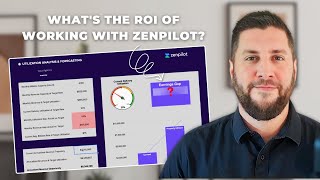
Gray MacKenzie, founder of Zenpilot, walks through the financial case for his operational consulting firm. He shows how professional services firms improve productivity, profitability, and team health through his process, with detailed numbers on what clients actually gain.
Is it really worth it to work with Zenpilot? That's the question I want to answer here together. My name is Gray MacKenzie, I'm the founder of Zenpilot. So you'll never guess how I would answer that question, right? No, I'm just kidding. There are situations where it totally makes sense. It's almost a no brainer. You look at firms like LegalZoom, Trinity, Veeam, Content, Gravity Global, really, really high level operating teams who have worked with us and who have the data to say, hey, this is absolutely worth the investment. You can see their stories, you can see other stories if you go to our website and look at security success stories of what that ROI looks like. But there's other situations where it does not make sense to work with us. And so I want to just take a couple minutes to try to dig into, hey, how do we think about that? How do we look for roi? How do we justify is this investment worth it from prospective client side and an actual client side? And then is it also worth it from the Zen pilot side? Is this an area where we want to put our effort into an engagement together? And so I guess the real question is like, is investing in gold standard operations worth it? And then the secondary question is if the answer to that is yes and worth it has to do with the investment and the return. So I want to talk about how we measure the return because we'll be able to help you walk through, hey, here's what we think the investment is going to look like to get to where you want to go to. But really the that's the fundamental question, is investing in our operational infrastructure, is that worth upleveling? And the second question to that is like zenpilot is one of the ways that we get there and what's the best way to get there? And best is some combination of what's the overall cost, how many resources it's going to take internally, what's the cash exchange that happens in the engagement. Least risk is a huge piece of this. You can certainly find more expensive, less expensive ways for just about anything. And a lot of this boils down to have we screwed this up, this has more repercussions. Like, this hurts us way more than just the biggest cost is not the actual dollars that we spent, it's what happens if we get this wrong. So what's the lowest risk way to get there? And then obviously time is another element that plays into that as well. So best is some combination of all three of those. Everyone leads those a little Bit differently, but all three of those play into it things. So let's talk about what return looks like on this and we'll break it down into three main categories that are three main categories in our mission statement, which is we are here to help build more productive, more profitable and healthier teams. And so that productivity, profitability and team health. Each of those components are where the ROI primarily shows up. It shows up in a bunch of different ways. But let's talk about productivity for a second. That's gonna be the first way that most teams feel a lot of impact. First thing is as we're initially designing the blueprint together and we're going through the first stage of the process together, there's almost always unlocks. Just as we go through our operator assessment and we're leading the conversation, the discussion around that, there's almost always questions no one's posed before and there's almost always a handful of unlocks of like, I don't know how we didn't see this issue and some quick wins there. But most of the time we're going to see productivity gains before profitability gains. It's not always that way and I'll explain why when I talk about profitability. But we're basically creating productivity unlocks more supply, supply being our time to go fulfill new client work. And so we're unlocking more supply and then it takes some time to fulfill that supply, you know, create the demand, the paying demand for that. So we're able to repurpose that excess time that we create through being more efficient. We're able to reallocate that to internal work first. But we ultimately want to fill most of that supply with client work in most situations. So productivity, of course, is not just efficiency. Efficiency is part of it. How much faster can we get at this? The other piece is what's the quality of the work and the outcome of the work. And better processes, better communication, better visibility through that whole thing improves both of those more efficiency and better outputs. So that's kind of the first part of productivity. The second part of how productivity helps create more profitability as well is it increases client health. So doing better work faster is always a great thing in a client relationship. That's going to increase the health, that's going to increase and improve the strength of the relationships that you have. And it's going to increase your ability to monetize both through better retention, especially if you're a retainer or subscription style firm or if this is upsells or, you know, ongoing work in a more project oriented firm. So that's the productivity side and that can be really massive. We'll look at some of this when we talk about the math of hey, how are we looking at this and measuring this? The second piece is profitability. So this is intentionally part of our mission statement. If we work together, this should impact your bottom line in a really healthy way. And you're totally fine to take that and say, hey, that we're for sure going to improve gross profitability. If you don't want that to hit net, if you've got other places you need to go invest, that totally makes sense. Just like driving a car, the faster you want to accelerate, the lower your fuel efficiency goes. Same thing, you might say, hey, this is great. Now I've unlocked this extra 10% of profitability and I want to invest that all into growth. And I realize we're going to be less efficient at it for a little while. Our business is not going to turn off the cash that could have turned off otherwise. But we'll take that gross profit and we'll take it from the services side of what we're doing, keeping our promises to our clients and we'll invest in making our promises to our clients, in our marketing and sales efforts. So profitability improvements for most of our clients come in two waves. There's the first wave, which is that first time, that first set of data that says you're losing money when you deliver on this specific type of service or this specific client is massively underpriced and you either need to fire them or reshape this unless there's some extenuating circumstances where you ought to be continuing to work with them. There's some strategic reason that that makes sense. But there's almost always some immediate stuff that services sometimes that is, I didn't realize it, but this person is, you know, basically pointless to have on the team. And I think sometimes this feels very unfortunate. Hey, we've got to lay somebody off. This is a not uncommon consequence of the work that we do with teams is that there are layoffs made relatively quickly once we improve productivity and once there's clarity around what's actually on people's plate and what they're doing. And I think in the short term there's definitely pain that goes with that. Um, that's hard for any entrepreneur. I know having been in that seat, that's hard for any entrepreneur to do. But that's a huge opportunity. You're helping someone graduate to a better long term opportunity for them as well, and so I think love is doing what's ultimately best for people. And if that's ultimately best, it's better to do that earlier rather than later. And then long term benefits come around. Better utilization, better pricing. You're getting both. The post sale side, hey, we've sold it at this price. This is the whole fulfillment side. Now we've got to do that and we want to do it as efficiently and as well as we can. And so that's the utilization side and the productivity side. And then there's the presale price which is, hey, if we have more accurate information about what it actually takes to deliver on this and what our bandwidth is, that can shape our pricing and we know how to fill that supply better. So there's both pieces that come from that. Then obviously from a team perspective you will see increases in profitability over a longer time horizon around less turnover, less having to go recruit, go through the hiring process, go through the onboarding process from that perspective as well. And that ties right into team health. So the first way that team health shows up is first there's the almost therapy session of the, of the blueprint process. We have to work pretty hard to keep this somewhat contained and not let it turn into, it's. There's unhelpful venting and then there's, hey, there's issues that weren't surfaced before that we need to get on the table, make sure we're all aligned and everyone's bought in and then we can go solve these together. That is helpful to get stuff surfaced. We then need to solve those as quickly as we can. And so that next piece usually comes in the form of comments that you'll hear from the team around visibility. Hey, I've got, now I can actually see what's on my plate, how it's expected to be done every day. And that feels so much better to the typical employee walking into a team, the typical individual contributor, the typical, really anybody on the team knowing what's on their plate and also knowing that at the next layer up, hey, what we're doing from a capacity planning and forecasting perspective is impacting me in a really awesome way. So that's the first piece of team health and that winds up rolling into a bunch of other clear communication, clear expectations. Clarity truly is kindness. That's a huge part of it and it's a huge part of retention. We create a saner work environment. A lot of the chaos, we're just systematically going through and replacing the chaos with clarity. And even when that clarity doesn't feel like kindness. It truly is. Sometimes that clarity is you're substantially underutilized. We've got to improve, we've got to increase those improve and increase blended together. We need to increase your output and we need to find a way to do it at least keeping the same standard of work if this is going to work. And that does not feel like kindness. The first time that you hear that as a team member and ultimately that's the, you know, the kindest thing that you can give people is that gift of feedback and help them become a better performer. Teams love to be high performing. I'm sure you've experienced this and lived through this. The highest performers on your team have all kinds of options to jump ship. They can go get a role anywhere. We are the first, the largest, the most well known, the like the flagship name in this small pond of ClickUp consulting for teams. And ClickUp's kind of like the, the veil on our business model. Right. We're here to help teams get more productive, more profitable and improve team health. And we do that through the lens of this very tight note focus so that we can go super deep and produce consistently awesome outcomes for teams. Well, because of that, because of being the big fish, even in a small pond, our best people have so many options to go wherever they want to and so they'll stay here as long as this is a high, high performers are the first ones to jump ship and go because there are a lot of options for them. And so improving overall team health and improving the percentage of folks you have who are high performers on your team and the overall outcomes, that's what everybody, everybody wants to be impactful in the work that they're doing. We, we all really long for that and to have clarity and that to be really clear to the leadership team if they're doing an awesome job so that they're getting rewarded and recognized around that. So anyways, that's some and that all plays into then retention and retention of the people who you want to retain. So those are some of the ways that the return on the investment that you make in working with M pilot show up. And now what I'd like to do now is just take a couple minutes and walk through this agency operator scorecard. It's going to be applied to a bunch of different business models but we're going to take the professional services business model and walk through some of the math and examples of where would this make sense and where would this not make sense to work with Zenpilot let's dig in. Okay, so we talked about some of the ways that return on the investment of working with Zenpilot or return on the investment into gold standard operations will take shape. We talked about productivity, we talked about profitability, we talked about team health. Well, let's look at something here in the agency operator scorecard is I'm going to pull up here. This applies to primitary professional services business. But we're going to walk through some of the ways that we'd go about looking at what's the size of the opportunity. So I'll pull up my screen here. We've got the intakes, right? So here's our inputs, our delivery FTEs. So full time equivalents. How many folks on the billable side of what you're doing do we have? So if we're talking about a classic marketing agency, you've got maybe a person in this example, this is a 30 person firm as a real life example, 30 person firm, they've got two founders who are excluded from client work. They've got a full time salesperson, they've got somebody who's part time in marketing, they've got some ops folks and they've got somebody in leadership as well who is not focused on client work specifically but 24 of the 30 team members. So if you break that down into sixth, five sixths of the team are on the delivery side. And what's our utilization target for that specific subset of the team? And for most healthy agencies it's going to be 80 to 85%. There's some businesses like law firms where the utilization targets are substantially higher. There's some law firms where there some service firms where the the utilization targets might be a little bit lower but generally it's going to be in that 80 to 85% range. Then your target billable rate. So what are we aiming to meet, you know, every one of those hours in utilization again is just the percentage of overall hours. Say we're hiring people for let's say 40 hours a week on a full time basis. You know, I want them to be spending 32 of those hours on client work. And of those hours I'd like to be earning $200 for each one of those hours worked on client projects or paid work. Then we'll take their average current monthly revenue in this case is a $3 million a year firm, so 250. And then annual growth rate. How fast are we trying to grow? We'll talk about where that plays in here in a second. But just Some of the inputs, 51 clients, mostly retainer based, but not completely client retention numbers. And NPS would love to see retention be a little bit better. NPS is actually pretty good. We can walk through the rest of these if that makes sense. But I'll just do kind of an abbreviated example. If you want to go through all of these metrics with us for yourself, go to zenpilot.com call book a call and we'll walk through your situation together. Okay, I'm going to go into this utilization tab, which is where we see the most immediate impact from for most teams. So we're looking at what's our total capacity right now? Billable and if we took kind of that total. So this is 24 team members times 40 hours a week, or 167 hours a month, or 173 hours a month. I guess technically it would be the average here. That is our, that's our total amount of opportunity that we've got to sell into. Right? So that's where, that's where we're winding up with that number. If we sold every single one of Those hours at $200 an hour, that's our target billable rate. We could make $832,000 a month. But that's not our target. To be clear, our target Is to do 80% of that. That's our, this is, you know, target utilization. And so 80% of those hours. So what is that? 4,160 3,328 hours at 200 an hour, it gets us to the 665 number. Right? Track with me. Well, that's not where we are today. And so this is the point that we want to have clarity into. So we talked about creating clarity for everybody on the team. How do we get to that clarity of knowing, hey, where's our time actually going? What are we earning, which projects are profitable, which ones aren't, what clients are profitable, which ones aren't, what departments are profitable, which ones are less profitable. So we've got some options. Let's just assume that the team is working at 200 an hour. Every single hour that they're working on client work, you're earning 200 an hour. That's awesome. Right? Well, if that was true, they're only utilized 30% of the time. So we are way overstaffed in this example. Odds are that's, that's probably not true. Let's go the other way and say, hey, we're actually fully utilized. Everyone's working, you know, on average 80% of their week is going towards paid client work. Well, then our current average billable rate, what we're actually earning effect and the other way to say this is effective hourly rate is actually only $75. So less than half of what we're shooting for, obviously. And so we're 50% below if we're saying, hey, we're earning the right number per hour, we're just not fully utilized. Or if we go the other way, we're missing out on $125 an hour, all these hours that we're working. So in that case, we're significantly underpricing work. So it's one way or another, either we're significantly overstaffed or significantly underpricing somehow. If we just looked at, hey, what would you do in revenue, you growing by 15% this year? We'd project the next 12 months to look like this. If we got to the numbers you wanted, here's what the, you know, what you're targeting, here's what revenue would look like. Well, that means we've got over a $5 million opportunity here. If in your market and geography and current team structure and everything else, these inputs are realistic. So we're trying to establish is, is there a big enough opportunity for us to be interested in getting involved in solving and also to highlight for you, is there a big enough opportunity? Have you done this math? Have you thought about this and figured out how am I going to get there? Because this is not just a Zen pilot thing to come solve. Like, we're not going to come in, plug in some ClickUp stuff, train your team. That's not like, that's the very granular details. That's the end of this. This is not like the strategic part is how do we actually take advantage of that opportunity? And almost certainly in a team like this, what this is going to look like is simplifying and clarifying. And we are almost certainly in this type of opportunity unless there's a growth lever to press to grow substantially or increase pricing substantially. More often than not, this is going to be a case where you're going to downsize the team. Once we figure out the efficiencies and tie that in, okay, if we look at overall utilization of the firm is 24%, that's too low. This is a, you know, a sign that, hey, either we're substantially underpricing and $200 an hour is either not realistic or you have not figured out yet how to make that realistic, or you're substantially overstaffed and we need to trim back. So this is just some of the math of like, hey, how do we get there? The first thing that we're going to see as we make progress towards these targets of 80 utilization and 200 an hour, first thing we're going to see is efficiencies. And that's actually going to most likely decrease our utilization. It'll increase our effective hourly rate. So this will go up. But our actual utilization, let's say today it is actually 80%. We look at the numbers, or you even have the numbers, and we're seeing 80%, but we're seeing this kind of performance. We're say, hey, there's probably a pricing problem here as a half of it and the other half, and I'm using half here kind of generically as a bucket for like, hey, there's some percentage and we need to have clarity on what that is. But the other half of that is how do we create the efficiency so we can earn our revenue more efficiently and therefore be more profitable? Look at some of the drivers of efficiency. You know, earnings per FTE is not uncommon. To see a firm that's making 100, 125, 150 per FTE, obviously in this case, their target is to do over 260. This would put them in a very, very healthy place in terms of earnings per fte. It's not where most folks get, it's where most mature teams. There are certainly teams, we've worked with teams that are making 600k per FTE, but most mature firms are somewhere between 220 or 240 and 350 per FTE. All right, what drives that efficiency? And so here we're going to just do some modeling out around what's actually achievable based on your current setup. And this really does not come until we're actually behind the scenes in the weeds of getting there. We'll certainly have this conversation on the front end with folks, and you should have this conversation right now. But until you dig in, it's going to be hard to identify how much are we going to be able to pick up by getting to a single source of truth. Easier to use standardized processes. So both, both of those, like, how does work get done the right and best way by everyone, every single time. Getting rid of delays that are unnecessary is a huge problem. Anybody in a professional services firm is familiar with this from a client approval perspective. So frustrating to have work done and then have it sit there for you. Rush to get something done, have it Sit there for a week where you get approvals. There's a million different things that you can do to improve that. But there's really like two or two or three key things that are the right steps for most teams. No drop balls eliminating client fires like how do we consistently set and clarify expectations, then meet those time after time? Talk about all the drivers and where this goes. You can look at this from a tech perspective. This is the place that everybody starts because the easiest way to say dollars in dollar savings back out comes from tech. But this is always going to be the least like you should ignore if ClickUp's the right tool for you for your team, you should use it regardless of licensing cost. If money.com is the right tool for you, you should use it regardless of licensing costs. If productive IO if notion if you whatever the tool is, you should almost certainly if that's going to be the hub of your project management, you should almost certainly use that tool at almost whatever price versus trying to hack it together to save money. This is an example with a team that was coming off of an older agency focused system, but very clunky ui they had to tag on another time tracking system. And when you're looking at the other costs they're wiki systems that they had and a couple other tools were able to get eliminated. And even with 30 people and moving to ClickUp they're saving 30 grand in year one that is. And even if you annualize this out and you go you look forward three years into the future and assume that prices just advanced at the same rate between both it's 100k that is so much easier to make out of improving your utilization and the way that your your team is performing and your clients are paying you than it is to make on the tech side. So this is sometimes helpful especially in enterprise situations. These numbers can be quite large and sometimes this is just how decisions get made. But it's an extremely short sighted way of making decisions and not kind of seeing the full the full picture here. We talked about that component of cost savings as well. But just like for the average household, the average employee somewhere in the U.S. the answer is less about hey, how much can I restrict my spending? There's certainly I'm the first person to advocate for really sound fiscal judgment and forecasting and budgeting. But for most people it's going to be way easier to go get a 10 or 20k pay increase over some period of time than it is going to be to save that amount of money. That's not always the case. There's certainly times and you probably can think of people where it's like pretty easy for them to cut 40k out of their annual budget. That might be you, but for most of those people it's going to be easier to go make that money up on the income side than the opposite side. Not a reason not to do both. Like let's, let's aim to do both but just realize there's only so far we can go on the cost saving side and then the other side there's a lot of opportunity so let's go capture that. Or and I don't even just like that has to be more sales into whatever else. That's almost always part of the equation. But it's really, it'd be way more if like we could get to that same cost savings by being able to cut one fte salary from the team then go do all this tool maneuvering. So I'm obviously, you know, you'd think in my seat I'm highly incentivized to get people to switch tools or jump onto ClickUp. If that's the number one argument is just cost savings, I will almost never tell somebody. Yeah, you should definitely do this. There's gotta be a better, more compelling reason than that. And the math should speak for itself. Well, thanks for walking through the agency operator scorecard with me. Like I said, would love to do this exercise together with you. Go to zenpilot.com call book a call with our team and we'll walk through the math of improving OPS in your situation.










