Why the HubSpot Admin Is Your Next Big Hire | HubSpot Admins HUG | October 19, 2022
Kyle Jepson and Jason Azikar, founder of Hub Search, discuss why HubSpot admins are becoming critical hires. They cover market demand, salary trends, required skills, and how the role differs from RevOps professionals, plus strategies for recruiting and retaining this specialized talent.
I am so happy you are all here. Welcome. I totally did not forget to hit record and now I'm going to pass it over to Jason who founded Hub Search. Jason, tell us what Hub Search is.
I'd be delighted to. And luckily I didn't have to do it alone. I had two amazing co founders. My wife Bridget and our VP of sales, Megan Prescott are two, two phenomenal co founders. That helped, that helped me build this thing. I'll start a little bit before Hub Search to set to set some context. So I worked for HubSpot for years. I was very fortunate to be at HubSpot from 2012 to my team and I were the tech recruiting team. So I led tech recruiting for HubSpot. So we were responsible for hiring all software engineers, designers and product managers for Cambridge and Dublin. And it was amazing. It was a wild ride. It was a blast. It was during like true hyper growth, like just pre IPO and post IPO mode. After HubSpot, I wanted to do some really cool consulting, basically teaching tech startups how to build talent programs, how to recruit. And then in 2019, Bridget and Megan and I put our heads together as we were thinking about spinning up a business and the idea of how is there not a recruiting organization fully devoted to the HubSpot ecosystem was just an idea we couldn't get away from and we really felt like there was something there. And as we started to do more research and really dig in, it became clear that there was a huge opportunity and that the ecosystem had finally become big enough to desperately need a recruiting company that like planted the flag in the ground and said like, we are gonna, we are really gonna own the HubSpot ecosystem and, and really specialize at helping organizations hire people who know the HubSpot product. And that's where this thing came from. And three, three years in and going strong, got an amazing team of 16 all over the country that just do, do unbelievable work to help companies hire amazing people and to help the candidates we work with find their dream jobs.
That's awesome. Thanks so much for sharing that. So Jason, perhaps more than anyone else on the planet, he and his team have eyes on how the jobs inside the HubSpot ecosystem are growing and developing. And he has some, some key insights into this idea of a HubSpot admin and whether it's a real thing and what it looks like and, and what we can expect from someone who calls himself that. He has some slides and things prepared, but I want to call out if you have questions if there are things you want from, I'm going to say, the world's leading expert on jobs in the world of HubSpot, drop them either in the chat or the Q and A. I will be monitoring both. If you have a question that you feel like is maybe a little off topic or can otherwise wait till the end, drop it in the qa. We'll get through as many as we can when, when Jason's done with his prepared remarks. But Jason has told me he's happy to be interrupted. Make it conversational. So if you have questions, if you need clarification, if you want to hear more about something that he talks about, not in depth, drop it in the chat. I'll be sure to, to halt the conversation and make sure we go down all the different rabbit holes until we've covered this topic in depth. So, yeah, Jason, you want to tell us a bit about the outlook of HubSpot admins, what you're seeing from your.
Oh, for sure. And before I jump into the slides, let me just say that, Kyle, I could not be more thrilled you're doing the work you're doing. I mean, I appreciate the kind words you said about the place that we've gotten this ecosystem, but you also just are so central to this thing. And the HubSpot admin in particular has become a topic that I get to talk about. We get to talk about an awful lot because we're, we're watching this thing become a thing right before our eyes. And I'll talk about this when I go through some of these slides, but this just wasn't a conversation three years ago. I don't have to go back three years, a year and a half ago. This wasn't really a conversation. Like when we started Hub search. There was no demand, no request for this type of a role. Yeah, I'll talk more about like, what that means and what, how we're thinking of the definition of what a HubSpot admin is because it changes and it's totally fluid and it's, it's being created as we go. But I'm just glad that you're shining such a light on this thing because the ecosystem desperately needs it and it exists. And now you're finally bringing a way for us to like quantify HubSpot admins, which is going to be such a super powerful thing. So.
Yeah, and let me just pass that praise on to the 68 people who are here. You know, the theory that maybe HubSpot admins don't exist is, is not tenable anymore because look, here you are, a whole bunch of you all together, showing up for events in the middle of the day. And so, yeah, I. I'm very excited to see where this all leads in, in the rest of this year and in 2023 and beyond.
You got it. All right. This thing is asking me for permissions to share my screen, so let me make sure that this is going to work. Bevy is an interesting platform.
That's a nice word for it.
Let me see if I can make this work here.
Things we should have tested before we started.
Think we got it. Can you guys see this?
Yes, we can see that. Perfect.
All right. Nailed it.
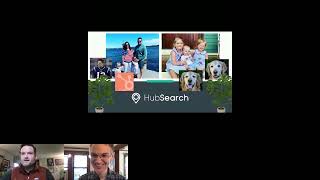
All right, Perfect. So first of all, Kyle, thanks for inviting me here. This is awesome. I love to get to do this type of stuff. So let me go through some of these tabs. The first one is just a quick, fun, photo filled intro. So again, you know, I'm Jason Azikar. I'm the founder and CEO at Hub Search. It wouldn't exist without my family, my amazing wife and co founder Bridget, our kids who have been an inspiration to us, Moose and Conway, who we lovingly call our Chief Happiness Officer and our Chief Security Officer. Conway is our Chief Security Officer. He keeps us safe from wild turkeys and squirrels and such. I wouldn't be doing my Boston roots justice if I didn't have a picture of Tom Brady in here because he's just, he's. He's my icon. He always will be. Him and Dharmesh, I mean, they all, they hold pretty, pretty equal places on that, on that pedestal. And then of course, I put the HubSpot logo in here just as a reminder to mention that, you know, I, I did. I. I think I will always bleed orange a little bit. I mean, those three years that I spent on HubSpot were. I mean, it changed my life. It really put my career on this, on this trajectory that led to Hub Search. You know, I got. I've been recruiting and in people ops and talent for almost 20 years, which makes me feel old to say that out loud. But I got super lucky to be in the Boston tech scene at just the right time. I mean, I was the first full time recruiter at Wayfair way back in the day, before, it was before Wayfair was Wayfair CSN store. So I got in really early at Wayfair, which was awesome. Then I got recruited to go to HubSpot, which was just this amazing time. I mean, there was seven of us on the talent acquisition team. That team 60 or 70, maybe even more globally. It's just become this behemoth and they, you know, one of the things that I was so fortunate to be a part of at HubSpot was really early and really cutting edge recruiting tactics that just companies hadn't really thought about. I mean, it was the first time that tech companies really started to have to think about recruiting as a marketing function, as an employer brand function. We just got to do some really cool stuff. So that was amazing. All right, so some of the stuff I most want to talk about today, and I hope what, what our audience here today comes away from is from our perspective, from, from the Hub Search perspective. And we're just, you know, we've got this really cool lens on this ecosystem that we're squarely in the middle of. First of all, what the heck is a HubSpot admin? Because everybody you talk to is going to define it differently. And that's, that's not, I don't know that anybody is going to be incorrect in their different definition because it's, it's changing. It depends on what company you're at, what type of HubSpot instance they have. I mean, it depends on a whole bunch of things which we can talk about. But I want to try to add some color commentary on how we're defining what HubSpot admin is. Where did it come from? Because it's a very new thing. Like I, like I said at the opening year, this, it just wasn't a thing three years ago, maybe even a year and a half ago. Like, this is a very new concept. I for sure want to talk about the marketplace demand. I mean, it's, it's, and I'll talk more about this, but it's become a thing that our clients are demanding most frequently of us.
Oh, wow.
I think, I think I'm jumping ahead a few slides here, but I'll just say this now because I think it's a really important statement. When we started Hub Search, most of the stuff we were working on was some flavor of, hey, we need a great digital marketer who knows HubSpot. It was some flavor of that. It was mostly digital marketing, inbound content, et cetera. Right? What you'd expect from a marketing hub practitioner professional, that has very much changed. We still see a lot of that, but by volume, the most common thing we get asked to work on now is much more akin to the HubSpot admin.
Right?
Really, the technologist, the ops professional, the person who's most responsible for owning HubSpot instance architecture, infrastructure, data. And I'll talk more about that when we get to the definition, but that has become the most requested thing. Megan, my co founder and VP of sales sent me an awesome stat. She said, out of the last 30 sales calls that we've had, 30 discovery calls with brand new potential clients, 14 of them were asking for some flavor of a HubSpot admin. Whoa, that's wild. I mean, almost half of the requests we're seeing are for this type of person. An OPSI technologist sysadmin for a HubSpot instance type of profile.
You hear that, friends? You guys are in demand.
Oh, without question. And I just, you know, one of the things I want to do here with one of the, with one of the last slides is talk a little bit about HubSpot ecosystem compared to Salesforce ecosystem because that's the trajectory that we're tracking and it's just the demand is going to skyrocket in years to come. I think Dharmesh himself actually said this at some point on one of his YouTube. One of his YouTube videos that he does on startups. He talked a little bit about if he was starting his career, he would choose to become a HubSpot technologist today because that is going to be massively in demand in the near future.
That's awesome. Just to interrupt you here real quick, not a question, but I want you to know that in the, in the chat here, Alison Gilson has said, yes, I am a HubSpot admin recruited by Hub Search, but my title is Rev Ops Manager.
So love it.
Happy.
And I'll talk about that because the HubSpot admin title has a bunch of other potential titles.
Right.
It's like it's, it's still not quite a defined thing, but that's awesome. And Kyle, just so you know, I can't actually see the comments in share.
No, I know.
That's why I missed anything.
Yep, that's my job. I'll be here.
All right, cool. And then we'll talk about what companies need to hire a HubSpot admin. Because it's, it's many, but not all. And then how do you become a HubSpot admin? What's the, what's the career trajectory? What's the course? What should you be learning? Like, let's talk about all that stuff. All right, so here's just an interesting sort of macro stat that I wanted to put out there that talks about salary and comp expansion across all of the placements that we've done where HubSpot Admin is a huge part of this. This is substantial. I mean, over the course of a year, we've seen the average salary of the candidate that we place increase from 79 to $88,000. I mean, that's substantial. There's, there's a, there's a lot there. You know, I posted this on LinkedIn a few weeks ago and I got a bunch of comments about, well, is that just inflation and is it a part of it? Sure, but it's, it's definitely not the full story. Right. I mean, as, as I think all of us sort of recognize salaries and comp rates are definitely don't, definitely don't have a one to one relationship with inflation. If they did, we wouldn't be worrying so much about inflation. Right. Salaries grow much more slowly. So there's, there's, there's a lot going on in this slide and really what, you know, if I had to talk about one thing here, it's the fact that this ecosystem is starting to become more focused on technology first candidates. Right? Technology first systems and ops first people. Not to say that great marketers don't have a ton of demand. Of course they do. And great marketers can be technical. But the demand for us is really starting to shift to, you know, I'll say it in kind of narrative form. We get a lot of requests for like, hey, we've got a good marketing team. What we need is someone to really squeeze every drop of performance and ROI out of our HubSpot platform, make sure it's humming, working at its most operationally efficient pace, and that the data is excellent. Right. So just a different, just a different, a bit of a different profile than the traditional inbound marketer.
Yeah.
That's awesome. And I, I mean, maybe you'll get to this. So this is, this is just me maybe getting, getting the cart ahead of the horse, but I would. How do you, as you look at candidates, how do you identify someone? Who is that? What, what, what experience do they have or how do they, how do they prove that they can help someone squeeze every drop of ROI out of it?
Oh, that's a great question. It's all through interviews. So one of the things that we've spent years doing is building a database of people that we've spoken to, people that we've interviewed. It's candidly, it's, that's our, that's our superpower. Right? I mean, we've got a database of over 7,000 people that we've interviewed that we've talked to that we've had meaningful conversations with over the years that have convinced us that they've got some, some strong level of HubSpot skill. And really the way we recruit generally is very proactive. We reach out to people who look amazing that we should know when we go, hey, what's your dream job? What do you want to hear about from us in the future? And when we see that, we'll reach back out. And then once we find, you know, an opportunity with one of our clients that feels like a great fit, we reach out. We do, we do a role specific interview and we really get into the weeds on what are you doing, why are you doing it, how are you doing it, who your stakeholders, who do you report to, who you report out to. Really just get a clear sense for how are you leveraging HubSpot? Because the thing that our clients lean on us for is that they don't, they don't end up speaking with candidates who haven't convinced us. And my recruiters are exceptional interviewers. Everybody who gets to one of our clients has to convince us that they've done sophisticated, complex, meaningful work in HubSpot that's moved the needle on their business. Like, that's the thing. That's the thing people have to be able to convince us of to get through, to get through our initial interviews.
That's amazing.
And that's a lovely tie in Kyle for the future HubSpot Admin cert.
Yeah, well, that's the problem I'm trying to solve. Right. Like, I had a conversation with someone once who, you know, leader in a company using HubSpot who had just kind of crossed that line where they were looking for that person who can help them get the most out of what they're paying HubSpot for.
Yeah.
And they got this candidate they were really excited about. Seven years of HubSpot experience. Awesome. But it turns out it was seven years of HubSpot experience as a sales rep. Right. They had been using deals and sequences and contact records, but they had never added users, they had never imported contact. They had no idea, like, whether the automatic association setting should be turned on or off. Right. And like, that's not what they were looking for. So, like, years of experience using HubSpot is not. It's a great metric if you're doing the right kind of work in HubSpot, but it's no guarantee. Right. Because there's so many different things you might be doing in HubSpot.
That's gonna be a really cool addition to this ecosystem of the certification. Like just in our world, we're gonna be able to say to the companies we're working with, like, we think that we know this person's amazing because we interviewed them and here's a bunch of data. Oh, and as a major bonus, they've been able to pass the HubSpot admin certified. So you, you know, there's, there's legitimate quantifiable proof that this person has done really hard stuff in a HubSpot portal. Because one of the things that we heard, one of the biggest pain points that we heard early on from, from our clients was this really unfortunate recurring narrative of like, hey, we hired somebody. They convinced us they knew HubSpot, but we don't know HubSpot, so we didn't really know what to interview on. They had a couple of academy certifications, so we just figured they knew the tool they got here and they couldn't do a lot of the more complex work and it didn't work out.
Yeah.
And that's, that's one of the reasons why we designed the interview questions. You know, the HubSpot skills interview questions that we have so that we can, we can help alleviate that pain from our clients.
Yeah, that's huge. I mean, I, I work at HubSpot Academy. I will never say anything unkind about it, but I'm not convinced that our certificates as they currently exist are necessarily like an indication that you should hire someone. Right. Like that's not exactly what they're for. I'm hoping this admin cert I build will be different from that. But it, it, it has to be. Right? It's something much more robust than I can watch some videos and watch some comprehension answer some multiple choice comprehension questions afterward.
I, I so agree with that. Like the academy is amazing. It's, it's an incredible wealth of super valuable information and how to guides and you. Everybody here knows how amazing the academy is, but there's an awful lot of certifications you can get without ever having to do really in depth technical complex. In an enterprise level HubSpot portal, for example, being able to show that thing as a badge will be super valuable.
Yeah.
Real quick, before these questions, scroll into the ether and lost forever. So two different questions. I'll let you decide which one you want to handle first one is when in addition to tech skills, how important are communication skills with multiple teams? Sales, marketing, ops when you look at admin candidates. And then the other, which I've lost. Oh. Is should we talk about how rev ops and admin get confused and mixed up all the time. Do you want to talk about like.
Oh my goodness, I love that question. Yes, for sure. Let's. Let me hit both of those. Okay. So communication skills are prerequisite, right? It's like. And we talk about this when we do searches sometimes. Well, I shouldn't say sometimes. We talk about this with our clients all the time. It's like we're going to show you candidates that have convinced us that they have these HubSpot skills and all of the other things that go into what generally make a successful professional.
Right.
Like great communication, organized. They responded to us in timely fashion through the process. They were, you know, thoughtful and just. Communication is critical.
Right.
I mean being an. You can be the most technical person in the world, but if you can't effectively communicate with a bunch of different internal stakeholders, it's going to make being an effective admin nearly impossible. Because the admin sits at the center point of various teams, you've got to be able to manage complex like upstream downstream communication. And the rev ops to admin thing is, is something we I think a lot about and I talk a lot about because they very much get confused and they're similar but they're not the same. And here's how I think about it. I think revops some of the skills are very similar but rev Ops is closer to the business and what I mean by that is RevOps is closer to strategy around how to optimize core business metrics and drive revenue more efficiently. Where the admin is closer to it and systems management. I hope that makes sense. And the way we talk about it is the HubSpot admin is really the person who sits at the center point amongst various teams. Like by the way, in a future state we're going to see lots of bigger companies have a rev ops manager or team and a HubSpot admin that is a wildly dynamic and powerful duo. Having both of those people will enable mid market and enterprise companies to do really valuable things with HubSpot and the data and automation et cetera and integrations and. And so on. But yeah, RevOps is more business strategy, revenue growth, revenue and growth strategy with a bunch of systems included. And the admin is really more HubSpot infrastructure, automation, data cleanliness. It's really becoming. It's not quite there yet, but it is evolving to really become a CRM heavy role.
Yeah, yeah.
And that matches my intuitions as well. I like what Dana Gilof says here in the. In the chat. Why versus how right so Rev Op is, is kind of up there.
Yes.
At the strategic executive level. How is this business as a whole going to generate revenue and, and grow and then HubSpot admin is, is the execution piece. Like we know what we need to accomplish. How are we going to use HubSpot to, to get us there?
I, I totally agree. And like I said, I think, you know, a lot of savvy companies are going to have both and that is just going to be a wildly powerful duo.
Yeah.
Sorry, one last that just came in. What are you seeing for the balance of technical chops versus strategic thinking at? I think for the admin level?
I mean, every company wants both. Of course.
Right, of course.
It's, it's so common that we, we have to have the conversation. You know, company comes to us and says, okay, here's what we want. And in many cases they're, they're well scoped and reasonable and, and reflect the reality of what one human being can accomplish. But in a lot of cases we have to go back to companies. Go, guys, this is, this is two humans. What, what you're talking about is, is two different people. And it really is back to this conversation. Like you're, what you're asking for is a really skilled Rev Ops strategist. You know, the strategist piece gets left off that title. I think of Rev Ops as strategist combined with somebody who's so deeply technical that they could be an admin and there's a bunch of crossover. Right. Of course, very few people are going to be totally pegged one way or the other, but our job in, when we're interviewing candidates and working with people and companies is to figure out what's the right balance of strategy to technology.
Love that. I'm going to let you talk for a bit. There are more questions coming in, but we'll get to it. I want to know what these slides mean.
Okay, cool. And I can get through these reasonably quickly. So one of the things that we, my team and I wanted to do for the audience here was show the escalation of compensation. I mean, this is just said very plainly. This HubSpot admin space is an unbelievable opportunity for people in this community to earn right. There's going to be a lot of financial benefit to working your way into a HubSpot admin type of position. So we do a lot of community polling and a lot of it is narrative over, over conversation with clients. We run a lot of like feedback surveys. We put a lot, we push out a lot of polls on LinkedIn and this is what we got last year. So I'll show, I'll show the delta between last year and this year. Community sentiments. Last year almost half of our respondents said that a HubSpot administrator, technologist, product owner, whichever word you want to use was somewhere between 75 and 90 and 40% said 90 or better. Those numbers have substantially changed even in just a year. I think it's actually two slides forward. But this is the data that we compiled. We took all the sources of data.
Right.
And one of the one huge source of data is of course what our clients are willing to pay.
Right.
There couldn't be a greater primer on what the market will bear for this type of thing than what companies are actually saying. Here's my budget for this thing and what candidates are telling us they are currently making and what they need to be at.
Right.
And I, this, this mid range I think is just, is so important. Four to seven years is going to be somewhere between 85 and $125,000. Those are, you know, that's, that's what we expect to see in this space. And once you get up to 7, 8, 9 years of experience in this world, 125 to 150 is, is absolutely reasonable. There aren't a whole lot of other really HubSpot specific roles are going to get, they're going to get people into these types of substantial earning ranges.
Yeah.
And it's, it's, it's super exciting to see. I mean that's, you know, and this is just base salary and a lot of companies will have that, this type of structure plus incentive plus equity plus plus all sorts of cool stuff plus you know, full bennies like this is just base cash.
That's awesome.
Here, here's just some examples of some other polls that we ran. So Bridget ran one, one of our recruiting managers, Ken ran one, you know, and this is, this is a little, this, this is more from this year. So you saw the 2021 stats this year we're seeing more like 90 to 125 was the number one response.
Right.
For. And Kyle, this, this one was a shout out directly to you. This is, we asked.
Yeah.
For a certified HubSpot admin when that's a thing with about six years of experience, what would you expect to have to pay people? Peep. The community is telling us 90 to $125,000 base salary. That's pretty good.
Ah.
And we got, and Ken, Ken's poll actually even peaked a little higher than that. His primary respondent section was 125 to 150. So again the broad message here is awful lot of earning opportunity for people in this space and people who are working their way toward getting into this space. And I definitely want to talk about what that means. What are the types of things you should be focused on? How do you, how do you work your way from, you know, let's say you're I don't know, two or three years out of school and you're I don't know, pick a thing, a sales ops person. How do you, how do you parlay that and build on your skills to become some, you know, 30 million dollar mid market SaaS companies, HubSpot admin in a few years. Yeah, I think that's an important conversation.
Yeah.
So just Ashton, no Roman asked, do you have any statistics for HubSpot integration developers? And Ashton shared a link to the full thing. But I, I, you mentioned just kind of in passing that this is kind of like as high a salary range as you see for, for HubSpot related roles. How does, what is that shakeout like, like what are, does that make sense as a question?
I think so. I, I think so. I can come, I can sort of compile a question from the, the, the Romans question plus what you said Kyle. So I think that the highest pay ranges are for sure the most technical people generally until, until we start to get into like executive leadership.
Right.
I mean if a company comes to us and says hey we need to chief marketing officer, VP of marketing, we're going to start to get up, you know, maybe north of the 150 mark. But if we're talking individual contributors, it's, it's almost certainly the technology first professionals. The HubSpot admin, the integration developer is the other piece. Right. If you, if you can actually go in and build really complex integrations like build API integrations for example, that's, that's an unbelievably lucrative space.
Yeah.
You know and I actually think there's a really interesting tie into what we're seeing in the partner community where people may know this but I'll say, I mean an awful lot of our business is done within the HubSpot channel partner community. Yeah, we do a ton of business with HubSpot customers and it's actually gotten to a point we're working with some non HubSpot customers as well. But by volume most of our searches, a little over 50% of our of our searches are done for HubSpot part partners. And more and more those are becoming the partners that are really technology first. Of course we, you know, for sure we work with your, kind of your standard inbound marketing agency. So we, we do an awful lot of work and get an awful lot of requests from the partners that can actually go run a really sophisticated enterprise integration, for example. Because that's not most. Right. I mean there's, there's an awful lot of partners that just wouldn't be able to pull off something that technical or sophisticated. And those partners are pulling away from the pack in my opinion. I just, I think that type of HubSpot partner is going to have such an, such a specialized opportunity in years to come. Especially as HubSpot gets pulled upstream.
Right.
As HubSpot gets more and more love mid market and enterprise. The partners and the people at these partners that can really manage highly complex, you know, rollouts, migrations, integrations, that's, that's where the biggest dollar signs are going to come from in our world.
So interesting. Thank you for sharing that. I'll let you share some of these comments now.
And this is just, I mean this is just fun stuff. We just wanted to throw out some fun stuff around, around the certified six year admin.
Really.
We wanted to just kind of highlight. There's, there's an awful lot of demand for this thing. We pick, we picked and chose some fun comments. But there, you know, if I can only make one point today, it's that there is an enormous amount of demand for the HubSpot admin and in a future state, HubSpot admins who can say oh and I'm certified and I actually was able to complete Kyle's HubSpot admin certification. That's just a wildly powerful thing. There's going to be enormous demand for that.
Yeah, that's the plan.
Cool. And then this is, this is an important thing for me to talk about because one of the things that we caught on to, we as in like my team at Hub Search, what we caught on to early was that and I'm sure others recognize this, HubSpot's ecosystem, HubSpot's community in many ways is mirroring what happened in Salesforce many years ago. Right. But with, with some key difference, with some key differences like Salesforce always really went out targeting enterprise companies. Right. They wanted to own that market. HubSpot obviously took a very different track.
Yeah.
Which I think is actually really important to talk about. Like you know Kyle, you and I, I think you and I probably have, you know, see this based on we Were we were, you know, in the walls of HubSpot. But HubSpot for a long time sold HubSpot on the idea that you don't need an admin. Yeah, right. Like that was part of the selling narrative. Like one of the ways that HubSpot differentiated itself from Salesforce was by using things, using storylines. Like our tools are so, so intuitive, so simple that you don't need to hire an admin, which is why we're better than Salesforce. Like that was a core selling narrative and that's just, that is just not really the case anymore. Right. And I think HubSpot, Kyle, I'm sure you have felt some friction internally. Like that's just not the case anymore. And the fact that you are now at HubSpot internally working on this thing means that that ship is turning.
So I mean I, I still run up into that. Especially our sales teams that focus on our smaller, the customers. That is a very important talk track for them. And the way I sort of started reframing this is, look, HubSpot is still easy to use. We still have a world class interface and it is intuitive and in the world of CRM, like shockingly easy to learn how to use. But we have five Hubs now. Right. And, and if you are, are running that level of mission critical data through HubSpot, the data demands an admin. You need someone making sure that data is clean and consistent. You need someone monitoring security and access to that data and making sure it's safe and scalable and clean. And that's why you need an admin. Not because HubSpot is hard to use. HubSpot is the tool that admin is going to use to ensure that your company keeps growing. But if you're running marketing, sales and service and your website in a single system, you better have at least one person who knows what's going on. Right. Or else you're headed for disaster. And so that's, that's the framing I'm using now.
Well, and I think that's such a smart way to approach it and I totally agree. And I think that is why the HubSpot admin is really evolving to become a CRM professional. Yeah, this is really a database, data cleanliness, security, permissions, person. Like it's ultimately it's going to be, it's going to be more an IT role than, than, than anything else. I mean it really is going to be akin to like an organization's CRM administrator. You know, if you're. Kyle, you phrased it perfectly.
If You're a mid.
Some smaller companies would need this. But especially a mid market or an enterprise company. If HubSpot is your CRM of record and you've put millions or tens of millions of dollars into building a database that your sales team lives in, your marketing team lives in your support and success teams, how could you not have a person who's responsible for the data in that system? That would be an insane, that would be an insane lack of protecting of an investment. Like you've built this database that is the lifeblood of your, you know, of your go to market teams and you're, you don't have somebody who like deeply knows how to protect that data. It's that that's going to drive an enormous amount of demand.
Yeah, yeah.
And I guess you could probably see the chat now. But I like that Phil says you don't need an admin if you only want to use 5% of the potential of HubSpot, which is.
Nailed it.
Right. And I, yeah, we're getting lots of comments about like how you need an admin at a certain scale. I'm curious, do you have a, do you have an opinion on that? Like where, where is the point where a dedicated admin starts making sense for a HubSpot customer?
Oh man, it's so hard to give one answer. I, I think the simplest way I could answer that is you need. When. Once, once CRM. Once HubSpot CRM is your company's CRM of record. Tough, tough to have a CRM that your team doesn't know how to use. Right. It's like, can really small companies get away with it? Sure they could. But I mean if that's a thing you're going to invest hundreds of thousands, millions of dollars into building this database, it would, you know, it's just, it's just one of those things that as a growing organization when you, when you get to a point where you recognize that you're. How much you're investing in your CRM.
Yeah.
Part of that investment is get somebody who really knows how to use the system because it's going to so pay for itself.
Right.
This is an investment that pays for itself. This is not a cost center. This person pays dividends, like real revenue dividends for a business.
You hear that friends? You are investments. You are not cost centers. Hold on to that one from a man who knows. A question from Laura a few minutes ago. How do you ensure people succeed in the HubSpot admin role? So I mean you're doing these interview things and stuff. Is there a. Do you have any advice on.
Love this question. Okay, so how do we, how do we as hub search ensure that somebody succeeds?
I, I, I assume the U means yeah, hub search, but it could just be like a general U. How does one ensure that.
Yeah, okay, so, okay, really cool opportunity for me to talk about a thing that we're actually building which Kyle, I think you, you and I have talked a little bit about. So current state of hub search, like current and past state of hub search, we actually don't get all that involved in long term success, which was a problem for us. Right. I mean our job is to go find somebody amazing, make sure they've got the required skills that our client calls out and introduce them to that company and then manage the process, manage the interview process, like help our clients acquire the talent. But after that we really became very hands off. Like at that point it becomes an employee employer relationship and it really becomes up to the, the per. The individual and the company to work together to think about like how is this person going to be hyper successful for years to come? And that's a huge gap for us. Then we recognize this several months ago and it started us down a path on building a new service offering which is going to be really aimed at this. It's going to be people ops and retention as a service.
Wow.
So one of the things, so we're, we're going into beta testing with four of our clients in Q4 and our goal is to get this thing ready to release in Q1. And really, and it's directly to answer this question, it's like we found somebody amazing. Our client hired them. Now we get to do all sorts of really interesting projects with our client on. Okay, you got somebody great. How do you keep them for years? How do you keep them engaged? How do you keep them growing? How do you keep them highly energized in the role? How do you plan for growth and career trajectory? Just like really, really cool stuff. Because hiring anybody is hard. Like the talent acquisition piece, getting the person is hard, really hard.
Yeah.
Keeping that person for a bunch of years is harder.
Well, especially now like all the headlines, people don't stick around.
They're totally like, it's really hard to recruit great people. But you know, again, full, full candor. Keeping, keeping great people for a bunch of years and keeping them happy and engaged and upskilling all that's definitely harder. And that's, and I think we, we've got a really cool opportunity to help, to help the people the candidates who work with the people we work with be, be happy in their roles and really love the work they're doing and help the companies that we support retain.
Yeah.
And protect their investment. I mean, hiring anybody, whether you use, whether you use a service like ours or not, hiring anybody is a huge investment.
Yeah.
And this thing will be a lot of teaching and program coaching and integration for companies. It's all about like, how do you protect that investment.
Yeah.
Yeah. And especially, I mean, tying this back to the admin conversation. Someone who's been with you for four or five years and knows all the mistakes you made along the way and has all that historical knowledge is going to be able to make much more informed and powerful decisions than the person who just came on last month and is trying to figure out what it is your company does. Right. Like, as skillful as that person may be, if you can, if you can, the longer you can hold someone, especially in this admin role, I think the more valuable and powerful they will become for your organization.
Without question. And look, it's great for both sides. It's great for the company, it's great for the person. It's just a total win win.
Love it.
So looking at the Q and A here. Cause we got a few questions here. And again friends, I'm looking at the Q and A now, which means I can't see the chat. So if you have a question, go one tab over and drop it there so I don't miss it. So Farzad wants to know, would a HubSpot admin be considered a client facing role? Why or why not?
Great question. Probably not. Usually not. This, this is this again, it depends on where on the life cycle of this thing you look at it. But right now probably not. This is probably more of an internal operator who is dealing with like the HubSpot admin clients. Like this person's internal clients. Like their clients are stakeholders. Their clients are internal team leads for sales team leaders, marketing team leaders, support team leaders. Success. If there's a reporting group.
Yeah.
Dev, if there's complex integration, like this is a person who sits at the center point of like IT administration and systems admin.
Yeah, yeah, that makes sense to me. And I mean I would hope they are informed about your customers. Right. Like so much of what they're building inside of HubSpot is going to affect the customer experience, but they're probably not interacting directly with customers very often.
Kyle, I'm going to share one more thing on my screen because if I don't. Ashton's going to yell at me.
Great. In the chat here.
Ashton's the best.
My goodness. It's a whole like hub search party.
I almost, I almost neglected to share this beautiful Q QR code that she put up here. So there. There we go.
Okay. Yes.
If you can see it. I don't even know if you guys seen it yet.
No.
Okay, let's try that again. There we go.
There it is. Oh, nice.
Oh, and even we, Ashley did a whole bunch of awesome work to prep for this thing. So we, we've got, we've got the salary guide that we do and we're going to be working on getting ready for the 2023 release. But we did, to prepare for this thing, we fine tuned and really crafted a specific version for HubSpot admins.
Nice.
It's just this info.hubsearch.com forward/admin/hug. And there's you'll. There'll be some cool stuff that's specifically around this topic. This compensation banding, this career trajectory that I hope is super valuable for.
Wow, I love that. Thank you so much for doing that, everyone. Go, go check that out.
I'm gonna keep.
Huh.
I'll just leave this here for 30 seconds or so.
Yeah, yeah. And. And Bridget has dropped the link in the chat. So if you don't want to pull out your phone and scan a QR code, if you just want to click a link, please, everybody, I'm not offended. If you leave this tab, you'll still be able to hear us talking. Grant. Hello, Grant. Grant Carlisle from Sprocketeer has a question.
Hey, Grant.
How do you describe candidates to employers after you've interviewed and qualified them? What do you share with the employer in the handoff?
Love that question. Okay, so this is actually a thing that we've substantially refined over the years. So when we're onboarding a client. So we take our clients to this whole onboarding process because our clients send us their clients. Companies are used to sending job descriptions to recruiting companies and going here, this is all the data you need. Go find us. And that's just not, that's just not reality. It's just like job descriptions are great, but they're very poorly prioritized. They're almost certainly just a laundry list of stuff that the dream human being, if they existed, might be able to do.
Yeah.
So what we do is we make our. Before we get into a search, we make our clients really like prioritize until it's painful. Down to the top. The top three skills and that's the way we talk about it with our clients. We go like, what are the three things you need us to test for before you want to talk to somebody? And that's the stuff we talk about when we introduce a candidate.
Oh, nice.
You know, we say, hey, client, meet Kyle. Kyle's great. He's got this really cool experience and he was able to convince us that he's got the three top skills because he's done this for, you know, data management and this for complex workflow creation and this for integrating with whatever.
QuickBooks. Right.
So that's really, generally what we talk about is why did this person convince us they've got the most important things? And then, and then our clients get to do their interview. Like it's. We do our first interview and then the companies we work with, of course, still take people through their whole interview process.
Sure.
And they're checking our work because of course they are. They're going, okay, we agree that the person has 1, 2 and 3. And then they're interviewing for 4 and 5 and 6 and whatever. And really the way, and the way we talk about it with our, the companies we work for is like, look, you're leaning on us to show you people who can do the work, but we really can't interview for culture fit and core values alignment. Just can't. It would be impossible.
Yeah.
That's the thing that we, we really urge our clients to really dig in on. Like, skills are great, skills, fantastic. But skills without culture fit and core values alignment doesn't equal a good hire.
Right.
It has got to be both.
And culture and values is not something you can outsource.
Exactly. You just can't.
Right.
Exactly. Literally isn't possible. And it's, it's actually going to be a big part of what we do in this people ops offering because we, it doesn't happen all the time, but lots of times we talk to companies, we go, hey, what are your core values? What is your culture? Just like that we're collaborative. We're, you know, just like, we get.
Sort of the driven.
Right.
And it's just clear that, you know, it just clear that lots of companies haven't actually sat down and worked on this thing.
Yeah.
And I, I am very. That's a big part of what we're going to be doing with our clients is like, don't hire anybody until you know who you are. Until you can say, like, this is us in our DNA. This is what it means to be a great fit here at HubSpot.
Or whatever.
And what it also means to be a poor fit. Right.
Like totally.
Right.
If you're not, if it's not dividing the wheat from the tares, then it's not actually a qualification metric 1,000%.
And it's, and it's not just great for companies, it's, it's excellent for candidates also because if you're a candidate and by the way, people, you know, people list people in this audience. Like if you're going through an interview process and you ask that question and a company that you're, that you are interviewing.
Right.
Because you're interviewing companies for fit just as well if they can't talk at all about what are your core values, what is your culture like that should be a giant red flag.
Yeah.
Because it means they don't really know if you're a good fit or not.
Yeah.
And they may just be hiring on skill, which is dangerous.
Right.
Because you, you get into the job and you've got all the skills and then within a few months it's really clear that you're just, you clash with the personalities and the culture fits.
Not right.
And it may end up with, you know, it may end up in an unfortunate outcome for you as, as the new hire.
Yeah, for sure.
Which is why, you know, we talk a lot about that with our candidates. It's like you, you've got to be interviewing these companies just as much as they are interviewing. Like an interview is very much a two way thing.
I love that. Next question. What crossover do you see between hiring a HubSpot admin and hiring a HubSpot partner agency to manage a HubSpot instance?
Great question.
Okay, I am very interested in your answer.
Okay. So there's a couple of different ways. There's a couple of ways I can go with this. So in some cases. Oh man. It really just depends on the scope of work that the company has retained the partner agency to do.
Right.
If it's, if it's a partner agency that's really focused on inbound marketing. Demand gen, lead gen.
Right.
Then have that company. Having a HubSpot admin is an unbelievable benefit because now the partner agency has a really technical counterpart in the inside of their client. Amazing. In other cases the admin will replace the partner. It just, it just naturally will happen.
Right.
I think that's going to be more rare though. I think having, having a part. Let me use, I think, you know, pick, pick a partner company that's really skilled with complex integrations can do really like from the ground up, dev really sort of like unique bespoke integration work. Unlikely that one HubSpot admin can kick that. That's probably the. The combined efforts of multiple people.
Yeah.
I think in some cases the admin will replace the partner. It's just true. But in most cases, I think the admin within the company actually makes the relationship with the partner much more fruitful because now they've got this amazing counterpart.
Yeah, yeah.
And I will say I'm gonna share an opinion here, folks, and if you are strongly for it, or especially if you're strongly against it, I would love for you to jump in some of the admin cert brainstorms I'm running next week so you can push back and help me understand where I'm wrong. But internally at HubSpot Academy, we're also thinking about this idea of a solutions architect, which is a program we're working on for our solutions partners as we talk about that. I like the word architect because if you imagine what an architect does, drawing the plans and making sure everything's going to be up to code and understanding the needs and the constraints and here's your blueprint, then I think of the admin as like the contractors and the building team, the person who's actually going to execute that plan. And I think as admins get more and more advanced and get that strategic thinking, they'll be able to do that for their own company. But one advantage that HubSpot partners will always have is that they've worked with hundreds, if not thousands of clients. They've seen all the pitfalls, they've seen what works and what doesn't work, and they can bring this level of experience and perspective that's very hard to get if you're just a person inside a company. And so I love the vision you're painting, Jason, of this. Like, the admin knows HubSpot inside and out, understands the company like the back of their hand, and can execute any plan. And when the partner says, here is the plan, they can either take it and say, yes, got it. And I will not just execute it, but also maintain it and scale it and own it long term. Or they can be like, actually, because of certain compliance issues our industry imposes upon us, we can't do this particular thing. Right. Like, that's how I imagine admins. That's what I want to certify you all for. If you hate it, come tell me next week.
No, Kyle, I so agree with that. And I think you bring up a really interesting point that the HubSpot admin, especially in the context that we've been talking about it so far is mostly brand side.
Right.
The solutions architect is almost the equivalent of like a HubSpot admin but within the partner agency.
Right.
I think it's a very, it's a similar skill set with a little more strategy, a little more like how do we solve a thing but for you know, for the agency and there are, There are some HubSpot partners. We've run this search for a couple of the US elite partners. A couple of US elite partners have solutions architects and it's for exactly this thing, right. Complex organization comes in and says like we've got a really great, we got a dev team, they're ready to go. We've got this amazing product team. We just don't know how the heck to solve for this thing.
Right.
How do we do this? And you know, enter the solutions architect within a really skilled technology first HubSpot partner and they get to jam with, with the internal team and come up with this beautiful solution.
Cool.
We got six and a half minutes left so speed round here. Actually it's not really speed round. Here's the last question from the Q and A and then there are a couple in the chat I want to get to but Jason mentioned they have interview questions for HubSpot admins or a test question mark. Can they share that with us so we can self test ourselves?
We don't have a test yet. We don't have a test yet. There's no hands on thing. The way we interview is all narrative like situational and behavioral questions that my recruiting team does over the phone or over zoom. Usually over the phone and it's, it's really like okay you do you know this? It's like level one, level two, level three interview styles. Like, like do you know a thing? Yes. Okay, cool. How would you do the following now that you said you know this thing. Okay great. If that doesn't work and this breaks and you get this error code or whatever like how do you troubleshoot so that, that's, that's the way we get into real depth. Like okay you said you know a thing, great but can you talk us through how you actually implemented and or designed a thing? So we don't, we we at hubs as hub search, we don't have any sort of like hands on testing you know yet. Look, I'm hoping to be able to use this, the HubSpot Admin Cert in the future. Like I, I, I for sure, I, I for sure envision a future where we're talking to a great admin who hasn't done the certification yet. We're going, but go, go do the certification. It's going to make you stand out in all these ways. Then we get to, as we're working with you, we get to say to our clients, yeah, they're amazing. We talk to them. They've got all this really cool, relevant experience. Oh, and by the way, they're so good. They were able to pass this, this difficult to get certification and they care so much about focusing in the space that they took that time to do.
So.
I won't let you down. It'll be just that. I believe the last question here, friends, if any of you have asked a question and I haven't passed it on to Jason yet, ask it again in the next three minutes. Chris, Kristen asks, is the demand for HubSpot admins in Europe as high as in the U.S. so what's, what's the, what's the geographic reach of, of your data here?
I don't know yet, but I need to know is, is the most is the honestly candid answer. So all of our business is US and Canada today. And really mostly US. Like we've done, we've done less than 10 searches in the Canadian market. We have done, we've, we haven't gone to uk, Australia, New Zealand. Like, we have not gone English speaking international yet. And honestly, only because there's still so much room for our organization to grow in the US and Canada. But it's very much on our roadmap. Like I, I can't wait to be able to say we're live in the uk. That's going to be a very cool milestone.
That'll be a big day. Sorry about that noise. That's my slack noise. Okay.
Yeah, so I don't, I don't know yet, but I, I need to know soon.
Okay. I'm seeing a red dot by the. Okay, one. This will be the last question. If you have other questions, the last thing I'm going to do after asking this question is ask Jason the best way to get in touch with him. So we'll get there. Lindsay asks with the certification, will the certification have a sandbox available? That's the biggest struggle, right? Okay. All right. That's a question for me.
That's a kind of question.
The answer is yes. I hope so. It's the only thing that makes sense for two reasons. First of all, the only way to test your admin skills in a meaningful way is to have you actually do the work. And secondly, if I, if you're a good admin, you're going to refuse to do the work in your own portal, right? Like if I say something really basic like how do you update your billing information for HubSpot? I don't want you to update your billing information for HubSpot. Right? Like, don't do that just to get a certification. And so I've got to figure out how to let you build workflows and reports and these much more impactful things in a safe space that will not destroy your own portal because that would be like the opposite of what an admin cert is supposed to do. But you know, I've got some things I've got to figure out first, so that's great. We have two minutes left. Jason, if people want to get in touch with you, they're interested in Hub Search. What. Give them a call to action here. How can they, how can they keep the conversation going?
Two items. So if you have a question for me in particular, please don't hesitate to email me. It's just Jason, hubsearch.com I'm happy to, happy to field questions and respond and everybody should, should for sure see the data that we put together on compensation. And it's not just comp. It's it's also about sort of like the way you become an admin. Career trajectory planning. Go, go to that, go to the site that Ashton put together. Go to the, the Hubs Hub Search forward/admin-hug. There's a bunch of useful stuff in there, so check it out.
Awesome. Jason, thank you so much for being here. 66 other people still in the room right until the end here. Thank you all so much for coming. Love this. I hope you all know if, if you ever want to get in contact with me. I am, I am never more excited to hear from somebody than from you all here who are showing up at this hug I'm running. So grab me on LinkedIn or just email me kjepsonubspot.com love to hear your input. Last thing I'm going to ask of you all is I'm going to drop a link in the chat to a survey to get some, some feedback about this session. So it's just two questions. One is standard NPS. Just rate us on a scale out of 10 and then the other is just a text box where you can tell me whatever you're feeling right now. Did you love it? Did you hate it? Do you want more of it? I'm seeing lots of tens in the chat. Go put it in SurveyMonkey so I can show it to my manager and say I'm doing a good job. This is a good thing for me to be investing my time on Jason again. Can't thank you enough. This has been fantastic.
Thank you.
Appreciate you sharing all your, your, your unique knowledge and this, this insight and perspective you have on the world.
It's a pleasure.
That is. That's the end of this. So I'm going to shut it down. Thank you again all for coming. Have a great.
Thanks, everybody.
See you later. Thank you. Bye, everyone.










