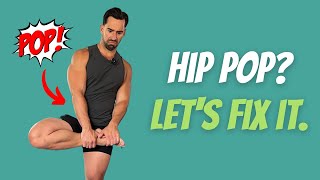
In this 6‑minute tutorial, Glenn Dawson first explains why a hip may “pop” during activities like a golf swing, describing the pelvis as a multi‑axis box with capsules and tendons that can create friction when misaligned or weak. He emphasizes that popping is only a problem if it triggers pain. Dawson then guides viewers through a concise corrective routine: (1) lying on the back, engaging the pelvic floor while sliding the heel on a low‑friction surface (2 × 10 reps); (2) a single‑leg glute bridge performed with continued pelvic‑floor activation; (3) a side‑lying hip abduction/leg‑lift with 5‑second holds and negatives, optionally progressing to a full side plank with bridge and multi‑plane leg movements; (4) a standing march or leg‑lift with slight knee bend, glute activation, and elongated holds (up to 30 s per leg) while maintaining a neutral spine and preventing knee collapse. After completing the sequence, viewers are instructed to retest the hip for popping, and Dawson ends with a call to comment, share, and subscribe. The video blends biomechanical insight, clear cueing, progression options, and a brief self‑assessment.
Chapters
Does your hip pop all the time when you're swinging your golf club, moving your hip in and out like this? In this video, I'm going to show you how to erase that hip pain in less than 6 minutes. Follow along. Before we fix this issue of hip popping, first let's diagnose what's happening. So your pelvis is kind of like a moving box, has all these twists and angles that it can use. It can twist forward, backwards, down, backwards, in, out. One side can twist like a Rubik's Cube in, the other side twist out. Plus you've got these hip capsules here, and you have all these tendons going in and out the entire time like a bunch of rubber bands in your moving box that can basically slide over the top of those pelvic walls. That's where your popping is coming from, is it's out of alignment, or it's just not strong enough, or it's not unstable. We're going to fix that. Before we do, I want to let you know that it doesn't mean that it's bad unless it's causing a pain response. It's just friction. Unless it causes a pain response, it's not terrible for you. But I've never met somebody who enjoys it, so we're gonna get rid of it. Let's go. The first exercise we're going to do, I want you to lay down flat. Make sure your tailbone is on the ground. And then from here, I want you to engage your pelvic floor. So what that's going to look like is you're going to bring your pelvis into your belly button. So you're going to flex there and kind of rock it back and squeeze. Now I want you to hold on to that, and then as you're doing that, slide your heel out at the same time. This is easier if you've got like a towel on a hardwood floor or something that has less friction. It'll still work with what I'm doing right now. But for you guys at home that are watching, make sure you do this on an easy sliding surface. Obviously, you're going to switch. I would do 2 sets of 10 just holding on this entire time. Now, once you've got that mastered, I want you to go into a small bridge Keep that same turn on pelvic floor and lower ab core and squeeze your glutes. So from here, you're going to go into that single leg glute bridge and come back and then alternate. Once you've done that, move on to our second move. All right. Now we're going to do a sideline hip abduction. Or sideline leg lift if you don't speak functional trainer. Lay down on your side like a sexy model. Bend the bottom knee. The top knee, you're going to let go straight. Now from here, I want you to engage your core. So to do that, you're going to drive this knee into the ground, and you should see a little bit of a gap here, and you're going to lift. Now I would hold this for 5 seconds. Then slowly lower for 5 seconds. If this lower hip is too much pressure, go ahead and turn that off and just focus on the top leg. Up 5 seconds, then do a negative for 5 seconds. That'll help with stability through that. Now, if you want to really advance the move, you can go up into a full side plank and bridge and then lift. And then you can even go through different planes of motion with this top leg, bringing it to the front, down to the back, and holding it all the way through stable. Once you've done that, we have one more for you. All right, for our last move, we're going to do a standing march or leg lift. I want you to slightly bend your knees, put your weight onto your hips, so that your glutes are turned on, and you're going to lift one knee and hold. Don't come to the point where you're lifting so much that your spine rounds. You want to come right below that so that you can maintain a straight, stable spine and hold. So from the front view, here's what it looks like. And then make sure that this front knee isn't collapsing in either. It's going to be very difficult to hold like this. You want to make sure that it's either straight with that big toe or outside, and then hold. Now you want to do elongated holds with this. So, you know, as long as you can with one leg, say it's 30 seconds, switch to the other one, and you want to slowly lower. Now once you've done this, retest that hip, see if it's still popping. It should be greatly improved whether you're swinging a golf club or you had a pop in a different your, you know, sport or course of action, inner course of action, whatever your hip was popping. If you feel better and your hip is no longer popping, make sure you share this video, comment below, let us know how you're feeling. And if you haven't subscribed, you're missing out on the content we bring out every single week. You probably should because most people would pay for this and you don't have to. It's free. All you have to do is subscribe so you don't miss out. See ya.