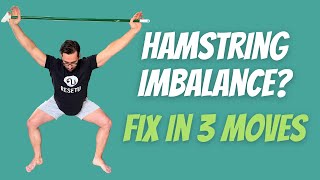
Glenn Dawson shows how to test for hamstring imbalance with a broomstick squat, then walks through three stretches: a hip-flexor lunge with torso twist, a contract-relax hamstring stretch using a yoga strap, and a 90-second supine glute-hug rotation. He says strength training addresses the root cause.
Chapters
Let's talk about the hamstring imbalance. When you did your 18-second at-home personal assessment with the broomstick, did you have that hamstring imbalance where your knees pushed out really wide like this and you tilted forward? If so, I'm going to show you how to fix it in this video in 3 moves so you can relieve tension right now. Tension from the outside of your legs, the knees, sciatica, SI joint pain flare-ups, all of it. Now, if you have no idea what I'm talking about, you've never, ever, ever heard of an at-home broomstick squat test, guess what? In the description, you can find a link to your own at-home assessment. For everybody else, let's dive into these 3 moves. All right, so for our first move, we're going to do a hip flexor lunge stretch with a twist at the end to really, really open up that outside of the leg. To do your hip flexor lunge stretch, you want to create 2 90-degree angles, put your arms above your head, flex your abs and the glute of the knee that's on the ground. So flex this bad boy here. Turn this on. That way you don't hyperextend, tilt your back backwards. From there, you're going to push your hip down and forward and keep your spine straight. Now, as an added twist, you're going to twist over the front leg and hold. This should provide more of a stretch for you and open up the hip even more. And then also give you a good stretch on the outside of the leg in the front. Hold it for at least 30 seconds. If you can go to 90, do it. And then once you've done this, move on to our second move. In this second move, I'm going to show you how to open up your hamstrings like they've never been opened before. To do that, I need a yoga strap, a belt, cloth belt preferably, or just something you can strap around your foot. Go grab it now. Pause the video and then come back. Awesome. You have your strap. Let's get to work. So with the strap, you're going to strap your foot around the ball of your feet. Then you're going to bend your knee, lay the other leg flat so you can get that hip stretch. You're going to push your leg into your hands. This is going to activate your hamstring. Do it for 5 seconds and then release and stretch. Make sure your knee is straight. So even if your knee is straight out here, I don't care. Start wherever your body gives you so you can hold the stretch. Now the stretching portion, you're going to hold for 30 seconds. This is important because we're basically teaching you how to relieve your sympathetic nervous system. That's what tightens up and guards and feels pain. Once you feel pain, your body's going to lock up. So you have to kind of let it loose on its own. We're also in a neutral position with our back. We're keeping our hips down. That way your back can't flare up in this position. It's a beautiful, beautiful thing. Once you've done 30 seconds, you're going to repeat 3 more times. So you're going to push for 5 seconds. 1 Mississippi, 2 Mississippi, 3 Mississippi, 4 Mississippi, 5 Mississippi. And then grab and hold and pull back for another 30 seconds and do it 2 more times. And then switch to the other side. Once you've done that, your hamstrings will feel great. Move on to our third movement. This last movement, we're going to work on that person that has sciatic nerve damage or they've got bound up SI joints. To do that, I want you to lay down flat. And our first movement is going to be to hug your glute. Now, if this is a big enough stretch for you, this is a lot and you're really flared up, just stay here. If not, you're going to tilt the leg over the body slightly. Now, if this still doesn't feel like a stretch to you, what I want you to do is inhale, exhale, throw this arm out as an anchor, and then just twist until the stretch is applied. Just like everything else, you're going to hold this for 90 seconds. And then switch. And then retest, reevaluate, see how much straighter your knees are in that squat test. Feel your lower back, see how that's feeling. Everything should be relieved temporarily. Now, if you don't want to do stretches every single day for the rest of your life and still be in fear of another flare-up, what I want you to do is fix the root cause, the muscular imbalances. Those muscles that are pulling the joint side to side out of alignment. To fix those muscular imbalances, you need strength training. And to do that, we've got help for you in the description of this video. Go down, follow the description, take the next step in our reset protocol. See ya.