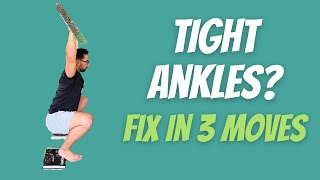
In this instructional video, the presenter explains that limited ankle mobility can disrupt the alignment of the knees, hips, lower back, and even shoulders. He introduces the broomstick squat test to differentiate ankle tightness from hip tightness, showing that elevating the heels reduces forward lean if the ankles are the issue. The core solution consists of three targeted mobility drills performed in sequence: (1) an ankle release that stretches the front of the ankle by positioning the big toes together and applying pressure while on all fours; (2) a knee‑over‑toes tracking drill that trains the knee to stay outside the big toe while the foot stays flat, performed from two angles; and (3) a calf and Achilles stretch using a downward‑dog position with calf raises and heel‑down holds, with single‑leg variations if needed. After completing the routine, viewers are instructed to retest their squat depth to confirm improvement. The presenter emphasizes that these moves are a short‑term fix and that lasting results require correcting underlying muscular imbalances by strengthening weaker muscles, directing viewers to a free resource linked in the video description.
Chapters
Is your ankle mobility throwing off your knees, hips, lower back, maybe even your shoulders? In this video, I'm going to show you 3 moves you can do to increase ankle mobility and feel better if it's the thing that's holding you back. If you did a squat test and you were leaning forward, it means it's either your tight hips or your tight ankles. Then you elevated your heels on books or anything around you to elevate your heels, and you leaned forward less. That means that your ankles are the main root cause of your problem. In this video, I'm going to show you the 3 exercises you could do to get rid of almost any ankle problem. It's very rare that it won't. Check it out. And if you have no idea what I'm talking about with this ankle stuff or ankle mobility stuff or a broomstick squat test, in the description of this video, we have an awesome, awesome, awesome thing for you where you can actually check your own muscular imbalances and and get relief now. For the rest of you, let's dive into the ankles. Your ankle is a complex joint. Most people, I would say over 98% of the people that we see, have an ankle issue that'll throw off everything north of the ankle. So everything. Let's break it down. There's a couple of different spots where your ankle can get tight. The first one where the shin moves forward like so, It can get tight in this joint here where the shin bone meets the talus and it'll pinch in the front. We're going to remove that in our first exercise. The second one is if the knee and the shin can't rotate. There's two bones here. If they can't rotate out, you'll get an impingement and tightness on the outside of the ankle. Last but not least, there's that Achilles tendon on the back. Now, if that gets tight, you'll have a stiffness here in the back. And you won't be able to move your knee forward like you need to, to have proper hip mobility. So follow these in order and open up your ankle completely. First, we're going to do is an ankle release. So to do that, point your big toes together like the bottom of a heart. Then I want you to go on all fours and slowly move your butt back, putting pressure on those ankles. So you're opening up the front of the ankle. Do this 10 times. If you don't feel the stretch there, you can elevate with a pillow, putting the toes together still, and sit all your body weight back onto the ankles. Then repeat the same process 10 times, feeling that stretch in the front of the ankles. Once you've done this, move on to step 2. Step 2, I'm going to show you 2 different angles of. The first one, you want to move back, stretch out the front of the ankle, hold on to the foot, and drive the knee over the toes just like so. Keep your foot flat so you get the stretch and drive over the toes. Now, when you look at it from the front side, what I really want you to focus on is the knee doesn't go inside the toes like this. It stays outside. The big toe. So it's tracking outside the big toe, just like so. You want to go back and forth and kind of retrain your knee where to line up with on your foot. Once you've done this 10 times, move on to our last stretch. Last but not least, we're going to work on the calf and Achilles tendon. To do that, we're going to do a downward dog stretch. So you're going to go to all fours, lift your butt in the air, and you're gonna do a calf raise. You're gonna hold this calf raise for 5 seconds and then stretch your heels to the ground for 30. If you don't feel the stretch here, what I want you to do is go to single leg calf raise, hold 5 seconds, and then stretch. If you still don't feel the stretch, which would be weird because most people feel a stretch there, you can do your calf raise and then lift your leg and then stretch, and you'll most likely feel the stretch there. Now, once you've got your ankle mobile in the front, the side, and you've loosened up the calf and Achilles tendon, retest if your squat looks better. If the bar doesn't lunge forward, if you squat deeper, then you know you're on the right track. However, this is not a long-term fix. To long-term fix, you have to fix the muscular imbalance, the root cause. Otherwise, you're going to be constantly fixing everything. You got to strengthen those weaker muscles. To do that, I have a special gift for you in the description of this video. Look below, enjoy, and get your body reset completely.