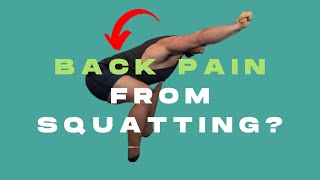
Your lower back hurts during back squats because your ankles or hips can't move properly. Test yourself with a broomstick: if the bar tilts forward, you have a mobility problem. Fix it with Zurcher squats, a light front-loaded squat with heels elevated, then gradually lower your heels as you improve.
Chapters
If your back hurts when you squat, today you're in luck. I'm going to show you how to reset it and fix it so it doesn't have to happen anymore. But first, let's start with why. So at ResetU, we do this awesome overhead squat mobility test every single week and build our programs around that to make sure that people don't get injured in the gym. What I want you to do is diagnose yourself for a second. Grab a broomstick or I'm using a band because I don't have a broomstick here. We're a vacuuming type of people. We don't actually have broomsticks. You're going to make 90-degree angles with your hands and press the bar, band, or broomstick over your head. Then space your feet out shoulder-width apart and squat 3 times to the front and 3 to the side. Now, what you're going to notice when you go to the side and you review your video, that the band doesn't just go straight up and down. Your band or your bar tilts forward like this. Maybe not that much, maybe just like this. But if there is a cup of tea and that cup of tea tilts over even a little bit, structural stability problem, and that's what's causing your lower back pain. See, the lower back is a bunch of little tight muscles wrapped around the pelvis and lower spine. And the spine acts like a skyscraper. And the skyscraper is out of alignment, that's more tension, right? Because gravity is pulling straight down. Each one of those joints on the way down has more tension. So if your hips are out of alignment, like tilted down and forward, look how much tension my lower back muscles, tiny lower back muscles, they don't have a lot of strength, have to carry, which means my spine, my bones, my joints are going to carry it. So then when you load up a squat rack on a frame that's unstable, then you have problems. So if you can't squat with air correctly, don't back squat. If your trainer is making you back squat, you can't squat with air correctly, fire him or her right now and go find someone else who does an assessment. It's trash. Now, we don't really know if it's mostly a hip problem or an ankle problem. We're going to find out. The easiest way to do it is grab some books if you're at home, or if you're at the gym, grab some 10-pound plates, put them in front of you, put your heels on the 10-pound plates. This is going to act like a riser for your Achilles. It's like giving you an extra inch of flexibility in your Achilles. Now, if when you do this and you squat again, it feels way better and you could squat below parallel without your hips breaking or bending forward, then you know it's mostly an ankle problem. If you still have an issue, then you know it's a hip problem too. The good news is, as promised, there is a squat you can do on top of, you know, actually resetting your body, which we have other videos. I'll put them down below. But this squat is perfect for you to get you started, make you feel better, more confident, and take the pressure off your spine and put it on your glutes, your hamstrings, and your quads and get rid of all the tension. Here it is. So the Zurcher squat. This squat is specifically made to counterbalance your hips, put all the weight onto your heels and your glutes and hamstrings. And I'm going to show you how you can go from this to your back squat. So if that overhead light squat squat isn't correct, you're going to start with your heels elevated, right? Then you're going to put a light bar. This is like 20 pounds, 15, in the middle of your elbow crease like this. Then do your squat. As you descend, push the weight out in front as a counterbalance. Go nice and slow and create stability and make sure you're driving through your heels as you squat, you have to reprogram your heels to activate. Now, over time, when you're doing your ankle mobility exercises, your hip mobility exercises, you start to solidify this. You can lower these down to like a 5-pound thinner elevation and then lower it down to no elevation, right, where you're doing it with no elevation at all. You're just using the hip counterbalance. Once you've mastered all of those, Then you can easily go to your back squat without any kind of struggle or tension or pain and back squat without any kind of tension, pain, or aggravation in your lower back, feeling stable and happy the entire time. Now, if this brought you value, make sure you comment below. Let me know. And share it, and then obviously subscribe because I want to keep resetting you. Thanks.