How To: Strengthen Core w/ No Equipment (At Home!)
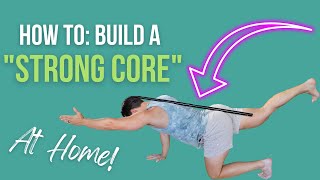
Your core isn't just your abs. The host redefines it as your shoulders to knees and shows four no-equipment exercises to stabilize your hips and spine: glute bridges, side-plank clamshells, dead bugs, and bird dogs. Do them before workouts or in the morning to fix lower-back pain.
Chapters
Listen, if you're dealing with lower back pain, you've probably been told you have to strengthen your core. Today in this video, I'm going to show you how to strengthen your core from home without equipment. And we're going to redefine what the core actually is because the other stuff you've been talking about with the sit-ups and the crunches and everything else isn't the real core that's going to save you from lower back pain. Let's dive in. So first things first, let's define the core that you're trying to strengthen. Your core is basically your shoulders to your knees and all the connective tissue that goes into it. Your hips are basically your center of gravity. As you move, your hips move, and that's where everything goes. So if your hips are off, what happens is, is it'll throw off your lower back. So if you have lower back issues and your hips are off, think of it like the foundation of a skyscraper is shifted. Well, every single joist up that skyscraper or your spine is going to be off as well. So what we're going to do today is we're going to work on stabilizing the hips mainly, and then the shoulders along with it, almost like if you were a puppet and you wanted the strings to attach the shoulders to the hips so that everything moves together. That's what we're going to do today. Now, if your hips are out of alignment, this may help realign them. But see our other video about getting your hips into alignment, because that's the number one thing to do to get rid of back pain. This is more to stabilize the back so it doesn't keep happening. So your first exercise, one of four, is going to be a banded glute bridge. Now, if you don't have a band, it's okay, you don't need to use it. If you do have a band, use a light one. You don't need a big tension. Put it around the top of your knees. Now what we're going to do is we're going to do a glute bridge and focus on pushing through the heels. Most people that have lower back pain have trouble activating their glutes, and that part of your pelvis doesn't get held because your lower back does all the work instead of your glutes. So we want to make sure as you're doing this, you are focusing on the glutes firing. So what you're going to do, lift up your toes slightly, push through the heels, bring your feet underneath your base, drive up and flex your glutes. Hold it for about 30 seconds as a static hold because we want to hold everything into alignment and then lower slowly. Now, I would do at least 3 of these for 30 seconds to get those glutes to fire. If you feel it in your lower back, then stop. It means your glutes have given up. They're too stressed out. They can't hold you up anymore, and your lower back is taking over. You don't want to recruit your lower back anymore. You want to just focus on the glutes. So 30 seconds. If you can't do it for 30 seconds, lower it down. And if you don't need this band or you don't have it, it's okay. Don't worry about it. All right. The second one we're going to do is more glute work. That's right. Most people, their glutes, their butt doesn't fire because their pelvis is shifted so far forward. All they do is work these quads. So for us to stabilize your core, remember shoulders to knees and get rid of your lower back pain, we got to get your glutes to fire. What we're going to do is a side plank clamshell. Now I'm going to get on one elbow and bring this elbow underneath me and keep it at a nice 90-degree angle. I'm going to bend my knees and we're going to do some pauses. Now, this is a tough move. Don't be ashamed if you can't do it automatically. It's actually pretty difficult. I'm going to lift this lower hip, hold, and I'm going to lift this top leg. I'm going to hold it for about 5 seconds and then lower. Now, you're going to want to do about 5 of these each side. And if you can't hold for 5 seconds, it's okay. It just means that that muscle's weak and it means we correctly identified one of the areas of your core that needs to be worked on. Once you finish this, move on to the next exercise. The next one is actually going to work your abs, the muscles on top of your core, which I know you're hyped about. So we're going to do a dead bug. Now, that's a gross name, But when you see it, you'll understand why we're doing it in the first place. It's going to work your shoulders. It's going to work your hip flexors. It's going to work everything and kind of tighten it up for you. And the best thing is it keeps a neutral spine and teaches you a neutral spine, which is difficult for most people because their spine is super out of alignment. So I want you to lay down flat, bring your knees up at 90-degree angles, bring your arms up straight, and then from here you're going to alternate. Pushing one leg out and raising the opposite arm. Now, as you do this, stay within your range of motion. If you feel some lower back pain as you're pushing because you're going too far down, then obviously don't go that far. That's too far. Your hips can't handle that range of motion and you're doing damage. You want to just strengthen here. So stay within your happy range of motion. Keep everything nice and tight. And I would go until fatigue, not failure. If you're going until failure, what's going to happen is you're going to start to recruit other muscles. You might extend your lower back too much. Your shoulders might get tired. Bad stuff can happen. You just want to go until your body feels the exercise. Whoops. And then move on to your last exercise, the most difficult one out of all of them. All right. Now for our last exercise, 4 out of 4. We're going to do a bird dog. Now, the bird dog, I'm going to break it down into 3 different things that you can do for it because it is a little intense and it, it's basically teaching your lower back proper extension. You're not supposed to extend too much and you're definitely not supposed to cause flexion and round like you're playing on your phone all day. Neither of those is good. What you want to do is get into a quadruped stance or all fours. And we're going to start with a deconstructed bird dog. Now, this is going to be just lifting one arm at a time and one leg at a time. So just like this and keeping that spine straight. Now, as you move around, the opposite arms and legs are stabilizing. Make sure as you're pushing this leg back, you're pushing through the heel, not the toes. It'll help you to activate your glute if you can push back through the heel. Now, if you can manage that, we're going to mix it in and cause a little bit more tension to your core. So you're going to go up with one thumb. Make sure you stay looking down. Keep your collarbones high. So don't round like this. Keep everything straight and hold, and then switch. If you're having trouble finding your neutral spine, I like to flex my abs and tuck, and then also feel my glutes at the same time. Or you can grab a stick like this, stick it on your back where your spine's at, and practice balancing the stick. Now the stick should stay balanced the entire time, and you can use a broomstick for this, or I'm using a part of a tripod. It's completely up to you. Just make sure that you find your neutral spine. Now, the best time of day to do these core moves is either right before you start working out so that your core is activated and you're holding your core, embracing your core before your workout or first thing in the day. You don't got to do it 2 or 3 times a day. Just activate your damn core so that your lower back doesn't have to take any of the pressure. Now, this video brought you value. Make sure you share it. And if you haven't subscribed yet, you're going to miss out on our next video, which is even way cooler than this one. Like, extremely cool. Like, so cool that you're going to hate yourself for missing it. So you might as well subscribe.
More from Glenn





Touch Your Toes in 6 Minutes | Release Muscular Guarding for Better Flexibility





