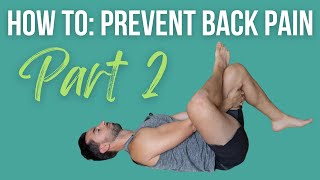
Follow a progressive stretching routine targeting hips, glutes, and hamstrings to prevent lower back pain from returning. Hold each stretch 30 to 90 seconds, twice daily. The series continues with hip and core strengthening in part 3.
Chapters
This is video 2 in a 3-part series of how to prevent lower back pain from coming back. If you skipped video 1 where we went over foam rolling and the foam rolling that you should do to reduce the tension on your nervous system so that you can stretch, it's pretty vital. Go back and go do that first. This video is for once that tension is relieved, the places that you want to stretch specifically to get rid of lower back pain. Now, once again, we have not done an assessment on you. I don't know if this is going to help you or not. So if you haven't gotten an assessment by one of our fitness professionals, click below, get an assessment. It's a quick 18-second test and we can tell you exactly where your pain's coming from. But if you're too shy to do that or too embarrassed or you don't want a lot of help, maybe you just want a little bit of help, keep watching the video. So the first stretch we're gonna do is a hip flexor lunge stretch. Now, this hip flexor is a band that basically goes from behind your hip and your pelvis and then goes down in front. Now, this gets shortened when you're seated. It gets really, really, really tight. We're supposed to be bipedal hunter-gatherers who walk around all day, hunt stuff, and obviously gather stuff. We ain't doing that anymore. At least I'm not. I have a desk job. Maybe you do too. This is why this stretch is so important, because it has to lengthen this tissue here. So you're going to feel it right here in front of the hip. Now, as we do this, it's very important not to create extension in the lower spine. You don't want to do this because it's going to create tension. It's going to hurt you. You want to keep everything neutral and tight. So tighten your abs while you do this. Make a 90-degree angle with the front leg. With the back leg, we're going to slowly push the hip down and forward at a diagonal angle. Like so. Then we're going to put our arms above our heads. Exhale. Keep a neutral spine. Don't lean back. Keep everything tight and neutral. And then after about 30 seconds, rotate over the front leg. You're going to hold it for another 30 seconds. I'll show you the other side. So you're here, keep your chest up and rotate over without creating extension through the back of your spine. Now, if you're doing this twice a day, you are going to drastically reduce the tension on your spine because your hips are gonna be in alignment. Hips are like the foundation for your spine. Once you've done this, move to stretch number 2. So we stretch the front of your hips. Now we have to look at the back, the glute, the hip capsule, that area. So the first thing we're going to do is some invasive glute stretches, and then we're going to get evasive. So less intense and then more intense just to see if you can do it or not. The first one you're going to do is basically just lay down flat, bring your knee to your chest. Now, if you could do this and keep your spine on the ground, go ahead and move to the second portion of this stretch. But if this is too much for you, just hold here and breathe. Inhale 5 seconds, hold 5 seconds, exhale 8 seconds. Just like the foam rolling video that I know that you already watched because I told you to watch it, to do it first. Now, this is easy enough. Cross your foot over the opposite thigh, reach through and grab the hamstring on the opposite leg. Now you're going to feel a stretch here in the glute. This is a figure 4 stretch. Now, with any stretch, you're going to want to do it for at least 90 seconds to reduce tension. And because we already foam rolled, it should be easier to lengthen the tissue. Now, if you can do this without tension, go ahead and move to the expert level stretch, the pigeon stretch. This is best performed with something that's soft, like a bench or a couch. Because you want something to give your knee a nice little wiggle room. Now set it up by putting a pillow on the ground before you even move. This is very, very, very important. Now I'm going to pigeon stretch my opposite leg. You can kind of see how it's going to work. You're going to lay down the opposite side of the calf. So this side on this side. So you can't see it right now. You're going to brace, lower the back knee, and then hold. Now this is a very, very intense stretch. This is probably enough stretch for anyone with lower back pain because if you have lower back pain, there's a good chance your hip capsules are really tight and your glutes are really tight. So this is probably going to be enough. You don't need to do anything else. I will post a pigeon stretch video below if this is too tight though, to show you how to pigeon stretch correctly and really, really get you in it so that you can get access to this stretch and open up your hips. But once you've done this, go ahead and move on to our third stretch. All right, this next one is kind of a doozy to get into, but it's very, very good for stretching out your groin and your hamstring. It's very important to hit all these things to make sure that you're, you're basically releasing all the tension around your pelvis so that your spine can move freely. And then in our last video of of this series. We're going to show you how to strengthen it so that the pain doesn't come back. That's the key that everyone misses. So I want you to set up with one leg straight and one leg sort of bent. Keep your spine straight. I'm going to take my right arm, same side as the leg, go inside the knee and outside the foot like this and grab. Zoom in on this. You got it. Sweet. Now, once you have this placement, you're going to lean back slowly and then start your stretch. You don't have to lift the leg automatically. You can keep it tight so that there's less of a stretch to begin with. But the whole point of this is to get a stretch with your spine being straight so you're not rolling your spine. When your spine's on the ground and it's flat, it's very easy for you to keep a straight spine. So from here, slowly lay back and then lift up. Now, whatever the stretch is for you, this may be a stretch here, might be a stretch here, might be a stretch. I want you to hold this for 90 seconds and just breathe and relax. I'll show you the opposite side. Again, inside the knee, outside the foot. That also reduces the tension on your IT band. From there, roll over to your stomach. Now you're probably thinking, wow, I feel great. I have reduced my back pain. I'm fixed. I'm healed. But don't be fooled. That's what most people think. And then the back pain comes back. So in our last video of our 3-part series, we're going to show you how to strengthen the muscles around the hips and core to tighten everything up so that it doesn't go back out of alignment. So you don't have to keep going back to the chiropractor, physical therapist every single week. You're actually strong and stable and you hold everything there and you don't have to worry about the back pain. Or worry about your next flare-up. So if you haven't subscribed, do so now because the third video may be the most important.