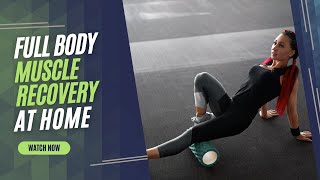
In this instructional video, Glenn Dawson of Reset U Fitness demonstrates three practical recovery methods designed to accelerate tissue healing, reduce delayed onset muscle soreness (DOMS), and improve flexibility. He first explains the activate‑release technique, which involves a 5‑second muscle activation followed by a 30‑second stretch, repeated several times to overcome muscular guarding and promote lengthening. He then shows how to combine this technique with foam‑roller trigger‑point work, emphasizing neutral spine alignment, slow rolling, and targeted pressure on knots. Finally, he introduces the Voodoo Floss Band, a flossing tool that simultaneously compresses both sides of a muscle, detailing appropriate tension levels for different muscle sizes and demonstrating its use on the quad while also benefiting the hamstring and calf. Throughout, Dawson highlights the physiological rationale (increased blood flow, fascia mobilization), safety considerations, and how the same principles can be applied to other muscle groups. The video concludes with a call to action to subscribe for more content.
Chapters
This video is all about recovery, how to get your body to recover faster from those difficult workouts. Hi, I'm Glenn Dawson with Reset U Fitness, and if you've done all the stretching and you're not lengthening tissue, you're not actually giving yourself help. So I'm going to show you 3 different methods that you can use with a couple of tools to actually release tissue, feel better, lengthen tissue, heal faster, all that good stuff. So the first thing that we're going to do is an activate-release technique. When your body is in pain, it does what's called muscular guarding. It locks up and then doesn't release. It makes it very difficult for you to actually lengthen tissue like you want to. So we're going to activate the muscle for 5 seconds and then release it for 30. You can repeat this 4 times through, and you'll see the muscle actually start to stretch. It's pretty Amazing. Hypothetically, let's just say I have a tight quad on my right side. That's what we're going to work with basically the whole entire video. This will work for everything else though. So if you have a tight chest, you can flex your chest and then stretch it afterwards. Tight calf, you can flex your calf and stretch it afterwards. It doesn't matter what it is, it'll work. Now your quad, this muscle here, let's imagine it's really tight and sore on my body. Well, how I'm going to activate it is I'm going to push my toes into the ground and you'll feel your quad activate. And that's how you activate your quad. So I would do that for 5 seconds, push my toes into the ground. 5, 4, 3, 2, 1. And then I would stretch the quad after that. Now I could stretch it this way and elongate it with the hip flexor. We could do this 5 times and add motion after, or you could do a static stretch and stretch the quad for 30 seconds. I can also go here and I can push back into the quad and create a different type of stretch, stretch more of the lower part of it. Either way, the goal for you to loosen the tissue— and keep this in mind— 5 seconds of pressure activating the quad, and then stretch it for 30. Then you would just go back, activate the quad again for 5 seconds, and then repeat. That could be your hamstring. It could be anything. The next thing I'm going to show you is how to trigger point with the foam roller. So let's hypothetically say it's the quad and the hip flexor. What I'm going to do is I'm going to line up with the foam roller on top of my hip. Now, a normal foam roll, you're just going to keep your spine neutral, move forward. The neutral spine will help you to basically practice keeping your back safe and strong. You want to go relatively slow so that it's kind of like a massage and you're squishing all the layers of fascia down together. That's the first way. The other way that I could do it is I could do that activate-release technique with the foam roller and pair those two together. So say I have a knot here, I could stay here on the knot, I could rotate in and out, or I could bring my heel to my butt, creating more pressure, and then extend my heel, activating the quad. Either way, if you find a knot, putting more pressure on it is going to help you relieve the tension. And foam rolling— say you did 3 passes— will break up the tissue in that quad and help you heal faster. Next, this is my personal favorite, the Voodoo Floss Band. This is like foam rolling, but every single side of your muscle at the same time. Plus you get the antagonist muscle too. So for this one, we're going to go around the top of the knee where the patella connects to the kneecap. Whenever you're wrapping with the Voodoo Floss, man, I like to think the bigger the muscle, the less tension that you need. So if you're going to wrap like the lower part of your calf, it's super small, especially on me, and, uh, you'd want to go with like a 9 out of 10. For this upper part of the quad, it's a bigger muscle. We'll go like a 7 or 8 out of 10 just so that we can still move it around. Now that I got the quad here, what I'm also going to do is I'm going to pad the ground get rid of tension on the ground from the knee. And we're going to go through that same exact sequence for the quad. I'm going to push my toes into the couch now, activate 5 seconds, release, and go back and forth, giving me a nice quad stretch. Now, as I'm doing this, I'm also getting my hamstring loosened. The interconnections of my calf into the back of the knee, all the stuff that kind of connects into there. I'm flossing, creating new blood flow, new fluid to help heal that area faster. And we've seen a ton of just relief from delayed onset muscle stress, DOMS, just from doing this. Now, once you've done this 10 times, You can also do your seated quad stretch here. Give yourself a nice stretch here. Take the Voodoo Band off. It's going to feel amazing. And the last step, because we just took all the blood flow out, put the blood flow back in. Your quad's going to feel amazing. Now, the same rules apply for every other muscle. Activate, release, apply pressure through massage or foam roll. And if it's an appendage, it's going to be really hard for you to like— if you had a sore neck to wrap a booty band around your neck, don't do that. But like bicep, forearm, everything else, this bad boy will help you a ton. Now, guys, if this brought you value, make sure you subscribe for the next video and I'll see you.