Next TV Summit SF Session #3 Who's Mapping the Future of OTT and TV Everywhere
Industry leaders discuss building OTT services, from content and business models to analytics and device fragmentation. Modern platforms have lowered barriers so anyone can launch, but success requires knowing your audience and using data-driven marketing. The panel debates AVOD versus SVOD economics and predicts IP-based delivery will replace broadcast and cable.
Chapters
All right, everybody. We're going to begin our next panel discussion. This is a great one. Who's mapping the future of OTT and TV everywhere? I'd like to invite up your moderator. And his panelists please come on up. Your moderator for this session, please welcome John Mattei of Greenberg Traurig. John, please take it away with your panelists.
Welcome.
Thank you so much. So we have a large panel on a large, large topic today. I want to tell you that, first of all, it's both exhilarating and horrifying to be back in this room. The last time I was here was when I got out of law school in 1977, and on that occasion, if I wanted to watch TV, I could watch ABC, CBS, NBC. Fox was still about 12 years away. No HBO, no anything else. And here I am today, and all hell's broken loose, and we've got some choices. I could not be more honored than to introduce this extraordinary panel. And I think the best way to proceed would be to let you each say a word about yourself. Justin Fadjen.
Hi, I'm Justin Fadjen from Beachfront Media. We are a video distribution and monetization platform. We work with media companies of all sizes, so large media companies like, uh, Condé Nast and Yahoo. To MCNs, like Collective Digital Studio, and also individual content creators focused on millennials, otherwise known as YouTube stars. We facilitate our mission through 3 platforms, fundamentally. One is called Beachfront Reach, which is a syndication platform. Beachfront.io, which is our own ad server, and also SSP and DSP platform. So we enable both publishers of websites and apps to monetize their inventory. And on the demand side, the DSP side, we enable advertisers to create private marketplace opportunities to reach the consumers that they want to reach across all screens. And then lastly, most relevant to this discussion, we also have an app development platform called Beachfront Rise, which we're very excited about. It's focused on developing video-centric apps for content creators. And the market we've been focused on primarily has been on millennials.
Thank you. And Greg Gudorf.
Thanks, Sean. Greg Gudorf, I'm the CEO of Pureflix Digital. We're an SVOD service serving family and faith-friendly content to people all across the USA on a variety of devices. We were born out of Pureflix Entertainment, a 10-year-old studio producing faith-oriented movies. You may have known some of them. God's Not Dead was one of our box office hits last year. And just recently in October, we launched Woodlawn, the movie Woodlawn, and it's doing well in box office right now as well. I've been involved in SVOD and facets of SVOD from my days at Sony, for Paul Allen with the Digio Moxie Group in the cable world there, and most recently before Pureflix Digital, the MGO system, which was launched out of Technicolor. I led that team and we launched it into a joint venture with Technicolor and DreamWorks Animation. Looking forward to the panel.
Thank you, Greg. Tom Mohler.
I'm the CEO of Olympus At. We're both a distributor of content. We distribute over 100 channels in 4 primary areas. Spanish is one of our main areas where we distribute over 70 channels. We have, ooh, about 30 English language channels are divided up between faith-based channels, so most of the faith-based channels in the United States. We have on one of our satellite transponders. And then most of the shopping and infomercial channels. So those are kind of our 3 main niche areas. And we do all the technical stuff involved. You know, we do the distribution from a sales standpoint, but we do all the technical stuff from satellite to IP, all kinds of ways of distributing. And doing OTT platforms now. So we've partnered with France Telecom, which is known as Orange these days, to launch an OTT platform from a technical standpoint for our— initially for our Spanish networks. So we'll be launching over 100 networks in the United States and Latin America. And that platform is a B2B platform. Called Vimox. So we're partnering with a number of the major operators to market that product. I think that's about it.
Okay, Angela Northington.
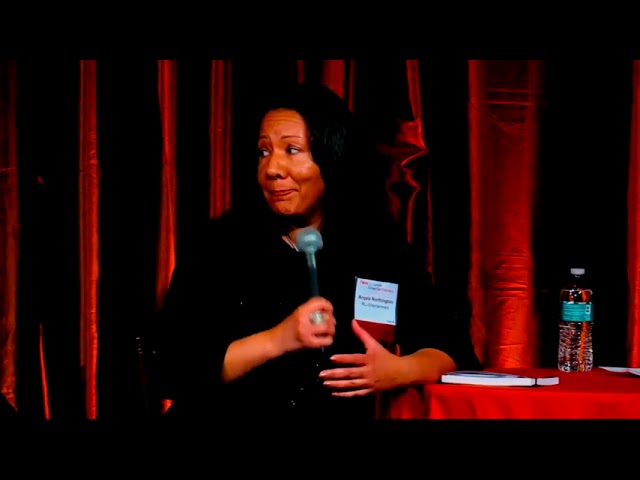
Hi everyone, I'm Angela Northington. I serve as Senior Vice President of Content Acquisitions for RLJ Entertainment, and also as General Manager of one of our proprietary SVOD channels, Urban Movie Channel. As a company, RLJ comprises about 6 different business divisions, including Acorn, which is our huge British television library, as well as Acacia, which is our fitness line, and of course, our feature film division, of which I oversee the urban content division. Our feature film division has released films recently like Bone Tomahawk with Kurt Russell, and we specialize in day-and-date releases, much like The Cobbler, an Adam Sandler film, which came out earlier this year. And so, as a content aggregator, you know, we are very highly focused in the OTT space, obviously, with our 3 proprietary SVOD channels, Acorn, Acacia TV, and now Urban Movie Channel.
Thank you.
Greg Gudorf.
Good morning, everyone. Greg Gudorf, I'm the Director of Sales for ClearLeap. We are an intelligent video platform and backend engine that powers premium content out for multi-screen consumption. We do quite a bit of delivery for out-to-cable set-top boxes, as well as we stand up a lot of TV Everywhere and OTT solutions. Some of our customers are NFL, HBO, Sony Pictures, A&E. Scripts, and many more. Happy to be here.
Thank you so much, Greg. And I believe that Tom has a short piece of video that maybe you could introduce and—
I hope so.
Let's see. I don't know who has it.
Well, it wasn't here in 1977, I can tell you that.
Oh, there it is. OK. Don't hear the volume, but that's OK. Basically, what you're seeing are some screenshots from our Vimox platform. So you will see that launched in a number of applications. We're doing a beta test right now with one of the major operators, probably shouldn't mention their name right at the moment, but— so we're on iOS, Android, all the Android devices. We'll be launching on— in December on— all the Fire product, Amazon Fire products, LG smart TVs, Samsung smart TVs. I'm leaving out a few devices, but essentially we're gonna be by end of first quarter-ish in pretty much all the major devices. So, you know, when you're thinking about OTT devices, you still have to keep in mind that 70% of all OTT viewing is on the actual television set. So being in any kind of device like an Amazon or an Apple TV or the smart TVs is imperative because, you know, unless you don't want to reach the 70% of the people watching on their TVs, then you can avoid those. So that's imperative. You know, of course, being on all the iOS and Android devices is, you know, fantastic as well, but that still only represents 30% of the market. So anyway, so that's what we're doing, and as I mentioned, we're launching with— through all the MVPDs and other business partners to market this.
Thank you so much. Okay, let's start with the hardest question first. What's OTT? Let's get our— let's calibrate this and get our definition together. What are we talking about?
OK, over-the-top television. Really, that term got coined a few years ago. I think it was a cable operator that first coined that. But essentially what that means is that it's a delivery of content that's outside of the normal delivery by, in this case, a cable or a telco. You know, so you hear IPTV. IPTV is where you're delivering through within the scope of the cable operator's system directly to the home. In this case, it's being used, you know, it's being delivered over the internet, and it may ultimately then go through or will ultimately go through the cable broadband or anyone else's broadband and then go to any device, not necessarily just the TV. So that's why they call it over-the-top.
Anybody else?
If you think about it from the consumer's perspective, and that's an important part, from the consumer standpoint, it's not about over-the-top anything, because that was the cable industry term for it. It's about getting access to programming they want for themselves and for their family that fits a niche that they feel is important for their family. So whether it's faith and family friendly, whether it's a sports channel, whether it's a do-it-yourself channels, It's an opportunity to subscribe to different things, bring different pieces of content into their home that meet their need. That's how a consumer looks at over-the-top.
One thing to add is that we look at it as not just a TV type of phenomenon, but it's a screen agnostic phenomenon. While we're focused very much on the TV everywhere concept, everywhere means whatever device, wherever the device, wherever you have your device.
OK, anybody else?
Well, I think we all agree that television content is not going anywhere. It is robust. And there are a variety of services, outlets, platforms, you name it, that provide and have a robust content offering. So I think I would agree. It's more about delivering to that consumer over and above whether it was traditional linear television or via cable and satellite.
Good. OK, so we know what it is. So the question is, so what? Who are the new market entrants coming into the space? Big media companies, affinity-based channels, niche players? Who's jockeying for position in the space?
Everybody. I mean, that's the great thing about OTT right now. It used to be that if you wanted to do something in this space, you needed to have a tremendous engineering effort behind the scenes to build a platform, to develop the databases, to develop the encodes, the playouts, all of the technical stuff that had to happen. But over the past 5 years, that's changed dramatically. And the existence of platforms that provide the technological solutions make it relatively easy for people with an idea to seize on bringing a market solution to this OTT space. And that's really in an exciting spot. In fact, the technological part is no longer the most difficult part. There's the content, and there's getting the subscribers, and there's keeping the subscribers. Subscribers that are all part of the issue now.
Right. Well, if you want to see the future, and it's funny when people argue about whether OTT is going to be the future. Well, I mean, that's not really an argument in the discussions I have with all the MVPDs. It's not really an argument. It's just a foregone conclusion, just in case everyone wonders. And the reason for that, in part, is when you look at the millennials' behavior, the millennials being basically, you know, say a 25-year-old's behavior, Says something like 70% of all their TV view, or the video viewing right now, is via OTT. So there's the future. And it's a relatively immature market, obviously.
I think there's a bit of controversy around terms like cord cutters, and now this emerging term, cord-nevers. And obviously, we all understand that broadband is still a necessary evil in order for that consumer to find the content. But from that perspective, there's that growing segment of the audience that is not ever going to be a traditional cable or satellite subscriber. So I think you're seeing everyone who wants to reach that consumer and figure out a way to deliver content that's meaningful for them, that's who's getting into the business.
I'm seeing two different plays here of people entering the space. There's the large media companies that use OTT YouTube is an extra way for users and customers to access their content, and then there's other niche markets that it's a direct-to-consumer play, and that's kind of one of the main ways that people are monetizing on their video. So there's two pieces, the small and the big.
Okay, let me put it like this. In the 30 years I spent at Warner Brothers, I think I had every dreamer in North America in my office, and we know that dreams without execution don't go very far. How do you do it? You have a concept, you've got the greatest idea for an over-the-top channel. What are the nuts and bolts? How do you get from the alpha to the omega?
Well, there's quite a few steps, actually, to stand up an OTT service, and I can take this pretty high level and have you guys add in. But the first one is really defining your content. What is your library, and then what is your market? That's kind of the first thing you got to think about. The second one would be, What's your business model? Are you gonna do an AVOD approach where you're serving ads against your content? Are you gonna do a subscription-based SVOD approach? Or maybe a hybrid model where you start with AVOD and convert them to an SVOD. Once you've thought about that, it's what are the destinations that you want to deliver your content to? I mean, the common ones: iOS, Android, web. And then you look at Roku and Sling TV and some of these virtual MVPDs. you know, gaming consoles to smart television. Like, where do you want to be? So once that's all been figured out, now your next step is your platform. Are you going to try to build this in-house and host it? Or are you going to integrate with a video platform that can help you kind of manage, package all your content, and distribute it? Once that's been done, your next one is your apps. Are you going to try to develop apps in-house? Or are you going to use a third-party vendor to help you with the app development? When you think about apps, I mean, there's two main things that come to mind. You can go with like a reference app approach where the code's pretty much already been built and you need to change your logo and feed your content to it. But you may not have a lot of flexibility with that model, but it's quicker to market, less expensive. Or you can do a custom app build, which is going to be longer time to market, a little bit more expensive. And it might be a little painful along the way, but you will own the code and you will be the owner of that app fully. Once that's all said and done, I think it's the marketing. How are people going to find you? And I can kind of stop there and let it go down the line.
Well, if we haven't thrown a bucket of cold water on your ideas to launch an OTT platform yet— sounds like a lot of work, doesn't it?
It's very exciting. Very exciting.
The good news here is that it's easier than ever to take that idea, that dream, and just focus on a few things and get a system stood up and running, gathering consumer feedback, and then figuring out what they want from there to build forward. We launched Pureflix Digital in June of this year. We had an underlying platform with V Platform, the company that's owned by Comcast. That was our video serving platform. We had relationships with CDN, major CDN, so we didn't have to worry about how are we gonna serve this content out reliably and play it out. We had content library originally. We were able to get a couple of good partners to bring content in. We had, because of Pureflix being a studio, we had a catalog of our own to bring into the mix. So we had some content. We got ourselves onto a few application platforms like iOS, Android, Roku, PC, of course. And from that, we were able to launch out to a consumer base. So Greg's right. When you run down that checklist of things to do, it can be daunting. But the reality is, with today's technology and the platforms and the players that are out there, some of them here on this stage, you can piece together enough elements to launch a valid service and begin to get consumer feedback immediately. And once you start to get that feedback, then you know where to really drive your attention and where to drive your focus going forward.
And I would say, I think fundamentally, it's about knowing the audience that you're going after and looking at content that you're going to provide specifically for that audience, whether that's niche content. I've spent a large part of my career focusing on niche and specialty content. So I have a keen awareness in terms of marketing efforts and what it takes to get to that particular consumer. So I think that— is above all else really knowing your audience and what are you doing to provide content that will differentiate that platform in the marketplace.
Yeah, that's right. And that's why we launched with Hispanic or Spanish-speaking piece, because we saw a vast opportunity there. Just, you may have heard me share these numbers if you're at another conference, but But there's— when you look at the Spanish market, it's— you're really trying to focus on the Spanish dominant market, which is 56% of the total Spanish market. And of that segment of the market, there's about 13.5 million homes in the United States, and only 4.5 million of those can get paid to— or get a Spanish tier, you know, if you cumulate up all the Spanish tiers from the MVPDs, that's what you have. And so 9.5 million, or 9 million, don't have a Spanish tier, are not subscribing to a Spanish tier. And because we know the vast majority of those, according to Nielsen, watch their TV in Spanish 75% of the time, it's pretty logical to deduce, well, if they're not already in a Spanish tier, they may be a never. And in fact, now we have a lot of other research that points to the fact there's about 9 million Nevares in the Spanish-dominant home. So that's a pretty good market for us to go after. So yeah, that's fundamental. If you want to launch a platform, pick a good product to start off with. Don't just go out there. And then all the many technical things that you ran down, that's 100% true. I mean, it is somewhat daunting. And it's why you see platforms announced by major companies and then a year or 2 years after the announcement, they still haven't launched. Because this is quite a big checklist. And there's one major difference, if you're streaming channels, I mean live channels versus doing a VOD, whether it be SVOD or an ad-driven VOD or whatever, it's a big difference in the technical apparatus and particularly the CDN costs. If you're streaming channels live, and you don't have a good CDN cost-wise, you're sunk. Your model is sunk right there. So that's fundamental.
Yeah, you're right. And you also remind me that a lot of the platforms out there allow you to stand up a small audience very quickly and simply. But don't get fooled into thinking you're going to build a multi-hundred thousand, million type subscriber base on some of those small platforms. You really have to pay attention to that piece as well.
OK, let's talk some more about that. In my past, I launched two broadcast networks. And you do all the work. You spend all the hundreds of millions of dollars at that time. You get your shows, the best shows money can buy. You go on, and then does anybody care? How do you aggregate an audience? How do you prevent churn? How do you get people into the tent that are going to stay? What kind of marketing's involved? You have done everything you can do on a preparatory level. To aggregate a meaningful audience, how do you get them? Is there a trick?
Well, in our case, this is why we decided to go with a B2B platform. I think marketing, personally, is a daunting task, especially the wider your audience. Even though we have a niche audience, being Hispanic speakers, it's still a pretty wide audience. And, you know, we have a lot of business with MVBD, so I thought, you know, I don't really think I want to compete with them. So, you know, we, I think, have made a convincing case to them that, hey, guess what? You've got a lot of broadband potential here. And guess what? There's 30 million DSL customers out there still in the United States. Can you believe that? And so there's a big nexus in, you know, kind of the telcos trying to build up the DSL speeds to the point where they can support video, let alone HD or, you know, 4K is out of the question. But I mean, so it's a great ground for competing, you know, cable broadband versus DSL and a lot of money at stake there. I don't forget what the number is. It's, you know, tens of billions of dollars per year. We're preaching that double play with the Spanish. So when you're talking about marketing, hey, we're just going to let them go out there and market it like crazy and just try to provide a good product.
Angela said it early, you got to know your customer. If you know your customer, you can focus on where they are and you will reach them that way. In the case of Pureflix Digital, Pureflix.com, As a studio, we had this following of millions of people on Facebook for our movies, like the God's Not Dead movie from 2014. Paying attention to that, realizing that that was our customer, allowed us to utilize digital media very strongly at the start— from the start, I should say— to build that audience. And then once you do that, you have to pay attention to where the conversations with those consumers go. And you find out, in our case, as a faith and family-friendly service, we found out the churches they were involved in, you hear that coming through the conversations and you can reach out to that. It's the basic blocking and tackling of marketing more than anything else, John, but it's got to be done. It's got to be done and it's got to be focused at the consumer level, as Angela said.
And once you have your audience, you know you're getting viewership, how do you measure it? You know, in the olden days when Nielsen had the task of measuring ABC, CBS, NBC, and Fox, measuring tonnage, probably pretty doable. When you get down to measuring tenths of a point, and fifths of a point, and very narrow demos, how do you do it with any certainty that somebody's getting it right? Or does it matter?
The analytics, the analytics that are available, depending on your platform that you have developed. In our case, the analytics that we have are extraordinary. I mean, we can tell you exactly, not just the demographic of the person, we can tell you exactly who the person is that's watching and what device they're watching on at any given moment of the day, and all kinds of other things that are too lengthy to talk about right now. But, so it's extraordinary, and quite frankly, you know, it's gonna be an interesting time for Nielsen, you know, because I would think that they were gonna have to get really deep into this because it renders their type of data almost useless, I would say, because it's just so much more expensive, what we can do.
Right. Certainly, the evolution of the platforms, it's another barrier that has been overcome. They have massive insight into what's going on in terms of how people are interacting with content. On the advertiser side of it, though, they have their way of doing business, the way they've always historically bought media. And the services that they use to measure audience, not in terms of just size, but in terms of composition, The good news is that things have come a long way in the last several years. You know, ComScore and Nielsen are the two authorities in terms of audience measurement. We're now at a point now where they can actually make reputable representations of audience composition such that advertisers are now comfortable buying OTT on an audience basis. And in evidence is, you know, a lot of the OTT services that— and apps that we have, they're all sold out. You know, and Steve from Roku mentioned that. As well. So I think we're out of the dark ages. There's still some limitations in terms of, you know, some consumer— or excuse me, advertiser shift and evolving away from the cookie-based tracking world, but they've made a lot of progress.
It used to be you'd say, "I wish I could know X about this customer. I wish I could figure out Y." The reality today is the analytics platforms surface all of this data. It's truly a sea of data. The most difficult thing is to figure out what is it I want to know that can then be turned into an actionable thing. And that's the most difficult thing when it, at least in my experience, when it comes to launching and building an OTT platform, is figuring out what the right data elements are to chase after. Because the analytics are there, it's all available. You just got to figure out what it is you need to build your business.
In addition to the analytics piece, I think it's important to have a good subscription billing partner. We work with both Zohra and Vendicia. And there's things we can do to reduce the churn by, you know, if this user hasn't logged in for, say, 2 weeks, and they usually watch religiously every week, you can kind of do some direct marketing to that person and say, "Listen, you know, we have some exclusive content," or, "This new episode's coming out," and kind of, you know, put a little fishing lure out there to get his attention or her attention to come back to the site. And, you know, also, when you talk AVOD versus SVOD, you know, you're right. Traditionally, you've been served ads against it. But when you pay for a subscription, I feel like you feel obligated to go back, kind of like a gym membership or something.
Go ahead.
Well, I was just going to say, to your point, Greg, you know, I think it's also key to understand what are the key metrics that are important to you and your platform. You know, something for us, you know, we're trying to measure not just watch data and those analytics, and, you know, and churn, obviously. But what are the conversion rates? You know, how are we converting and at what pace, you know, on the various devices and platforms that were available? So, I think that's what— that's that other critical component that you want to discover.
Yeah. One of the things that we focused in on early was how many hours of impact we were having with the consumer. You take the number of consumers watching and the number of hours of content they're watching and you— the first time you saw it go past 50,000 hours in a month, it was like, "Wow, that's 50,000 hours that they're watching at Pureflix.com as opposed to watching something else." And you start to figure out what those key elements are and then you can build upon that and you can focus on that and drive that. You're right, Angela. You got to figure out what works for you and your business.
Let's talk some more about the economic model. AVOD versus SVOD. You know, I could make the case for either. You know, it strikes me on the one hand, a lot of AVOD, you feel like you're watching, you know, daytime CBS. A lot of SVOD, you could easily get to the point where you're paying as much for your SVOD services as you are to Time Warner Cable. What do you, how do you think it shakes out in terms of the economics and how new market entrants and affinity affinity-based channels find an economic footing?
Well, I think for the Spanish-speaking market, it's a simple thing because they're just, you know, if they're a never, they're not, I mean, they very well might have Netflix or whatever, but I mean, they have a limited amount of SVODs probably that they're taking given their TV viewing characteristics. But in general, I kind of take a different argument. I've heard people kind of, try to do the logic adding up the various costs of SVODs and saying, well, gee, it's going to be just exactly what you said, more than Time Warner. But they forgot the one key element. Oh, Time Warner doesn't have the Pureflix content, or your content, or whatever. Oh yeah, that's not available. We forgot that part of the equation. So if it's not available and you're passionate about that product, you're going to get it. And that's the bottom line. And quite frankly, from my own experience and that of my children. I've got 5 children. From, from their, um, they look at, they look at, you know, VOD now as being regular TV. And, you know, the, the, what we would call regular TV is like this other, this aberrant thing, you know. But, uh, and to me, it's about convenience. You watch what you want to watch, for the most part, when you want to watch it. Now, how much is your time worth, depending on how much your your particular time is worth, you're gonna spend that amount of— appropriate amount of time on those subscriptions. If your time is not worth a lot, then, you know, you may just want to have free TV.
I think there's an interesting quandary in an AVOD versus SVOD decision that you have to work through. The cost of your content and the size of your audience are both directly impact that decision.
For AVOD or SVOD.
If you've got a very large audience, an AVOD play may make sense financially. If you've got a niche audience, by definition it's going to be a smaller audience, and yet you've got the cost of the content to bring it to them. You know, if you bring a theatrical movie to an SVOD platform, it's not inexpensive. You got to have a business model that allows you to then monetize that appropriately. And so I think this AVOD, SVOD, whether it's advertising-based, whether it's subscription-based, has a lot to do with the size of the audience that you're attracting and the cost of the content that you're bringing into it. And from my standpoint, for a niche play, the easy start is an SVOD start. mGo, when we started mGo.com, it was a TVOD start, right? So that's a transaction-only-based play, just another business model out there. But I think in the niche play, it's an SVOD model that makes sense at first anyways.
Okay. In terms of all the choices, you know, there are probably thousands of network choices over the top, many devices. What— how do you deal with the issue of fragmentation? And it seems like consumers mostly want ease. You know, you have one device, one box. So how do you kind of cut through what may become clutter? And what's the organizing principle in terms of finding your channel, finding channels that you want to see, affinity-based channels? Who is going to take the lead in organizing all this?
That's a difficult question. And that's really going to be part of the evolution of this business, is kind of an organizing feature to this. Obviously, it's somewhat chaotic right now. You know, whatever your device is, and you're gonna have a multitude of applications. So it's just, you know, like, what's that, what's that? And there'll be some organization of this, I would assume, at some point. But in terms of the fragmentation of the market in general, I think, you know, it's just, you know, it's kinda like the Wild Wild West right now. We're just kinda going out there and finding these niche markets, kind of like somewhat like the retailers do on the street. You know, everyone's opened up their storefront. You're trying to get a good position in the street and, you know, location, location, location. It's so different now. And, uh, and so there'll be a lot of falling out in the market, no doubt. And, um, you were talking about devices though. Prioritizing the devices is, is key. You know, just fundamentally looking at how many devices that thing represents. So we look at Samsung Smart TVs, it represents the majority of the Smart TVs, then go down to LG, which is, I guess, 20% or something of the Smart TVs. So you really have to prioritize because apps are expensive unless you're doing it in-house, and in which case there's still labor cost. And so you want to really prioritize those apps. I think though, fundamentally, you want to be on every app you possibly can within reason because I think you've seen a direct correlation to companies like, for example, Crunchyroll, who have had a very, very good success with a very kind of niche market. That's, it's basically kind of Asian content. And I think one of their keys, and the key to Netflix, was getting out there on a multitude of devices very, very quickly.
And you know, I think I would agree with that with one caveat. I think you do have to be smart, you know, especially as a standalone service, an SVOD service, about what devices make sense for your platform as well. And because, you know, each of these outlets may or may not have a specific demo that responds to, you know, that content anyway. And so every service may or may not make it to a PSTV. You know, Sony, you know, And on the PS Vue side, you know, on the virtual MPPD side, you know, it may not make sense for that particular platform. Do you make sense on Xbox versus Amazon Fire? Well, that's another argument to think about. So I do think you have to kind of look at the universe of what's available and what makes sense for you. And then going back to prioritizing, you know, your development costs and what apps you're going to build to those platforms. —then you can sort of reorder your business strategy.
Personally, I think for the user right now, in this time, it's a little confusing. There's so— like you said, there's so much fragmentation. And then there's the niche markets that are going to have the quality content direct to their consumer. But I ultimately see this— some consolidation happening. And a lot of the larger platforms with their variety of content may win out. They may get a larger amount of subscribers, like a Netflix or something to that. But there's always going to be a need for the niche. So I think we're going to see some shakeout over the next couple of years.
From the consumer standpoint, finding the content, there was a good lesson to take from the Roku comments that Steve made this morning. The Roku MGO search, the unified search, you put a name of a movie in, and it tells you where it's available. On that platform. That's a tremendous tool from a consumer perspective. And if we could think about that in the area of multiple platforms having a syndicated search, if you will, it would really help the consumers from that perspective, John.
Just to amplify that point a little further, right now, content creators, it is a little bit of a Wild West out there. They have no choice but to embrace fragmentation just to be there, just in case. But over time, there will be consolidation. No question about it. And the winner, the winners, if there's only a couple of them, will be the ones that make it easiest for a consumer to find the content that they want without them even knowing that they want it in some cases, right? They can have a relationship at the molecular level with the content that they love.
Now, a couple of blocks from here is a building called the Green Street Lab. And I know that because there's a plaque on the building. And that's where Philo Farnsworth invented television. Now, as far as I'm concerned, this moment in time is the greatest moment in time for television ever. This is the most explosive, fantastic moment for all of us. And so the question I want to ask you is, where does it all go? Does OTT become the dominant instrumentality by which television is disseminated? What happens to broadcast? What happens to the cable companies? How does it all sort out?
Well, the cable companies recognize, like I said, that— I'm not speaking for them, obviously, but my conversations with them, they recognize this is the future. There's no question about it. I mean, there's so many advantages to it. When you're delivering via an IP, you know, Internet Protocol, you know, you're not limited by channels other than your software. I mean, it's not a bandwidth issue. It's just a virtual issue. And it's just controlled by software, what you can send. So there's no question this is the superior delivery platform. So that, you know, there's not even an argument there. So, I mean, you know, the question of how it's going to be sorted out as it relates to the cable, the MVBDs, is a difficult one. But, you know, if I were them, is what I've been preaching to them, is just taking advantage of where they're really making their money, which is on broadband and telecommunications. And really, not to get out of the video business, but couple that with the broadband telecommunications, make it drive those products. That's where the profit margins are, and that's where they should be concentrating. And I think they're getting that.
Anybody else? All about the consumer.
Fundamentally, the change has already happened. You just look at how millennials consume media, and they're the model for how it works now. It's what I want, when I want, wherever I want it. And that just says that the future of the traditional broadcast model, outside of live events, sports, things of that nature, is fundamentally changed forever.
I think there's probably time for a question or so, if anyone— Yes, sir.
Hello. Just a quick question between AVOD and SVOD. So in the digital space, I'm from Twitch, Adblock is becoming extremely prevalent across the space. And my curiosity for OTT is, do you think it's training a generation of people to just not want ads, period? And then immediately lean on an SVOD kind of model versus an AVOD model, just because they just—
time saving more than anything.
I would say yes is the answer to that question, especially when you look at what Apple's doing with the ad-blocking software. I'm highly skeptical of the future of ad-driven business. Not that it's not viable now, but I think in the future there's going to be increased market pressures on that type of a business model. So I'm very skeptical about that.
Anybody else?
I was just gonna say, I think you have a good point there. I know some of the cable providers have done the ad blocking already. It seems to me as it moves forward that they may give— Pandora did it really well, where you can serve ads against the content or they can subscribe. And Angela and I had a conversation yesterday about where it's gonna go, and maybe a subscription-based service, you may even throw in a little mid-roll ad because people are used to seeing them. And that could be a way to double-dip the monetization. Just like on a network, we're exactly on time.
The program is over.
You want to take a seat?
Thank you so much. Thanks.