🏠 How I turned £250K into £1.6M GDV using Property Filter with Will Burrows
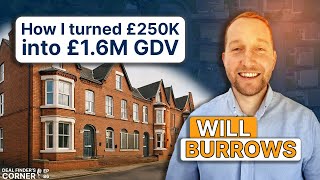
Webinar transcript of Deal Finders Corner (Property Filter) featuring Will Burrows. Will recounts his transition from product design and landscaping into full-time property investing, specializing in high-end co-living HMOs and short-lease flats. He presents two case studies: (1) Project George — purchased for £272,500, £230k refurb, converted 3-bed Victorian terrace into a 7-bed co-living HMO with estimated GDV £700,000, rental income ~£72,000/yr, monthly costs ~£3,550, net cash flow ~£2,150/month, ROI ~86%; (2) a short-lease top-floor maisonette bought for £125,000 with ~£15,000 light refurb, target GDV ~£200,000 and projected profit ~£40,000 via assisted sale and lease extension. He explains funding routes (bridging, Castle Trust), use of commercial valuations to recycle equity (BRRR), design/spec process (detailed architect packs), builder selection, due diligence, and operational tips (filters on Property Filter, follow-up, viewings). Emphasis on taking action, building momentum, and using Property Filter to pipeline deals.
Questions this video answers
£272,500
£230,000
£700,000
£72,000 (approx.)
About £3,550 per month
Chapters
Hello you fantastic lovely people. Welcome to the Deal Finders Corner, your weekly property talk show brought to you by Property Filter, hosted usually by everyone's favorite Frenchman, Guillen Black. But starting today it will be hosted by your favorite Northerner, Asif Omar from the Property Filter team. We are the UK's highest rated platform for finding deals and we're on a mission to empower our property investors and and deal sourcer members to find 1000 deals this year thanks to the Property Filter Blueprint. The purpose with your Deal Finder Corner is to give you more and the best of the available resources. Invite expert guests who will share with you the latest and most current strategies, tactics and secrets about what actually works right now in terms of finding and making deals and the reality of systemizing the and running a high performance business in property. It is my pleasure today to introduce you to the rather fabulous Will Burrows on today's Deal Finders Corner. With a background in product design engineering, Will has transitioned into entrepreneurship by launching a successful landscape gardening business which has thrived for over a decade. For the past 11 years he has built a solid track record in property investment. He's completed the Simon Zucci Property Mastermind program and as the top performer in his cohort focused on development of co living HMOs for young professionals and long term to lease partnerships with social housing charities. Currently he is part of the Guillen Black and Kanish Khan Property Filter inner circle where he specializes in inquiring flats with short leases and assisting landlords in maximizing their returns and through assisted sales strategies. So in today's episode we are going to learn how will has turned 250,000 into a GDV of 1.6 million and counting using Property Filter. And we're also going to learn about high yielding co living HMOs understand the essentials of designing and managing these co living spaces tailored for young professionals. And of course there's going to be an exclusive Q and A. So if you have any burning questions for Will then please pop them into this chat and we'll get to them at the end. So can we please give a massive, massive property field to welcome to Will Burrows.
Thank you everybody and thank you for that introduction. As if I will just go ahead and share my screen and then we'll dive straight into it. Have you got it?
We have got it. That is good.
Okay, so as I mentioned, I'm Will Burrows and really proud to be here. So I've got two case studies to present today that I'm going to be Running through one was my latest deal and one that I'm currently running through at the moment. But before I dive into that, when Andy asked me to do this a week ago, I was feeling really good and now I've got a cold, so you will have to bear with that, I'm afraid, and I might need a drink halfway through. But before I start, I want to take you right back to how I started out. And as Aziff mentioned, I've got a degree in product design engineering. Graduated from that, did really well, came out as sort of one of the top performers, performers again in that. But we were in again a recession and the job opportunities were just not great. So I decided to use my entrepreneurial spirit and start up Sage Living Spaces, which is a local landscape gardening business. This was one of my passions and hobbies at the time and I'd always done it as working. So I had a gap year and during that time I spent six months working as a landscape gardener and thought, you know what, why not just do this for two or three years, it'll be good and then I can always go back to design. Fast forward 10 years and I've still got the landscape gardening business. I've trained many apprentices and built up a team of people that work in Winchester predominantly on garden maintenance and landscaping projects. Alongside that, I've also been investing in property for over 11 years now. And I started off with just the one flat in Winchester, and over that decade of ownership, not only did it double in value, but I also gained a really good yield from it as well. So by the time I was 30, I had completely paid off the mortgage and I thought I was absolutely winning at life. Did really well, didn't have to, you know, the property just sat there. When I compared that to the landscaping work, it was working really hard and didn't need too much input. So I thought, there's definitely something in this and I need to investigate further. That took me to pin. I went along with my sister, Southampton Pin at the time, and within three days we were driving up to London to get to the Mastermind Accelerator course, which was absolutely brilliant. Really blew my mind at what was possible and all the things that I could have been doing. And when I did meet Simon Zutshi at the time, I told him about what I was doing and he quickly burst the bubble of how pleased I was feeling about having one property unencumbered. When he drew out the ways of which I could have had four properties and the net amount would have been much higher and the whole understanding that not all debt is bad and actually we can have good debt as long as we're earning a good return on that. So leverage is one of the powerful things within property that I'm now working with and getting very comfortable with as well. So from that I decided to do the full year long Mastermind. I did MMV6 for those of you that will know. And my why was simply freedom time freedom. I've got a young family, I've got a two and a half year old girl called Imogen and a one year old called Josie. And honestly spending time with them is just what I want to do. I don't want to be having to go out traveling, working away, just being tired all the time and property can really give me that. I can work from home. I've got much more flexibility and just working to the future. It's sort of that idea of work once and get paid forever. I can't think of anyone that wouldn't want to do that. So that was my real driving force to building up this business. So as I said join MMV6 did really well from that, came out as the top performer and I suppose the main thing I took from that, I joined it with my sister, we both went into doing co living HMOs but when I look at the start of it I think, well, the landscaping business, I was kind of just going along from year to year, not really driving it, not really having goals. I deliberately stayed under the VAT threshold so was sort of not really pushing myself. And that was one of the big things is I decided to make the visit the landscaping business go VAT registered and within that year I doubled the turnover and also employed a head gardener who then took over the sort of day to day running. So I started stepping back away from having sort of a gardening job to having more of a business to the point now where I'm pretty much full time in property. So that was one of the big things. I've also built up the HMOs that we'll, we'll be running through one of them anyway. I think one of the headlines on Mastermind is getting a million pound GDV and the 50,000 pound profit which between me and Sarah at the time, we definitely had achieved that. I'm now also the Basingstoke pin host. I've been doing that for just over a year now, which has been really good, I think. I love meeting people in the community and really giving back. So for anyone listening on the recording or here today, Quick plug. It's the fourth Tuesday of the month. We'll love to see you there. If you haven't been to any PIN meetings before, you can use the voucher code will be, you can come as my guest for free and we'll love to see you there. So my strategy at the time and still is creating co living HMOs. And for those of you that maybe don't know, co living HMO is just a very high end HMO or house of multiple occupation that's at the top of the market. It's really nicely designed, it's interior designed, it's well thought out, often bespoke elements to it and it's got a feeling of community. It's not about people just living in their rooms, it's about accentuating the living spaces so people can really thrive and enjoy it. So that's kind of what pulled my product design flair to it because we've often taught in product design you're designing for people. So I fully understood the target market and the need within the sector. And the benefit, I suppose is not only do you get really good rents, you end up attracting good tenants as well. They often stay for longer. And you also get a very good valuation. You can go for commercial valuations. So in terms of recycling, your money is a very good way of doing that as well. So I could see the need, I could see that there was a saturation of average HMOs and the only thing you can really can compete on when you go down that route is price. So you want to price at the top. And also you get longevity as well because they stay nicer for longer. What the results so far? So I've fully let all of the properties 1 in build at the moment as well. And it's building momentum. It's well documented in property that it's really hard to get going. You know, you've got all this investment and no money coming back in. So although I had released the equity from the flat and I had a good chunk to go with it, that soon went out the door in terms of the deposit and the build. And it's not now until we've built up a portfolio of properties that are all generating rental income each month, that that momentum makes it much easier. And of course, every property, your first deal is never going to be your best deal, but it's getting off the line and it's doing the learning, making sure you don't make any big mistakes, but ultimately getting it done, taking action. So Guillaume was talking for Those of you that came to the property filter intensive, it's about that flywheel and building that momentum. Once you get that moving and you get that ball rolling, it gets so much easier. Not only do you build and refine your power team, but everybody just knows all those cogs just move so much freer so that I'm seeing that in action. So if I can do this, you guys can definitely do it too. How have we funded these deals? So we've used bridging loans, Castle Trust, usually. So we get 80% loan to value, which means we only have to put in a 20% deposit and then we fund the refurb ourselves with that. And then on the back end we get a commercial valuation, which means that we can then recycle a lot of that equity back to go into the next property. So that's generally how I've been doing it. I've been doing one at a time, dovetailing them together so that when we're getting near the end of the refurb, there's another one that we're going straight onto as well. So there's generally not too much time standing around in between. The challenges for me during this period was getting the planning for Sui Gen. It's this particular property was in a Article 4 area, so we already had six rooms in the bag that we had done under lawful development certificate. We put the planning in during the build and we're hoping because we hit all of the parameters and it was only going from six to seven, one extra room wasn't a material change, but what it did do is threw up a bit of an uproar with the local neighbors and community. So ended up going to committee, which basically meant it took a lot longer because we had to wait two or three months for the for the date and everything to line up. So we were on bridging for longer than we wanted to. But I decided to stay on that bridge and not refinance because I knew that if we could get the seventh room, that would unlock a lot of extra gdv, which did pay off. We did get the planning, so that's worked really well and was worth staying on the bridge to be able to refinance at a higher level. So here is the property. This is the second deal we've done, but this is Project George after it was completed. You can notice it in the middle. The eagle eyes amongst you will see the two for sale and Sold signs either side. It does turn out that HMOs are not the most popular among Neighbors. But this is probably why we literally took the whole thing completely back to brick. So as you can see on the photo on the left, we took the roof off, all the floors down and literally back to brick. It was almost like we've. What we've got now is a fully rebuilt modern HMO within a Victorian terrace. So it does kick up a lot of dust. There is a lot of materials that came out and it is a hugely expensive thing. But future proofing is what we wanted to do. So we've added in all the latest technologies, we've insulated as much as possible, we've put in networking points everywhere. So it really is a modern HMO designed for this purpose. And then getting into the fun part, which is adding in the paneling and the details that really make this a more bespoke product. As you can see, the photo on the left shows the more communal areas with the TV that goes on the wall and as we move forward, the final photos. So in this we went for colour drenching on all of the ceilings and walls, paneling as well. So it had a real immersive feeling. It was almost like a bespoke boutique area. We had lights that light up as you go up the stairs and splash light down onto the steps. We've got a really nice light living area and dining area with a tv. Spacious kitchen. So we've got two of everything. We've got the double induction hobs, there's a dishwasher, there's a full height fridge and full height freezer, two double ovens. And we've one of the other top tips is within the cupboards. All of our tenants have a top cupboard and a lower cupboard as well. So we've labeled inside so everybody knows where everybody's stuff is and there's no confusion. Same with the. The fridges in the freezers. We've labeled each shelf and all our tenants get a shelf and a drawer, freezer, freezer drawer as well. Moving into the bathrooms. So we've pretty much gone all ensuite apart from in the front two rooms, where we decided to keep the bigger room sizes and go for a really big walk in shared bathroom. So it's one between two and that works really well. Again, we could have gone all ensuite, but it would have meant small room sizes, small ensuites as well. And really you want space to store stuff. So all of our rooms are sort of 12 to 13. This top bedroom that you can see is actually 18 square meters with a massive load of storage in There as well. We've got bedside lights plugged in at the side of all the beds and you can turn off the lights from the bedside table as well. So they're the sort of things that you'd find in a hotel that we've added in just to make it really nice to live in. Within the bedrooms we went for more of a neutral color scheme so that people can make it their own color. We're not imposing our sage colors everywhere. But then people, it appeals to everybody. Then I've got, hopefully if this plays, I've got a video that I'll just run through that will give you a really good sort of quick snapshot of how it's laid out and the sort of finish that it is. So we'll just.
Sa.
Yeah. So as you can see with that one we were able to get the seven rooms because it had what I call an outrigger on the back. So it's a, it's a row of terraced houses with that back bit which meant we could extend into the loft and create an L shaped dormer. So we've got two rooms up in the loft area, both on suites, three rooms on the first floor and two on the ground floor with a big extended living area. So let's get into the numbers of the deal and what is it? So it was a three bed Victorian terrace property that we converted into seven bed co living HMO found on Property Filter along with all of my deals. I use Property Filter daily. It is absolutely brilliant software. Fully recommend it. You guys will all know that because you're within the. Within the software itself, but it does all the heavy lifting. It was a probate property. So the sale had fallen through for with a first time buyer. So basically the vendors became more and more motivated that they wanted to move this property on. And we were able to come in with a below market value offer. But what we could move with was speed and certainty on a bridging loan. So they knew that we were 100% going to commit to it and we did very quickly and we used the BRRR strategy to then pull our money back out. So it was purchased for £272,500. And I think the previous offer was about 290 or 292. It was about £20,000 less. So we did well from that. And the main thing is it was the right size and fitted our criteria. Refurb cost came out at 230k. This was a little bit more. We did have a 10% contingency. That we did need to use. But like I say, we forward plan everything so that we make sure that, you know, this is an asset that we're going to hold for the long term and we want to make sure that we get it built right the first time to minimize our costs going forward in terms of maintenance or any issues. For instance, things like we had to tank the whole downstairs because there was some damp. Getting through the walls is what you often get with Victorian terrace properties. It's just making sure that you're not going to then finish it and then find that damp starts coming through. Because once you've got tenants in and it's all ready and up and running, that's the last thing you want to have to get them out and pull the plaster off the walls and redo it. So the rental income from this is around £72,000 a year gross amount. So it does cash flow really well. Fully tenanted, as we say. Monthly costs, which is the mortgage and all the cleaning fees and all the bills, they come up to about 3,550 every month, which means we have a net cash flow of around 2,150. It generates an annual income of just under 26,000 with an ROI of 86%. And this is mainly due because of the GDV. So we got a 700,000 pound GDV on this, which means the cash left in only £30,000. So within a year and a bit that all that money's out, but then we continue to have this property which cash flows for us year in, year out. So, yeah, that's one of the deals. Happy to go through. Any numbers, any questions you got at the end on that? What I'm turning to more now, particularly because I'm on the inner circle looking at the way things are moving, is moving towards short, looking at properties with short leases, predominantly flats. And this is one that we are doing at the moment. So it's a top floor masonet, basically. It been on the market because it's got a short lease. It was cash buyers only and the market for that is just very flat at the moment. So they kept getting very low offers, offers that they couldn't accept even if they wanted to because of their loan size. So it needs a bit of a spruce up as well. It's sort of a little bit tired. It's been rented for a while, so it's. It's just a few things lining up, which means it's sat on the market. So we put an offer in, it was Rejected. And I went back to them and said, well, if that doesn't work, what would? And there's potential that I can work with you to get a result which would help the vendor as well. And what I've arranged with this is effectively an assisted sale. So the benefits of doing an assisted sale is that I'm not actually buying the property, so I don't pay any stamp duty. I've got no bridging or finance costs. Although we are helping cover the cost that she's running at the moment, because that was part of the issue with it, is that this is empty at the moment. And the vendor, we're covering that we're paying for the bills, they're covering 50% that will come off the end price, which works for us. It's still less than what it would be on a bridge by a long way, and gives the vendor the security they need and as well. So I will. One of the things that we did with this is we got our architects and interior designers to go around and measure up and come up with a plan. How could we turn this round and basically flip it on and make it saleable? One of them is obviously extending the lease and the others, we're going to add similar paneling that we've got in the previous property that you've seen, and we're going to obviously redecorate new carpets, new flooring. We're going to put a new kitchen in as well and just really upgrade the whole thing without spending way too much. So part of the thing is I want to leverage lots of these, so by having a team of people that can come in and create the blueprint of what I need to do, so they come up with a plan. Here's all the fixtures and fittings. This is what you need to buy. This is what it'll look like. So I can draw, show that to my builder. He can go in and just get it done. It means that I'm not having to be on site managing it all the time and I can do lots of these side by side. So where with the big projects, it's sort of one or two a year. We can hopefully maximize this and start to do many. So what are the numbers looking into it, it's got a market value we reckon at about 160. We've purchased it for 125. We're going to spend around 15,000 on the refurb. It's fairly light refurb, as I've mentioned. Once we've got the mortgage extended we're reckoning all done up. We'll have a GDV of around 200. I've done a lot of due diligence in the area and that should be. I think that is achievable. We're aiming for a 20% profit margin which will mean that all going to plan this will release £40,000 profit. So it's a really good for me where I've got the cash flow level sorted now it's moving more into the profit plays to build up the equity. So, yeah, that's one thing that's ongoing. The idea is that I do lots of these. So it's a really good strategy moving forward. This is my company name. Just had the logo redesigned and everything. And I've got a another page with my details. So if anybody wants to get in touch with me, please do so with these. And that is fairly much my presentation.
As if that was absolutely fantastic. Well, I'm sure a lot of people got a lot of value from it. I've really enjoyed what you've done with your properties. In terms of the interior design, did you do that yourself?
No. So the interior design, we've got architects now and they do the interior design as well. They're absolutely brilliant. And one of the things I would say is find people that are better than you at doing stuff. Because although I've got an idea and I can help steer things, what we want to do is we want to be the person that's sort of organizing not. But not trying to do everything yourself. You know, get builders that do everything. Don't try and get wrapped into. I can paint that wall or I can do this. Oh, I know how I can get furniture from Ikea and all this sort of. They come up with a plan and you get people in to do it because ultimately you're on a bridge which is costing you a lot of money every day. So the quicker you can get in and get out on a job and get it finished really well, that's how you move forward with property, really.
Absolutely. And that's how you make your money as well, because time precious. So one question that I've got. It seems like Property Filter has played a very big part in your recent property investing. But what was life like for you before Property Filter and what attracted you to Property Filter initially?
So before Property Filter, I would be looking on rightmove. Probably that was the only thing I used. I would have to be making notes, I'd be speaking to a lot of agents and kind of where I was just looking in one area that's sort of manageable. But really now I'm moving into areas where I'm looking in a 45 minute radius of, of Winchester. And I'm speaking to multiple agents in different areas as well. It's just impossible to track. And you end up looking at the same properties over and over again, not, not realizing if they're on with one agent or two agents. So what, what it does is it just gives you all of the cards in front of you, you know, all the history, how many times it fallen through, when was the price reduced? You can make notes. One of the things now is every time I ring an agent, I'll have the notes column open, I'll make a note of who I've spoken to, anything that was spoken about on the call, and I just record that. And that stays within the specific property. So when someone rings up, I can just pick up the app. So if you haven't got the app, get it on your phone because you can quickly look at the property, see what all happened. So you don't have to try and keep everything in your head. And I think that's the one thing is it sort of, it takes a lot of the hard thinking work out of the equation. It does all the heavy lifting and just gives you all of the cards. So the amount you can make through Property Filter, it's an absolute no brainer.
No, absolutely. And in terms of what is your favorite feature on Property Filter and how does it help you find deals?
I really like the flexibility with it, you know, because there's a number of setting up all your filters. So right now I'm sort of either looking at things like lowest equity or most reduced. And obviously it's got the motivation. So how many times have things come back on the market and they've been reduced? So it narrows down your search. Instead of looking for thousands of properties within one area, all of a sudden you've got a list of say 10 to look at and they're the ones you want to go to first and see which ones work. And it's just the speed of implementation. We can move to sort of big areas, move to new areas maybe you're not familiar with, and quickly find deals. So it's just, yeah, moving things into your pipeline. I've got obviously now a queue of deals and things that, you know, you put offers in, they say no. Well, deals are made, not found, as Guillem often says, and keeping things in the follow up folder, you know, because they might say no. Now, but no, now doesn't mean no, never. And often things do come back around. So keeping them in the follow up and then setting the little timers right, I'm going to contact them in 20 days, 30 days, whatever it is, until they basically say categorically no and they taking it off the market. But even then when people have taken stuff off the market, what I've done is sent letters to the properties as well, say I'll see that it won't work, what's happened. So there are so many ways in which we can use Property filter to our advantage and it's the ability to now send letters as well. It just keeps getting better. Obviously I was probably one of the first in because on MMP6 we were given it as probably one of. We were the first mastermind that actually got Property filter included. And I did my onboarding session with Guillaume himself who was sort of talking through it all and the stuff that's been added to it and all constantly gets added to is. It's amazing really. It's just so powerful.
Fantastic. So I've got a few more questions, but before we get to my questions, let's see what the audience have got. So first question that we've got is from Caroline and it is how much is the lease extension costing?
On this lease extension we were quoted I think about 11K. But what we're going. So there are two ways that you go through with lease extensions. There's the formal and informal route. The formal route does take a bit longer, but ideally you want to go down the informal route and that 11 grand is to extend it to a 150 years or something. Well, we don't need an extra 150 years to make this mortgageable. So what we can do is negotiate. We'll say well we don't want 150, how about just 90 years or whatever the amount we need and then can we, can we pay less? So it's all negotiable. And the idea with this is we're doing the negotiations but we're not necessarily having to put the money in ourselves. What we will do is put it back on the market and then when we find the new buyer, it'll all move on the day of completion, the money will go to the freeholder to extend the lease and then it'll all be done in one day. So that's the, the ideal thing with it. So it doesn't actually going to be money that necessarily I need to spend.
No, I agree. Yeah, absolutely. And in Terms of what are your future goals and how does Property Filter support them?
I, as I said, I'm doing more assisted sales now and Property Filter is absolute, absolutely crucial in that in terms of building up, it's not just one deal in an area where I know well, I'm looking in multiple different areas. So having the pipeline which is building up, you know, more and more properties in the pipeline that I can deal with, and some of them will be flipped onto places like Site Finder. The idea is just to keep finding more and more deals, do as many as I can, and any that I can't do, pass on to other investors as well. So Property Filter is completely crucial in getting this done and identifying the short lease properties in the first place, because there's now a filter in there where you can just put, I'm looking for short leases or assisted sales. So all of those things are basically done for you.
Brilliant. And how can this lovely, lovely audience help you? And how can you help this lovely audience as well?
Yeah, yeah. So, I mean, we're always looking for investors. We're also looking to help other people as well. So if there are people out there that, you know, want to come on the journey and share and learn from what we've done and our blueprints and how we do things, I'd be more than happy to hear from people and see where I can help them as well. Because, you know, it's a, it's a really great community that we're in and I want to be able to help as many people as I can as well, because ultimately that's the goal. So, yeah, get in touch.
Really fantastic. I think we haven't got any more questions from the audience, so I suppose now it's really about your final thoughts. Have you got anything else to add?
I think the main thing is just getting out there using the resources that are on Property Filter. There's so many interviews, there's a lot of help on there that actually you can get so much information just from spending the time going through these videos, listening to them in of the podcast and things like that. Get yourself educated and just take action. Ring agents. Because ultimately if you want to be successful in property, it's all about doing viewings. So you think, how many viewings am I doing? How many can I do and maximize? Because if you don't go out and do viewings, you're ultimately not going to find property deals. So it sounds funny, but lots of people say, oh, I'm doing property. Well, how many viewings have you done probably one or two a week. And it's just all about increasing that level and getting out, getting yourself out there, making yourself known, tell people what you're doing, increasing your sort of social media presence as well. So you're sort of letting everyone know that you're in the game. And it's surprising how many people do come out of the woodwork and say, oh I love what you're doing. I didn't realize you were doing this. And you know, since coming on things like this and telling everyone what I'm doing is amazing how much positivity comes back and how you can really excel your journey. So I just say put yourself out there, make sure you're doing something every day to push your business forward, tell everybody what you're doing and attend all of the property filter things that they've got going on. There's so many deal clinics and momentum calls and things like that. So just throw yourself into it and keep phoning those agents and keep banging the door down until they say yes. Because ultimately if you offer on enough properties, they say you need to offer on at least 10 properties to get things over the line. You get one deal out of it and that one deal can change your life. You don't need loads necessarily. Well and good if you can, but just keep building that momentum like you say, that flywheel, getting that momentum behind you and you'll be flying.
Yeah, great, great advice. But before we wrap this up it seems like the questions are actually flying in now. So Ola says what was the original floor space of the three bed terrace and what was the floor place after the refurb and approx size of each studio excluding ensuites and the size of the ensuites. So technical.
That is very technical. Off the top of my head we did this last year so it was about 117 or 10718 square meters before we did any extensions and we had because it already had the 3 meter extension on the ground floor. So all of the works within the first property was done under PD and we've probably added another 60 square meters in the top floor. So it's going to be 170 odd. It's a really spacious HMO.
So follow up question on that. So when you are on property filter and you are looking for HMOs what's the minimum surface area that you look for in your filters?
Yeah, so I think at least over 100. Really 100, 105, something like that. The, the other thing you've got to look for is sort of how wide it is. Terraced houses, you need to have that outrigger out the back to be able to get the seven bedrooms. But yeah, depending on what you want to do, if you want to just go for a four bed then you don't obviously need so much space. But if you're trying to max it out and get into the loft and do seven, I would say you need to have at least 100 square meters and the bigger the better really, because it just. You can't go wrong with having more space and being able to do more with it.
No. And I think one of the tips that I've got for the people who are looking to do HMOs as well is you can filter lots of different ways on property filter. But what I tend to do is go onto there and go buy the largest surface area, for example, and then work. Work my way down through there. So that's one tip to have. So the next question we've got is from Andy and it says, have you done any direct to vendor marketing? And if so, how have you found those conversations?
Yeah, so when I first started, did a lot of direct to vendor marketing. I haven't done loads since, to be honest. I do need to build it up. But it's funny how the market changes even in a short space of time. When I started my mastermind, it was sort of the stamp duty holiday. It was all sealed bids, there was no chance of getting any offers really. So the second half of it it completely flipping around and all of a sudden it was much more of a buyer's market. So I think if you're going to do letter campaigns, do it within property filter and I would do the more targeted to properties that you actually want to buy. Because what I did before was I took the HMO registers off the government websites and then I'd do stamp campaigns to sort of large areas and I would get quite a few responses but then I'd look up what the properties were and they weren't really ones that I wanted to take on anyway or they were sort of. I wasn't finding that the deals were great off them, but letters do work. I think it's just doing it as a campaign but I if I was to do it again now, and I think I will start doing more is targeting properties that you're really interested in and making them a bit more bespoke. So rather than sending 400 out to a whole area, I'd be sending, you know, half a dozen. But Ones that are targeted that I know are gonna, you know, potentially be well received.
No, I agree and I think director vendor is the way forward. Of course. Property Filter is fantastic, but just a story for recently in terms of one of my success stories from this week is I found a deal on Property Filter and we're currently refurbing that. It's a five bed HMO conversion. Literally across the road was a property that I thought was empty. So I visited it two days ago and I put a note through. Within half an hour I got a phone call saying, yeah, we were looking to put in auction this week, so if you can make an offer before that, that'd be absolutely fantastic. And this property is potentially about 50, 60k below market value in terms of what we've negotiated. So fingers crossed. Hopefully good news coming on there as well. So moving on to another question from Andy, we've got you mentioned due diligence earlier. What does that look like, including stacking deals?
So what do we do due diligence with the HMO1 it comes down to, is the size right, is the price right, does it stack up? So you can use the either. I've got my own spreadsheet that I use to stack everything up, but I also use the Property Filter one. It's got the calculators in there that you can work out. So what is a deal? And I suppose what is a deal for you? Because I could say, well, that's a deal for me, but it might not be necessarily for you. So you've got to work out what your own parameters are and what you're happy with. But it's building in contingencies. So now we've, we've done a few, we know what our costs are so we can be quite accurate on what we need to pay, what the ROI will be given. Also with a bit of leeway and contingency, because you can never be too sure with these properties what you're going to uncover once you start ripping everything out. So basically comes down to what's the purchase price, how much do you need to spend on it? Can it definitely be turned into an HMO? So is it Article 4? You just got to make sure you're covering all your bases there. Have I got the funding in place or do I need to get an investor on board? Make sure you're just crossing off all of the things along the way and also looking at things like rental demand, because need to make sure that if you're going to do an hmo, it's got to be in an area where there is demand because the worst case scenario is you, you put another HMO in a saturated area where then you're having to compete on price because there's loads on the market. So growing towns, obviously they've got to be in cities where there's well connected on the roads and things like that. But yeah, that's basically what the, what the doodle process is. Brilliant.
And is there a certain return of investment that you look for?
Yeah, I suppose my minimum would be looking at sort of 25% now, but generally they're much higher than that because we're pulling out quite a lot of money. So the, the money left in is fairly small, which is why you saw on the last One it was 86%. That was because there was only £30,000 left in. So at the moment what I'm trying to do is using leverage to them to the maximum and pulling that money background to be able to build out as many HMOs and short lease properties as I can and then the inflation of time erode at that. And also if I want to, I could start using the rental income to paying down some of the mortgages on the long term. But ultimately I think at the moment it's a buying opportunity now. So I do see this is a really good time to be getting into property and yeah, one to sort of fill your boots and do as much as you can.
No, I absolutely agree and it's quite interesting that you mentioned 25% return investment. And it's also very interesting that you mentioned because I think a lot of our members are still looking for their first deal. And I think right at the beginning, and it was a favorite phrase of mine from you, it said your first deal won't be your best deal, just take action. And I think we're in a current climate where we're seeing a lot of social media stuff. We're seeing the fact that people are pulling all their money out, they're getting 25% below market value. And I think that is part of the reason why a lot of people are struggling to find deals because they don't necessarily know what a deal is. And there's nothing wrong with having 25% return investment, nothing wrong with having 20%. It's a deal. And then once you've got that deal, as you mentioned, you get the momentum from there.
Yeah, you build your credibility, you build your belief within yourself as well. Because a lot of these things is you can have all of the, all of the knowledge and all of the support. But ultimately if you haven't got the mindset to go with it and what builds your confidence is just doing a project, it coming out successfully and getting 20% is a massive amount. You're never going to get that in a bank. So you know, get stuff done and they don't have to be all money out. It is quite hard to get all money out. So you know, leaving a small amount of money in when you're getting 20% on it is really good. So, so I think you just be careful not to over leverage in areas as well because you need to make sure that if you, you know, say you lose one or two rooms, you need to make sure that you've got contingencies, make sure you can keep up with the mortgage payments as well. That's the only other thing with it. Obviously the higher the mortgage then the less cash flow. So you can either go with playing it safe and the other way around. It depends what your risk profile is like as well, what you're comfortable with. Those are the things that you need to identify which will be completely, completely unique to yourselves.
Some great tips. So Andy, again, so we've got, you've mentioned deals are made, not found. What does this mean for you? Including both HMOs and short lease deals. So I think we've kind of touched on it.
But yeah, it's, it's all about the follow up. It's building the relationships either with agents or with vendors direct and it's basically they want to know are you going to follow up and, and carry on with what you're saying or are you just going to be tire kicking and wasting time? So I think it's sort of keeping in the know with agents so they might say no. But then if you just go cold and don't speak to them, they forget about you because there's thousands of people coming through the doors. So what you want to do is set your, your timers on the follow ups and just phone up and say what's, what's happened, is any, anything happened in between when I last phoned, if you had any other offers, what's the vendor planning to do if he doesn't sell it at sowing those seeds of doubt and just finding out and keep following up and ultimately they'll keep you in the forefront of their mind. And what happens the longer and longer things come on the market, the expectations start to drop and if they're really motivated then they will drop the price. But ultimately what we want to be doing is aiming for the people that are motivated and that's how you find it. Over time, people get more motivated. So it's just keeping in the know, making sure you're still active, you're still looking, and the more you can do that, the better.
Really great. So we've got a couple of questions about builders, so we'll join them together. So number one question is, will, are you your own project manager? That first project was a big one, including dropping both floors and then this. Also what we've got is a big part of some deals is the build. How did you find great builders and tips for working with them?
Yeah, okay, good questions. This one that I showed you wasn't my first deal. I had done one before that on Mastermind. This is just. These are two of the ones I'm running at the moment. I've got other deals as well. So that was a biggie to go into, dropping both floors and, you know, doing all of that. And I'm not 100% saying you should go in and do that on your first deal, but on the first deal we did a five bed. It was still a back to brick, but we didn't drop floors or do anything like that. We did do a rear extension and I have got quite a lot of experience with working with builders, both doing my own house and other ones as well. So picking the builders is probably one of the biggest things you'll do because they will make or break a project. I generally don't use project managers with my one because I have one main contractor and we have plans that are so detailed down to every plug socket which is dimensioned, where it should be, how high off the floor floor and where everything goes. So every single fixture and fitting everything is dimensioned. So there's no sort of question marks where things should go. I don't need to be on site going, oh, should we have the plug there or should we do this or should we do that? It's all of the furniture's laid out. I know exactly what furniture is going where before we even put one spade in the ground, say. So I think, how did I find the builders? I went on the Master Builder Federation website and I looked at all of the builders in the local area and then I rang around them all, spent the day ringing and just found out who was interested. And you quickly gauge. Some people say, oh, you know, they're too busy or they can't take on any more work. And then you, you find the few that are interested. And then what I had was about five, five builders and we did back to back viewings through the property. So they came in, we show them all around. We had all the plans and you get a feel for who's really interested, who's looked, who's prepared, who's printed out all of the plans and knows exactly and who stays in touch and keeps asking questions about the project. So key and we found one builder that were just completely on it, kept in contact, was asking exactly what we wanted. And ultimately that's the same builder we've used for all of our projects and they've done a brilliant job. So once you do find a builder that's good, hold on to them and make sure you look after them.
Agreed on your question. So I've got a question as well. So how did you actually create that spec pack? Because that is quite difficult to do.
Yeah. So not myself, I can't take credit for this. This was our architects who came up with overall plans. There's like 30 different documents of floor plans, of electrical plans, plumbing plans, so all different details on each. Every single room had pictures of all the walls and how it should look. So this is where the paneling goes so that they knew when they were doing stuff, how it should look. They also had renders of the, of the rooms and what it looks like. So all of the rooms they could go, this is what it should be looking like. And basically they built a whole tender document that they then loaded onto a central system so the builders could go in and download those packs and really go through. And it had all of the structural engineers spec on there of what steels needed to be included. So the, the thing that you get with this is then all of the builders are pricing off the same page as well. You've not got one builder specking one thing that's different to another. So you can start comparing apples with apples. So it does cost a bit and it does take a bit of time. We always run our architecture plans at the same time as conveyancing. It's a bit of risk. If it falls over, then we've effectively lost that, that work and that money. But what it means is we can then, by the time we're on the bridging loan, we've already got the builders on board, they know what they're doing. We've got the building control side of it already approved. So basically we're ready to go straight in from day one, rather as opposed to doing nothing through conveyancing and then having to start everything and then losing two or three Months with it, with the empty not really working. So for us it's always played off and we haven't actually had any fall over yet. But again, I make sure I'm picking the right properties. I generally don't like going for anything in a chain because your chains break down all the time and you can't be in control of it. So if there's no one on chain, that's a really good thing. And if we know the vendors 100% wanting to sell and is going to sell, you're stacking everything in your favor, really. So find good architects and there are lots out there and do the same sort of process. Just ring around and find out what experience they've got and the level of detail, asked to look at other plans that they've done as well, and that's how you do it.
Great. So you touched on bridging as well. So we've got a question here and I think this is the final question before we wrap things up. It is on the three to seven bed conversion, did you use bridging finance for both purchase and refurb works?
We didn't personally, but you can do so with. You can either go for a lower, so you're putting in a higher deposit and then they'll fund 100% of the development work, or you can go for a higher loan to value, but then you have to fund it. And one of the things we found is we had the money to fund the development, so putting less money into the deposit worked for us. The only thing you need to be mindful if you go down the route of getting the development is that the money comes in arrears, so you have to get an assessor to come out to see what work's done and they charge you five or six hundred pounds every time they come out to say, yes, that work's been done and then they release the next tranche of money through. So you do need to make sure you still got that first float and that you're able to go for. You need to have enough float in there to be able to get from valuation to valuation, because the more you have, the more that's going to cost you in getting people out. Every time it's 5, 600 quid. So that's one thing to be mindful of. But lots of people do do that and it's. It's 100 doable.
Great. Yeah, that's what I'm doing at the moment. And it does cost a lot every time you invite them out. 500 pounds and next time 500 pounds. But. But you know what, thank you for joining us today, Will. You've been absolutely fantastic. Any final thoughts before we wrap it up?
Well, thank you very much. It's been really nice to revisit these things. I think one of the things is looking back and seeing how far you've come and actually you can only really compare yourself to what you're doing and it's easy to look at everyone else and think, oh, I can't do that. But honestly, getting going and taking action because it's amazing what you can achieve in a year. So the time is now. Get out there and get it done, guys.
No, absolutely agree. So, folks, I hope you've enjoyed today's Deal Finder Corner. It was an absolute pleasure to have you here. Well, no doubt our members got a lot of value from that and a number of golden nuggets. All the left to say is the usual. Visit propertyfilter.co.uk and log on to your Property Filter account. Check out the deal blueprint, define your gold mine area, engage with motivated sellers and assess properties within seconds. And then load your pipeline and make deals. Have an endless supply of deals, join the top 1% and become a high achiever. Deal finder for next week, here at the Deal Finders Corner, we have Suzanne Elzee of Furnishing Interiors, who helps property professionals maximize profits, save time and reduce stress by delivering tailored solutions that enhance property value, boost our desirability, minimize void period and increase the rental income. So don't forget to join us. So that's me, Asif from Property. Looking forward to seeing you all next week. Go and get those deals and catch you soon. Thank you.
More from Guillaume



🎯How Sourcers Can Turn Dead Leads Into Paid Deals at Auction with Dewi Davies


🛜 Connect AI to Your Email, Calendar and Deals (Watch It Go to Work) with Guillaume Black

⚙️ Stop Drowning in AI Tools, The Only 3 Things That Actually Matter with Guillaume Black

⚙️ Work Less, Earn More: The Tools That Save Property Pros Time and Money with Chris Kirkwood

🏠Exempt Accommodation or Supported Living? Understand The Best Strategies Working Now w/ Nisha Patel


📈 Unlock 100% Funding: Finance Your Next Property Deal Without Cash Out of Pocket w/ Kirsty Rogers
