Property Lifestyle Mastery Ep. 60 | A systemised deal pipeline of opportunities with Guillaume Black
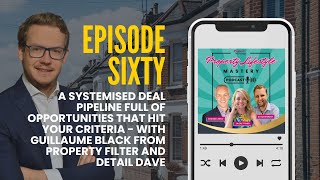
This is a YouTube video titled "Property Lifestyle Mastery Ep. 60 | A systemised deal pipeline of opportunities with Guillaume Black" published in August 2024. It features a detailed podcast conversation between hosts Jackie Tomes and David, and guest Guillaume Black, CEO and co-founder of Property Filter. The discussion centers on building a consistent property deal pipeline, focusing on sourcing motivated sellers, negotiation tactics, deal analysis, and the importance of relationship-building in property investment. Guillaume shares insights from his experience since 2012, emphasizing the people aspect of property deals, the value of persistence, and systematic deal evaluation. The content is an in-depth expert talk rather than a casual conversation.
Hello and welcome to the Property Lifestyle Mastery Podcast. I am Jackie Tomes and on this show we're having open conversations about building a property business that creates not just cash flow, but also freedom from those of us who have been there and done it. So from startup to over 70 million pounds of deals done to date. So we're talking about the highs, the lows, and the lessons in going on holiday every six weeks and everything from big picture strategy, maximizing your inner human potential, and right down to the practical solutions. And today we are joined by Guillaume Black from Property Filter. And Guillaume has created an amazing piece of software called Property Filter and it's all about how you can create a systemized deal pipeline that's full of opportunities that hit your criteria. And this is super important if you want to be able to do property deals no matter where you are in the world. Dave. Dave is joining Guillaume today and he came off this conversation absolutely buzzing. It is filled with insights about the inner workings of how to get enough property deals done no matter where you are in the world. You're gonna love it. So without further ado, here is Dave and Guillaume.
Hello. And we have Guillaume Black with us today who is the CEO and co founder of a fantastic sponsor software called Property Filter. And he's been a property investor since 2012. And he calls himself an accidental property tech entrepreneur. And he helps, primarily his job is helping other investors to find deals, obviously on top of finding his own deals, but that he's expanded into that area. So it's a joy to have you on on the podcast today. K, thank you so much for being here, David.
Thanks so much for having me.
And I just want to give some scope to where we're coming from with this conversation today because we have a lifestyle mastery blueprint that we work from. And one of the third, like one of the legs of our stall, of our three legged stall is business strategy. And one of the parts of business strategy really in property is all about sourcing deals, finding the deals in the pipeline and the investors to go with them. But today we obviously your expertise, we're going to be focusing in on those deals. And in particular, what I wanted to discuss with you as a general is like, what is so hard about finding deals? I mean, I have a lot of clients who kind of have, you know, maybe find a great deal and then we work together and it takes them quite a while to find the next deal and they're getting very frustrated and I'm having to work with them through various tools and techniques that I have to get them to a point that they're actually starting to find consistent deals. I think the consistency is the word that's most important because a property investor can't be, you know, we need to build a business that's consistent in some way and deals is the lifeblood of that. So for, for me, I want to just cover that ground with you. Like you've obviously started in 2012. You've been through a whole process of learning how to be a genius at consistently finding deals. So yeah, I kind of would love to hear a little bit to start with just about what you think the main problems are from your perspective.
Yeah, thanks a lot. Thanks for. First time someone called me a genius for finding deals. So I appreciate, I appreciate it. So I think, I think to start with, you want to understand why is it so important finding deals. And the reality is that every success in property is downstream from one's ability to find great deals. There's no one out there who can buy his sourcing fee, sourcing fee after sourcing fee, buy themselves the lifestyle and the portfolio that delivers on that lifestyle. At some point you have to become really good at finding deals. There is no shortcut to that and it's a skill. And if I were to summarize some of the lesson learned around this topic, it really would be that one, property is a people business and the best deals are both from motivated sellers. And it's all about understanding the circumstance of a vendor and having the conversations with the right people where the terms of the sale will be more valuable to the seller than the actual number of the sale. And this is where you, you have creative strategy, you have all sorts of ways where you create value. And the best deals are both in this way. And property is a people business. That's really my first thing. And you know, I could sit here and be the data guy, you know, because we sit on more data than rightmove, you know, with Property Filter. But it's understanding the industry we work with and it's. The property market is full of irrational actors. And if you just look at the data, the data will give you an average performance of an area. And the way we see it, it's always been about outperforming the average. You want to buy or acquire above performing assets. And you do this by being the anomaly in the data. And you do this because you are engaging with people. So very much so property is a people business and the best deals are done by buying from what we, or one would call motivated sellers, people who are more interested in the terms than the actual tag on it. Second lesson, I think it would be that properties, it's a numbers game and it could be a double entendre in there, you know, like there's a numbers game in terms of the number stacking, etc. But really what I mean by that is that the deals are in the follow up and we live in, you know, in a bit of a, what I would call the Amazon generation. You know, like back in, when I was a kid, you know, and teenager, my dad used to call it the cooked meal generation, you know, where we already, you know, we are used to have the ready stuff, you know, and it's even worse now. You go on Amazon, the price is the price you add to the basket comes to your door next day, you know, and people commit property from this mindset, you know, and, and no one wants to do the follow up, you know, no one. You know, the deals really, it's a numbers game. The deals are in the follow up and anybody who tells me, oh, there's no deals out, there is no deals in my area or nothing stacks. So these are people obsessing about the asking price because on Amazon the price is the price, you know, and, and really this is where people struggle is they want the, the immediate, immediate results like they get on I say Amazon but there's plenty of, you know, immediate gratification websites, shopping solutions out there. But that's really where I think people fail. They look at the wrong opportunity to start with, you know, the wrong people, you know, people who are not motivated, they can sit on it for four years until they achieve their price and, and they're not ready to follow up, you know, they don't enter it with the mindset that it's going to take three months, six months from the time I do this viewing with this good lead, it's going to take me six months of follow up. Three months of follow up. And you mentioned about your students having their first deal and then they're struggling to get the next one. And you said something really, really important and it's this consistency and it's the viewings you do today that are your deals pre Christmas this year. And people go into this mindset where oh well, I'm not sourcing right now because I've got a project on the go and then everything is stop start. You stop sourcing because you have a project and then you start again. You are no one to the market and then you have to rebuild the relationship with the agents. The people in the area from scratch. And then you have to push all of this flywheel, like get this momentum going and you getting out and then three months, six months later, you finally find this deal, you stop to go do your project and then you need to start the flywheel again when you start sourcing again. And I think this is the biggest reason why people don't get a constant unlimited deal flow of motivated sellers. This deal flow is they don't want something entertain their pipeline. And you should always be sourcing even if you do one viewing a week, if you're viewing the right property or sending 10 letters a week just to have conversations kicking in the background. And it doesn't take you more time and you just keep this momentum. The hard thing is to start, but it's like riding your bicycle where when you start you have to put the small gear and then once you're moving you don't need to do any effort anymore. And it's very much the same with sourcing. So you start, once you start this flywheel, which you have to start anyway, might as well get it kicking and rather than let it die because you do your project and having to start again three months, six months later, just keep it moving and it's zero effort. It's five minutes a day. You could honestly source with five minutes a day, one viewing a week and then a few WhatsApp and email follow up conversations, half an hour a week and then you've got more deals than you can buy. You can pass it on to your friends. It pays for your other deals. I mean the ones who do really well, they are, they, you know, this is what we do. This is the consistency you were talking about.
Brilliant. Like you already just covered all the genius. We could just stop it right there. As far as I'm concerned, we don't. You, you've proven yourself in every way with just those three things. I totally agree with 100, everything you've said. I want to take us back to mo to the beginning people business. So we're talking about motivated so sellers here and I, I totally agree with you. The job here is to find the people who. These are the best deals. To find the people who are ready to sell at a price that works for you. And that could actually what I find interesting about motivated sellers as a concept is that actually some people aren't necessarily even. Some people aren't necessarily even motivated. They're just ready to sell at a lower price because they, because they see it that way. They view the price as that lower level. And they're just, they're just realistic. And other people have got unrealistic and need to become more motivated. So it doesn't matter what we're dealing with, but what we're dealing with is people trying to sell something and they have an expectation of what they want to get out of it. And you have got to fulfill that expectation or not in some way or another. But what I find interesting is, you know, you talked about it as a data game and we are talking about right move as a primary, one of people's primary or zooplar as a primary approach to finding properties. But the way you talk about it is almost, I think most people would listen to that and say, okay, so maybe, okay, if it's a people game, I'm trying to get to the seller directly, should I be doing direct to vendor campaigns? Should I be going out there and knocking on doors? What should I be doing to get to the people? So I guess my question for you is how do you see the interrelation between the people you're trying to get to the seller at the other side and the fact that really we're just looking at a freaking computer screen at rightmove. And then the next next step is we got the barrier of an estate agent. How do you link from one point to the person at the other end?
So I think if, if in this day and age you are, you know, looking for properties on right move, you are wasting your time. If you are randomly sending out letters and leaflets, you're waiting, wasting your money. So do you want to waste your time or waste your money? It seems like this is, this is the solution most people have, you know, so no point intended, but there are better ways, better ways to, to find, to find deals. And, and I would say there's nothing wrong with properties being on the market or not. The reality, especially with residential properties, is that I think 92 to 94% of the sales that are going through are going through an agent at some point or they were listed with an agent at some point. So the immense majority of transactions going out there, they leave a trace on the Internet. They leave a trace that they were at some point on the market. And that's really interesting because. And this is why randomly sending letters don't work. Because there's 33 million addresses in this country. There's 1 million listing online every year. 800 to 1.2 million are sold every year. So if I'm random and never mind all of these people, be motivated, but when we're looking for motivated sellers, the clue is in the name. Where are the sellers and what is the motivation of the seller? And so how to qualify someone as a seller, where we said 92 plus percent of the sales are going through the market. So it's a really good qualifying factor that, okay, all of these people want to sell because it's very common. Let's say you look for corner plots or something like that and you randomly send letters on the only qualification that they have, a corner plot. Well, you know, most of these people aren't gonna, they don't want to sell, you know, or unless you play the really, really long game and you are in it for, you know, you're gonna follow up with them for the next 10 years, you know. But other, other than that for most people, because they want the deal right now for the, you know, in the next sort of three months, it's not going to, to work, you know. So if you do some math around, I said, you know, there's 33 million addresses, 1 million change ends every year, roughly. And if you think 23% are bought by investors, so that's the, the share of the PRs. So if you then randomly send letters on properties on the only qualification that it's got a door and two windows, you've got 0.7% chance of finding someone that might sell their house in the next 12 months and never mind them being motivated. So you'll have to understand that if you want to get into direct to vendor, there's a true cost, there's a true cost of 0.7% chance might sell the next 12 months. And then within this, you have to weed the, the motivated. So I'd say with marketing, and it's interesting, you talk about the business pillar, you know, of your, of where this sits in marketing. There's this concept of, you know, organic leads, organic traffic and paid paid leads. Paid traffic. And unless you're really, really good at negotiating any good leads, most people will really waste their marketing money. They'll waste their time on not converting good leads, you know. So if you start by spending a lot of money on marketing, you'll be wasting all those good leads, you know, and it might have cost you thousands of pounds, you know, to get to this really good phone call of this portfolio landlord or whatever, you know. So I'd suggest you probably want to start by exhausting the organic bits, you know, like the free stuff, because then it doesn't cost you anything to replenish it with another one. You know, so and it's the same for all things. Any business you start by, you know, selling to people around you, you know, organically. You know, you go like. And then you go wider and wider, broader and broader. You do organic content. You do, maybe you have a blog, maybe you have YouTube, all of these free stuff and then only once you kind of max out on what you can do there, you start to pay referrals, you start, you know, to pay ads and things like that. And the logics should be the same in property. You probably want to exhaust your organic leads, have a way to find the needles in the A stack within those organic leads before you start to, you know, spend a lot of. Because you really want to cut your teeth on these, you know, on these free leads or cheap leads so that it doesn't cost you a fortune the fact that you don't convert them on the other side. So there's a logic for me where you want to exhaust the organic, your organic marketing when it comes to finding deals before you move into paid solutions. And the organic is the free stuff. But it could be a lot of efforts if you don't have a system basically.
And what when. Okay, I, I totally agree with everything you just said. I can't tell you how many people are going outside of sourcing. Often people are looking for investors, particularly with their marketing and that's the area I've seen just people spend a thousand pounds, two thousand pounds a month retainer to some marketing company. But they haven't, they haven't done any of the initial start, they haven't exhausted the organic stuff. And it's really. You are looking for a needle in a haystack which means you're just going to be. It's a gamble, right. It's a massive gamble at that stage and that. Yeah. But going back to property. Yeah. What is all organic lead? Because I think earlier you said, you know, in rightmove for example to me sounds like a free approach. Right. There's no cost to it and you're going right in there and you've got all these leads, potential leads, prospects available to you. Where does organic come in if it's not right move.
Yeah, so, so, so organic is basically stuff that is available online now. It's available, you can, you can find it. And to I, I said earlier, you know, if you are still scrolling through right move today you're wasting your time. It's because 90 of what's on, you know. Right move and the other portals is, is a waste of time. You Want to have a solution basically that, that amongst these gives you the needles in the A stack. So we've established that they were vendors because they've put their property on the market at some point and it doesn't have to be on the market right now. And now we need to identify the motivation indicators of these vendors and have these as triggers to go and engage with them. That's really the best ROI you'll get on any lead generation marketing is to use some kind of system that does this for you and you know, you could build your own or, or you could leverage some, some cool solutions available.
Brilliant. I think from our perspective, what I've. The way we built our business is along the same lines in theory, using though rather than just right move, just relationships with all of the people, the estate agents, the sources, everyone who is in contact with the vendors in the area. So our approach has always been to become the go to for those people we work to become the one that they pick up the phone to. Because you're right, the term needle in a haystack is literally what we're looking for. And I think that's a problem with most people's mentality. They come into property, they think, oh, there's loads of properties, he'll be fine, just, you know, just gotta find a deal and be easy. And then nothing stacks. But really, then they lose heart. Really it is a needle in a haystack and there is a kind of element of you've got to play the system, play the game and you've got to somehow be the, be the beating the odds, be beating the odds somehow. And for me beating the odds was a matter of being the go to. So we, we as a business went to every single agent, we were building the relationship with them by being friendly, being there, trying to buy properties, putting in offers. And it was the old fashioned route I would call it, of relationship buying. And that way they were better. Making it super clear to them, for us as a sourcing system, our biggest tool was making it very, very clear what we were sourcing. So it wasn't just we buy any deal, we buy any property. It wasn't that at all. It was the opposite was we only buy this type of property in this type of area and this, it has to hit these criteria, but if it hits those criteria, we will offer and we will buy at the right price. That's it. So it became a game of keep them aware of that to the point that as soon as that type of deal came in, we're the ones they pick up the phone to. So you're evening out the odds. You're no longer just trying to hope you found it on rightmove. You're actually being the first to call. And then we get the first put an offer in. And now, now we've got much greater odds than that point, whatever percentage it was.7% you said. So that, and that worked very well for us as a concept. But it does require you to be super, super focused on your model. And I think most people aren't. But yeah, it's, it's a game, right? It's a numbers game. And your job is to find a way to beat the numbers, to beat the odds and become, you know, find it easier to find those prospects, find the quality. So you talked about that as a numbers game and the Amazon generation thing came up, which I loved your way of putting that you've got pay what you see wanting immediate results. It's very aligned with what our younger generation. Kind of like it's all a now generation. I want it now and that's it. And you're right, I've seen this over and over again with clients. They see the asking price on whatever platform or whatever someone said and it's like they can't get away from it. Whereas one of the biggest advice I always give is no, no, the asking price means nothing. Like that's just ignore it or for me, an asking price. All it tells me is how likely they are to say yes to my offer. That's it. It's an indicator of motivation compared to my offer, but it means nothing else. So yeah, I'd love to hear your a bit more around that. This kind of concept of the numbers game and how you go about putting in offers and negotiations, how you, how you made that side of the business work.
Yeah, if you think it's a whole pipeline, you know, like. So it really starts by identifying the right leads because you could waste your time all day long, you know, like speaking to vendors whenever you want to sell or where you don't have a problem to solve. So it really starts by this, identifying the problems, identifying the problem properties or those motivated sellers. And really the idea here is to do 10 times fewer viewings, sending 10 times fewer letters, but having 10 times more interesting conversations with these type of vendors. This is really the start of things. And then it's going exactly as you said is being the best way to show and portray yourself professional is, is to be very accurate in what, in what you want. And nobody remembers you if you go, oh, we just some, we're just some dude buying any property, you know, but if you go, oh, we buy, we buy, we only buy semi terraces on this side of the road that are 112 square meter and above and that have, you know, I've, I've not got an extension or lost conversion done to them, you know, like everybody in the office is talking about you now, you know, so. And I find the best way, the best way to go and create these relationships is actually to identify this ideal property. You know, you use this first lead as, as an icebreaker and you go and you know, try to make this deal, this deal work because this is the property that match exactly your criteria. You're serious? Because you've actually been there, you know, you've, you've, you've had this conversation and maybe you can't make the deal because of the circumstance of the vendor, or maybe you can, et cetera. And then you use this as a lever to say, okay, anytime you see something like this, the more dated the better. But this is exactly the kind of stuff we only do this. And then deals are like buses. The more active you are, the more you get. So the best way to build a relationship with an agent is, is to actually have done a deal, you know, once you've done it once, then you, you know, you just, you just make it to their, their respect book book and, and they can, they can send you more on the num. On the numbers game. I think it's really important. So when you position yourself for the, the, the negotiation and the offer, I think one of the best advice I've had is the first one who says a number, you know, loses the negotiation. So it's almost the best technique I've, I've, you know, employed and seen doing is to actually not offer. So especially if you've got a direct. If, especially if you are direct to vendor, you know, and it could be that you are direct to Vander from identifying the property on the market. There's all lots of scope, you know, kind of stuff you can do here. When people are frustrated with the old, you know, property, not selling and complaining about the agent, you can make, you know, you can be their best friend. And what I find is, is positioning it like, I'm really trying to help you, but I'm not sure I can at this number introduce a third party, like authority. So like, it's not just based on me. I'll have to speak with my partner about it. And I'm not too Sure, I can help you. And then leave it to them and then they lower the price. I'm not sure I can help you. And then with a few conversations like this and you need to build a rapport over time and they just drop the price. Once you build it in their head that you are the only solution because you are the only one following up, you know, once you, once you followed up for more than three or four weeks, nobody else follows up that long, you know, so you've made it to their, you know, you occupy some headspace with the vendor or the agent that you, you are the only possible solution to their problem, you know. So from that point you've built enough rapport so that they, they really, they only want to sell to you basically. And the best technique I've seen is to actually not offer to get them lower the price and sometimes quite significantly and say I'm really sorry, I don't think, I'm not sure we can help. You know, I'd love to help you, but I'm not sure we can help. And then this sort of makes it wait time and their own motivation will show, will show off, you know, in that way. And then the lower, the lower price to what you want or to a level as you say, where it becomes more likely that they offer that they'll accept your offer which is then at a lower gap compared to the initial asking price. And you really want to beat the ignore the asking price. The asking price is putting off all your competition because you'll buy this for 50k less than this anyway. If it was listed for 50k less everybody will be jumping on it and it'd be gone. So that's really the idea there. And the idea of the follow up and Anomals game, it's very much occupying some headspace. So they only see you as the solution. And it's nothing more than, you know, if it's the agent, it's a phone call to the agent. If it's a vendor email, WhatsApp phone call. I think phone call can be intrusive for some vendors sometimes WhatsApp is great. Emails are great if you make them conversational. So where things people fail with emails and negotiation in emails is so Here are the 15 questions I've got for you. And then emails takes a week to come back and be like screw that, you know, but if you go, you've got 15 questions but you ask them one at a time and then you build up your, this email as a conversation like you would do and make it More like a WhatsApp type chat, you know, than actually a corporate type email. You know, you writing to a supplier, a client, something where you know, you don't want to, you want everything in one place and you know, you know, forget that. You can build the momentum with this conversation and they'll tell you a bit more, you know, they'll tell you why they are trying to sell. They'll tell you what's the balance on the mortgage or you know, question nine, you know, like over, over time and, and, and you, you'll build so much rapport like this that they only want to sell to you. Love it.
Yeah. And you're just like, you know, what's so amazing about you is, is you're really a natural salesperson. Right. I don't know how you've done any sales training in your life, but like in theory, the concepts you're saying from the way you approach people, the way you deal with things, it's, it's, it's beautiful organic sales tactics. The, the nice ones, not, not the like scarcity and urgency type tactics that you see in, in, you know, door to door salesmen as it were. It's, it's just, it's lovely to see because you're just basically espousing these wonderful negotiation tactics that are designed to lead people in. It's, it's talking about conversation and led selling, you know, and not trying to be too professional. I see this over and over again with people. They want to, because of their own insecurities and fears, they want to put forward a professional front. It's like you don't think people are going to take you seriously if you don't put forward this very professional, proper. I'm a, I'm a. Take me seriously. I'm a proper investor type front. The problem is all you're doing is actually undermining and undermining your own success because people aren't interested in that. You've created a facade. You created something that people have to pierce and actually create a sense of uncertainty around who you really are. You created a barrier and the person you're interacting with isn't seeing the real you. And it automatically, subconsciously puts them on guard because they don't know what they're really dealing with. But when you start approaching it as just a conversation, just having a chat, you don't think about professionalism coming across really well. You just have a chat. It's you, it's really you talking to them and it gets them off their guard and immediately like you say opens up there, they'll tell you stuff that you wouldn't expect, but you've done it by just being natural and opening up. And so again, I always see this thing of the more we try, the more we try and be something, try to do something, the worse our results are. And the more you just relax and just let it happen and just go in there with an open, you know, open mind and just be, be yourself, the easier it so often is. And that's a great example of it. And I'd say the other thing I really picked up on there, you keep saying the vendors, you are the only possible solution. The truth is you're not, you're never the only possible solution. But because you're there, you know, to them you are the only thing that is easy. The only thing that is easy. Everything else is hard. They could go and do so many other things to try and sell that property. But people, human beings are inherently lazy. That's just a known fact. We all know it for ourselves. And yet that's what you're dealing with. You're dealing with an elating individual who can't be asked to go and do another option to try and sell their property. And you're right there. You're the easy, simple route. So if you, as long as you're there being a nice easy route and being present and being in there in their kind of life and that's all you're saying, right? Regular follow ups to be in their life. And then, and then when it comes down to it, they'd rather sell to you. Because it's easy, it's just, it's just simple. Just get it done. And the problem, the motivation changes because it gets more and more frustrating for them. They have, you know, this, this property they haven't sold, you're the easy route. So. And I love the hurdles. I'd say another thing you've said there, which I love so often we don't think about the other party and what we're doing to them. And we don't think about like you want, you want them to take the next action to be as easy as possible. And if you, you're right. If you put a list of 15 questions, how damn hard is that? And everyone going back to the inherently lazy, everyone procrastinates. When the job becomes too annoying, too hard, you procrastinate on it. You just don't get around to it and then eventually you forget about it. So yeah, one question at a time. Genius advice, so simple. But it Solves the problem. So I love all of that, as with everything you've said. So then what about coming to the numbers? You've got all these deals, not deals. You've got all these motivated sellers that you're needing to give an offer in on. From my perspective, there is a question around deal stacking and analyzing, and I think it's something that is ignored in this industry. Everyone knows I'm detail Dave, everyone knows who listens to this podcast that I care about the detail and the numbers. That's where I come from. But in theory, property is a numbers game. Like, yes, it's a people game, but fundamentally it's an investment. And investment is numbers. Your job is just to find out the numbers so you can then go out and do the people thing. But like, if you don't have the numbers right, like, what have you got? You've got. You could put a bodge deal a bad investment, you know, potentially. So I would love you to elaborate yourself on how have you gone through that journey of deal stacking and like, trying. Because if you've got loads of properties or loads of vendors you're looking at, it can be a real headache. Quite hard work to. To do your numbers every time and do it well. I hear a lot of people with their back on a back of a fag packet numbers which may or may not be right, but invariably can cause you big problems if you get it wrong. So, yeah, give me a bit of thoughts around that.
Yeah, so for me, I really take this for granted because somehow it's very easy for us. You want to have a bit of a system, an approach where systematically, when you look at something, you have a process when it comes to. So there's two questions here. There's the deal analyzing and there's the deal calculation, deal stacking. So I think the deal analysis is kind of a risk. You look for red flags and things like that. And the stacking is just black and white numbers, what the offer needs to be for it to work. And I take this for granted because it seems quite obvious for me. But the way you ask the question, because you might speak to other people, it's not obvious, but it's very basic. So the deal stacking is just black and white. So you've got different strategies, different ways of stacking deals. So everyone should have their own spreadsheet or a system with a deal calculator for every strategy. So what I mean by that is you don't stack an HMO like you stack buy to SA or Holiday lets because you've got occupancy, cleaning fees, different things come in the mix. So you want to have just a place where you've got all the deal stacker templates and know they are right and that's it. You know, you just put the numbers in. So offer, you know, what is the offer number, what is the deposit and there's no uncertainty at all there. It's black and white what the offer needs to be. And then most people don't know what a deal is a deal for themselves. So you, you probably need to start by saying what am I trying to achieve with this investment strategy? Am I looking for 10%, you know, yield on, on some blocks of flats and buy to let. Am I looking for you know, 40, 50% plus you know, HMO conversions where I'm going to do, you know, I'm going in for 12 months of you know, planning and heavy works and ensuites and stuff. So you need to start to be quite clear with what a deal is a deal. And there are some benchmark of, you know, what a good HMO conversion is, what a ready made HMO is, what you know like your typical blocks of flats lend to a charity is. So this gives you again the average of an industry of your market. But you can be more or less demanding. You know, you want, maybe everybody, everybody wants a good deal. But you need to understand that the, the more aggressive you are on the numbers, the, the, the smaller conversions you'll have through your pipeline. So if you want, if you only do all money out deals, you'll have a lot less than you know, some guy, you know buying buy too let's at market, you know, market price, you know, you know you'll have a lot more choices. Yeah. So it's understanding where is a, a sweet spot for you where it outperformed the area. You can be happy for yourself and it's still realistic that you'll find dozens of it. So for example for us with HMOs when we were actively growing the HMO side of the business, we wanted 40% ROI after we commercially refinanced. We want to get the money out within a couple of years basically. So that was the thing and that's recognizing also, you know, that was, it's a lot of work, you know, you, you turn a one, you know, 110 square meter property into 150 square meter property. You extend left, right and center. You've got some builders on it, you know, for six months, you know, it's you know, you, you deserve the reward, you know, but if you're looking for, you know, some, then it's just there's a, there's a ratio between the work you do and the work you're ready to do and the expectations you can have on the other side. You know, I don't think you can buy a ready made HTML with 40% ROI. It wouldn't work. So it's understanding the amount of work you can do. And all this work you do can value and translate itself into the numbers on the other side. And that's kind of it really. Start with understanding what a deal is. A deal. It's like what to offer at auction. You know, what to offer at auction. You just stack it and it's bloody black and white, you know, I'm not too sure.
I think you make it sound so easy. Yeah, but I think the reason people can't struggle with that black and white thing is that they actually don't know what their criteria or metrics are. Right. And that comes back for me to focus. We started this and I always come back to it. Jackie does as well. Like if you don't get focused on your model and what it is you're gonna, you're doing, you end up kind of access, you can do anything, right. I might do an HMO or I might do a commercial conversion. I might. I mean what you said earlier was perfect. You said when we were growing our HMO portfolio, we were doing this and going after that. It was very clear, very clear model. But if you don't have that, it's very hard because every model has different things. It's going to be able to achieve, you know, 40% returns after refinance is really impossible on a buy to let property generally. Because unless you're in a very special area, that's not going to happen. And you know, every model has its own metrics. And that's for me, I break this down into. I have my deal criteria which are the.
That's right.
What makes, what makes a deal a deal? Like it's got to be a certain type of property, a certain type of place. You know, I'm going to do these things to it. What makes deal. But then I call these deal metrics. On the number side I'm like, what key metric am I trying to hit? And then that's the 10 return, 50 return. You know, I need to hit this much uplift on cost, this much on gdb. Like that's my. I just call them metrics because it's in separate it out. And most people don't have that. So like for example me on my analyzer, I have a very clear that the front and center, the very first thing at the top is an amalgamation of my four or five metrics that I am going after. And that's where it's literally at the top. And then I have to go down below it to start putting in numbers because that's what's important to me. And most of my deals are set up in a way that this is what I do for my clients as well, that you are doing the same thing every time. Which means nearly every number is the same every time. So approaching a deal stack is as simple as you say. It's probably changing five numbers. Five numbers being the amount of refurb required, the maybe the level of interest you're paying to an investor or on the bridge, you know, and then, and then really like how many rooms. If it's an hmo, that, that kind of rent aspect, then you've got the end value. You have to have an end value in mindfulness worth. And the final number is once you put all those in because everything else pretty much stays the same in your model. How much can I pay for it? And that is just playing with the purchase price until it hits your metrics.
Exactly.
Done. You've changed five numbers and you're done. But if you do a different deal type every time, all the numbers change and it's a headache every single time. And for most people becomes a procrastination point because as I said, we are inherently lazy, even us, so it becomes hard.
But it's really true what you said, when you said, you said something, you said the numbers are always the same, but that's with the assumption that you are focused on this one strategy. And we've got 1400 members on props filter finding deals all the time. But we ask questions at the onboarding like what strategy are you into? So we can give like bespoke help and guides and stuff like that. And it always baffles me that people are mixing things and you know, like the ones who are going to be successful, they pick one or two strategy, you know, they'll have a cash flow strategy, they'll have a profit strategy, an asset play. But they are very specific on that. And then you know, the ones who are going to struggle and we try to help and coach them into understanding that less is more. You know, when you, when you've got, oh, I'm doing rent to rent and commercial to resi in the same sentence. It, it doesn't make sense, you know, but, but sadly we get a lot of people come like this and we, we do our best to try to, to help them, but it's, There's a misunderstanding, a fundamental misunderstanding of what makes you success in property. You know, one is a, is a trading business, is a cash flow strategy, it's a business skill thing. It's not really an investment. The agency model, you know, of the rent to rent or management model. And the other one is like a, you know, medium, medium size, you know, great size, big size development. You know, you, you know, these are different flows. You know, you can do every, you know, anything, but you can't do everything. And then it might be that you need to focus on the one thing now and then, and then do the other thing in 18 months, you know, and it's absolutely fine. But people don't give themselves enough time, you know, enough longevity. You know, you probably. And the prime. One of the problem is with some of the, you know, education industry around where, you know, you get things like, you know, you're two rent to rent deals away from sitting on the beach, you know, like, well, rent rate is not passive. Like, you know, like is not passive. You know, so people are being a bit, you know, not lied to, but it's been very misled into believing that it's the two deals away from doing nothing and retiring. And it's very, not, it's very much not the case. And, and because a lot of people who get into property, and myself included when we, when we started is we don't have business skills, you know, we come from maybe an employee background and we hit a frustration point and we want to change and we believe that of all the different side hustles, you know, classes and asset classes, property could be the vehicle for whatever reason. And that's great to get into the industry because you want to make changes in your life because so many people have done it before you. And I think everybody can, can actually, you know, achieve significant things. But equally it's quite, you know, it would be quite, you know, misleading and challenging not to stop a little bit and get some business skills on the way. You know, like thinking you're two deals away from retiring is bloody. Is. Yeah, it's, it's an advice that we see going around all the time. But what people have not understood is they need to work on their, on their mindset so that they understand, you know, like business modeling and commercial balances and say, oh for me to have a team in place, management in place and me to be able to focus my attention on other things. My first commercial balance is I need 10 units. So you're not two deals away from sitting on the beach. You're, you're 10 units away from, from having your business in a position where you can have a part time manager full time and then therefore you can grow other aspects. And your next, maybe your next commercial balance is to go from 10 to 50 and then from 50 to 200, you know, and that's really like the trading, trading model. So you'll have different cost base, you know, like based on the number of units you need to serve that will grow, you know, and then you have always a gap in between. It's because one, I don't know, property manager could look at 20 units in a given month. But from the time you've got 21 units to 40, you are either overstretched or under resourced. So under resourced or you're paying too much for. So you've got to cross this crossing the desert. You have to cross this from one commercial balance to the next one. So these are all business skills you pick up on the way, you know, but people need to, I think when you get into like a strategy like rent, rent, you need to have more of a. I'm building a specialist, let's say agency for short stay, holiday lets or for you know, like very specific for corporate stay in city center or for you know, you know, blue collar HMO things. And people don't really understand who they are serving. They're thinking how many deals they need but they don't. They need to have more of a, a business mind. Who am I serving? What is the brand I'm creating or do I attract this specific type of customer? What else do they want? Because we get this all the time, you know, it's like oh and props filter, you know, like where's the template for essay, you know, like what essay? Like what of, of the 20 different types of customers you can have in, you know, in one town, what is it, you know, is it your corporate, you know, single executive, you know that needs a place to stay Monday to Friday? Is it just for two nights? Is it two maybe senior managers who are going to share, they want two bathrooms. Is it for, for you and your nan to go on a, on a holiday somewhere? Like there's a million different case for short stay, you know, so yeah, and most people don't really look at it from a business perspective. I'm looking at the actually who is the customer and what are you trying, you know, how can you serve them? And then by having this clarity, you'll know also what are these people paying for and what amenities do they need. And all of a sudden you build a very clear criteria of what deals you are looking for and then you can layer the metrics you were talking about on top of it.
Fantastic. I agree with everything you said. That's obviously why we got into business strategy and why we brought strategy to the property industry was for literally that concept. How can we make it easy to understand property as a business rather than treating it as this kind of like you say, just a thing that you do a bit and then somehow expect to step away from. But I would love to hear, going back to what some of the first things you said, right, we talked a bit about the fact that people start sourcing, then they stop sourcing because they get busy with the project and then they start again. It stop, start. And one of the words you used, which I think was fantastic was the term pipeline. A pipeline. And I know this is a very standard business term. It's understood in sales pipeline, you know, marketing funnel, sales partner. When people hear these terms, they kind of think they know what they mean. But I don't think when it comes to push comes to shove, the rubber hits the road, people don't really know what it means. And I think you probably know better than anyone what pipeline means in terms of deal sourcing. So, yeah, could you just tell me what your understanding of that term means when it comes to sourcing a deal? Yeah, basically.
So you want to convert all the good leads that come to you into great deals. And this acronym will change over the course of different steps. And the steps are quite predictable for you to convert a good lead into a great deal. Chances are you might have to view the property, you might have to have conversations with people, you might have to certainly put offers in or have conversations about the offer. And certainly you'll want to follow up at some stage. You might do some due diligence and stack your deal and things like that. So in the most basic term, you can build all these steps from cold to warm, from lead to deal in a very predictable way. And what you want is having those needles in the A stack coming at the end, having your magnet at the front end of your of your pipeline, attracting all these good leads and then you just push them through the pipeline, you know, and then every step of the pipeline is an action to take for you to convert all These good leads into great deals basically. So there's no. And the problem is people don't have a pipeline. So they'll be super obsessed about this one property. They look at something, they try to project their strategy on the vendor, on the property, on the floor plan. And I want to do an HMO on this. And they obsess and obsess. They stack it left, right and center again and again to try to make the number work better. Because when you actually get the insurance quote, I can put 20 pound cheaper per month. So maybe it's going to stack better. And this is like this big procrastination loop. And the sad thing is people will obsess about this one deal, they'll have conversations and it's going to look like something is happening. And then three months later the things fall through. They can't agree on price anymore. And the truth is they've probably upset the vendor all along, wasted everybody's time. And this is because they don't have the abundance and pipeline mindset. And the pipeline is just an organized way of you to track many properties at different stages. And you will be condemned to stop, stall, stop, stall and a lot of effort if you just, if you are not organized about your, you know, about deed finding, you know, as, as basic as having just a few steps. I'm doing a due diligence. So do you do some level of due diligence before you do the property? Do you revisit this maybe after? Do you offer before doing the property or after? This should be your way of doing business and you should stick, stick with it, you know, because it's the only way you'll be able to scale. And even if you are alone sometimes we can be our worst employee. You need to follow your own steps. You need to follow the steps so that if anything it breaks you away from any procrastination loop you are in because you see progress, you see progress, you can see that it's actually predictable and lot more predictable than you thought. And you'll surprise yourself to see how healthy, juicy and fat your pipeline can become very easily by applying simple concepts of lead generation and follow through follow ups.
You know, Absolutely brilliant. What a wonderful explanation of a pipeline. So yeah, from my perspective, just our pipeline, it follows pretty much that exact rule of we actually go down and we always offer on a deal before we actually view it to save ourselves time. So our pipeline was designed to be as efficient as possible for us. So I'm always thinking about time management and efficiency in how we set up our pipeline because I don't want to put time and effort into something that isn't necessarily going to work out, pan out. So I have the initial phases where step one is going to be a quick appraisal like a non deep due diligence one that is just very fast and a quick number stacking as well. So that I know that on a rough number stacking it's going to be fine and I know what number I'm going to go in at. I know you said earlier you find the best negotiation starts with no, you don't, you don't put the offer and you wait for them to put a number. Right. But obviously that's not always possible. And our whole process works, our negotiation process. Obviously we do put numbers in, but we tend to always have a walk away price that gets calculated on day one. An initial analysis we call it. But we come to a first number, we know if they accept it we'd definitely be able to do it. There's no problems whatsoever, it's just a definite. And then we might put that number forwards but we know it's not the highest we can go. So we've built in margin. So we're just putting it forward. And we're putting it forward in a way of like, look, we're interested to go see this property. We'd be looking in the region of this kind of area now for our kinds of deals that work well because actually we're dealing with large blocks of flats and it's a big enterprise to.
Go and view it.
Whereas for other people I often suggest actually it's better to get in there and view the property because you can put them off with a low offer, low ball start and they might just be like, don't waste my time. And then you don't even get to go see the property. So it's better if you want to get in your pipeline. It's better in many ways to have viewed it sometimes just so you can, you can come back to it later very easily. But that comes like you say, down to your specific approach. So in ours we do initial analysis. Then if they're kind of anywhere in the ballpark, they say, you know what, it might work, you might as well view it. Then we go view it and then after viewing I would then do a deep dive analysis, a much more detailed one. And at that point I come up with my walkaway price. I call the price that I would go up to. And then I, and then I've got to stop there and I the negotiation starts from where we gave the number in before all the way up to the walkaway price at which point we stop and put it in the for follow ups. It's in the for follow ups if they, if they don't take that price, it goes into our follow ups stage of the pipeline which we then give it a category. It's like either follow up monthly follow up quarterly follow up, 6 monthly depending on what, what the motivations of the seller were. And so the ones where they seem fairly motivated, it'd be obviously monthly at least to go and check in for ones where it might have gone to someone else, sold some to someone else. Then we might check in monthly just to check if that sale's going through. Because our best, some of our best deals came from deals that fell through and motivated changes. So yeah, we give it a priority level and then follow up based on that priority level and then that gets us to. Yeah, you're right. Then it becomes a numbers game and you're shocked. It's shocking how many can work out that. I mean, I think my, one of my best deals we offered it was on the market for 750 grand originally, block of 5 flats and we eventually agreed it at half a million 250 grand less, 33% reduction in price two years later. And that was only because we had a good follow up process in place and it became a fantastic deal. I had another one that was on the market at 2.4 million block of 13 flats. We offered at 1.6 originally and then kind of agreed 1.8. But he wasn't happy and it couldn't work out two years later, even the market's gone up a lot. We still agreed at 1.842 years after that and then it was worth 2.6 at that point. So only from a great follow up system, keeping in the relationship built. That's where the best deals come. I think you said that at the beginning, but you're right, the phase of the pipeline. So thank you so much for explaining.
You seem to be describing the props filter pipeline right here.
That's it, that's it. Can I add something David, about what.
You said about offering before or after? And I think there's two information in what you shared. One is you are actually quite experienced so your time is worth everything. So I would say and for some people, so for example, we help people really save their time in this similar way. So you know, doing 10 times fewer viewing, sending 10 times fewer letters and then really niching down on these needles in the A stack opportunities. But equally when people are starting out, we don't encourage them to go and cut their teeth. You want to, you want to really build up this experience of seeing properties, different conditions of properties, speaking with different people and building this muscle and you can't really skip the gears, you know, like, you know, if you want to go further, you really want to go and build that. And the second thing you said is you are offering before and especially on blocks of flats and it makes total sense. So you know, it's a pain for the agents, a pain for the vendor. You know, you've got a portfolio of 10 properties. Hello, can I view it? You know, like so actually the, the context of this, you know, all day long you want to offer before and they're used to, you know, it's investor to investor. It's proper like B2B kind of relationships. It's a bit different when you buy people's homes where you, you need, probably need to go on a, build a relationship before you can offer.
But yeah, I totally agree. Yeah. And I think when we first started we were doing simple one bed flats and we would never have not viewed something. It was a, it was an immediate everything. We viewed every single one bed flat in the area, full stop and then every single time put an offer. And I think that's one of the things people struggle with as well. You talked about always sourcing. You said even if you've got stuff on you should be doing it once a week. At least try and view one property week. I think people struggle with this because if they haven't got the money lined up, if they've got it all tied into project, might not have another investor, whatever it might be, they're like, but what's the point? And what do I do if I've actually, I viewed it and I, I can't offer on it is how they view it. What would you say to people like that?
Yeah, so you know, if you look at what we are up against, so there are millions of people scrolling through rightmove, you know, how many of them actually book viewings? You know, like I don't know, maybe 10, 15, 15% tops. And then on the ones that view property, how many of them put offers in, you know, and then is it another 15, 20% of them, you know, so once you get into the mindset that you want to do 10 times fewer viewings, you know, value your time, only view the good stuff and then every viewings you do, you know, if it's worth viewing, it's worth offering, and vice versa, you know, so it's like, why did you go and do it in the first place? You know, so why are you in, in this property game at all? You know, so, and then all the what ifs, you know, what if, what if they say yes, what if, you know, I don't have the money, I don't have investors. This is the, the old momentum thing, you know, where you create yourself, you know, your own personal brand, your own, you know, the perception people have of you by being active all the time and you've got this flying, kicking around, you know, like, and bringing you deals and all the time. And the truth is, it's a really good problem to have if, if you actually accept a good deal. So worst case scenario, you'll, your worst case scenario, you, you can flip it to someone, you know, you, you'll give it for a fee to a friend, you know, and, and I, I'd encourage everyone to be in some kind of a property community of some sort with people doing similar things to them. You'll have people, you know, at your level, people ahead of you, people a bit behind you, and you learn from everyone. You know, the people at your level, you, you know, you kind of race in a healthy way. The people ahead of you, you know, you can look up to and they'll help you. And then you learn by teaching people who are, you know, a bit, maybe a bit behind you in terms of the experience, et cetera. And the great thing about this is then you'll have other people, you know, they'll, you know, if you're the best, if you're the best person, you know, if you are the best in the group at finding deals, everybody will look up to you. And with money, you know, bags of cash, you know, like, so, so worst case, you can flip it to a, to a friend like this, you know, and again, property is a people business and it means also, you know, from your own network of, you know, the people you surround yourself with. And, and then, yeah, like, why did you get involved in property in the first place? You know, like for me. So I guess maybe there's some mental and mindset things people need to work on, but I don't know, I live in this kind of place of certainty. And my world is very, my world is very simple. You know, it's like, well, you know, you want to do property, like, put off, you know, like view good deals and view good leads and offer on everything, you know, like it's it's kind of.
I'm glad you said that.
Dumb it up. You know, like sometimes I think, I.
Think I'm glad you said that because I think anyone listening here. So everyone has their own mindset issues. You've obviously one of the reasons you're so good in this area is because you are lucky enough to not have those mindset issues around offering on properties. And that's the reason you're so good at it, naturally. But anyone listening, just hear what Guillaume's just said and just know that that's the truth. That's what he should be doing. If you want to be successful in property and if you are finding reasons or excuses to not do it, whatever they might be, such as, oh, I, you know what, I haven't got any money lined up. I won't go this week, I won't do it. Oh, you know, I'm not sure I won't be able to put an offer in. I'm worried about that. Any, any excuse, whatever it might be, you know, no, right now that is a mindset blockage that is holding you back. Very simple, nothing else. If you work, Guillaume, the genius of finding properties and sourcing properties, you would have been out there, you would have viewed the property and you would have put an offer in. And I think you're right, Guillaume. I work on a basis of you just put in an offer that would work, you know, you put in a low ball offer that would work for you, whatever. The agents like you because you've actually made an effort, you've actually put something in and that's good because it makes them look good to the seller. They've actually got someone with an offer, but you know, if they accept it, you'll make it work because it's a great number. And if they don't accept it, that's fine. It goes in your pipeline for follow up, for when you feel better, when you need a deal. I think brilliant. Right. Look, I'm aware of time, so it's been longer than our normal episode. So I just want to finish up. Guillen, it's been such a wonderful conversation and you've said it's just gem after gem after gem after gem. Like everyone listening, I hope has been writing down with a pen everything you've said because it's just exactly what everyone needs in theory. We've talked about the kind of making sure you're clear on what your deal criteria are, putting them through some sort of a pipeline, having a very clear, easy way to make sense of who the motivated sellers are and who aren't being able to find the needles in the haystack. We've talked a lot about kind of being the people, having a people oriented approach and being the only possible or easy solution and having a nice easy way to then rate the motivations of your sellers. There's been a lot about kind of taking a very systematic approach and in particular around your pipeline, making sure you've got a really good pipeline in place and then stacking deals and having a good deal stack. That means you can easily jump through those numbers and do it very quickly and easily so that doesn't become a procrastination point. And know what your deal metrics are at the back end and know what a deal is for you in terms of numbers and in terms of criteria. Those are the main things and just get on with it. Just go out there and put in offers and don't, don't get scared by an asking price. So that's, that's my executive summary of everything I've heard from you in a very quick way. What I would love to know, because this is, this is the magic, right? I know you have a fantastic solution to pretty much everything I've just described there. Almost everything. Maybe not the mindset side, although it sounds like you might be helping people with that as well as you, as you work with them. Can you tell me about what you've done as a solution to all of that? Yeah.
So all the problems we described, these are lived problems, you know, like turning up at viewings and nobody wants to do a deal, you know, sending loads of money on letters. All of these were our pain, you know. So a few years ago when we committed to property and we started to look for our own deals, we had to go through all of these challenges. And being engineers initially we looked for solutions because the cheapest way of using a tool you're not going to build your own wheelbarrow is to go and buy one. And so we couldn't find things that worked for us, so we created Props filter which basically helps property investors find great deals faster. So it's all about finding your own deals. So the way it works it, it matches and merges all property related data all in one place and it's all about finding motivated sellers and all about doing deals. So it's not one place where you go and procrastinate on looking at lots of data and things like that and wonder what on earth have you done all weekend? It's very much, you know, within minutes you Set and forget your criteria. You go straight to the top five, top 10 motivated sellers in your area and you're ready to go and do viewings. And then it's described in very similar way to the way your own pipeline works where you can do some due diligence before. And the idea is you don't want to, you know, you want to be, you want to initially stack with a bit of margin exactly like you did, because this is going to be the bottleneck of your, of your sourcing thing if you spend ages, you know, two days on an initial due diligence. So you stack very quickly. There's lots of automation finds the full address of property pulls, all the information. You've got deal calculators for every strategy. All the stuff we talked about basically is in the system all the way to the pipeline, all the way to the follow up. You know, set a reminder to call back in two weeks, in four weeks, exactly as you, you described it. So we've got 1400 members using this up and on the country and we get phone call every week, if not every day because we find their first deal, their third deal, or indeed their 30th deal. You know, some, I think some of your, some of your clients actually do really well, you know, churning lots of HMOs through the system. So, so yeah, it's really, really great. And we joked at the start that I'm an accidental tech entrepreneur because we built this for ourselves and as property guys and when people wanted, we started to do quite well after it, following the principles we talked about so far. And then people wanted in on the secret. So it's like we were like, well, build your own. Why are you asking me? It's to show how immature we were for lots of, you know, you learn a lot of skills and mindset things, you know, as well, you know, and, and then we, we gave it, pretty much gave it away to a few of our friends in our property, Circo, same type of community we described earlier. And I, I know, I know you run a really successful one. And then they started to do really well too and then they wanted more stuff, you know, and like, well, I told you, build your own, you know, and then from there say, oh, well, you know, if you do this, we'll pay you. So. Okay, that's interesting. So, and then we never launched, you know, like, you know, we never launched, you know, like startups, we'd have like launch parties and stuff. It just merged into this thing, you know, from a tool we built for ourselves. To now a really fast growing, you know, you know, tech company in the property space. All about helping, you know, common people, ordinary people do, you know, change their lives through property by finding great deals. You know, like it's all downstream from finding great deals. So and, and yeah, we feed off people's feedback. We're very. People don't really expect this from a tech company but we run lots of calls and support and you know, you speak to me every week as a member. You know, we, we. There's a lot of around the support and live chat. You speak to a human and, and for us it's not so much what we've earned, you know, because we've grown and it's all good programs to have, etc. But it's very much been what we've learned and because we've been so engaging with our community that we know all the all. So we, we're just building, we are building things all the time, but we've really learned all the, you know, there's a huge, there's huge leverage in having a thousand people doing deals all the time in your community. And we know exactly what people with boots on the ground, you know, want. So although we started with good assumptions on because we built it for ourselves, we were on Avatar. Now seeing all, all different ways people do deals is just really. Yeah, it's really, really interesting. And now we are aggressively adding to it all the time, you know, so. And our North Star Matrix is all about, you know, how many deals can we get this week for our members. You know, it's all about improving the product, the service, all about doing deals. Oh yeah, you know, it's, I'm having a really good ride to be fair. It's really fun engaging with the, the, yeah, some of the most active people, you know, doing, doing deals, it's really grown a passion for this and an addiction for the impact we can have on other people. So it's been really rewarding on the personal side in terms of fulfillment.
Yeah, that's so nice. And I think I first of all can't recommend it enough. That would be my starting point because I think what you've done in such an amazing way is to merge the needs of the property industry with the business savviness of someone who understands how a business needs to operate. And you've turned them into one simple tech solution that does both. That's a starting point. And most people don't know like what a pipeline is and yet you've just got it right there. On a system ready for them, ready to go. Lots of aspects we talked about people just aren't aware of because they haven't had the business training. You've already integrated it in this product. But also I'd say one of the results, you know, you're here on our podcast is because you are coming from a place of service. You believe in the product, in how it actually helps. And you wouldn't be doing this unless it made huge impact with your clients, right? And with everyone you're working with. If it wasn't making a huge impact, you wouldn't be happy. You wouldn't be fulfilled. Even if it was making money, it would be like, what's the kind of, what's the point? But I really feel it from you. It's a passion for helping people to transform their businesses through this, this product. And, and with that comes hand in hand with the fact that you're constantly improving. And it's one of our kind of beliefs, is that we believe in kind of perpetual improvement. You're always looking for ways to improve things, make things better. And when it comes to service, that's such a magical thing to be able to do because you're always looking at the impact, always looking at how it's being received, how people are using it, and always saying, well, how could we improve this? How can it be better for them? How can it make more powerful? And I think that shows in the results people are getting. I see it in our clients. And when our clients sign up to your service and start using it, they immediately find.
More from Guillaume



🎯How Sourcers Can Turn Dead Leads Into Paid Deals at Auction with Dewi Davies


🛜 Connect AI to Your Email, Calendar and Deals (Watch It Go to Work) with Guillaume Black

⚙️ Stop Drowning in AI Tools, The Only 3 Things That Actually Matter with Guillaume Black

⚙️ Work Less, Earn More: The Tools That Save Property Pros Time and Money with Chris Kirkwood

🏠Exempt Accommodation or Supported Living? Understand The Best Strategies Working Now w/ Nisha Patel


📈 Unlock 100% Funding: Finance Your Next Property Deal Without Cash Out of Pocket w/ Kirsty Rogers
