Angela Duckworth and Mary Murphy on Resilient Teams – Wharton People Analytics Conference 2024
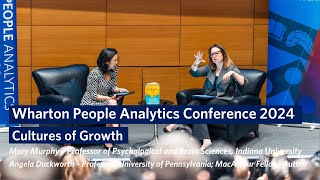
Panel transcript of Angela Duckworth moderating Mary Murphy (Wharton People Analytics Conference). Murphy reframes mindset as both individual belief and cultural feature, arguing mindset sits on a continuum rather than a binary. She identifies four common mindset triggers (evaluative situations, high-effort/new tasks, critical feedback, others' success) that push people toward fixed thinking, and provides practical strategies and HR-focused interventions (hiring for "distance traveled," onboarding, feedback framing, mission/job-ad language). The discussion mixes empirical evidence (text analyses of Fortune 1000 materials, Glassdoor correlations, startup founder longitudinal study, team pulse surveys) with real-world examples (Microsoft under Satya Nadella, Spanx, McBride Sisters) and cautionary cases (Enron, Theranos, WeWork, Uber, FTX).
Chapters
Thank you so much. It's great to see everybody here. I indeed had a short commute, which I got to take with Jonathan Tugman, who is an alum and beloved member of this conference community. And I'm here in part with an iPad with some questions, which I hope become populated with your questions. And so I'm going to prioritize your questions above mine in this conversation about growth mindset. I also am waving around Mary's unbelievably positive review from the Wall Street Journal.
Shocking, I know.
I didn't know there were reviews like this. And so I just wanted to share just the very opening because I think it kind of puts growth mindset in its place culturally. So Michael Luca writes, one day, back when my son was still in kindergarten, we were sitting around the dinner table when he asked me whether I have a fixed mindset or a growth mindset. I was taken aback. I had heard about the potential value of encouraging students to adopt more of a growth mindset, but I was surprised that the idea had disseminated so widely that 5 year olds were talking about it in class. And so, Mary, let's begin. I know, I know a little bit of your story of meeting Carol. If we could get a little bit of preamble, just sort of, when did you enter this narrative of growth mindset? And then, of course, straight from you, what is a growth mindset? Definitionally?
Sure, sure. So I was a PhD student at Stanford in the psychology department, and Carol had just arrived from Columbia to Stanford, and we were. What happens every year in the PhD program? This is the mindset culture origin story.
I'm going to share.
Yes, I love origin stories. I was in a PhD seminar. Students present every year their research, and I'm there to support a friend. And from the right side of the room, in the middle of his talk, someone just blurts out, doesn't even raise their hand. Faculty member says, well, it's clear the fatal flaw is xyz. And then someone over here on the left shouts out, no, the fatal flaw isn't xyz, it's abc. And they start fighting amongst each other in the middle of this talk. Who's the smartest in the room? How can I find the fatal flaw? Take this idea down the most quickly, most devastating way. And I see what it's doing to my friend. He can't concentrate. He is, you know, he just chokes. And then ultimately, what was more important I think than that even was that he didn't even want to pick up the work to two to three weeks later, because that experience was just so painful. Two weeks later, I'm in a different seminar, equally eminent faculty members, and they're really treating the student talks very differently. They are engaging in finding the problems in the research, but they are now instead of who's the smartest in the room, who can actually solve the problems in that research the most effective way. So, oh, this person should include new scales, work with a different population, right? Brainstorming. And the students responded differently, able to participate in the brainstorming, answer the questions, and they left motivated with tangible strategies to actually dig into the work right away. And as I was thinking about these two environments, I kind of felt like they had mindset at the center of them. And so I took this idea to Carol knocked on her door and I said, carol, I know everyone for the last 30 years has been thinking about mindset as something in our minds. What's your mindset? How does it affect you? What is mindset? How does it affect me? Exactly. And let's change everyone's minds right inside. And I said, but I think that mindset actually can exist as a cultural factor in that our interactions and what we say and do, there can be these fixed minded, what I ended up calling cultures of genius, where you either have it or you don't. It looks at for the star performers, you can either cut it or you can't. And then there's these growth minded contexts, right? Teams, organizations, groups that really believe that talent, intelligence and ability is something that we're going to develop and grow together. And so I told her, has anyone ever thought about mindset not as an individual difference in our head, but actually as a cultural feature? And she said, no, mare, no one's ever done that. We should do it together. And that was 15 years ago, by.
The way, Carol Dweck calls Mary. So I was like, I can't do that, but I really think that's adorable. Okay, so that's the origin story. And you've defined mindsets as beliefs, but they don't have to just be your beliefs though we all have these in our heads, but it's a cultural phenomenon as well. One of the most provocative questions that I think you wrestle with in the very beginning of the book is the misunderstanding of growth mindset as either or either you have a growth mindset or you have a fixed mindset. And you say instead we should think of it as a continuum. And Rajbi asked a question that's related to this. So I'll ask you to both explain this Continuum concept and also address this question is how do you move from the fixed mindset point in the continuum to. To a growth mindset point in the continuum, particularly after a setback. And thank you for that question.
That's a great question. So if you Google mindset, fixed and growth mindset, and you look at the Google images, you are likely to see pictures of two heads. One, usually red, is the fixed mindset, all the bad things associated with it. Right. And one is green and all the good things associated with the growth mindset. And usually the header is something like which mindset do you have? Either. Or it's like which Harry Potter character. Exactly. And you can see the iron irony of thinking, do you have the fixed mindset or do you have. It's a very fixed way of thinking about the fixed and growth mindset. I mean, it's like extremely ironic, but when we're in classrooms where I've done a lot of research as well as in organizations that say they sort of teach through the lens of growth mindset, I see these posters on the wall all the time. And it really emphasizes this idea that you have one or the other. And when I work with people in organizations, they say, oh, that employee just has a fixed mindset. There's nothing I can do about it. Right. So ironic. And what we know is actually taking it back to the very beginning of the way that mindset was initially structured and examined. Mindset exists on a continuum. It's a scale. Right. And we move. The experiments show we move between our fixed and our growth mindset based on what I call 4 predictable common mindset triggers. And these are to your question, one of them is critical feedback. But there are evaluative situations where I'm anticipating someone's going to evaluate my work. I'm pitching a new client. I'm preparing a presentation. How do I approach that preparation? Is it trying to show how smart I am, make sure that I'm seen as effortlessly performing, or am I trying to learn the most that I possibly can while making this presentation? Do I leave a lot of time for Q and A or no time? Because I either want my idea. That's right. That's right. So evaluative situations, high effort situations, trying something new for the first time, being asked to master a whole new area that sometimes moves us to our fixed mindset, where we believe that effort and ability are negatively correlated. If I have to try hard, it means that I don't naturally have it. So we know that's a place that people move towards their Fixed mindset relative to their growth critical feedback. When that feedback actually comes, we know that that is a really big fixed mindset trigger for people, for other people. We can shift that critical feedback trigger to be more growth by really figuring out both how to give critical feedback in a way that's not going to shut people down, literally making it difficult to hear or remember or see because the threat of it can really shut down our visual systems and our memory systems. So critical feedback and then the last one is the success of others when we see other people winning the prize we thought we might be eligible for this year or being praised on the team, a lot of times it can put us into that zero sum. You either have it or you don't. If she's so successful, how is there any room for me? Right? And so how do we actually move towards our growth mindset where we can take inspiration from the success of others, talk to people about what they did to prepare and figure out how to apply that more authentically to ourselves. So there's a whole section in the book around these mindset triggers and strategies for both. If I am someone who has direct reports and I am actually giving this feedback, making these high effort assignments, praising other people on my team, how do I do it in a way that the whole context and team is going to be moved to their growth mindset rather than what is typical which is being triggered into our fixed mindset.
One of the things I love the most about this book is that it's both theoretically grounded. I mean it's not just that you're talking about science that's been done. Much of it is your own research. And yet it's extraordinarily practical, including that four item checklist. As you were rattling off those things, I was thinking about my own class here in the MBA program. Not sure how I would do. I'm like evaluative. Critical feedback, comparative force curve, by the way.
That's right.
That's not my policy. But anyway, it's the schools, so thank you for that. Another question for the audience is how can HR professionals change a fixed mindset culture? And again, you began to give an explanation of this, but I think particularly within management and leadership teams and is there anything that we often get wrong? What are the common missteps of a well intentioned manager or leader or somebody in charge of talent management, A term that you can talk about whether you like it or not. I mean not whether you like it or not, just what do you think about it. But anyway, that's the question if you could give us some examples.
Yeah. So we have been doing studies across the HR cycle looking at how we've used different kinds of methods. We used a Bayesian causal forest kind of method. We've used method that just makes fancy statistics.
I know it's analytics but. But in case you're not a Bayesian regression. Well, we're all Bayesians anyway.
Yeah. And then we also do scraping of. For example, we have a study published on Fortune 1000 mission statements and public facing documents. And then we can look at the extent to which there's fixed and growth mindset language built in and we look at how that actually influences people who are considering applying to the organization because this is the material they can actually access. And look at. We've analyzed job ads, we've analyzed interview processes, selection processes, evaluation processes, promotion processes, learning and training processes for more fixed and growth minded kind of supports. And this is something that HR professionals are going to be dealing with on a day to day basis. Right. And so the question is to actually look at everything through that lens of learning. The question is, are you just talking about the best and and brightest? Right. We're looking at people. This is the next place you can come and do your best work. Right. That was an Apple slogan for a long time. Or is this a place that not only are you going to have incredible results but we're going to support you to grow and develop? Right. To take on new challenges. This is more growth minded language around developing your potential. We want high talented, highly talented people, but we also want them to be growing and learning. A lot of times people to your question around what people get wrong. They think there's a trade off between rigor and growth mindset culture. They think growth mindset culture is endlessly affirming rainbows and sunshine and unicorns. Everyone's great participant.
Ribbons for everyone.
If you've ever worked with Carol Dweck you will know this is not the case.
Nothing is actually ever good enough.
That's right. That's right.
Let's revise it again.
And the level of rigor in a speaking of data analytics, the level of rigor in cultures of growth is so far off the charts relative to cultures of genius. In cultures of genius, these fixed minded cultures, who's making the decisions? It's those who are crowned and deemed the genius in the room. And it's based usually on their gut what they think regardless of what the actual data says. So you see actually in these cultures of genius huge risks and shifts in Risk. What does the genius feel like today? Okay, that's what we're all going to do, right? What does the genius feel like tomorrow? Okay, that's what we're going to do. What? In a culture of growth, you are seeing much more use of data on a day to day basis and you're seeing rapid cycle experimentation that's using data to identify whether or not our effort that we're putting forward and the changes that we're moving towards is actually moving us in the direction of our goals. And so you can make more quickly pivots if needed when your data start to suggest that maybe you're going off track or you need to optimize in a different way. And so we really see these cultures of growth being much more rigorous. They're not always pleasant because what we see is that the expectation for learning and development is continuous, which means that if anyone hits a learning plateau or a performance plateau, it's not good enough. Right. And so that is the demand of the culture of growth, rather than thinking about it as so rainbow, sunshine, everyone's great all the time.
So in a couple of sentences or just a couple, can you just name some of your favorite culture of growth heroes? I know you talk about Satya, Nadella, but maybe in addition to Microsoft, actually Microsoft now, maybe not Microsoft before Satya, but I know that's one on the hero list. But just exemplars and possibly cultures that you would say these are real at present, cultures of genius. So can you just name a couple of those?
Our most infamous cultures of genius are places. One of the most replicable findings that we see across the literature now on these cultures of growth and cultures of genius is that cultures of genius have real ethical and integrity problems. Enron is the old school number one. Right. And why is that? Because in a culture, culture of genius, the coin of the realm is how smart you're seen. Your reputation and your status are everything. And so your co workers become not collaborators, but competitors. And so you see this entire system, people are watching their backs, maintaining their status. A new star is being born every day and I have to compete against that. And so you see people start to take ethical shortcuts. Right. I'm accidentally leaving you off the calendar invite for our next meeting. Right. I'm hoarding information because information is power in a culture of genius. And so the big ones are of course Enron, Theranos, Wework, Right. Uber. In the previous iteration of Uber, these are the places FTX most recently that we have seen, you know, who the genius is, you know, they're making the decisions and then you can see what everyone around them is doing in order to maintain their own personal status in those environments. Right. Cultures of growth. Of course there's Satya who like said Microsoft is going to be the first growth minded company in the world. But what I'll say about that is that it was a real challenge to actually get that to be true culturally. Throughout the organization he talked. When he first came into Microsoft, someone asked him in an interview, what is it like here? And he showed this New Yorker cartoon that has all these executives sitting around a conference table and they all have guns pointing to each other and he says that's what it's like. But when he named Microsoft a growth minded company, he said that those guns started to get loaded with growth mindset. Now it's like, I'm the most growth minded person you shouldn't listen to. So and so I have more of a growth mindset. That's a fixed mindset. Right, right. So, so this became mindset in name, mindset in not. The value implementation gap was huge for some time. And so really figuring Kathleen Hogan, head of people and talent at Microsoft, had the job of trying to make this real in their processes and the way they promoted and recruited and evaluated people. And then for Satya, in his strategy, resource allocation, how was he actually going to invest across the organization, which is how you got cloud computing was a function of this kind of just growth minded strategy of resource allocation. So that's a big one. The founder of Spanx, Sarah Blakely, has a really good example of growth mindset where she did not pass the LSAT the first two times. She took it thinking she was going to be a lawyer and then she was working as a vacuum salesperson for years. And she had the idea one day it was a fall, right. Cut off the bottom of her hose and she was like, wow, this is an incredible thing, maybe I should do this. But couldn't find investors, right. People didn't see the benefit of a woman's product like this. And so she had to use that growth mindset, try new strategies. She went down to the floor of department stores, talking people up individually, making sure her product actually matched the needs of her customers and really applying that growth mindset and that, you know, different kinds of investment strategies to really have success. The one I really love the Most is the McBride sisters. Has anyone had or heard of McBride sisters? McBride wine? Nobody? Okay. The McBride. Yes. Okay, over here. So the McBride sisters were trying to infiltrate the Wine business. And they are African American women who are in a huge culture of genius, the wine business, you know, family legacies and dynasties, right? You either have it or you don't. And you have the whole framework around you of the ecosystem that allows you to do this wine business. And so they decided to apply this growth minded strategy for themselves, creating a micro culture of growth around the two of them and then creating a macro culture of growth around the business they were actually conducting. And they built a whole new customer base. They worked with all kinds of new, different collaborations, innovative collaborations and sponsorships. They found new investors that had never invested in the wine business before and now they are the number one, the largest black owned wine company in the United States. So this is the power of the growth mindset, right? Trying new strategies, collecting data along the way, pivoting when we've come up against a challenge, finding new collaborations, innovative and creative opportunities. That's the growth mindset in action.
I love that example in part because you just underscored the point. I mean just the raw numbers on their revenue growth and market share are a testament to. It's not like consumers are buying it to make people feel good, right? Like they're buying it for the wine. So there's not a trade off there. Relatedly, there's a question from Jonathan Tugman. Oh gosh, this is favoring. Sorry, I'm gonna answer, ask you to answer Jonathan's question. What role in particular? You mentioned hiring and onboarding, but I wonder if you had anything more to say about that. And also this word talent. Because as I was walking over here, Jonathan was telling me about like a new chief talent officer and I think that word is an interesting word. So why don't you say whatever you want to say about onboarding and hiring and talent officers?
Yes, yes. So you know, when we think about what we count, when we are counting qualities, characteristics, when we're looking for things, you know, there's a lot of really interesting research on when we create what's called bought teams or built teams. Bought teams are where we're really, it's the culture of genius model. Who are the stars, who have the best pedigree, the best background, the most opportunities that they're going to bring in, they're sort of already created and we're just going to create a team of these stars, these bot teams. We know that over time those teams actually perform usually worse over time they can have short term success here and there. But it's almost like flying a plane into headwind when you have a bot team. Right. Your expenditures are going to be greater, you're going to be delayed oftentimes because these stars are competing against each other to see whose ideas should prevail. And everyone's going to be more stressed in these environments. Built teams are going to be teams that really consider growth and development together. One of the considerations in this onboarding and interview process is the distance traveled. What challenges have people overcome and have had to face? Right. Because we know that the distance traveled from A to B is going to predict the distance traveled once they're inside of our organization, how they're actually going to respond. Right. Everybody wants high ability people, highly talented individuals. The question is, do you want people to have a growth mindset for those high skills and abilities that they have where they believe they can continue to grow, learn and develop? Or. Or are you coming in with people who are really focused on their strengths? Something else I describe in the book as problematic. All the strengths finder stuff, the strength finder stuff tells you what's your strength now only do that how fixed minded now only focus on those strengths. And so when we're thinking about what kind of characteristics we want, we have to look at the growth and development people are bringing the experience of that, how they can actually help. When we think about who we invite to TA classes, do we invite the people who just performed at the very top of the distribution, the entire class, or do you want to invite people to be TAs who help others who actually struggled initially and figured out how to learn the material? Because those are the individuals who are going to be best probably in helping other students who are struggling. Right. If it's always come natural to me and easy, how will I even know how to help? What new strategies are needed to help individuals actually succeed over time? So these are the characteristics we can think about in that way. What do I think about talent? I think talent is fixed minded. I think you and other people have done research on this question. I know the question, Angela.
I want to know what Mary thinks.
That's right. I think it moves people right into their fixed mindset. That talent is sort of the idea of it. What we have in our minds, the cultural prototype of talent is very fixed. Right. And even by the nature, gifted and talented. Gifted and talented. Exactly. So I think it can move people to their fixed mindset. Unless you redefine talent as sort of, you know, built talent as malleable. Right, Exactly. We're going to have the same problem.
Yeah. In case anybody wants to change their company Titles to Chief Skill Officer. We are voting for that.
Hey, I like that.
Also, I also thought there should be like a grade point change and not just a grade point average. So maybe you should have a GPA and a gpc. But anyway, it's up to you to create these cultural norms. Speaking of which, I want to ask you a question that comes from JJ which is maybe specific examples of how you can quantify, given that it's the analytics conference here at Wharton, how you can and indeed should we quote, quantify the culture of a company on the continuum from growth to fixed.
So we have done that in some studies. We did this analysis of this Fortune 1000 data set that we had looking at materials inside organizations. We've also had studies where we've gone deep into organizations and looked at their processes within the organization. But the one I'll talk about is external where we're able to do this. And then we looked at what our algorithm produced around the analytics of on the continuum, the fixed and growth mindset culture continuum. And we compared that to Glassdoor data because we wanted to see now there are problems with Glassdoor data of course, but we wanted to see in particular whether the way in which the fixed and growth mindset score predicted people's satisfaction with the culture, not with every single analytic that is provided in Glassdoor, but the culture in particular. And we saw that it was a unique predictor of people's satisfaction and of the culture outcomes. So it really affects people's experience on the ground. When we look internally to organizations, we also find that there is greater trust, there's greater organizational commitment, people are less likely to answer when the headhunter calls in these cultures of growth and in these cultures of genius. And we also see better bottom line performance in these organizations. In a study we did with hundreds of entrepreneurs and early stage companies, the series A, series B startup firms, we looked at the founders mindset and we looked at the practices that they were putting in place in the early stages of their organization, including talent searches and others. And what we found, those fixed minded founders, they wanted to be the most innovative, the most creative. Of course they were on the line to raise all these funds, but they didn't want to hire anyone smarter than them.
That would be very dangerous.
It's problematic. We said good luck with that. Right. And we followed them over time and we found that those with stronger cultures of growth were able to reach and exceed their fundraising goals much more than those in cultures of genius. And then when we analyzed those Fortune 500, we found that those companies were more innovative, they were more resilient to market shifts and they were more profitable. So they had better bottom line outcomes too. So is it useful to think about that? Yes, it is for us to understand the predictive impact of cultures of growth and cultures of genius. But remember too that on the continuum you're not fixed. There could be a set point for a moment on the culture continuum. But culture is something that's never one and done right. It is something that's always shifting, always changing. And, and it's a product of the people in the organization. And so as our people shift, so too does culture. And so it's something we always have to be attending to. And so a set point at any given moment might tell us where we are in time, but it's not the end all, be all is what I would want to say about that.
Back to measuring, David said, is there a way to measure individual team members impact on the culture of growth in an organization?
Yes. So this is one of the things we do when we get into organizations. Usually we enact through organizations already existing. Most of them have a pulse survey. And so what we'll do is we'll measure people's mindset beliefs in a pulse survey. We also measure their perceived mindset culture of their local teams. And if it's an organization, say like Apple or Microsoft, that has many different divisions, we'll look at divisional outcomes. And so we analyze that data by teams and by divisions and then we conduct a hotspot bright spot analysis where we look at the places where you have very strong cultures of growth, very strong cultures of genius. And then we can understand and dig in and create some local case studies around those strong cultures of growth to understand what has to be in place. What are they doing differently that's allowing these cultures of growth to flourish. Right. If you think about the macro culture of an organization, you're going to have some level of on the culture continuum of mindset culture, but you will have many micro cultures within your organization. Identifying the places where cultures of growth have been allowed and are thriving in those environments can be instructive. Maybe they're not exactly what you can then apply to these other parts, but there might be some learning about what they're doing together or how they actually onboard people, or how they create team dynamics, how they start their meetings, how they actually surface mistakes and challenges and help support each other in those solutions. How do we understand that locally? Because you can take the Microsoft case study, but people will say we're not Microsoft, we don't have that DNA. So finding the local context inside is really helpful to figuring out then how to switch spread those cultures of growth across the organization with that organization's own DNA baked in.
Mary, one of your colleagues now, James Gross at Stanford. When I started collaborating with James, he would say something in our meetings that always took me a half beat to kind of like he would say, like, Angela, table three. I see this comment like, help me get smarter about fill in the blank. And it almost took me a half beat to be like, what? And I was like, oh, right, explain Table 3. And after a few years, it dawned on me that he was using growth mindset.
Yes, he was.
And just yesterday I was talking to James about how difficult it was for me personally sometimes to manage more junior people and that I personally felt that sometimes I was frustrated and kind of like, why aren't things happening faster and so forth. And he said to me, and this becomes a question for you, I'd like you to maybe share if there's any kind of personal angle on this. But he said to me, one of the things that's massively helped him as a mentor and as a manager is to really lean in to the growth mindset frame. He's like, every time a junior person says something to me, I don't think of it as just what they said today. I don't just think of it as this paper and this project. I look at that person as somebody who's changing. He's like, in my head, that's somebody who's changing. In my head, that's somebody who's getting smarter. Before my very eyes, it turns frustration into something entirely different, which is encouragement not only for the mentee, but for him. So I thought that was a wonderful story for James to share with me. I'm a little bit behind on this, but I'm catching up. For you personally as a striver, what has this whole mindset meant for you? And do you have any stories?
Yeah, yeah. I mean, I would say there are a lot of places where I find myself in my fixed mindset. And I think that really to move to the growth mindset, we have to understand those fixed minded triggers. We have to be able to identify for ourselves those moments where I'm like, oh, yeah, there it is, there it is again. And there it is again. Because one of the big problems we've seen as mindset has actually exploded in the context of education, and now it's taught in Teach for America and all these other teacher education programs is really thinking about mindset as we can't talk about the fixed mindset. We all just need to have the growth mindset. And so it becomes something that we can't even identify for ourselves. So for me personally, when I feel that coming on, it's oftentimes when we're in the 4th or 5th or 17th draft of a paper or a grant proposal and we just can't be seeming to get it right. And I've made comments, but they're not being brought through to the whole document. And how frustrating is that? And similar James and I actually, he was one of my mentors on my first year project at Stanford. So I had early access to James and this idea. But I do feel like finding myself coming into this, like, wow, this student is really struggling here. And maybe there's something I haven't done to really clearly explain or to help model and do this. And so we have taken in our lab a process of calling it our favorite mistakes. So we kind of like, say, what was your favorite mistake this week? My favorite mistake was again, finding that I left comments, but we didn't pull them through. So let's talk about why we're going to do this, how we do it better. And that favorite mistake idea has been kind of light. Sometimes I wore a white shirt and spilled coffee on it. That's my favorite mistake from this week. But some of them is about really learning and growth and development and how to improve the work and just by being able to recognize that we're fallible, that we're going to make mistakes, but that the whole group is going to learn from them because we're sharing them broadly. That's what we see in true cultures of growth, that the mistakes are not just suppressed, as they are in the culture of genius, because mistakes are seen as a sign that you don't have it. We recognize those mistakes, but we also mine them from learning. And we share that learning across the team, across the organization. So that my interaction with this student isn't just to us, between us, right? It now becomes for the whole team. And that has been the thing that I feel like has taken me out of frustration and into that real learning as a community that allows us to be quicker, right? To actually not have the same mistakes every week. And so, yeah, that's what we do.
So we are just about out of time. I want to read you the last sentence from this stunningly positive review from the Wall Street Journal. Learning can be daunting, especially when starting something new, whether it's skiing running a marathon or speaking a new language. Cultures of growth is a good reminder that abilities are not static. It's a helpful starting point for thinking about how and when we might adopt a different mindset. You are giving me something like my favorite mistake. Okay. I'm doing that literally at my next meeting. And forevermore and truly, this is one of my favorite books. So if we could give a very warm Wharton people Analytics round of applause for Mary. Yes. Oh, let me announce this. Okay. Thank you so much. And for the questions as well, I will say this. I asked the organizers and they said, yes, that Mary will be signing books. And we have a break now. And so she's going to scoot out the back and then come out the front. And then right up there, there's a table where books are for sale. She has a Sharpie. She is very excited to meet you. And I will see you up there as well. Thank you so much.
Thank you.
More from Guy


Cheryl Strauss Einhorn | The Human Edge: Smarter Decisions in the Age of AI | Talks at Google



Rachel Glennerster | Innovation and the Center for Global Development | Talks at Google

Rebecca Winthrop | Rethinking the Purpose of Education in the Age of AI | Talks at Google

Dr. Robert Wachter | A Giant Leap: How AI Is Transforming Healthcare... | Talks at Google



