Are you a planner or are you ‘Winging It’?
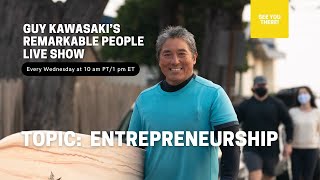
Guy Kawasaki (livestream, Dec 23/24, 2020) discusses the theme of "winging it" — the idea of "fake it till you make it" — prompted by a new Remarkable People podcast episode with Emma Isaacs (founder/CEO of Business Chicks; author of Winging It). Kawasaki contrasts planning with winging it (arguing experts like Steve Jobs could "wing it" because of deep preparation), shares personal anecdotes about starting at Apple while "winging it," and answers live questions about entrepreneurship (fundraising, churn, cannabis regulation), corporate culture, mentorship, work–life balance, and virtual-presentation tech setup. He plugs his Remarkable People podcast and other projects, and closes with COVID safety advice.
Chapters
Foreign. Good morning, It's Guy Kawasaki. I am in Santa Cruz, California, and Merry Christmas. This is the 23rd, I think my. My life is like Groundhog Day. Every day is the same, so it's hard to remember what day it is. But this is, I think, the 23rd, so Merry Christmas. We're two days away from Christmas, and I don't know about you, but I can hardly wait for 2020 to end. So today's topic is. Is our new episode of Remarkable People? The guest was Emma Isaacs, or is Emma Isaacs? This went live about three and a half hours ago. Emma Isaacs is the CEO of a networking organization that started in Australia called Business Chicks. And I have to tell you that when I first was pitched to have her as a guest, my instant reaction to the name of her organization, Business Chicks, was, let's say, not positive. But I looked at what the organization does, I talked to her, I read her book, and she's a remarkable person. So we actually get into the name of her organization and why she kept it and what she thinks of it. So that's a whole discussion inside the episode. And the title of her book is Winging It. So here's an interesting question for you that you can put in the comments is do you think that in your career, if an entrepreneur or an employee at an established company, can you make it by winging it? Because that's the thesis of the book. And, and I don't mean that or she doesn't mean that in a totally cavalier kind of way of just, you know, making shit up. But winging it means that, you know, you kind of fake it till you make it. You accept challenges, you default to yes, and figure it out later. And this has been a common theme in many, many guests interviews that they. Shelly Archambeau, for example, was invited to be on the board of directors of Nordstrom and Verizon. And when she went through those first board meetings, she kind of said, you know, who am I to. To be on the board of directors of a Fortune 500 company? A little bit of imposter syndrome? And then she figured out that, no, she's just going to wing it or fake it till you make it, and the rest is history. So I. I have seen that over and over and over. We now have about 59 episodes, and there are many people who ascribe their success, starting with Winging it, saying yes to positions and challenges and tasks that, that they knew, they, quote, unquote, didn't know how to do, but they winged it so that's Emma Isaacs. She is the founder and CEO of Business Chicks and the author of Winging It. Let me read the subtitle. Stop thinking, Start doing why Action beats planning every time. So we're going to review questions as they come in and pop them up on the screen. So send in your questions about winging it and faking it until you make it and networking for women, the glass ceiling, whatever you want to discuss. So here's, you know, one, one interesting point that people are bound to wonder about, which is, was Steve Jobs always super prepared or did he ever wing it? And in a sense, for Steve in particular, it sets up somewhat of an artificial dichotomy because the way the question was posed, it implies that you're either prepared or winging it. And I would say Steve was both. And at some level, when you are prepared enough, you can wing it quite often. So that's a very interesting concept related to Malcolm Gladwell's concept of, you know, blink that after you do things for, I don't know, 10,000 hours or years and years, and then you can make an instant decision. Did you just wing it or did you really, really acquire knowledge over 30 years that enables you to superficially look like you are winging it? I would actually favor that theory that Steve Jobs was so good at product development and, you know, the vision of computing that what might seem as a flippant, off the cuff, non thinking, winging it kind of response actually reflected years of years of years and years of preparation. So I would say that Steve Jobs was super prepared and he did wing it because he was super prepared. So let's see here. I have to tell you personally, maybe you could put in the comments a time when you had to wing it or you took a leap of faith. I took a leap of faith. So my checkered past was that I never took a computer class. I never really worked in a significant position in tech. I. I was at a software company for about six months before I left it, and that was an educational software company. Apple II and Amiga, Commodore Software, but it wasn't really a technical position. And then I went to Apple to be software evangelist. So my job was to convince people to write Macintosh software. So let me tell you something, I was winging it because, you know, did I understand how you write assembly language programs? No. Did I understand Pascal as a programming language? No. Did I understand all the Macintosh ROMs? Not at all. But off I went with my Macintosh prototype in a bag and to convince highly technical programmers and highly Technical managers that they should bet their company on Macintosh. And I would say from 1984 to 1986, I was winging it. I was absolutely faking it until I made it. So do you have any experiences like that? Leave some comments. And let's see here. We got a lot of people from all over the world. Oh, wow. I'm gonna wait for Jeff and Peg to filter the questions because they're coming in too fast and hard for me to read them. So a little bit of recap. So Emma talks about first the name, because I wanted to get into that, and I can't tell you that. You know, I think that calling an organization for women chicks is a good idea, but she said it had enormous brand awareness and you could almost make the case, which she does that. You know, it's. It's. I wouldn't say she said it in so many words, but it's like such a controversial and maybe bad name that it's good and that people who join business chicks and love business chicks feel a sense of pride that they can belong to an organization with a name like that and get past that. So it's almost as if it's kind of a in your face name, which I'm all about being in your face. So, yeah. And by the way, so she has this networking company that has tens of thousands of members but reaches really about half a million people. She has this book, and she relocated from Australia to Los Angeles to increase the footprint of business chicks, and she did this when she has six kids. So, yeah, let's talk about winging it. Wow. So that's this week's guest, Emma Isaacs. So let's talk about other things. You know, for example, I'm very interested. How do you come up with ideas? Because that's a theme that has constantly been flowing through my podcast. Also, you haven't heard it yet, but a week ago, I interviewed Julia Cameron. Julia Cameron is the author of the Artist's Way. And she explains how she comes with ideas, how she writes her book. She writes her book, by the way, in longhand on paper, and then she goes to a FedEx office and she photocopies the paper. And then she mails one set to an editor who trans. Or. I don't know if it's an editor. It's a partner who transcribes and puts it into a digital format. And she's been working with this woman for years. So that's her method. Of course, I introduced her to the remarkable tablet because I think it could be made more efficient. Now, Jeff, I just saw, okay, what do you think if people what to do if people think our idea take on our idea as a gimmick? Aman, you know, at the early stage of an idea, it's a very tricky thing to solicit feedback because let's just say that many ideas that turned out to be absolutely fantastic ideas and companies at first were ridiculed. For example, when Apple came up with the idea of Apple retail stores, let's just say that every retailer expert in the world said this is the dumbass idea. Because frankly, a store cannot, cannot support simply one brand that you go to, you know, a Best Buy or a computer store. And there's Windows machines, there's you know, monitors from Samsung and Sony and Lenovo and you know, whatever. So there's all these multiple lines and that's the only way you can have a computer retailer is by having multiple lines. And then Apple says, no, we're just going to have one product line and there's not going to be boxes and crap all over and we're going to have a genius bar that offers free support and all this kind of stuff. So people ridiculed the Apple Store idea and let's just say I guess they were wrong. So my theory here is that I think you should solicit feedback. I think you should listen to what people say. But then I think you should take all that information and decide by yourself. Because there are many ideas that were poo pooed at the start that succeeded. On the other hand, I cannot tell you that I believe that whenever you seek advice and you get negative advice, it means that you are going to be successful. It's not that simple either. But I would not take negative comments as deal killers. Listen, people thought Macintosh was a joke, you know, over and over again. So I would say that's why entrepreneurship is hard. Because if it were easy and you had a world class team with a proven market with no competition and everybody was certain you'd be successful, more people would be entrepreneurs. But that's just not how it works. So Dave Weiner, is this Dave Weiner? This is the. Dave Weiner just sent a comment. So Dave Weiner, I read your newsletter every night. So Dave Weiner is the godfather of outliners and he had a product called Think Tank. This is before many of you were born and Think Tank was an outliner. So you know the outline view in Word, it was like that, only it worked. And so I love thinking in outline format. And Dave Weiner made the Product think Tank. And his company was called Living Video Text. And boy, I cannot remember people's names from last week, but I can remember that Living Video Text was on Easy street in Mountain View. It was Dave Weiner, his brother, Peter Weiner, Alice Lancaster. It was a great time. Oh, I love Think Tank. So, Dave Weiner, my hat's off to you. And, you know, also, Dave Weiner kind of invented RSS feeds and podcasting. Or besides that, you know, he hasn't done anything, right, Dave. So anyway, I read your newsletter every night, Dave. Thank you. Uh, let's see. Three years ago, I started a cannabis ice cream company. It feels like we are always winging as regulation changes. How do you install investor confidence in a field that is ever changing, that requires many pivots? Susan, that is a very good question, because I think to this day, although states have legalized cannabis, I think it's still a federal crime. And so asking investors to, you know, take a shot with something that's a federal crime is a little difficult, to put it mildly. And I don't know, connect me if I'm wrong, because I'm not in the business, but can you open up a bank account now? I mean, can you even do that, or is it still an all cash business? Having said that, there are a lot of people in the business, so somehow it's happening. But I think that that is a very tricky proposition where it's against federal laws. So I, I think that's, that's, that's one thing you got to get over, and maybe the Biden administration will legalize marijuana federally and then, you know, have at it. But until then, I think it's really tricky. I, I wouldn't touch it. I wouldn't get into that business right now because of that. That I just, I don't want to take that sort of federal law risk. But hey, no guts, no glory too. Let's see if you have traction. But churn is an issue. Any advice to keep going and how do you re engage people? Well, Heifetz, in a sense, your question is sort of oxymoronic, because if you truly have traction, it means that people like your product and are using it. So you should not have churn. So either you have traction and no churn, or you have no traction and a lot of churn. I guess you could have some traction and some churn, but, you know, this is the $64 billion question. So I think all aspects of entrepreneurship are high, hard. So it's hard to get someone to try something it's hard to get someone to stick with it, and then it's really hard to get someone to pay for it and stick with it. That's why entrepreneurship is a hard game. And I think right now, if you can get someone to try it, in today's app world, that means installing something which is an act of God, so getting someone to install it, to try it, to use it. If you can get tens of thousands of people to do that every day, then I think the logic is, well, we got so many people signing up, we'll figure out how to monetize it someday. I think that's an investable theorem. You could also say we're getting not tens of thousands, but thousands of people to sign up, and we're getting, you know, 2, 3, 4, 5% conversion rate to paying. So. So you're not getting as many people signing up, but the people you do get to sign up are paying. That's also a viable investment and entrepreneurial theorem. But I think what most companies represent is they cannot get lots of people to sign up, and they cannot get anybody to pay. And that's, let's just say, the worst place to be. And that's, I think, where most companies are, let's say. Elliot, have you winged it as an angel investor, venture capitalist? Much love, respect, and holiday wishes to your family from Miami. Miami has a valley. So, you know, it's an interesting question, because I don't think that. Well, I don't think that most investors wing it in the sense that you mean, because, let's face it, an investor has to be convinced and write a check and then every once in a while, add value. So in that equation, you know, usually the investor is buying, not selling. So the investor doesn't have to wing it. The investor just has to write a check and then pray. Whereas an entrepreneur is selling, not buying. So the entrepreneur has to wing it. Because the entrepreneur has to deliver a product, sell it, monetize it. All that. All of that takes winging it. Whereas a venture capitalist or an investor, most of them are passive. Even though they say they add value, basically, they're writing a check. Now, they may have to wing it in a board meeting, pretending they have more expertise than they do have. And if a deal is really competitive, that is, lots of people want to invest in it. So it is, for the entrepreneur, a buyer's market, not a seller's market. If that's the case, then, yes, the venture capitalists will have to wing it, because you're going to have to prove why an entrepreneur should take your money in addition to or instead of money from Kleiner Perkins and Sequoia. So, yeah, that's the only time a venture capitalist has to wing it probably is when it's a. When it's a seller's market from the entrepreneur's point of view. So let's see. Can you talk about planning and winging effects on corporate culture? Yeah. I gotta tell you, I mean, I don't know if you can admit that you wing it in a corporate culture. All of corporate culture is about covering your ass and making sure things happen good in 90 days. And all that kind of stuff was just the antithesis of innovation and winging it. So I think it's very different in a corporate culture. It's hard to imagine that you can go to your boss or go to your vice president, say, my strategy for 2021 is to wing it and fake it until we make it. That just. And I would say the more educated your manager is, the less likely that that's going to fly, especially if you have an mba. Because if you have an mba, not you, if your manager has an mba, they're thinking that running a company and starting a company is a science. And so nobody based on science would say, yeah, our strategy is to fake it. That's just not going to fly. So I'm not saying you shouldn't wing it and fake it. I'm just saying you shouldn't tell anybody you work for that. That's what you're doing. You should pretend that you know what you're doing, which is a form of faking it. Let's see here. Any more questions here? So I hope all of you are going to remarkablepeople.com and listening to my podcast, because I promise you, I promise you that by listening to these people, you will get to be more remarkable too. And I have people like Jane Goodall, Steve Wozniak, Christy Yamaguchi, Steven Wolfram, Steven Pinker, Bob Cialdini, David Aker, Royaguchi the chef. Sean Thompson, the surfer. Andrew Yang, Vivek Murthy, who's going to be the next Surgeon general. And Ramoine epidemiologist at ucla, explains all about vaccines. Jerome Kim, who runs the International Vaccine Institute in South Korea, also about vaccines. Julia Cameron is coming soon. Kara golden, who started Hint, the water company. Let's see. Susan Frey, who sells more pumpkins than anybody in America. Let's see. I can rattle him off. So I've had 59 episodes of remarkable People. And let's see. Here, Peg has provided a. Let's see. Another thing you could comment on just for everybody to see is, you know, What are the challenges that face women entrepreneurs now? I mean, obviously I'm not a woman, so do they have to create a different path? Is the glass ceiling just as bad? Can you raise money as a woman? Although I have to tell you that I've asked many female entrepreneurs, is it harder to raise money as a woman? Do you care? Or, you know, what's the consequence of much fewer women CEOs than male CEOs? And, you know, pretty much they tell me that they just ignore that because one. Yeah, so what if it was true? They're not going to have a sex change so they could raise money or, you know, be a male CEO. And I also think they have a very healthy attitude, which is. Yeah, you know, that may be statistically true, but my job is to make my company successful, not to just be a statistic. And so this is, you know, this is a data point of one that they care about, not the big picture. So. Oh. So Peg Fitzpatrick. Peg Fitzpatrick asked the question, do you believe in work life balance? So, yeah, I would love to hear your answer to that personally, having interviewed 59 people and also, you know, obviously been in tech myself, I think the concept of work life balance is bullshit, that there is no such thing. And as an entrepreneur, when you are an entrepreneur, you basically are going to be all in. And so this concept where you can do everything well is vastly overrated. So there are stages of your life where you're going to work too hard and be undercompensated. And then there's going to be stages of your life where you're not going to work as hard and be overcompensated. That's the stage I'm in. So I think work life balance is pretty much an illusion that you just have to pay the price for a few years. Yeah, let's see. Now. Pick Fitzpatrick. Just asking, where do you go for inspiration? Actually, Julia Cameron answered this question a little bit and she has this idea of where you take yourself on a date. And this date is something that brings you joy and enlightenment. She says that she goes to a bookstore and plays with. I think it was a rabbit. And there are other people who go hiking. For me, seriously, for me, I go for my inspiration. I come up my, my best ideas when I'm driving. And in particular it would be optimal if I were driving a stick. So it has to be a car that is a manual transmission. Unfortunately, right now I hardly ever drive because I'm sheltering in place, like Gavin Newsom told me. And I don't have a car that's a stick. So that's why I'm not particularly innovative these days, because of that. So maybe I should buy a Porsche and drive around in circles. So, see Peg Fitzpatrick here. When do you listen to your gut versus listening to the experts? That's a good question. When do you listen to your gut versus listening to the experts? I think that is a skill in and of itself because you have to temper yourself. So on the one hand, you know, there's a temptation to default to experts, so you listen to people who've been there and done that. On the other hand, people who have been there, done that are probably set in their ways and cannot embrace new markets and new techniques. So, for example, if you were to ask me how to do something, I would probably always default to evangelism and social media, because that's what I know. But as they say, to a carpenter, every problem is a nail. Is that right? Something like that. Something like that. So if you only have a hammer, every problem is a nail. Well, what if you, you know, should get a screwdriver? So I think it's a very, very big challenge to figure out when you listen to experts and when you defy experts. For every example of listening to an expert, I can tell you there's an example of defying an expert. And therein lies the challenge with people like me who write business books and people like you who may read business books, because business books are not scientific, right? They're all based on stories. So there's the story of Fred Smith coming down to his last payroll, going to Las Vegas, you know, and puts it on the, I don't know, crap table or whatever, roulette, and wins and has enough money to pay another salary, and Federal Express continues. So, you know, there's a story like that. So what are you supposed to do? Say, okay, Fred Smith is an expert. So, yeah, I'm going to take our last seed capital and go to Las Vegas? I don't think so. So the problem with management books is that it's all stories. It's not science. And if you think about it, you truly wanted to test something. You need to control the variable. So you need to take two identical teams and two identical markets with two identical competitive spaces, two identical products, and then change one variable. But that's. You can't do that. I mean, so that's why I think management books are flawed that way. So it depends on which one you read last. So Elliot Grossbar wants to know if I have more books in me. That's an interesting question. Podcasting has taken over my life, and every week I have to spend, I would say, 10 hours podcasting somehow, you know, either editing the last version, preparing for the next version, or interviewing the next version. You know, something like that. And I find podcasting much more rewarding than publishing a book. And the reason is that publishing a book takes about 18 months, best case, right? So you write the book for a year, six months later it's out, best case. And you know that the day the book comes out, it's already wrong. Because, I mean, imagine if you wrote a book and you talked about, you know, how to start a company, and you finished it in February of 2020, and so now you're done. Your, your magnificent work of art is done. It's going to get published in six months. And then the pandemic happened. So now everything in your book has to be rewritten because all the rules have changed. So what do you do? Well, a podcast, you know, every week you can change the subject and the content. With a book, you write it, 18 months later it comes out, and you pray. So that's one big advantage of podcasting. Second advantage of podcasting is with a book, the only monetization is you get an advance from your publisher and you pray that you exceed the advance and you get money beyond that. With a podcast, you could sell sponsorships every week. So, you know, you could change midstream. I mean, there's a lot of ways to monetize a podcast. You can monetize a book. So maybe that's more than you wanted to know. Mel Yokoyama, how did growing up Kalihi Valley shape your outlook in life? Okay, so I grew up in a lower middle class part of Hawaii called Kalihi Valley. Let's just say that it was of mixed ethnicity and low to lower middle income. I, I don't want you to think that, you know, I came from a total slum, but I definitely did not come from an upper middle class family and place. Having said that, you know, it's not like I ever went without clothes or food. It's never, I, I never faced oppressed, oppressive poverty. I was robbed twice, which had fundamental effects on my psyche, that I said, I am never going to live in a place where I get robbed all the time. And another pivotal event in my life, believe it or not, is in high school, some family friend took me for a ride in his 911 and oh my God, I said, this is it. I have got to get a Porsche in my life. So, so Kalihi Valley, coming from lower middle class, I think was net, net positive because it forced me to, you know, not just be a trust fund baby and inherit wealth. It forced me to see that, you know, with envy and, and really jealousy that other people had a better lifestyle, better car, better whatever. And so, you know, how are you going to get that is not going to be in a will. So the way you get that is you study and you work your ass off. So that was the lesson and it was a very valuable lesson. So Mel, thank God for Kalihi Valley. So do you think it's important to have a mentor or mentor in or external to the company you work for, in or out of your field of work? I would say I've had two mentors in my life. One at Apple and one in the jewelry business. They were very helpful. It protected my career, protected me. They taught me lessons, they pulled me aside and told me how I was screwing up. I would say a mentor is good. I would not say a mentor is sufficient or necessary, however, to succeed. And by this I mean this formal, like you have absolutely picked one person as your mentor. I think the better attitude is not, well, if you can get that one person, hallelujah. But I think it's maybe better to get a diversity of opinions and ideas and critiques from a bunch of different people that you respect that more data is better than less. So I'm not exactly sold on. You need to find that one sacred, special person who's going to change your life. Let's see. So what do you think the next big thing will be for online entrepreneurs? Yeah, I would love to hear this. So send in a comment. What do you think the next big thing is? Because I have given up trying to predict the next big thing. I have been more wrong than right. So. Oh, Dima, would love to know what you're using for your audio videos. Okay, so my audio video. So I decided that at a time where every appearance is virtual, you have got to make your virtual appearance as good as possible. So you know there used to be a book called Dress for Success. Well, now you need to tech for success. And so I went on like a months long project to figure out how to do everything. And I literally mean it took months. Okay, so what you see here is I am using a Sony A6100. It has a. I'm trying to read that. It has a 35 millimeter 2.8 lens. So I have a digital SLR with a very high quality lens. This is. Is a sure XLR microphone. And I have a. I think it's the newer. I have a ring light. I have one light bouncing off the ceiling. I have another light bouncing off the ceiling. What you see behind me, that's kind of a Hollywood set, okay. Because I am in what used to be a clothes closet. So the bamboo is simply to give some vertical lines. And that shelf, the purpose of that shelf is only to be a good background behind me. It's really not to store books. So I should actually sell slots on that shelf. So when I go like this, you can see the books that I have. So if you have a book and you want it on that shelf, make me an offer. And then I. I happen to love the concept of bouquet. There's some controversy how you pronounce that bouquet or bokeh, but bouquet, where the background is out of focus. And so that's why I went to this digital SLR and all that. And then I have these LED lights that I just turned off. It's like $8 at Bed Bath and Beyond. Because I love how lights get all bouquet out. So that's my setup. I have a digital slr. I have a Shure XLR mic. I use an ATM mini. This is a little mixer I'm going to take into the deep end of the pool. I know Jeff and Peg hate when I do this, but I have noticed that if you take the video and audio from a camera and you really check it right, you will see that the audio is two or three frames in front of the video. And that just drives me crazy. So I'll clap. Hopefully I don't have it today, but anyway. So theoretically, when you heard the clap and you saw my hands hit, it happened at the same time. That's because I have a. A little mixer that delayed my audio by three frames because that just drives me crazy. So if you really want to know my entire setup, I wrote an article and I would post that link here, except that I don't think my comments will get through to all the systems. Your comments get to me, but my comments won't get to you. But you can reach out to me at Guy Kawasaki Mail and I'll send you the link for the exact setup. Links to Amazon, you could just. The total cost of everything, probably about 1500 bucks. And I mean, if you are a manager or above or you give any kind of virtual appearances, if you don't spend 1500 bucks to get, you know, quality like this. I think that's crazy because I mean, 1500 bucks, let's say you were going to go to south by Southwest one year. So the airfare would be 750. The hotel would be a thousand. The food would be another, I don't know, 250 taxi to 250. It could probably cost you 2,000 bucks. Oh, and then you got to pay to get into south by Southwest. So all in, you probably pay 2,500 bucks to go to three days south by southwest. You can pay 1500 bucks and have every one of your zooms and video calls and conference calls and recordings all be high quality. So anyway, spend the money. Let's see. When is the last time you met Steve Jobs? Well, I mean, I'm on, you know, he died, right? So it's been a long time. But I remember probably 15 years ago. It was a long time ago. Yeah. What do I think of the Apple car? You know, Ken, I believe it when I see it. So I used to be a Mercedes Benz brand ambassador and so, you know, I got pretty tight with the Mercedes people. I understood what it takes to make a car. And if you think it's hard to make a computer or a phone, making a car is about a thousand times harder because you know, if your phone or computer crashes, you reboot. If your car crashes, you die. So it's a whole different level. And worst case, you have a laptop and it gets banged around and maybe in dusty places and you know, coffee shops or whatever. Pre pandemic we think about what a car goes through, right? So car is driven by semi qualified people. Rain, sleet, snow, hot, cold, humid on tires with other people flying past. I mean, think of the complexity of the environment of a car versus a computer. So you're telling me that Apple is going to make a car. I mean, you know, how about making the Macintosh OS bug free before you work on a car? And then of course, you know, if Apple makes a car, they're going to use special kind of electricity and it's not going to be able to plug into any of the existing Tesla or you know, recharging infrastructure. If it does plug into the existing electrical infrastructure, it's going to take a special dongle that attaches to the special cable that you can only get from Apple. And the dongle is going to be 2,500 bucks and the cable is going to be 2,500 bucks so that you can use a Tesla Charger. So, so I Mean, I guess so, but let's just say I won't be an early adapter because I mean, a car is so hard. So how do we get on that? You bought a 93 Acura because of what you wrote in the Macintosh way. I love that story. So Acura at the time, the macintosh Way was 1987 Acura. That was a sweet, sweet car. You know, it was just, it was beautiful, it was well made. It was like the best of Honda's engines. It's a beautiful thing. Yeah. So let's see, let's see, let's see, girlfriend. But Musk was able to. Why not Apple? Well you bring up a good point. And that's why you shouldn't listen to experts. Maybe it will, but if you think about it, so Tesla started off by making a little sports car that was based on a. What the hell was the name of that car it was based on? Lotus maybe. So it's based on a Lotus and then it took 15 years. I think so. Okay, so let's say Apple introduces a car in 2024 and let's say it's no better or worse than Tesla. So 2040, I'll buy an Apple Car. Of course in 2040 I will be 86. I might be dead by then, so I might not. I might not. I don't see an Apple car in my future. So I will tell you though, if, if I wish I could buy. So I was right. Lotus. Yeah. So if I had to buy a car today, well, I just got a mattress. So I got a mattress that was upfitted by Peace fans. So it has ability to sleep four people. It's got a table in it. It's really, really sweet. Cars, surf racks on the top. I'm thinking of buying another car because that car is going to really become my wife's. And at one extreme I think I'll just might just go buy a Mazda Miata because that's cheap, reliable, really fun to drive. The other extreme, maybe a Cayman gts, because a Cayman GTS is going to be six cylinder, not turbocharged, normally aspirated and it only comes with a six speed stick. So you heard me say earlier that I think, you know, my most innovative times is driving a stick. So for the sake of my career, I think I need to buy either a Miata or a Cayman gts. I forgot. Just convinced my wife of that. But anyway, so let's see, we've just totally gone off the rails as we should. Love Canva. When did you get involved? Are you Still, I got involved with Canva six years ago. I am still the chief evangelist of Canva. My job is to spread the good news of canvas. If any of you need to make graphics, Canva is the way, baby. Because we have democratized commerce. Excuse me, we have democratized design. So I'm just curious, do any of you have you have you had, like, this great idea and not tried to do it? Because, I don't know, you didn't raise funding. You are, you're too afraid of failure, all that? Because again, you should read Emma Isaac's book, Man. Or Kara Golden's. It's. It's about winging it and faking it until you make it. Or Shelley Archambault. Unapologetic, unapologetically ambitious. Any of those three books would help you get past this. Let's see. Let's see here. I think Peggy has given up on trying to. Can you talk about the Enchantment book of yours? How does it reflect the idea of influence? Okay, so I wrote a book called Enchantment, and it was really inspired by the book by Dale Carnegie and Bob Cialdini. They both wrote about influence and persuasion and how to win friends and influence people. And I thought, oh, so it's been a while since those books were written prior to social media, and obviously a lot of social psychology knowledge has accumulated. So I wrote a book called Enchantment, and it's basically how to change hearts and minds. So I, I, I had a fantasy of being in the same kind of mention as Dale Carnegie and Bob Cialdini. Didn't quite make it. But, yeah, that was my fantasy. So if you want to learn how to influence people and change people's minds, I would say Dale Carnegie, Bob Cialdini, and humbly, Guy Kawasaki. Another one is Absolute Value. I forget the author. The book's name is Absolute Value. I would say that that would probably cover you. Okay, so elevate you. Loves Canva. Yeah, I love that. What time of day are you most productive? Oh, Mimi, That is a good question. I have really not decided the answer to that question. I, I don't put a lot of thought into it. Basically, if you really want to know, I, I am kind of, I schedule my life around my family. So prior to the pandemic, you know, I would take my kids to school and pick them up. So it was, I had to be productive after I took them to school and before that I picked them up and then after I brought them home and before I went to sleep. So it was basically dependent on their schedule. But now my kids are learning at home. And so if you really want to know my schedule, I'm a little embarrassed to tell you this. So basically my schedule now is more or less dependent on the tide because where I surf, the conditions are best at low tide. So I kid you not, when I schedule a meeting, a podcast, recording, you know, any of those kind of things, the first thing I check is the tide. And you will see that most of my meetings happen when it's high tide because at high tide I cannot surf anyway. So I guess I have biological rhythms based on the tide because man evolved from the sea. And so the tide of the sea also in interferes or affects my internal biological clock. And if you believe that, woo woo, go for it. But basically, I schedule my life around low tide because that's what I want to surf. Okay, so I think I filled you with enough. Knowledge to be generous. So remember Emma Isaac, CEO of Business Chicks on Remarkable People, released this morning. Next week is going to be. Who's going to be next week? Next week is going to be Amy Ehrett. She is the CEO and founder of Madison Reed. Madison Reed is the hair dye company. I actually am considering using hair dye because they have a men's line. So I might try maybe next week. Remember this look today because maybe next week it'll be a lot less gray. So that's that. And, you know, practice your winging it. Don't let the bozos grind you down. So remarkablepeople.com canva.com peace vans if you want a mattress that's upfitted for great camping. And what else can I plug? Merge4Socks. I love my Merge4Socks. So that's it. That's all my conflicts of interest. So that's it. Merry Christmas, as we say in Hawaii. Mele kaliki maka. And how the hell do you say happy New Year? Oh, it's holy. I forget how you say happy New Year. I could google it right now. Someone put it in there. So, Emma Isaacs, remarkable people. Melee Kalikimaka. Okay, one more thing. Wash your hands, wear a mask. Don't go into crowded places. Don't. Don't travel. Just listen to people. Like, don't travel. Sacrifice this Christmas so that you can have another great Christmas, a great life, starting in about six months. Okay? Just like write this Christmas off. And there's a great parody on YouTube and I will give you my favorite line from that parody. And it's wear a mask. Wear a mask. Get your head out of your ass. Take care. Bye bye.
More from Guy


Cheryl Strauss Einhorn | The Human Edge: Smarter Decisions in the Age of AI | Talks at Google



Rachel Glennerster | Innovation and the Center for Global Development | Talks at Google

Rebecca Winthrop | Rethinking the Purpose of Education in the Age of AI | Talks at Google

Dr. Robert Wachter | A Giant Leap: How AI Is Transforming Healthcare... | Talks at Google



