Building Social Business | Muhammad Yunus | Talks at Google
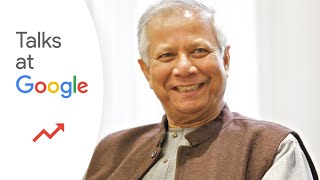
Muhammad Yunus describes the origins and design of Grameen Bank—started from a $27 loan to 42 villagers and formalized in 1983—emphasizing reversed banking rules (no collateral, bank goes to borrowers, priority to poorest, focus on women). He reports scale and performance: ~7.5 million borrowers (97% women), 27,000 staff visiting >80,000 villages weekly, and 98–99% repayment rates. Yunus explains programs (beggars-to-entrepreneurs, Grameen Phone, solar/Grameen Shakti, water) and introduces the "social business" concept: non-loss, non-dividend companies created to solve social problems and recycle capital rather than one-time charity. Q&A covers training philosophy (minimal formal training; fostering opportunity) and mechanisms for handling defaults and disasters (community support, loan restructuring, interest cap rule).
Chapters
For several years, the Nobel Committee has come to recognize that many human conflicts have deep roots. They recognize that the environment, social stigma and poverty are key contributors to these conflicts and have begun to award the Nobel Peace Prize to organizations and people who have dedicated their lives to solving these seemingly intractable problems. Our speaker today is one such person. In announcing the award to Muhammad Yunus, the Nobel Committee noted that lasting peace cannot be achieved unless large population groups find ways in which to break out of poverty. Microcredit is one such means. Development from below also serves to advance democracy and human rights. Professor Yunus joins us today to talk about his new book, Creating a World Without Poverty. And it is my honor and pleasure to introduce our speaker, Muhammad Yunus.
Thank you. Thank you. Well, thank you. Thank you very much. I was very happy to be able to come to this campus of Google. I got used to the other campus. I went there twice. So I thought it's about time to come to this campus. I'll have a few minutes. I'll briefly introduce you what the Grameen bank does, what it has been doing and other related issues and come to a subject that I'm trying to bring to the attention of people about business as it is. What is the kind of business we should have and the possibilities of business. Let me first mention about Grameen Bank. You are familiar with the word Grameen bank, that it lends money to the poor people, particularly poor women. The thing that I will mention, that we didn't intend to create a bank. That's not what our intention was when we began some 31 years back. I was trying to solve a local problem, a tiny little problem in the village next door to the university campus. I was teaching economics in the department of Economics. And here's the village next door. And we were going through a very rough situation in Bangladesh, situation of famine. So there I was trying to see what little things I can do in the village so that people I can make myself useful to people in the village. I did a lot of little things. One led to the direction that I took later on as being familiar with the loan sharks in the village. And when I made a list of people who are borrowing from the loan sharks in my list when it is final, finally prepared, I had 42 names on that list and the total money they borrowed was $27. So my first action is to solve this problem by giving this loan $27 to 42 people so that they don't have to go back to the loan shards them be exploited by them in a very Ruthless way. So once I had done that, it created a lot of excitement in the people and I wanted to continue with this. So I thought one way I can solve this problem by linking them with the bank located in the campus. So when I went to the bank, bank said they cannot lend money to the poor people. And it became a big struggle for me to persuade them. So I wouldn't give up and they will not give in. So it went on for months after I talked to everybody in the banking hierarchy to persuade them. After seeing for several months that it's not happening. So I offered myself as a guarantor. I said, I become the guarantor. I sign all your papers and you give the money. I take the risk. So that was the first time that I got involved with a bank to lend money to the poor people. I had no idea whether people will pay back the money. I had no experience of that. And when I did that, I was amazed that every single penny came back. Despite the fact bank was trying to persuade me that it will never happen, you'll never get your money back. But it happened. So that encouraged me and I wanted to expand and. But the more successful it became, more reluctant the bank became. They didn't want to support it. They said it's a matter of time, the whole thing will collapse. Because it cannot. It doesn't make sense why it should continue because something, maybe you are lucky, maybe something happened, but sooner or later it will collapse. In the meantime, I'm becoming more and more convinced that it works for good reason and it will no reason to collapse. So I wanted to have a separate bank without going to them. So it took me more time to persuade the government to allow me to have a separate bank. And finally in 1983, we got it. We made the bank called Grameen bank or a rural bank, Village bank. And we kept on expanding. Today we work all over Bangladesh. We have seven and a half million borrowers. 97% of them are women. And the bank is owned by the borrowers. And banks make profit and the profit goes back to the borrowers as shareholders. And the repayment rate has been outstanding all along. We have 98%, 99% repayment rate. People try to understand what all these things mean. One thing is about can if a big bank, known commercial bank, give loan to the poor people, would it become a Grameen Bank? Or there's something else, and I try to point out it's not the size of the loan that makes Grameen bank the bank that it is. It is the Way it has been designed, it's organized one way I try to explain Grameen bank by saying that it's almost a reversal of the conventional banks. You take all the rules and reverse it piece by piece. You get the Grameen back. So it's not just giving simple small loans. It's the whole totality of the structure, design and the philosophy behind it. Like the conventional banks are based on one basic principle. The more you have, the more you can get. And that's where the collateral and all those things come about. So as a result, it became an institution which is focusing on the bigger and bigger people so that they can give more money, so that they can go bigger. If you take that rule, it implies that if you have less, they have no interest in you. So we reverse that principle. Our principle is less you have more attractive you are us. If you have nothing, you get the highest priority. So we have reversed the basic principle of the banking itself. And in order to do that, we have to get rid of the whole idea of collateral. Entire banking edifice is built on collateral. So the whole idea of banking that you must give something against which I can give you a loan. And as a result, they cannot go to the poor people because they cannot give you anything against which you can give a loan. So we dispense with it. We said, I don't need anything, I just give you a loan. It's a very scary thought. People get very nervous. How can I give money if it doesn't give me anything? And that's what we do. We have no collateral, we have no guarantee. Not a third party come in and say, I stand guarantee. We have no such thing. And above all, we don't have any lawyers. Imagine banking without lawyers. It's impossible to think. And we don't have lawyers. Maybe that, oh, he gives a small amount of money. Who cares for the lawyers for this small amount? Yes, amount is small for each. But Grameen bank lends out over half a billion dollar a year. So when you put them together, it's become a huge big money and there is no lawyer involved. If they all gang up, all seven and a half million borrowers, we are not going to pay you back. We can't get anything. We can't sue them, we can't do anything. And with numbers, they're so big you can't go and touch them. But it works. So this is one. And then conventional bank requires that the client, when they come to take a loan, has to explain he knows everything about the business for which he wants the money. He's an expert. There's no way he can fail in the business. You have to prove that you document yourself that, yes, you know everything. Your business plan is so great, and only then they gave you money. After all, you provide the collateral and everything else. But in Grameen bank, when we go to a woman, we would like to give you a loan. She said, no, not to me. Don't give it to me. I don't know anything. I never handled money in my life. I'm scared to death to touch money. Give it to my husband. He's the one who knows how to handle money. And he brings home money and food, and I take care of the food. So our client doing exactly the reverse, saying that I don't know anything. And we train our staff that when you meet, you go around in the village, you meet woman who says, I know how to do business. Can you give me some money? Don't pay any attention. When somebody you see, you say, the World Grameen bank would like to give you a loan. Explain how great Grameen bank is in giving money to help you after you give your whole spiel. Finally she said, no, no, I don't need money. I don't know what to do with money. And she explains very persuasively that you are wasting your time talking to me. And we say, she is the one we are looking for. So again, we reverse that in conventional banks, you have to go to the bank, pursue them, talk to them, and so on. We reversed it. We said, people should not come to the bank. Bank should go to the people. So we go to the people all the time, every day. That's what we do. We have 27,000 staff in Grameen Bank. They don't sit in the office behind the desk. These 27,000 staff go to the villages, more than 80,000 villages in Bangladesh to meet seven and a half million borrowers at their doorstep every week. So within one week, five working days, we meet all of these seven and a half million borrowers at their doorstep. We do the business at their doorstep. So this again and the reversal that we are not something that we ask you to come and do business with us in our premises. We go to your premises to do the business. And our focus is on women. 97% are women. In the focus of conventional banks. You decide where their focus is. But our struggle was in the beginning, I was complaining against conventional banks in Bangladesh. My challenge was, show me one bank in Bangladesh where the number of women borrowers from their bank happens to be at least 1%. At least 1%. There was none. That's why when I began, I wanted to make sure within our program, at least half of the borrowers are women. It's easy to make a decision like that, but very difficult to implement that we found out because when we went to the woman, these are the women saying, no, not to me, give it to my husband. It took us six years of total struggle to persuade women just to take a tiny loan. And finally after six years, we hit that point, 50 50. And we are very excited. Then soon we started noticing money going to the family through women brought so much more benefit to the family than the same amount of money going to the family through men. So I don't want to elaborate on all the details. After seeing it repeatedly for months and months, the question came to our mind, what? What is so good about 50 50? Why do we have to stay with 5050 if it is so good entering the family through women? Why don't you do it this way? So we changed our policy. We said we focus on women. As a result, we move from 70%, 80%, 90% women, and we have 97 women. The one question we are discussing while sitting here, why do the people pay back? Are they crazy? They're not crazy. They are just as people like us, everybody else. It is. They find out it is to their interest to pay back. We organized the system in such a way. It kind of focuses on the interest of paying back, that the benefit of paying back. If you pay back one immediate thing, you see bank is willing to lend you more. So it's opening of a door where you have now a kind of a credit channel. You can keep on taking money, move on forward. You pay back one loan, you are ready for another loan and go step by step. If you don't pay back, the worst thing that can happen. We don't penalize anybody. That's another thing. There is nothing of any kind of punishment within coming back. It's very strange. You have no lawyers, you have no collateral, and you have no punishment. Still, it works. We don't scare people. If you don't do this, terrible things will happen to you. We never say that. So that's another way. And we don't have anything to punish you like we don't have any panel interest rate. If you don't pay us within the such period, your interest rate will go up by 1%. So you want to pay back earlier before it goes up. We don't have time. So then why do they pay back if they don't pay back what is missing, your door gets closed, meaning that you can't take any more loan. For the first time, one door closed in their life or one door opened in their life and they don't have to go to the loan sharks. So that is a big incentive for them to keep the door open and continue. Not only we lend money to the poor, not only we lend money to women. One of the things people were telling us that when you lend money, you probably look for the entrepreneurial poor, the smart ones. You are picking up the smart ones, the one who can do business success. Today within Grameen bank, within Bangladesh, 80%. 80% of the poor families now have access to microcredit. Bangladesh is the most intensively done micro credit in the whole world. So question of picking and choosing, not much is left. Because when you do 80%, you got almost everybody there. And our goal is by 2012, we want to reach the 100% coverage so that no family, no poor person is excluded. And then I said, all people are entrepreneurs. All human beings are entrepreneurs. Which goes against the traditional view that entrepreneurs are a very rare kind of people. They are no rare kind of people. It's a part of human being. Entrepreneurial ability is built into each human being. Some got a chance to bring it up a little bit. Some never found out that they have that entrepreneurial ability because society never gave them a chance to discover that. So human beings, particularly the poor human beings, are unexplored. Creativity and ingenuity and all the energy which remain unexplored. So it's not the fault of the person. She was never given a chance. So the entrepreneurship, as I said to us, is a kind of universal quality of a human being. But there are many who debate about that. We wanted to demonstrate by our work that what we are saying has more truth in it than the others are saying. Four years back, we introduced a new program within Grameen Bank. This time we wanted to focus exclusively on beggars. The idea is if the beggars can become entrepreneurs, that will show that anybody can be entrepreneur. So we went to the beggars, we started talking to them. And one idea we kind of raised with them, that as you go from house to house begging for some food, some for rice or something in the village, we said, as you go along, would you care to carry some merchandise with you? Some cookies, some candies, some toys for the kids, whatever you can carry, and there's no extra work for you because you are going there anyway. And that made sense. To them. We are going there anyway. So if you want to do that, we'll give you the money to buy those stuff so that you can sell it to them. And people liked it. And we thought we'll have about 2,000 or 3,000 such beggars in the program to see what happens. It became such a popular program, not only popular with the beggars, it became so popular with our staff. Everybody was so thrilled to serve a beggar. If I can be of some use to a beggar, why not? Everybody wanted to have some beggar member to serve. So as a result, today we have over 100,000 beggars in that program. Within that four years, more than 10,000 of the beggars have stopped begging completely. They became successful door to door salesperson. And for the remaining 90%, I would say they will better describe as part time beggars because they are mixing begging and selling together. And I tell my colleagues that they're in the process of reorganizing their business. They are trying to close down their begging division, trying to strengthen their sales division, restructuring the whole business. And more and more are actually coming out of begging. Some of them are being successful as personal shoppers. Because many of the women in the village can't go to the market to buy things. So they will ask the beggar to buy her something and give her the money to buy it. And she gets a commission out of it or extra money. She earns some money for that. So again, we didn't talk about it. They figured out when you talk to them, they tell you which house is good for begging, which house is good for selling. So they have market segmentation. They know that. So again, coming back to the question of ability of persons to be creative and entrepreneurial is in the person given the opportunity. We got involved with lots of different kind of other activities focused to the poverty issue. We got interested in technology. We created a company called Grameen Phone, cell phone company in the country. Everybody said, are you crazy? You want to make a cell phone company? Because we are saying that we'll bring this cell phone in the villages and give loans to the women in Grameen bank, the poor women, to buy herself a cell phone and sell the service of the cell phone to the villagers and make money by doing that. Everybody said it's crazy. Nobody ever heard of that. We did that and it worked. Became very successful. They became known as telephone ladies. We had some 300,000 telephone ladies all over Bangladesh. And Gamin Phone became very successful company, very attractive company in Bangladesh. Is one the largest company in the country in terms of paying taxes to the government. Grameen Phone pays the largest amount of taxes to the government of Bangladesh. So it's not a small company. We wanted to bring other things like Internet services and other services through the mobile phone. Now trying to see if the remittances and other things can work well through this cell phone thing. And we got into solar energy. Today we have more than 100,000 solar home system working to the solar company called Grameen Shakti or Grameen Energy. And it's becoming very popular solar energy in the rural areas of Bangladesh. And our goal is to reach million solar home system very soon. And we are just signed an agreement to sell the take the facility of cdn the Clean Development Mechanism to sell our work through biogas and the solar system to compensate for all the emissions made by others. And we got into lots of such companies. And we ask ourselves and people ask us why are you creating all these companies? Are you making a lot of money? I said no, I don't make any money. I'm not a shareholder any company. I don't own the Grameen Bank. I don't even have a share in that company. Grameen bank is owned by the poor people. Similarly in the solar which is a very attractive company, makes good profit on that. But I don't want share. So I was trying to understand what is it that I'm trying to do and the other companies I made. And I see this as a pattern that is missing in the business community as a whole. Because in theory it doesn't exist. In theory there's only one kind of business. That's why when you say no, I don't want to share Then why do you create that company? If you don't own a share, you don't make money. Why you make that company. And it's not a tiny company. Huge company like Grameen Phone I could be very rich if I had few shares in that company. I don't. And I created the company but I didn't take any share. Why do you do that? So the way I tried to explain it, I said today all these questions come because there is only one kind of business in the world that economic theory never presented any other kind of business. The only kind that we know is a business to make money. Profit maximization. See, somebody is firing at me. You don't talk about profit making. So only way you can do business is to make money. And you continue to do that and you become successful. And I feel very uncomfortable with that idea, I said the theoreticians who made that theory presented human being as if they are money making machines. So if you go into big business, you show your talent as a money making machine, how you make more money. Money making is a very important part of human being, but it is not the whole of human being. Something is missing in business we want human being not only wants to feel happy by making money, they want to feel happy by doing other things too. And other things like making a difference in the world is also a happiness one would like to have be useful to other people. Solving things for other people of the world, of the planet, that's also part of the happiness. If I can contribute something in changing the idea, changing people's lives, I would like to do that. It's part of human being. I'm not imposing it on him. If you want to justify the totality of human being. And I'm arguing that there should be at least two kinds of business. One that we already know to make money. The other kind is to do good to people. So I'm calling it, giving it a namesake social business Business to do good to people, business to do good to planet. And but it is non loss, non dividend company. You don't make money out of it. In one company you make all the money comes back to you, the profit comes back to you. In this company, nothing comes back to you except the investment that you made. If you made a million dollar investment, you can take back your million dollar over years. But that's it, not a penny more. Because that's not why you created the company. You created the company to solve a problem like we have created some social businesses. One business is a water business. As a social business we have arsenic problem in our water in Bangladesh. Many of you probably know it's a big problem. When you drink water, you're really drinking arsenic day after day and you get the effect on your health and your everything system. So we are creating this water company to bring safe drinking water to people at a price they can afford but with no intention of making money out of it. So you can make it cheaper. You can make the technology available to them so that they can have that. So your whole calculation of the business changes. Because if you're not making money, you'll be amazed how your thinking process changes completely. Because you are not gimmicky anymore. You don't want to show any gimmick to attract people. So you save a lot of money in packaging. Make the packaging so attractive that you spend so much money. And then ask the consumer to pay for the things that you did for them, which they didn't eat, but they had to pay because you did all those packaging, all those marketing. They're not eating the marketing, but you made them pay for it. So once it's a social business, you don't need to have those extra excess money and you go to the bare things which is needed by the people and the company runs with its own money. Because it's a business, it comes back. It's different than charity. This could have been done by charity. Somebody donated money and you have produced water and people get a free water, that's fine. Charity is important. I'm not undermining that. But charity dollar has only one life. You can use it only once, you can't reuse it because. Because that's what the charity is. You give, it never comes back. But social business dollar has endless life. It recycles, it keeps coming back and you do it, you reach more and you achieve the goal. Social goal. So I'm advocating that maybe this is the time to do that. Create social businesses. Design social businesses and go for it. Address all the issues which remain unresolved. Poverty, diseases, water, sanitation, environment. Design your business and address them. Where the money come from? Money come from just like anywhere else, like all the other businesses money come from. And at the same time, it can come from foundations. Foundations are charity money. So you can take this charity money and say, instead of giving everything in charity, we can design business like this social business. And we would like to put our own money as individuals into social businesses. Some are going for creating a new stock market, social stock market. Because this stock market is about making money. So you need another stock market. We want to do good to people. So look for the company which is bringing good quality water, good medicine at a price. Affordable good housing for the people who cannot afford housing. You name it, you have a long list of it and you can do that. In the USA there are 47 million people who don't have any health insurance. So there could be a social business to bring health insurance to the people who never had health insurance. Health insurance in the USA there are people who don't get access to financial institutions, never can borrow. They have to go to the pawn shops, they have to go to the payday loans and all kinds of things. So it would be a good business to have a social business to bring all those services to them. Those who cannot open a bank account, for example. There are millions of people in the USA who are not eligible to open a bank account because the bank don't see them big enough to open a bank account. So these are the issues and challenges ahead of us. And these are the issues that I've discussed in the book that we are talking about. And see if people would be interested and discuss and get involved in creating those businesses. And if we can create that, then the idea of poverty would be coming to us in a very different way. Because poverty is not something inherent in a human being. Poverty is artificially imposed on a human being. There's nothing wrong on the basic human being who is a poor. Simply the society didn't give him the chance or give her the chances to change her situation. So once we redesign the thing, she will have as much opportunity as everybody else and move out of poverty. And there will be no poor person. We can create a world without any poor person. Nobody will be poor person. And I said that in that case, when we happen that only place we can see poverty probably will be in the poverty museums. We'll have to create museums like we have museum for dinosaurs, which doesn't exist since there will be no poor person in the world. So we'll be curious to know what our children will be curious to know what the poor people used to be like. So we'll take them to the museum to see what it is to be like. And that the children who will go there, they will be horrified to see what happened to people for no fault of their own. And they will promise it will never come back again. Make sure absolutely that thing is passed and it will not be repeated anywhere. So that's the kind of world we can create. This idea that I was trying to promote. Thank you. I'll stop and.
I'll have to make this shorter. First of all, thank you for coming. You really represent what a hero is in this day and age. So it's an honor to have you here. One of the things you mentioned was it took six years to get the women to accept the money. And I feel like a common problem when you're dealing with people who may not have the resources that many of us here are lucky enough to have is confidence. So once you got them to take the money, what role did your organization play in giving them the confidence that any ideas they may have would work, that they could do it? Was there any training involved from that side?
We avoided training right from the beginning. Our idea was that people already have lots of unutilized capacities. So only thing create opportunities for them so that they get confident and start using their unutilized capacities and then they will move forward. And the training, if it is, it has to be examples. If I see my neighbor is doing something, I can't sleep at night because she's making more money than I do. So I figured out myself what to do. That's more than training. She figured out how to do it. So we didn't want to come and impose something in her mind. Sometimes training is counterproductive because you get so used to it brought to you in packages, you don't use your own talents to discover it. So we would rather teach tickle their own creativity rather than bring things in packages so that you unfold and assemble and move on. So she remains dependent on things coming from outside. So we thought it should come from inside. Even when we introduced the cell phones, she never saw a cell phone in her life, never heard of it, but we never trained her. Except when you buy equipment, there's some salesperson explain which button to push and that sort of thing. That's what the phone company did. Explain how to use it. That's all.
They had the confidence already. They just needed somebody to give them the chance. Thank you.
Thank you. Hello.
Thank you very much for coming to speak. I had a question about. Even if with all the screening and the careful planning and just the assistance that the bank is able to provide someone who's getting the loan, what if through a variety of reasons, that they come to a position where they need to default on the loan, or if their business does not succeed, is there a mechanism for them to not fall into terrible debt?
Is the poor people who are likely to have more problems than non poor people? The life is so uncertain. Lots of things happen. Misfortunes are part of their life. So failing in their business is a very common thing to happen. This is one personal thing. Imagine we had two floods last year in Bangladesh. Two major floods, not a tiny floods. And then we had a big cyclone. You read it in newspapers with the cyclone, with 250 miles, 250 kilometers per hour speed, and people lost their homes, their animals and their family members washed away. But still life goes on. If you are running an institution which works in those circumstances, you have to prepare for all those disaster situation, personal disasters and national disasters together. So these are part of our system. How to cope with this kind of situation? Like in a personal disaster system, if you fail to pay back one of the things that we discussed among borrowers, what would you do if your friend fails to pay back? The first response without Being coached without being explained. No, no. How can she fail? We will help her. She cannot fail. I said, suppose she fails. Oh, we'll make sure she pays back. So we try to explain and repeatedly tell her. Very clean, simple words. Getting angry with your friend is no solution. The first thing that you do if you are together so your friends. The moment you hear that your friend can pay back today, you get worried about her. You say, oh my God, she's in trouble. And then go to find out what is the trouble. And one common trouble we always see is husband took the money and ran away. Very common. So getting angry with her is no solution. Because she didn't create the problem. Somebody else created the problem. So help her to find the husband, get back, preferably with the money. In the meantime, he may have blew the money. So this is one way. Or the cow died. The cow that she bought with the money died. And what do you do? You get angry with her. It's because she cannot pay back because there's no milk anymore. We said, look, you should be sympathizing with her, not making her life more miserable than it was. And we are in the same mood. We don't want to make people more miserable than they were. We want to lessen the misery, not enhance the misery. So we said, discuss with her what she would like to do first. Give her consolation. Give her confidence that this is part of life. We have to deal with it. Let's move on. And if she says, I want to take another loan, go ahead, we'll give her another loan. The first loan where the cow died will be written in the book as a long term loan. Someday, somewhere she will pay. Forget about that. Concentrate on the present loan. And on top of the present installment, she pays. If she can pay a few units of taka or the currency more, then that will go for the other one. But it will continue. And our rule is in Grameen bank which you make it simple. No matter how long it takes, your loan amount can. Your total amount, your interest amount can never exceed your principal. It will never exceed your principal, no matter how. So there's a protection. You can take your time. So. So that way we try to resolve it within the system. Rather than saying that you're a bad person. Right? Okay.
Okay.
Thank you. Thank you.
The professor's on a tight schedule. So we have time for one more question. And then he'll have time to sign.
A limited number of books.
But he has to be out of here at 4.
So thank you. I also want to thank you for your talk today. You honor us with your presence. My question is, have you been involved or the bank's been involved with bringing the the same approach and model to the poor in countries like the United States? And what have been the obstacles? Have they been the same or different given the nature of the infrastructure of the economy? Basically same. We were invited to do it in the USA way back in 1986. We became a bank in 1983. We were invited to do it in the USA in 1986, but by a governor of Arkansas called Governor Bill Clinton. So I came there in Arkansas and did the Grameen program set up and was headed by the first lady of Arkansas called Hillary Clinton. She was the chair of that committee who ran the Grameen program. It was known as Grameen Fund in Arkansas. And then it came another program was created in Chicago, a similar program in South Shore of Chicago. And since then there are a lot of microcredit programs in the United States. And recently we started again called Grameen America. And Vidar is here somewhere? Yeah, right here. He's the one, right. We're in Jackson Heights in Queens, New York. Our national headquarters office, the on the second floor just within a block of the subway stop. $1,500 a month rent and they're out making loans right now as we speak. And the reason it's going to work is that it is run by Shah Nuaz from Bank in Bangladesh and he has worked with Professor Yunus for 22 years. So he is exporting technology from Bangladesh here to New York. If capitalism will work here. Wow. Very good. Well, we are almost waiting there for your queue. Thank you. Thank you very much.
More from Guy


Cheryl Strauss Einhorn | The Human Edge: Smarter Decisions in the Age of AI | Talks at Google



Rachel Glennerster | Innovation and the Center for Global Development | Talks at Google

Rebecca Winthrop | Rethinking the Purpose of Education in the Age of AI | Talks at Google

Dr. Robert Wachter | A Giant Leap: How AI Is Transforming Healthcare... | Talks at Google



