Carny: Americana on the Midway | Virginia Lee Hunter | Talks at Google
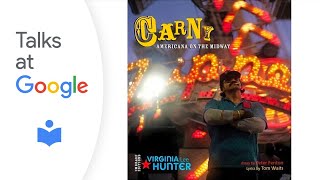
Virginia Lee Hunter describes a decade-long (begun in 1996) photographic and documentary project, Carny, documenting carnival workers and American fair culture across U.S. regions (Wyoming, Nebraska, Appalachia/West Virginia, Central Valley CA and others). The work juxtaposes colorful midway/pop-culture images with black-and-white portraits of carnival workers, includes first-person interview excerpts that highlight subculture themes (family, belonging, hardship, hierarchy), and concludes with a short documentary trailer and audience Q&A covering rides, safety, economics, sideshows, carny vocabulary, and technical details of the film/photography.
Questions this video answers
1996
About 10 years (a decade)
Talks at Google — January 18, 2008 (video title metadata)
Western plains (Wyoming, Nebraska), Appalachian hollers (West Virginia), Central Valley (California); also traveled Central California, Nebraska, Wyoming, upstate New York, Pennsylvania; Cheyenne (Frontier Days) mentioned
Shows range from ~30–50 people up to ~300 people
Chapters
Thanks for coming out and thank you, Julie, for inviting me to speak at Google. I began working on this project in 96, 1996. I was at a carnival, and I started looking around and I saw myself and these young children marauding through the midway. And I thought, what this reminds me of. Myself. I have. It started then generating my own memories. And I thought, well, if I have a memory of the carnival, surely others do too. And what does the carnival mean in our collective memory of Americana? I then started photographing and embarked on a nationwide adventure off and on for 10 years, going to different carnivals throughout the western plains in Wyoming, Nebraska, deep in the hollers of Appalachia, long in West Virginia, and then the Central Valley here in California. My intention was twofold. One, to pay homage to the carnival as it represents Americana, to see if it's still relevant in today's society. With a barrage of entertainment. Is the thrill of winning a teddy bear still as exciting today as it was 50 years ago? Also, I wanted to explore who the carny was. Everyone has their ideas of a carnival worker. There was a saying told to me when I started this project about the carnie, lock up your daughters, bring in your laundry, the carnival's coming to town. I wanted to know who these people were that created such a reputation. So my intention was twofold. To look at the carnival as pop culture, and then also to look at the carnival as subculture. I'm gonna go through some images and then read some from my book. What I'm reading are interviews that I conducted with different carnival workers. It wasn't me to tell their story. It was for them to tell their story to me and then to communicate to you all. So let's see. So the images are both in color, in black and white, obviously, the color to capture the midway feel, to represent the pop culture aspect of the carnival. The bright lights, the colorful food, colorful games. I used a form of street photography where I would just wait and look for images that had classical representation, And then I would do portraits of those that I would come across. I reserved the black and white for the carnival workers to show the behind the scenes of the carnival life. This image is of a ride jock. And I'll just read you a little bit from Ralph, who this is. We're ride jocks, not splinter heads. Joinies, stick joints, games. Splinter heads are called that because they work around wood. Their joints are all wood. The rides are all heavy metal. We're heavy metal. This carnival life is a good life. If you ain't got Nothing else. This is where it's at. It's party town. We work all day and party all night. We throw down every night. We got a barbecue out there, steaks, burgers, hot dogs, beer. Every now and then there's a sweetheart on the road, just for fun. They're around. They don't last long though. Relationships just don't last long when you're out here and traveling around. We fight amongst one another. We knock the hell out of each other every once in a while. But that's between us. Nobody else could come here and do that to us. One day Ted may walk up to Jack and take a two by four to his head, but the next day, some townie come up, jump on Jack, and Ted will take a two by four to his head. We take care of our own with discipline. Inside our family, we discipline ourselves. The few, the proud, and the in between. One of the many things that I learned about the carnival is that it is a family. It's very much us versus them subculture. The carnival takes in all that mainstream society disregards and it creates a sense of loyalty amongst one another that you don't see very much in modern day society. Those that perhaps have had lives that didn't turn out the way they thought they would have a place to belong and still feel autonomous. There's a lot of respect amongst carnival workers, A lot of allegiances to what they do. This is Walter. I'll read a little bit about Walter. I thought that he was at first the scariest person I'd ever seen. But then as I got to know him, he was really the most fragile. This is Walter, a ride jock. I've rode trains, been in the penitentiary for five years. You can't tell me nothing, show me nothing I ain't already seen. I've been there, done it, and I ain't afraid to do it again. I just don't want to do it again. I know if I don't stay on this show, I'm going to stay in trouble. The carnival keeps me out of trouble. I know the way I am. I know that the way I was brought up. This tattoo FTW means fuck the world. I got tattoos, love and hate on my knuckles. When I was 14, I was a lover one moment, then a hater the next. The past 10 years, I ain't talked to nobody in my whole family. Couple years ago, I was probably six hours away from them. Hey, man, in six hours I can go see my mom, you know, I had to turn my head and go the other way. A lot of people on this show are my family now. A lot of people on this show care a lot about me and they know what I'm about. This place gives me security. I think the craziest thing I ever seen was in Harvey, Louisiana during Mardi Gras. I had a 22 set swing, 22 seat swing. All of a sudden I heard a gunshot. I seen a guy hit the ground at that time. It was like a herd of buffalo coming towards my ride. I stopped the ride and I told everyone, don't move, just sit. I got me a crescent wrench and got on top of the ride and wouldn't move. Gun or no gun, I got to protect myself and the man's ride. I had pride and joy in that little swing set. Now, who'd ever thunk that somebody that had steely eyes as he and these pretty intense tattoos would want to protect a little swing set and people he didn't even know that were dangling from the sky? It brings out the carnival brings out. I don't want to sound like too much of a cliche, the child and all of us, but it's what that child represents. That innocence and joy that we all want. And life's circumstances may bury those feelings deep within. But the carnival allows these people to allow that to come out and be a part of their life. I don't want to paint the portrait that all carnival workers are like Walter or steely misfits of society. That's not true. There's a lot of families that live and work on carnivals. They do quite well. A lot of them live a very comfortable middle class life. A lot of carnival shows will have schools for their kids and they live in $200,000 trailers. But those are the people that own the carnival. It's very different than those that come to the carnival for a place to belong. So people like Walter create these scenarios. This was taken in Cheyenne, Wyoming, at the frontier days. Just all the people and the lights and the scenery just create such an atmosphere that speaks of what the carnival is about. It's this autonomous fun zone that comes in in the middle of the night into a vacant field. And by sundown the next day, it's this. It's just bright lights, twirling, whirling rides, the cacophony of sound and the smells of sweet spun sugar. And just as quickly as it is put up, it comes down. I loved photographing the people at the carnival. It's a place to socialize, to parade around. It's the promenade. These girls Were from Omaha, Nebraska. Quite the fashion statement, I must say. These boys were from West Virginia, this particular town where they lived the carnival, as you can see in the background, it really isn't very much. It's all the town commerce could afford to bring in. But it's still just as important as a large state fair. It's the only form of entertainment that comes through this holler, and it comes once a year. They save their quarters and their dollars and they spend it all at the carnival. You see people at the carnival, for instance, this. Presumably father and son sharing moments together. And you wonder if this little boy will remember this time with his father. Because you can't overlook the big stuffed animals that you can run at a carnival, nor the rides. This is. We call him Bozo Dave. Alison, my film partner, and I met him several years ago when we started working on our documentary. He works in the dunking tank. The dunking tank basically sits in a cage above four feet of water. And he angers passersby. He solicits, remarks, and tries to rile them up so much that they'll spend all their cash on trying to dunk him by throwing a softball. He grew up in the carnival business. His older brothers are Ronnie and Donny Galen. They're legendary Siamese twins or conjoined twins that were part of the sideshow. Bozo Dave is one of our main characters in the documentary Carney. So you have. Carnivals represent this capacity, and they represent this capacity. Tattoo artists were historically associated with carnivals. I find the prizes that you can win very unique. And of course, how many people have died to win a goldfish at a carnival? I see some hands coming up. Trying to capture moments like, this one was my aim, excuse the pun. A friend of mine's son saw this picture. He's four. He says, mommy, it looks like they're falling in love. And of course, the corn dogs. And the ice cream. This is Sybo and Darlene. When I first embarked on this Project 96, a lot of Carnival workers lived in their rides or under their rides. Nowadays, they're bunkhouses that they travel, that they live in. I thought this was a unique situation. This is about throwing down every night, drinking beer and playing craps. This image, I think it's the end of the season and they're getting their bonus pay. It's also a very solitary life as well. This is Paul. I befriended a lot of these people throughout the time of working on this project. I've kept in touch with many of them. Paul in particular, he Lives in a nursing home in Nebraska. And I go up and visit him quite often. Because I was funding this project on my own. I didn't have much money. I never stayed in motels. I would bring a tent or sleep in the back of my car. But oftentimes I would set up a tent on the fairgrounds in the back lot. And the carnival workers thought that was so bizarre. Like, why would you want to stay here? But, you know, for one, I too wanted to be a part of a community. Going out and traveling by yourself throughout the country gets pretty lonely. And I wanted to be a part of this as well. I still get calls from some carnival workers who just say, man, I can't believe that you lived with us. That was just so cool. And I. I wanted to. I wanted to be a. I too wanted to run away with the carnival. And sometimes when my cash was low or somebody was working in a game and somebody had quit and they needed some help, I would step in and try and hold my own hawking darts. I was pretty good at it too. But to do this 12 hours, night after night, day after day, in all types of weather, it wears you out. And so it really takes a certain type of person who can live this kind of life and work this life. This is Harry. Harry is also part of our documentary. This is Melinda. Melinda represented a form of person that finds themselves at the carnival. It's probably the dirty laundry that the carnival owners don't want to have exposed. And meeting her was probably, for me, going into the darkest corner of the carnival life. I'll just read some of what she's told me. When I do. Excuse me, when I do drugs, I'm considered a whore who doesn't know and doesn't care. It's not that way. I hooked up at the carnival show near Reno. I met Todd, who has a joining boss there. I got yelled at by Mac, the owner, for having sex on the ride. I got drunk, flirting, ended up with Charles and went to Colorado. I picked him up in Libby, but left him first for a guy in Libby and blah, blah, blah. It kind of goes on and on and on that way. But then she started to express who she really was. And it wasn't just about jumping from guy to guide, ride to ride. Since the first time I can remember, I said no. My grandpa sheltered me. He was one of the only I could confide in, and he promised to keep it a secret. My grandpa started to get sick when I was seven. He died when I was 11. Things started changing and I left home then. I believe in God and I believe in the devil, and I believe in life. And this is what really captured my heart towards Melinda and started to realize that this image is really a very. Although compromising sexually, it's a very chaste image. I just want to be able to go to heaven with my uterus and tubes untied. You know what I mean? If there is a goddamn place, I want to be prepared. I'm 29. I've had so many opportunities and I've pushed them away. The metaphor to that is there are a lot of women out there that have been abused throughout life, and they feel the only identity that they can express is a sexual one. But that's not always the case. Yes, this is a very compromising image of Melinda, but it's also a very pure image. That's how I see it, at least. He was so proud of winning this little Pooh Bear. There are still a lot of sideshows that travel with Cornwalls. Fewer and fewer. The giant snake, of course, is just a big boa constructor. But nonetheless, it scared the heck out of this little boy as he's scrambling to leave. And then the end of the night. So that's the slide show. I can then show the documentary, the four minute trailer, and then we can open it up to questions. Are we okay time wise with that? Okay.
C A R N Y. Carney. Do you like the carny lifestyle? Some people say Carney's scum.
Cotton candy is where it's at.
One game for two, three for five. How about you, Carolina Blue? Come on, guys. Fire. Give me a juicy one. I knew it. I knew it. He makes me look good. Pay for those, daddy. Pay for those games. We're all the way up top. Who's it gonna be next to? Duck, Main round and Clown. Hey, hey, hey. Now, don't be talking about my mama. I could have been your daddy. Bo. Hey, honey. That's a real pretty blue dress you got on. Was that included with your Malibu Barbie?
He is too good.
I'm back. Hey. Daisy do called and she wants your shorts back. I'm Poochie. I'm Poochie love. I've been a showman for basically all my life. The games that I used to work were games that were called traps. Games that you couldn't win unless I want you to win. But they are outlawed now. I don't know how a person thinks that comes to a carnival. I've always been at the carnival. I was born into this. So this is It. My family owned some carnival rides. And then my brothers Ronnie and Donnie, the Siamese twins. Ronnie and Donnie were on exhibition. There's a new generation of carnival people who have forgotten about, you know, the freak shows. If you would. My name's Rebecca and I'm 21. I joined up at the fair in the middle of July. I wanted to get away from everyone. I figured I'd be able to think out here. Where I'm from, I don't know. It's a lot of drugs, a lot of drug addicts and a lot of retired people. There's nothing there. The claw is a good ride. Spider. Ah, the wave swinger. That's my favorite ride. You're just, I don't know, it's like you're flitting. Yeah. You have a lot of time to think, you know. When I was younger, I got into a lot of trouble with the law because I was on my own. Did a lot of time for it. When I first came out here, I was just like a lot of these young guys. I picked up over 100 girls in less than six months out here and did whatever, wherever. Actually out here in my town, if.
You'Re at all different, it's bad. If you have goals that are different than anyone else's, or you want something bigger or better for yourself, or you want a haircut that's different than anyone else, it's extremely hard. But here I never feel like the strangest one. I want everyone to think that I'm happy. And it's hard to be at a carnival or be at a fair where everyone's supposed to be happy and upbeat and be sad. It almost makes you more sad that everyone's happy and you're not. So that's it for the presentations. I'm happy to now open things up to talk about any questions you all have. Did you follow just one carnival? I traveled with several different shows. Carnival shows will stay to a particular region just because what they call the jumps have to be within several hours, time wise. And just the cost of a jump. Sometimes with some shows that are so big it costs $10,000 in diesel fuel just to make a jump. Five hours. So there were four or five different shows in different areas. Central California, Nebraska, Wyoming, upstate New York, Pennsylvania. In the heart of the height of the fair season, there's probably, I don't know, thousand different shows out there. From anywhere from 30 to 50 people, up to 300 people per show.
I went to a fair not too long ago. My nephew and one of the Things that I noticed was that a lot of the rides that I experienced when I was younger are still going like the Zipper or you know, the Salt Pepper, which is now renamed something else. It's almost like they just slap on a new sign. Did you get any sense of how old these rides were and what the safety precautions were, you know, when they're slapping them up overnight and you know, starting the show the very next day?
Well, some of those classic rides like the Zipper and the tilt wheel, are they still make them? They may be. I can't even put an age on them, it wouldn't be fair because I don't know. But they still make those rides because they are classics. Because somebody like you who takes your nephew to a carnival and you see something that you remembered as a child, you want to ride it or not ride it. It depends on how you felt afterwards. But I always thought that the carnival rides were some of the safest compared to, let's say stationary rides at large amusement parks because they are manhandled on a daily basis and they're gone over with fine tooth combs dismantled and remantled.
When I think about carnivals, I mean the image that comes to mind is Ray Bradwick short stories and that's 50 years ago. It's almost a surprise to see that it still exists as a culture. I mean, do you think it's a. Is it a different thing now from what it was 50 years ago?
Oh, yes. Well, that was one of the reasons why I wanted to embark on this project to see where the carnival fit in modern day society. They're much cleaner. In fact, a lot of modern carnival owners want to even change the name from a carnival to a traveling amusement business basically calling themselves like a Disney on wheels. And if as a spectator, I am not really interested in having everything homogenized. I like the carnivals of the yesteryear and they had a lot more character to them. The agents, Pucci, whom you saw on the documentary, how he's grinding and they've got this little shtick and it's more, it's entertainment that you're getting these little bits of entertainment trying to have the agents bring you in the town marks. And so a lot of the heritage has been swept away. You can't win as much money as you used to. The gambling games have been outlawed.
And I suppose the other side side of that is, are they still going to be around in 10, 20, 30 years?
I sure hope so. I mean carnivals aren't just a part of the American Fabric. It's universal. They have carnivals throughout all of the world, and they are. Well, I sure hope that they're still around. The rate that fuels going and insurance, it's going to knock out a lot of the smaller shows. That's true. They just won't be able to afford to travel. Can you tell them more?
Like, what's the hierarchy? Like you said it was a family carnival, or did people sometimes own their own little booth or a ride?
Well, if you're born into the carnival business, it's a business. For the most part, it's a business and people can. It's usually a family business. Four or five generations of carnival people, and then they get. They inherit the carnival. The some rides and concessions. That would be the popcorn popper and the lemonade stands and then the games where you win teddy bears. Those are owned by. How do I put it? Not really conglomerates. But let's take one particular show. There may be three or four families that own aspects of the carnival. Three or four rides. Some of these rides we're talking in the millions to purchase. So it's a pretty big investment. The workers, they get a salary kind of breaks down to $2 an hour. We discussed that in the documentary. So labor is fairly cheap. But again, things are changing. A lot of carnivals are bringing in people from Latin America, giving them work visas and just putting them on a salary as opposed to a commission, which is what a lot of the agents work off of. So there is a hierarchy. If you own games and rides, you can bring in pretty good amount of money, and then you hire people to work for you. And those are. Some of them are just kids that want to travel for a summer. Some of those are people that I mentioned earlier that just want a place to belong. So in the business sense, it's a business.
I know that this is. It's pretty far away from carnivals, but I did think about something like Cirque du Soleil and how, you know, it's a very different form, yet there's some similarities there as well. I wonder if you know much about Cirque du Soleil and how it compares to this, knowing that it's very different. You know, how those are two very different forms and, you know, like, is one the future and the other.
Well, Cirque du Soleil is just such a hybrid of circuses. It's so unique. But if I can answer the question by comparing carnivals and circuses, they're two very different, and they don't get along at all. Circuses, people that travel with circuses have a low opinion of carnivals because there's no talent to it. They say, you know, I mean, the circus is all about riding elephants and trapeze artists and entertaining. It's kind of a different setup. At one time, carnivals and circuses did travel together. That's where the term midway comes into play. That would be the main promenade as you're approaching the big top. And they would have some little rides, but mainly sideshows or girly shows or the strongman and some games on either side. And then you go to the circus and you see the show for two hours and then you come out and then you spend your money. But circuses were feeling, well, they're taking too much money. And the carnival people were saying, well, people are saving their money and spending peanuts in the circus and not on us. So they had a parting of the ways.
In the same vein you had mentioned about, say, like the Python or whatever, when was the turning point for, say, the end of the freak show? Certainly not being very PC.
Yeah, there's that. As society became more. Concerned about exploitation. But that also went hand in hand with medicine becoming more advanced to correct a lot of the ailments that caused deformation, which is kind of a drag because there's still a lot of people that have physical abnormalities that are now wards of the state when they could be vital, thriving entrepreneurs.
Did you see any remnants of that at all?
Yes, I did. There's a family that have a couple of, like the mermaid, the one that comes to my mind was a mermaid. And you pay a dollar and you go in and you. There's a little obtruse with a mirror, like you're looking into a fishbowl and there's a woman down there and she's kind of waving and you can see she's actually watching tv. Like the glow of the blue light is flickering on her face and you look a little closer and she's somebody with spina bifida. And I asked around and she was from Jamaica, I think. So a lot of. A lot of people from the Caribbean, Third World countries will get a job doing something like this. But a lot of the sideshows nowadays are performance based sword swallowing. And I did have the opportunity of meeting Ward hall, which is. He's a legendary sideshow entrepreneur and he had a 10 in 1 sideshow that hooked up with one of the shows that I traveled with. And that was marvelous because he's legendary. He's in his 80s and he's been doing it since he was 14, so he's been a part of the sideshow life for a long time. You should Google him. Was it hard? I mean, you talked a little bit about having your tens. Was it hard for making inroads for these people? Yes, it was. Carnival people, as you can imagine, are pretty shut off. They don't want exploitative stories on them because they've had such a bad rap for so many decades. So I did have a hard time initially breaking into befriending some shows, but after a while they understood that really what I was trying to do was tell their story. Story. And that it wasn't just a sensational piece. And I hope that that comes through in the book. I never wanted it to be a sensational piece, but to pay homage to the carnival and to give the carnival worker their own voice to tell us who they were. How much time did you spend with people? I mean, I know you said you traveled with different shows, but like, how long were you on the road just kind of in the tent and talking to people? Three to six weeks at a time. And I might go to different shows, but again, because it was kind of hard to introduce myself, I'm basically a shy person. So it took a lot of courage for me to muster up going out onto the midway with my camera and trying to start up conversations when people just kind of look at me and roll their eyes and. But after a while, I was the camera lady and they wanted me around. Were you invited to their after hour party? Yes. Well, that's how so many of these images like the craps shot when they're playing craps in the barbecue. And then the image of Melinda.
What's some interesting vocabulary you learned?
Let's see, grinding is the term. Grinding means when you're working in a game and you're trying to bring marks, town marks in, you're grinding. And mark is a town person that the origins of the mark comes from if somebody was flush with cash and they stop at a game and they play and they spend a lot of money and the agent then would take some chalk on his hand from underneath and he would pat the back of that person and go, see you down the road. Nice, you know, nice meeting you. And he's just now been marked. So now other agents know he's got money and he's. He spends it freely. That's the term mark. Ride jocks, as I mentioned earlier, they work with rides and splinterheads or joineys work in the games because those are stick games. They're made out of wood and traditionally they don't get along, but nowadays it's a little different. Ghazarni, that's the language of carny. And it's sort of like a pig Latin. And if I were to say anything right now, it'd be mess up. I wouldn't do it right. But it's like kizarni with a K and then a Z after every word. So, yeah, I learned a lot. And that also really helped me. Back to your question about getting in with the carnival people. As I worked with this on this project longer and longer, I was able to throw out some of the slang. And then eventually they would say, I think you're with it. Which means that I've been with the carnival. Let's see, what's the term? I'm not a 40 miler. I'm like a May to September person. But to. I always felt, and I still feel to be able to have the official title that I'm with it from any old timer is quite an honor, in my opinion. I also recently went to carnival. My dad lives in Stanley, Virginia. Yeah, middle of nowhere. I've been there. Yeah, it seemed like that. Some of those.
I was like.
I thought it exactly. But we had like the sweetest lemonade we've ever had in our entire life. And there's like, you know, three fried dough stand this thing. Do they have like family recipes or how do they decide either? Is there some sort of cookbook for carnival food or do they buy to Costco? That's an idea. I don't know. I don't know. I couldn't answer that. They may have. They've never shared that with me, nor have I asked. I guess I asked for lemonade without as much sugar on the garlic. Tequila. Well, but you're coming from a region where everything's sweetened. Sweet tea, sweet milk. Did you have any fried Twinkies?
No, they didn't.
I was actually hoping that they'd have like fried Nutter Butters and they didn't have. It wasn't that elaborate. It was smaller than that because our friends are from Dallas and they have a state fair there and it's fry anything. Yeah, yeah. They only have fried dough and they have three fried dough stands. So I don't know why they didn't sit on the competition. Must be a little tough. They must be owned by the same family. Did you eat any fried dough? I would allow myself once a day to have a little treat, you know, at the carnival. I still wanted to participate. No more questions.
What kind of equipment were you using?
All film, Nikon and Leicas and then with the documentary we shot on video MiniDV and Super 8, Kodachrome 40. I think we were one of the last productions to work with Kodachrome 40 since Kodak phased it out in Super 8 form at least.
Was that then a nightmare to process?
And. I think we were able up until probably the last time that we shot, we were able to still send it to the official lab in Switzerland, but in Kansas, Parsons, Kansas. I'm trying to think of the name of the Duanes. They still do Kodachrome 40. They've stopped becoming an official Kodak lab, but you can still get Kodachrome 40 processed lab there. Well, thank you. I appreciate this so much. I'm clapping for you guys. Thanks for coming out. I really appreciate it and I'll be happy to sign some books. Can I unmic myself.
More from Guy


Cheryl Strauss Einhorn | The Human Edge: Smarter Decisions in the Age of AI | Talks at Google



Rachel Glennerster | Innovation and the Center for Global Development | Talks at Google

Rebecca Winthrop | Rethinking the Purpose of Education in the Age of AI | Talks at Google

Dr. Robert Wachter | A Giant Leap: How AI Is Transforming Healthcare... | Talks at Google



