David Aaker on “Strategic Stories” from BerkeleyHaas
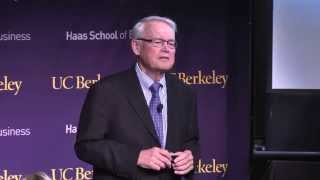
David Aaker explains how brands use signature stories to communicate their essence and inspire employees. Stories work because they stick in memory, trigger emotion, and get shared. He walks through examples like Blendtec's viral blender videos and Jared Fogle's Subway transformation, then outlines how to source, evaluate, and keep brand stories alive.
Chapters
Welcome, welcome everybody to this Dean speaker series. I'm Rich Lyons, Dean here at Berkeley. Hawes just to my right here, Dave Acker, longtime friend and colleague. Let me start with an experience that I had literally earlier this week. I was up at Memorial Stadium with a group of people visiting from the National University of Singapore. Berkeley is building a global campus, you've probably heard in sort of the Richmond Bay area. And we were talking among other things about data science and Berkeley's developing a brand new analytics data science curriculum at the undergraduate level. We think it's going to be a really big deal. And the person that was running the meeting was one of the head data scientists on the Berkeley campus. EECS Professor Electrical Engineering, Computer Science. And they were talking about this curriculum and the idea that NUS might actually participate in it because they might participate in the Berkeley global campus and Cambridge University might as well. And the more I'm hearing this, they of course were talking about the curriculum and they were talking about data science. But I couldn't help but hear that given how I've been trained by Dave and I just heard branding opportunity. What if the open source undergraduate curriculum available to everybody in analytics and data science got developed here and that institutions like NUS and Cambridge became part of that. And when I mentioned this of course the word brand, most of these data scientists don't use that word, right? So I tended to use the word reputation. Anyways, the point was it's a lens, it's a way of seeing. It's a way of seeing opportunities that we don't often see. And it's a way of of course seeing threats that we don't often see. I wouldn't have anywhere near this kind of perspective if not for literally my friendship with Dave and the books that he's written. And that's why we're assembled here today. So let me introduce him so that you can hear directly from Dave. He retired from our high school, taught here for many decades. He retired in 2001. Part of what we wanted to do was ensure that we continued to have access to him and his latest thinking. And we established, we launched the David Aucher Distinguished Lecture Series. Today is co hosted by the Dean Speaker Series and the David Aucker Distinguished Lecture Series. We also have co sponsoring by the Haas MBA Marketing Club and our Undergraduate Marketing Club Imagi Cal and I'm pleased to see many of of course you in here are marketing students. So thanks for being here today. He returns every year to give a talk around this time of year. He's the author of more than 100 articles, more than 17 books, eight of those on brand strategy per se. His books have sold well over a million copies. They've been translated into many, many different languages around the world. His most recent book, Okoron Branding 20 Principles that Drive Success. There's a picture up there. I have a copy of it right here. This is in many ways a kind of compendium, a summary of all of those books. It is really chapter by chapter, a great resource. And I sent, just to finish my story with those data scientists, I sent a follow up email to them. And in the email I said, you should get a copy of this book. So I love sending EECS faculty members links to branding books. And this book really is a terrific one and I learned a lot from it. He's recognized as one of the world's top marketing strategists. He's referred to by many, many people, including his peers, as a guru in the field. He's known for the Akker Brand Identity Model. This was a model that we've used here at the Haas School and is used widely throughout the economy, helping to understand what is the essence of a brand. What is the essence? What are sort of the core elements of it, what are the extended elements of it? The brand essence of the Haas School was something he helped us think about as we were going through that process. Another thing, very recently he was honored. He's an inductee into the Marketing hall of Fame. This is a lifetime achievement award in the field of marketing. He was the only academic honored by the American Marketing Association. This year there were four inductees. Just real quick on sort of the prestige of the nomination. Other inductees include Shelley Lazarus, Chairman emeritus of Ogilvy and Mather. Yvonne Chouinar, who is the founder of Patagonia. Trevor Edwards, president of Nike Brand. It is this level of people and in most cases practitioners. We couldn't be prouder of Dave for that honor and many others that he's received over his career. He was a Berkeley faculty member since 1968. Currently is the et Grether professor of Marketing and Public Policy Emeritus. He's Vice Chairman of Profit Brand Strategies co founded by Scott Galloway. Scott Galloway Rather and ian Chaplin, both MBA92. A company that still is is here. Alum Michael Dunn, MBA 1990, currently serves as chairman and CEO of Profit Brand Strategies. I want to thank Dave for being here on behalf of all of us today. His talk on Signature Stories is going to be a very helpful one to all of us. Dave thanks for coming.
Hmm. Oh, here. Well, thanks for having me, Rich. Rich is one of my best friends. He gets a star award this year for the best attendance at my lectures. He's always here. And there's no question Rich Lyons is the best dean in the world. Best business school dean. We are very lucky to have him. And I'm sure you're as sad as I am to know he's now accepted an offer at Harvard. It's April Fools. I had you going, didn't I? Rich was saying. I didn't know that. But anyway, the steps that Hawes has taken under Rich is just finished. We now have a new building. The last US News report continued our trajectory of recognition. And it's really, really a source of pride to see that happen. So I want to talk today about stories. Stories is a hot topic in marketing and it's very strange that stories should become the hot topic. But anyway, I'm going to take a different spin on it. I'm going to say, well, how can we use stories strategically as opposed to tactically? And let me start out with three stories. The first is about Nordstrom's. In the mid-70s, there was a store in Fairbanks, Alaska, and there was a salesperson there that had only been there two weeks. And in fact, John Nordstrom was actually in the store and a customer came in with two worn snow tires. And that customer said, you know, these aren't working, I need my money back. And the salesperson without question gave him which was then $145 and took back the tires. Even though Nordstrom's of course, have never sold tires, although there was a tire shop at that site some years prior. But Nordstrom's never sold tires. So what that tells you not only about their fabulous money back guarantee, but also something about how they empower their employees and how their concern for the customers, all that in that story. In 1998, Jared Fogle weighed 445 pounds and he had a big health problem. He tried all sorts of diets. Nothing worked. And he was attracted to the Subway. Seven under six, seven sandwiches under six grams fat. So he developed his own diet. For lunch, he ate a six foot turkey sub with P baked chips. And at dinner he ate a 12 inch veggie sub, whole de mayo. And he did this for month after month, well over a year. And he lost 245 pounds. He then weighed 180. So this story tells you not only about the fact that here's a fast food company that can help you lose weight, but it's healthy. Leon bean in 2012, was a mid-30s man who loved hunting and fishing. And he went duck hunting, and he came back with wet feet. And he decided, I'm going to do something about this. I'm going to create a new boot which will have a rubber at the bottom and leather at the top and sew them together. And he did that, and no more wet feet. So he said, this is such a good idea. I'm going to make some and sell them and I'm going to get some names from the fishing license department of the state of Maine. And he did that. He sold 100 of them, but they leaked. So what was he going to do? Well, he took them all back and gave their money back, even though he couldn't afford it. And he made them better, improved the boot so they didn't leak anymore. And that became the basis of the L.L. bean Company. It tells not only about their again, fabulous guarantee, but about their passion for hunting and fishing and also their passion for innovation, for doing new things. So a signature story is like any story, needs to be compelling, needs to be something that's memorable and impactful, but it also has to have some other characteristics. It has to communicate the essence of the brand, of the firm in a way that will inspire employees and it will foster a relationship with customers. So it has to be important. It has to be meaningful, the message that is. And furthermore, it needs to have enduring relevance. It's not something that we're doing to help us communicate something immediately. It's going to be an asset that's going to be with us for some time to come. How many know the Nordstrom story? How many have heard that before? So maybe a third of the audience. That's incredible. Nordstrom hasn't even mentioned it for 50 years, 40 years, and yet people have heard it. I mean, this is an asset that lingers. Now, there's another kind of story, and that is a sort of a set of stories that all have the same theme, the same kind of thing, but they have variations that make them a little different and helps you see the concept in a broader context. Can you turn up the volume a little? Happy Valentine's Day. They say that diamonds are a girl's best friend. And because of our limited budget, we are going to blend cubic zirconia imitation diamonds today.
Now, on a hardness scale, zirconia is.
8.5, and diamonds are at 10 on the Mohs scale, wrappers refer to diamonds as ice. So I'm going to push the ice Crush button.
Diamond smoke.
Don't breathe this. They say that diamonds are forever. Not in the Blendtec Blender. So this is one kind of story set where you demonstrate the product. They've done this since 2006. So they've done it for what, eight years? They have had 300 million views. 300 million with no advertising budget. 300 million views. There's another kind of story, and that has to do with customer experience, different customer experiences. And an example of that is Google. You can go to a website called Google Stories and you can see all kinds of examples how people are doing Google. Using Google to do phenomenal things. Dr. Julian Bayliss is a conservation biologist at the Kew Gardens outside London. And he was exploring in Mozambique, near Mozambique. You don't actually like to go in Mozambique. It's very big, dangerous there. But he was on the border and he noticed in the distance a mountain that looked promising as far as biodiversity goes. And he went back to Google Earth and he was able to explore that and discovered the largest undiscovered rainforest in southern Africa. And then subsequently, teams of people went out and explored forest. And it was amazing. They found 17 new species there of plants and animals and all kinds of examples of endangered species. Very rich, lush rainforest. And Google Earth enabled him to do that. Google Earth. So anyway, there's Google Stories of all kinds of varieties and. And so that's an example of a signature story set. So to understand signature stories, you really have to understand the power of stories. And this is sort of basic to all stories. It's really remarkable. Really remarkable. So suppose I put out these seven facts about the bean hunting boot, and I asked you to read them, and I asked you five minutes later to write down all you could remember, or I asked you three days or a week later to write down everything you could remember. You'd be lucky to get one or two. But if I asked you to, if you remember the story, everybody would remember the story. I mean, everybody. It's remarkable. So you go from like 5% memory to 100%, and there's all kinds of studies to document this. And why is that? Well, first of all, when you hear a story, you're attentive and you're interested and you're involved, you process. Second of all, you have a cognitive frame of reference. So. So when you hear the bean story, everybody, if they haven't been hunting and fishing themselves, they at least know about hunting and fishing and they kind of know what that is. So in your mind, that story sort of fits into Some broader context has some leaks. So anyway, a story is. And besides a story, you only have to remember one thing. You don't have to remember seven things. You remember only one thing. So stories are remembered. Second, a story avoids specific claims. Now, if you went out and told people that our company Subway can help you lose weight, can you imagine what the lawyers in your firm would say? Can you imagine the pushback you would get and maybe lawsuits for making that claim, that Subway will make you lose weight. You simply couldn't do it. But you can tell this story and people will get the message that there are circumstances in which this menu can help you lose weight. Help Jared Fogle. So you're able to talk about claims you just couldn't really talk about factually. I mean, nobody expects Nordstrom's to give back money for a tire. There's nobody that's walked in, even though everybody knows the story. Nobody brings tires into Nordstrom's, right? But still the story tells you about the Nordstrom power of empowered employee, about their guarantee and so on. And another thing, it spawned social communication. Now, how do you Suppose Blendtex got 300 million views without advertising? It had to be social communication, right? It had to be people saying, did you believe this guy put an iPhone in a blender? And here's a link that's only got 300 million views. And you're not going to get that by talking about the seven functional properties of Blendtex blenders. How powerful it is, how many rotors, how fast it goes. That's not going to get 300 million views. Views, it's going to get none. And most impressive at all, it persuades. Uncle Tom's Cabin was a best selling book in the 19th century. And there is a theory that it helped the unions win the Revolutionary War. I mean, the Civil War. Because this book was so influential that in England people were politically unable to go and help the south, which was their political inclination. But they weren't going to perpetuate this slavery stuff. And Uncle Tom's Cabin made that, created that aura of perspective. And that also helped recruiting in the North. And another theory is the Civil War was decided because of overwhelming numbers from the north. And this was a recruiting device. I mean, stories are really important, but it's not just common sense. We know that from psychological research. There has been all kinds of studies. In One review of 76 articles since 2000 that reported on 135 studies, they showed again and again and again that stories impact beliefs, attitudes and behavior. So all these Studies would compare stories versus a factual counterpart and stories win. I mean, they win big. So why is that? Well, first of all, stories inhibit counter arguing and that's really important. So if you have again the Ellioen story, if you have somebody talks about the facts of a boot, that it's expert craftsmanship, you, you say, oh yeah, that sounds like puffery. Why would they have more craftsmen than some other boot manufacturer? I mean, what's behind that? But if you tell the story of L.L. bean stitching together this bead, conceiving of the idea in his mind, rubber bottoms, leather tops, you don't counter argue this. There's no context for counter arguing. So the story is able to give the message without counter arguing. And again, this has been shown in psychological studies, it's just not a hypothesis. And then feelings get transferred. So if you hear that Nordstrom story, it gives you a good feeling about Nordstrom's. I mean, they've really got their heart in their right place and that gets transferred to the brand. And again, psychology, a whole branch of psychology around consistency theories where people like things that are consistent. And so if you get good feelings there, you'll get transferred to the brand source credibility. So if you have somebody in an ad telling you factually that you should buy Nike because of these functional benefits and, and they even have tests to back some of them up, that's not going to be as credible as Tom Dickson sitting up there demonstrating the Blendtex or Leon Bean inventing a new boot. I mean, that has a lot more credibility. And finally, again, from common sense and research, we know that in education and if you get people to do it themselves to learn it instead of telling them, the learning will occur. So anyway, the stories tend to be over facts. And incidentally, a story is not a set of facts. It's hard to define what a story is, but it's not a set of facts. So a story is remembered, voids specific claims, it's bond social communication and it persuades. So that's the, that's stories, that's strategic stories. So how do you, how do you implement that idea? Well, you have to find stories, you have to select them and then you have to leverage them. So we have story sourcing, story evaluation and keeping stories alive. Story sourcing. First of all, before you even find stories, you need to have something to say. There's no point in figuring out what's the best thing to say. I mean, the best way to say something if you don't have anything to say in the first place. So you need to have values, a vision, a strategy, because without that, you really don't have anything to say. And second of all, you really have to want a signature story. You have to really come to the conclusion that communicating facts is not working. We're spending a lot of money getting little penetration, cognitive presentation or, or impact. It's not working. So we gotta find a way to convert these facts to stories. So there's gotta be a motivation. That's the first thing. But after that, we have to understand that there's a lot of sources for stories. We've already seen. Some can be an employee source, can be a customer source, can be offering like Blendtec. It can be a founder like L.L. bean. So there's a broad array of places we can look to for stories, and we can generate those like there was when Mobile, before it joined with Exxon, had a brand vision that was leadership, partnership and trust. Leadership, partnership and trust. That's what Mobile stood for. And so what Mobile did, they had a contest among their employees for who could create or who could find the best person, program or organizational unit that best exemplified one of those brand vision elements. They got 330 entrants. The winner got to go to the Indy 500 being the infield. And they got a lot of signature stories around those things. But there's some other ways you can do a transforming CEO. In 1984, there was a refrigerator company in China that was as bad as it gets. I mean, you could make a comical movie about how bad it was. They had a sign in there saying advising people do not urinate on the factory floor. And. And they got this guy, Zhang Ruhman. I think that's how he, Zhang Ruman, who was a middle level manager, to come over and take over this company. I mean, what a hopeless job. It was really a derelict. Early in his tenure there, a customer came in with a defective refrigerator. So Zhang took him out to the warehouse to see if he could find a replacement. And he found that there was a lot of defective refrigerators in the warehouse. So he pulled out 76 defective refrigerators, which was about a quarter of the warehouse, put it in the factory floor, got a sledgehammer and destroyed them all. Can you imagine that? And all these employees sitting around watching him destroy refrigerators that they had made with a sledgehammer. But that event completely created a whole new culture at that company. And they went on to make some much better quality projects. They started to blossom and that company, named Haier, is today the largest appliance manufacturer in the world. 10.2% market share in the world. Nobody has Haier. They have over 20% in refrigerators, wine coolers and washing machines. And their innovation is amazing. They're one of the leaders in smart, smart appliances. They've got this air cooled, frost free refrigerator. They've got a washing machine you don't have to clean. They're an amazing company. And it all started, it's all based on this sledgehammer event that the CEO did. And then you can have programs as heroes. Lifebuoy, a division of Unilever. Incidentally, Unilever is an amazing company when it comes to social responsibility programs. It's just amazing. But one of their products, Lifebuoy, has a Help Reach a Child, Reach 5 program. And the idea is you teach a billion people to wash their hands right, they will not get sick, diarrhea, and so on, and you will save lives. Two million kids under five die each year. And a lot of those could be prevented if they learn to wash their hands right. In one of the. They had one video that showed how children are taught to wash their hands in school that got 19 million views. I'm going to show you excerpts from another one that got 11 million views. And this is about a woman who lives in a community where you plant a tree every time a child is born. Sam. So 5,000 babies a day die. And a lot of those could be prevented by washing hands. And lifebuoy is making a difference. Just think about that story, though, and think about, for one thing, how they're able to put emotion into the story. And they put emotion. It had such a great narrative beginning, a middle and an end and a message. So the second step is to evaluate stories. Because you get a lot of stories, which ones are you going to put your investment behind? There's two ways to evaluate a strategic story. One is by the message. So you want to have a message that will inspire employees, that will resonate with customers, so that it will strengthen the relationship they have with the brand. So you want a message that's meaningful, strategically meaningful. Not tactically. You want something that's strategically meaningful, that will make a difference, that will support the values and the strategy of the organization going forward. So it usually means it's something around organizational values, brand essence, business strategy, value proposition. Second of all, you evaluate it in terms of how compelling the story is. It should have a narrative flow. It should have a beginning, a middle, and the end. Like, think of Jared Fogle. He had the big weight problem. He had a diet issue. Try Diets and then he on the Subway diet. And then he lost weight and became a symbol of Subway's healthy alternative, memorable challenge. Think of two worn snow tires. Empathetic, authentic characters like Tom Dixon. L.L. bean. Engaging, surprise, detailed, visual. Just think of the visualization of that boot or that blender. So you want a compelling story, something that's memorable, something that will impact, something that'll change people. And so that's the second way you evaluate the story and finally keeping stories alive. Because if we're going to have this as an asset, long term asset, we got to find a way to keep the story alive. And so how do you do that? Well, if you have a set of stories instead of just one, you can have this guy's blending something new each day. Golf ball, iPhone, whatever, and that keeps it thing. A while ago, Timex used to have a story set that was really, really remarkable. They put these Timex on Mickey Mantle's bat or an assumo wrestler's tummy and generally at risk. And then they would see what happened. And if the watch survived, then it sort of obeyed the adage, it takes a licking and keeps on ticking. But one of the things you want to do is to have a breakout story that really sort of carries the flag. And for Timex, it was the cliff diver in Mexico wearing a Timex, he dived off the cliff, he struggled to the shore, clambered above and went to. They had a newsman, John Cameron Swayze, that was sort of moderating this thing. And Swayze looked at the watch and he said, time, it takes the licking and keeps on ticking. And this is ticking. And so you gotta have something that pops out of the stories, otherwise you get overwhelmed. I mean, you have so many Google stories or whatever that they sort of recede. You've got to have a few that catch your eye. Now, a standalone story is a different problem because once you hear a story, you don't hear it again. I mean, once you know the Goldilocks story, then the second time it's going to be the same story. So how do you keep that alive? Well, there's a few things you can do. One, you can extend the story. So L.L. bean, Leon Bean, was really passionate about hunting and fishing. So he found a way to keep talking about hunting and fishing in various contexts. And every time he did the boot would sort of be there in the background. So he came out of the magazine and something like 20 years after he did the boot, in which he said, years of testing shows that eight flies in two Sizes are all you need. If salmon don't bite on these, call it a day. So he had all kinds of advice on hunting and fishing buddy. He, he sort of stayed involved, stayed current, provided content so that people would continue to sort of experience his passion for hunting, his passion and knowledge about hunting and fishing and his innovation, you know, trying new flies, testing flies, and so on. So it's all part of reinforcing this story and having ties back to the story. You look at Branson, at Virgin, he wrote a couple of books and they sort of expand these key signature stories of Virgin. And you can use symbols. Jared Fogle has 62 inch pants that he wore when he weighed 445 pounds. And these pants have become a symbol. And in 2008, actually they had a tour de pants where they took these pants around the country and then they retired them into a Museum. The L.L. bean Boot is a statue in front of the home office, but they also have the boot on a vehicle that they parade around in parades and elsewhere. And then the sledgehammer is encapsulated in a window at the boardroom of Haier. Now actually they've created a museum of which that's one of the prime ingredients. So symbols can be really important. You see this symbol and bang, you got the story. It comes to mind you can have events like the, the 30th birthday party for the Mac. And they created a video in which they showed people using Apple products during the day all over the world, using the iPad, the iPad, the iPhone in addition to the Mac. And so this video was really well done and widely seen. And, and it kind of brings you back to 30 years ago, 1984 AD, probably the most famous and impactful ad ever, where incidentally, a guy threw a sledgehammer through a screen. So maybe there's some relationship between Apple and higher. But anyway, so you could have an event. You can have all kinds of employee recognition that are tied to one of these signature stories. And you can surround with customer facing programs. So Subway has a lot of programs that sort of are around healthy eating that are supported and buttressed by the Jared Fogle story. So they have this seven under six, seven sandwiches under six grams of fat. They have the eat Fresh things, which has real substance behind it. I mean, the bread is freshly baked and the things you put in the bread are fresh. And then they have all kinds of fresh alternatives. They have water and fruit in addition to chips and so on. Course, people actually buy the tips, but nevertheless they have, when you walk in the door, you know there's going to be healthy options even though you may not decide to use them. One of the stories around Harley Davidson is the ride to Sturgis every year, Sturgis, S.D. and Harley Davidson has the ride planner that is tied to that. And you can surround with internal programs. So this Nordstrom way that's around that tire story. Well, they have a lot of internal programs. They really deliver on what's implied by that story. They actually have two aspects to the internal program. One is empowered employees. You know, Nordstrom's, there's. You learn the first rule as you become employee, which is use your best judgment in any context, especially to help the customer. That's rule number one. There is no other rules. That's it. So employees at Nordstrom's really have some ability to do what's right. And the second element of their thing is detail. There is they talk about making the customer's shopping experience efficient and productive and fun as they can. And they have exhaustive detail. I mean, they go really fine. I mean, no salespeople at Nordstrom points. They take people to another place. And it's really amazing how much detail they think through to make that customer experience really good. So there's a lot of ways to keep stories alive. But the bottom line is that stories are hot in marketing because they work. And strategic stories are those that tell a strategic message as well as being compelling. So they inspire employees, they strengthen the relationship with customers in some way. And stories, strategic or not, are remembered. They avoid specific claims, they spawn social communication, and they persuade. They persuade big time. Amazing. And again, we have hundreds and hundreds of psychological studies to prove that. Communication studies. But to make it happen, we got to find the stories, we got to select the stories, and we got to keep them alive. So anyway, thank you. And that's the story of stories.
And we have time for questions, please do use the microphone so that we can get it on the video, please. Thanks. Hi, my name is Renata. You mentioned how good and positive this service can be for a brand, but.
We also know that.
So stories can be negative. If, for instance, Nike or Zara. If people find a story that is not as positive, how do you think the brands can manage this and how bad the consequences of a bad story can be to a brand?
So I wrote a section in my brand relevance book, which has become a chapter in this new book called Threats to Brand Relevance and what to do about Them. And one threat to brand relevance. There's three threats to brand relevance. One you're no longer making what they're buying. Two, you've lost energy. But three, there's a reason not to buy. So this third, the third problem threat is when there's some reason emerge not to. And that really usually involves a story. Like for example, Walmart has got stories about mistreating employees or suppliers or buying in China. And so there's a lot of people that refuse to buy at Walmart because of that. So what do you do? Well, one thing you can do is you can argue head on that these stories aren't true or that I've corrected things so that the stories aren't relevant anymore. We now treat our employees much better. We now are more rigorous about buying in China, we're trying to buy in the US more. And that's a tough job. And Walmart tried that and wasn't very successful because sometimes all you do is remind people of the problem instead of convincing them that the problem is smaller than they thought or doesn't exist. The other thing to do is to change the conversation is to try to get them to think about something else instead of that problem. And so in the case of Walmart, they've become an environmental giant. They have so many environmental programs that are making such a difference that there was a guy that wrote an article. It's hard to hate Walmart anymore because they're doing all these good things. But so what they're doing is they change the conversation so that when you talk about Walmart, especially in a political or social responsibility context or an ethical context, there's another thing to talk about. You don't have to talk about employee rights and things. You can talk about the environment and boy do they have a story to tell. So one answer is to find another story and try to make that the focus of conversation instead of the negative one. Any question about any kind of branding is okay, yeah, Next. So this is actually a story time question around. You know, I don't know if you remember back the old Seinfeld episodes, Jay Peterman, they had a catalog, they would make up stories about every single item. Even his hat was worn when rhino hunting. And a lot of startups actually they, there's been some work recently, you know, sort of identifying that. They go back and do something, some.
Revisionism around what the real story was.
And the question there is really around authenticity of the stories.
Can you make up stories?
Can you come up with a story that's better than the real story? Or you need to stay with a story that's actually authentic and on Point. Yeah. No, one of the qualities of good stories is authenticity. And that comes from. It comes from the source, what the impression of the source is. It comes from the content of the story. And ultimately, if you have stories that are false, you're shooting yourself in the foot because in the best case scenario you're not going to be delivering on them. And so it's not going to, you know, it's not going to pay off. The worst scenario is that you'll be, you know, found out of telling mistruths and then you're going to lose on all kinds of different dimensions. So it's not only not very good ethically, it's not very good, you know, from any point of view. So you. Do you consider fiction to be misrepresentation or do you need to just sort of indicate this as a fictional story? Or are you better off staying away from that altogether when it comes to. No, if it's clearly fiction, if it's clearly some kind of a fantasy or something, that's fine. Then you can do anything. A lot of the humor, humorous ads or humorous stories that are very effective can be. Somebody knows, nobody would ever. They know that fish can't fly. But you know, I had a friend, Bill Wells, who was at Needham, who talked about verisimilitude and how if you're creating an ad, for example, that's got animation and you have birds flying, you say not birds, but if you have cows flying or something, you're in a situation where, well, if cows could fly, that's what they would look like. And the test is, are you irritated by saying that's off? That wouldn't happen. In the absence of such irritation, then you have verisimilitude, which is the appearance of reality, even though it's not reality. Yes.
What was your best book you ever written?
What is the best book I ever written? Well, you know, the best book is always the last book, I think the last book is. But actually the most impactful book I ever wrote is called Building Strong Brands because it showed people how to manage brands and at the time it was the first book to do that. And so that's probably had the most impact. I think that the brand relevance book, though, I think has potentially the biggest idea, The basic idea is that the only way to grow is to create customer must haves that define new categories or subcategories for which competitors are not relevant or have very little relevance and then manage those categories or subcategories so that they win and you become the exemplar and. And so on. And I think that's a big idea. I think that going forward, the most important competition is not going to be brand competition, it's going to be subcategory competition and so on. I also wrote my biography, of which a picture is of Landon, who just asked the question. And so that was a big highlight of that book.
Yes, Rich, I'll use my microphone here. You've written a lot. Many of us think about branding as sort of the interaction with the marketplace. You've written a lot about sort of the internal organizational challenges of getting marketing right. Maybe you could just offer a few thoughts on organizational challenges. Internal?
Oh, yeah. I really got. My company had a lot of experience with organizational difficulties and I got exposed to that. So I wrote a. Did a study called, in which I asked people, you know, you have these organizational silos. How much problem is that and what have you done to remedy it? And I wrote a book around that called Spanning Silos. And it amazing. Organization after organization after organization. It's the silo problem that's really inhibiting them because the brand becomes very confused, it becomes inconsistent, they're wasting a lot of resources and they're losing opportunities to do cross organizational brand building. And it's really a mess. So sort of universal problem is dealing with a silo problem. And my conclusion was what you do is you don't kill the silos because they're too powerful, but what you do is you try to do everything you can to enhance communication and coordination and to reduce competition and isolation. And anything you do in that direction will help you, not only in branding, but in all of marketing and other areas as well.
Last question. We have time for one more, please.
Thank you. In a world with, I guess, limited resources, stories are so important. But you have all these new mediums coming out. You know, Facebook organic reach is going down. You have Instagram's popping up, Twitter popping up. What do you see as the best medium or channel for either young brands to get their stories out? That's a question that all the companies are asking. I mean, at the verge of being panicked. How do you create a digital strategy? How do you get a digital confidence going? And it's very hard because digital is so fragmented. There's so many dimensions to it. I compare it to the people that thought if you needed to market in Europe, you get an office in London and then you're in Europe. Well, it turns out that if you have an office in Norway, you can't even sell to Sweden. So Europe is very. Well, digital is the same way. So you just say, we're going to build up digital, have a digital strategy. It's very hard because there's so many elements to it and it's so dynamic. And like you point out, that just to stay on top of what's going on is really hard. So I think that I have a chapter in the book on digital strategy, which is my take on digital, which is to recognize that digital can take the form of augmenting the offering, adding something to it. It can augment the promotion of the offering, it can create a new promotion, or it can create content that will allow you to communicate with a customer because you're talking about what they're interested in instead of what you're interested in. Like the Walk for Breast Cancer or the Pampers Village Baby Care instead of diapers. So that's my take. But it's a really good question and there aren't a lot of good answers out there.
Let me close with one quick story. A colleague that we both share, and when I think of this story, I do think of Dave, because he's very much made of the same stuff. In 2009, we all learned that one of our colleagues, Ollie Williamson, had won the Nobel Prize. It was a very exciting time. Before he'd even been to Stockholm to receive the award, he sent me an email and said, could I come see you? He's a few years my senior, of course. Ollie, come see me. I thought he needed some more research funding or whatever. He came into my office and he said, rich, Dolores and I have given this some thought and we would like to gift the nearly million dollars in prize money back to the school to endow a chaired professorship in my field, the economics of organizations. You know, people like Dave, people like Ollie, when we talk about beyond yourself and so forth, it really is here. It's on the ground. Dave Akor, thank you very much.
Thank you.
More from Guy


Cheryl Strauss Einhorn | The Human Edge: Smarter Decisions in the Age of AI | Talks at Google



Rachel Glennerster | Innovation and the Center for Global Development | Talks at Google

Rebecca Winthrop | Rethinking the Purpose of Education in the Age of AI | Talks at Google

Dr. Robert Wachter | A Giant Leap: How AI Is Transforming Healthcare... | Talks at Google



