Guy Kawasaki interviews Jane Goodall for the Remarkable People Podcast.
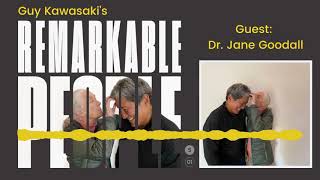
Jane Goodall talks about her path from secretary to primatologist, discovering that chimpanzees use tools, and founding Roots & Shoots in 1991 to tackle climate change and education. She discusses how Louis Leakey shaped her career and what legacy she wants to leave.
Questions this video answers
1991
About 60 countries
David (nicknamed "Graybeard")
London
Chapters
Foreign.
This is Guy Kawasaki. Welcome to Remarkable People. You are listening to the inaugural episode. Believe it or not, I've never been on this side of an interview. I love the concept of go big or go home. So I wanted to unveil my podcast with a truly remarkable person who could be better than Jane Goodall? Duh. That was Goodall doing her chimp impersonation. Goodall is a scientist, conservationist, peacemaker, and educator. She wrote the book on chimpanzees and the relationship with humans. She's redefined our understanding of animals for the past 60 years. I met her because Ronit Widman Levy, the producer of the Terex Salon in Palo Alto, asked me to interview her on stage in September 2008. Being asked to speak at a TEDx event is an honor. To interview Jane goodall at a TEDx event is life altering. I love Jane Goodall. I love her wit. I love her passion. I love her love of our blue marble. I love her spirit. I love her fearlessness. I love her energy. I love that she skipped a bachelor's degree and skipped a master's degree and.
Went straight for a PhD.
I love that my kids think I'm cool because I know her. Can I tell you how I really feel? In this podcast, she explains the of her mother of education, secretarial skills, and why the earth would be better without humans. Have you wondered what animal Goodall would like to be in her next life? Keep listening and you'll find out. I'm Guy Kawasaki. This is the Remarkable People podcast. And now here's Jane Goodall.
I was born in London and then for some reason, my father wanted me and my sister to grow up speaking French. I don't know why. So he rented a house in Le Touquet and I was five and she was one. Three months after we got there, the war broke out. So that was the end of learning French. I didn't learn anything. Then went to my mother's mother, my grandmother, in Bournemouth. That's where I grew up. That's where I used to roam on the cliffs with my dog. And that's where I watched the birds and the squirrels read Dr. Dolittle and was. I wished I could have a parrot to teach me animal language. And I pretended. When I was eight, I pretended to all my friends that I could understand. I interpreted the dogs barking and the cats meowing and the birds singing. They believed me. And then When I was 10, I used to save up my few pennies of pocket money. We had very little money. My father had joined up as soon as the war be. And I saved up these few pennies and I found a secondhand bookshop because we didn't have TV back then. There was radio, but no tv. And I don't think the radio talked about animals at all. I'm sure it didn't. It was building up for war and that, you know. So in this little bookshop I found a small volume called Tarzan of the Apes. Just had enough money for it, read it from COVID to cover, fell passionately in love with the Lord of the Jungle, and was really peeved when he married the wrong Jane. So, you know, I knew that there wasn't a Tarzan. But that's when my dream began. I would grow up, go to Africa, live with wild animals and write books about them. So everybody laughed at me. How would I do that? There was a war on, Africa was far away. We didn't have any money and I was just a girl. Only my mother said, if you really want something like this, you'll have to work really hard, take advantage of opportunity, but don't give up. And I've taken that message all around the world, particularly to young people in disadvantaged communities. And I wish Mum was alive to know how many people have come up to me and said, jane, I want to thank you because you taught me that, because you did it, I can do it too.
Growing up in World War II, what.
Was that effect upon you?
I think it had a very major effect and I think, you know, it was horrible and people we knew were being killed. But at the same time, it taught me not to take anything for granted. Food was rationed, clothes were rationed, everything was rationed. So you didn't waste, you made use of every scrap of food. And we didn't have much money either. So today, young people take things for granted. They take it as a right that they have this, that and the other. It's not their fault. And yet how shocking to think that even in the wealthiest countries there are people living below the poverty line. So, you know, there's something really wrong with us.
You haven't mentioned formal education. How far did you go?
I was always. Did well at school, came up very close to the top and I was still going out. I went to a riding school and because I volunteered to clean the harness, they let me ride the horses and I worked on the farm. But even so, I came second or third in the exams and I should have gone to college, my friends all did, but we couldn't afford it. And back then you couldn't get a scholarship unless you were good in a foreign language that wasn't. And so it was just enough money for a secretarial course. Really boring shorthand typing, the old fashioned typewriter where you had to bang down bookkeeping. All of which I detested. But I got my diploma and got a job in London. And then the opportunity came when a school friend wrote and asked me if I'd go for a holiday to Kenya where her parents had moved and had a farm. And of course I couldn't save money with my job in London. So I went home and I worked as a waitress. It's very hard work. And took about six months to save up enough for a return fare to Africa. Back then, no planes going back and forth. I think there were a few, but they were really expensive, so I went by boat. And so the first place I set foot on Africa soil was Cape Town, which I loved until I asked the friends my mother had there. What does this writing mean in Afrikaans? White people only. And then I wasn't brought up that way. My grandfather was an amazing congregational minister. And we didn't judge people by their language, the color of their skin, their culture, their religion, but as human beings. So I was glad when we left Cape Town. And Kenya was much better. It was just on the very, very brink of independence from British colonial rule.
Now, fast forward for me. Well, it's not too much fast forwarding. Richard Leakey. How did you get that job?
It was actually not Richard Leakey. Richard Leakey's father, Louis Leakey, a famous paleontologist, anthropologist. And he was curator of the Natural History Museum at that time. So I stayed with my friend a little while. And then somebody said, if you're interested in animals, you should meet Louis Leakey. So I made an appointment to see him. He took me all around. He asked me millions of questions about all the specimens. And because I've read every single thing I could find about Africa and animals and spent hours in the Natural History Museum in London, I think he was impressed by how much I knew. And guess what? Two days before I met Lewis, his secretary had suddenly quit. He needed a secretary. That boring old secretarial course. There I was, paid off.
It paid off.
You see, you never know. You never know. And life offers you these opportunities. At any rate, he took me on as his secretary. Now I'm in a world where people can answer all the questions about mammals, the birds, the reptiles, amphibians, insects, plants. And that resulted in him allowing me to go with himself, his wife, one other young English girl and I think about six of the Kenyans. Every year he used to go for three months to Oldubai Gorge, which is in the middle of the Serengeti plains, searching for the fossilized remains of the early humans that he was sure he would find, even though nobody believed him except his wife. And it turned out they were right. But when I went, they hadn't found any human remains. We were there for three months. I think we saw four Maasai Morani in total. And it was just the Africa of my dreams. There were animals everywhere, all, you know, the still animals on the Serengeti, but back then, goodness, we used to see giraffe and antelopes. And one evening we met a rhino, Gillian and I, we were allowed out just walking. And one evening it was a young male lion, he was about 2 years old, fully grown, followed us for, well, I don't know, about probably close to 10 minutes. And it was a bit scary, but it was exciting. This was Africa. And I think it was that evening around the campfire that Leakey decided I was the person he'd been looking for to go and live with and learn from. Not just any animal, but the one most like us.
From the outside looking in, you would say, well, so she didn't have a college degree, much less a master's or PhD. And you know, every, every parent today is trying to push their kid to get all that formal education, to get all that. So is it luck? Is it serendipity? Was it your passion? I mean, all of the above?
I don't know. I sometimes feel it was a path laid out for me. I really don't know. But it was partly my mother, you know, encouraging me and not preventing me because to allow a 23 year old girl back then, we were very naive. It was more like a 16 year old. Today she let me go on my own on this boat and, you know, I'd just been preparing myself for this all my life. Doesn't mean that I just sat and learned about animals. You know, I had terrific fun, I went to parties, I flirted and did the sort of things you would expect. But what I really wanted was to be out in a forest. And that happened.
Can we fast forward a little more.
And talk about how did you get the chimpanzees to trust you? What did you learn about trust?
I needed infinite patience because they ran away as soon as they saw me. And it wasn't until about the fourth month of the study that one of them began to lose his fear. I Called him David Graybeard. He had a beautiful white beard. And I saw David one day and he was breaking off grass stems to use as tools to fish for termites, breaking off leafy twigs, and to make them into tools, he had to strip the leaves. And so he was using and making tools, which at that time science thought was unique to the human man, the toolmaker. So that was the turning point. That was when the Geographic agreed to continue funding. At first it was only money for six months from an American philanthropist.
And didn't all the biologists of the day say that that's just wrong? Well, on two levels. One is she shouldn't be befriending her subjects, and secondly, chimps don't use tools.
Yeah, There was a lot of disbelief. That's why when Hugo came and chimps began to lose their fear, people, you know when I describe kissing, embracing, holding hands, patting on the back, swaggering, using rocks as weapons, different kinds of objects as tools, and when Hugo began filming this, as the chimps began to lose their fear, then the scientists were sort of forced to believe. But after two years, Leakey made me go to Cambridge University. He said I would need a degree and there was no time for an undergraduate degree, so he got me a position in Cambridge University in England to do a PhD in ethology. I didn't even know what ethology meant. No Googling back then, no Internet. So you can imagine how I felt when I got there. And many of the scientists told me I'd done everything wrong. I shouldn't have given the chimpanzees names, they should have been numbered. I couldn't talk about their personalities, their intellect or their minds, because those were unique to us, particularly the emotions. Attributing human behavior to non human animals was an ethological sin and it was anthropomorphism. But fortunately, I'd been taught by my dog when I was a child that the professors were wrong. Of course, we're not the only beings with personality, mind and image. And so thanks to the chimpanzees and this gradually unfolding information about their biological and behavioral similarities, science was forced to move out of that narrow reductionist way of thinking. And then once you break down the line between us and them, then the chimp's going to look back and say, what about all the others? So now we know. Now there's this huge excitement studying animal intellect and not just chimpanzees and other primates and elephants and dolphins, but the behavior that birds are capable of. Crows and ravens and parrots and probably many, many more. They can make tools, they can work out problems. And then on top of that you've got this extraordinary intelligent behavior in octopuses and, you know, they don't even have a sort of brain that we would recognize.
When you see what man has done, do you now think the world would be better off without men?
Oh, I think infinitely better off without men.
Not humankind or the male species?
No, both. Both, yeah. Well, you know, the women have been overpopulating the world with considerable help from the men, of course. No, you know, the problems that face us today, caused by us, you know, first of all how we're destroying nature with the pollution and the fossil fuel emissions and the cruel raising of animals in factory farms, clearing the land to grow the grain to feed them, using masses of fossil fuel to get grain to the animals to the abattoir, meat to the table water that we use to change vegetable to animal protein. And then during their digestion they produce methane gas. Well, we do too. And that's a very virulent, so called greenhouse gas. The main one is CO2, of course, this is creating this blanket of gas around the planet, trapping the heat of the sun. Now we have the climate crisis which is so real and was predicted by the scientists years and years and years ago, but nobody paid any attention. Now people have woken up finally, some people have, well, there are people, yes, who say, I mean even Donald Trump now says, yeah, there is climate change, but it's nothing to do with us and it's all reversible.
Let's not go down that path with Donald Trump.
I finished with him in one.
You mean he's off the radar? You're just ignoring him from now on?
No, I just, you know, if it wasn't so terrifying, it would be funny how somebody like that can be head of the most powerful nation in the world is beyond belief. And the uk, look at the mess there with Brexit. And we have, we have Boris and all around the world there's this swing to the far right and environmental regulations are being tipped over in, you know, for short term gain. And what about our children's children? What's the world going to be like for them?
So when you had your son, you paused your career?
Well, actually I didn't stop my career. My son Hugo, who got to be known as Grub, who was originally Grublin and silly reason, but anyway he got known as Grubbing. So I was still at Gombe and I spent the morning with the Chimps and the students had a research station by then. When he reached the age of six, up until then he was homeschooled in Gombe and having the most amazing life. But then he went home to live with my mother, so it was like having an extended family. He went to a little school in the UK and he spent every holiday with me. He visited his father as well. We were divorced by then and so I never gave up my career. But at the same time, one thing I've learned from the chimpanzees is there's good mothers and bad mothers. And the most important thing for an infant chimpanzee, which I believe is important for a human infant as well, is for the first two or three years to be surrounded by a group of people the child can trust.
Are you saying that those people don't have to be the biological parents?
I am. I don't think it actually matters if it's a biological parent or not, as long as there is that the child feels safe, supported. And we found, looking back over now, 60 years of research on the chimps, that the supportive mothers tend to raise offspring who do better. They're more self assured, the males reach a higher position in that male hierarchy and probably sire more infants and the females are better mothers.
Okay, now let's switch to the last big topic, which is activism. Act three in Jane's life, I think. So first of all, do you believe we're beyond the point of no return?
I definitely think we have a window of time, but it's closing. We are getting towards the tipping point. You know, I think that the thing that gives me the most hope is the young people. So for the last 10 years, gradually environmental education has crept to the school system and they've begun to understand about things like climate change and pollution and how we're growing food. Really sprinkling poison onto the land is not a good idea. So it's on the food. It's also killing the soil with our artificial fertilizers, pesticides, herbicides and so on. And you know, the sea, the forests, two great lungs of the world, destroying the forest, burning them, CO2 being released back into the atmosphere. The seas are polluted. It can't in many places absorb CO2 as it should. And so children are learning about this and once we help them to become educated and then we listen to them and we empower them to take action. You know, I started our Roots and Shoots program back in 1991. Main message, every individual makes a difference every single day. And unless we're really poor. We can choose what sort of difference we make. What we buy, what we eat, what we wear, did it harm the environment and so on. And every group is choosing for itself. Every group of Roots and Shoots projects help people, one to help animals, one to help the environment. So it began with 12 high school students in Tanzania. It's now in 60 countries. And they are learning that it doesn't matter what color your skin is or what your culture is, your language, your religion. If you fall and bleed, the blood is the same. If you weep, your tears are the same. And when something strikes you as funny, there may be cultural differences in sense of humor, but the feeling of the laughing, which does us such good. And so roots and shoots us becoming this family. And everywhere I go now, there's young people wanting to tell Dr. J what they've been doing to make this a better world. And, you know, that's the hope. They're out on the streets. They're marching now. They're making their voices heard.
Do you look at the rise of.
Greta as like, yeah, well, Greta's risen because of social media, without question. She went viral with her one speech. And, you know, our Roots and Shoots young people have been Gretas for years. Didn't go viral. They didn't have the great idea of children taking a day off school, which I would have loved to do. But yes, I mean, you know, providing those marching children then can roll up their sleeves and actually do something. Because even though we are stealing our children's future, I still don't think it's okay for a child to go up to somebody in the government and say, you're doing everything wrong. Look, I'm doing my bit. I'm planting trees. I'm collecting trash. I'm putting notices up to say, don't throw your plastic down. Then you can go up and point a finger and say, what you're doing is wrong because you're doing something to help.
You touched on this already. So what can an ordinary person do?
Well, I think we all have these little choices to make. And if we start making ethical choices, I mean, one thing is to eat less or preferably no meat. That makes a huge difference. And I just learned yesterday that in Europe in the last. I think it's six months, there's been a 20% drop in the buying of meat, which is incredible. That's why I say, I think we've got a window of time, because change is out there. I see it. I've been traveling around this world since 1986. And there's a big change, a big change in understanding. And also people are beginning to feel we need to take action now. Sam.
Do you have any Jane Goodall.
Tips for how do you get people to act? How do you get people to believe?
Tell stories, stories of whatever. Supposing you're wanting to talk about climate change? I tell people how I've stood in Greenland with Inuit elders who said even in summer the ice never melted here. This great ice cliff, this was late winter and already, you know, icebergs were crashing into the ocean. Water was pouring down that ice cliff. I've met people who've had to leave their island homes because of the rise in sea levels, meaning it was not practical to live there even in high tide, let alone storms. I've seen the results of some of these terrible, terrible droughts with animals lying dead. I've seen the terrible damage inflicted by the hurricanes and the typhoons and the flooding. And, you know, so I've seen it, you feel it, you know it. And I know the planet is heating up, but I think if we all get together in time, we can at least start to heal some of the harm and slow down climate change.
What comes to mind when you think about the legacy you want to leave?
Well, I want the legacy to be young people all around the world fighting, doing their bit, you know, a different kind of mindset, so that we elect politicians who will resist doing something for short term gain, not give permission for yet another shopping mall, not give permission for yet another great highway, not give permission to probably go against existing legislation so that you can go and make a mine or logging in an old growth forest. We need that kind of politician. We need businesses that are ethical. And, you know, the thing is this intellect which makes us more different than anything else from other animals, chimps and everybody, they're way more intelligent than we used to think. But we sent a rocket up to Mars and a robot's been taking photos. We don't want to go and live there. And that was supposed to be at one time the most hopeful planet to take over. So we've just got this one, Mother Earth. How bizarre that the most intellectual creature that's ever walked the planet is destroying its own home. And there seems to have been a disconnect between clever brain, human heart, and we're making decisions based on how does it help now, short term gain, rather than what's this going to do to the future of the planet, the future of our own species.
My last question, if you could pick what animal you'd be in your next life, what animal would it be?
Well, I sometimes think I'd like to be a dog in a really good home, but a really good home because my favorite animal is a dog. But of course, some dogs have the most terrible, terrible life. And if I'm in a wild animal, it's going to depend on the level of protection that I would have because so many wild animals are losing their habitat. So. Well, if all things were equal, I'd probably like to be an elephant. I think elephants are absolutely amazing. Chimpanzees are so like us that I think of them not as animals. And there's nice ones and nasty ones, just like people.
If you want to help Goodall protect and save our wildlife, go to janegoodall.org Special thanks to Neil, Driving Miss Daisy Pearlberg, Dan Dupont and Carmen Mullins. In the next episode, we go from learning how much chimpanzees are like humans to how we are influenced by social psychology, situational roles, and bad people. With Dr. Phil Zimbardo. I'm Guy Kawasaki, and this was the Remarkable People podcast.
More from Guy


Cheryl Strauss Einhorn | The Human Edge: Smarter Decisions in the Age of AI | Talks at Google



Rachel Glennerster | Innovation and the Center for Global Development | Talks at Google

Rebecca Winthrop | Rethinking the Purpose of Education in the Age of AI | Talks at Google

Dr. Robert Wachter | A Giant Leap: How AI Is Transforming Healthcare... | Talks at Google



