Guy Kawasaki's Remarkable People Live Show
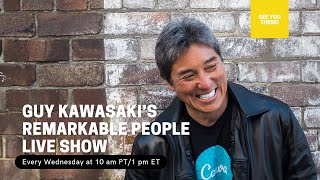
Guy Kawasaki hosts the first live edition of his Remarkable People Podcast show (around the podcast's one-year anniversary), explaining how much work goes into producing each episode (research, interviews, editing, sound design, social promotion — roughly 15–16 hours per episode). He previews the week's guest, Shelley Archambeau (author of Unapologetically Ambitious), and summarizes her emphasis on career planning, ambition, and overcoming imposter syndrome. Kawasaki also recaps recent guests (epidemiologist Ann Ramoine and Tim Kendall) and answers audience questions about vaccination, COVID's effects on entrepreneurship and education, and podcast/video production tech (Streamyard, Descript, Squadcast, Zoom H6, ATEM Mini, Sony A6100). He gives practical advice on setting up a low-cost, higher-quality audio/video studio (~$1,250–$1,500) and previews a special episode on vaccination psychology featuring multiple behavior scientists.
Chapters
Foreign. Good morning or good afternoon or good evening, depending where you are in the world. My name is Guy Kawasaki. I am the chief evangelist of Canva, and I am also the creator of the Remarkable People Podcast. And this is the Remarkable People Podcast live program. And this is the first one. This is the first episode of a live program for the Remarkable People Podcast. And it is happening just about on our one year anniversary. So in the first week of December a year ago, we had our first episode and we thought we'd start slow, you know, gradually introduce high quality guests and get better and better as we go along. So we started with Jane Goodall, which obviously I'm being facetious because could you think of a better guest than Jane Goodall to start your podcast with? So, yeah, Jane Goodall was our first guest and we've had about 52 more after that. And I have to say that podcasting has pretty much taken over my life. I thought it'd be really simple. You get on, you record some audio, and then magically the audio is ready. And let me tell you what the real process is like. So for any given guest, many of them have books, so you have to read one or two books. Then you have to do all the research about them. You have to watch their YouTube videos. There's probably three or four hours of research for every guest. Then you have to formulate the questions. It really takes another hour. So now we're at five hours. And then you do the interview, that's six hours. And then I take the first pass at the raw audio using a product called Descript. That's probably two hours. So now we're at eight hours. And then Jeff C. The sound design God who's behind the Remarkable People podcast, he probably spends four or five hours. So now we're at 10 or 12 hours. And finally we have a finished audio. And then Pig Fitzpatrick, social media goddess that she is, she kicks in and she probably spends another four or five hours marketing the podcast and, you know, getting it ready and all the blog posts and all that stuff. So all in, it's probably 15 or 16 hours per podcast. So trust me, it's not as simple as turning on a recorder. So, but I. I have to. I have to tell you, I love podcasting. I was freaking born to do podcasting. I love interviewing people. I love learning about what makes them remarkable, and I love thinking that I can bring out some of their knowledge to help you become remarkable. And so podcasting has taken over my life. I've redone a room in my House to accommodate it during the pandemic. And, oh, God, I spent. I spent so much time podcasting and. And luckily, about three or four months ago, we found a great, great sponsor, the Remarkable Tablet. What a concept. So, you know, if you think that the Remarkable Podcast and the Remarkable Tablet was a coordinated effort to use the word remarkable, let me burst your bubble. That was pure dog luck. So at the start of this podcast, I thought of calling it Wise Guy, because I have a book called Wise Guy. But then I thought if I call the podcast Wise Guy, then most people are going to assume that it's about me and my wisdom, which it's not. And if you listen to my podcast, it's 95% the guests, 5% me. So there went Wise Guy. And, you know, we just kept talking to people and this is, yeah, you know, I want to have Remarkable People on it, and so why not get Remarkable People Podcast? And then I found out that remarkable people.com was for sale. So I bought it for. Correct me if I'm wrong, Peggy, but I think I bought it for about a thousand bucks. So for a thousand bucks, I got a remarkablepeople.com. bada bing, bada bang. I'm in business. So that's the. The past. So now it's. It's a podcast and a live weekly Wednesday 10am Pacific Radio show in which I'll discuss the previous or the current guests, because we release a new episode every Wednesday morning. And so I'll discuss the current guests and some of the recent guests, and I'll look for comments. You know, operators are standing by looking for great comments and questions that I can address. Okay, so first of all, you know, we love to see where you're from. So in the comments, send us a hello and where you're from. And believe it or not, we're live right now on Facebook, LinkedIn and Twitter Periscope. So lots of comments can come in. And you know what's really interesting is we're on a platform called Streamyard. So little plug for our buddies at Streamyard, and it enables me to broadcast live on three platforms at once, and to see comments from three platforms at once, and that just makes my head explode. Because in the old days, you'd have to do one show here, one show here, and one show here. And now I can do all three at once. So that is just phenomenal. So if you want to know about the tech of this radio show, it's Streamyard. And if you want to know tech of my podcast, we take the audio Recordings. We run it through Descript. That gives us a textual transcript. I edit the text in the transcript and that edits the audio. Wrap your mind around that. Most of the audio is recorded using squadcast. And what that does is it creates a local audio file on both ends, rather than trying to just keep it live in the cloud. So it records locally on both ends, then it syncs those local files to the cloud, and I download it from the cloud. This means that it's not subject to compression and it's not subject to the vagaries of Internet access. So that's basically the technology. Now with all that background, let me tell you about this week's guest. So this week's guest is a woman named Shelley Archambeau. And she is a Silicon Valley kind of a mover and a shaker and a big hitter. I, I joke with her and tell her that she's the second most famous graduate of Wharton. And that's a joke, actually, because guess who I'm referring to as the first most famous graduate of Wharton? Not somebody you want to emulate. So anyway, she is a woman with a plan. And from a very young age, she had a very specific plan. She wanted to be CEO of a company. And it was, I don't know, I probably decided that in her preschool. But she was a woman with a plan. She worked for IBM while in high school and then left after she graduated. Excuse me. She worked for IBM when she was in college, and then after she graduated, she went to work for IBM in sales. And even that was a plan because she noticed that the people who are CEOs in life, the people who are, you know, the boss, many of them come from sales. So you either come from sales or engineering. She wasn't an engineer, so she went into sales and she did well at IBM. She, she became president of Blockbuster, the video company, the video sharing or video rental company, CEO of Loud, CMO of loudcloud, CEO of Zaplet, and CEO of Metric Stream. Today, she's on the board of Nordstrom and Verizon. Little side note there. So if you're a Verizon enterprise account like me, let me just say that making an Apple Watch work with a Verizon enterprise account is a significant challenge. And so knowing that she's on the board of Verizon, I asked her for help. And she then asked Verizon for help. And let's just say the waters parted when someone on the board of directors asked for help. And so that's why my Apple Watch works with Verizon. So it's good to be guy when you can interview people like that. So her book is all about career planning, about busting through the glass ceiling, about kicking ass and taking names, about understanding that life is not fair. But that doesn't mean you can't succeed. And it's also about the imposter syndrome. So the imposter syndrome is the thought that, you know, you have self doubt in the sense that, you know, Verizon asks you to be on the board of directors, or Nordstrom asked you to be on the board of directors and you're thinking, oh, the other directors, you know, they're experienced, they're famous, they're rich, they really know what they're doing. They should I be a director? Why am I here? Why am I invented, invited? And so the imposter syndrome is like self doubt that you think you're an imposter, you don't deserve to be where you are. And she addresses that and she basically, she says, just freaking bust through the imposter syndrome. Because quite frankly, my experience anyway is that most people are not sure why they are there. And so you are not alone. Everybody's wondering, well, how the hell am I qualified? Arguably, arguably I would make the case that if you are certain that you deserve where you are and you have mastered the universe and all that, I would say that you're probably delusional. So you are the dangerous case when you don't have any, you know, traces of imposter syndrome doubt. So the point is, most intelligent people who have a realistic appraisal of themselves and a realistic interpretation of world are going to have some imposter syndrome. But you need to just bust through that. The second topic that she addresses in great deal is in great detail is about why ambition is such a great thing. So a lot of people think that ambition is wrong. It leads to, I don't know, perversions, it leads to megalomania, it leads to trampling over people. But she focuses on the positive side of ambition. That ambition is good. It drives you to do great things, it drives you to work hard, it drives you to plan. And that's a very valuable lesson. Ambition. You should want a company full of ambitious people who want to, in the words of Steve Jobs, dent the universe. That's a high quality problem compared to people who are not ambitious and who are just trying to maintain the status quo. That's not ideal for a company. So you know, it's all about, and this, if you want to know more about ambition and Shelly Archambeau. She's written a book called Unapologetically Ambitious. Take risks, break barriers, and create success on your own terms. And I want to tell you one more story about Shelly Archimbo. So she, she, she is such a great planner that believe it or not, when she was buying a winter coat in her, I think 18 or 19 or 20 years old, she purposely bought a coat that would work when she was pregnant. So this is a woman with a plan. And she knew that she wanted to have kids early. She was not exactly wealthy yet, so she planned and bought a coat that would work when she was pregnant, four or five years before she got pregnant. So that was kind of a remarkable story for me. So, yeah. So that's today's guest, Shelly Archambeau, very inspiring woman about basically kicking ass as a woman. And last week's guest, also a kick ass woman. Her name is Ann Ramoine. She is an epidemiologist at the University of California at Los Angeles, their School of Public Health. And she basically explains how vaccines and epidemiology and virus works. She did a lot of groundwork in Africa fighting the Ebola virus. And she talks about what it's going to take to defeat this pandemic. She had a great line in the interview where basically she said, listen, if, if you don't zoom at Thanksgiving, you're going to be in the ICU for Christmas. And obviously it's past Thanksgiving. But we're seeing that she was right, that, you know, people who got together for Thanksgiving are now getting sick and dying in record numbers. So she has a cautionary tale and she's saying basically, don't blow it again for Christmas and New Year's. Don't congregate, don't get together. Just, you know, plan for a great Christmas 2021 by sacrificing Christmas 2020 because you may not make it to Christmas 2021 if you don't stay away from each other in Christmas 2020. So Ann Ramoine is a great, great story. So two kick ass women in a row. And I tell you, my mental faculties are not what it was. I think I had. Let me just look at something here. So who was before Ann Ramoine? So before Ann Ramoine, it was Tim Kendall. Tim Kendall used to be president of Pinterest. Tim Kendall is the guy who figured out how to monetize Facebook. That's a debatable accomplishment. So Tim Kendall worked for me as a intern and then he went on to Pinterest and Facebook. So he he and he was one of the stars of the movie the Social Dilemma. So you if you want to know insights about social media. Tim Kendall, 2 weeks ago so, Peg Fitzpatrick, question for viewers. Have you ever dealt with imposter syndrome? Huh. Well, there have been instances where I thought, you know, why am I so lucky? So, well, here's the thing. You know, it's not like I have had it is such glorious rewards. It's not like some Fortune 500 company has asked me to be on their board. So I haven't been in a position where I needed to doubt myself because I was never honored in such a way. How's that? That sounds a little ass backwards. Now. I am now 66. So I will tell you that at 66 the greater danger is not imposter syndrome, it's delusions of grandeur syndrome. So I cannot tell you if a company asked me to be on their board or you know, do something like that, that I would think I'm an imposter probably. I would think that it, I more than deserve this. So, so as you get older, impostor syndrome goes down and delusion goes up. So I'm on the delusion curve right now. Let's see any other questions here? Really concerned about side effects of vaccine on elderly parents? 94 and 88. You know, I hear you, but I have interviewed an Ramoine, also Vivek Murthy, who is to be the next surgeon general and he was Obama's surgeon general. And also Jerome Kim who runs the International Vaccine Institute in South Korea. So compared to your other random podcaster, I know a lot about vaccines and, and you know, these tests where they do 30,000 people, 15,000 people get a placebo and 15,000 people get the real thing. It's a pretty serious test. It's certainly, you know, not like Rudy Giuliani said, take Clorox. I mean, frankly, I wouldn't do anything Rudy Giuliani suggests. I would do the opposite. So now you could make the case that we don't know about the long term effects of these vaccines because quite frankly, they haven't been around that long. So, you know, yes, you could make the case that there are long term effects of the vaccine, but you could also make the case that if you don't get vaccinated and you die, then what's it matter about the long term effects? So I guess my test, I'm 66 years old, so I'm, you know, I'm not, I'm not a medical essential worker. I'm not in a nursing home, thank God. I don't have any of the mitigating circumstances that make me more likely, you know, I don't have cancer or, I don't know, whatever the. You know, there's a lot of things that typically truly healthy people, even if they're old, don't die from it. But if you have other. I forget what the word is. If you have other symptoms and other diseases going on, it makes you much more likely to die. Knock on wood. I don't have that. So I'm not in the top tier, but I'm in the third or fourth tier. So, you know, would I get vaccinated? Absolutely. I would not hesitate to get vaccinated, and especially when Joe Biden is president and Vivek Murthy is Surgeon general and Tony Fauci is the medical advisor. So if Joe Biden, Vivek Murthy, and Tony Fauci says get vaccinated, I'm rolling up my sleeves, baby. I'm ready to rock and roll. That I will. I do that all day long. So, yeah, let's see. You gotta. For everyone to answer, what do you think ambition. Do you think ambition carries a negative connotation? Pig fits back. It's actually a good question, you know, that this one of those kind of words that depending on who says it, it could be good or bad. So when Shelley Archambault says you need to have ambition to succeed is good. I mean, I would not be here if I didn't have ambitions. I would still be in Honolulu and I would be, I don't know. Seriously, I. I left Honolulu when I was 18, never to return again for any significant time period. And it was because of ambition that I did not want to just live in Hawaii and work in tourism or work in retail or, you know, work for the government. I wanted to, you know, go to the mainland and create a large company. So it was ambition that drove me off the island. And had I not had that ambition, I'm not saying I would not be happy in Hawaii, but that would be a very, very different career path. I'm not sure what I would be were it not for my ambition, so. Absolutely. So let's see. Danilo, based on your perspective, what's going to be the future of entrepreneurship after Covid? So, you know, there's many, many bad things about COVID at the extreme death. But there's suffering, there's unemployment, there's closures of businesses, etc. Etc. So all of that is true. But I also think that we're going to look back and we're going to say, wow, you know, the coronavirus really caused us to innovate, caused us to jump to the next curve, caused us to learn new things, to make online education better, to make online communication better, to. I think that it, it has flattened the world even more. Because if you think about it, pre pandemic in high tech entrepreneurship, there was a considerable advantage to living in Silicon Valley, you know, because then you could just go to Bucks and meet with venture capitalists, you could go to Bucks and bump into venture capitalists, you could go to networking events and, you know, you could shuck and jive with Elon Musk and all this kind of stuff. Well, guess what? In a pandemic, you can't do any of that. So the advantage of living in Silicon Valley being one hour from Sandhill Road is gone. That's the bad news. Well, if you live in Silicon Valley, that's the bad, bad news. The good news is now where everybody is a little window in zoom. It doesn't matter if you are zooming from Menlo park or from Munich or Buenos Aires or, you know, Texas, it really doesn't matter where you are. So you could make the case that the coronavirus has flattened venture capital, raising and pitching, and even customer acquisition. Because before the customer, you could meet face to face. There's an advantage to that. But now, where no one's meeting face to face kind of levels the playing field where, you know, where a company could not afford maybe a remote salesforce. Now nobody has a remote salesforce. Everybody has a virtual salesforce. So it kind of leveled the ground. I'll give you a great story about Hawaii. So Hawaii wants more tech business, right? They, they don't want to be dependent on pineapple, sugarcane, and tourists. Well, duh. Especially in a pandemic, you know, if you're dependent on the tourist business, you suck rocks. So they want more tech. And so right now they're, they're doing this thing where if you come to work in Hawaii remotely, they pay your airfare, and I think they're even like helping you with housing. So, you know, wrap your mind around that. The state of Hawaii will pay to come to Hawaii to work remotely for Google, and they'll reduce your expenses. Now, in the old days, someone in Hawaii might complain, will say, well, you know, why are you spending money to bring workers to Hawaii? You're displacing Hawaii residents. But guess what? If Hawaii encourages tech workers from Google and Facebook and ebay to come work in Hawaii. Those people are not displacing jobs in Hawaii because they're doing jobs that they had in Silicon Valley. But the people who work for those companies who are now living in Hawaii, their salaries are going to them and they're spending money in Hawaii. So Hawaii is not losing any jobs for its residents, but it's gaining income from those people who are paying rent and eating and doing all kinds of stuff in Hawaii. So it's good for Hawaii. So, you know, wrap your mind around that. That's a change in entrepreneurship. So I can't tell you that I believe it's a good thing for entrepreneurship. But, you know, one of the hallmarks of great entrepreneurship is that you take advantage of what's handed to you. And the coronavirus has, has made the world shrink and flattened it even more because everybody is the same in a zoom window. Any other questions? Let's see here. Do you think exposure to this pandemic has encouraged us to become more mindful of our impact on social media? Not the Republican administration, that's for sure. So I think that I have a unique approach to social media. So I'm like the anti social media social media user. I view my social media as a broadcast mechanism as opposed to an engagement mechanism. So listen, I know, you know, I know all the Gary Vee theories and all the influencer theories about how they want to engage with their audiences and that. And that's just not me. I use social media to push information out. I view my role as a curator rather than a creator. And so I'm trying to disseminate information as opposed to make friends. I have a wife, four children, bunch of surfers here. I got all the friends I can handle. I'm not looking for new friends. I am full up on friends. But I want to disseminate information. I want to empower people. That's what the Remarkable People podcast is about. I want to empower people to be more remarkable. So, I mean, I. I would hope that the pandemic has caused people to be more aware of what they're doing on social media, but it's kind of hard to build that case. You know, social media has brought us together, but it also has enabled people to create conspiracies and create, you know, anti vaccination threads. And to say that Hillary Clinton was running a pedophilia ring out of a pizza parlor, I mean, yeah, I mean, there's. Well, you should listen to the Tim Kendall, Tim Kendall episode where he discusses this kind of thing about social media. So let's see, I gotta scroll down here. So what's your advice for small business starters? In this pandemic, I think what you mean is, you know, what's your advice for people who are starting a small business? And my advice is not that changed from any other time, which is focus on the prototype, focus on shipping, focus on getting stuff out. The purpose of a business, to create customers, not create PowerPoints or Excels or words. And while no Canva, just FYI, Canva has 16 by 9 templates. So that if you're going to create a presentation, use Canva, not PowerPoint anymore. So just remember, the purpose of a small business or any business is to create a customer. And the only way you create a customer is to ship. So ship your prototype. Let's see what else here. Lewis, one of my former boss told me he's always worried about the weekend coder. It is a. Sadly, with the pandemic, I have to say that I'm more free than ever. I've been for use. My pursue my goals instead of following someone else's agenda and smash that imposter syndrome. I do not know if I will succeed, but I am forging ahead. This is a great and invigorating podcast. Thank you, sir. Okay, we'll take unadulterated praise, no problem. So, yeah, thank you very much, Louis. I love that. See, because of COVID how do you see higher education changing with edtech companies adding in AI? So I think that. Oh, my God. That the pandemic is just forcing complete and utter changes into education, online education. We also on the Remarkable People podcast, for those of you interested in online education, is Salman Khan. You can't get better than that. He is truly a remarkable person too. So listen to the Sal Khan interview. So I think that, you know, let's face it, this, this, this coronavirus thing is nine months into it, so we hardly have figured it all out yet, but we are definitely forcing online education. And if there are legitimate heroes in this pandemic, of course there are the frontline medical workers and there are the people who are keeping just things working. But one group of people that should be recognized specifically are teachers. Because what was already a hard job has been made even more difficult. And so, you know, I hope that there's someone somewhere who's saying, you know, zoom just doesn't work that well for teaching. I. Or we are going to create the ultimate online education system for teachers. That would be a good thing. So, yeah, now in the university market, oh my God, man, if I were a university president, I would be quaking in my boots. So. So let's say you're Stanford or Harvard or you know, the Ivy Leagues probably you don't have to worry because you know, some skeptics may say, well, in person, Stanford cost 300,000 bucks for four years. Is it worth getting a remote Stanford education for 300,000 bucks? Honestly, probably yes. Because saying that you graduated from Stanford is a proxy that most people accept to mean that you are smart and you are diligent and you work hard. Unless you had a fake high school transcript where you really weren't on the rowing team or tennis team. But let's assume that you know, you didn't do that, you really deserve to get it to Stanford. So yeah. Is a Stanford online education and degree still worth 300,000 bucks over the course of your career? Yes. Now when you go to the second tier and the third tier. Wow. I mean that's where it gets interesting that is it worth 250000 bucks for a second or third tier degree or the degree is not second or third year. It's it that you attended a second or third tier company? That's a more difficult question. Question. And I think that there's going to be a lot of colleges that are going to be in deep trouble because people just can't put two and two together that, you know, it's, it's not worth a quarter million bucks for a virtual education. So now let's see here. How did you compile the tech for the broad podcast? Through trial and error, through consultant, expert publication. Have it already before you started, Maha, Let me. Okay, so I would say that I will answer this question not just for podcasting, but podcasting and video broadcasting and video recording. Right. So the whole shooting match, it took me a good six months to figure it out. And what you see now, I am in a room that used to be a clothes closet. But then, you know, I didn't want to commute to an office or anything. So I'll get out of the way here so you can see. I'll let the background go into focus. So you see all that black stuff? All that black stuff is acoustic tile. So I took a closed closet. This Closet is roughly 5 by 8. I took all the stuff out and I put black acoustic sound editing tile on almost all the walls. And then I put up that shelf. That shelf over there is pure Hollywood. It's there just to have something interesting behind me that can be out of focus. The bamboo over there. The bamboo over There I bought from OSH, you know, like $8. And I just, I didn't want to have books all the way across. I wanted some vertical stuff to break up the background. And there's a Buddha back there just because, you know, I got this Asian theme. And then I went to. I went to Bed, Bath and Beyond and I bought these LEDs. So these LEDs are battery powered. So I pull out the battery. Okay. So I just think that bokeh or Bokeh, I. E. The blurred background is much more interesting when there's a light on. So you see how those lights are all out of focus. So that was a plan. So I am going to. Now I'm going to post a link that explains all the technology I have going on in this room so that you can copy what I have done easily. Because it took me, I swear to God, a good six months to figure this out. It took me six months to figure this out. Wait, I gotta change it. So this link doesn't allow you to edit it. Hold on here. Okay, so here comes the link. So this link is to a Google Doc that explains what I have going on. But the gist of it is that I have a Sony A6100 that's about a 600 camera. I have a Sony 28 millimeter lens, that's about a 400 lens. I have a. A ring light. I have a Shure XLR mic. I have a GVM light shining at the roof. And let's see, I have an ATM mini which is kind of a mini mixer, and I have a Zoom H6. Now I'm going to take you into the deep end of the pool. Look at that link. But I'll give you the gist of what's happening. So the camera is sending an HDMI video signal to the ATM mini mixer. The microphone is sending audio via XLR to a Zoom H6 portable recorder. The reason why it goes to that is twofold. One is because this microphone is not a USB microphone, it's an XLR microphone. So this microphone requires phantom power. The Zoom provides phantom power. Not Zoom the pod, not Zoom the communication platform. Zoom the hardware device. Okay, different company. Now, the second reason why it's going to zoom is because when I do podcasting, I use Squadcast to record both sides of the conversation. But I want a backup of my side of the conversation. So when I record a podcast, I am recording using squadcast locally my audio, But I'm also recording locally on a Zoom device to an SD card. So at the end of my podcast recording, I have an SD card with my Wave Audio, and I have squadcasts with Wave Audio, so I have two copies. And then taking you even deeper in the deep end of the pool and putting weights around you. The reason why I use an ATM Mini as opposed to going directly to the computer is because I have noticed that audio is often two or three frames in front of video when I record or go live. So here I'll clap my hands. Theoretically, you all saw when my hands hit is when you heard the clap. And that's because I have used the ATM Mini to introduce a 22 frame lag. Because somehow, without introducing lag, audio is in front of video and very few people notice and even fewer people care. But I care. And so the ATM Mini is a way of introducing multiple frame lag to your audio so that syncs up with your video. And I just saw Natomas Boy. Do you have a link for the ATM Mini. You know, Natomas Boy, there's this thing called Google and you type in ATM Mini and you can find it for yourself, brah. Okay, so let's see. So anyway, so that's the totality of what I have going on. Now, let's suppose that you don't care about getting a second sound recording, so all you care about is audio and video going to a computer. Okay, so audio, video going to a computer, well lit, I'll tell you, would cost you about 1250 to $1500. Okay, so my logic here is that in the old days, pre pandemic, what would it cost to make a business trip? Let's assume you fly coach. Let's assume it's San Francisco to, I don't know, Denver, Chicago, maybe New York. So coach shopping. Well, maybe your flight costs 750 bucks. And then you catch a cab both ways to the airport. Now, we're at 850 bucks. That's actually cheap. Let's say we're at 900 bucks. And then you stay there for, let's be conservative, one day, and you stay in a $300 a day hotel. Now, some people are gonna say, oh my God, guy, you know, I stay in mail till 6 for 69 bucks. Well, I'm 66 years old. I don't stay in Motel Sixes for 69 bucks anymore. Anyway, so when you add all that up, you get to 1500 bucks. You gotta pay the parking at SFO where you left your car for 48 hours. Okay, so the whole thing adds up to 1500 bucks for one trip. All right? So I'm telling you, spend 1500 bucks so that every one of your zoom calls, every one of your appearances, every one of your recordings, every one of everything forever looks like this quality. It's the best 1500 bucks you could ever spend. Because I can tell you that in the valley of crappy audio and crappy video coming from your built in laptop camera and microphone, someone who looks and sounds like what I am right now is king or Queen. So for 1500 bucks, man, separate yourself from the rest of the pack. I'm not telling you if your information and your communication sucks, it's going to fix all that. But I'm telling you, I mean, you know, 1500 bucks, you can look like this. I, I can't imagine there could be much better ways to spend 1500 bucks. Now you might say, well, I could just buy a logitech camera. Yeah, for a Logitech camera, you'd get a good HD video. But it will not get bokeh, which people tell me is the right way to pronounce it. I would prefer pronouncing it bokeh, but it's the stuff where the stuff behind me is out of focus because you want the stuff behind you out of focus so that it sets the mood. But it's not so in focus that people are trying to figure out what books you're reading, what books are on your shelf. Right. So it should just like, look at those autofocus lights. It's beautiful. So anyway. Oh my God, we really freaking. Jeff and Peg, they're pulling their hair out. Like, guy, what the hell are you doing? Like, spending half these podcasts about podcasting cameras. You're not talking about remarkable people. So. So if you want a remarkable podcast and remarkable video conferencing, Just click on that link. But if you want remarkable management tips, entrepreneurial tips, life tips, go to remarkable people.com. okay, so let's say, is there any more guys? Been 43 minutes. 43 minutes. Are you going to take the vaccine? Yes, I'm taking the vaccine. When Tony Fauci, Vivek Murthy, or Joe Biden says, take the vaccine, I am there. I'll take that vaccine. I will drive up, roll down my window, stick my arm out and get the shot. No problem. No problem. In fact. Okay, so let's go down another rat hole. So I think that the science, the medicine, that's not the hard part. Because at this point we have two or three candidates with 90, 95% efficacy. So we've kind of figured out the Science. Now, there's some logistics. How do you make billions of doses of vaccine? But that will be figured out, too, I think, when all the dust settles. The hard part of vaccination is not going to be the science of vaccination or the logistics of vaccination. It's going to be convincing people to take the vaccination. It's a psychology, it's a behavior, it's a social media question. How do we convince people to get vaccinated so that we can achieve herd immunity? That's going to be the challenge. And so, believe it or not, I'm working on a podcast special episode, usually Remarkable People. Podcasts are one remarkable person for about an hour. This one is going to have 10 people, and they're all psychologists and behaviorists. None of them are doctors. Okay? And so it's going to be people like Bob Cialdini, father of influence. David Aker, father of branding. Phil Zimbardo, really father of social psychology. There's going to be Jonah Berger, there's going to be Sally Sarenan, there's going to be Scott Galloway, and these are going to be behaviorists and professors of psychology addressing one question, which is, assuming that the logistics are worked out, assuming that the science is worked out, how do we get as many people as possible to get vaccinated? So I'm asking 10 people, 10 psychologists and behaviorists, this question, and I'm going to put it into one episode. So this is going to be the Art of Of Vaccination episode, and that's coming up soon. Okay, so how do you choose which remarkable people to have on your podcast, Catherine? That is a good question. So some of it is obvious, right? I mean, nobody had to tell me that. Jane Goodall is remarkable, Margaret at was remarkable, Christy Yamaguchi is remarkable, Stephen Wolfram is remarkable. Duh. You know, would I like Michelle Obama? Yes. Would I like Barack Obama? Yes. If anybody knows them, tell me how I can get to them. So there are some people who are very obvious like that. But then there are some people who are listeners to my podcast who tell me about people that I have never heard of. And that happens all the time. So, you know, I didn't know who Ann Ramoine was, so it was suggested to me. So I didn't know who Vivek Murthy was. And a friend of mine who listened to my podcast said, hey, you ought to get him. He used to be the Surgeon General for Barack Obama. You should get him. And so I got him. I recorded, and two weeks later, he's heading this coronavirus task force and he's going to be the next Surgeon General. Talk about dog luck. So. So some of it is from suggestions of people that I know. I will tell you the flip side of this, which. Here we go. We're going to offend some people. So I. Every day, I kid you not, every day I get a pitch and I'll just use generic term from Joe Blow or Joe Blow's PR person. And the pitch, I'm, I'm, I got a text message, I'm trying to see if Peg or Jeff were trying to pull me off. So every day I get a pitch that goes something like this, you know, my name is Joe Blow. I am the founder of Joe blow consulting. I'm 26 years old. I have now achieved middle six digit consulting fees. I enjoy your podcasts. I like Jane Goodall, I like Steven Pinker, I like Andrew Yang, I liked Margaret Atwood. And because I'm so familiar with your podcasts, I believe that I would make a valuable contribution as a guest. So I would like to be on your podcast because I am an author of the Blowway, published by Blow Press. I have this consulting practice of six or seven digits. So I believe that I should be on your podcast just like Jane Goodall. Every day I get one of those and I. Oh, my God. And let's say that I have developed a general algorithm. And the general algorithm is if someone asked to be on the Remarkable People podcast, they probably should not be on the Remarkable People podcast podcast. The only exception to that so far has been David Aker. David Aker is a friend of mine and father of branding, and he asked if he could be on it, to which I immediately said yes, But I have turned down just about everybody else. Now, there is one more rich vein, and that rich vein is a book publicist. So when a book publicist from Penguin or St. Martin's Press or, you know, HarperCollins, and then like a not, not, not Joe Blows publicist from below press, but, you know, so a legitimate author, when their publicist says, you know, Scott Galloway is coming up with a new book in two months and would you like a copy of the book to review? So they may not even know about the podcast. Well, if you look up Scott Galloway, see, he's a professor at nyu. See that? He's just a kick ass kind of guy and he has a new book coming out. Kara golden, the founder of Hint, you know, Nancy Gianni, who is the advocate for down syndrome. So when they have A book coming out and you look at that, you say, well, this is for real. This truly is a remarkable person that I never heard of. So that's a rich vein. So that's how I find guests. Now note that the name of this podcast is Remarkable People. Not rich people and not famous people. Rich and fame do not necessarily make you a remarkable people guest, because I'm not after rich and famous people. If, take an extreme example. If a billionaire, private asset, private equity, you know, fund manager says, yeah, I'm worth $2 billion, my fund is 50 billion under management, I deserve to be on Remarkable People, oh, I could care less what you do as a private equity manager. So if Warren Buffett said, I'd like to be a Remarkable People, trust me, he'd be on. But you know, Joe Blow from Blow asset management, over 50 billion under management. I don't think so. So don't get me started. See what else here. Lowell Trump. If Donald Trump called and said, can I be on Remarkable People? The answer is no. Rudy Giuliani. No, I. Well, my definition of remarkable person is a person who has dented the universe. Not necessarily the whole universe, but, you know, Nancy Gianni, good example. So she's dented the universe for. For families with down syndrome. That qualifies. You know, that's remarkable. So, you know, I often ask myself three questions, right? So question number one is, would you want your kids to grow up to be like this person? Well, that eliminates a lot of politicians right there. Okay, so that's number one. Second question is, would you want your son or daughter married to a person like this? And question number three is, you know, do you think you're furthering goodness in the world by bringing this person on? And pretty much the answer has to be yes for all three questions for someone to be unremarkable people. Okay, see, Morris, then all your friends like Zuckerberg and company are disqualified. Mark Zuckerberg is not a friend of mine. I've never met him, so I don't know. Mark Zuckerberg asked to be a Remarkable People, would I take him? Well, he has created a remarkable company. I will cross that bridge when I come to it. But, you know. Yeah, let's see. Man, I think that I have exhausted my remarkableness for 52 minutes. So. So one last plug for remarkable people. This week's guest is Shelly Archimbo, kick ass entrepreneur and activist and ambition evangelists. Last week was Anne Ramoine, epidemiologist. Listen to her episode. It literally could save your life. No, it could literally save your life. And the week before was Tim Kendall, former president of Pinterest Guy who figured out how Facebook should monetize, star of the Social Dilemma, discussing the impact of Social Dilemma. And so I think that that's about it. I'm thank you very much for signing on to the first edition of the Remarkable People live show. And we'll see you next week on Wednesday. Every Wednesday we come out with a new episode. Please tell your friends to listen to Remarkable People. I will tell you something that as I look back over my career, I think that the Remarkable People podcast is the best work that I have ever done. I also tell you I think it's the least appreciated work that I have ever done. So I think you should take it as a challenge to fix that. I'm Guy Kawasaki. This is the Remarkable People Live Show. Thank you very much for being here and all the best. Bye.
More from Guy


Cheryl Strauss Einhorn | The Human Edge: Smarter Decisions in the Age of AI | Talks at Google



Rachel Glennerster | Innovation and the Center for Global Development | Talks at Google

Rebecca Winthrop | Rethinking the Purpose of Education in the Age of AI | Talks at Google

Dr. Robert Wachter | A Giant Leap: How AI Is Transforming Healthcare... | Talks at Google



