How Sacrifice and Innovation Created a Billion Dollar Business
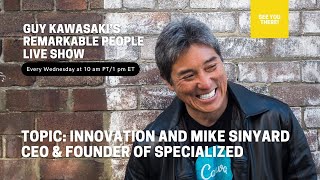
Mike S. founded Specialized Bicycle Components on passion and sacrifice, creating the Stumpjumper mountain bike that changed the industry. The conversation covers how biking helps manage ADHD, why electric bikes like the Como 3/4 matter with their 80-mile range, and what built Specialized into a billion-dollar company.
Chapters
Foreign. Hi, it's Guy Kawasaki. And good. What day is it? Good. Wednesday morning. I should know that because we release a new episode of Remarkable People every Wednesday. So good Wednesday morning. I am in Santa Cruz, California right now in my closet, no pun intended, literally in my closet. See? So the topic and title of today's episode of our live show here is about how passion and sacrifice and innovation created a billion dollar business. And specifically the industry is bicycles. Because this week's guest is Mike Stringart. He is the founder of Specialized. I guess the formal name is Specialized Bicycle Components. And so we are going to talk about that. But, you know, as an icebreaker of a question, when's the last time that you rode a bike? Because I, I have found that I probably use my bike more than my car these days, which is one of the more positive aspects of sheltering in place and the pandemic. So actually, in the interview, Mike Stringard brings up a very good point that, you know, may everybody's thinking that electric cars are the solution, and it may be that the electric bike is more important than the electric car. And that's a very interesting thought because I could see how that could be true for many people. A bike may be more useful than a car. So that'd be interesting. Somebody should tell Elon Musk, although I guess Elon Musk has created an electric bike too. But it's probably, you know, $75,000 and it's autonomous and pretty soon it's going to catch fire. But that's all right. So when was the last time you rode a bike? I. My story with Specialized is that I was in the Macintosh division of Apple and I worked with a woman named Andy Cunningham, and she was on the PR firm side. So she was outside of Apple working for Regis McKenna, the PR firm. And so she was kind of running the Apple account. So she and I became friends. And she listens to remarkable people. And she said, you ought to interview Mike String Yard because he's a remarkable person. Not only did he create this billion dollar business called Specialized, but he also, because of the issues he's faced and his family has faced with adhd, he has now been heavily involved with a foundation to help people with adhd because one of the things he noticed is that strenuous physical activity like biking tends to help you settle down your adhd. So he's worked with Stanford on research about that. So, and, and as soon as she told me that, I, I happened. I love Patagonia. Okay, so there's a Patagonia store on the west side of Santa Cr. So I went to the Patagonia store, and the Patagonia store is heavily, heavily controlled. I mean, they only let a few people in the store at once, and they close for lunch every day. So I happened to go there when it was closed for lunch. And next door is this new store. And this new store is a Specialized Experience center. And it is not a bike store, so you cannot go in there and buy a bike. So Specialized has created this just for people to come in. And the store is like, really beautiful, like Apple store quality. It's kind of got a genius bar. It's a whole thing. So you go in there and you talk to Specialized employees about bikes, and then they let you ride bikes. So it's to experience the Specialized bike. And then they tell you go to Family Cycling center or. Or go to Spokesman, the two, I think, probably leading Specialized bike dealers in Santa Cruz. So they tell you to go buy the bike from an actual dealer, but to experience the bike at the Specialized Experience Center. So I was so impressed with that store. That made me even more enthusiastic about interviewing Mike Stringard. And so that's the story. So, you know, this episode is. Is really about sort of the genesis of a company based on passion, right? So Mike was at San Jose State. He was a passionate bike rider. He sold his VW van to raise money in order to go to Europe to bike around Europe. And he did that. Then. Then he was in Europe, and he decided to try to pitch Cinelli, the Italian bike component manufacturer, about becoming a Chanel dealer in the United States. So he did that, and he started importing Chinelli parts. And one thing led to another, and pretty soon he started making Specialized bikes. And he was particularly a pioneer in mountain biking. So if you go to Smithsonian, you'll actually see the Stump Jumper mountain bike by Specialized in the Smithsonian. So that's how that business started. He was importing parts into a trailer. He was storing the parts under the trailer that he lived in. It's a whole story. And, you know, were it not for him and a handful of other people in Santa Cruz, maybe there won't be. Wouldn't be mountain bikes today. So I love that story. And I'll tell you, there are many stories about people who had a passion for biking and started Specialized, you know, that kind of story. But there's also. I hesitate to tell you too many stories about people pursuing their passions and making a business out of it, because probably for every example of it working out, there's an example of you had a passion but you couldn't make it work out. So I would not say that the old yarn of do what you love and the money will come is necessarily true. But in this case it did come true for Mike's Jr. It doesn't mean it's going to come true for like I love surfing and I really love surfing, but believe me, no money is going to come to me because of surfing. Okay, so it's a very interesting story. So, you know, another interesting question for you to think about is have you ever considered, you know, pursuing a passion to the extent that you could actually make a living doing it? That's a very interesting question. I hope more people do. But it is also not a guarantee for success. The concept that do what you love and the money will come I think is flawed. It's more do what you love and the money might come. So, so let's talk about bikes. And also, you know, if not biking, what's your favorite mode of exercise? So I have to admit that I don't consider biking a form of exercise or my main form of exercise. I think my main form of exercise is surfing. So I surf about twice a day sometimes. That really depends on the tide. So where I live, surfing is best at low tide. And in a perfect world, there's a low tide at dawn and then there's a low tide in the afternoon. So you can surf in the morning, work midday and surf again. But right now that's not true because right now the high tide is in the morning, the low tide is in the. The low tide is not two times a day. It's of course two times a day, but it's not two times a day when it's light. So right now, you know, surfing is really limited to the afternoon hours of maybe, I don't know, 2 to 5:30. And that's why I never have appointments from 2 to 5:30 these days. So anyway, so yeah. What's your favorite form of exercise? Mine is surfing. I hope it's biking. Here, look at the. See we're getting a lot of whole. Oh, okay, so we have walking, we have skiing, something his or her favorite form of exercises. Typing. I love that. So aerobic typing. Yeah. Hook up your Garmin or hook up your Apple. Watch and like let me know how many calories you burned. I think that is funny. Swimming. You know, my, my wife loves to hike and she goes on these 15 mile hikes that, wow, that's 14 miles too far for me. I'm not A big hiker. So. Well, aren't there any surfers? Everybody is a walker, a hiker, a runner. Huh? Let's see. Man swarmer. You have the mother of all last names. Sworna. Sean, You must have a hell of a time making airplane reservations. Wow, that is a mouthful. Wow, let's see. So you know, I want you to check out the interview with Mike about how he turned his passion for bikes into Specialized, the billion dollar company. We've recent guests, we've had Tim Kendall from Pinterest and Facebook about the perils of social media. We had an Roy Ann Roy is an epidemiologist at UCLA and she was discussing the current state of testing and vaccines and social distancing, mask wearing and washing your hands. So if you are really interested in the current status of the pandemic, you would love that. She was a very good guess. So drumming. Jim Armstrong. Drumming. Is this Jim Armstrong from Apple? I must be. Taiko drumming and yoga. Wow. I can see how Taiko drumming could be absolutely aerobic. No kidding. Badminton. Badminton is such a sophisticated sport. It's too sophisticated for me. So. So let's see. Got any questions for me? Send them in because you know, Peg gives me an outline of things to cover and I've covered it. So now we're winging it. So. Oops. Surfing. Yes, it is. Jim Armstrong. Jim Armstrong and I work together at Apple. So Jim was an evangelist. So those are the days. Jim Armstrong has tycho drums. Wow. Jim Armstrong, your hair is even whiter than mine is. Wow. So I think my, my. The, the favorite part of the Mike String yard episode is probably where he discusses how biking helped him and his family deal with ADHD and that how it helps kids deal with adhd. And, and he also, he threw surfing into that category. I mean something about these sports that require total focus. That you know, if you're surfing or biking, it's not like you can just totally zone out because you're moving and it's fast and you can fall. So I think it's part of it is just. It takes total focus on something else. So yeah, yep. My most beloved book on surfing. Oh God, do I have it here? See here, one second. Okay, so here are probably my two favorite books about surfing. So one is. Can you see that? Let's see. Barbarian Days, A surfing Life by William Finnegan. Imagine that. A book about surfing won the Pulitzer Prize. And then this other book is a book called Making Mavericks and it's by Frosty Hessen. So this became a movie and this is about Jay Moriarty, a young surfer getting fathered and coached by Frosty Hessen and becoming a big wave surfer at Mavericks. Frosty lives about three or four blocks from me and as a matter of fact, I saw him yesterday. So those are probably my two favorite books about surfing. So let's see. How do you think about retirement? Do you ever want to retirement and not work for a paycheck? What is your timeline? So that's a complex question. So I am 66 years old. I don't know if I'll ever quote, unquote, retire, because my observation is that once you retire, you sort of physically and mentally just, I don't know, at best plateau, but at worst degrade. And so I, I still have two more tuitions to pay. I have a 19 year old daughter and a 16 year old, so, so I'm not free and clear yet. So I really can't retire. But I, I, I can't imagine a time where all I do is surf or play golf or watch Fox. I mean that just, I love surfing. Don't get me wrong, I surf every day, but could I only do that and like, what would I do with my mind? So that's why, believe it or not, podcast. I was born to podcast. So I've, I've been podcasting for a year now and it has really taken over my life and I really enjoy podcasting. I love the prep for the interview. I love the interview itself. Yesterday I interviewed Julie Cameron. She's the author of the Artist's Way. And so you have to prep for that. So that takes a, two, three hours, then the interview takes an hour, then the editing. I take the first pass at editing, that takes two hours. And then Jeff C. Takes another four or five hours of sound design and editing. And then Peg Fitzpatrick kicks in and probably spends another five hours of figuring out how to package and promote it. So there's probably 15 hours in each hour episode and I'm responsible for only about five of the 15. But then I'm doing, you know, two of those a week. And so it is, it is quite an absorbing thing and it's forced me to learn a lot of subjects. Like, I never knew anything about bicycling before. I didn't know, you know, the Julie Julia Cameron theories of the Daily Diary and you know, the, the kind of mental dates you're supposed to provide yourself, that kind of thing. Certainly I learned about epidemiology and vaccines and social distancing and all the, the science behind defeating a pandemic. Because I interviewed Anne Ramoine and Jerome Kim and Vivek Murthy, who's going to be the next Surgeon General. So I think podcast has kept my. My brain alive, and it is taking over my life. Anyway, so are electric bikes making people lazy? So that is an interesting question. I actually asked Mike that question, right? So, you know, you will encounter peers who say electric bikes make people lazy. It's a cop out. You know, how can you cheat that way? Blah, blah, blah. So that is one way of looking at it. But I'll tell you, and I've asked hardcore bikers about this, so, you know, even the hardcore enthusiast biker, there's always bikers who are better than you. So there are trips where you cannot go because the people you hang out with are more fit, more whatever than you. But now an electric bike enables you to do harder things. So, you know, I say, to each his own. I mean, that would be like saying, well, to use a computing metaphor, is. Is Macintosh cheating? Because it should really be Unix, and I should be working with Terminal, and I should be at the command line, and I should be typing in commands, and Macintosh with its WYSIWYG graphical user interface, you know, blah, blah, blah, mouse. That's cheating. Well, okay, but I mean, you know, if everybody only use Unix, there'd be a lot less people using computers. So I say, hey, makes you happy. Cheat. What the hell? Let's see. Do I own Bitcoin? No, I do not own Bitcoin. I do not own one single Bitcoin. And I have to tell you that the whole cyber currency thing is absolutely a mystery to me because I speculate in many parts of my life. So I am chief evangelist of Canva, and when I cut my Canva deal, I said, I don't want any money. I only want stock options. So that's a little risky, right? And so I have my ass hanging out in a lot of places because of that attitude of I want options, not dollars. And so do I want to have one more risk, which is to bet on the currency with which I'm being paid. So imagine if I said to a client, well, you know, you can pay me. Pick a round number. You can pay me $50,000 to make a speech, or you can give me two bitcoins or three bitcoins. So with $50,000, you get $50,000. With three bitcoins, you might be getting 50,000, you may be getting 150,000, or you may be getting 5,000. And so with what I am being paid I want something extremely stable because I don't want to be gambling not only on my performance, but how I'm being paid. So yes, there's the upside, but yes, there's also a downside. So just, you know, if I want 50 grand, just give me freaking 50 grand. And if I want to go buy bitcoins, I'll do it after the fact. But I, I am not speculating on currency. I, I want a stable currency, not a speculative one. I speculate plenty on other things in my life. So now you're all saying, yeah, you got, you know, you're like, you're a dinosaur. Okay, you want to speculate on currency? Have at it, baby. Let's see. See, Jim Archer. I enjoy biking more on an electric bike. Yeah, so do I. Specialized electric bike. So we have a Como 3 and a Como 4, and the range is about 80 miles, although I've never even come close to that. And I think the top speed is about 20 miles an hour, which. 20 miles or 25 miles an hour on a bike, that's plenty scary enough for me. So. And you know, four or five mile trip on an electric bike is a piece of cake. I mean, it's, you know, and trust me, I'm not wearing spandex and all that goofy. Okay, so I'm not that kind of biker. All right, so, ever thought of electric bikes made of hemp? That's a funny story. Funny question. Okay, so would you be open to mentioning entrepreneurs from India? What do you look at in founders or companies you associated with? Basically? Oh, basically, I, well, I'm not an investor anymore. I've just kind of retired from that part of the game. But you know what, what entrepreneurs do I help? It's, it's entrepreneurs who make stuff that I would use or do use. So, for example, I'm, I help a company called Merge4. And Merge4 makes just the coolest socks. In fact, just hang on here. So I'll show you something. In my humble opinion, these are the coolest socks you can wear. So here is one example. Here is another example. If you want to be. Here is another example. And you know, not as wild. Here's one that looks like a piano, right? Here's banana slug socks. How did this turn into a Merge4 commercial? And this is, I don't know, is that a killer whale or a narwhal? I don't know what that is, but it's some. It's a unicorn fish. So anyway, you asked the question, how do I pick companies and entrepreneurs That I help with is make they make stuff that I like. So this camera getting focus here, Why is it out of focus? Okay, there you go. So I help companies that make stuff that I like, basically. Let's see, what else? How to reach investors. The way you reach investors is by people who know them. It could be your corporate finance attorney, it could be your college professor. But the way to reach investors is through, oh, also people in an investor's portfolio that know you. So if you know people who work for a company that's funded by a venture capitalist, you ask those people to introduce you to the venture capitalist. This of course, assumes that the venture capitalist likes them because they are making their numbers. So that's the way. The way that doesn't work is a cold call over the transom, sending in an email or letter that says, dear investor, just don't even waste your time. Let's see. Have you ever made a sacrifice to reach a dream? Peg Fitzpatrick is asking me that. I make sacrifices every day, Peg, but I must admit, I don't make the kind of sacrifices that, you know, like heart wrenching made for TV movies, sacrificing that kind of sacrifice. I work my ass off. But, you know, don't cry for me, Argentina. There are people who have a lot more challenges than I do. So I live a charm life. Make no mistake about it. I work my ass off in this charm life, but it's not like I'm overcoming some horrendous medical affliction or some horrendous oppressing poverty or total lack of, you know, any kind of education. I'm, I'm a lucky guy and I realized that. So let's see, what are your thoughts on Silicon Valley access to Miami? Okay, Elliot, first of all, two venture capitalists going to Miami is not an exodus. Secondly, like, if you told me, guy, you could live anywhere in the world, I would not tell you that Miami is up there because, man, it is like so humid there and Miami beach is just like, it's just crowded and it's like, I don't know, I mean, so. And then they got this governor who, you know, doesn't think the pandemic is real and has these parties and then they, you know, they raid people who are whistleblowers. And although, you know, the other side of that story is she took 20 minutes to come to the door. So I, I don't really know what happened there. But, you know, if you're venture capitalist and you live in Silicon Valley and now you want to go live In Miami. Go for it, baby. Just go. Aloha. Oi. Don't let the door hit you. That's that much less traffic and that many fewer surfers. Go. Just go. God bless you. Go. Let's see. I'm making electric drums based on iPads. Huh. Wow, that's interesting, huh? Let's see. Okay, Jeff, you got any more questions? Because I've been plugging remarkable people. And again, this week's episode is Mike Stringard, who is the founder of Specialized Bikes. If you know anybody who's a mountain bike or really a biker, tell them to listen to this. They will love the inside story of Specialized Bikes. So let's see. Do you see a difference in how to approach Vestas in the US versus eu? You know, Meno, I really don't. I mean, I think that wherever I go, I've noticed that entrepreneurs and investors are pretty much the same. They're very similar. They're more similar than they are different. So, you know, I think the great pitch for an investor anywhere in the world is a working prototype that people are already using. That's it. I mean, that's. If you got that, you're good to go. It's when you only have PowerPoint or you only have a presentation, and, you know, you're basically full of. And you're saying, well, if I only get 1% of the people in the EU, do you realize how successful I am? I will be? So the key is a working prototype. Can you please suggest a good book about evangelism and technology? Your books especially. Where do I start? You have come to the right place, bro. So first of all, you could just. You could just Google the Art of Evangelism. And when you do that, you will find a Harvard Business Review that I wrote, Harvard Business Review article that I wrote about evangelism. So in about five pages, I give you the gist of evangelism. I've also done this on YouTube, and I swear I did it for remarkable people. But anyway, so you don't necessarily need to buy a book to learn about evangelism. Having said that, if you are going to buy a book and you want to use evangelism specifically for entrepreneurship, you probably also need other information about entrepreneurship. Then my suggestion is you buy the Art of the start 2.0. I have other books that focus on evangelism, but the Art of the start 2.0 has enough about evangelism plus all the other stuff that if I were to recommend one book, that would be the book the Art of the start 2.0. Okay, are you compiling a best of 220 of your guests of remarkable people? If not, you should. Elliot, Every guess is a best of So I have 52 best of's so. Oh, pig. Found it already. You see, that's what happens when you hire A plus players. Let's see. Okay, Jeff, any more questions? Would you be interested to be a mentor of advisory board member of an anime online learning online edtech startup that uses zoom and online whiteboard too? CK low. Honestly, no. It's not a critique of what you're doing. I. I am just totally focused on my podcast in Canva and surfing and my family. And after those four things, there's no more time in the day. So I am basically kind of turning down everything right now. So yeah, what can I say? So you know, my definition of success is the ability to turn down stuff that I just don't want to do. So that's it. Let's see. Here. I think we're about done here. Okay, so remember my podcast, Remarkable People. And the way it works is I spend about five hours on it, Jeff spends five hours on it, Peggy spends five hours on it. So 15 hours to get an hour. It's remarkable people like Jane Goodall, Steve Wozniak, Stephen Wolfram, youngest MacArthur Award winner Andrew Yang, presidential candidate Christy Yamaguchi, figure skater Roy Yamaguchi, chef Andrew Zimmerns, chef Chris Burdish, paddled across the Atlantic by himself. Let's see. Sean Thompson, world famous world class surfer. So these are the kinds of people that I. Oh, Bob Cialdini and Ramoine from ucla. So I truly have remarkable people. And if you listen to my podcast, it's 95 them talking 5% me. Because it's about them. It's not about me. And I guarantee you that every time you listen to an episode, you will be a little more remarkable too. And the current episode is Mike Stringer, founder of Specialized, the bike company. And if you're into bikes and entrepreneurship, you will enjoy that. So that's it for this week's live multi platform. This is right now, going on Facebook. See LinkedIn, YouTube and Periscope. Slash Twitter. So that's how we roll. Thank you very much. Remember, remember, wash your hands, don't go into crowded places, wear a mask. Oh, there was. I posted a great parody and it's like I'm not known for my singing, but the best line in that parody is wear a mask. Wear a mask. Get your head out of your ass. I love that. So wear a mask and get vaccinated when your number is up. Okay, get vaccinated. Okay, take care. Bye.
More from Guy


Cheryl Strauss Einhorn | The Human Edge: Smarter Decisions in the Age of AI | Talks at Google



Rachel Glennerster | Innovation and the Center for Global Development | Talks at Google

Rebecca Winthrop | Rethinking the Purpose of Education in the Age of AI | Talks at Google

Dr. Robert Wachter | A Giant Leap: How AI Is Transforming Healthcare... | Talks at Google



