How to be Remarkable: Unseen, Unexpected, and Unexpected Practices | Guy Kawasaki | TEDxHarkerSchool
Guy Kawasaki shares 10 counterintuitive ways to become remarkable, drawn from his work at Apple and Canva. Show up and practice consistently. Get into opportunities any way you can, say yes, and learn on the job. Test whether you love the hard parts of the work, not just the dream version of it.
Chapters
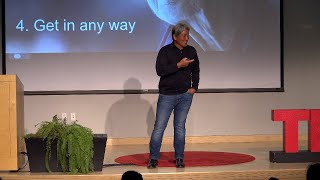
Thank you very much. So it appears that I make an appearance at TEDx Harker every 10 years or so, so I hope I can make one more. A little bit about my background. I. I work for Apple. I was Apple's chief evangelist. I'm currently Canva's chief evangelist. Hopefully, some of you may use Canva. And I'm also the host of this Remarkable People podcast, and I have interviewed about 160 people. And you develop some pattern recognition of what makes people remarkable. And it's not obvious from the outside looking in. When you see someone like Neil DeGrasse Tyson or Jane Goodall, you know what made them remarkable. So this presentation is my analysis of what made people like that remarkable. And I hope that this will help you become remarkable, too. So this is about how to be remarkable. And these are unseen, unexpected, maybe even hidden and counterintuitive things that I learned about why people become remarkable. And, you know, from the outside looking in, you think, well, you know, being remarkable is all fun and games, and it's like, cool. And you get to hang out with Barack Obama and Bill Nye and take selfies. If you're Neil DeGrasse Tyson or if you're Jon M. Chu, you make crazy, rich Asians. And this is a great film, and, you know, that's cool. And everybody knows you and you're famous. Or if you're Brandy Chastain and you win the World cup and Olympic gold medals, from the outside looking in, it looks like all spectacular and easy and like instant success. Then if you're really lucky, you get Jane Goodall to look for lice in your hair. And I just want to show you that underneath all of this and before all of this, a lot of things happened. And so this concept of sort of being instantly remarkable, I have found to be completely false. It takes a long time to do this. And so These are my 10 observations about how you can be remarkable or more remarkable, too. Okay, so the first thing, I think that the world has done many young people a disservice when many people tell you to find your passion, pursue your passion. And it's almost as if at the age of 18, 19, or 20, you should have already found your passion. And for those of you who have not found your passion, you. You're thinking, well, am I an underachiever? Am I a failure? Why have I not yet found my passion? And I think this is much too high a bar, and it's an unfair bar to most people that. My observation is that instead of trying to find Your passion, you should pursue interests. And at any given moment in your life, your interests will be very different. It could be soccer, reading, art, music, ukulele, baking, cooking, surfing. It could be a lot of different things. So my first thought for you is don't get hung up on trying to find your passion. And I'm listen, I'm 68 years old. Three years ago I discovered podcasting. Podcasting is currently my passion, but through the decades of my life, I've had multiple passions and they all started with more of an itch, more of an interest than head over heels. Fall in love, dedicate my life to something. So for those of you who have not yet found this thing in your life which you would define as your passion, don't sweat it. As you go through life and you find things that are interesting, scratch the itch and one day you will discover a passion. Second thing, this is Christy Yamaguchi. A little known fact about Christy Yamaguchi is that in her first ice skating contest, she placed 12th, 12th. She asked her mom, why are the other girls getting ribbons and I'm not? And her mom told her, because, Christy, you finished 12th, not first, second or third. And then Christy Yamaguchi went on a decades long pattern of showing up, of practicing four to six hours every day. And that's what it takes. You have to keep showing up. It doesn't happen like that. The third thing, the third thing, this is Steve Wozniak. And the lesson I learned from Steve Wozniak is that rather than being, quote, market driven, being data driven, the richest vein for finding these interests and these passions and ultimately to perhaps building a company, is that you build what you want to use that rather than finding this theoretical market, this theoretical segment, if something interests you, build it, create it, and then hope you're not the only person in the world who wants it. When Steve Wozniak built the Apple one, there was no proven market for personal computers. Indeed, the founder of IBM predicted a world market of five computers. Five computers in the world. Steve Wozniak built an Apple one. It was the computer that he wanted to use. Luckily, it wasn't just Steve Wozniak who wanted to use a computer. So my advice here, if you want to be remarkable, is build stuff that you want to use. The fourth thing, this is a picture of Jane Goodall. So Jane Goodall started her career in Africa working for the Leakey Organization. Now you would think that working for the Leakey's Jane Goodall, who she is today, truly a remarkable person. She must have had a PhD in biology or zoology from Oxford or Cambridge or Stanford or Harvard stuff, something like that. Right? So she had these amazing qualifications. She got hired by the Leakey Organization, she started interacting with chimpanzees, and the rest is history. Well, let me correct the story for you. Jane Goodall came from a very. Not a very. She came from a poor family. And coming from a poor family, she went to school and she learned secretarial skills because that was the closest path to employment. When she went to Africa, it just happened that the secretary for the Leakey Organization quit. So there was an opening for a secretary in the Leakey Organization. So Jane Goodall got her job in Africa for the Leakey Organization because she had secretarial skills, not because she had AP Bio, AP Calculus, AP Physics. She didn't have a 4.2 GPA. And years later, the Leakeys told her that she needed a PhD. So she's one of the few people who ever went without an undergraduate degree straight to the PhD program at Oxford. The lesson that I learned is get in any way you can. It would be great if you got the perfect job because of your perfect curriculum, because of your perfect background, your perfect work experience. God bless you if you can pull that off. But you know what? Remember Jane Goodall? She got in because she has secretarial skills, not because she had a PhD in biology. Don't be proud. Get in. Listen, I got my job at Apple as a software evangelist. I have an undergraduate degree in psychology. That was the easiest major I could find at Stanford. And I really after to tell you about my checkered past. So after I graduated from Stanford, I went to UC Davis Law School. I lasted two weeks. I quit law school after two weeks. And then I went back and I worked in Hawaii. Then I came back to the mainland and I entered UCLA for an mba. So the bottom line is I had no technical degree, no technical work experience. The way I got my job at apple was pure 100% nepotism. My Stanford roommate hired me because we were friends. On paper, I was totally unqualified for that position. When I was being interviewed at the Macintosh division, the guy who hired me is named Mike Boich. So Mike Boich met with Steve Jobs after I had interviewed around the division. And Mike Boich said to Steve Jobs, so what do you think of Guy and Steve Jobs? Ringing endorsement of me was, he's okay, but if he doesn't work out, I'm gonna fire you too. That's how I got into Apple. Whether your secretary or your best friend hires you, don't be proud, just get in. It doesn't matter how you get in. It matters what you do once you're in. And that also works the other way too. Let's suppose that you are a trust fund baby, that your father or mother, amazing tech CEO or something you know and gets you in the next day. It doesn't matter if you're a Mark Zuckerberg kid. It doesn't. It really does not matter. So it can work both ways. Get in any way you can. Number five. Number five is when you are asked if you can do something. I have to be very careful here. I'm telling you, just say yes. Now there are some limits to this. Somebody says to you, you know, can you perform a cochlear implant? I don't suggest you just say yes. All right? But if somebody says, you know, can you make a TikTok posting? Can you figure out how to use slack? Do you know how to use Trello? Do you know how to use all? Just say yes. I am telling you, fake it until you make it. You would be amazed. Most people are faking it until they make it. There are very few really qualified people. So don't be afraid, just say yes. And then. And then you have to figure out how to do what you just said you can do. But that's why life is interesting. Just say yes and figure it out later. Number six. Number six is stubbornly refuse to be framed. If you're good at engineering, refuse to be cornered into. You're just a nerd. If you're good at marketing, refuse to be cornered into. You're just a good shock and jive sales guy or gal. You need to refuse to be framed. Listen, I'm completely non technical but I can hold my own in most technical conversations and you need to be able to develop that. So don't get pigeonholed if you want to be remarkable. You need to fight the resist fight and resist that market force to pigeonhole you. You want to remain as broad and as flexible as possible. Don't let the world frame you. And I will tell you maybe even more important, don't frame yourself. Don't get it in your head that I'm a math nerd, I'm a data won't, that's all I can handle. Or I'm an artist so I cannot handle numbers. Self framing is probably more dangerous than being framed externally. Don't let yourself be framed even by yourself. Number seven. Number seven is, I think many people Many macho people are always telling you, you fight fire with fire. When you meet resistance, you resist back. When you find hate, you hate back. You know, when you find violence, you are violent back. I think that is a very poor piece of advice that when you encounter fire in your life, use water to fight back. Put out the fire. Don't create another fire if you want to be remarkable. Number eight is, and this occurred over and over in my interviews, which is so many people told me, guy, I had to get over the imposter syndrome when I was named to this board of directors. I went to the first board meeting and I looked around and everybody was more qualified than me. And I was asking myself, why should I be on this board of directors of Verizon? A woman who is on the board of Verizon told me that. And so this is going to occur in your life where you get into these situations and you. And you're wondering, did I really deserve that promotion? Did I really deserve that raise? Did I really deserve that additional responsibility? And listen, I'm not saying to flip over to the other side and start feeling like you deserve everything and the world owes it to you. I'm not saying that at all. But I'm saying that you need to, like, not spend a lot of time wondering if you deserve something. If you got it, take it and run with it and do the best that you can do not waste any of your cycles wondering if you deserve it. Go for it. Number nine. There's this great story about putting the stones in first. So the way this story works is there's sort of two approaches to life. If you have a jar, some people, they put in the sand, they put in the pebbles, they put in the water, and at that point, there's no more space to put in the stones. The way you should run your life, in my humble opinion, is you put the stones in first. The stones are the big things, the things that you have interest in, the things that you feel passionate about. Your family, your loved ones, your friends. You put the big, big things in first, and then you put the pebbles if there's space, and then you put the sand if there's space, and then you put the water if there's space. But you will find that if you put in the sand and the water and the pebbles first, we will not have room for the stones. Put the stones in first. And number 10. Number 10 is we're going to test the. The morals of Harker and TedX. I did research on this, and to my knowledge TedX does not. Well, I won't say they condone it, but they do not say that you cannot use profanity. And frankly, there is no better way to say this. This is the acid test of remarkability. You will know that you have found something you truly love, your passion, if you will, that it has gone from an itch and an interest to something that is a life calling. The Japanese have a word, ikigai, that it is your mission in life and a very good test for you. When you encounter things that may be your ikigai, maybe your passion, your interest, your love, ask yourself, do you enjoy the shit sandwich that is required to do this? Let me illustrate with my own case. So podcasting is my ikigai. It is my calling in life. At 68, it involves three or four hours of prep for each interview, three or four hours of the interview itself, and then three or four more hours for editing. So it's probably five to 10 hours of my personal time per hour of interview. Okay? And that is a shit sandwich that I love. I love the editing. I love the prep. If you're a writer, people have this impression of writing that you. You sit on this windswept beach and your house is clean, everything is going great. You're weighing multiple acceptances from Dartmouth, usc, Stanford, Harvard, Carnegie Mellon, and you're trying to figure out what to do. And you're sitting there and you have this tablet of parchment paper, and you have this gold nib fountain pen, and you write and the words flow onto the page. That's not how writing works. Writing is more like you open a vein and you pour your blood out onto the page, and then you have to edit and edit and edit and edit for months at a time. That's a shit sandwich. Writing is a shit sandwich. Programming is a shit sandwich. Trying to debug programming is a shit sandwich. So I'm telling you, I'm leaving you with this final message, which is you will discover what you're going to be remarkable at when what it takes, takes is loving the shet sandwich. When you love the shed sandwich, you're on the way to becoming remarkable. And that's how to be remarkable. Thank you very much. Thank you. Thank you.
More from Guy


Cheryl Strauss Einhorn | The Human Edge: Smarter Decisions in the Age of AI | Talks at Google



Rachel Glennerster | Innovation and the Center for Global Development | Talks at Google

Rebecca Winthrop | Rethinking the Purpose of Education in the Age of AI | Talks at Google

Dr. Robert Wachter | A Giant Leap: How AI Is Transforming Healthcare... | Talks at Google



