If the Creek Don't Rise | Rita Williams | Talks at Google
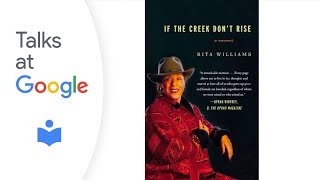
A Talks at Google recording of author Rita Williams discussing her memoir If the Creek Don't Rise: My Life Out West with the Last Black Widow of the Civil War (Harcourt, 2006). Williams recounts growing up in Steamboat Springs, Colorado, raised by Aunt Daisy—the last African American widow of a Union Civil War soldier—shares family history, racial experiences, Civil War legacies, research methods for the book, and readings from the memoir, with audience Q&A.
Chapters
Today for our Authors at Google series. And I wanted to just read a brief introduction before I hand the floor over to Rita. Rita came of age in the cold and rugged mountain terrain of Steamboat Springs, Colorado. By the age of four, her father had left the family and her mother had died, leaving Rita to be raised and cared for by her aunt Daisy, the last surviving African American widow of a Civil War Union soldier. Her previous works have appeared in LA Weekly and O the Oprah Magazine. A former actress, musician, and college professor, she is a thesis advisor for the Master of Professional Writing program at the University of Southern California. She received her MFA in theater from the California Institute of the Arts and lives in Los Angeles next door. If the Creek Don't Rise, My Life Out west with the Last Black Widow of the Civil War is her first book, which Harcourt published in May of 2006 and recently came out with the paperback just a few months ago. So Rick's very excited to have Rita here, and I will hand the floor over to her.
Thank you, Rita. Hi, you guys. It's great to be here. And a special shout out to everybody in Colorado. I wish I was there with you. I guess I should start out by. By giving you a little bit of the reason why I wrote the book in. I think it was 1993, the remains of a Soldier came above ground at Gettysburg, and my aunt received a call from a group of Civil War enactors saying, would you come back and meet the last Confederate widow and help us inter the Remains of the Soldier. And I hadn't really been around my aunt for a really long time. She and I had a very fraught relationship, as you will see if you read the book. Nonetheless, we were relatives and kindly disposed toward each other at that point. And I was also really curious about this business of the Civil War reenactors, but I didn't really, really expect it to be a big deal. I sort of figured that, you know, the Civil War enactors would put on their Confederate, you know, costumes and the unions would put on their costumes and they'd march around and that'd be that. However, when I got there, there were thousands of people in Gettysburg. And not only were the Civil War enact the New York Times and Time magazine and a full Marine army guard for Daisy, and they buried the soldier with the Arlington Guard soldiers, those kind that, you know, they march like this, you know, without moving anything. And I was like, really? Really? I had to really stop and step back and take a look at what I was at. And then I realized that Like a lot of us, my small minded thinking had made me not really take a good look at what it meant to be the last one of the last widows on a Civil War pension. Which meant that my uncle, uncle, whom I never met, had been a soldier in the Civil War. And here I am talking to a woman who raised me, who really and truly knew people from the grand army of the republic. And my only association with her was that when I was four, she became my legal guardian. She was in her mid-50s at the time and she was pretty much a tyrant. I thought I lived in Steamboat Springs and you know, I was in Ski Town, usa. You know, everybody wants head skis and you know, I wanted a turtleneck and she wanted to teach me how to tan a deer hide and I wanted to go and, you know, get to the mountain and be with my friends. And what we had to do was live exactly like we were in the 1800s. And part of the reason for this was that the man my aunt married when she was 21 and he was 79, I'll repeat that, she was 21, he was 79, had had a magnificent ranch in western Nebraska that it had taken him three tries to really put. Daisy had married Mr. Anderson when she was 21 in Tennessee. And then when she moved with him up to Nebraska, she lost that ranch in the 1930s, right after the stock market crash. And her entire life really became about the loss of the ranch, the loss of her husband, and an attempt to make some kind of amends for having been so improvident as to lose that great piece of property. Property and really essentially wind up once more cleaning houses. So when she became my guardian, she was really committed to making certain that I wouldn't make those same mistakes. And so she was kind of a taskmaster. So that's the basic background of my Aunt Daisy and myself. And when I. I finally realized after she had died that I had had an opportunity to sort of stand at a crossroads in history, it was really weird. I was young enough to really, really know some of those stories that would really fall away if I hadn't. If I didn't live long enough to tell them. I'll share one. For example, after the Civil War, my uncle still owed the Union army two and a half years. So the people who were in the government at the time were in the process of eliminating the Native Americans from their lands in Nebraska and Wyoming and Texas. And so they started to use some of those black soldiers who had fought in the Civil War to oppress the Indians and help in the clearing off of those lands and herding them onto reservations. Now, you have to also understand that my great grandmother was a Cherokee. And so my aunt was very ambivalent about being in the position of having married a man who was an Indian hunter. So one night I was helping her in the garden, and the dusk had fallen and it was a beautiful, beautiful night. And I had gone back to the shed to get something for Daisy. And I looked up and. And out in the pasture in front of our house was this beautiful doe. And I was standing there looking at her. And then my aunt noticed that I had stood still like that. And she told me that that was how my uncle used to stand. And she said, he was standing and he seen a squaw down there at the river. And he said to me, you know, I had her in my sights a good long while. She was feeding a little girl earthworms because they was starving. And he kept her in his sights, and he put that rifle on that rock, and he kept it there a good long while. And he said, you know, I just didn't have the heart to kill that one. And I thought about that for a long time. What did it mean? I didn't have the heart to kill that one. How many others had he killed? And when I asked my aunt questions about that, she got very defensive. Now, you just mind your mouth. I would get things like that, you know, But I did some research on the book and I tried to tell the story as much of it as I could. Let me read just this little bit to you. Here. Hornets, yellow jackets. Wasps in the eaves. Restlessly industrious. The creek, the trees. The bawling of a steer for no apparent reason. Then to. Too soon it was fall. The stun leaves suddenly golden against the white bark of the aspens and the still cobalt sky. The oaks rusted red, almost like holly. The birds hurtling south each night. The dark and the cold came earlier. The smell of wood smoke on the wind wafting from the neighbors. 10 minutes sooner. Less water flowed in the creek now and at night, a film of ice along the edges. It was time to dig up the potatoes, their skins the color of apples. Time to tie off the onions and braid the garlic into gray ropes. The first snowbird appeared on the hill. The first rifle crack rippled across the valley. Hunting season again. You know, cold has a smell of its own. The basement wall was already frozen. The crock of chokecherry wine, heaviest stone. A deer now hung in the shed, driving my dog mad. With a scent of fresh meat. And so the seasons rode past like a horse cantering downhill with the bit in its teeth. All my sulky resistance beside the point because once more snow claimed the place, because it could. Okay, let me ask you. I'm going to read something that is not as light hearted as the pretty rocks and the pretty water. My aunt sent me off to stay with the nuns because I was a behavior problem. You need to just. I can just say that out front. I was a behavior problem. Okay. I think I got thrown out of one. I got thrown out of about four schools before I kind of graduated from high school. But the one thing that I am most proud of is this school that I got thrown out of. What happened was that this nun came to me and she said to me, I was 13, by the way. I had been left at this Catholic school because my aunt didn't want me to come home for the summer. So the nuns were going to have a summer camp. And the sister came to me and she said to me, I'm sorry, you're not going to be able to swim with the rest of the kids because we don't have a swimming pool that we're swimming at a motel. And the proprietor has said that no black, black kids can come. Now one of the things you have to understand was that this is like, you know, the 60s. I am assuming that by now all of this race stuff is behind us. And I needed to assume that so that I could focus on my studies and focus on my life and let all that ancient history sort of be done with. I was sick of it. You know, I know that everybody is sick of the race problem. Every single one of us is sick of it. And I certainly was. And I really decided to live inside a paradigm where that wasn't my primary concern. Every day I wanted to get up and go out and be about my life as opposed to go up and be about my little dark skinned life and wonder when the next bomb was going to drop. My aunt had been exposed to that consciousness that's about ethnic cleansing. And I did not like what I saw in her and I didn't want it for myself. Now that may be shallow on my point on my part, but you know, I was like that. Anyway, the nun said to me that you aren't going to be able to swim with the kids. So let me read this section. I left that school and I decided to go talk to the owner of the motel that said I wouldn't be able to swim there. So I walked about five miles out to the Swimming Pool motel, and I walked in the lobby and I said, I need to speak to the owner. I was shaking, and not just from the air conditioner. You're not looking for a job, said the gal that was sitting at the desk, because I just got hired. She called on the phone and asked the proprietor to come out front, and she looked at me and she said, the bar's down that way. After the intense sunlight, I was blind in the dark of the bar where he was. The place was as cold as a locker and steamboat where we stored our wild meat. It stunk, too, a little bit, like a bar rag, but I had never expected that I would go from that Catholic school to a bar. What if the nuns found out He's a Rebel was playing on the jukebox? Would you just take a look at that spring chicken? Said a guy I couldn't quite see. Gradually I made out the leather booths along the wall. A couple of the guys wore crushed cowboy hats. One was bareheaded and bald. Another was wearing a cap that said Protected by Smith and Wesson. I thought, what am I doing here? The proprietor came toward me. You too young to be working in here, he said. Are you the proprietor? I asked. He said, yeah. You know you gotta be 21 to drink in the state of Colorado, and that's doubly true right here in spitting distance of the pen. Canyon City at the time housed the Colorado State Penitentiary, where my uncle had done time for rustling turkeys. I don't want to drink, I said, and then I realized how parched I was. I'm from St. Scholastica. I want to talk to the guy who told Sister Mary Richard I couldn't swim with the rest of the kids because I'm a Negro. The man pulled down his glasses and snorted. Nah, get out of here. I mean, come on, it don't show. That completely threw me. Was it some trick? First humiliate me, make me less of a person because of the shade of my skin, and then make a joke about it. No wonder Daisy was crazy. But I hadn't walked all this way and risked getting kicked out of school to have him weasel out. Well, I am black, and that certainly was the point when you told Sister Mary Richard you wouldn't let me swim her with the rest of the kids because of it. He took a step back. Jesus Christ, honey, you walked all the way here from the girls school and the seat that's nearly five miles. He took off his glasses and he looked at me hard. You know I hadn't seen a real man in months. And here I was in a room full of them. Look, I just need to know if you said that. I couldn't say anymore. And he said nothing was going to really work unless he told me the truth. And I started to cry. I didn't want to cry. Oh, Jesus, he said, come on over here behind the cigarette machine. Now he was nervous. You know, sweetheart, it warn't nothing personal. I yelled at him. Then it was too personal. You personally said, the person that's me isn't as good as any stupid old white kid. He put his hands on the machine and he goes, you know, I got a second on this place. And all my customers are from Texas and Oklahoma. And I don't have no business except folks coming up from there except for folks visiting the pen. Suddenly I was just too tired to mess with it anymore. I looked at the bar and I said, could I have a glass of water and some of those cherries? You absolutely can and will, said this bluesy voice behind me. Connie, come over here right away. I'm Mrs. Cardellucci. She said to me, can I help you? My old man started to find Miss here, didn't he? I looked at her. I'd never heard an accent like that. Not west, not south. Oh, you poor little lamb. Hurt your feelings, didn't it? I'm so sorry, Angelo. Let's go get Rita. What's your name? Oh, it's Rita. Okay, go get her a coat. And then she led me out to the restaurant. You must be starved. Let me get you a sandwich. You like bologna? I love bologna. And I sat down and I listened to her. You know, honey, I'm not telling you. I know what it feels like to be a Negro. Nobody can understand that. But you should see how they treated Italians back in Philly. We were in a neighborhood with Irish everybody everywhere. You look to come a MC Cop, you know. And Angelo wanted to join the force. You think he could get a job? I don't think so. I hadn't seen anything but uniforms and habits for so long that I just sat there and let this theatrical woman tell me her story. Mrs. Cardellucci, I said, are you guys Catholic? She looked at me, shocked. Of course. But that don't mean you got to be a nun, you know. I must have looked stunned, because she said, what, you think if you're not a sad sack, you can't take communion? Phooey on that, I say. And then I sat there all afternoon while she talked until I realized it Was late and I had no way of getting back before supper. I said, in time for supper? Don't tell me you just walked off, she said, and walked over here without telling us, Telling those nuns where you were going. I told her I was going to go pick up some shampoo and then I'd be back in time for vespers. Then her mouth dropped open. You could have been kidnapped by some prison runaway. At the word prison, I really jumped. I'm gonna go get Angela. We gotta get your fanny back up to Canyon City school right now. I knew they were gonna kill me. Probably not. She said, honey, getting kicked out of San Scholastica is not gonna kill you. That hadn't occurred to me. She said, what you did here is no small thing, but that doesn't mean they're gonna appreciate it. But what am I gonna do? I wailed, be yourself. That didn't sound like a very good idea. I tried again, but what am I gonna do if they kick me out? Nobody gets to know that ahead of time. And before I knew it, we were at the school and all the lights were blazing and they kicked me out. Okay, enough. Let me hear from you guys. Do you have any. Any questions or any thoughts about the reading? So I'm curious. How often do you go back to visit kind of those old places where you grew up, or do you. And what are your impressions these many years after? After that? Well, I go back to steamboat, because that's home, you know. But the other part of it is that the steamboat that I knew is no more. In the middle 60s, the valley transformed markedly into a mini aspen. And so the majesty of the mountain and the, you know, the condos and all the ranches. Now I think there's probably one of the really big working ranches left. Not too many, though, because it's all tourism. I go back, though, because it is home and I probably always will. But the Steamboat Springs that I put in the book is the one that I want to preserve. That's part of why I wrote the book. Any other questions?
I was just wondering, now that you've had obviously a long time to reflect on it, what do you think is sort of the greatest thing naysayer taught you and how has that sort of affected the decisions you made in Cisco?
I think the peculiar great thing that Daisy taught me is to be curious. I remember I would have these really horrible things happen to me, and I would be standing there and I'd go, well, I wonder how this is going to turn out, because there was no Way out. So many times I would have things happen that were absolutely catastrophic. Like, you know, I lost my parents, I lost my grandparents. Ostensibly, I lost both my sisters. Until after I wrote this book, I sort of got in touch with my family again. But it just seemed to me that there was one catastrophe after another. But the thing that I've discovered is that if the only thing that I'm really aware of is the catastrophe, I won't notice the deer. And that really is the biggest lesson that always in the middle of this really, really enormous life and this terrible thing that's going on, I'll tell you another thing. Like, I got kicked out of school one more time, and I go home and my aunt is fed up with me, and she gives me this. This shed to stay in right next to the chickens. And so all night long I hear. And I kind of realized it was kind of sweet. And I looked outside the window one morning, and there in the middle of a field of hay, right outside the window was this magnificent red tulip. And it was like, it's not the kind of thing that you look for. But it got me through that day, you know, And I think it's sort of like one of the things that I got dropped off all the time at the library. And I started realizing that there's a huge world out there and there's a lot of ways to do a thing. You know, I didn't particularly take all the information that was handed to me when I was a little kid and run with it. I examined it, and I decided in the light of my own circumstances, did it make sense to me. And I think that's my gift from her. Although she didn't like it, she told me to think independently, but not if it deviated from what she wanted. Know what I mean? Okay.
I was curious about what you said about your attitude about race when you were young as opposed to Daisy's, and that she. I didn't quite understand what you meant by her sort of attitude about ethnic cleansing that you didn't want any part of. So that's the first part of my question. The second part is, how did that change for you? Maybe after the event that you read about and then just as your life continued?
Well, you know, the. The thing is that my aunt had post traumatic stress when she was a young woman. She watched her brother be lynched and the entire family was run out of town from Tennessee to Arkansas. Daisy's entire way of being in the world was seen through the filter of that trauma. And I Think when I was a little kid, after having gone through. I lost my mom. When I was 4, she was asphyxiated due to carbon monoxide poisoning. And I looked up and I had my own enormous grief. And I looked at her, and I realized I couldn't survive both hers and my own. So I became sort of a little monster. I just, you know, sort of, like, had to carve out some space for myself because she was very nearly psychotic with her history. And I could see that I was never going to be able to be a normal kid, but I wanted to at least be a functional one. And I can't tell you that at 6 years old, I could articulate that, but there was an instinct. It's like you put a little plant in the basement and it looks for the light, you know? And that's part of what I was doing. And I didn't understand Daisy at all because she never taught. Talked about these things. But, you know, for instance, she'd been struck by lightning. I mean, you know, she had gone through losing that ranch. She had lost her husband, so many losses that Daisy wasn't the fun Girl Scout leader who made brownies, you know what I mean? And basically what happened was part of what I had to do was survive my own circumstances and survive her as well, because she did beat me a lot, you know? And what I learned after I finally got away from her about race is that it is one of those kinds of things, which is mercurical, you know, it can mean nothing at all in one set of circumstances, and it can be the deciding factor in another. And I've learned to sort of study Zen and look at the moment and look at my present circumstances and try to move through the particular. I feel like a little salmon, you know, when they're trying to climb the dam and they build steps for them, I look very, very concretely. What is the step that's in front of me? What do I have to do to get to the next level? What do I have to do to get to the next level? What's in front of me? And I get very, very concrete and simple. I mean, otherwise it's too overwhelming, you know? And the other thing I know is that the most toxic thing in my life has been resentment. I have to do what I have to do to flush it out because it'll cripple me. Could you speak just a little louder? I can't hear you. I'm sorry.
You mentioned that Daisy didn't really speak about history. And I guess my question would be. When writing this book, what did you uses your sources, Were they anecdotal? Were there diaries? Were there other family members you spoke to? Because it seems like pretty much.
I used all those things. One of the things that I did was I hired a private detective to go and send somebody down to Hardin County, Tennessee, to find out what were the records on my family. I also got on a jet and I went back to Nebraska and I talked to the people who are still living in Hemmingford and Alliance. And I also flew up and spoke to a wonderful author named Darrell Wax, who was a historian, who also whose mother went to school with my mom. And I talked to him and got a transcription of interviews that he had done, I think, in the 40s. And I. I also listen to family members, and it's been amazing. Once I started to try and explore what this book was about, since I published it, I could publish a whole other volume because of the stuff that has been unearthed since then. But there are vast gaps that I don't know. For instance, I don't know whether there were 13 kids or eight, because the truth is they didn't keep records on blacks in the 1900s and the 1800s, especially once the war was over and especially once that period in the south when they were lynching people, it was, you know, nobody keeps records on stuff like that, if you know what I mean. So, you know, I've done the best I can could. But, I mean, there are a lot of things that are family stories that I can't really prove. And when I wrote the book, I tried to acknowledge that this is what Aunt Gracie said, you know, so that's what I did.
Colorado. Do you guys have any questions? Your mic is off, but you'd have to. No. Okay, I have a question that is. So one thing that you stated is that in the process of writing this book, you essentially sort of created and articulated a history. And when you've contacted relatives or the relatives that have contacted you since you've published this book, there's bound to have been sort of differences and things like that. What are some of the more interesting things where relatives that you talked to said, oh, hey, this makes me think of this, or this is something that was completely different than I thought of because of the book that you published?
Well, it has been very, very strange. Almost everything that I've talked about has been corroborated. And as a matter of fact, one of my sisters went on Amazon.com to post a little thing saying, you know, this did happen. What she's saying is the whole truth. And I was amazed last. I just sent an article off this morning to O magazine. There's an article, hopefully, that's going to come out in Christmas, about surviving the holiday reunion. And one of the things that I talked about in that article was how I discovered, once I wrote this book, that it's a very, very good idea to check your guns at the door when you go in to sit down with the family. Because of that enforced intimacy, we really don't have any protection against those barbs and those socks and that, You know, that kind of, you know, it's not direct. That's when it really wounds you, when it's that sort of COVID judgmental kind of thing. And when I went up to visit my family for the first time, I think one of the most extraordinary things that happened was, well, I had a little sort of Japanese niece, and I had a Mexican nephew. And I had a guy who was a New York Jew who had married my half sister. And there was a wonderful really, really, really dark guy who could build anything. And there was my father's guitar. And my aunt was just furious about the idea that all you want to do is pick that guitar. Why don't you do something ladylike? And all of us, it was like this DNA had been tracking through time. All of us sat down and played the guitar. I could not believe it. It was one of those kinds of things where, you know, we're black people. I mean, well, I'm. This. My tread election is black. I mean, there was the rest of them, but it never occurred to me that that one thing that my cowboy daddy transmitted was that love of Chet Atkins. And I think Doc Watson might have been before his time, but that really, really great music that tells stories. Tennessee Stud was long and lean the color of the sun his eyes were green he had the mud and he had the blood and there never was a horse like a Tennessee Stud and, you know, I mean, I sing like that and I'm black, you know, I mean. You know what I mean? And it's sort of like I never expected to find any other black people who sound like that, but there they were. It was really funny. Any other. Any questions?
Thank you very much, Rita.
More from Guy


Cheryl Strauss Einhorn | The Human Edge: Smarter Decisions in the Age of AI | Talks at Google



Rachel Glennerster | Innovation and the Center for Global Development | Talks at Google

Rebecca Winthrop | Rethinking the Purpose of Education in the Age of AI | Talks at Google

Dr. Robert Wachter | A Giant Leap: How AI Is Transforming Healthcare... | Talks at Google



