INTERVIEW Dr. Jane Goodall, DBE, with Guy Kawasaki | TEDxPaloAltoSalon
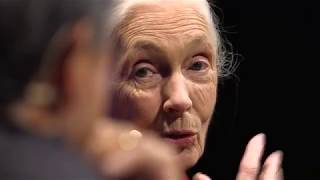
Dr. Jane Goodall talks with Guy Kawasaki about her decades studying chimpanzees in Tanzania, discovering they use tools and have distinct personalities. She discusses her youth-led Roots & Shoots program, now active in over 100 countries, and why eating less meat and spending time in nature matter for conservation.
Questions this video answers
Founded in 1991 with 12 high school students in Tanzania.
About 150,000 active groups (reported in this interview).
Nearly 80 countries (reported in this interview).
"Zero. Absolutely zero."
After an 18-month review of ~400 chimp studies, the NIH team found zero experiments that were relevant or potentially beneficial to human health (per Goodall's account).
Chapters
Does anybody ever begin one of these conversations with you by not saying it's an honor to be here with you?
No, very few. So please don't say it.
Okay, I won't, I won't. And who are our friends here?
Well, I'm going to introduce them at the point in our conversation when it's relevant. But this is Kao, this is Mr. H, and this is Ratty.
Okay.
And at the appropriate points as we talk, I hope there'll be an opportunity to tell you why they're sitting here.
Okay. And also me, Guy, Eugene. All right, all right. I've read the books, I've watched the film Jane. And one thing that struck me was that apparently Dr. Leakey didn't want a so called trained biologist. So when you first met him and began this saga, what were your qualifications?
Zero, Absolutely zero. Except that I was born loving animals. When I was a child I just watched animals and there weren't so many where I grew up in England, you know, there were worms and snails, there were all kinds of birds and occasionally there was a fox. And I watched them as much as I could. And I did well at school and we didn't have money for university so I had to do a secretariat and got a job in London. And how that ended up for me studying chimps, maybe that comes later.
All right. At the time that you began studying the chimps, scientists were not supposed to name them, not supposed to attribute human qualities to them, attribute tool making capabilities, attribute empathy, and yet you did all these things. So what's the lesson there about define wisdom, defying convention, define what's right.
Well, I think to answer that question, I sort of have to go back a bit and say that when I eventually saved up money to get to Africa to follow my childhood dream, which actually began when I read Tarzan of the Apes. That's why I said Tarzan and fell in love with him and was very jealous because he married the wrong Jane. Right. And that's where my dream began. I would go to Africa, I will live with animals, write books about them. And everybody laughed at me. But I was incredibly lucky in having an incredibly supportive mother who said, if you really want this thing, you're going to have to work really hard, take advantage of all opportunities and never give up. So left school, no money for university, did a boring, awful secretarial course, opportunity when a school friend invited me to Africa. And to get the money I had to leave my job in London, where you couldn't save, go home to Bournemouth and work as a waitress. Which is very hard work. By the way, have you ever been a waiter? No.
No.
No. If you had, you would know. It's really hard work. Anyway, I eventually got the fair, got to Africa, heard about Louis Leakey and he offered me this opportunity to go and study the chimps. And now we can get onto your question. At first the chimps ran away from me. They'd never seen a white ape before. You are an ape. I'm not sure if you're white. I'm a white ape. There's some people out here who have different colored skin, but we're all the fifth grade ape. That's what we biologically are. But they'd never seen a white one and so they ran away and eventually they got used to me and I was able to observe them. And I observed this chimpanzee reaching out, picking stems of grass, using them to fish termites from their nests, pick them off. And I observed him picking a leafy twig and stripping off the leaves. In other words, he was using tools, he was making tools. And at that time it was supposed to be, according to science, only humans that used and made tools. So Louis Leakey, my sponsor, was extremely excited. That enabled him to ask the National Geographic to step in to fund the future research. And they not only agreed to do that, but they sent a photographer and filmmaker, Hugo Van Loek, to record what I was observing about the chimps. So I was learning more and more about the chimps as they became used to me. And then Louis Leakey said, you have to get a degree. You can't get money when I'm dead if you don't have a degree. He said, you we haven't got time to mess with the ba. I found you a way of going to Cambridge University in England to do a PhD in ethology. And I didn't know what ethology meant.
But you skipped the bachelor's and master's and went straight to PhD.
Yes, yes. It was nothing to do with me, guys, nothing to do with me. It was leaky and it was a huge responsibility for me. And so I'd been two years with the chimps and I got to Cambridge and imagine how I felt when I was told by these erudite professors, you've done everything wrong. You shouldn't have given the chimps names. It's not scientific. They should have had numbers. You can't talk about their personalities or their minds capable of thought or their emotions. I was scared of those professors. But fortunately, when I was a child, I had an amazing teacher who taught me that. Wise though these professors may have been in their learning, in this respect, they were wrong. You know who that teacher was? My dog.
Your dog?
You, I'm sure, out there in the audience. Do you understand we can't share our lives with a dog, a cat, a rat, a rabbit, a horse, a pig, a bird, whatever, and not know the professors were wrong. Of course, we are not the only beings with personalities, minds and emotions. And so I stuck to my conviction and eventually the professors came around and I truly believe, I honestly believe that we have to thank the chimps a lot because it now turns out they're so like us biologically, so that we differ from them in the composition of DNA by only just over 1%. And the similarities in the immune system, the composition of the blood, the anatomy of the brain. That combined with Hugo's film of their postures and gestures of communication, kissing, embracing, holding hands, patting one another, swaggering, shaking their fists, throwing rocks, using tools. They had to believe that we are not the only beings with personalities, minds and emotions. So that's how it happened, okay? Thanks to my dog.
You're killing me, Jane.
Why am I killing you?
You're killing me because yesterday my daughter brings home a puppy and I said, we are not keeping that dog. And now she's grinning ear to ear right here. I can anticipate this conversation. Well, Dr. Goodall said you can learn so much from a dog. We should. Would you like to share custody with me?
Well, I could provide some parental support. Perhaps. Your dog, Biscuit.
Okay, thank you. I appreciate your concern. There are many young people in the audience and who are watching this. So in today's setting where everybody believes they have to get this undergraduate education and they have to go and get a PhD and all that, what's your take on the necessity of formal education today for a young person?
It depends on what the young person wants to do. And what upsets me is that there's this, you know, if you don't get a degree of some sort in some kind of college or university, you're useless. And that's rubbish. I mean, you can. Thank you. It really depends on what the young person wants to do. The problem is in science that it's very difficult to get a job if you don't have a degree. So that, you know, even Louis Leakey told me I would have to eventually get a degree. So I would urge young people who want to become scientists. I didn't want to become a scientist because when I was growing up, which is an awful long time ago. Women didn't become scientists. Now they do. So women now who want to become scientists will probably need to get a degree. If they just want to work with animals and help animals, they don't need a degree. And the main thing is for a young person to know exactly what they want to do, to be really determined in what they want to do. And then my mother used to say to me when I had this crazy dream, if you really want this, you're going to have to work extremely hard. Take advantage of all opportunities, but don't give up. So that's my advice to young people today.
It sounds like your mom was the original tiger mom.
She was utterly amazing. And if I hadn't had that kind of mother, I might have not have done what I've done. I mean, I don't know. But she supported my dream. She didn't get mad when I took earthworms to bed when I was one and a half.
Bring puppies home?
No, I didn't find puppies, but I found mice and injured animals, and she never got mad at me.
Okay, you said in the movie that you, when you were young, you had dreams, and in those dreams you were a man. Can you explain that? And is that still necessary in today's world?
No, I don't think it is. But when I was young, you know, girls were supposed to. Well, they got. The sort of thing in UK is you got married, you looked after your children, you were a good wife, you cooked for your husband, and you didn't become a scientist. You might become a secretary or a nurse, or perhaps you might become a missionary's wife. So those were the expectations for women. And I remember that I went to Buckingham palace, and for some bizarre reason, I was proposed by somebody to get a. A dbe, a dame of the British Empire. And all these women were there.
You went to Buckingham Palace?
Yes. To get this degree. Okay. Yeah. Well, anyway, they said to me, I heard them talking and they said to me, don't you want to be, you know, working in Buckingham Palace? Don't you want to be a maid of honor to the queen? Don't you want to be. And I said, no, I want to go to Africa and live with wild animals. And they looked and they kind of shunned me, like they went over there, and I was left on my own. So I was considered to be peculiar. But I had a mother who believed in me and supported me. Look what's happened.
Amen.
Amen.
Yes. Yes. So we. We've Already touched a lot about your mother and motherhood. I also found it very interesting that when you had your son, didn't you essentially pause your career?
Yeah.
And what are your hindsights on that? Was that the right thing to do? Was it?
No. I believe. You know, I get very upset when women who can. Some women can't. Some women have to continue with their careers to bring in the money to survive. But some women, maybe their husband brings in a lot of money, like you.
From your mouth to God's ears, J.
And if they decide they want to take time off and be a mother, and people say, well, that's, you know, that's like going back to the old days and tying yourself with your apron strings to the kitchen. It's incredibly important, if you can, to spend time with your young child and be there for them and be supportive. So it's a job, and it's a very hard job, but I think it's tremendously important. On the other hand, there are some women who aren't cut out to be good mothers. They just don't want to be good mothers. So then the answer is to try and find an alternative. So I truly believe for a human child, it doesn't have to be the biological mother, but that child needs to feel secure, needs to feel wanted, needs to feel there is at least one and preferably two or three adults who are there to support that child.
I've read your theories of the stages of life. Would you explain those stages and tell people about the stage you're currently in?
My stages of life? You mean like Shakespeare? Yeah, like the five agents of man. Okay, well, the stage I'm in now is my last stage. I don't suppose there'll be many more stages. You know, I'm nearly 85. And when you get to 85, you know, you're closer to wherever the end is. Might be here, there, or there, but you're closer than you were when you were born. And the stage I'm in now is a stage of increasing my activity because I've got less time to get out a message, which is an incredibly important message. And so I have to work harder and longer hours and travel 300 days a year, which I hate, and spread a message of awareness because we're running out of time. And what I've learned from the chimpanzees is the way, not only the ways we're similar to them, but the way that we're different. And to me, the key difference is the explosive development of our intellect. So the chimpanzees are way more intelligent than we used to think, but so are so many other animals. We're learning that we're not so different and yet in this respect we are because we've designed. For example. Well, I guess you could talk about Apple computers if you would, but I'm going to talk about that rocket that went up to Mars and a little robot crawled off and took photos of the surface of Mars, the planet that we once thought maybe he had some kind of life. But you look at those photos, I'm sure you have. You don't want to go and live there, do you?
No.
So here we are, this most intellectual species to ever walk the planet and yet we're destroying our only home. How come? Is it because there's a disconnect between this clever brain and the human heart, which is love and compassion? What do you think?
Well, the lesson that I drew from the movie and the book was when that four year war took place. So it seems like in the DNA there's this inherent tribalism and violence and I think we're seeing that now. So I was going to ask you about that. So, you know, know, I had no idea that that war happened until I, you know, did the research for this presentation. And I always thought it was, you know, Kumbaya among the chimps and such is not the case. So can you explain that and the ramifications upon society?
Yeah, well, the reason Louis Leakey sent me to study the chimps was because, you know, he was searching for the fossils of early man and from the fossils you can tell a lot about what the creature looked like and what it had from its tooth, oops, tooth wear and things, but you can't tell about the behavior. So he, knowing that the great apes are our closest living relatives, thought well, if Jane finds behavior that's similar or even the same between chimpanzees today and humans today, maybe that behavior was, was in a common ape like human, like ancestor about 6 million years ago. And maybe, just maybe that behavior has come with the human line and the ape line and that would help him, he said, to understand a little bit better or to imagine how early humans might have behaved. So I think he was right and I think that we've had a great insight into how our earliest ancestors behaved because of the information about chimps. But you know, aggression, do we have inherent aggressive tendencies? I think so. That was a political issue in the early 70s and when I talked about the fact that chimps had the equivalent of, of a Primitive warfare. That I should suppress that and not talk about it, because that might imply that humans had innate aggressive tendencies. And it was a whole movement then, I don't know if you remember it, but that we were human babies, were born with a clean slate, and all aggression was learned. And I couldn't believe that. I could not believe that. Anyway, I did talk about it, but, okay, so we do have, I think, innate aggressive tendencies, but we have this superior brain. We are capable, if we so wish, of suppressing those aggressive tendencies. And most of the time we do. Our language says differently. I mean, you say, oh, I could kill him, but you don't actually go and kill him. You say it, and maybe you think that would be nice, but you don't actually mean it. So we can suppress our aggressive tendencies, but unfortunately, aggressive tendencies that become political, they're different. That is not the primitive chimpanzee aggression where you fight members of a neighboring community over territory. This is something different. It's all tied in with our materialistic lifestyle today. And politics gets so far away from who we really are, doesn't it?
So what's your vision or idea for how to improve this?
Well, we have a program called Roots and Shoots. And I began this program because as I was traveling around the world trying to raise money for everything we were doing in Africa, which was not only protecting chimpanzees and their forests, but improving the lives of people living in and around the forest in poverty to find ways that they could make livelihoods without destroying the forest. And that's worked. So we're in six different African countries helping to protect the chimps, by the people becoming our partners. But I had to get money for that. It's expensive. And so I was traveling around the world and every single continent that I went to, there were young people, high school students, university students, who seemed to have lost hope in the future, who were mostly just apathetic, not seeming to care. But there were those who were angry, even violent, and those who were deeply depressed. And I began talking to them and they all said more or less the same thing. We feel this way because you've compromised our future and there's nothing we can do about it. And you've heard this saying by one of the Native American chiefs, and I can't remember which one. We haven't inherited this planet from our parents. We've borrowed it from our children. But we haven't borrowed their future, have we? We've stolen it. And we're still stealing it, thanks to our materialistic, greedy lifestyle. And we forget what Mahatma Gandhi said. The planet can provide for human need, but not human greed. So I understood why the children were feeling that way, these young people. But is it too late? And you know as well as I know, and many people out here will know, there are scientists who tell us that we've gone so far in damaging the natural world that we're on a downward trajectory and there's nothing much we can do. If you feel that, why do anything? Not worth it? And that's what these young people were feeling. And you may disagree, guy, but I think we have a window of time. And if we get together, if we get together, then we can start to heal some of the scars that we've inflicted. You know, the deforestation, the pollution of air, water and land, the pollution of the oceans, the plastic that's floating around. We now are faced with climate change, where, you know, not only we just had the hottest summer ever recorded in Europe in England, but we have hurricanes more frequent and more violent, and that's threatening the east coast today as we speak. And climate change is a nightmare that we have to face. So Roots and Shoots is about young people coming together, choosing projects to make the world better. One for people, one for animals, one for the environment. And the main message is every single individual, and that means you and me and everybody out here, every single day, we make some impact on the planet. And if we start thinking about the consequences of the small choices we make, what do we buy? How was it made? Where did it come from? Did it cause suffering to animals? Did it harm the environment? Is it cheap because it was child slave labor or sweatshops in some other country? And we start making ethical choices in what we buy, that's going to start moving towards a better world. So this was the kind of basis of roots Shoots. But, you know, I was at a school this morning, and there's a roots and shoots group there, and they're already beginning to learn that what they do is making a difference. Roots and Shoot, which began with 12 high school students in Tanzania in 1991, is now in nearly 80 countries. We have about 150,000 active groups. And a group can be a whole school. And we have members in preschool, not too many, but kindergarten, university, everything in between. And, you know, it's one of my greatest reasons for hope.
So you, you just mentioned one. But are there any other simple things that, you know, all of us can go home and tonight or starting tomorrow that will just help, like practical things?
Yeah, I mean, first of all, do what I just said. Think about the consequences of the small choices you make, which means probably learning a bit. Very often parents can ask their kids because they know a lot better what's going on, what's in the food, if it's palm oil, you know, that sort of thing. And I don't know what you think about this because we don't know each other very well, but one thing that really will make a difference is eating less meat.
Less meat, less meat.
No meat is better. And the reason is one these intensive factory farms and the cruelty to animals. Well, maybe people don't. Maybe people think that animals like cow, that's why carry cow, are just sort of machines. They're not. They have personalities. They feel pain and fear, and they are in these horrible farms. But maybe you don't care about the animal. Okay, fine. But what about the impact of those billions of animals that are now being bred in factory farms to supply the meat for the more and more people around the world who have more wealth today, and to feed them, you have to clear the environment to grow the grain and the soy, and then you have to use masses of fossil fuel to get the grain to the animals, the animals to the abattoirs, and the meat to the table. And then it's a huge waste of water. And don't ask me for figures. They're there, but I can't give them to you to change a vegetable protein to animal protein. And then if you don't care about any of that environmental stuff, maybe you care that to keep these poor animals alive, they're given all these antibiotics not because they're sick, but just to keep them alive. So the bacteria are building up resistance, and people are dying from a scratch in a finger from superbugs. And I heard the Surgeon General of England about four years ago say, you know, it's possible that the era of the antibiotic is ending, and a huge part of that is due to intensive animal agriculture. Think what the world would be like today without antibiotics. And there's one final thing we talked about climate change. All these billions of animals, when they digest their food, they produce gas. We all do. You do? I do. I don't know what the polite word is, but food in, gas out, and belching too, and that's methane, and that is a more virulent gas in the greenhouse gases even than CO2. CO2 is more frequent, makes up a larger percentage of greenhouse gases, but methane is much more virulent. And it's these greenhouse gases that are caused by burning Fossil fuels by cutting down rainforest, by changing the ocean so that there's all these dead areas. That's what's causing climate change, trapping the heat of the sun. It's like a blanket.
Okay, so all the little things, stop eating meat.
That's one good thing. And think about the consequences of what you do. And you know one thing that would move us towards a better world? Have respect for people of other cultures, other religions, people with different coloured skin to you, people who might wear different clothes. Have respect for them. Have respect for cow. Have respect for ratty. These little guys are so intelligent. And in Africa, the giant forest rats are being taught to detect landmines. And they're working in Mozambique and Cambodia and Angola. And have respect for people. And keep your mind open. I think one thing really important today is to keep your mind open to thinking out of the box. And another thing which I would urge every parent to do, is to let your children spend time in nature. Take them off their cell phones and their theater. Because it's actually been proved by science that children need the green spaces and the green things for good psychological development. That's proved.
What do you think of surfing, then? You must love surfing. Concept of surfing, there's no self.
Well, I've never surfed, but I have dived in the coral reefs.
Would you like to learn how to surf?
Not at 85.
Why not?
Because I'm so busy. I don't have so much time left. And learning surfing isn't something that I feel is desperately important to me to take my message around the world. If it was desperately important and if it would really make a difference, I take you up on it.
Okay. Well, arguably the world's best surfboard shaper is sitting in this audience. But if you ever change your mind.
Okay, we will. I know you now. Okay. Okay.
Can I get a little tricky here? I really like to hear your opinion on two things. One is animal testing. Total cruelty shouldn't be done at all. Necessary evil.
Well, these are the guys, the rats and the mice who've borne the brunt of animal testing. First of all, most of the tests that are done on animals like in pharmaceutical, are totally unnecessary today and should be stopped. They're very cruel. Testing that's done medicinally. People used to believe it was desperately important, but we've now found that even chimpanzees, who are the most like us of any animal, even they don't respond the way humans do to a lot of the experiments that are done. The other thing, which is more in Your court is the development of technology is finding ways, of alternative ways of testing drugs and looking for cures that don't involve living animals. So let's say one, the use of animals in these medical labs is incredibly cruel. I mean, I've been in the labs, I had to go and learn about what was happening to the chimpanzees so that I could talk about it. It gave me nightmares for weeks. Our closest living relatives in five foot by five foot cages with just bare bars all around. When I seen them in the forests of Africa, it was shocking and I knew I had to fight to stop it. And chimps are now all the National Institute of Health chimps are out of the labs in the sanctuaries. Taken a long time, but we've done it. Why? The reason that that's happened isn't because of ethical reasons, although that should be important and to me is, but it's because a team from the National Institutes of Health itself went round all of the five, there are 400, there were 400 chimps in medical research. And the questions this team was asked is go and look at all the experiments done in these labs and ask, is it relevant to human health? Is it potentially relevant to human health? And after 18 months, zero, not one single experiment was either relevant or beneficial to, or potentially beneficial to human health. So the director, who's my great friend Francis Collins, said, right, chimps out to sanctuaries and it's happening and they're going to chimp. Haven taken a long time, but the point is that even chimpanzees are not like enough, that experiments done on them can really be sure to be useful for us. And so I think our amazing intellect should be capable, understanding that these experiments are horribly cruel. We should be capable and we are beginning to find ways of doing these tests that don't involve live animals.
Okay, I don't even know if I want to ask you this, but zoos.
Well, zoos, when I first began, you know, doing my research way back then 1960, I'd spent time in London Zoo 1957 and 58 and it was awful, it was so bad. And there were chimps there in this awful condition and zoos around the world were all similar and there's still some very bad zoos today. But those people who sort of point fingers at zoos and say we got to let all the animals out and not understanding that a zoos have really improved, zoos have understood animals need to be occupied, to be engaged. They don't want to be Bored. They need the right kind of food, the right kind of social environment, the right kind of space, and the right kind of keepers who understand about them and care about them. That's happened. It hasn't happened to all zoos, but the good zoos are like that. But what people are not understanding is that the wild should be. People say animals should be in the wild and the wild should be wonderful. But I know chimp habitats across Africa. This is why I left. You know, started traveling around the world to talk about what's happening to the chimps. It's not nice. Chimps hear the chainsaws approaching. Chimps are being caught in wire snares and losing arms or legs or dying of infection. Chimps are being shot for food. Chimps, mothers are being shot to steal their babies for the live animal trade. So many, many chimps in the wild are living lives of fear. And very often if they hear the chainsaws coming, they move away. But they go into the territory of other chimps who are protecting their territory and will kill them. So when I watch a group of chimps in a good zoo and I think, I'd rather be here.
So let me get this straight. So you do believe there are such things as good zoos?
I do. And the other reason I think there's such things as good zoos is the number of people I've met who said, well, you know, when I was young, I went into a zoo. I looked into the eyes of a chimpanzee, a gorilla, an elephant, and I understood that these are beings with their own personalities, minds and emotions. And I want to help them and I want to save them. And the good zoos put a lot of the money that they make into protecting the animals in the wild, protecting their environments.
Just, can you name some good zoos so we know which ones to go to?
Okay, well. Oh, dear, must I?
Well, I mean, yeah, okay.
All right. Well, I mean, the zoos that are really trying to do the San Diego Zoo, I've known them for a long time. Okay. And yeah, very good. The Los Angeles Zoo. When I first went there, the chimps had a terrible conditions. Now it's much better. Lion Country Safari in Florida is fantastic. Probably one of the best zoos in the United States is Disney's Animal Kingdom. Really? Yes. It's amazing. I was there right from the beginning when they got all this flack. All these animals had died. It was five animals that died. And I know why they died. And the animals have huge space. They have great caretakers, they have lots of enrichment. And they're helping many, many, many young people understand what these animals are beings. They're not just machines. They're beings. They look in their eyes and they understand, and they want to help them.
Okay. All righty. Switching gears to something very pragmatic for any of those of us who are in the not for profit world. Can you give us your tips about fundraising? Because you've been extremely successful in raising funds.
You know, I haven't. Why do you think I've been so successful?
Well, it looks to me like you are. So. Okay, well, they tell us what not to do, then.
Well, no, first of all, it's extremely hard work. You have to be able to convince people that what you're doing is actually a sustainable way of moving forward. And you have to find the right people who believe in your goals and your ethics and all the rest of it. And that isn't actually easy. You have to find corporations. You can't just go to any corporation and say, well, it would be lovely if you gave us money. If they're doing things that are ethically, you believe are not good, because then your name is linked with them, and people think that you're hypocritical. So raising money is hard. Traveling around the world the way I do is hard. We have 34 Jane Goodall Institutes. We have our roots and shoots programs to sustain in nearly 80 countries. You have to be able to convince people that what you're doing is a good thing to do. You have to build up an organization filled with the right kind of staff and volunteers and interns. We have finally done that in the US and, in fact, there's two people from the Jane Goodall Institute here tonight, which is Carmen and Susanna and Christian. I don't know where they are. I can't see how that's bright. But anyway, there they are. And we have many others in Virginia facing the hurricane right now, probably battening down their houses and their windows. And whatever you do when you're approached by a hurricane, this is pretty bad. So raising money is hard work.
Okay, let's take some audience questions. Okay. Were you ever afraid while observing the chimps?
Of course. I mean, you're pretty stupid if you're not afraid. When you hear buffaloes, who are supposed to be one of the most dangerous animals in Africa, and they're snorting behind you and charging towards you, and you climb a tree, it's when you get afraid that you get that extra adrenaline which makes you able to climb a tree that you Actually can't climb. Was I afraid when the chimps who'd been afraid first decided that I should be treated like a predator and they should try and chase me away because they didn't like me at that time? And they would sway and shake branches, hit my head with the branches, run up behind me and bash me. They were there like nine times, 10 times stronger than me. But I just had this feeling when I was there that I was meant to be there and that nothing would actually hurt me, which may have been stupid, but nothing did hurt me. So maybe it wasn't so stupid after all.
This is a great one. My grandfather and I recently had an argument about whether or not animals have abstract thought. As an expert, do you think they are capable of abstract thought?
Yes, I think they are. And we learn an awful lot about that kind of thing from animals who are actually in captivity. And, you know, you can actually learn a lot more about the way that they're thinking in captivity, but they. When we're talking about abstract thought, Let me tell you one story about a parrot. I know a parrot in the Bronx in New York, and he was born in captivity. And he lived with this woman since he was three months old. And she felt, well, if you have a human baby, you don't pick up and say, rat, rat, rat, and reward the baby. When he says rat, you just talk to the baby. So she talked to this parrot called Nkisi. She gave him toys to play with, you know, little battery toys that run along, and Enkisi loved to chase them. And little things where you press A which says A for apple. He now, Today he knows 1,700 words. And she rescued an iguana from a pet shop. It died anyway, so she's got this iguana laid out on the ground. She's got a box to bury him in a coffin. She's very spiritual. She's burning candles. She's got smoke, you know, incense burning, and she's crying. And Kisi, who's By this time 12 years old, comes flying down and looks at this situation and says, try a new battery.
It's hard to top that one.
You don't need a better example, do you?
What was your most surprising discovery?
That chimpanzees like us have this dark and brutal side and are capable of primitive war. I was shocked, saddened, but I suppose not really surprised.
Okay, I am a teacher. How do I introduce the concept of global community to my students?
Get your students, whoever you are involved in roots and shoots, and they will immediately be A part of the global community in 80 countries. And if you want to know about roots and shoots, look up rootsandshoots.org and you can find out all about it. Okay.
You are a good fundraiser. Just look at the sheer beauty of this card. You have to answer this question. I don't even care what the question is. It's so beautiful. What was your favorite part of living with the chimps and how do you plan to protect them?
Well, my favorite part about living out there was the time I got to spend in the rainforest. Because when you're in the rainforest, you get to understand about the interconnection of all living things. You get to understand that each little species, even though it may seem insignificant, has a role to play in this great magical tapestry of life. And so I could spend time out in that rainforest and feel the great spiritual power all around. And within that, there were the chimpanzees. And I could gradually get to learn about their personalities and their incredible lifestyle.
Who was your inspiration?
Tarzan. You know, there weren't any people. You have to realize when I dreamed of going to Africa when I was 10 years old, that was in 1944, there weren't people out there. I suppose I was fascinated by Jacques Cousteau, but there weren't that many people out there that I could become inspired by. So my inspiration came from books. Doctor Dolittle was number one. If you haven't read doctor Dolittle, you jolly well should. Okay.
Who is more intelligent, chimpanzees or American politicians? Actually, that's my question. I didn't read it off the card.
Guys. That's his question. Who's more intelligent, chimpanzees or American politicians? Well, I have to say it depends on the American politician there. It also depends on your definition of intelligence. But there are chimpanzees who are more intelligent than others. One of the aspects I've loved observing in chimpanzees is males competing for dominance. And there are two ways. One way is using your intellect, finding your right allies. And those chimpanzees turn out to be really good leaders. And they lead by example. And once they get to the top, they're very calm, very relaxed and respected. There are other chimpanzees who get to the top and don't last very long, but they do a lot of posturing and a lot of gesturing and spouting out.
Do they last less than four years?
They kill them. They seldom last more than two.
Once again, from your mouth to God's ears. You know, I heard that the French consider you a saint. And there's these rumors that you're going to start a church called Our lady of Perpetual Chimps. Is that true?
I haven't heard it.
I saw it on late night tv.
Well, late night you probably heard fake news.
So, on a more serious note, now, how do you. In the presence of so much evil and suffering and ignorance, and yet there are many beautiful good things. But how do you keep the faith?
Well, I keep the faith because, you know, as I travel around, first of all, I meet all these young people in roots and shoots or similar programs, and they come up to me with shining eyes and they want to tell me what they're doing to make this a better world. And it's not that young people can make a better world. They are. There's no question. And secondly, there's this brain. And you know all about how the human brain can create technology that will lead us into ways of better harmony with the natural world. And also we can use our human brain to have better relationships between each other and between the natural world and the way that we live each day. And my third reason that, you know, that I get this hopeful feeling is the resilience of nature. So in 1990, when I flew over Gombe, it was a little oasis of forest surrounded by completely bare hills. When I began in 1960, it was part of this equatorial forest belt that stretched from East Africa right through the Congo basin to West African coast. And I looked down and there were clearly more people living there than the land could support. Too poor to buy food from elsewhere, struggling to survive. That's when we started our program to improve their lives. If you fly over Combi today, you won't see bare hills. It's trees. And the trees have come back. And we probably all can think of places that we have destroyed in our thoughtless way, which, given time and maybe some help, can once again become beautiful. And nature can be restored with the trees that absorb carbon dioxide and give us oxygen and clean water. And animal species on the very brink of extinction can be given another chance. I wrote a whole book about it called Hope for Animals and Their World. Plant species almost extinct can be brought back. There is one, one seed that was found from the days of King Herod, and it was a date palm seed. 2000 years it sat there and it came back to life and produced a palm. I mean, isn't that magic? Isn't that magic? 2000 years, the germ of life can once again produce life. Yes, I think it's magic. So my next reason for hope is right in your court. It's social media so that for the first time ever in human history, we can bring people who care about some particular issue like climate change or the rights of apes to have a life free from danger, like the, the Great Ape Project. And we can bring the voices together so that our voices gradually can get stronger and stronger and stronger until we force big corporations to change their ways because we're not going to buy their beastly food that's made in an inhumane and non environmental way. And eventually because of that, the politicians will change. It's all a big cycle. And so social media and then finally the indomitable human spirit. And that's why I carry Mr. H around with me. So Mr. H. Well, he was given to me 28 years ago and he was given to me by one of these people who exemplify the indomitable human spirit. The people who tackle what seems impossible and won't give up. People who suffer from tremendous physical disabilities, but they lead lives that are incredibly inspirational. And before I talk about Mr. H, I met a Canadian who was born with no legs. He just had one, probably something like a foot coming out of his thigh and his arms were to here. And on one of the arms there was a little thing this long, which I suppose was like a thumb. That's all he had. He just went round Europe by himself on a skateboard. He drives one of these £40,000 tractors to help his family, his friend on a farm. When you meet him, you know, I felt like sitting on the ground with him, but he hopped up on the sofa and sitting. Talking to him is like talking to you. You're talking to this wonderful live person who says, I was made this way for a reason. And when I said to him, have you ever thought of getting, you know, some artificial legs or something? He said, well, yeah, they said they could do it, but I'm not sure that I should do it because I think there's a reason that I was put together like this. But I might take them up when I climb Mount Everest, you know. But anyway, Mr. H, I've had for 28 years, given to me by a man called Gary Horn. That's why he's Mr. H. And Gary went completely blind when he was 21 in the US Marines, and for some bizarre reason decided as he learned to live in this new black world, that he'd become a magician. And everybody said to him, but Gary, you can't be a magician. You're blind. And he said, well, I can try. And I'm telling you, if he was here where we are, you wouldn't know he was blind because he sets out his things ahead of time. But he works with kids and at the end he'll tell them he's blind and say things may go wrong in your life, we never know. But don't give up, there's always a way forward. And he does cross country skiing, he does skydiving. I think it's personally think it's crazy to jump out of a plane, but think him jumping out of a plane into blackness. I mean, well, anyway, crazy guy. But he's just taught himself to paint and he does it by touch. Of course he has to have help with the color, but he's painted this portrait of Mr. H whom he thought was a chimpanzee. And I took his hand and I said, what is this Gary? Chimps don't have tails. So he said never mind, take him with you. And you know, I'm with you in spirit. So if you get this book, it's called Blind Artist by Gary Horn and I urge you to get it from Amazon. He self printed it and it h a u n like a forn Horn H a u n and he's got this portrait of this chimp, this monkey that he's never seen and it's incredible. I mean learning to paint for the first time when you're completely blind, doesn't that blow your mind?
It does.
And so this is the indomitable human spirit. And this is why I have hope for the future, because of the energy and commitment of young people when they know the problems and they're empowered to take action because of this amazing brain. And Silicon Valley, I mean you see the example of this amazing brain and intellect all the time. And because of the resilience of nature, amazing. Because of the social media that can bring us together from all around the world, because of this indomitable human spirit.
You know, clearly there's a reason why you're here too, and it's been just a wonderful hour with you and I assure you from bottom of my heart, and I'm sure everyone here, it was an honor for us to be here and we have learned so much. So we all want to thank you, thank you so much.
Well, thank you, thank you, Thank you, thank you.
More from Guy


Cheryl Strauss Einhorn | The Human Edge: Smarter Decisions in the Age of AI | Talks at Google



Rachel Glennerster | Innovation and the Center for Global Development | Talks at Google

Rebecca Winthrop | Rethinking the Purpose of Education in the Age of AI | Talks at Google

Dr. Robert Wachter | A Giant Leap: How AI Is Transforming Healthcare... | Talks at Google



