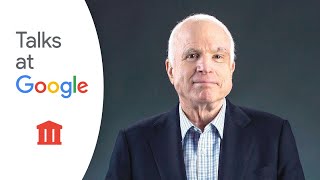
John McCain discusses his military service, POW experience, and 2008 presidential campaign with Google CEO Eric Schmidt. Topics include the Iraq surge, Iran's nuclear program, torture and Guantanamo, climate change, immigration, and energy policy.
Chapters
Afternoon. Good afternoon everyone. Welcome to a joint policy talk at Google Authors at Google Talk.
We want to thank the policy team and Pablo Chavez, the authors team and Josh Mendelsohn for all the work to pull this event together. We have special introducers for our special guests today. We have three Googler Naval Academy grads.
Roy Gilbert, who's here from India, runs our Hyderabad operations. Don Fall, who's one of our managers.
On checkout, and Dan Green, who's one of our managers on AdWords.
They are here to introduce our special guest. Good afternoon. My name is Dan Green and it's my pleasure today to help introduce our CEO Eric Schmidt, as well as US Senator John McCain. Senator McCain has served the great state of Arizona for the last 20 years in the US Senate. He's the ranking member of the Senate Armed Services Committee. He also serves on the Committee for Indian affairs as well as the Committee for Commerce, Science and transportation. During his 20 year career, he's focused his attention on campaign finance reform as well as defense spending and closing special interest loopholes. Prior to his service in the Senate, Senator McCain spent two terms in Congress after a long and distinguished career in States the United United States Navy as a fighter pilot. After graduating from the United States Naval academy. Like the three of us, Senator McCain was also a distinguished combat veteran of the Vietnam War where he spent five and a half years in the North Vietnamese prison camp as a prisoner of war. Shortly into his captivity, the North Vietnamese Learned that Senator McCain's father was an admiral in charge of all US forces in Vietnam and offered him the opportunity to return home early ahead of his fellow soldiers. McCain refused in a heroic act, keeping faith with his fellow prisoners, sacrificing his personal freedom. Stayed in north Vietnam. Senator McCain declared his candidacy for the Republican nomination for president in 2008 last week. He's known for differing from his party on platform issues such as campaign finance reform and stem cell research. He's also known as having appeared as a guest more often than any other person on the Daily show with Jon Stewart.
Yeah.
He's also the author of six books, so we're welcoming him today as a member of our Authors at Google series and also at Google Policy Talk. But before he comes out, having been here for a couple years, I know that Google can be kind of a strange place if you're a Naval Academy graduate and to make on your first day at the Naval Academy, they teach you, they shave your head, they teach you how to march, and they teach you to say beat army loudly and often. And there's no better way to make Senator McCain feel right at home at Google, because it's truly bipartisan. Everyone, whether you're liberal or conservative, wants to beat army in football. So on the count of three, let's give Senator McCain a very loud and rousing beat army to welcome him out. One, two, three.
Beat the army.
Senator John McCain.
Thanks for that introduction, guys. They didn't mention that I stood fifth from the bottom of my class at the Naval Academy. If my old company officer were here today, he would tell you that in America, anything is possible. They didn't mention that I was able to intercept a surface to air missile with my own airplane, which is. Which is no mean feat aeronautically. That was then Secretary of Defense McNamara's way of winning the Vietnam War. So I thought I might want to clear up that part of my. My bio and anyone who served in the army here today, I apologize for that.
Well, thank you. Thank you, Senator. Senator McCain is one of the greatest war heroes in America today, and he's devoted his life, I think, to public service. Not only has his family done it, but his two boys, one in the Marines and one now in the Navy.
So.
So the tradition continues. What I wanted to do, and of course it's a great honor to have you here at Google, is I wanted to begin with a reading from a remarkable book that you wrote, which is Faith of My Fathers. And I want to use that to ask you about the presidency. This is about his reflections upon the seven years of torture at the hands of the North Vietnamese. In prison, I fell in love with my country. I had loved her before then, but like most people, my affection was little more than a simple appreciation for the comforts and privileges most Americans enjoyed and took for granted. It wasn't until I had lost America for a time that I realized how much I loved her. I loved what I missed most from my life at home. My family and friends, the sights and sounds of my country, the hustle and purposefulness of Americans, their fervid independence. Sports, music, information, all the attractive qualities of American life. But though I longed for the things at home I cherished the most, I still shared the ideals of America. And since those ideals were all that I possessed of my country, they become all the more important to me. Is this why you're running for president?
I think so.
Let's turn.
I think so. I think it has a great deal to do with my belief in public service and that to serve a cause greater than one. Self interest is the noblest of all professions. And it doesn't have to be in politics and it doesn't have to be in the military. There's a thousand ways we have to serve our country, either part of our lives or all of our lives. And I would like to point out, Eric and I know that many people in this audience know we're in a very difficult situation in the world today. We are beset and assaulted by a great force of evil, that of radical Islamic extremism. People who want to destroy everything we stand for and believe in. And so I may not be the President for all times, but I believe I can be the President of these times. Because my entire past, my heroes, my inspiration, my beliefs, my values, I think qualify me and make me prepared to serve as Commander in Chief.
We. I like to think of the presidency as a job interview with the American people. And you're also sort of interviewing at Google.
Yes.
And it's hard to get a job at Google.
I know I've got. And I know I have my work cut out for me.
The question that was submitted was how do you determine good ways of sorting 1 million 32 bit integers in 2 megabytes of RAM? Sorry, sorry. I'm sorry. That was not an appropriate question. Let's ask a different question. When you're president, we really do ask people that question. By the way, when you are president, how will the world be different? How will the presidency be different? What are you going to accomplish as President of the United States?
Well, the first thing, obviously, that I would do, as I mentioned before, is to try to find out how best to defend our nation and defeat our enemies. Part of that, and that isn't just militarily. Militarily is the easy or probably the most straightforward part of the challenge we face. We face a challenge today around the world. America's prestige and standing have never been lower. There has never been a greater threat from radical Islamic extremism, as we know. So there has to be not just military, but intelligence, diplomatic, economic, and hearts and minds. Right now, my friends, some would argue that through the use of the Internet, Al Jazeera, many other ways, that the forces of evil are making greater gains than we are. We're going to have to do whatever we can, particularly through modern technology, to win people over to our beliefs, our faith, our values and our ideals. And my friends, we can't do that if we're abusing prisoners. We can't do that if we have places like Guantanamo Bay that have become a symbol of abuse of people. We can't do that if we are doing renditions and taking people to other countries where God only knows what is being done to them. We cannot torture prisoners no matter what. And how immediate the problem is, we have to maintain our moral superiority as a nation. And we do that because we are better than our enemies. And if people can't, if we act so that people don't know the difference, we're going to have great difficulties in the struggle that I'm describing to you.
I reread your book, which I said is just an extraordinary story. And for many people in the audience who were young or even not born during the Vietnam War, it is a chilling tale of being shot down. And you all should know that the senator before he was in Vietnam, was actually on a ship called the Forestall, where one hundred and thirty six people died in a terrible fire. He saved many lives during that fire as a jet pilot. Right after that, you went on a series of missions which culminated in the mission that you were shot down. Before we come back to the future, which I think is where we should spend most of our time, can you talk a little bit about what it's like to go through that many years of bones being broken maliciously? Isolation, terrible conditions, mental and physical torture that no one in this room, aside from yourself, has ever experienced. How did you get through it? And more importantly, why are you not embittered?
Well, first of all, I think faith in God is an important. Or faith in a higher being is an important element. Good to be able to turn to someone for. Or something for comfort. I happen to have had that faith. I think faith in your country is an important item. Many of you are not that familiar with the Vietnam war, but in 1968, Lyndon Johnson stopped the bombing of North Vietnam. And we were there and we thought, wow, we're going home. And it was a number of years later. And faith in one's fellow prisoners. One of the, one of the techniques that the Vietnamese used was to. Was to try to get people to make anti war statements or tapes or others in order to help their propaganda effort. And you had to believe, you had to believe that your fellow prisoner, before they made that tape or wrote that statement, did their very best they could to resist. I'll never forget early on when I was captured, one of the interrogators, one of my early interrogators, he said, we want to make you, we want you to make this tape condemning your country. And I said, I can't do that. And he said, well, no one will know. No one will know. And I said, but I will know. I will know. And I tell young people that many times in our lives we are tempted to do something and no one will know. But the fact is that you will know. You will know. Let me just tell you one quick story though, because when you hear about all the bleak side of it, as you described it, one we communicated with each other. The bonds of friendship and comradeship are unbelievable to describe. Those that I know best and love most are those that I. That I served in that situation with. In fact, I hear from them almost every day. I get so much advice and counsel from them and criticism. But I'll never forget I was privileged. I was privileged to observe a thousand acts of courage and compassion and love. Just one brief story about. I think the meaning will be clear to you. One of the techniques that the Vietnamese use to try to get us to cooperate with them was to take ropes and tie your arms very tightly and then pull them behind your back and loop the rope around your head and pull your head down between your knees and leave you in that situation which you can imagine becomes very, very painful over fairly short period of time. One night I was being kept in that condition, as we called it, in the ropes. And we had various guards, some interrogators, some who were. Who took basic care of us. And then there was regular guards, just walked around with a gun for security. Well, the door of the interrogation room opened and this gun guard, a guy who was just one. Who carried a gun, came into the cell, went like that and loosened the ropes that were binding me. And about five hours later, which was obviously the end of his watch, he came in and he tightened them up again and left. The following day was in October, Christmas Day. We were kept separate in. In those days, so we couldn't. They didn't want us to see or communicate with each other. But because it was Christmas Day, I was allowed to stand outside of my cell for about 10 minutes. And so I was taken out. And I was standing there and it was this dirt courtyard. And I long walked up the same guard and he stood next to me and for a minute and with his sandal on the ground, he drew a cross. And he just stood there for a minute and looked at me and then rubbed it out and walked away. Even in the worst of situations, no matter how difficult it is, you can always some find someone or something that you can share your faith and. And your hope with. And I'll never forget that, man.
When you got out of the terrible situation you were in and you Came back and you ultimately decided to run for Congress. You talked a lot about the inspiration for that. Ronald Reagan was part of that. Can you talk a little bit about what took you from literally hell to a political career with such a tremendous impact?
Well, I came back to the Navy and I was able to get back on flying status and was able to fly for quite a while, for a few years. And I commanded a squadron. And then I couldn't pass my physical anymore and for flying. And at that time, my friends and I had no mean to revisit ancient history with you. But there were tough times in America after we'd lost the Vietnam War. Institutions of government were under assault. There was riots on campuses. There was assassinations. Martin Luther King, Bobby Kennedy. We had in later on in the 70s, Americans being held hostage in Iran from our embassy. A lot of Americans thought that our best days were behind us. And the loss of the war in Vietnam. It wasn't just the loss of the war, but our country was very badly divided. It was very, very badly and bitterly divided. So along comes Ronald Reagan. He had great optimism. Many people didn't maybe share his philosophy or his party affiliation, but he had this core of principles, but he also had this vision that America's best days were ahead of us. And probably Ronald Reagan wasn't the most brilliant intellectually president that we ever had, but he had a set of core principles and beliefs about the greatness and the future of America that I think was shared by Teddy Roosevelt, Franklin Delano Roosevelt, Abraham Lincoln, and other great, great presidents that we've had. And he basically turned our country around in difficult times. And so he inspired me because I share that belief in optimism. And I don't mean to say anything that sounds like pandering, but when I'm in a room like this and I see the faces in this room and I see where these young people have come from and I see what they have achieved, any doubts I have about the future of America are quickly resolved. I'm honored to be in your company because you are the future of this nation and you should be proud of what you do every single day.
So if we Fast forward now 30 years later, the country is in.
Time flies when you're having fun.
I know and you know a series of senatorial terms. And I want to come back to some of the domestic issues, but I want to ask you another Iraq question. We now have an unpopular war, according to all the. And many people in the room disagree with President Bush. Last night in the debates, you were sharply critical of the execution of the war up till now. And if there's anybody in the room who has some expertise in this, it's yourself. You're also in favor of something called the surge. Why should we believe that the surge will work given the previous execution has been so poor?
First of all, I would be glad to chronicle for you many of the errors that were made in the conduct of this war. Instead, I. I commend to your reading and I get no royalties. A couple of books. One is called Cobra 2, another one is called Fiasco by Tom Ricks. It's very depressing. Both of the books. When you read of how badly mishandled this war was, from not having enough troops to allowing looting to not. I won't buy the. But we are where we are, and the mistakes and the mismanagement of the war by Rumsfeld and others is just appalling. We are where we are. And where are we now? We're in a situation where we really have the last chance to salvage this situation. We have a new general, and we have a new strategy, not just the surge. The way you combat counterinsurgency is to take areas and hold it and keep the bad guys out while the population is able to continue with their economic, political and other lives. And what we were doing before was just going in, killing bad guys and leaving, and they would come back in. Now, in 53 outposts in Baghdad, we have Iraqi and American soldiers 247 trying to maintain a secure environment so people can lead better lives. Anbar Province, we now have had. The Sunni sheikhs have come over on our side, and there's dramatic improvement there. That's the good news. Bad news is outside of Baghdad, particularly on the Western side, well, all sides, a lot of bad guys have moved out, and there's very heavy casualties and heavy fighting. There will always be suicide bombers for a long period of time. It's the most difficult form of warfare to combat, going all the way back to the kamikaze pilots, the Japanese in World War II. Ask the Israelis how hard it is. They've literally sealed their borders with Gaza and the west bank, and they still have people who get across and blow themselves up in order to take the lives of others. Militarily, it's not impactful. Psychologically, it's terribly impactful, as you can imagine. So this, if we can get a secure environment, the Iraqi military to take over our responsibilities, our military leave, the Maliki government function, my friends, one of the greatest dangers we have. I'm giving you a Little straight talk is whether the Iraqi government will function as an inclusive government or whether it'll be a sectarian government. They've got to pass laws on the oil revenues, they've got to pass laws on de Baathification. They've got to have elections in the provinces. They've got to perform like a government that's a true government of all the people. I can't guarantee you that will happen. I can't guarantee that this new strategy will succeed. I can guarantee if we have to withdraw any date certain, and that is there'll be chaos, there will be genocide, and other nations in the region will be drawn in. The Kurds will want to become independent. The Turks won't allow it. The Iranians will be attempting their age old ambition to have Persian hegemony in the area. The Saudi Arabians will feel that they have to defend the Sunni. Jordan has already got 750,000 Iraqi refugees and that's a small country. The list goes on and on. The Egyptians will feel threatened because Al Qaeda will establish a stronger base in Iraq. So there's a lot at stake here and I believe that. And may I say, and I should have said this at the beginning, I understand the sorrow, the frustration and the anger of the American people and a lot of people in this room because of these failures. We have sacrificed so much, so much in American blood and treasure and the mishandling of this war. I think it's going to be a race against time and I hope we can succeed. If you start showing some success. The Iraqi military takes over, the US begin to withdraw. Other nations in the region who have an interest, even the Iranians over time have an interest in not seeing chaos in that region. And maybe they will play a greater role and be of more assistance as far as money is concerned. I would remind you that they're sitting on the second or third largest pool of oil in the world. I'm sorry for the long description, but there is one bit of good news, my friends, and you know them and you've seen them, but these soldiers and marines and airmen and navy people are the best of America. They're the best we ever had. They're the most professional, they're the best trained, they're the most courageous. And every time you see one of them walk over and say thanks for serving.
You, you mentioned Iran and Iran is in many ways even greater concern because of the nuclear.
Yep. And it was asked last night in the debate, and you may have remembered that I made reference to an old Beach Boys song. Some of you may have heard, I won't do that again, but it's on YouTube. Maybe I could do Good Vibrations or something like that. Anyway, the.
Is there a level at which you believe Iran's misbehavior justifies a preemptive strike?
I apologize for some of the answers that are maybe are longer than they should be. But these are complex issues. In short answer, my friends, we cannot allow Iran to have nuclear weapons. Now, there's a whole lot of things we have to do between now and then before we would reach a point where we would act militarily, economically, diplomatically, encourage democracy, work with our European allies, do many, many things that need to be done before we would consider anything other than the economic, domestic, political and other sanctions and efforts that can be made. I just want to remind you the President of Iran came to the United nations and pledged his nation's dedication to the extinction of the state of Israel. My friends, it's hard to deal with people who think that way. Their president has this cockamamie me idea that the 13th Imam, or whatever it is, it's going to come and that can only happen after Armageddon. And they're not rational. I would remind you that the majority of the population of Iran is sophisticated, cultured, interested in democracy and freedom and a very, very modern society. We're not talking about North Korea here. We're talking about people who are very interested in having the freedoms and the rights and privileges of a free society. Is it difficult? Yes. My greatest fear, and I'll end with this, my greatest fear is not that Iran develops a nuclear weapon and launches it, but my greatest fear is that Iran acquires a nuclear weapon and gives it to a terrorist organization. Because there are ample evidence that Iran is a sponsor of terrorist organizations such as Hezbollah and Hamas. This is a very great threat we face and we can get our allies and friends, particularly in Western Europe, to work with us. The Russians and the Chinese are being singularly unhelpful.
I'd like to move a little bit more to domestic policy. Although everyone's very much focused on the foreign policy issues. There are many, many domestic issues that we face and US President would inherit many of them. And what's interesting about your political background is you've taken so many, I think, what you would call straight talk positions which are not really part of either party.
Party.
So, for example, you were one of the first people to be concerned about global warming, which is very much at odds with many of the people in your own party. Can you tell US the domestic policies that are signature issues for you which would be fixed quickly under President McCain.
I'd like to mention two of them. One, climate change and the other spending. When I ran for president in 2000, in town hall meetings. I do town hall meetings all the time. That's why I hope we have a chance for people in the audience to ask me some questions. That's where I learn. That's where I learn what's on people's minds. That's where I understand their hopes and dreams and aspirations far better than I can any other way. Town hall meeting after town hall meeting in 2000. Young people, stand up. What are you going to do about climate change? I didn't know anything about climate change. I went back to the Senate after I lost, by the way, after I lost to President Bush in South Carolina primary, I slept like a baby. Sleep two hours, wake up and cry. Sleep two hours. So I went back. I was chairman of the Commerce Committee. I had a hearing after hearing after hearing. I traveled all around the world, usually at your expense. I've been to Savalbard, near the Arctic, near the North Pole. I've been to the South Pole. I've been to the Brazilian rainforest. I've been to Point Barrow, Alaska. My friends, I've seen it. It's there. I've been to Greenland. It is there. It is a threat to our nation's future. And if there is a criticism that I have of the Bush administration domestically, it's our failure to act on this issue. My friends, it's a matter of time. And I don't know where the tipping point is. Everybody in this room is probably smarter than I am. But I know this, that unless we take serious and concrete steps to reduce greenhouse gas emissions, we are going to give our kids a planet that's going to be very difficult to live in. By the way, small addenda, recently, in case you missed it, some retired military officers issued a report about the threats to our national security posed by climate change. I mean, this is an all encompassing challenge that we face. Spending. You know, I used to say that, that, and I mentioned this last night. I used to say that Congress spends money like a drunken sailor and that I never knew a sailor, drunk or sober, with the imagination of some of my colleagues. Well, I'm not making this up. I'm not making this up. A few weeks ago, I received an email from a guy who said, as a former drunken sailor, I resent being compared. To $3 million to study the DNA of bears in Montana. I Don't know if that's a paternity issue or a criminal issue. In 1987, Ronald Reagan vetoed the then highway bill. It had 152 earmarked projects on it. He said, I haven't seen this much pork since I gave out blue ribbons at the Iowa State Fair. Two years ago, the President of the United States signed into law a highway bill with 6,140 earmarked projects, including the now famous Bridge to Nowhere In Alaska, a $233 million bridge to an island with 50 people on it. The next time you're stuck in traffic, think about what you could do. And you know what it did? It bred corruption. It bred corruption, my friends. We've got members of Congress in jail. We got the FBI raiding people's offices. It led to corruption, and Americans are sick and tired of it. The first pork barrel bill that crosses my desk as President of the United States, I will veto it and make the authors of those projects famous. You will know their names on Google.
So I have one more question, and we'll get some audience questions as well. So I think people, we have some mics, people, people can ask questions. When you're President of the United States, will you promise our audience to talk as honestly and openly in a straight talk way as you are in the campaign?
I will. And I'd just like to mention many of you, and I know you keep up for a year or two people saying, he's not the old McCain, he's not a straight talker. He's doing this and he's doing that. My friends, the reason why I've made a, quote, comeback in the view of some is primarily because I'm doing the things we used to do. We're doing the town hall meetings, we're going, getting on the bus. We're letting all the media people on the bus with us and talk as long as they want and ask as many questions they want. I deal directly with the American people and I deal with people who are in the media, and I'm glad to do it. As long as it's not filtered through somebody else's prism, I'm going to do just fine. Now, right now, the approval rating of Congress. You know how low the President's approval ratings are? The approval rating of Congress is even lower. I think one poll I saw was about 17%. You get down that low, you're down to paid staffers and blood relatives. I want, I want, I want to restore people's faith in their government and their belief that we're working for them and not for us and not for reelection. And every single day of my time as President of the United States, I want to at the end of the day say, did I work for the American people today or did I work for my own personal ambition? I hope that on most days I can give the first answer. But my friends, I promise you, I know there are people in this room right now and we'll get to in more questions that disagree with me on a specific issue, whether it be Iraq, whether it be on abortion, whether it be whatever it is. But I promise you, I will take these positions because I've thought about them, talked about them, and believe in them and believe they're best for my country, not for my personal ambition. Thank you.
Some questions. The lady on the right.
Yes, ma'. Am.
Okay.
Do you hope I ask a really long one to. Senator, thank you for coming here. It's an honor to us. It's also very unusual for us to have a Republican visiting here. Most of the. Some of your best friends are Republicans. I bet most of the people I've met in high tech are either liberals or libertarians. I wanted to ask you why you think that is and why you think we should be Republicans. You know, Here's what I believe about the Republican Party. I'm of the party of Abraham Lincoln and Theodore Roosevelt and Ronald Reagan. We have a core set of beliefs which I respectfully disagree with my friends who are of different political philosophy. We believe that less government is best government. We believe in lower taxes. We believe in less regulation. We believe that the best government is the government closest to the people. We believe in a strong national security. We believe in a robust foreign policy. We believe that those immortal words that all people are created equal and endowed by their creator with certain inalienable rights, among these are life, liberty and the pursuit of happiness, apply to all not just because they happen to live in our hemisphere or in our country. And I believe that this greatest and noblest nation that ever graced the face of the earth does have a noble mission. And it's not by sending armies or missiles, but to spread the core principles of belief and freedom and democracy throughout the world. And it will be my job to continue that because I believe people all over the world deserve the same opportunity. So less government, lower taxes, less regulation, government closest to the people. Why not let businesses and others do the job that government does not do well, including, by the way, handling natural disasters? So I could tell you a lot. And a strong military establishment, you know, When I look at what this organization is all about, I think I identify more closely with it than a Democrat does because I believe in less government regulation. I believe the Internet is the greatest invention since the printing press. We all know that. And I believe that the less regulation, the less oversight and the more that this can flourish. The reason why I opposed Internet taxes, the more that this new information technology can flourish and spread all over the world, the better off the world is going to be. I think that's a core Republican philosophy. Finally, one footnote. Eric just showed me that globe of the world and the places where all of this activity is taking place. And you know, it's wonderful. But as he pointed out, it's also kind of sad when you look at vast blank spaces on Earth that still people are unable to share in this incredible, incredible thing that's happening. I lose the ability to describe it. But you look at the whole continent of Africa, as Eric showed me, isn't that terrible that those billions of people are unable to have the same privileges that we have and the ability and access to information? I think our job ought to make sure that some very short time from now I look at that globe and its uniform all over this earth. Over here.
Go ahead.
Yes, sir.
Thank you for coming today, Senator. At Google we care very much about protecting users privacy. It's one of. It's very important to us across all of our products and a lot of things that we work on. I'm curious, if a bill came to the Senate enshrining in the Constitution a general right for all Americans to privacy.
Would you vote, how would you vote on that? I would vote in favor of privacy, obviously. I mean, I mean, obviously I think we all have that right, but when you get. Obviously that's my position, but I'm not sure exactly the aspects of that bill that you are talking about. Pablo, is that. Have we had. Do we have that. Any legislation of that nature? Yeah, but I was asking if there was any legislation. I did not see any. I have not seen that particular legislation, but I am certainly in support of consumer privacy.
Okay.
Yes, sir.
Larry, I need to warn you about. Larry.
Senator.
Senator, go ahead.
Larry left your coffee cup in the laundry room, so. Thank you. Larry.
First of all, I appreciate your coming, taking the time to come here. Since Eric won't allow me to ask about computation under resource constraints and I promised Eric I will not ask about UFOs. It was a really fascinating story that Carter told. I warned you. I will give you a choice of three topics. Do you Want a question on genocide, campaign finance or the flag?
Genocide. Genocide.
Is this a new forum that you're going to use? Larry, where do you come up with this thing? Sorry. In all serious note, this was actually my most critical question. Three years ago we remembered the 10th anniversary of Rwanda and you co wrote an article entitled It's Happening Again. Last year you co wrote another article entitled Rescue Darfur. Now why, I mean, basically, do you feel that you, the Congress and the administration, who all call this a genocide, have done everything possible to end the crisis in Darfur? If not why? And what can we all do to stop this?
I know, I don't think we've done all that we could, obviously, because it's still going on just as it went on in Rwanda and just as it went on in the Holocaust and just as it went on in Cambodia. I understand and I've been briefed many times, and I'm sure you have too, about the difficulties, the size of the area, how you separate good guys from bad guys, that the logistics are difficult. If there was someone here from say one of the agencies of government, they could probably describe to you the 20 difficult aspects of this whole genocide in Darfur. But it seems to me that we've not done enough because we're the most powerful nation on earth and we need to do more. One of the things that I would do is to call the African states together that are, that are capable and there are some and have militaries and say to them, look, I'll supply you with the air transportation, with the logistics, with the equipment, whatever is necessary, but get in there and start separating these warring parties and stop this genocide. We've made many efforts. I've got to give Republican and Democrat and all of them, they've made many efforts, but it's, it still goes on. And so I would have to sit down frankly and say, what haven't we done? And there must be some things we haven't done. Would I send in the US Military? That's the big question. Because that's the ultimate. I would if I could be sure that it would be effective. And there is some question as to whether we could have a beneficial effect even with American military there. But tragically, my dear friends, when we turn on the evening news, we don't see this slaughter. When we listen to whatever it is online, we don't hear about it because we don't have media people in the country. And when they do come in the country, the government gets rid of them as quickly as possible. We haven't done enough. We got to do a lot more. I would sit down and say, okay, what haven't we done? And. And I would risk a great deal, because if we don't, as, you know, a few years from now, we'll look back and say, never again. Yes, Sir. Welcome, Senator McCain, to Google. Thank you. Earlier, you mentioned in the same breath Teddy Roosevelt and fdr. Yeah. And you also discussed your opposition to big government. And it seems to me that the architect of the New Deal and your stance against big, big government are in conflict with one another. How do you resolve that? And do you have any specifics, say, for an issue as encompassing as health care? First of all, the reason why my admiration. My admiration for Franklin Delano Roosevelt is that when this country was in the depth of despair, he lifted this country up. When he saw World War II approaching and recognized the threat of Hitler and fascism, he took steps, which were extraordinary, to try to prepare this nation to meet the threat of fascism. And in some ways, it was almost in violation of existing law. And certainly if he had not taken those steps, I think we would have. I think we would have won World War II, but I think it would have required us to do make a great deal more sacrifices. I don't think many of the New Deal programs worked. I don't think many of the Great Society programs worked because I don't believe fundamentally that government can carry out these responsibilities very well. And I could make a historic case for it. But I respect Franklin Delano Roosevelt because he led this nation in a time of crisis and he inspired us and, and he lifted us up. The fireside chats, if you ever hear much about it, were a very important tonic to the United States of America when we were in the depths of a depression, the dimensions of which are hard for us to encompass today. So I can put Teddy Roosevelt and Franklin Delano Roosevelt, who were distant cousins, in the same category because they both inspired America, and that's the kind of leaders that I respect, respect, and admire. Go ahead.
Yes. Senator, as a lifelong Democrat, I want to tell you I've always been impressed by your straight Talk.
And in 2000, in one of the.
Most I would take courageous statements, some might say suicidal, you came out with a very strong statement, both on the.
Left and on the right, on religious extremism. More recently, you seem to have pulled back from that.
And I wanted to get your sort.
Of impression in 2007, heading into 2008.
On that same topic.
I believe in reconciliation. When I, after I'd been back From Vietnam for several years. I met with some anti war people. In fact, one who had gone to Hanoi and signed a peace treaty, which was very well publicized. And we heard about it in loudspeakers in our rooms. I reconciled with that fellow because we wanted to move forward for America and heal the wounds of war. Reverend Falwell came to my office and sat down and he said, Senator McCain, I want to put our differences behind us. Anyone who walks into my office that I've had problems with and sits down and says, I want to put our differences behind us, I'm glad to do it. Then he asked me to speak at Liberty University. I spoke at Liberty University and I gave a statement and a speech about tolerance. I was politely received. A few weeks later, I went to the New School in New York City to give the exact same speech. I was booed and heckled. The faculty turned their chairs around and put their back to me and carried signs. And it was a remarkable experience. I believe in reconciliation. I believe that you ought to move forward rather than look back. No, I have not had communications with Reverend Robertson. I have not had any communications with him. I have not had any communications with Reverend Dobson. But when Reverend Falwell came into my office and said he wanted to put our differences behind us, I was glad to do it. Yes, sir.
Hey, Senator, My name is Kurt. You recently said that faith in God is one of the most important values to you, especially in your time in Vietnam. I am an atheist, as are many in this room. Atheists are famously one of the most persecuted minorities in America. A fellow Republican named George Herbert Walker Bush said, quote, I'm not sure that atheists should be considered citizens. This is one nation under God. Could you comment on a few things? Number one, what you think of atheists in general. Are we going to hell, for instance? Number two, the state of atheism in America. And number three, what should be done to combat the stigma against us?
I believe that everybody's entitled to their beliefs and no policy or idea of mine that I would. That I may. I may disagree. I have a personal disagreement, but I would never hold any public policy or views that accept that you are entitled to those views. And that's one of the greatness of America. Yes, sir.
The current administration has for a number of years, used a dialogue of extremes. Good versus evil, win versus lose, red versus blue, the. And the result of that is that the nation has become, in my opinion, deeply divided. In fact, in your recent appearance on the Daily show, you yourself responded similarly when pressed about Iraq. You responded as though, if we haven't won, then who did? Was. I believe your words, when in fact, that statement ignores the possibility that nobody did. So my question is just how do you plan to address this in the event that you were elected?
Thank you. I'll address it again. The majority leader of the United States Senate said the war was lost. Any rational observer will say that if a war is lost, then somebody won the war. That there's no. That's perfectly logical. And it would be illogical to say if someone lost a war, that. That somebody didn't win. Al Qaeda will win that war. And to say that somehow we didn't lose, if we have to withdraw and chaos ensues and Al Qaeda becomes. Uses Iraq as a base for attacks against us. My friend, these are extreme people we're facing. Not long ago, there was a car that went through a CheckPoint and with two children in the back of the car. They were waved through because there were two children in the back of the car. The guy driving it got out, walked away and blew up the car with the children in it. If these guys will kill their own children, what do you think they would do to our children? Did you ever hear about the website sawing off somebody's head? Look, these are evil, extreme, terrible people that are bent on our destruction. This isn't Beanbag. This isn't a discussion about atheism versus Christianity. This is a discussion about people who want to destroy everything we stand for and believe in. Now, if you think that there's some common ground there or some. I'm acting in an extreme fashion. I respect your views. I know of too many people, too many people who have sacrificed their limbs and their lives in the cause of freedom for the people of Iraq. We have an honest disagreement. Sir. Go ahead, Senator McCain.
Something struck me while you were speaking that I couldn't first ask a question without thanking you for your service in our nation's armed forces and in our nation's Congress. So I wanted to say thank you on behalf of all of us here and everyone who's not here.
But I also have a question.
I'd like to change the direction, maybe away from the Middle east, because I feel like we talk a lot about it, but it's always going to be tied to that. I'm curious to hear your opinion on Russia. As you know, they're helping Iran build a nuclear power plant and have been for. For the last 14 years or so. As a nation that we typically consider one of our allies, are they just confused not on board, or is there some sort of miscommunication happening that they.
Would continue to have this cooperation?
Or are we simply going to agree to disagree about this issue?
I'm very concerned about Russia. I think we all should be. It's gone from a nation that certainly had some of the beginnings of a free, open society to a consolidation in the Kremlin by Putin and his apparatchik, KGB apparatchik friends. As you know, they have even kicked out international organization. He appoints all the governors now. The list goes on and on. But it's very disturbing when the media is being repressed as it is in Russia today. The Russians are being very unhelpful as far as the Iranian issue is concerned. And of course, as far as North Korea is concerned. Putin is intimidating his near neighbors. He is bullying Moldova and Georgia, by the way, Georgia is a remarkable little country now that is making some significant progress with, under the young president who was educated in the United States. I think that the Russians have to understand that if this path towards autocracy and the attempt to restore the old Russian empire, and they can't, by the way, they're not nearly this size, nor look, if oil were $10 a barrel, they would be an economic collapse. But I think they have to understand that in certain international circles they will not be accepted if they continue to practice this kind of behavior. And I'm very worried about it. But I don't view it as another reignition of the Cold War. I just don't see that scenario. But I have great sympathy for the people of Russia as this consolidation of power in the hands of a few people continues. It's very disturbing. Yes, sir. Thank you for visiting Google. I'm Tom Zhang at Google Staffing.
My job is to recruit the top talent for Google.
So as Erica pointed out, it's very hard to get a job at Google.
Everyone you see here in this room.
That the best of the best. So we have some requirement on the.
GPAs of the candidates.
We know that President Bush was a.
C student at Yale. So do you remember your GPA at school? By the way, if you can find a solution to reduce the gas price in mountain view below $2, I can help recruit 100 volunteers for your campaign.
Thank you very much. My GPA earned me fifth from the bottom of my class at the Naval Academy of Status. So the GPA was. Since that was in the Coolidge administration, they gave. They. It was a different measurement, but I can assure you on today's standards, it would be Barely passing. And that's. And so look on energy real quick. When oil is $10 a barrel, ethanol doesn't make a lot of sense. When it's $60 a barrel, it makes a lot of sense. When we are dependent upon foreign oil supplies, then we are very, very much in need of energy independence. And one of those. And one of those, by the way, it's not just corn based ethanol, by the way. Sugarcane, biofuels, switchgrass, whatever you want, ethanol is part of it. The Brazilians are able to convert their entire Automobile fleet to E85. We should be able to make significant progress in that direction. Nuclear power has to be part of any equation if we're going to reduce greenhouse gas emissions and we are going to reduce our dependence on foreign oil. The French generate 80% of their electricity with nuclear power. Can't we do something similar? We are at risk. If you look at many places in the world, our oil supplies are at risk. And so we're going to have to become energy independent. That means higher emission standards, that means higher miles per gallon. It means a whole lot of things, but it doesn't mean we have to shiver in the dark and not enjoy the lifestyles we have, by the way, hybrid cars, electric cars, the Average citizen drives 25 miles a day. We could have electric cars. We could do a lot of things that would not be painful but would help us as we try to achieve energy independence. And if you give me the list of names, I'll call them personally.
Hi, Senator, it's good to see you again. Back in high school, I campaigned for you, but unfortunately we lost to Bush and his cronies.
So it's been a long eight years. So I just wanted to know, what.
Issues have you changed your views on since then?
What do I need to know if I need to get back into campaigning.
For you this time around?
I think the biggest change of course was 9, 11. I'm sure you know that that event changed America and the world. And although there had been other terrorist attacks prior to that, there's no doubt that would now open a new chapter in America's history and in the world history. The other thing I think that that's happened, there's a number of things that happened, but one of them was, as I mentioned earlier, in 2000, I knew a bit about climate change. Now we know a lot about climate change and we have to act on climate change. I think the third thing is this corruption issue that I told you about. Americans more and more are registering as independent voters. They're registering as independent voters because they can't find a home in either party. So I think we've got to have a real effort at restoring the faith and confidence in our government. Those are some of the changes. Thank you. Yes, sir.
Hi, Senator, I have a question in relation to your stance about don't ask, don't tell policy. In a recent letter to the Servicemen's Legal Defense Network, you claimed that allowing gays and lesbians to serve in the military would harm troop morale, unit cohesion, things of that nature. How do you reconcile the discrepancy between that claim and a recent Zogby poll that found 75% of active duty staff servicemen have no problem with gays and lesbians serving in their units?
Because I listen to military leaders, I listen to Colin Powell, I listen to all of the leadership ranging from second lieutenants to four star generals, and they tell me that this policy is working, that it's satisfactory, that we have the best and most professional military in the world and they don't want it changed. That's why I rely on them. Go ahead.
I have a follow up to that talk about how it, you know, it helps our military. Since the institution of don't ask, don't tell, three dozen linguists specializing in Arabic and Farsi have been kicked out of the military. You claim that allowing gays and lesbians to serve would harm national security. Just how much safer should I feel knowing that the US Military has a reduced capacity to translate Arabic and Farsi?
Well, I guess I can repeat my answer to you. And I will. When the leadership of the military that I rely on to carry out the mission of the military and ensure our nation's security tell me that they think the policy ought to be changed, then I'll want to change it. As long as I give them responsibility to fight wars and defend the nation, I will listen to their advice and counsel as to how they can best do it. Go ahead, Senator.
We've run over our time.
Maybe do two more.
Well, we can do whatever you want. Senator, you're in charge. My suggestion was we get a sense of the topics from the folks quickly and maybe you can give an integrated answer.
Whatever works for you, Senator. Sure, sure, go ahead.
Just give us each of the topics. Mine in one word. Just accountability. What would it look like under you? Go ahead. Improving a broken military. Okay, go ahead.
That also how deregulation doesn't mean Enron.
And California power rollouts like what is deep deregulation mean? That makes sense. Go ahead. The role that justice would Play in your administration.
Good question.
Go ahead.
Foreign aid or free trade to help the people in India and Africa living.
On less than a dollar a day. Interesting. Go ahead. Immigration laws. And also, how do you plan on realizing peace over the world? So Senator, this is the Middle east part of your job interview at Google about immigration and how we can improve things. Maybe you could just give an integrated answer to that.
But I just start with immigration because it is a vital issue. If Google is going to be able to maintain its supremacy in the world, it's going to have to continue to get the best and the brightest from all over the world. Let's make sure we understand that. And I accept with your gigantic egos that you are the best. We have to have a comprehensive solution to the immigration problem and we have to enforce our borders. Every nation in the world. And we have to enforce and secure our borders. But there must be a comprehensive approach to it. And it must mean that we have a temporary worker program. That means we must have H1B visas that meet the requirements. It means that with that someone who works must be have a tamper proof biometric document. And you know, we can achieve that in order to work. Employers that employ people without those documents should be prosecuted the fullest extent of the law. We should address the issue of the 12 million people who are already here. And I would. And, and it is not amnesty because they broke the law, but there ought to be an opportunity for them to obtain citizenship under certain stringent conditions. Getting in line behind everybody else. I've been working for the last several months with the President, with Ted Kennedy, with other Democrat senators and Republican senators trying to put a package together. I think we all have a different idea about immigration in this room. One thing we know, the status quo is not satisfactory. And I also would make one additional point. We got to make sure that young people from all over the world who want to come to our country and are qualified to work, I mean to study in our best institutions have the opportunity to do so. And so the other questions had to.
Do with both corruption, globalization, efficiency of government.
I'm a free trader. I'm a free trader. I believe that America can compete with anybody in the world, Ike, as long as those markets are open and as long as there is not barriers to our products. I think that one of the reasons why we have as much difficulty in our own hemisphere today is that we have barriers to their products into our nation. I am a free trader and I believe that obviously if somebody is blatantly abusing Patents blatantly abusing intellectual property rights, et cetera, et cetera. But I think the worst thing that could happen in the United States of America is for us to go into protectionism. And, and the last election was moving us in that direction, my Democrat Party friends. So I hope that. I hope that we will understand the benefits of free trade and the fact that American products, American ingenuity, American knowledge can prevail any place in the world. And we will, and we can. A lot of Americans, as I mentioned, don't know that 50,000Americans today make their living off ebay. We know about the layoffs because of the manufacturing, loss of jobs. A lot of people don't appreciate what this new information technology has done for America and the world. And I'd like to answer your question real quick.
Thank you. I was wondering if you had made any personal changes to combat global warming. Like, do you drive a different car?
We have some electric vehicles. We have some solar panels in our place up, up north. Have we done enough in our family? No, but we're, we are working on it. My daughter, who's about to graduate from Columbia, we're going to get her a Prius or, you know, we're going to, you know, we're going to make her sacrifice. What the hell.
Let'S. Francoise and the other two. Can I just get your.
By the way, that's a fine automobile. I don't.
Can we get. Just a summary, Francois, just one.
What is your version of the no.
Child Left behind that is actually going to work this time around? And the next two, please.
Yeah. It has to do with the balance between ideals and pragmatism and how America is recognized both for ideals of democracy and other things. And yet we're a member of the global community and other places don't have the same ideals.
And we have to be practical in.
Creating allies and things like that.
How do you balance those things? And our final question. I was also going to ask about trade, which you just touched on, but I was going to ask specifically about world trade agreements versus bilateral and also how you would work with the Democratic Congress.
What compromises you? I'd like to see. I'd like to see a world free trade. I'd like to see the Doha Round succeed. And I worry when we make just a series of bilateral agreements, but that's better than nothing. But we've got to reduce the influence of special interests if we're going to have worldwide free trade agreements. On the issue of no Child Left Behind, I think was a good Beginning. I don't want to scrap it, but we got to fix it. It's been five years, five or six years now. We should go back and revisit it. Choice and competition, I think, are the key to successful education in America. And finally, if I could end up with that young man's question of. There's always a tension in America between Wilsonian principles and those. And those famous words about all are created equal and endowed by their creator. And then America's noble mission to spread democracy and freedom around the world and also the real politic in other countries. There's no tension. There is in US Example. What about Musharraf in Pakistan? Musharraf in Pakistan is not a freely elected president, but the fact is we know that if he were overthrown right now or removed for office, you'd probably get a good chance of his radical Islamic government. We called for free elections in Palestine, in the Palestinian area, and we got Hamas. So there's always these tensions. And I come down on the side of idealism. I come down on the side of democracy. Democracy and freedom. I come down on the side of the profound belief that there are billions of people in this world today who enjoy none of the beauties and bounty of a free and open society and do not have an opportunity to better their lives for themselves and their children. And that means the kind of government that they have. We looked at that blank space in the continent of Africa. Why is it? One of the reasons is because Africa is full of. Of failed states. So I believe that the pillars of freedom, the opportunities that everybody in this room and I have enjoyed, should be extended to all Americans. And if there's a close call, it's on the side of that side of the argument, as opposed to the rialpolitik. I want to thank all of you for allowing me to visit with you today. I don't mean to continue to boost your already sizable egos, but I would. But I would like to say. Say it's an honor for me to be in your company long after. Long after politicians like me have left the stage. Your contributions will be lasting and eternal. And I think every single one of you can be proud that you have been part of an incredible period of the history of the world, and you have made an enormous contribution to it, and I am humbled to be in your company. Thank you and God bless.
I think. I think we see. I think we see the answer to my question, which is your character, your leadership, and your strength. Straight answers and this team. Appreciate it. And I think I speak for everyone that this is an amazing day at Google. So thank you very much. We're going to go to the left.
More from Guy


Cheryl Strauss Einhorn | The Human Edge: Smarter Decisions in the Age of AI | Talks at Google



Rachel Glennerster | Innovation and the Center for Global Development | Talks at Google

Rebecca Winthrop | Rethinking the Purpose of Education in the Age of AI | Talks at Google

Dr. Robert Wachter | A Giant Leap: How AI Is Transforming Healthcare... | Talks at Google



