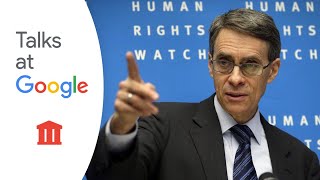
Ken Roth, who has led Human Rights Watch since 1993, describes the organization's investigations and campaigns in Darfur, Afghanistan, and Colombia. He details efforts to push China on Sudan, restrict cluster munitions, and prosecute war crimes, and criticizes CIA prisons and torture under the Bush administration.
Questions this video answers
1993
70 countries
Founded 1978 as Helsinki Watch
1988
Based in New York; offices in Brussels, London, Moscow, Hong Kong, Los Angeles, San Francisco, Tashkent, Toronto, and Washington
Chapters
Thank you for coming today. We really, really appreciate it. My name is Tara Cannobio and I'm part of the google.org team. It's my pleasure today to introduce Kenneth Roth to Google. Kenneth Roth is the Executive Director of Human Rights Watch, a post he has held since 1993. Human Rights Watch investigates, reports on, and seeks to curb human rights abuses in 70 countries Human Rights Watch started in 1978 as Helsinki Watch to monitor the compliance of Soviet bloc countries with human rights provisions of the landmark Helsinki accords in the 1980s. America's watch was set up to counter the notion that human rights abuses by one side in the war in Central America were somehow more tolerable than abuses by the other side. The organization grew to cover other regions in the world until the Watch committees were united in 1988 to form Human Rights Watch. Human Rights Watch is based in New York with offices in Brussels, London, Moscow, Hong Kong, Los Angeles, San Francisco, Tashkent, Toronto and Washington. More than 150 dedicated professionals work for Human Rights Watch around the world. They are lawyers, journalists, academics, and country experts of many nationalities and diverse backgrounds. They often join forces with human rights groups from other countries to further their common goals. Mr. Roth has conducted human rights investigations around the globe, devoting special attention to issues of justice and accountability for gross abuses of human rights, standards of governing military conduct in time of war, the human rights policies of the United States and the United nations, and the human rights responsibilities of the multinational businesses. He has written more than 80 articles and chapters on a range of human rights topics, such as publications in the New York Times, the Washington Post, Foreign affairs, the International Herald Tribune, and the New York Review of Brooks. He regularly appears on major media and speaks to audiences around the world. Much of HRW's current focus is on the crisis in Darfur. Since early 2003, Sudanese government forces and ethnic militia called Jajanaweed have engaged in armed conflicts with rebel groups called the Sudanese Liberation Army Movement sla, slm, and justice and Equality Movement jem. As part of its operations against the rebels, government forces have waged a systematic campaign of ethnic cleansing against the civilian population, who are members of the same ethnic groups as the rebels. In early 2005, the number of government attacks on civilians decreased, partly because the majority of targeted villages were already destroyed and their inhabitants displaced from rural areas. Since late 2005, however, the situation has dramatically worsened, particularly after the May 2006 Star for Peace agreement. The agreement has brought little peace organizations such as Google, in conjunction with the United States Holocaust Memorial Museum And Human Rights Watch are currently working to document and hopefully bring an end to human rights abuses in Darfur. With that, please join me in welcoming Kenneth Roth to Google.
Well, thanks Tara, it's a pleasure to be here. Let me start off with a confession. I'm actually one of the few people, maybe not so few, who actually uses Google as my homepage. And what I did, this is slightly perverse. I have it on News Google and I have Human Rights Watch plugged in there. And so that way, first of all, see what bad things are we saying about other people? But probably more to the point, what bad things are people saying about us? Since often governments that don't like us reporting on their atrocities attack us. And it's always nice to know who attacked us overnight so we can figure out who we have to respond to in the morning. So that's my kind of perverse use of Google. I use it in many other ways as well. Anyway, what I thought I would talk about today is obviously Darfur. I want to talk a bit about a couple other campaigns that we have going. Our effort to limit the use of cluster munitions and also our efforts to stop some of the worst atrocities of the Bush administration's so called war on terror. And then I thought if we have time, I may end with just a few words about Google in China and my thoughts on that since I know that that's source of interest. To begin though, as Tara mentioned, Human Rights Watch works around the world. We're in about 70 different countries on a regular basis. Basically any place where you have an abusive dictator or a repressive war, we will have people there. Way of protecting rights. And we do this, we basically begin by investigating and exposing human rights atrocities because everybody tries to hide their human rights abuses. You know, even Saddam Hussein tried to keep things covered up. And so most of our team is composed of researchers, we call them. They're basically, you know, investigative reporters. They, they live in the country or they travel there regularly and their job is to talk to the victims of human rights abuse and talk to the eyewitnesses and collect as accurate information as they can about what the government or what a rebel group is doing to suppress the rights of the people there. And we then take this information and write it up in the form of a report which we publish. And the publication of that report serves as the basis for our efforts to put pressure on the target government. And we do that in essence in three ways. One is by shaming or embarrassing the government, we'll publish the report and the press relies on what we say and they will write about it. And so when I do my little news Google search, a lot of entries show up because every day the press is reporting on what we say. And no government likes to see themselves portrayed as a human rights abuser. It's like being called a child abuser or something. It's just you don't want that said about you. So that can be very powerful. Because if governments realize that they will lose their reputation if they continue with human rights abuses, then ultimately you can get them to curtail those abuses or even to stop. So that's a big part of what we do. We also will go to influential governments around the world and we'll say to Washington or to the European Union, or it might be the United nations or the World bank, we'll say, use your economic or diplomatic influence to put pressure on the target government to change. And sometimes they do that voluntarily, sometimes we have to embarrass them to do it. But ultimately, if they say to a government, you're not going to get this next tranche of aid or you're not going to get this diplomatic visit that you wanted unless you change these rights abuses, that's another source of pressure. And then finally, in the worst case cases like Darfur, we try to prosecute the perpetrators and we actually try to get them brought before one of the international tribunals that we've played a large role in setting up so that the mass murderers face at least a decent prospect of spending the rest of their lives in prison. So those in essence are the tools that we use. Just to give you some quick examples, we've been doing a lot of work in Afghanistan, looking not only at abuses by the Taliban, but also at abuses by the warlords who happen at this point to be most of Karzai's allies. And there was an interesting case a few years ago, I guess about two years ago, we had done a report on Dustum, the kind of Uzbek warlord in the north, and the BBC broadcast and it was a big deal in Afghanistan. And he literally took a copy of the report, lined up his commanders, read the relevant sections, and he said to them, if I ever hear you doing this again, I'm going to kill you. Now, this is not the remedy we tend to prescribe, but it shows nonetheless that even a warlord is sensitive to his reputation, doesn't want the BBC announcing his abuses. In Colombia today we've been focusing a lot of our attention on President Uribe's so called demobilization plan for the paramilitaries. The paramilitaries have been responsible for most of the killing in Colombia. The problem has been that they've been closely allied with the army. And so Uribe is trying to kind of get them to demobilize, but gently. He doesn't want to punish them. He doesn't want to force them to give up the gazillions of dollars that they've made through extortion. And we've been trying to push back basically through the US Congress, getting people like Senator Leahy to say to the Colombian military, you know, you want your next hundred million dollars of military assistance, you better start making sure that these paramilitary leaders are really getting prosecuted, that they're not just going to go off and retire in their hacienda and enjoy their ill gotten gains. And Uribe has then had to respond and has had to sort of increase the pressure on them and increase the penalties, et cetera. So this can be a very powerful tool. An example of prosecution, maybe a good one to cite would be Charles Taylor. Many of you probably are aware this was the former Liberian president who was responsible for not only destroying his own country, but destroying Sierra Leone next door. And he had been indicted by the special court for Sierra Leone, a kind of a UN backed institution that was set up and he fled to Nigeria to avoid being prosecuted. And President Obasanjo, the guy who's just now stepping down, was going to shelter Charles Taylor because nobody likes, you know, no president likes to set up a precedent where, you know, presidents of African countries are being thrown in prison if you have maybe some skeletons in your own closet. So Obasanjo was kind of holding onto him and holding onto him and not letting, not surrendering him to be prosecuted. And so here we had to say, well, what does Obasanjo really care about? And the thing at that point that he cared the most about, he wanted a meeting with President Bush so that Bush would bless his effort to change the Nigerian constitution and be able to run for a third term. The Nigerian constitution is like the U.S. constitution. You only get two terms as president. He wanted to change it and run again. And he really wanted this meeting to try to convince Bush. And we were able to convince the Bush administration not to give him the meeting until he turned over Charles Taylor. And suddenly Charles Taylor was in custody and is now in the Hague awaiting trial. So the key in all of this is to sort of find what does the government care about? Is it their reputation, is it their aid relationship, is it diplomatic relations and to Try to target that, you know, with the information we've collected from the ground to try to maximize pressure to curtail human rights abuses. Now, how does this apply to Darfur? First, I want to say that I think what Google Earth is doing with Darfur is absolutely fantastic. I assume you all are kind of aware of it. And it's just what we need to kind of keep this issue in the public eye, keep people recognizing that this is not even close to being solved and that much more attention is needed in order to stop what remains probably the worst place on Earth to live today. Human Rights Watch has actually been working in Darfur for probably four years now. We started working there when no one even knew where it was. And indeed, that was our first problem. How do you put it on the map? Not just on Google Earth, but in anybody's mind? And at first, the Sudanese government was not letting any journalist in. They figured that one out quickly. So we literally had to go to the border of Chad and just start driving across the desert and kind of sneaking around, trying to avoid the rebels and avoid the government forces and find remnants of villages that had been burned, find witnesses who had survived attacks by the Janjaweed. And at first, the reports we put out were just saying, this is happening, and this was news nobody knew. And indeed, our biggest challenge was to get it on tv. Because these days, TV is really cutting back on its international coverage. They're all hurting economically. International coverage is expensive. They think people don't care. And so a lot of the tv, the big networks, barely have any international reporting. And the first thing we were able to get actually on abc, it was only because we ourselves sent one of our researchers in with a video camera and she took pictures. And we went back to ABC and we said, now we've got pictures. Would you run this? And Peter Jennings, who was still alive, did. And it took things like that. I mean, I remember getting on the phone and pleading with cnn, would you send somebody? Which they finally did. So step one is always letting people know what are the atrocities that are taking place? Because if you don't have that level of knowledge, you can't do anything. I think we're there now. I think today most people do understand that there's a huge problem there. And the real question people are having is, well, what can we do about it? It's great to remind everybody to save Darfur, but how? Now, we've been pursuing really two strategies. One having to do with prosecutions, the other having to do with peacekeepers. And let me Try to run through each of those with prosecutions. Let me tell you a story. I was in Darfur a couple years ago, and after visiting, I went to Khartoum and was able to arrange meetings with a number of ministers. And I was struck by the fact that they were all incredibly worried about the International Criminal Court. And this struck me as a little odd at first, because the International Criminal Court, you're not subject to its jurisdiction unless either you have ratified the treaty yourself, which Sudan has not done, believe me, or if the UN Security Council sends you there. And at that stage, the Bush administration was sort of in the middle of what you might call an ideological jihad against the International Criminal Court. It was determined to kill the court. And the last thing in the world it was ever going to do was to allow the Security Council to send anything to the court for fear that that would legitimize the court. And so I kept thinking, well, you know, why are these people in Khartoum so worried about this? But it got me thinking because it was clear that this was a potential tool. And so we started a campaign really focusing foremost on Europe to try to get the key European governments to push the idea of having the Security Council send Darfur to the International Criminal Court. And they were all for it. But the question was, how do you get past the United States? And the US Kept coming back and saying, well, instead of the International Criminal Court, why don't we send it to the Rwanda Tribunal? They can do it on the side. You know, this at the point where they're actually trying to close the Rwanda Tribunal. Or at another point, they said, well, why don't we just set up a brand new Africa Tribunal, you know, which of course, would only apply to Africans. What they never liked about the International Criminal Court is it could apply to Americans. And we had to, you know, kind of veto all of these and show why these wouldn't work for various reasons. And finally, we were able to present the Security Council with the choice, either you give impunity to the killers in Khartoum or you allow Darfur to go to the International Criminal Court. And that was the choice they had. And the key thing that kind of tipped the balance in our favor and convinced the Bush administration in the end not to veto this resolution, but to abstain, meaning that Darfur did go to the International Criminal Court. The key ally was, interestingly, the Christian right, because the Christian right in this country, you know, to its credit, hates the killers in Darfur. They've hated them for years because these are the Same people who were killing Christians in southern Sudan for 21 years. And even though that war is over with, it's the same killers. And so even though the victims today are Muslim, not Christian, the Christian right is still very much with us in trying to end the impunity that has allowed this slaughter to take place. And so today, the International Criminal Court is involved. They've indicted the first people, just the beginning, but this is a way of putting pressure because the leadership in Khartoum knows that if they get too outrageous, they're going to get indicted. And so this hasn't stopped the killing, but it's been an important element in trying to restrain the killing. And I think that anything we can do to sort of support that effort, and Human Rights Watch has been actively providing information and. And helping at the evidentiary level. This is one avenue to try to make things a little bit better in Darfur. But by far and away, the most important thing that we can do is to get peacekeepers deployed in Darfur. I think many of you may know that There are currently 7,000 African Union peacekeepers in Darfur. But the African Union doesn't begin to have the capacity to really stop the killing. They don't have the attack helicopters to rush to the scene where the Janjaweed are killing somebody. They don't even really have the great transport. This is, in a sense, a rudimentary force. And everybody has agreed for some time now that it should be supplemented by 20,000 UN peacekeepers who would be much more robustly equipped. And indeed, the UN Security Council authorized these peacekeepers almost a year ago. Now, the problem, though, is that nobody wants to invade Darfur. Nobody's got the stomach for that. And so the Security Council authorized these peacekeepers to deploy conditioned on the consent of Khartoum. And unfortunately, that means asking the killers, can we please will you agree that we can stop you from killing? And they so far, surprise, surprise, have said no. And so the issue today is how do you. This may sound odd, but how do you coerce consent out of Khartoum? How do you raise the pressure so much on the Sudanese government that they have to consent? And that's what we're up to right now. That's the key at this stage. That's the thing that would be more important than anything else to stopping the killing? Now, we are doing that really through two routes. One is through economic sanctions, and the other is through China. And let me outline a little bit what's going on with each. First, in terms of sanctions, the only Real sanctions imposed so far are pretty pathetic. The Security Council has identified four individuals who are not allowed to travel and whose bank accounts are frozen. And believe me, that has made no difference whatsoever. But the US Government, very much at our urging, and we've been pushing this for some time, is now threatening a so called Plan B. Plan B, the essence of it is that the Treasury Department would order American banks not to permit any dollar transaction with a set of Sudanese companies. And those Sudanese companies are basically the ones who are in the Sudanese oil industry. This would be incredibly powerful because oil is sold in dollars. And if you can't sell it in dollars, it's very hard to sell it at all. And if US Banks are not allowed to deal with these companies, basically all dollar transactions have to be cleared to these banks, and you create this huge impediment to the major source of revenue for the killers in Khartoum. So this is a powerful, powerful tool. The US is about to propose this. Britain suddenly was saying, we're willing to go along with sanctions too. And suddenly Ban Ki Moon, the new UN Secretary General, said, no, wait a minute, wait a minute. Give my diplomacy a chance. We were appalled. So I went to see him two weeks ago and in essence said, what are you doing? And he, many of you may know there are real questions about is this guy, is he as firm as he needs to be? He is a retiring individual. He's not exactly charismatic. He's not the kind of person who you can see him sort of really pushing hard, let alone using kind of his public microphone to really shame a government to change. And so he said, no, no, I really think that I just met with, with President Bashir of Sudan in Riyadh, the Saudi capital, recently, and I really told him that I meant it. And I was really firm. And I said, Mr. Secretary General, I'm sure you were, but I've heard this before. I've been sitting at this same table when your predecessor was telling me about how firm he was, and it didn't make any difference. And indeed, frankly, you could have been banging on the table and it wouldn't have made any difference. You need sanctions. You need something that is going to really force these guys to change. And interestingly, he said, I almost was banging on the table and I was much tougher than my predecessor. So unfortunately, though, this kind of new diplomatic approach has thrown a wrench in the proceedings. But the Bush administration, to its credit, has said, we're going to give this a few more weeks, period, and then we're going to go to Plan B. So in this time, Bashir has said, okay, I'll let in 3,000 more troops, you know, not the 20,000 that are needed, but 3,000 more, but give me till October. And that's sort of where it stands right now. And he figures, you know, what is it, six months from now or something? You know, by then everybody will have forgotten about the sanctions and whatever momentum we have going will be lost. So, you know, Bashir is no idiot. You know, just kind of kick it off into the future. And so we'll see if the Bush administration really means weeks rather than months. And that's one key area to put the pressure on. Because all, you know, what really matters, what Khartoum listens to, is money. And if they see their oil revenue being curtailed, that's how they fund the war. That's how they pay for the Janjaweed. That's how they buy the arms. If they can't keep the money going, the killing's got to stop. And so that's why it's very important at this stage for us to keep the pressure on Bush in particular to do the right thing. He's suddenly threatening the right thing, but now we got to do the right thing and do it fairly quickly. So that's one key focus right now. The other, as I mentioned, is China. Now, China, I think most of you know, is the principal purchaser of oil from Sudan. And China has this philosophy of non interference in the internal affairs of other countries. You're committing genocide, it's your business. And they are actually quite explicit about having no strings attached relationships with other governments. So Human Rights Watch has been spending, I'd say, about the last year and a half or so, talking about what kind of global citizen does China want to be? Does it really want to be seen as the supporter of thugs and murderers around the world? And the truth of the matter is it doesn't. It is beginning to see itself as a significant global power. This whole idea of non interference in internal affairs, that's the argument of a weak government. That's what a government says when it's worried about other people interfering in its internal affairs. But China is a powerful government at this stage, and so it is beginning to rethink this. I actually confronted the. What is it? The vice chairman of the National People's Congress in January. I asked him this, and he was, you know, absolutely, we want to be global citizens and, you know, responsible in all this. And so that gives us something to play with. The other thing, though, that's been very important is the threat of linking the Olympics to Darfur. You. You probably all are aware that Mia Farrow and her son wrote this op ed in the Wall Street Journal a couple weeks ago where she talked about the genocide Olympics, and, boy, did that wake them up in Beijing, because they really care about the Olympics. They want them to go off without a hitch. This is a source of enormous potential pride for the Chinese people, and they don't want this marred by other people's misdeeds. And some combination of this kind of growing pressure linking China to Darfur finally got the Chinese government to send a delegation to Darfur and then to come to Khartoum and to publicly urge Bashir to accept the peacekeepers. And that was really the final push that got Bashir to say, okay, I'll take the 3,000, not 20,000, but three in October. So, you know, it's an incremental step in the right direction. But the key to a lot of this is China, because China is also the government that can veto tougher Security Council action, since it's one of the five permanent members of the Security Council. So this, in my view, the key really, and I'm not sure how the Google Earth thing is set up, whether there's a clear what you can do other than go to the Holocaust Museum. But what I recommend is that you really be clear about the quite precise steps that people can do in terms of making sure the US Government keeps the heat on and making sure that we all keep the heat on Beijing, because China is so much the key to making this happen. And those are the steps that will be required to get Khartoum to consent to the deployment of the full peacekeeping force, which is really the best chance for ending the killing. So let me stop there on Darfur. I wanted to just touch on a few other things somewhat quickly, just to give you kind of a broader sense of some of the human rights issues out there that we're dealing with. One I wanted to mention was some cluster munitions or cluster bombs. I don't know if you're all familiar with this. These are the modern weapon system today that kills more civilians in time of war than anything else. They're things that basically they could be a bomb, it could be a rocket, it could be an artillery shell. But what they all have in common is that they open in the sky and release a whole bunch of submunitions, each one of which is a volatile explosive that then trickle down to the ground and kill anybody who's anywhere near it. And it's not just one, but you may have hundreds released by a single cluster bomb scattered over an area half a kilometer in radius. And so these are deadly things. And to make matters worse, I mean, not only are these incapable of being targeted precisely, so if you use these in a populated area, a lot of civilians die, but on top of that, a certain percentage of the submunitions don't explode initially when they hit the ground. And they then become, in effect, antipersonnel landmines, just waiting for some kid to pick it up or some farmer to stumble on it or what have you. And so they are a problem that will kill and maim people for years and years to come. Now, Human Rights Watch has been working on this problem for about a decade, and we've been making some progress, which is why I want to bring this up, because this is a moment where pressure on Washington can make a big difference. We began dealing with the US Government, which has been the largest user of these things. After the Kosovo war, we went into Serbia and Kosovo and went to every place where civilians died. And we basically asked, why did this civilian die? Was it an accident that was an unavoidable consequence of war, or was there something that could have been done that would have saved the person? And we found that a quarter of the civilians who died died because cluster bombs were dropped in populated areas by NATO. And so we went to the US Air Force after this and said, what are you guys doing? You're using all this high tech precision stuff. You can bomb somebody's chimney, but then you're using these cluster munitions. And we convinced them to stop. And by the time of the Iraq war, the Air Force had basically stopped using cluster bombs in populated areas. So we thought, great. The problem at that stage though was that the Air Force hadn't talked to the U.S. army. And the army went into Iraq and they don't drop bombs, they send off rockets because they're on the ground. They launched these things called multiple multiple launch rocket systems, MLRs, which were sort of volleys of six rockets at a time that would drop over 3,000 submunitions in a sort of a 1km radius area, killing basically anybody within there. And hundreds of people died because of the Army's use of cluster munitions in populated areas. So we went to the army and said, hey guys, didn't you talk to the Air Force? No, but they were filled with excuses, very red in the face explaining that they needed this rocket system because this was the only way to strike back at the Iraqis from a long distance. And the only warhead they had were these cluster warheads. They didn't have a unitary shell, but they're changing that and it'll never happen again. And so we'll see. But they sort of made a lot of the right noises. Most recently, Israel used cluster bombs in southern Lebanon. And in the last three days of the war, there basically scattered cluster bombs over broad areas of southern Lebanon. We're not sure why, whether it was just sort of a last ditch effort to kill whoever was there, whether it was an effort to kind of make southern Lebanon uninhabitable with all the duds that fell, who knows. But it was utterly inexcusable. And this combination of things, this repeated misuse of cluster munitions has slowly helped us in our larger goal, which was to adopt a treaty outlawing any use of clusters in populated areas and any use of clusters any place when the dud rate is more than 1%. And we've been negotiating a treaty in Geneva under something the auspices of something known as the Convention on Conventional Weapons, which is ccw. And the problem with the C CCW is that like most UN negotiations, it's done by consensus. And what that means in UNESCO is that anybody can veto. And so if anybody doesn't want a treaty outlawing these weapons, such as the United States or China or Russia, just for example, they can block it. And they have been blocking it for years and years and years. We face something very similar a decade ago when we were trying to outlaw the use of anti personnel landmines. And the key thing we did there was to convince Norway and Canada to create a separate negotiation. All those who want to use this consensus system, you can stay in Geneva and negotiate forever, or those who really want a land mines treaty, come to Oslo or come to Ottawa and we'll really negotiate a treaty there. You're welcome to come if you want a treaty. If you don't want a treaty, stay home. That was the way they worked on consensus there and it produced the landmine treaty, which now virtually every government except the United States and a handful of others has ratified. We've just been able to do the same thing with clusters. We were able to convince Norway in February to convene an alternative negotiation where these UN consensus rules didn't apply and governments got together. There were about 80 some governments and they agreed that they will produce a treaty by the end of 2008. So this is a huge step forward. Now. It's not the treaty yet, and the US government hates this idea because they just don't like treaties that restrict weapon systems on humanitarian grounds. So we have our work cut out for us still. But it was a huge step forward. And it means that very likely this awful weapon system will increasingly be like landmines, be something that you just can't use without real shame. Let me say a word about the Bush administration's so called war on terrorism. And I know that this is a source of concern for everybody, I would imagine. Let me highlight quickly four issues. Bless you. With the aim of sort of giving you a sense of where things stand and what more still needs to be done. And I'd like to look at secret prisons, torture prosecutions and the detention of people without trial. Now, I list these things because these are areas where in many respects we've made some real progress. And I'm not sure that everybody fully understands how much has been done. But then still, what remains to be done with respect to secret prisons, you may recall, I guess about two years ago now, Dana Priest at the Washington Post wrote an article where she said the United States has been. The CIA has been maintaining secret detention facilities in Eastern Europe. But I can't name the countries because the CIA asked me not to name them. That's what the article said. And so that afternoon, Human Rights Watch named the countries because we had been doing this work as well. And so we said the evidence suggests, and we listed the evidence that there was a detention center in northeastern Poland and also at least a temporary detention center in Romania. And we outlined the evidence, including sort of these flight logs we were able to get that show these odd flights going from, you know, Bagram Air Base in Afghanistan to Guantanamo via this remote air base up in, you know, northeastern Poland and then Romania and then Morocco and then Guantanamo. You know, so it was, you know, not exactly your direct refueling stops or anything of the sort. And there's, you know, a number of pieces of evidence like that we were able to piece together. And these embarrassing revelations ultimately led Bush this past September to announce that the CIA was at least temporarily closing its secret detention facilities. And 14 of the people who were being held there were turned over to Guantanamo. So that was a big step forward. You know, Guantanamo is not a great place, but at least Guantanamo's acknowledged attention. These people haven't disappeared. The Red Cross sees them. You know, they're much less likely to be subjected to waterboarding and the like than they are in these secret detention facilities. Problems still remain in that Bush. This is a temporary promise. It wasn't a permanent promise. We also don't know what happened to everybody who disappeared. We've got a list of another 20 some people who we know disappeared into CIA custody. And where are they? And that's one thing we're trying to find out. Did the CIA just hand them over to the Jordanian Intelligence or Egyptian intelligence or some cooperative allied intelligence agency? And so Bush can say we don't have them, but somebody else does. So that's where we're pushing now, but at least it's a step forward. On the question of torture, one of the problems was the Bush administration kind of defined torture out of existence. The famous torture memos said that it wasn't torture unless the pain was the equivalent of the loss of a major bodily organ. So if they're merely pulling out fingernails, that's not torture. Now, they were kind of embarrassed into withdrawing this definition, but they haven't substituted a new one. So one of the real questions is, what do they mean by torture when Bush says they don't do it? But the other sort of somewhat sleazy thing they did is that there's a parallel prohibition on what's known as cruel, inhuman, or degrading treatment. And the Bush administration had vowed not to use cruel, inhuman, degrading treatment as it's defined in the US Constitution, which had been always the way the US Dealt with this, you know, way before Bush. And we thought that that was fine. It was basically an effort to explain what degrading treatment meant, because that's not a kind of an American term. And so they just referenced the cruel and unusual punishment clause of the U.S. constitution. Everybody thought that that was close enough. But the Bush lawyers came up with this brilliant idea that because the U.S. constitution only applies to Americans or to non Americans in the United States, that as far as this prohibition of cruel and human and degrading treatment, it was okay to use cruel and human degrading treatment so long as the victim was a non American held outside the United States. They just kind of made up this loophole which was the rationale for the secret detention facilities. And so that, you know, closing that loophole became a huge effort of ours. And we worked very closely with Senator McCain, and in December 05, he passed legislation that shut off this loophole, making clear that you couldn't use cruel, inhuman, integrating treatment to anybody. And indeed, the army or the Pentagon as a whole has now adopted what's known as the Army Field Manual on Intelligence Interrogation, which basically we could have written. It really outlaws all the right things. It says that coercion is not the way to conduct interrogation. You get bad information, there are much better ways to do it. And it essentially has taken the Pentagon out of the course of interrogation business. The big question is, what is the CIA up to? And the so called Military Commissions act adopted last fall instructs the CIA, instructs the Bush administration to come up with rules for the CIA. And they don't have those rules yet. Nothing has been published. And now what we hear through the grapevine that CIA interrogators are refusing to use these techniques until they have legal cover, which is good, but we don't know what the rules will ultimately say. So this is an area where real pressure is still needed to get the CIA to adopt the same rules that the army has now with respect to prosecutions. This Military Commissions act is a bit of an improvement over what we had before, because before Bush was proposing to be able to try people on the basis of secret evidence, evidence that they would never even see. You can imagine what kind of a trial that would be. We were able to get rid of that rule, but the Bush administration is still insisting on being able to use evidence that was secured through what any of us would probably call torture, what it would call merely inhumane treatment. And the current rules literally say that so long as you were subjected to inhumane treatment before December 2005, before the McCain legislation, it's okay to introduce that evidence against you in your trial before the military commissions. So basically, you can be convicted and sentenced to death on the basis of coerced testimony. And what's more, when you start asking, well, can we at least have a hearing about the nature of this coercion so we can test whether this is really reliable or not. Was this waterboarding? Was this pulling our fingernails? What was it? They'll say, no, no, no, that's classified. We can't allow that. That's secret information. And so it really is this awful catch 22 where still people theoretically can be convicted on coercion that they can't even prove happened. So we still have our work cut out for us there. And Human Rights Watch has had people down in Guantanamo, really, for each of the sessions at the Military Commissions, pointing out the absurdity of trying to convict people with these kind of unfair proceedings and how this is really going to backfire because it makes the unfairness of the trial the issue much more than the crimes of these alleged terrorist suspects. So, you know, this is a work in progress. Final point in this regard, though, is the concept of enemy combatant. Because the Bush Administration, as you undoubtedly know, has adopted the view that there is a global war against terrorism going on. And therefore anybody who they say is involved in that global war, regardless of where they're picked up, can be called an enemy combatant and be put in prison for the rest of their lives without a trial. Now, there is a sort of a legal fig leaf that they cite, which is that in a traditional war, if you pick up somebody on the battlefield, they can be held until the end of the war. But usually you're limited by the battlefield. And you also know when the war is over with because people stop shooting at each other. But here the battlefield is the entire world, and the threat of terrorism is never going to be over with. And so they're taking this sort of classic military concept of enemy combatant and expanding it beyond recognition. And what this means is that all the rights that you thought you had, that if you're arrested, you get to go before a judge and you get to be charged with a crime and you get a lawyer and you're not going to be interrogated through coercion and all that, none of these exist for you. If they decide to call you an enemy combatant and there's nothing to stop them, it's just some executive official deciding to call you that and suddenly your criminal justice rights are not there. Now they're smart enough not to do this against Americans because it would kind of get to court. But the whole idea of withdrawing habeas court corpus jurisdiction was to prevent non Americans from challenging this in court. You can still challenge it before the so called combatant status review tribunals, which is just a bunch of military officials, but you don't get a real trial. And that is the radical legal theory that the Bush administration is still maintaining as a way to fight terrorism. And of course, this is such an affront to some of the most basic due process concepts that it does threaten to, you know, make us. It threatens to sort of build the kind of animosity on which terrorist recruiters thrive and which is frankly more likely to give rise to terrorism than to undermine it. So let me just conclude with a brief word about Google in China, since I'm sure that, you know, I certainly would be remiss if I didn't talk about this for a moment. And I recognize that this is a complicated issue and that there's not a sort of a simple answer to it. And indeed, I for one would like to see Google be able to operate in China, because I see that there is real value added there Baidu, who is, I guess, your principal competitor, would just as soon get rid of you guys because Baidu is perfectly willing to invoke Chinese censorship. It does it aggressively, generously, lots of room. So there is something to be said for having Google there and of course the fact that Google CN is there in addition to google.com, in a sense it's just another tool. And so insofar as Chinese can still get to google.com, which I gather usually is the case, I've been told that there are instances in which you plug in google.com and you get Google CN, but usually you get to google.com, then this is really just an extra tool and why not? So these are all reasons to be there. I also recognize that Google has adopted some good practices in contrast to some of your competitors. The fact that there is no user information stored in China, which I think is still your policy, is very good because this is a way of avoiding the Yahoo problem where Yahoo turned over user information and was part of why somebody got dissident was sentenced to 10 years in prison. And so while undoubtedly there will be pressure over time to move user information there, that should be resisted because that is one key way of not being complicit in the persecution of any particular user. I also think this is still true where that if a search is compromised, it says that on Google cn. So again there's full disclosure. And one of the things we are all worried about is if somebody uses Google cn, what would they feel that this was the universe because it's a Western company and not realize that the universe is actually constricted because of censorship. And so long as that disclosure is there, it helps to avoid that problem. I'm also aware of the need to sort of follow local law and you can't operate in a country by just ignoring the laws. But this is where I think more could be done to sort of fight for free expression through Google's presence in China. Because let me take Microsoft for example. Microsoft, when it is through its blogging function that it has there, it has adopted a rule where if the Chinese want a blog removed, they have to give a request in writing. Microsoft will not take down blogs without a written request. Now they don't do that in the search area and neither does Google at this stage, but both of you should. And what I think would be helpful in terms of sort of broadening the space for free search and free expression would be simply not to make censorship easy for the Chinese. In other words, if they want a search term blocked, if they want a website blocked, they should have to tell you and tell you in writing with some appropriate authority, signing the piece of paper and citing the appropriate law. But my understanding is that that's not how it works right now. That instead what happens is that Google in essence, tests the Chinese firewall. It tests what gets through and what doesn't get through, and then it anticipates what China wants. And if it doesn't get through the firewall, it. It therefore blocks that website or potentially those search terms on Google cn. And that's making it too easy for the Chinese. I mean, that basically is becoming their sensor for them. I accept that if you're there and they give you an order with the appropriate authority, you've got a sensor, and that's the cost of doing business there. But if you accept overall that there's value added in being there, that may be a cost that has to be accepted, but you shouldn't make it easy. And so what I would recommend is that you insist on written orders, that they, you insist on them being itemized, that you reveal what has been given to you through some format, you know, listing all the search terms that are blocked or listing all the websites that are blocked, and that you make this as transparent as possible, because that is one of the best tools for making it difficult for the Chinese to engage in the censorship because they're embarrassed by it too. They don't want the world to know that you can't look up democracy or you can't look up Tiananmen Square or whatever. And one way to fight back is to make it hard to make it transparent, and certainly not to do anticipatory censorship, but to insist only on censoring what China is explicitly in writing, asking for. So I know that there's a lot of internal discussion on this, and I just wanted to encourage you to, to push back as best you can. And none of this is easy, but I do think that there is much more space to be given to free expression concerns than is currently being done by Google or by any of your competitors at this stage. So let me stop there and I'd welcome any questions on any of this or anything else that you have in mind. Yes, thank you. That was fascinating. I noted your comment on Dana Priest not giving the country's cuss. The CIA asked her not to. And I wondered if you could tell us something about your opinion of how the US Media has covered and helped with human rights abuses cases. Well, you know, at this Stage, I think that the US Media is doing a good job. It took a while. You know, after 9, 11, the media was as scared as everybody else. And it was difficult to get into the papers, you know, critical information about the way the Bush administration was fighting terrorism. That's no longer the case. When Human Rights Watch publishes something, it's covered. And indeed, we have many allies in the press. You know, the Washington Post and I think most major papers are routinely approached by the government and told to not print something for national security reasons, and it is sometimes legitimate to grant that request. In this case, I don't think it was in this case, what was really being hidden was other governments, allied governments, cooperation with a blatantly illegal program because these people were being disappeared. They were being held in unacknowledged detention, which is the definition of disappearance, so they could be tortured. And none of that was appropriately being secret, you know, being kept secret. None of it was appropriately being done. And therefore, it was an inappropriate use of sort of the national security claim to try to cover up complicity in that Poland and Romania should pay a price, as should the US Government as a way of discouraging this kind of stuff from happening ever again. And that's, by the way, frankly, Human Rights Watch went public because we didn't think that this was an appropriate use of the classification function. Thanks for coming today. I really appreciate it. Sort of knowing that you're on the watch and keeping the world leaders honest helps us sleep a little better at night. Thank you. And do our jobs. Another thing that sort of helped us, at least assured many of us in the world, was sort of the understanding that we learned our lessons in the 90s from Rwanda and the Balkans, and clearly we haven't. I'm sort of interested to know, to hear your take on setting aside maybe unique factors to Sudan that maybe are unlikely to be repeated elsewhere in the world, sort of. How optimistic are you that going forward we will sort of, as a world community, be able to prevent genocide? And. And what are the factors that concern you that will prevent us from preventing another genocide going forward? It's a very good question. I mean, I think that there are several elements. One is clearly knowing about the precursors to genocide, because it's very rare that genocide just pops up like that. I mean, even in Rwanda, where it was very quick, it was clear for at least three or four months beforehand that big trouble was brewing. And Human Rights Watch was there at the time. You know, Romeo Dallaire, the French Canadian peacekeeper, was there and so part of it is just getting the word out so that you can get international attention focused. And then there are questions of tools. I do think having things like the International Criminal Court helps and getting these prosecutions going forward and a few convictions will wake people up. You know, seeing Charles Taylor actually convicted is going to deter a lot of other African leaders who, you know, don't want to be in his footsteps. So that's a tool. But the other thing we need is really, you know, you can say, well, you know, people should have invaded or they should have deployed peacekeepers more quickly. I think what we need to do is to develop, to make that easier for countries to do. And one thing that Human Rights Watch has been pushing for is the creation of what we call a standby capacity at the un, which doesn't necessarily mean it's got to be a military brigade camping at First Avenue in New York, but it does mean that governments have to pledge. It could be troops, it could be police forces, it could be, frankly, just monitors, but people who can be deployed in two or three days and who are sort of on that standby basis ready to go so that the Security Council doesn't have to sort of vote to deploy somebody and then spend three months trying to find volunteers that you've already kind of gotten past that hurdle. And I think having that standby capacity will not only speed things up, but will actually make it easier for the Security Council to act, because it knows that the words, the resolution that it adopts won't be empty, that there is an immediate ability to follow through. The hardest case is, of course, when you have to invade. And that's never going to be easy. It's obviously much harder when the US And Britain are completely caught up in Iraq. And so there's limited even, you know, military capacity. But before you get to the invasion stage, there's a lot that can be done of a preventive nature which is still more consensual. Sue. And thanks for coming. I just had a question about what the image of the countries that are imposing these sanctions on Sudan, their images, because I know on certain countries like North Korea and Cuba, they'll use something like this to vilify the country, saying, you know, they want us to be more isolated, and they kind of thrive on that. Just wondering, what if the leaders there are using this as something to further their own advantages, if there is any threat or fear that sanctions will play more for their advantage rather than ours? Well, I think that much has been learned about what are appropriate and what are inappropriate sanctions at this stage. I think very few people would ever advocate the kind of sanctions that have been imposed, for example, on Cuba, which are completely broad based, undifferentiated sanctions, which clearly do hurt the Cuban people far more than Castro. And so I don't know anybody who recommends that kind of sanction anymore. When people talk about sanctions these days, it's much more targeted. It would be something that, say, cuts off a flow of arms or that freezes the bank accounts of certain corrupt leaders or maybe cuts a revenue stream that a government is using to wage genocide or what have you. And so those kind of smart sanctions are much more appropriate, the broad trade sanctions. One thing you'll learn is that regardless of what the sanctions are, the dictator always is living just fine. The army is always being fed. You know, the people who hurt are just the ordinary people. And so I think there's been a real movement away and frankly, any objective assessment of, say, Cuba would also move away from that. But ideology stands in the way. So I'm hoping we're learning from that and we wouldn't replicate that kind of broad based sanction anyplace else.
One last question. Who wants to have it?
This has been really fast. I know that when one reads about these things in the news, it's easy to feel very ineffective and overwhelmed. And so it's really nice to hear about targeted, concrete ways of stopping human rights violations that you guys are working on. My question was about enemy combatants, what you were talking about before. Yeah. Reading about the leniency of the definition has been really frightening. And so I'm wondering how you feel like this is going to be addressed through the legal system or perhaps is it just, you know, a change in administration or through Congress? Like what sorts of things will happen? Will this hole ever really be closed? Well, that's a good question. And there are a few possibilities. I mean, we do want to get it back to the courts. And one way to do that is to try to reinstate habeas corpus jurisdiction, which Congress is currently trying to do. There's a bill in Congress and I think it has a decent chance of passage. I know the effort is to try to pass it, attaching it to something that is veto proof. And I don't think they've worked out the mechanism yet, but I suspect within three or so months you'll find legislation moving through Congress that reinstates habeas. So that will be one route. We also, there are a lot more people who are sort of questioning this global war on terrorism concept, which sounds superficially appealing because obviously al Qaeda can be any place. But when you start thinking through what this means, means in terms of just undermining some of our most basic freedoms, there's real pause. I was in Washington yesterday, meeting with a leading conservative libertarian who hates this stuff and who's kind of building a whole campaign against it and was interested in kind of making common cause with Human Rights Watch. So you find kind of across the political spectrum interest in changing some of these things. So I'm actually fairly optimistic that kind of the political support changes there. It doesn't mean that Bush himself, who tends not to reflect on these things and never admits error, that he necessarily is going to change anything on his own in the next two years. But I think you're going to get pressure from Congress. And I'd be shocked if whatever the new administration is, Republican or Democrat, if they didn't repudiate some of these things. But let me just say in closing, first of all, on Darfur, we have a number of books back here. Please feel free to take. These are just Human Rights Watch publications on Darfur. So take, take whatever's left. Also, visit our website. It's HRW.org and there you can find, first of all, information on anything around the world. It's pretty simple to use. It's all organized by country or by thematic issue. And on a number of things like Darfur, there are kind of what you can do pages outlining steps where if you want to play a role, you can. And certainly with the Google Earth effort or others, we'd be very happy to link up and to kind of provide this kind of detailed what you can do information, should that be useful. So anyway, thanks a lot for coming and it's been a pleasure to be here.
More from Guy


Cheryl Strauss Einhorn | The Human Edge: Smarter Decisions in the Age of AI | Talks at Google



Rachel Glennerster | Innovation and the Center for Global Development | Talks at Google

Rebecca Winthrop | Rethinking the Purpose of Education in the Age of AI | Talks at Google

Dr. Robert Wachter | A Giant Leap: How AI Is Transforming Healthcare... | Talks at Google



