Live Show: Dr. Jane Goodall on Remarkable People Behind the Podcast
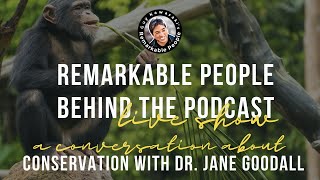
Guy Kawasaki discusses his Remarkable People podcast, including a recorded Clubhouse chat with Dr. Jane Goodall that became a special episode. He shares interview prep methods, marketing strategies from the pandemic, and technical setup details for his live show.
Chapters
Hi, everyone. Guy Kawasaki. I am the chief evangelist of Canva and the creator of the Remarkable People podcast. Today I am in Santa Cruz, California. I probably said that 52 times in a row. Probably tired of hearing where I am. I'm always here. If you see that background behind me, that's. I'm in Santa Cruz because that's a real physical background. In fact, I changed that bookshelf lately. So I used to have books that, that I either read or loved or something. But not to imply that I don't read or love the books that my guests write. But now it's all guests. So if you look there, I'm going to move so you can. It goes into folks, you'll see all those books were written by guests. So I figured out that. Man, I have a lot of great authors on my podcast. And I also have had two MacArthur Award winners. I wonder how many MacArthur Award wingers Joe Rogan has had. So, anyway, yeah, so this week's guest is. It was kind of a special situation. So about a week ago, I had Jane Goodall, and she and I did a fireside chat. She was in the south of England in the house that she grew up in, and I was, guess what? In Santa Cruz. And so we did a clubhouse. And for those of you who don't know what clubhouse is, it is, quote unquote, a social audio platform. So basically, you can schedule things in advance, but there's no recording. And it's. There's a quote unquote stage where it was just Jane and I, you can invite people up onto the stage to talk. Not that I did that, because it would have gone crazy. And so there are two of us on stage and we're talking, and people all over the world were listening, and there were about a thousand people listening. So we got into conversation about her. Her youth, how her mother encouraged her to take risks, how she got a degree or she got. She has academic training, believe it or not, in being a secretary. And she went to Africa. And just out of good happenstance, the Leakeys. The what is he, a primatologist? Biologist, One of those things. So his secretary had just quit. So there was an opening. So the reason why she got to stay in Africa and work for the Leakeys is because she had secretarial skills. And the secretary quit. So now, you know, all of us parents, we're all, like, training our kids to have that perfect PhD background and everything. And then come to find out Jane Goodall got it because she had secretarial skills. She's a lesson right there, which is, you know, do what it takes. And also, so she asked, she had secretarial. She did not have any formal higher level training in biology or primatology or anything like that, behavioral science. So a few years into it, the Leakeys actually arrange for her to go to a PhD program back at Cedar, Oxford or Cambridge. And she did this without getting a master's and a bachelor's. She went straight to the PhD program, which, I mean, she is Jane frickin Goodall. So yeah, that makes perfect sense. So anyway, if you're interested in Jane Goodall the woman, Jane Goodall the scientist, Jane Goodall the. The example of pursuing your passion, her opinions about the environment and what's going on. Every time I interview Jane, I feel a little guilty because I just not measuring up to her standards in terms of caretaking the earth. But anyway, so yeah, if you're interested in Jane Goodall, what we did is the Clubhouse interview was so good that we happen to be recording it. And so we. And it's just two of us. And so now we made it into a special episode of Remarkable People. Jane Goodall, by the way, was the first person ever to be on Remarkable People. And now she's making a return via a clubhouse appearance. And I just thought of something. So next week, well, next week is Mark Manson and the following week is Katie Milkman and the following week is Bob Cialdini. And when I recorded the Bob Cialdini podcast at the time, he was the first person to have two episodes ever on the Remarkable People podcast. He's coming out with a new version of his book Influence that is about a third new. So in I just remembered that I guess I could go back and edit this. But I say that this is the first time anybody has been on Remarkable People twice. But then come to find out, because we did this special episode because we like Jane's Clubhouse interview so much, technically she is the first person to appear twice. But then really, technically you can make the case that this is a replay of her clubhouse interview. So I could still make the intellectual argument that Bob is the first person to had two dedicated real Remarkable People specific episodes. That's a long explanation to tell you why if you listen to that and you notice that I am maybe not so wrong. Anyway, so, you know, I want you to listen to Jane Goodall. Jane Goodall twice is better than most people want. So I mean on other podcasts, not my podcast. So yeah, listen to Jane Goodall and. And let's see Send your questions, put them in the comments. You could all do me a really big favor. And you could send a text message or an email to someone who you think will enjoy the Remarkable People podcast. So just, you know, here we'll give you some music to do that with. So go ahead, send a text message or email to somebody saying you should listen to Remarkable People. Okay, Give you a few seconds to do that. We're not going to continue until you do that, so. Because I'm all about getting more subscribers. Okay, done. Remarkable people dot com. It's not that hard. See, I use a Rodecaster Pro so I can play music. Okay, enough of that. So that's one. And let's see, Jeff, you got the phone number. So if I started a text based Ohana community. Oh God, look how fast he is. So if you send a text message to that number, 831-609-0628, machines are standing by to sign you up into the Guy Kawasaki Extended Ohana Text Group. Unfortunately, I'll be up front. It only works for U.S. and Canadian numbers because Subtext, the company that we use, has only done for those two countries. Apparently there's a lot of privacy and legal issues for each different country. And so so far they did the big two, US And Canada. And come to find out like Gary Vee uses Community, which is a competitor, Subtext, and they only do US and Canada too. So you want to join 831-609-0628 so that. And send that text message or email to someone who would enjoy Remarkable People. I made a remarkable discovery this week. This week's guest was Paul Theroux, the American travel writer and just fantastic. He has a new book called under the Waves at Waimea. And he also talked about his book where he spent a year traveling the US Mexican border because Donald Trump said Mexicans are rapists and murderers. So he went to refute that in by traveling for a year along the border. So. And he wrote a book about it. So anyway, so I have discovered that if you go to a search engine and you type any of my guest name plus the word remarkable, Google, Bing, whatever, in the first few results, not pages, the first few results, it will find the podcast. So for example, if you wanted to listen to Jane Goodall's podcast, you just go and type Jane Goodall remarkable. Or let's say, I don't know, Steve Wozniak, Steve Wozniak remarkable. Or Ariana Huffington remarkable. You just type the name and the word remarkable and thank you, God SEO gods. Somehow my podcast comes up in the first two results or three results. And I wish I could tell you how that happened. I don't know, but it definitely works. So when I need to look up all episodes, that's what I do. I don't even go to my own website. I just go straight to a search engine. So anyway, let's see. Got some questions for me? I mean, play more music. What's one thing you've done this year that is good for the planet? Oh, man, put me on the spot, Peg. Geez. See, I was going to buy a new car and I didn't. That's good for the planet. I've cut down, but not eliminated, honestly, eating meat. By the way, the car that I kept gets 30 miles per gallon, which, you know, it's not exactly Tesla level, but for internal combustion engine, that's pretty good. Let's see, what else have I done? It's more like what I haven't done. I do bike a lot now. I got an E bike, so yeah, I bike more. I tried. I just tried not to drive. I can go days without driving, actually. So next time, Peg, prepare me for that kind of question. I have a good answer or better answer. What else? You've really inspired me with your life lessons and business stories. Well, thank you, Maria Mariah Edwards. I appreciate that very much. Please, thank you. Thank you very much. Can you do my Frank Gehry? Is Frank Gehry still alive? Let me just Google it. I would love to. See. Here he is 92 years old. Wow. Huh? Wow. I'll give that a shot. That's very interesting. I wonder if he's still giving interviews. Huh? That's a great idea. I gotta write that down. Of course I'm going to write it down on my remarkable tablet. So there you go. Because the remarkable tablet company sponsors the remarkable podcast, which is kind of a remarkable coincidence. And I am going to write that down so that I don't forget, because trust me when I tell you, forgetting things is definitely top of mind these days. Okay, I wrote that down. I will try to do that. All right, what's the next question or comment? Are you optimistic about the impact of social media and the green economy drive we are having in Europe? Yes, I actually am. I'm. I'm fundamentally an optimist. I think social media, all things considered, is a good thing. Now, obviously there are abuses and there are obviously politicians who have used it to great harm for our world. But. Well, a. In one sense, you know, the horse is already out of the barn. So it's not like we're going to stuff the horse back in the barn. So, you know, this is just a theoretical discussion, but I think all things considered, the world is a better place with social media than without. And, you know, let's just not focus on the bad stuff. I mean, you can make the case that the printing press allowed, I don't know, pornography to be printed. So, you know, should we get rid of the printing press or the telephone enabled people to call people and bug them all the time or, you know, coordinate crime? So should we shut down the telephone? I guess every technology. And having said that, I would draw the line at guns. I think guns should be outlawed. But that's, you know, that's a popular. Well, I don't know how actually it is popular. Well, it's popular where I live and who I hang out with. But yeah, so I think there are some things like guns that should be limited, but not social media. What else? Just lost all my followers in Texas. How can we break barriers between humans in a commercial oriented society? Ahmad, I think, you know, this is hard to say in a pandemic, but I really think that it is about, as we say in America, pressing flesh. That it is, you know, actually interacting with people in person. And that will come back why in Texas, it never stopped, but, you know, that will come back. And I, I interviewed someone named Steve Blank yesterday. Steve Blank is the guy who invented the Lean Startup. Eric Reese was his student. So, you know, Lean Startup mvp. That's all Steve Blank. And he had an idea that there should be a mandatory national service around the age of 18 in America. So now it doesn't mean you, you have to go into the army. It means that you have to perform one year of service for the country. And it could be, you know, anything. It could be building roads, it could be building bridges, it could be, I don't know, you know, whatever. It could be in the army too. And one of the benefits, major benefits he sees of that is that then you are forced to meet and interact with people that you probably would never have done before, that if you stayed in your bubble, you would never have met these people. And you would probably learn, as I have, though not necessarily through public service, that I think more people are more similar than they are different. And if we would just all, like, meet each other and hang out, you would see that we share a lot in common. So what else? How do you define success based on interviews of remarkable people? Has it changed? Yeah, you know, first of all. Paul, Remarkable people is remarkable people. It's not rich people, it's not famous people. So it's about, you know, has done something remarkable. And so that's number one. Number two, I will tell you that I. We very seldom discuss money. There have been. See, do I have any billionaires on it so far? I literally, I don't think we've had a billionaire. But if you had to ch. If you had to choose between having MacArthur Award winners or billionaires, trust me, you should pick MacArthur Award winners. So I really, I have not had a billionaire. That's an opening for somebody. So, yeah, I don't think it's related to money at all. I would define sex. Sex. I would define success as well. At a very tactical level, how I define success is the ability to say no to anything that I want that I don't. Don't have to do anything anymore. Now there's an element of finance to that, but it's also an element of your personal mindset and stuff that you don't have to be this. You don't have to do that. You don't need to be the center of attention. So that's how I would define success. It's not exactly fu. Money, it's just no thanks money. What else do you think the new iOS 14 for anti tracker features would be, Jason? Honestly, I don't know enough about that. I'm not exactly leading edge in tech, so, you know, I have my phone set to automatically update and some night when I happen to remember to plug my phone in, it updates. And the next morning it's got a new version of the os. And honestly, I probably would not even notice. So I. I don't know, I. I guess I'm just not that worried about Tim Cook tracking me for whatever reason. Maybe I'm deluding myself, but I just think that I don't flatter myself so much to think that all these people really care what the hell I do and where I am. What can I say? I'm just a dot. I'm just a speck in the universe. What else? What's one thing you've learned from Dr. Goodall about conservation? I think one of the best lessons I learned from Goodall about conservation is everybody can do something. It's not just for the Greta Thunbergs of the world. It's not just for the Jane Goodalls of the world. Everybody can do something, whether that is being kind to one another, feeding a thirsty animal, not eating meat, you know, whatever it takes, biking Instead of driving it, it's, I think everybody has to do a little bit as opposed to, you know, these amazing people are going to do everything for us and we just need to sit by. I think that's one of the major lessons of Jane Goodall. Everybody can help. Hello from Italy. How do you think marketing has changed during the pandemic? I. I think marketing has radically changed during the pandemic. A lot of it is now that you can do things like have a smaller selection. I would argue that a smaller selection of goods in stock is much more important than a large, broad selection of goods not in stock. So you can simplify your product lines. I think you should do business direct. You should not depend on resellers, retailers because who knows if those resellers and retailers will be in existence. Even if they are in existence, who knows if they'll be open enough. And even if they are open enough, who knows if they're going to decide to stock your stuff. So I think you cannot leave your fate in the hands of people who are multiple tier distribution. I think you've got to do it directly. If you're doing it directly, then the most valuable thing you could probably get is an email address as opposed to a social media follower. If I had a choice between an email address or social media follow, the choice is not even close. Email address is much more valuable, but even more valuable than an email address. I would make the case is a text. Oh my God. Jeff is, Jeff is. Oh my God. He's clairvoyant. So I think that, you know, email gets added a 40, 50% open rate if you're lucky. Extremely lucky. It's hard to tell because most email clients are set to not download graphics. And so even though someone read the email because the graphic was not downloaded, it doesn't tick the box that it was read. So I think when people say only, you know, 5 or 10% of things are opened, it's higher than that because things were opened but the graphic wasn't loaded so you don't know it was opened anyway. So let's say it's 20%, 30%, whatever. For email, I gotta believe text is more like 90%. So who doesn't open up a text message? So that's why I want you to join this text base. Extended ohana of Guy Kawasaki 831-609-0628 machines are standing by. What else? What do you think about all the women leaving the workforce due to pandemic? How can we as a society recover and not Leave women behind. Yeah. That is really a crying shame. I think it speaks to the unselfishness of women and maybe the selfishness of men. I don't know if I have the fix for that. To me, being successful in business is so hard and it's so dependent upon having great people. So to eliminate half the population that is women because they're women and reduce the gene pool that you can draw from, to me is just plain stupid. Whether that's in a venture capital partnership review or in job hiring, that is just plain stupid. And Amazon had a very clever idea. A few weeks ago. I interviewed Colin Breyer on Months now, but he, his episode came out a few weeks ago and he told me a story that one part of Amazon had a very difficult time getting gender diversity. And so the way Amazon recruiting apparently works is you send in your resume and cover letter, somebody makes a decision to call you or not call you, and it goes from there. So what this department decided to do was they would call every woman applicant, thereby significantly increasing the gene pool of women who are applying because every woman was called. So because every woman was called, it's much more likely that every or more women would get to the next stage. So I think it's something like that. It's, it's a simple thing like that. You know, I don't, I don't know how admissions works, but you could, I don't know. Admissions seems pretty balanced. But let's say admissions, let's say any process is not gender balance, then you can make the case. All right, so let's do it. Amazon did. So every woman gets to the next step. Just every one of them. Every one of them gets. I, I, I think that's a great idea. What else? I'm very curious. What's your thought process like when formulating questions? Because you get to extract one of a kind answers in your podcast. Well, thank you, Jason. So my procedure is I try to. Well, I don't try to. I read. Many of my guests are authors, and that's a very synergistic relationship because the author, during the book introduction phase, is looking for any possible way to get exposure. And I offer exposure through a very popular podcast. So, believe it or not, you may find this hard to believe. I find it hard to believe myself that I asked the publicist of John Boehner, the former speaker of the House for the gop, who now has a book out. I asked the publicist if I could interview him. I can't tell you. They said yes yet, but I tried. So that would be the first Republican on the Remarkable People podcast. Well, the first Republican that I know is a Republican. Anyway, so. So I read the book, I watch the video, I read the Wikipedia entry. I, you know, I kind of do a general search. I probably spend, oh, two to four hours prepping for every interview. And then what I do is I create a Google Doc where I write the questions. Well, actually, I have a new workflow, if you really want to know so many people. Send me the book. So, for example, this pile of paper, this pile of paper here, this is the manuscript for Katie Milkman's new book, how to Change. So I got this, and then just recently, It became this how to Change. And so. But that finished book came out way too close or after I interviewed her, so I had to use this. And what I do is I read that, and then I use my remarkable tablet and I write down the questions on the remarkable tablet in print. I mean, not in print, in hell. How do you call it? It's the opposite of cursive, Peg. What is? What's the opposite of cursive? Where you just print out the letters. Just a freaking senior moment. What is that called? Anyway, Peg will. Peg will surely say guy. It's not cursive. It's blah. So whatever blah is. So I write out the questions, and then through the magic of the remarkable tablet, you can have the remarkable tablet email you the questions after a process of ocr. So on the tablet, I'm reading the manuscript, I'm writing questions as I go. At the end of that process, I have the document emailed to me, and ocr. So now I have this print and cursive. Right? Print is the right word. Okay, so now I have a. I have an email with the digitized OCR questions. And so I take those questions, which is often not that well organized, and then I paste it into a Google Document, and then I hammer on that for a few. Well, for a long time. So I reorganize that completely. And then, so now I have really the questions in a Google Doc really organized and ready to roll. Then I print that Google Doc to PDF and load it back onto my remarkable tablet. And during an interview, I'll show you one. During an interview, I am using a remarkable tablet the whole time. And so let's see here. I'll show you one that I already did. Okay, so this is the remarkable document, and this is what I'm working on. So it started off as, Pew, it's hard to keep this in focus Here. There it is. So I started off with this as a plain PDF, and then I started taking notes on it during the interview while I'm interviewing Steve Blank. So, you know, the check mark means I got that question. The circle means I really got to get to that question. And then other thoughts and questions occur to me as I go along. So that's what you see printed on the side. So I'm working off this document while I'm interviewing people. Now, this is all about the mechanics of what I do. And the question may be more about, you know, how did I get to those brilliant questions? And the answer to that is 30 years of living. Okay, next question. That was a long answer for a short question. My God. I think, okay, if you could write a book for children under 6 years old, what story would you create? Fiction or Fact Driven? I would write Fact Driven. In fact, I wrote one children's book. It was a children's book that was included in another book that I wrote. And this children's book was for entrepreneurial parents to use to explain what being an entrepreneur means to their kids. So that is included in the back of. Oh, my God. Which book did I put that in the back of? Let me see. When you have 15 children, you forget, I swear. Which book did I put that in the back of? Oh, of course. It's in the back of the Art of the start 2.0. So here, let me show you here. So I wrote a children's book that nobody ever heard of because this is in the back of this book, but in the back of this book is this children's book, what Do Entrepreneurs Do? And, you know, it kind of looks like this, where I explain what entrepreneurs do. So, yeah, I have written a children's book. Technically, I have written 16 books. So, yes, the answer is fiction and explaining what entrepreneurs did or do. Okay, one last question, because I got to go to lunch. Let's see. Oh, hi, guy. If you had an opportunity to work at Tesla, would you like to work there? Is this a loaded trick question? Well, Seemingly simple question. So I'm 67 years old. I'm at the end of my career. I can say no to anything. So would I go to work for Tesla as 67 years old, if I had to drive to Fremont every day or Palo Alto every day and park my car, go in the building, work at a cubicle and be subject to Elon Musk's craziness? Nope. No freaking way. Now, if I was 25 and, you know, I wanted to work at a Hot company. Yes. I would just like. Would you work for Apple? Yes. Would you work for Google? Yes. Facebook. Eh, Facebook. Probably Instagram. It's just part of Facebook, probably. But Tesla. Oh yeah, because I love cars and I love tech and. And he's in the Bay Area or it's in the Bay Area other than the part that moved to Texas, which I think is all bullshit anyway. So. Yeah, but not at 67. If he asked me, you know, guy, would you go on the board of directors of Tesla? Maybe. Unless the board of directors is just rubber stamping his decisions, then, you know, why bother? But yeah, so that's the answer to that question. If you know Elon, you can tell him what I said. So. Okay, one last question and then I am going to go. No more last questions. It's okay with me. Oh, this morning I bought Art of the Start. Yes. What should focus on mainly? Well, Scylla. Is it, Is it S C I L? Well, you know, Art of the Start honestly is more of a reference manual. So it's not something that you read cover to cover one time and you know, lives halfway ever after. So at any given moment you may be worried about your pitch. So read the section on the pitch. At some moment you may be worried about recruiting, read the section on recruiting, etc. Etc. So I think that at any given point, any part of the artists are 2.0 will be relevant to you depending on the stage of your startup. So it's just like when you get the physician's desk reference, you don't exactly say, okay, I'm only going to read the section about, I don't know, allergies. Because what if next week you have a blister, I don't know, or something like that. So you know, it's, it's a reference. So there is no part you should start. It's whatever you need. Okay, so another week has come to an end. Oh, and by the way, people have always been asking me, how do we do this? How do we stream on, let's see, Facebook, Twitter, Facebook, Twitter, YouTube and LinkedIn. So we're streaming at four places at one time. And the answer to that question is a company called Restream. R E S T R E A M. So the front end is eCamm, that's what encodes the video. But the back end, that sends it on its merry way to all places. Wonderful. Is Restream R E S T R E A M. And if you want to do this, use Restream and you will see how easy it is to do this. And one of the beauties of this system is that there is a level where the person, I. E. Me, doesn't have to do anything because there's a producer doing all the hard stuff. But another great thing, you don't have to do it that way, but it can be done that way. At least you have the flexibility to grow. And the other thing is that Restream gets the comments from multiple services and sends it to one place. Because in the old days, you. You. You would just wouldn't have done this. So in the old days, you would have said, okay, so let's have Twitter open and LinkedIn open, and we'll have two windows open, and we'll watch for the comments that come in on LinkedIn and watch for the comments that come in, you know, in another window. And it's just impossible to do. But here, all the comments from four services come to one place, which is a beautiful thing. So Restream. Check out Restream. Okay, so that's it. That's it for this week. Another episode of behind the Podcast for Remarkable people. I'm Guy Kawasaki signing off. Take care. Have a good week. Bye.
More from Guy


Cheryl Strauss Einhorn | The Human Edge: Smarter Decisions in the Age of AI | Talks at Google



Rachel Glennerster | Innovation and the Center for Global Development | Talks at Google

Rebecca Winthrop | Rethinking the Purpose of Education in the Age of AI | Talks at Google

Dr. Robert Wachter | A Giant Leap: How AI Is Transforming Healthcare... | Talks at Google



