Live show: How to Face Your Fears
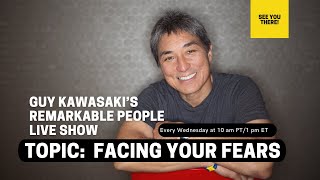
Guy Kawasaki talks with Lovey Ajayi about facing fear and speaking truth at work. They cover customer-focused hiring, midlife career changes, and using fear constructively. Ajayi discusses what she calls 'professional troublemaking' and how to lead ethically when it matters.
Questions this video answers
Lovey Ajayi
"If I want to kill myself, I would climb to your level of stupidity and jump to your IQ."
Sony A6100 with a 28mm lens
Moderna (he mentions getting his second Moderna dose on Friday)
Chapters
Foreign. Hi, I'm Geicawasaki and Jeff C. Podcast engineer and all around AV amazing Guy says that my picture is looking elongated, so we don't know why. So it's not that I'm unhappy and I have a long face. It's just something's wrong today. But some picture is better than nothing. So. I'm Guy Kawasaki. Good morning. It's Wednesday. I'm in Santa Cruz, California, and I'm here to talk to you about this week's episode of Remarkable People, as well as take a few questions from the audience. So if you're thinking of asking me something, send it in through the comments. This week's guest was Lovey Ajayi. Truly a work of art. I mean, she is a very remarkable, special person. First of all, she came to America as a kid not knowing that she was moving to America. Her family, family just sort of brought her to Chicago and she thought she was visiting. And when she got to Chicago, her mother said, guess what, honey, we're living here from now on. So, you know, welcome to America. She is from Nigeria and I have gotten to know a little bit about Nigerian culture interviewing her. And I have to tell you that, oh my God, I think I want to be Nigerian in my next life because for one thing, I swear they have the best insults. So if you've ever been insulted by a Nigerian, send a comment. It would be interesting. Or if you are Nigerian, send your favorite Nigerian insult. I am going to read you my favorite Nigerian insult as soon as I find it here in my notes here. I swear that I. I'm just having a bad day here because I swear I had it highlighted. So I am determined to find it here. If in doubt, blame word. Okay, so in her book, and she has a new book, she positions herself as a professional troublemaker. And this has to do with race, feminism, entrepreneurship. She was going to be a doctor and then she got a D in chemistry, so she dropped out of pre med. Lucky for us. And she started blogging and became this kind of just shit kicking kind of person. And if you want to laugh, this is the episode to listen to. So this is the Nigerian episode. Excuse me. This is the Nigerian insult that was in this episode of the podcast. So it goes like this. If I want to kill myself, I would climb to your level of stupidity and jump to your iq. Now that is a world class insult. So she tells me that Nigerians are particularly adept at insulting people. And, you know, they insult people like some of us may say hello. So, you know, I'M I'm all about accepting different cultures. I love that stuff. And then let me read. I, I'm having an out of body experience today. Not only is my face long, but my notes are somewhat suspect here. So she basically, she basically comes from a long line of quote unquote professional troublemakers. And it started according to her with her grandmother. And her grandmother I guess was just a woman who just took no crap from anybody. This is back in Nigeria. And so yeah, if you want to listen to a black woman who just is just a kick ass kind of person, this is definitely the episode. She defines professional troublemaking as basically seeing the world as half full, not half empty and wanting to leave the world better than you found it. So she's all about kicking ass to making, to making the, the status quo into something better. So it's for the greater good and it's all about her techniques for doing that. And I know I've said this two times already, but if you want to laugh, this is the episode. So let's see here. Any questions for me about Nigerian insults or love? Yajai, I hope there's some Nigerians listening because man, we could definitely, we could definitely have some fun here. I heard that Nigerian weddings are just the most amazing one week long thing. So I have a request out that if anybody in the Bay Area is throwing a Nigerian wedding, please invite me. Of course it has to be post pandemic, but yeah. So let's see here. What to do somebody who kind of hate us also try to take over our project and keep imposing his ideas even if they weren't good. Yeah, Aman, I mean, welcome to the real world. It's a fine line. It's a fine line between protesting too much and so you'll look like a complainer and a troublemaker versus shutting up and just taking it where you look like someone can walk all over you. And I admit that, that you have to decide that on a case by case basis. It's very hard for someone sitting in a closet in Santa Cruz to tell you exactly what to do. I will give you perhaps a guiding light. And the guiding light would be that, you know, focus on what's right for the customer. So as opposed to what might be right for you or you think is right for you versus what you think is, or what your boss is telling you is right for him or her. I think if you do what's right for the customer, when all the dust settles, you'll see that that was probably the ultimate and optimal path because I don't think you can go wrong doing what's right for the customer. Next question. It's like the topic came right on time. I was questioning myself for speaking up the truth many a time. Well, you will love this episode because she talks all about speaking the truth. And, you know, my experience with this is. And this is just one data point, but I think that in many cases the truth is obvious. And so by speaking it, you will find that many people agree with you. So you may think you're alone and that, you know, you're one of the few people, or maybe the only person who sees this. But I think when you speak up, you'll find out that many people agree with you. Because at some level, I mean, the truth is the truth. And as the saying goes, the truth will set you free. See, a couple years ago, I quit a job because I love. Because the people I worked with were awful. I'm so much happier in my new job. I was 100% worth walking away. Good for you, Susan. I mean, you know, my experience is that people stay in jobs they hate too long. Although you said you loved your job, but I don't know how much you could love a job if you hate the people you're working with. It's kind of a contradiction there. But anyway, my experience is that people probably stay too long rather than quit too early. Of course, to completely counteract that argument that I just made, I'm the guy who left Apple twice. And if I had not left Apple either time, let's just say that my lifestyle might be a little different. Although I'm not complaining about my lifestyle, but, you know, I left a lot of money on the table. Quitting Apple twice. What's next? Great takeaway. Do it right for the customer? I think so. I really think so. That, you know, that could be your. What's the metaphor? Your North Star. That should be your North Star. Do what's right for the customers. And listen, if you do what's right for the customer, you get fired. Hallelujah. You have the high ground. You have the moral high ground. So at least you have that satisfaction. What else? What to do if I lose my belief over my prototype or idea, if people call it something gimmicky, how to gain that belief back? Amana? I think it's all about the demo. And so it's not about what you say and it's not about what people think. It's how good is it? Because if it is good, if it's a good prototype, if it's a good demo. Then again, you know, the truth is the truth. And I think it's pretty obvious when something is good or bad. So it's not so much what you say or what people say about it. It's, you know, just how good is it? I mean, just that's. I know when I listen to company pitches like most company pitches are, and what really matters is the demo. So focus on the demo and the product and the prototype and the service. Not. Not the bullshit PowerPoint. Okay. What else? The key is keeping your ego out of it. Yeah, I mean, that helps. Although I will say as a slight counterpoint, you know, you have to have a strong ego to succeed because there's going to be many people who tell you it can't be done, it shouldn't be done, it isn't necessary. And if you have a weak ego and you simply listen to them and never try, you'll never know which is the worst case of all. So I'm not advocating ego less completely subservient people either. And wow, when you listen to lovey talk, you'll see that she is a very powerful ego. And I don't mean that in a negative way. I like people. I mean, Steve Jobs had a powerful ego. I don't think the powerful ego is the problem. I think if you have a powerful ego but you don't have the stuff to back it up or there's no reason for you to have a powerful ego, that's the problem. Let's see what else there. Do you mind typing in the chat? Your camera and mic model? It'd be my pleasure. Here. So if you want to emulate what I'm doing, that is how you can look like Guy Kawasaki. Oh, shoot. Let's see. Oh, that's interesting. So we're using Streamyard and it says Periscope. Didn't get the comment, but LinkedIn did get the comment. Jeff, who asked for that? Where. What service is she on? Let's see. So she's on Facebook. You know, I will shop if you I it. It's definitely on LinkedIn right now. Oh, there. There you go. The magic of good engineering. That's the link and I'll basically give you the gist. So I'm on a Sony A6100 with a 28 millimeter lens. So I have a DSLR. It goes HDMI to an HDMI to USB converter into my imac. My sound is in is a Hi O PR 40 microphone. That's an XLR mic. It's not A USB mic. So it's a hi o PR 40 that goes into a Rodecaster mixer. And the Rodecaster mixer is then the input for my phone, my computer, my microphone, basically everything. And one of the beauties of this, and Jeff C. Is the one who turned me on to this is like, do you hear that? Does the music come through? Okay, so, so you have the link that, that is my setup. Of course. I hope you like my setup because my face is supposed to be long today. I don't know what. We don't know why. So we'll blame it on Microsoft, although Microsoft has nothing to do with anything we're using right now. But in doubt. In doubt, blame Microsoft. Okay, any other comments or question? Huh? Let's see here. Shab, I hope you saw it. We put it on screen for sure. It's in my, in the comments, in LinkedIn. And afterwards I can tweet it too. I just actually I can tweet it right now if you want. So because I incapable of doing multiple things at once. So I am going to tweet the link right now. Okay, so the link to the Google Doc that explains my camera setup has now been tweeted. Okay, so how do you get past your fear of going through a four hour interview? Well, Stu, I don't think you do get past that fear. I mean, four hour interview for like four straight hours, is it one person? I think that is an intimidating thing. And you know, the fact that you're afraid of means that you're intelligent because if you're not afraid of it, something's wrong with you. That's a heavy, heavy toll. And you, you just have to power through it. I don't know if I wish I had some magic, tell a lot of stories because I think stories are more powerful than, you know. Everybody goes into a interview saying, I'm honest, hard working, dedicated, intelligent. You know, nobody says I'm a fat, dumb, lazy, you know, scumbag. So I think you tell stories, stories of when you were managing projects or how you did successful things. And you just tell story after story of Successes and the 4 hours will go by. What else? Jeff, I'm just enjoying this topic. Thank you for being so much fun and standing up for integrity in business. Stephanie Patel. Thank you, Stephanie. I'm flattered. Yeah, it's my pleasure. What advice do you give to someone who wants to do a career makeover in their 40s? Well, Roy, I'm 66 and I've made over my career a few times. Having said that, I think that there is a lot of ageism, that I think it's because, for example, in startups, many startups, because the founders are, shall I say, new to management, they default to a very simple algorithm, which is they hire in their own image. So if you're young and male, you hire young and males. And so I think that it's hard for someone 40 to get a job in a startup. I think legally, in larger companies, particularly publicly traded companies, if you detect ageism, that is a serious legal issue. So I think they have to bend over backwards. But that we're not really talking about. You know, you didn't ask about the legal issues you're talking about. You know, how do you reposition? And I think basically, you know, there's no denial. You can't go in there saying that you're a millennial if you're 40. But I think that, you know, you have to play your strong cards, which is, you've been there, you've done that, you've seen it, nothing is new to you. So, you know, you can bring some adult supervision to that company. What else? Being fearless is one thing and being courageous is quite another. Any thoughts? Yeah, I am not big into fearlessness because I think fear has a very, very necessary role in our life, which is, you know, if, if you fear something, that's probably because you should fear it. I mean, to use a surfing analogy, if you're paddling out into a 90 foot wave in Nazare and and you're not afraid, something's wrong with you. I mean, you're going to die. You should have fear. I mean, fear is what makes you make intelligent decisions and fear makes you prepare and train and fear makes you have contingency plans. And if you're absolutely, totally fearless, I would say that that's not a good case. That's not a good place to be. That's too dangerous. So fear is a good thing. And don't kid yourself, every entrepreneur fears failure. And if they tell you that they don't, then they're lying. Either they're lying or they're delusional. And, you know, dishonesty and delusional, not a good combination. What else? Business at times, pandemic times drive people to do unethical boundaries to the unethical boundaries out of desperation. How do I get the team back onto the moral compass? Well, this is a tricky question because if you look at what's going on in this world, especially the last five years until January 5th, it's hard to say that Crime doesn't pay. Crime was paying. So I just hope that you have an internal moral compass that is on the high road. That is not simply a compass whose direction is guided by the concept of this is what I can get away with, or this is what other people have gotten away with, so I can get away with it too. Call me naive, but I hope you have a higher moral compass than that. You should read Viktor Frankl's book about man's search for meaning to learn about the high road. Okay, what else? What is the best way to recruit and attract an outsider to join the company and grow it to hire people that are smarter and more experienced than you? Well, I think that Daniel Pink, who wrote a great book called Drive, he says in that book you offer people a map. Map. And the M stands for mastery. That is, you come work for our company, you will master new skills. The A stands for autonomy. That is when you come to work for our company, we don't breathe down your neck. You work autonomously and independently. And the P stands for purpose. So that if you come work for our company, we have a higher purpose that's simply making a buck. So you come to work for our company, you'll gain new skills, you'll be working autonomously towards a higher purpose. That's as good as it gets. I mean, I can't tell you anything better than what Daniel Pink has risen. How do you start talking to customers, overcome that fear in a startup when your product service is still a work in progress? Well, Thomas, you know, you just have to do it. I mean, there's. Listen, if you don't, okay, look at the alternative. If you don't talk to them and you don't find out what's wrong with your product, you probably fail. And so at one extreme, you have a choice. You can either fail or you can talk to your customer. And when faced with a life or death decision like that, I hope you'll decide to talk to your customer. And you know, I don't necessarily mean face to face, especially in a pandemic. I don't even mean on the phone, especially in a pandemic or not. I think that social media is God's gift to entrepreneurs because it's fast and it's free and ubiquitous and so you can have contact and you know, whether it's on one of these services we're on right now, or Clubhouse, why not? I mean, that's just. That just comes with the territory. If you can't handle that, you're not an entrepreneur. What Else, any tips on accurately detecting smart and loyal people in the interview? Jeez. Well, I'll tell you, I'll tell you what, I'll tell you what I think doesn't work. I think that many, many people believe they are gifted interviewers and let's just say just mathematically they can't all be right. And I definitely think that selective memory works where you only remember the good hires, you don't remember the bad hires. So you have an inflated estimation of your quality of hiring because you only remember the good ones, not the bad ones. That's number number two. And I learned this interviewing Colin Breyer, who was the chief of staff of Jeff Bezos, who was last week's remarkable people guest, which is why you should listen to last week's so you know, the Amazon recruiting process is very, very rigid and it starts with a phone call and then, you know, a group of people interview them and a candidate. And you know what, that group of people, they are each assigned to investigate a specific issue or area. So it's not like, okay, you're going to meet with these five people and the five people, you know, one at a time, come in and they just shoot the shit with you. So they are assigned that these are the values and these are the qualities you have to investigate. And then you have to come up with a written report and then there's another person who is not in the department not. And this, this new hire would not work for the person. It's kind of an elder statesman of the company. And that person also interviews the candidate and can veto any candidate. So this is kind of a devil's advocate, reality check person at the end of the process. So if you want to learn more about this, you can either listen to my podcast Colin Breyer last week or you can buy his book Working Backwards, which I think Working Backwards is the best business book I have read in the last five years. And if you are in a company and you aspire to be as successful as Amazon, it's required reading. It really well, when I read the draft, I like so much of it that I got their permission and I sent PDFs to the three founders of Canva. I thought it was so significant. What else? Which book you recommend to people doing startup for first time? You know, Iman, I hate doing this because it seems so cheesy. But honestly, if you want to just read one book that I help you with a startup, just read the Art of the start 2.0. That everything I know about starting a startup. So and it's a text for many, many universities in entrepreneurship. So just read that book. That's the starting point. And it, I feel like a little bit slimy telling you to read my own book because, you know, that's not exactly the lack of a conflict of interest. But on the other hand, I would feel even worse telling you to read a book that's not as good. So what can I say? So any more questions here? What is the best way to shine in the wake of mergers that quickly murky the sales waters? Mary? I don't know. You know, that is a complex question because who knows what actual situation you're in. But going back to an earlier answer, I think it's all about focusing on the customer. Just keep doing what's right for the customer. And you know, my naive, romantic opinion is that if you keep doing what's right for the customer, eventually cream rises to the top. So keep doing that. A federation of companies. A federation and companies in it stole my ideas, methodologies, and implemented them well. I have an NDA with one of them. It's a case of an iron pot against a clay pot. I don't know what the question is, so contact your intellectual property lawyer. I will tell you, though, that, you know, the reason why you hear about big settlements is because they're rare, not because it's easy. So you're going to have a ten year battle there. I love that you constantly recommend reading. How much reading should we do on average if we want to remain relevant and successful? Ah, God. I, you know, I don't want you to think I'm some kind of reading saint, but I, I have to read. And I have to read because I have 52 podcasts a year and the vast majority of those podcasts, the person has written a book. Indeed, that's often why they want to come on the podcast. So, so, you know, this week I interviewed Mark Manson. He's the author of the Subtle Art of Not Giving a Fuck. And so I had to read both of his books the week before I interviewed Melissa Bernstein. If you have ever bought a toy from Melissa and Doug, she's the Melissa in Melissa and Doug. And her book was about self discovery. Lovey has a new book out about being a professional troublemaker. So I had to read her book about being a professional troublemaker. So when all the dust settles, I probably have to read a book a week. And to interview a guest for my podcast probably takes three hours of prep. Because if you listen to my podcast, I hope it's very Obvious that, you know, I don't just pitch softball questions that I figured out from quickly glancing at the Wikipedia entry about the person. I like to ask questions that prove to the person. Yeah, a guy really did read your book. And so that is a challenge because, you know, Melissa's book is about self discovery and Mark Manson's book is about, you know, what not to give a about. And, and the week before I interviewed Paul Thoreau and Paul Thoreau is writing a book about travel. And before that I interviewed Susan Fry and she wrote a book about being a woman CEO farmer. So I had to learn about farming and you know, self discovery. It's like a lot of topics. Doing this podcast is definitely keeping my brain active and reducing the impact and probability of early onset dementia because, oh my God, you really have to be on top of your game if you want to be a good podcast interviewer. What is your take on the use of fear in marketing and advertising? Should big advertisers should focus and set new standards and hope to political campaigns will follow for less aggressive language? I, I have to say that, okay, so first of all, I understand the psychological principle that people are more afraid of losing something than gaining something. The concept being that if somebody said, you know, if you do this, you're going to lose 20 bucks or, or if you do the opposite of this, you're going to gain 20 bucks, the thought of losing 20 bucks outweighs the impact of the thought of gaining 20 bucks. So that would mean that, you know, fear, I. E. Financial insolvency, getting lung cancer, you know, some disease, something bad happening you would think would be the, the more effective advertising. I understand that on a social psychology basis, but it's not my personal preference. I, I don't think that fear is such a negative thing that that's not my preference. So I, I'm all about empowerment and the glass being half full and the rising tide floating all boats and making the world a better place. And that's how I want to attract people. So, you know, remarkable people is about, as I position it, it is about helping you become more remarkable, not less of a dumbass. I mean that's not how I would describe remarkable people. Okay, so what else? Women more often are bound by fears. How would you encourage, inspire, enable women overcome their fears? Anything for working women with little kids, how to overcome fear of losing livelihood, a breaking career, joining workforce after a break, etc. Yes, I completely agree. So roughly half of the people that I interview for my podcast, women, many of them have started companies Susan Fry, Kara golden from Hint. Emma Isaacs from Business Chicks. Melissa Bernstein from Melissa and Doug. Let's see. Sharon McGee from McGee Design Studio. Let's see, who else do I have? Well, Martha Stewart. So I think that women, they are much more susceptible to waiting for the perfect situation number one, and also the imposter syndrome. So what this means is I think that women, you know, when everything else is done, they finally take care of themselves. So, you know, at an extreme, they would say, well, when my kids are in college, when the house is perfect, when everything is great, that's when I'm going to start my company. But can I just point out to you that have you ever heard a man say, I'm not going to start a company until my kids are off to college? Those words never came out to the lips of any man. And so I think women should be cognizant of that and understand that it's okay to not wait for perfection. As far as the imposter syndrome, I also believe that women are more, more susceptible to the foster imposter syndrome. Imposter syndrome means that you don't think you deserve something. You got. You question why you got there. You know, do you really merit this? And I, you know, again, have you ever heard a man say, God, I'm not sure that I should have got that bonus. I'm not sure I should have got that promotion. No man ever uttered that either. And so many women brought up imposter syndrome. Shelly Archambault, for example, in my podcast. And I think the way to get over it is to just realize that everybody has it and that it's very common and that you just have to push past it and just basically ignore it. And to the extreme that, you know, many, many women on my podcast have said, you just have to learn how to fake it until you make it. That is a skill, a necessary skill in today's world. Learn how to fake it till you make it. And that is especially true of entrepreneurs. You need to learn how to fake it till you make it. How to remain brutally honest and still encourage employees during a rough patch. That's a tricky question because you don't want to scare the employees that you know the company's coming to a close. On the other hand, you don't want to mislead them. That is, that's something you just have to thread the needle. I, I definitely would not lie and say that things are going great, but I think you can also say that, you know, if you say that, if you say Things are going great and you're. And they're not, then you're just outright lying. And that's not okay. But if you say, well, things are not going great, that is honest. And I don't think it should be as scary as, you know, saying, oh, my God, we're gonna go bankrupt next week. Yeah, that's a hard one to do. But if in doubt, I would rather be more honest and less honest. And you could make the case that by being honest and painting this, you know, bad picture, you will truly see who believes in the company. Because I would say that the people who run for the door are maybe not the true believers. In fact, you know, there's a concept that you want employees who run toward the fire, not away from the fire. Bridget, I. I'll tell you something, Bridget. On Clubhouse, which is this other social media platform, whenever I do a room, I always do ask me anything rooms. And believe it or not, in my ask me anything rooms, I only give women the podium, so men cannot ask me anything in my ask me anything, because it's called ask me anything, not anyone ask me anything. And the reason why I only let women ask questions is because that I think that women's voices have been silenced for so long so that in my tiny corner of the universe, I enable only women on Clubhouse in my room to ask questions so that they have the microphone and the podium and they have the floor and their voice will be heard. And I don't think anybody else in Clubhouse picks who gets to speak in their room by gender. So. And if men don't like it, tough shit, because that's how women have been for hundreds of years. So get used to it for an hour. Wonder how I really feel. Okay, think we're coming to the end here. I just want to remind you. Please, please. The reason why I do this is I just. I want people to know about Remarkable People. Because I. I have to tell you, each episode of Remarkable people represents about 10 or 15 person hours of labor. So if you think it's just we turn on the recorder and then we upload it, you'd be very mistaken. There's 10 or 15 hours in it. And we're really trying our absolute best to make it so that when you listen to our podcast, that you gain insights into how to be remarkable. And when you listen to my podcast, you will hear that it's 95 the guest and 5% me. This is not guy spouting off about his theories. This is about Lavia Today. Last week, Colin Breyer So you can listen to this Nigerian just shit kicking awesome woman this week and last week, the chief of staff of Jeff Bezos, who's going to help you build a company as successful as Amazon. Like, where else can you get that kind of information? It's at remarkable people.com. you want the hard sell? There it is. So we got anything else there, Jeff? Should we bid a font adieu? Let's see. Bravo. You know, I truly believe I have a marketing theory, is that if you get women to like what you do, the hard part is done. Getting a man to like something you do is not that hard. It's getting women to like what something you do. So, Catherine hall, your podcast is great. You are generous and always. I. I always learn stuff I appreciate. Thank you. Thank you, Katherine hall, for that support. So, Bridget, you inspire me to just freaking show up as me. Yeah, you do that, Bridget, because. And you read and listen to Lovey Ajaya. You will love, love your Jay. And then I just. Now, everybody, I hope you were here at the start, but just in case, I'm gonna read you that great insult, because you could never have too many great insults in your quiver of insults. Oh, God, let me find that thing again. You would think I would be better organized here. That's a lot of scrolling. This was a long interview. Okay, so if you encounter somebody stupid, if you encounter someone who is, like, endangering others or just like I said, if you encounter somebody doing something stupid, this is how you insult them. This is the best insult ever. Ever. Okay, so you just say to them, if I want to kill myself, I would climb to your level of stupidity and jump to your iq. That's a Nigerian insult. And you'll learn more on the Lovey Ajayi episode of Remarkable People that released a mere four hours ago. So go listen to that. Okay, thank you very much. Have a great week. Wash your hands, don't go into crowded places, and even if you're in Texas, wear a mask. Oh, my God. You know, I don't know why they opened it up again. Poor Jeff, he's in Texas. So wear a mask, wash your hands, don't go into crowded places, and when you can get vaccinated, get vaccinated. I'm getting my second Moderna on Friday. The first time I got Moderna. I have to tell you, it's a funny story. I got Moderna, right? I come home and I just started having this craving. So I. I went surfing after I got my shot, which maybe wasn't the smartest Thing. So after I surfed, I came home and I was so hungry that I went to a Mexican bakery and I got four tamales and one. Oh, it's like an apple turnover. I don't know what you call it. Jimmy Changa or something. I don't know. Anyway, so I got one apple turnover, four tamales in the parking lot. Before I get leave the parking lot, I eat one tamale and the apple turnover and then I go home. Then I eat the next three tamales and then. And then I just got this absolute craving for a Coke. And I have not drunk an entire bottle of Coke or can of Coke in about five years. Five years ago, I just. One New Year's Day, I just said, okay, no more Coke and no more French fries. And I've kind of stuck to that for about five years. I haven't lost any weight, but I haven't drank a Coke or eaten French fries in five years. So anyway, so I had this craving for Coca Cola. So I sent my son out to go buy me a Coke and he comes back with a Coke and an. It's it for those of you not in the Bay Area. And it's. It is a chocolate chip sandwich. So it's got chocolate chip cookie on the outside, vanilla ice cream, and inside. So I'm telling you that after surfing in a Moderna vaccine, I ate and it's it four tamales, one apple turnover and one bottle of Coke. And so Anthony Fauci never said that after you get a vaccine, you're going to have a craving for Coke, tamales, apple turnovers and ice cream sandwiches. But as you get your Moderna vaccination, let me tell you something that could happen to you. So this Friday, I am prepared. I am going to get my tamale and I'm going to get my ice cream sandwich and I'm going to get my Coke and I'm going to get my apple turnover before I get the shot so I don't have to depend on my kids getting my desires after the shot. So I'll talk to you about next Wednesday about if Moderna 2 creates the same food cravings as Moderna 1. But you heard it here first. Not the Mayo Clinic, not the fda, not the center for Disease Control. You heard it on the remarkable People Live Show. Tamales, apple turnovers, Coke and ice cream sandwiches, plus the Moderna vaccine, the cure for the pandemic. Thank you very much. Have a great week.
More from Guy


Cheryl Strauss Einhorn | The Human Edge: Smarter Decisions in the Age of AI | Talks at Google



Rachel Glennerster | Innovation and the Center for Global Development | Talks at Google

Rebecca Winthrop | Rethinking the Purpose of Education in the Age of AI | Talks at Google

Dr. Robert Wachter | A Giant Leap: How AI Is Transforming Healthcare... | Talks at Google



