Live show: Leadership Lessons
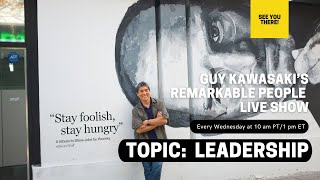
Guy Kawasaki talks with Colin Breyer about Amazon's leadership practices from Working Backwards. The company bans PowerPoint for six-page documents read in silence, limits teams to pizza-party size, and phone-screens every female candidate to fix hiring gaps.
Chapters
Foreign. Hi, it's Guy Kawasaki, and I am in my closet in Santa Cruz. You know, every time I try to be a good guy and shut off my camera so that I conserve power and raise the temperature of the earth a little less, and the next time the camera doesn't work, oh, my God. So I think. I think what's going on is, is that I have a dummy battery in that camera. And so when I just leave it on, it's fine, but when I turn it off, I think whatever little batteries in that camera drains completely, so it goes below the level where the dummy battery can kick in. So I could test my theory and switch cameras right now, but then my head would explode if I then lost all cameras. So I'm not going to do that. So you're going to see this extended view of my closet. Usually you see only about this much, but now you're seeing everything. So. And I am wearing pants. You can't see that much, but I am wearing pants. I am not stupid. I don't work for CNN or a bank. So, yeah, so this is really about. Not about my setup, but it is about my podcast. And my podcast is called Remarkable People. And today's guest is Colin Breyer. Colin Breyer was the chief of staff of Jeff Bezos, and so obviously he has some great stories. Now, who should listen to this particular episode of the podcast? Well, the honest answer is anybody who wants to create a successful company that scales. Now, I can't promise you that by listening to this podcast, you will create something as great as Amazon, but, man, Amazon has some very good ideas that Colin explained. So if you're interested in growing your company, you've got to listen to this episode. So it's based on a book called Working Backwards, and that's imminently out, and the name is Colin Bryer. B R Y A R. He co wrote it with another person who was at Amazon. You know what? Oh, my God. I'm in such a habit of looking there at my Sony camera that I'm not used to looking there. So I have to push that camera away so I break the habit. I need to look at the imac camera, not the Sony camera. So, yeah, Colin Breyer and book's name is working backwards. And the concept of working backwards, the. The two words as opposed to the book, is that what makes Amazon successful is that it works backwards from the customer. So this means that instead of thinking about what Amazon could sell because it has the technology, the expertise or whatever, or what a company could make because of its engineering or manufacturing. Instead, you work backwards from what the customer wants. So you look at what the customer wants and then you make your production, your expertise, your engineering match what the customer wants as opposed to making whatever the hell you can make and then forcing the customer to buy what you make. And that is a crucial concept. And to illustrate that concept, I mean, let's just think about the. I don't know, pick a camera company. So you pick a camera company. And have you ever thought that the interface on a camera was created by a company that was working backwards? And if you have, let me know which camera company that is, Because I see no camera company that does that. So for example, you know, let's say, well, what's something you commonly do, a pretty good habit is that every session you should reformat your SD card, right? So that you have as much space as possible. And you know, every. All file structure is all good. So you would think that working backwards from a customer's point of view, you would put the format menu item someplace pretty obvious, right? But no, no, I mean that format menu is always buried in settings, general setup, or it's in. I don't know where it is. I mean, that's the problem. But you know, that's an example. Also, somebody mentioned GoPro. GoPro is an excellent example of a company that does not work backwards. So let's just say here's so I have a Hero 8, I've had I don't know how many GoPros. And you would think that, you know, what year is this? 2021. You would think that by year 2021 there would be a GoPro with a much bigger battery. Because I don't know about you, but with my GoPro, when I take it surfing and I have it set to what I think is the optimal energy conservation mode, which is when I press the power button, it immediately defaults to video shoots the video. And then if I press the power button again, it turns off the camera. So the camera is not sitting there idling, but powered on waiting for me to start a video, it is off. And then when I press the on button again, the power button again, then it turns on and immediately starts taking video. Okay, so I admit that setting shows working backwards, but you know, in 2021, why are we still using those tiny little batteries? Because even doing what I just described, my best case is about an hour and 15 minutes. And my surfing sessions are longer than an hour and 15 minutes. So inevitably I run out of battery power in the middle of a surfing session using a Hero 8. Now, you would think again in 2021, by now we would have a bigger battery. I mean, you could apply that to Apple too, right? So obviously. Well, not obviously, but I must admit an iPhone 12 has much, much longer battery length. But you know, if you were to ask most customers, hey Joe Blow, would you prefer a thicker phone with much better battery life or a thin phone with what you have? And, and I'm telling you, everybody would say, give me a thicker phone because lots of people are buying, you know, these Mophie cases that double the battery life. So if we're willing to deal with a Mophie, we certainly would be willing to deal with a thicker phone. So obviously I feel very strongly about this, that companies should work backwards. I swear to God, many companies, when you deal with them, it's, it's almost like they don't even use their products. I mean, it's Apple. So, you know, why doesn't the Highest end or any MacBook have an SD card reader at this point? It's because Apple doesn't work backwards. Because, I don't know, Tim Cook must have a concierge that downloads his photos for him and never, he never has to take out an SD card and plug it in the side of a dongle that's hanging off like a colostomy off the side of his MacBook. So anyway, you got me started on this. So anyway, that's that, that's the title of the book. It's called Working Backwards and it is fantastic. I will tell you that I read a lot of business books, roughly one a week now because of this podcast. And I would say that Working Backwards is the most important business book that I have read in the last maybe five years. I truly do mean that. So the concept of working backwards at the highest level is very important. Some other things that I learned from Colin about Amazon. So they have banned PowerPoint, so you cannot use PowerPoint at Amazon. What a concept. That's a good concept. And instead of PowerPoint, now it's every. These meetings start with a 20 minute sort of period of silence where people read a six page document about the content of the meeting. And this six page document contains a fictitious sort of pro forma press release about what this decision or product is. It also contains screenshots for the design and it's that kind of thing. So rather than have. And so the way an Amazon meeting starts off is there's 20 minutes of silence when people read six pages, three minutes per page, and then the Discussion starts. And. And they have found that that yields much better decision making. Because with a PowerPoint decision making process, if you're a good presenter, a good presenter can sell a lousy idea. And if you're a lousy presenter, a lousy presenter could underwhelm you with a good idea. And both of those cases are bad outcomes. So no more PowerPoint six page document. They also have a very interesting thing which is the concep of a two pizza team limit. So if two pizzas can't feed the team on a project, the team is getting too big. And they also make sure that every team has a champion. So there is one person who is responsible for that team. It's not a matrix organization. And, and I just, I just love. Oh, one more great idea that I learned by interviewing Colon, which is that there was a department inside Amazon and it was. The gender diversity was severely lacking. So what that department did is because Amazon has a very rigid recruiting structure, which Colin explains in the book. And the first step is that people review the resumes and a screening phone call is made. So that's step one. If you don't get past the phone call, you don't get an interview. And, and so what. What this department did in order to increase gender diversity is that they made it so that every female candidate gets the phone call. What a concept. And guess what? Now they have great gender diversity. I love that idea. And in fact, in the spirit of that, after I, I interviewed Cole and I thought, that is such a great idea. So now you give every woman a shot. And so I thought, well, what could I do? And I don't recruit because it's just me. So it's not. It's me and Jeff and Peg, but we're not expanding this organization. So what I did as my little stake in the ground to help women on Clubhouse, when I host the room, I only let women ask questions. I only bring up women onto the podium, up onto the place where they can ask a question and be heard. So no matter who's raising their hands in Clubhouse, only women get invited to speak. And it's because I think that women's voices have been silenced for so long that I want to do this little thing, this tiny little thing just to help, I hope. I just saw a comment that, that my audio feed is down, but I hope that's not. Oh, so lots of people are still here. Okay, so. So only women can talk. And it's because I want to do my little thing to help women's voices be Heard and get the podium and get the attention because they have been silent so long. So that's what I do. And so now I'll take questions. You feeling the love? You should feel the love. I really believe in a meritocracy and I think that women should be given every right to succeed and every opportunity to succeed. And it just pisses the out of me. There's uneven playing field for women and minorities. What else? Oh, see, See how women love that when only they can talk. Amen. Let only women talk. Yeah, the way I look at it, men have been screwing up this world for so long. Like what's the downside of letting women try? I guarantee they'll do a better job. I mean, where would you rather be right now, New Zealand or America when it comes to the pandemic, duh. Now of course people might say, well you know, New Zealand is an island state. It's so much easier to control the coronavirus in New Zealand. Fewer people surrounded by water. Well, I guarantee you if Donald Trump were president of New Zealand, New Zealand would have a lot of coronavirus. Let's see, just passing by to say I still watch artists start@taycan2006. You know, Stephen, that is, that leads to a funny subject. So I was KeyNote addressed in 2006, this is a mere 15 years ago and ever since then Taycan has not really invited me back to be general session. There have been some, you know, where they asked me to be in a, in a simultaneous track but like just this year they asked me if I wanted to be in one, one little track. I said no, it's, you know, if you have me general session I'll do it but I'm not going to be in the sidetrack and I don't know why, but I'm not going to be sidetracked, so to speak. Let's see. Best ways to figure out what your audience needs. Well, Leslie, I have a theory on this. So my theory is that your audience, your customers can tell you how to evolve what you're already doing, but they cannot tell you how to revolutionize what you're doing. Because my experience is if you, if you were to ask for example Apple II owners what they wanted from Apple in the mid-80s, they would have said better, faster, cheaper. Apple II. No one would have said make a Macintosh graphical user interface, WYSIWYG display, WYSIWYG printing, incompatible software, different chipset, 9 inch monitor, you know, all the good stuff, one button mouse. Nobody would have described that because it wasn't in their wheelhouse to describe. So to evolve something, ask your customers, you ask your audience. But to truly revolutionize something, you have to jump to the next curve using your vision, your passion, and just freaking good luck. What else? We hired a stellar young lady a few years ago, the first female engineer at our company. She was a breath of fresh air at our company and broke the glass floor and ceiling. Now we have a dozen ladies kicking ass at our company. Amen. Amen. Yeah, like to me, just using logic, it's so hard to find good people. Why would you limit the pool from which you can hire by only hiring men? That just makes no sense to me at all. And there's some irony that I am Japanese and in Japan, women cannot or, I don't know, do not serve in management positions because I don't know Japanese in Japan figure that women only have secondary roles. I don't know. So they, they, like half the genetic pool is not available to them. Makes no sense to me whatsoever. Saying, hi from Japan, where women are silenced. There you go. There you go. Like, I really do not understand that. Like, that just makes no sense to me. That is so stupid. Like, why would you not recruit the best women? And why would you just turn your blinders on and look the other way? I don't understand that. It makes no sense to me. So what else can you tell that I'm really feeling like I should just tell it like it is today. Women in the culinary world are incredible leading men and sometimes making them cry in laughter. Yeah. Amen, baby. What else? I want you to know if you go to remarkable people.com and you look at, I have like 70 episodes right now, roughly half are women. So it would be a very interesting thing to look at, I don't know, Guy Raz's list or Terry Gross's list or Joe Rogan's list and see what percentage are women and what percentage are men. In other big podcasts, Malcolm Gladwell. Malcolm Gladwell does topical. Topical podcasts. So it's not as clear as, you know, just look up the guest name. But Malcolm Gladwell would be interesting to do an analysis of Malcolm Gladwell too, because he, he brings in four or five guests per episode on the topic. So it'd be interesting to track the gender of those guests for his topics. Anyway, I'm. Thanks. I am doing it Inquiry based learning in schools and a whole framework for designing learning. I own my own company. Go Women Leaders. Absolutely. Go Women Leaders. I'm telling you, if you go to remarkablepeople.com and listen to my podcast. There are, there's nothing but strong women there. There's Jane Goodall, Margaret Atwood, Christy Yamaguchi. Sarah Fry from Fry Farms sells the most pumpkins of anyone in America. There is Kara golden of Hint. There is Angela Duckworth, MacArthur Award winner Grit for Grit. The book Grit. Let's see who else is there? I have Nancy Gianni. She created a series of facilities to help families who have kids with down syndrome. I have Emma Isaacs, who started an Australian women's networking organization called Business Chicks. And let's see, coming up, I have Katie Milkman from the University of Pennsylvania Wharton. I have Susie Batiz, who started Poo Pourri. I have Melissa Bernstein of Melissa and Doug the Toy Company. I should just rename my podcast Remarkable Women. But it's too late now. Let's see. Okay, enjoy the AI episode. So guess who was on the AI episode? Lauren Coons. A woman. And Kooky. Well, Cookie is a female chatbot, so that's better than a male chat bot because a mail chat bot will tell you you're wrong and you don't know what you're doing. What else? How do you organize your day? Do you follow the schedule? I hate when people ask me this because I, I'm a very good now, excuse me, I'm a very bad example. So I'm kind of interrupt driven. I, I basically here's, I wake up at about 4, 4:30. I check all of my news sources, I check my email, sometimes I fall asleep again, sometimes I don't. When I eventually wake up, then I make myself a cup of coffee drip method and I have a peanut butter and banana sandwich. Every day, Every day it's like Groundhog Day so far. Every day I have the same thing. And then I check email and I check social media and I start working on my podcast. So I do podcasting, social media and email until it's either depends on the tide. Then I surf in the morning and then I come back. Sometimes I eat another peanut butter and banana sandwich with cup of coffee for lunch. And then I do email, social media and podcasting again. And then usually I have one or two virtual appearances a week. Sometimes I have to do stuff for my kids and then it's dinner time. Then after dinner, guess what? Email, social media and podcast editing again. So that's my life. And if you're looking for a great example of getting things done because of, you know, great insights and tips, I am not the right person. I just, I, I get a lot of things done because I just power through it. I don't have any magical. You know, I interviewed Julia Cameron, another woman, a couple weeks ago and she has this great concept of every morning you wake up and you write in your journal. You know, I don't do those things. I'm a terrible example of that. And yesterday, oh my God, yesterday I interviewed Sheila Nazarian and she is a Beverly Hills plastic surgeon. And put all your stereotypes of Beverly Hills plastic surgeons aside, she has a most fascinating episode. She has a Netflix TV series. And in the first, first episode of her TV series, she shows how she basically reconstructed a woman who was shot nine times by her ex husband. And she shows all the things she did to that woman's body to give that woman more confidence and self esteem. It's a fascinating process. So, yes, you're going to learn about plastic surgery from a Beverly Hills plastic surgeon on my podcast. That's true. So love the closet studio. Well, you, yeah, it literally was a closet. And so this is because, you know, the pandemic happened and I couldn't. First of all, you know, I have not done a face to face podcast interview since the pandemic started. I don't anticipate doing them for another year. In fact, I'd be happy to never do them again face to face. I think it's just so efficient doing it this way. And so I decided that I need someplace at my house where I could always depend on the background and the noise and the lighting. So at first I had a little office in the back of someone's home, but then that person had a dog and that dog would be yelping all the time. So that didn't work. And here's the beauty of a closet. The beauty of a closet is that there is no window. So when I shut the light, no matter what time of day, it's always the same. So this is a beautiful thing because I can record any time of day and I don't have to worry about, you know, is the sun on this side of the room, that side of the room, is it morning, like afternoon light? It's pitch black in here without light. So it's great that it's consistent, which I never thought of before until I did this. So what else? You should try almond butter with banana instead. It's way healthier than peanut butter. You know, I just don't like the taste of almond butter. What can I say? So on the scale of things, of the bad things I could eat, I don't think peanut butter Is the worst at all, to put it mildly. So I understand what you're saying, but, you know, it's all relative. And peanut butter, high source of protein, high source of, I think, healthy fats. And. Yeah, you're not going to change that. Happy to be able to tune in this week. Have you thought about building a remarkable people community? Members have exclusive access to cutting cutting floor content. Discount code for remarkable paper tablet. Oh, Elliot, I don't know if I can handle a community. Peg is listening. So, Peg, if you want to, if you think we should try a community, I'd give it a shot. And are you. So, Elliot, do you think I should just do it on Facebook or. We gotta roll our own here. Yeah. The thing I dislike about creating a community on some social media platform is that who knows at any given moment where that platform will be? Like, what if you were in Australia and you were publishing news through your Australian Facebook page and Mark Zuckerberg decides not to let you publish news anymore? I mean, you know. Yeah. What else? What's your opinion of the. Of the next block? Block? I gotta. I have to admit, Ramon, I just. I don't know enough about blockchain to give you a good opinion. So the topics that I don't know enough about to give you a good opinion are blockchain and cyber currency. So don't ask me any questions about those two topics because I don't know what I'm talking about. What else? What are some learnings that you've had from talking to various guests on your show? Oh, my God. You know, I've had 70 guests, so everybody has four or five things I've learned. So roughly 280 things that I've learned. I will tell you some things that are consistent though. One is that women, my guests, the female guests, a lot of them are concerned with having the imposter syndrome. And the imposter syndrome is that when you get promoted or you get a bonus or you get, you know, an honor, you think, I'm not worthy, I'm not good enough. I don't deserve this. Why am I here? So, first of all, women, you need to get over that imposter syndrome, because I guarantee you a, you probably deserve it if you got it. Probably you deserve it more if you got it, because probably you had to overcome even higher standards for you to get that. So that's number one of all people in the world. Women should not have an imposter syndrome. The second thought about the imposter syndrome is that you think about this have you ever heard of a case of a man who said, I really didn't deserve this honor, I really didn't deserve to be appointed to the board of directors or the board of advisors or, you know, have you ever heard of a man saying, what am I doing here? I'm not good enough. I. I'm not among my peers. These people are all better than me. No man has ever said that. So, you know, that's just a data point for you. Don't worry. So you asked me about the learnings of the people I interviewed, so that's one second thing. Also dealing with women is I think that women, before they decide to be entrepreneurs, they put their goals behind so many other things, which is to say, you know, when my kids are in college, when, you know, the house is perfect, when my husband is properly supported, when everything is going good, then I will start my company. And I think that is total, utter bullshit. Because, again, using the test, have you ever heard a man say, I am not going to take this transfer. I'm not going to take this new position in a new city. I am not going to start a company until my kids are properly settled in college? No man ever said that, okay? So I'm not saying that you should not consider your kids like, you know, Ted Cruz. He sacrificed his Senate career so that he could take his kids to Cancun, because God knows his two daughters could not fly with just their mom. I mean, he had to take them. And he, of course, planned in advance to come back immediately because he knew that his place was in Texas. So don't get me going on that rat hole. So anyway, yeah, so those are two lessons that I've learned that particularly apply to women. Oh, one more, one more. Many people have told me that early in their career, what helped them succeed is the concept of you just fake it till you make it. And I truly do believe that, too. That, man. When I started as a Macintosh software evangelist with my psychology degree, having worked in the jewelry business, I was faking it until I made it every day, man. I didn't know shit about assembly language or Pascal. I still don't. So I was faking it till I made it. So faking it till you make it is a very important skill in life. And don't let anybody else tell you that it's not true. Okay, what else? What are your thoughts on the future of influencers in marketing? I think, honestly, and some people consider me an influencer, I think that it's vastly overrated. I think that the Concept. Some. Some people have this idea that, you know, you get an influencer and they tell people to go buy this car or buy this camera or use this software or download this software or buy this microphone or buy this ring light or I'm looking around the room here, buy this scanner and bada bing, bada bang, all these people listen to the influencer and it happens. Now, yeah, maybe if Kylie Jenner says buy this lipstick, millions of people buy the lipstick. But it's not been my experience that I can just say, hey, you know, buy this. And all of a sudden the phones start ringing off the hook and website goes down. Because so many people listen to me. Now it could be that I'm just a shitty influencer, but it's certainly not my experience that people can move the needle that easily. So I'm not against influencer marketing. After all, some people think I do it, but I don't think it's as near a guarantee as people think. So there you go. What are your thoughts on servant leadership? I don't know what servant leadership is. Doesn't sound good. I am biased as to what it is. However, it seems to me if you're not serving others, you are self serving and that is not leadership. Ah, okay. So it is a positive. Okay, I should have read the whole question. Well, I mean, first of all, I recoil at the term servant. I mean that just, it's just like it's too close to slavery and indentured servant and you know, abuse from the white overlord stuff. So servant to me is a bad word. Service is not a bad word. But servant is a bad word. Has too many negative connotations for me to embrace that term. Now, I would make the case that I don't know if a leader serves his employees, but what I think a leader should do is a hire people who are better than himself or herself and then get the hell out of their way and let them do their job. I would not say that's a servant relationship. Might not even be a service relationship, but certainly I think many people hire people who are not as good as themselves so they can feel superior and then they do get in their way anyway because they think that they are better and should tell and micromanage every employee. So there you go. Yeah. See, Jason Scott, Earl agrees that influencers are vastly overrated. Okay. Big fan since reading Enchanted. Well, it was actually Enchantment. Okay. But currently discussing taking on an evangelist title at my company, inspired by you. Thanks. You're welcome. You're welcome. I hope you do that. And just remember, I'll give you the key to evangelism. Okay, Write this down. The key to evangelism is you evangelize good, because it is so hard to evangelize bad. That's the key. Find, create, or affiliate with something great. Speaking of something great, guys, I totally lost track. So remember, Remarkable People is the name of my podcast. This week's guest is Colin Breyer. He has come out with a great book with his co author about working backwards. And if you think that Amazon is successful, which I do, there is a lot to learn from this book. And I would make the case that this may be the most important business book in the last five years or so. There are like, as soon as I got it, I read it and I sent it to the three founders of Canva because I told them Canva's about 1400 employees right now. I said, you know, you should read this book because this will help us get from the 1400 level to total worldwide domination of graphics. So, yeah, what else other than leadership? Do you believe that there are common qualities between successful business owners? Well, it's kind of hard to separate things out, but, you know, I hope anyway that good leaders yield good products and good services and good customer service. So it's kind of hard to separate. You know, very seldom do you see a company with a great product and a shitty leader and you know, although you do, I have to admit, you can have cases where you have shitty products and good leaders, but, well, you know, I guess that's just the world is not black and white. So, yeah, I think they're all interrelated. I don't think you can separate it out. It's hard to imagine a really great company without a great leader. So let's see here, let's see. MIT Sloan cover with Buzz Aldrin says, you promised me Mars colonies instead. I got Facebook thoughts on how we can change the investor entrepreneur landscape at scale to solve real problems. Climate, circular economy, hunger in America. Boy, you got any hard questions? You know, I. I think that there are just. There are some things that cannot be done by the for profit economy. And some of it is it just takes people to have a good soul to do. And some of the things you mentioned there now, you know, could we have a new green deal that creates wealth and jobs and all that? Yes, absolutely. I think clinging to petroleum base and clinging to coal is ridiculous. That the trend is not your friend. And you know, what good is having a job if we're all dead with climate Change is one way of putting it. So let's see. I'll take a couple more questions because I gotta go surf. So what else? Love this podcast. Thanks for speaking up for women. Carried. I can guarantee you something. I will speak up for women. Absolutely. Absolutely. Although Colin Breyer is a man, everyone should read that book. I'm telling you, it will help you run a company better. Well, you should read the book. But first listen to the podcast. Okay. Because I'm trying to figure out how I can move my subscribers up. I swear, I have the best guest list in podcasting. So, thoughts on net neutrality? I am not a net neutrality expert. I don't see how you can argue against it, the fact that the. The Trump administration was not a supporter of net neutrality. My simple algorithm is if you go opposite what Trump wants, you'll be right most of the time. So, you know, I don't know if Ajit Pai was like, exactly trying to make the world a better place. So defaulting to my algorithm, which is, you know, generally opposed, what the Trump administration wanted to do, and you'll be okay. That's what my feeling is on net neutrality. So let's see. Are leaders born or created? I think that they are both, actually. But I think the more important conclusion is that leaders can be created. That you don't. You don't have to be born a leader. And I guarantee you that leaders are not born as only male. That is for damn sure. Okay, so I appreciate you, guy. Thank you for sharing so regularly and openly. Well, thank you, Ben. Thank you. Very appreciate of that positive comment. So now everybody go to remarkable people.com listen to Colin Breyer if you want to build the next Amazon next week is Lovey Ajayi, my favorite Nigerian. And, well, I gotta tell you, man, Nigerians. I love Nigerians. I want to be a Nigerian in my next life because they are so good at insulting people and it takes a lot of intelligence to insult people. Well, so let's see. I think that I will sign off here. Aloha, Guy. Continue to enjoy your podcast from day one. Your guests, how you interact, great storytelling, and how you interview guests. Mahalo. Thank you, Francis. I appreciate that. So, you know, is anybody here who doesn't listen to my podcast? Because that offends me. Because I will tell you that as I look back over my career, honestly, my podcast is the best work I've ever done and it is the least appreciated. So unless you want me to be psychologically scarred, I want you to go and listen to my podcast. And then spread the word about it. I want you to be remarkable people. Evangelists, in other words. Okay, can I give you a harder sales pitch than that? Okay, so Colin Briar this week. Love you, Ajayi. Next week. Life is good. Remarkable people. Have a great week. Remember, remember, we got vaccines now. But. But you still need to wash your hands. Don't go into crowded places. And for crying out loud, wear a mask, man. Don't be a dumbass. Wear a mask. And with that, I bid you a good week. Take care. Bye. Bye.
More from Guy


Cheryl Strauss Einhorn | The Human Edge: Smarter Decisions in the Age of AI | Talks at Google



Rachel Glennerster | Innovation and the Center for Global Development | Talks at Google

Rebecca Winthrop | Rethinking the Purpose of Education in the Age of AI | Talks at Google

Dr. Robert Wachter | A Giant Leap: How AI Is Transforming Healthcare... | Talks at Google



