Marc Benioff: Business is the Greatest Platform for Change
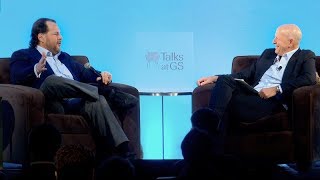
Conversation between David Solomon and Marc Benioff about how business—and specifically Salesforce—must address social challenges while adopting new technologies. Benioff discusses rapid advances in AI (Salesforce Einstein, including voice interaction), the local crisis of homelessness in San Francisco and Prop C (a tax generating ~$30M/month), corporate responsibility (taxes, community engagement), gender equality and pay audits, data/privacy and trust as a core company value, and his leadership approach including creating a co-CEO role. The overall argument: businesses are powerful platforms for social change and must operationalize values (trust, equality) into their operations.
Questions this video answers
Approximately $30 million per month.
62%.
More than 100 years (as stated by the World Economic Forum).
About 50 companies.
Chapters
Thank you, everybody. And thanks, Mark. Thanks for being here. Happy to have you. And since we've got a short period of time, I'm just going to dive right in. I want to start, start with artificial intelligence. And we were both at Davos at the World Economic Forum, and there was a discussion or talk at Davos of the fourth Industrial Revolution, fueled by advancements in fields like artificial intelligence. And so, you know, at Salesforce, you've launched Einstein. You've personally written about how AI is becoming more ubiquitous in everything we do. You've talked about interactive chatbots and brick and mortar stores. Talk a little bit about how quickly this is all progressing and when we'll see things like that.
Well, thanks, David, for having me. I appreciate it. And yeah, I mean, you can see the world is changing very rapidly and that AI is definitely on everybody's mind. What is happening? How is it going to impact our world not just in terms of our technology and the products, but also work, the workforce and jobs? And it's going to. We're going to see, you know, very significant implications today. I mean, I see that first. I mean, AI is being developed much faster than anybody realized. It's the nature of how it's being built. It means that it's going faster. There's some geopolitical implications of that. You know, when we were in Davos, I met with the leader of a large European country who's very worried because they have no native developers of artificial intelligence in their country. So they're either dependent on American companies to offer them high quality artificial intelligence or Chinese companies. And it's different than other shifts in our industry because it really is going to get really back down into the core of society and jobs. And as an example that for a while we've been working on our own artificial intelligence, which we call Einstein. And that has, you know, been very successful in regards to Einstein. You know, I've been running Salesforce with it myself for a couple years. That is when we run a management meeting, you know, every Monday, and we review the forecast and so forth. You know, we kind of leave an extra chair open at the table because we'll say, okay, well, Einstein, tell us, you know, how is. How's the company doing? What's going on? And we've been able to kind of get that to happen. Now, not only that, I don't actually have to type that command or do that query. I can just speak it. So I can just speak directly to Einstein. And what I saw video last night is I saw it basically for the first time, coming right back at me, speaking right back at me. So I have the ability to be managing my company with deep learning that is not just machine intelligence. It's really kind of the best AI we have in our industry today, which is deep learning technology that it's learning while it's interacting with me. Now, this has been going on already with our product for a while, but then when I saw and I'm actually just able to speak to it, it's speaking back to me. I'm like, this is extremely powerful, especially in the management setting, especially in the sales setting, but also in the customer service setting, where that's. Traditionally, you've had to speak to an agent to get complex information from a system that seems to be going to be fully disintermediated by technology rapidly.
Yeah. So furthering on that point, I mean, when you touched on jobs just a little bit, as you answer that, how do you see this and the progress of this affecting inequality in society?
If you just go right out into the street where I just was and walking up and down the streets, you know, it's a crisis of inequality. We have one of the worst homeless situations in San Francisco as any country in the world. Now, we're not like New York. New York has something called shelter in place, which means that the 65,000 men, women and children who are homeless in New York, they are legally obligated to have and be given the opportunity to have housing every night. We don't have that in San Francisco. So when we have adverse weather like we had last night, we don't have the shelters. And our city does not take care of our homeless very well. And so that's why we've been fighting for more homeless services. And we fought last year for something called Proposition C, which is that for the very top companies in the city, which we're one of a half of 1% of a tax, not very much. And that will go into a fund that will take care of the homeless. Well, that's now generating $30 million a month in additional homeless services. It has not yet been released by the city, but it's getting closer and closer to being released. And that will have a significant impact in the ability to provide direct services to our homeless population. Because as our tech industry has become more successful and our economy has boomed in San Francisco, the average price of a house here is now a million and a half dollars. And we don't have this kind of diversified housing that you see in other cities where we have different levels of Housing or protected housing or the ability, like you see in France, this kind of amazing housing that's dedicated to people who are below certain income levels. And what's happened is we were having a situation where we have mass dislocation. And this is a very significant issue right now in the city.
Yeah, since you went, you went in this direction. I mean, this touches on Davos also a lot of discussion about companies and the responsibility to stakeholders broadly to communities. You know, it's something we've thought a lot about at Goldman Sachs have always tried, you know, to build on programs and support the communities broadly that we operate in. You know, you've been a leader in thinking through some of this. Talk a little bit about how you think the broader business community needs to evolve on this topic.
Well, I think that it goes into a lot of very specific areas, but one area is taxes. I mean, CEOs have a Pavlovian approach when it comes to taxes. You say taxes, we say no. And that is why when I went on Prop C, not every CEO supported me. You don't have CEOs who are going to speak today who are against Prop C. And that was a tough situation because I'm like, how can you not walk down the streets and see that we have such a serious situation? But CEOs are tax adverse. They say they can't afford it. Their companies are really struggling. Obviously it's not true. And their companies are doing just fine. I know my company's doing just fine. And their companies are doing just fine as well. So we can all afford a little more tax. And it's probably true when you see, like, the tremendous tax cuts that companies have received, are the benefits of those tax cuts flowing into society and really impacting those people who need it the most, or is it going to some other area that's not really helping. And I think in some areas, especially when you see real wages not increasing, significant strife in public education, you know, advancements in the homeless populations, and many other things, you know, I think we're going to. We need to, like, do a check in on that and say, you know, are. Have we made the right decisions in regards to not just growing our economy, not just building great technology, not just making. Creating wealth, but are we taking care of everybody else? Are we committed, you know, are we committed to improving the state of the world, or are we not? And I think when it gets right down to it, for a lot of CEOs, this is not what they learned in business school. They learned about how to manage their EPs, they're not really focused on community impact, you know, but I don't know how to have a successful business with also having a successful community. The homeless situation in San Francisco is starting to affect our employees. It's becoming a material issue for us. So we have to take action. And we can't just say government is going to take action, because we know that government is mostly not very effective today. Not just our city governments, but our federal government, that we as business leaders have to take personal responsibility and start to say, what is it that we're going to do, each and every one of us, on the major issues that we know that we can make change. And we look, we have more power and more capability than ever, but business has to have that level of responsibility. And it can't just be corporate social responsibility. It has to be in a lot of areas. And this homeless tax issue is a great example because it's a tax that's like a big deal. It's addressing a major part of the city ecosystem. It was a major fight, you know, but I think that when everybody voted here in San Francisco, the reason why 62% of the population voted for it is because nobody wants what we have today here. We've got a real crisis on our hands.
Well, this is a topic that's going to get a lot of attention, you know, broadly, all over the world. It's clear governments aren't getting it done. And so it's certainly something we'll continue to talk more about.
And I think the other thing that you can look at right down into running your business, you know, like, when I look at programs, inequality, you know, obviously we have, like this inequality situation in San Francisco. So I'm thinking, well, how am I impacting equality in my own company? And one of the areas that's extremely important to me is gender equality.
Sure.
So when I look at how do we treat women in our company, what are we doing to make our environment and our work environment in our company better for women? And when I look at that, I'm like, there's really four areas, you know, equal opportunity, of course, equal advancement. But there's a brass tax, which is equal pay. Do you pay men and women equally for the same work? And for the vast majority of companies in the world, they don't. The World Economic Forum, where we just were, again said that it's going to be more than 100 years before we pay men and women equally when we do our own audits. You know, we saw these kind of multimillion Dollar spreads because between men and women that we closed. And the funny part is we've bought 50 companies in the last whatever it is, decade or more. And as we buy companies, when we do due diligence, which is of course one of the things you would know very well, we now have to actually look at pay scales and due diligence. Five years ago, David, I did not look at pay scales in my due diligence. I didn't look at culture. I didn't look at class door ratings. I didn't. Now I do. I have to look at those things because when you're gonna buy a company, you're not just buying the technology and the customers, you're buying the culture.
You get everything you want.
CEOs need to wake up. They need to go, wow, what am I doing in terms of what kind of environment am I creating for my organization? And that data's out there. You can action that into your company. And then the other area is preventing sexual harassment. You've seen in your city, several executives get taken down in the media industry in a very significant way. Very respected CEOs don't have their jobs anymore because they did not pay attention to preventing sexual harassment in their businesses. And that's not just true in your city, but in this city too, we have CEOs who are not paying attention to their cultures and kind of allowed toxic cultures to emerge. And it turned into a very significant issue. Even just a few doors down here at Google, they saw all of their employees exit their buildings worldwide last year because they voted on their sexual harassment settlements. And that was, I think, very eye opening for a lot of people. So no CEO wants to get into a position where you have all of your employees exiting the building because they're voting on your culture. And yet that's what's happening today. It's related. Actually. All of this is related because when we talk about equality, whether it's homelessness, gender equality, sexual harassment, culture is more important to ever to our employees. And as more and more of our employees are millennial employees, this is more and more important for them. So we're doubling down on that.
It's good that you're doubling down on all these issues. These are all issues where, candidly, all companies have to make more profit.
Yeah. And as an example, the CEO of Goldman Sachs 10 years ago, this was not something that they had to really focus on.
Big priority priority of mine.
The new Goldman Sachs CEO, four months in. This is something that's going to be a major part of your Leadership will be looking at all of these things, because when it comes to, you know, the Edelman Trust survey came out, you know, a couple of weeks ago, and this is the first year where they asked a question, do CEOs have responsibilities in this area? And 76% of the respondents say that, you know, I expect the CEO of my company to have clear positions in these areas, you know, wide ranging areas. And when it comes to something like that, you can't just be a domain expert in financial services software. AI da da da. You've got to know your stuff. When it comes to how are you handling your culture, your company, your community, it's all related.
Yeah, absolutely. Well said. I want to shift a little bit and talk a little bit about data and privacy, because there's a lot of focus on data and privacy. And you've talked about companies in this context struggling a little bit with a crisis of trust. And so just elaborate on that a little bit more.
Well, it's somehow. It's actually related to the last thing we just were talking about, because for each one of us in this room, every CEO has to ask a simple question. What is really important to me right now? What is really important to me? Or just how about this? What's the most important thing for your company? What is your highest value? Is it integrity? Is it trust? Is it quality? Is it success? You know, is it innovation? What is the most important thing to you? And for each one of us, we will have a different, slightly different answer.
You feel like it's got to be one of those. It can't be a number of those with some priority.
I don't know. When I was growing up, you know, there were all of these ads on tv, on Ford. They said quality was job one. I don't know if you remember those ads.
I remember those ads well. I'm old enough. Old enough to remember those days.
So that was their highest value. In fact, and I'm sure you've done this, you walk into the Michigan headquarters of Ford, and they have a plaque of their values. And the highest value is quality. So to us, my highest value personally and also in Salesforce is trust. Nothing is more important than the trust I have with myself, my higher spiritual power, but also, you know, with my customers, my employees. And how about with my local community? Where is that trust? Do they trust me? They see this big building, you know, shining multiple colors every night, all this stuff. They're going, whoa, do we trust that company? You know, we know where they are. Do we trust them? Are they taking care of our schools? Are they taking care of the homeless? Are they taking care of the hospitals? Are they taking care of us? Or are they just making more money? And I think there has to be a balance today where before maybe trust was not the highest value, you know, and one of our core values is not just trust, but we just hit it. Equality, not quality. Equality. It's got an E in front of it, you know, because that has to be a core value. And we have to be able to say, how do we operationalize those values? We do that. That's our job. Right. Once we get clear on what our values are, which could be trust, it could be customer success, it could be innovation, it could be quality, it could be gratitude. When we look at what are our values in our company, we have to say, now how are we going to operationalize those values? That's our business plan. That's what our employees are doing every day. They're operationalizing our values. That's the core of their work. So we have to be super clear what our values are, because ultimately that is what our employees are going to do every single day.
So bring it back to data for a minute because it feels like in terms of being clear on, well, we.
Have some companies that don't have trust as their highest value. They have other values. And you know that anybody who studies these companies can see. Oh, I can see right now. Okay. That the highest value of this company is not trust. That is. Is it the trust that they have with me and the data that I'm giving them? You know, now at Salesforce, that would be very serious. Because our, the data, our customers data is theirs.
Yeah.
We don't productize our customers data. That's their data. Even as we do AI or deep learning or sophisticated techniques, we've had to come up with ways to fully extract. So we don't never see our customers data.
Sure.
We have been complex.
Absolutely. Same issue.
Yeah. We can't look at our customers data, but we have to say, okay, how are we going to be able to maintain that trust? Nothing is more important to us than the trust we have with our customers. We're never gonna breach that. So how are we gonna handle that? Well, I think that not every company is at that level. And different companies, they just can't get up on stage and say, trust is our highest value.
Do we need regulation to help move the process on this along for companies.
That won't make that change, they're just asking for it. You know, they just can't get out of their own way. It's kind of crazy, actually. You know, I mean, it's like, wow, you really can't just say it, can't you? All you have to say is, trust is our highest value and we're sorry for any mistake that we've made. Forgive us. They cannot say it. They are just going in a completely different direction where they just keep fighting it. And by doing that, they destroy their brand, their executives walk out of the company. You see it. I mean, I watch the executives walk out. Obviously, you know, we're all very tight community here. So they're all having lunches and dinners with each other, whatever. And they'll say, I'm going to leave that company because that CEO, I'm not going to go through the names, just, you know, I don't trust them. Or all that CEO is interested in is X. And when you hear that that's that CEO's highest value and that's where you're like, wow, that if that was my employee or my executive saying that about me, I would try to be in touch with that before that executive or a whole series of executives walks out that door or customers walk out the door. Right. And you've seen it in your industry too. You guys have had to deal with this now for decades, right? Where it's like you have to constantly pivot back to the customer. And this is something that I think in our industry, we're just getting a taste of that for the very first time because of the nature of these technologies like AI that you mentioned and other things. There is a trust gamut with AI for sure.
Yeah. I want to talk a little bit about leadership and your approach to leadership. You speak a lot about the virtues of mindfulness. You've undergone digital detoxes. You really lead, you know, you lead in a very powerful by example way. You know, you speak your mind, you talk about things that are important. You've got great passion. You know, give me a little bit on your broad perspective of leadership. You've been running. I'm a new CEO. You've been a CEO for a long time. You know, you've been running, you know, your company really, really well, but also with a unique leadership culture that I think really had a very positive effect on Salesforce. You look today Salesforce, and they listed 100 best companies to work for. Number two, right up at the top of the list. Goldman Sachs has been on that list for a long time. But we'd certainly aspire to be number two. Talk to me a Little bit about your general leadership philosophy.
Well, last night, not last night, but the night before, I was in New York and I was at a retirement dinner for a CEO who's done an amazing job. And she's one of just incredible, a great CEO. But one of the things that she really did was she said to that company and to that board, you know, we have to have a purpose and we have to have a social responsibility. And we need to change our culture and we need to shift. We need to move energetically who we are as a company. We need to look at ourselves. You know, what are our values? What are our levels of diversity and inclusion? What are the programs that we're doing for our employees or our customers or for our communities? And the thing that's interesting to me is the night before that, I did a dinner with maybe a dozen CEOs of Fortune 100 companies. And whenever I go to New York, or actually any city, the night I arrive, I always do a dinner with a bunch of customers. Now, one reason I started that, honestly, it was quite selfish. It was sales type thing. I'm sure you do the same thing. You want to meet your customers. Right. But it rapidly evolved. And what happened was it moved from just being a sales pitch and, you know, having a slideshow and all that too, and around the table conversation about values and the responsibility of the CEO. And they were asking me the same questions that you were, because we were doing some things. And then I realized, wow, I think we actually need to talk more aggressively about what we're doing and how to do it. You know, there's two things in business. It's not just what you're doing, it's how you're doing it.
Sure.
You know, and that is challenging to cos. Because the things that we are talking about on this stage right here, a lot of the things that we just went through, there are not necessarily best practices or well established programs or classes. And this is not what we learned. Like, I went to business school from 1982 to 1986 at USC, at the Marshall School. That is not what we learned. There was no gender equality class. Okay? It did not exist. So we are on the fly. We're learning. And that's why we need to learn and grow together. And the role the CEO has changed. For CEOs who understand that their performance actually has improved, for CEOs who do not understand that they are struggling. And so that's why I think we all have to kind of pick up our skills and say it's not just about our products. We all have products we're selling. It's not just about our financials, we all have those. It's about our culture and what are we doing with these. You know, if business is not the greatest platform for change, then I don't know what is. And I've seen that over and over again around the world. That business really is this incredible platform for change. And when you use it for good, you can impact your, not just your employees and customers, but the communities that you're in. And I think that we can all be an example of that. And everyone in this room and as I travel the world and talk to our customers, this is something that's extremely important to them. And it's probably one reason why they do business with us because they all come back and say something really interesting, which is that values bring value. And that idea that our values bring value, that is a shift, I think for chief executives.
Yeah. So just to finish, one of the most interesting things you've done over the course of the last couple of years is you created a second CEO.
Yes.
And you know, I can say because Goldman Sachs is actually one of the few companies I know that at times has had two people running the company and it's, it's, it, there are, there are lots of benefits and there, there also can be drawbacks. But it seems to be working well for you thought process behind it?
Well, for me, you know, being kind of a CEO started to become single threaded and it became a burden in my life that was, I could just see that, you know, you'd be invited to events and conferences. You know how this is. Well, only the CEO can come, only the CEO can do this, only you can do that. And I'm like, this is terrible. You know, and I just realized it's not true actually. And I have a fabulous executive in my company who'd been with me for five years as my coo and I'm like, he would be a fabulous co CEO and he can be my peer and we can manage the company together and it can be release the burden. And you know, I was with it a friend of mine who is a CEO executive and we were at this event on Tuesday night again and that person was lamenting, oh, my job has taken over my life. It's everything. I can't get away from it. I can't go on vacation, I can't do this, I can't do that. If I do go on vacation, I have to be on my phone 247 and I'm like, well, I, you know, you.
Here's an idea.
Yeah. You've got to find your partner, basically, and it can really help you. And I said, oh, I can't do it. And I asked him a simple question. I said, then you have to find another way. And I guess that. That. He wrote me an email yesterday. He goes, I stayed up all night just like, focusing on that. How do I find another way?
Great piece of advice.
There's always another way.
Always.
Because there's infinite possibilities. And when it comes to things like the vision for our company, for our values, for who we are, what we're doing, our individual roles in these organizations, there's always another way. There's always another option. And the key is, how do you find that next way?
Well, I wish I had another half hour.
All right, well, thank you, David. Thanks for having me.
Really appreciate it. Thanks a lot. It's great to talk to you.
Always.
Really great.
Thank you.
More from Guy


Cheryl Strauss Einhorn | The Human Edge: Smarter Decisions in the Age of AI | Talks at Google



Rachel Glennerster | Innovation and the Center for Global Development | Talks at Google

Rebecca Winthrop | Rethinking the Purpose of Education in the Age of AI | Talks at Google

Dr. Robert Wachter | A Giant Leap: How AI Is Transforming Healthcare... | Talks at Google



