Technology Not Just a GUY Thing with Gil Asakawa, Guy Kawasaki, and Peg Fitzpatrick
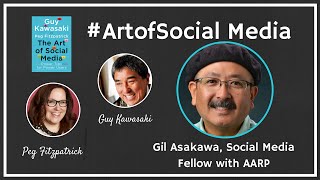
Guy Kawasaki, Gil Asakawa, and Peg Fitzpatrick discuss social media strategy and their book The Art of Social Media. They cover how to engage effectively on Twitter, Facebook, and LinkedIn, with particular focus on reaching older audiences through AARP and building personal brand.
Chapters
Hi, everybody, this is Peg Fitzpatrick and I am joined today by two awesome social media professionals and we are going to share a short Twitter bio about ourselves and then we will get into a little bit of Q and A about technology today. My name is Peg Fitzpatrick and I am a social media blogger. That will be my little quick Twitter bio.
Gil.
Oh, sorry.
Oh, my name is Gil Asakawa and I work with AARP's social media team and pleased to be with you all.
And I'm Guy Kawasaki and I'm the co author of the Art of Social Media with Peggy.
There we go. So we're going to turn it over to Gil Asakawa and he's going to ask us some questions about technology and social media.
So, you know, this is kind of an extension really of the web series that we started on YouTube and on AARP talking. The show is called Technology Not Just a Guy Thing. And we wanted the opportunity to talk more about technology and about social media. In fact, the second episode of the series is called let's Get Social and it talks about social media. It talks about your book, the Art of Social Media. Hey, I'm here. I'm here with you. I got the back, which just recently came out and it's a terrific book and it's a great resource for people and it's meant for. It says the subtitle is Power Tips for Power Users. So it's for a little bit of an advanced audience and I'm here kind of on behalf of maybe some of the not so advanced audience, and that's what a lot of that web series is about. So people who are 50 plus, which is 50 years old and older, the AARP audience are very engaged as entrepreneurs, so they have the potential to be very engaged with social media and technology, but maybe not as geeky as some of us might be. So tell us a little bit about the book and who you're trying to reach with it.
Okay, so the book was written because of Peg. Basically she just pounded on me telling me that we should write this book. Took her about six months of pounding.
I am very. I'm so persistent.
That's one way of saying it. And basically we're trying to give a very complete selection of tips and techniques to help people master social media because we've been asked so many questions so many times and we wanted to codify the whole thing and make it easy for people in one place. And there's over. Over 120 tips in there. And I think if you do most of them, you would be Definitely social media ninja. That's our whole purpose. It's not a lot of high level sort of theories about social media. It's almost all tactics.
Yeah. So it's not really about. It's not about programming. It's really good. Suggestions. Good. Best use case. Right?
Yes.
Okay, so let's step back a little bit, because the fact that Peg pounded on you for six months, that sounds.
Worse than it is, by the way. I would just make a gentle suggestion every once in a while.
Yeah, it was pounding. Guy doesn't have any bruises, so we're good. We're good.
Not visible.
Okay, whatever, whatever.
Tell us how you two met. Because Peg Guy calls you his social media guru. So tell us how you met.
We met on Tinder. Right?
No. Now this is going down even a worse rabbit hole. No, we met on Twitter.
I knew it began with a T and ended with an R. Right.
This is back in the old days when Twitter was the most popular thing. And the interesting thing is I was going to start a book club online, and Guy, he had published Enchantment, which is one of my favorite books. So I wanted to read Enchantment for my first book club book. And I tweeted that it was my first book. And I hashtagged Enchantment. And I not assuming that he was going to see the tweet because I was just tweeting it to, hey, I'm having a book club. I was inviting all of Twitter to my book club. Basically, the first person that RSVP'd was guy. So it worked out really well. That just goes to show you that if you ention people and you use hashtags that you can connect on social media.
That's right. It's proof that you can get a gig using social media.
Exactly. And I didn't have a ton of followers at that time. I had maybe 1500 followers, which I think the average Twitter user has maybe 100. So that's more than the average Twitter user. But it's not millions or it's not like I was a big, huge somebody on Twitter. I was just somebody. I was proficient in Twitter at that point because I had tweeted a lot. Maybe 20,000 tweets to my 100,000 tweets that I have now. So, yeah, it's fun. I still love Twitter. Guy loves Twitter. We're on other social platforms too, but you can definitely connect with people on Twitter by mentioning them and saying hi. So it's a great way. It's one of the easiest social networks to connect with people directly, I think.
Now, Guy, you and Peg are so active on social media. What are the platforms you find that you spend the most time on? I know, like both of you have huge followings on Google, more than anybody I know.
Yeah. Right now this is kind of a recent development. I'm spending most of my time on Facebook. So it's Facebook, but. But you know, it's hard from the outside looking in to see what I'm doing because I spend most of my time on Facebook. But Peg makes me look so great on Pinterest. So people from the outside looking in, you think I'm doing all these things. But it's really behind every successful social media man is an amazing woman. And so basically Peggy is the one who's making me look good on much of social media.
Well, the good thing about Pinterest is it's not time consuming.
Yeah, you pin it and forget it.
Right, right, exactly.
So what is time consuming about Facebook? Do you try to craft the message? You have obviously more space, 140 characters and whatnot.
Yeah, so I try to craft a longer message. I try to interact with the comments. I also interact with comments on Twitter and Google. So, you know, there are people helping me post, but only I respond to comments. And so when you, when you get responded to by me, that really is me. And so, you know, that's just. It takes hours every day for me to do all this. But that's, you know, that's the price of using social media as a platform. So. Yes, it's not about finding out who had a baby and who got drunk and who went to a party and who went to a Sharks game. For me, for me, it's a business.
Unless you went to a Sharks game and you're commenting actually is almost the most time consuming part of social media. Especially if you have a great popular post, which you hope all your posts are popular, but if you have one that's popular, the commenting can take a really good chunk of time, I think.
Because you have to interact with people individually.
Well, that's the goal. I mean, that's why you post stuff, because you want people to like it and comment on it. But guy picks things sometimes that are a little bit controversial because he likes to stir up the dust every now and then. I'm not a dust stirrer for the most part. I just like to post awesome stuff. But it does generate a lot of conversations. So it's good. Yeah, it's individual responding to individual comments. I go through and like I make guys communities awesome. By deleting out spam comments. And like, if people, if there's racist or, you know, sexist or, you know, inappropriate stuff, those are deleted. But all the good, even if there's a negative comment, those aren't deleted as long as they're not, you know, harsh profanity or something.
Let me, let me. There's two paths I want to go down. I want to get to talking about the kind of stuff that you share on social networks and the mix of messages that you want to get out there, but also specifically for our audience. So for aarp, the folks that I work with, we talk about this on our web series. Technology is not just a guy thing, which is available on aarp.org and on YouTube, but also when I hear a lot from people who are 50 plus, people who are 50 years old and older, about how they don't want to. And this is not necessarily like 70 plus, this is maybe still baby boomers who tell me, well, I don't want to be on social media because I don't want to share my life and I don't want. It's my privacy and I don't want people to know what I'm doing. What do you say to people who believe that? And I think that's a legitimate, you know, point of view. But how do you get them to understand still how important it is to engage on social media?
Well, you know, first of all, we don't assume that everyone has to be on social media. It's kind of a personal choice how much you want to share. And I share very little of my personal life on social media.
That's the key.
And I use it as a marketing platform. Now, if the AARP member wants to have social interaction with friends and family, I can't think of a better way. But for example, my wife doesn't use social media. She wants complete and utter privacy. I am like, I couldn't be further away from that. So it's really. We're not trying to convince everybody to get on social media. Trying to say, if you are on social media, this is how to optimize it.
Julie Coraccio, 41. 41.
It's interesting because my husband is the same way guy and I post stuff, but we don't post our spouses or our kids because we have a lot of followers. So they don't want to be on there. I did read a lot of statistics that said that people that are 55 and older, especially women, are looking for work and looking for ways to connect for New jobs. And social media is a way that you can connect with people for a career change to get your name out there. If you're on LinkedIn or Twitter, your personal profile on Facebook is not something that's going to help you get a job. And you don't need to have a professional page unless it's something that's going to help you. So if you're looking for a job, social media is a great place to be to try to build your expertise and connect with people. So keep your Facebook page totally private and keep all your settings private. And then do a public LinkedIn and Twitter and just keep it professional. You don't have to post where you are, where you're going. You can keep all your location stuff off. So there's ways that you can. I mean, the thing is Guy and I are posting all the time and we don't post our personal stuff. Our personal things that we share are really like professional personal. Like if we're at a conference, we'll share tons of pictures and that's where we are and what we're doing. Right. Then that's part of what we do. But, but if we're on a family vacation, we don't share our family pictures. We might share the location where we are, but it's still kind of our personal version of our family, but not our personal details, if that makes sense. Well, that's what we do. That's how people can be on social media. But they don't have to share all of their personal details, but people still get to know you. Does that make sense?
It makes perfect sense. And actually something you mentioned leads to my next question, which is are certain social media platforms that I think are better for certain things, certain types of youth. So LinkedIn is definitely one that's more work related in terms of looking for jobs. What are some of the. How would you. And you cover this in your book as well, the P's of social media. Right. You talk about the different platforms and what they're good for. Can you go over that a little bit?
Sure. So first of all, if you really want to use it for job search and business development, LinkedIn is the place to be because it's a much more serious social media site because people are there for that purpose. Right. So if you're there looking for a job, you probably are not going to be a troll and make, you know, make yourself look like an idiot. Although that does happen. But generally speaking, there's a self policing aspect of LinkedIn that makes it the Highest quality if you want to use it for business. And then, you know, sort of the broad strokes are if you really want to show people, like, stuff that you find cool and beautiful, then it's Pinterest. And if you want to very quickly show people pictures of what you're seeing, it's Instagram. And if you want to tell people what your perceptions are, what you're feeling, then it's Twitter. It's kind of like that, basically.
Okay, Peg, which do you feel most comfortable on?
I have to say I'm comfortable on all of them. It's what I do for my job. So sometimes the general questions don't necessarily apply to what I do because I am on all of them. And it's even hard for me to pick a favorite. But I try out the new stuff. There's recently a couple new networks that started, and Guy and I both checked them out, got our names on there, and we were like. We didn't even like them. Which is Ello and Sue.
Yeah, same here.
Yeah, we tried them out and we were like, eh. I don't even think about it. I don't even go back there. I don't even know if anybody's there anymore. So we try stuff. My newest little thing I'm trying is Snapchat, which I didn't think I was going to like, but I have to say, it's actually kind of fun, really.
Okay, so we should explain for our viewers how Snapchat works. It's like a very temporary thing, right?
Yes. And it's a little. I have to say, I'm a sucker for a good logo. I love hootsuite because they have their cute little owl and Snapchat is just this little. Well, that's going right on my thing. Snapchat is hard. Like, there's only like five buttons on it. It's got a little ghost you can see. Can't really see it. There's a little ghost down at the bottom. You just send a quick message to people and it goes just directly to those people. Or you can create a public story now and you can send. It's 0 to 10 seconds. You can select how long it is. You can add little text on it and you can send it to them. It's kind of like texting, except it's visual, which is. People love visuals. And brands are on Snapchat now.
How are brands using it? What's your favorite brand there?
They have this little discover thing and you can see the little stories that pop up. And they have well I love everything Food Network because the Food Network just does great stuff and they're on there on Discover. You have different. They do a little story that pops up every day. So Food Network looks like Comedy Central, Cosmopolitan of people. So you just go on there and there's just like a little 10 second story that plays. Let's see if Food Networks will play. If I do it here, we can.
See a Snapchat and don't they disappear?
Yeah, but theirs actually lead to a blog post which I don't know how they do it, but only brands can do that.
Interesting. So there are all these ways to build business right there.
Yep.
On social media, what's the in terms of tips, what's the most important thing people should do to communicate effectively with social media?
My advice is for everybody post you make, you have to include either a picture or a video. And now I happen to work for a company called Canva, which is the best way to make a great graphic for every post. But even if I didn't work for Canva, I would be telling you this. Every post needs to have a picture or a video if you want to have it.
Maximally effective for people to pay attention.
Yeah. Because it's such a busy world out there that, you know, the text ones just get lost.
And in fact, the web series technology is not just a guy thing. One of our upcoming episodes is all about Canva where you two walk through making graphics on Canva. So looking forward to that one. Definitely.
That was a fun one because your crew was like, oh my God, what was that? They had never seen Canva before and they were like, how did you make something so fast?
I think it's one of those tools that once you use it, it's just, you know, wow, why didn't I have this before?
Yeah, well, it's great for people who don't know how to use Photoshop and most people who are not using it for professional purposes are not going to have Photoshop. Like a personal social media user that wants to make a Facebook cover, they're not going to have Photoshop at their disposal. So finding another way to make it is important.
Now, one of the other things, and especially if you run a small business, I remember in the early days of social media it was pretty common to tell small business owners, oh, just hire some kid teenager to do your social media for you. And then pretty quickly, a lot of businesses realize it's not realistic. You have to watch your message. You have to really control the message that you're getting out There and also how much work it takes, how much time you need to invest to do it well and to make it effective. So what are the you2 know best more than anybody? How often should people be posting and what times of the day are the best that get the most readership?
Well, I think a good rule of thumb is take the number of times you think you should be posting every day and double it.
Those are common questions, Gill, and there is not really a one size fits all answer to what is the best time to post. Because everybody has different social media audiences and they are in different time zones. So the best way if you are a small business, is to use Facebook insights and to check to see when your audience what time zones they are in. And I love this free service called Likealyzer and it tells you what the best times to post are. And that's for your page. So if I go by any best time to post things, I find a service to check it myself on my own accounts. Because like for example, Guy and I wrote a book together. So you would think that our audiences may be similar, but they are not similar at all. My Facebook page has similar 70% women follow me. And Guy's Facebook page is like 60% male. And the top keywords are totally different. So it's really personal. Like depending on your audience, every community is different. Even if Guy started a different Facebook page on a different topic, the audience may be totally different. So there's tools that you can use to find the best times to tweet. Tweriod is one T W E R I O D. That's one where you can check the best times to tweet. Those are services that use your own audience and they see when your content was popular. And I use socialbro, that's another tool that I use for Twitter that'll tell you when the best times are. So any of those charts that tell you post Facebook at 1:00 clock on Friday, that's there's no way that that's the best time for every single person.
And also, you know, you just gotta remember that you should be posting when the people you want to reach are up. If you just remember that, that's 90% of the battle.
Yeah, college kids, midnight 1am Back to.
The hiring a young person thing though. You know, there's a pro and a con for that. You know, the pro is you want to make sure that, well, is that the young kids know everything that's coming up that's popular and how to use it. So there is A benefit to working with, you know, young people because they are so tech savvy and they just inherently know the new stuff and how it works. My daughters, for example, were on Snapchat. They were like, try it. I was like, no. It's like when it started out, it was all just inappropriate stuff. And I was like, I have no interest in that. Yeah, I was like, no interest in that.
At.
But now that it's popular, the kids find all the hot stuff, and then everybody else moves in, which is the model for everything except for Twitter, really. I mean, Facebook kids were on their way before. All the adults were. Now kids are leaving because adults are there. They're leaving. The kids are leaving because they're now on Kik and Snapchat and Instagram. They love Instagram.
You know, I remember a few years ago, everybody, they had two big concerns about Twitter. One was they didn't see a business model, and two, kids weren't using it.
Yeah.
And, you know, our logic back then was, so you're telling me that you're worried about something using a company because they might not have a business model? You know, by that test, you shouldn't buy a car from many people. I mean, like, and. And then, lo and behold, kids have flocked to Twitter now.
And they use it totally different. They have their own way of using it. So it's interesting.
Yeah.
Let me ask you one other question about content, because you write in your book about something those of us who work in this industry are familiar with, which is feeding the content monster. But in the midst of trying to find cool stuff to share on our social media accounts, what's the danger? There's a danger, right, of people promoting themselves or promoting their company or their product too much.
Well, our theory is that you should always be like npr, which is most of the time, you're providing great content so that you can run your pledge drive every once in a while, which.
Is your promotion once a year. Yeah.
Yeah. So that's the test. And feeding the content monster, a lot of it is just knowing the tips and tricks to piggyback on other people's work. So I have a website called alltop a L L T O P where I aggregate content by topics. So I find that extremely easy to use to find content. And you can also view the services, they have, like, these what's hot pages, so you can see what's already hot. The point is, don't try to bookmark 50 sites and visit them one at a time by yourself. There are much better ways to do this.
And what's the danger? Somebody just does pimp their company over and over? Do they lose credibility? Do people just stop listening?
Yeah. And you won't get followed. I mean, it's just embarrassing. It just won't work.
So, Kai, I noticed that you'll talk about technology, you'll talk about all sorts of things, but then you'll have the Heavy Metal cats and other interesting stuff that you're finding on altop. So if somebody follows you. If somebody follows you, Peg, they don't just get the things that you're pushing for your work, your career. They get this enormous variety of entertaining content.
The interesting thing is I did an experiment on my account. I don't know if I ever told Guy about this. I posted all the RSS feed from. Holy cow. From Feedly one time. I tried it for a while. It was not even popular on my Twitter account. They didn't care. It's interesting because Guy has built a reputation for sharing a whole bunch of eclectic, like, awesome stuff. And his followers know if they go to his Twitter stream, they can find eclectic, fun, trendy, awesome stuff, as well as leadership or entrepreneur, social media kind of things. But my followers know that if they follow me because it's just how your audience comes to expect content from you. So mine expect marketing and social media. I also post random stuff, but cupcakes and baking and stuff that I find on Pinterest. And my followers love that. It's really interesting how every community is built differently and they come to kind of expect the consistent content. So it's great to share a variety, come up with your basic plan and then add a few things that you're interested in. And people come to expect that. No one is surprised when Guy shares hockey stuff along with his other things because it's fairly common. We know that Guy loves hockey and that's authentically what he loves. So he shares it.
It's a reflection of him as a personality then, of course. Right? So the bottom line here, and we're going to wrap up this conversation, but the bottom line really is know your audience, right? And understand that you project a voice and a personality and a brand. And you just need to be consistent with that and your audience will follow and your audience will grow.
Well, also, people don't need to worry too much about making a mistake because there's so much happening on social media. Listen, I've posted things, identical posts three times in a row by accident. I do all kinds of stuff. It doesn't matter. It's just like water under the bridge. You think you make a mistake and millions of people are going to see it. It's just not true. Just have fun and whatever happens, happens. The sun will rise tomorrow again.
I don't have to worry then.
No, you really don't.
Alright, well you know what, it's been half an hour and we had decided to keep this to half hour so I really appreciate this opportunity to have this conversation. It's an extension of the AARP web series technology. It's not just a guy thing. There is one of the segments that's currently up on our social media series right now for this month is a conversation that I had with Peg and yeah, so it's cool that we get to extend this conversation and have it on a Google hangout as well. All right, thanks for your time.
Thank you Gail. Thank you. Take care. Bye Bye.
Bye.
More from Guy


Cheryl Strauss Einhorn | The Human Edge: Smarter Decisions in the Age of AI | Talks at Google



Rachel Glennerster | Innovation and the Center for Global Development | Talks at Google

Rebecca Winthrop | Rethinking the Purpose of Education in the Age of AI | Talks at Google

Dr. Robert Wachter | A Giant Leap: How AI Is Transforming Healthcare... | Talks at Google



