The Art of Social Media Power Users featuring Marques Brownlee, Guy Kawasaki, and Peg Fitzpatrick
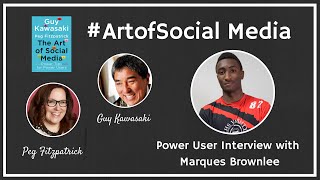
A recorded YouTube hangout where Peg Fitzpatrick and Guy Kawasaki interview Marques Brownlee about his rise as a tech-focused social media power user. Discussion covers how Marques began on YouTube, his workflow and equipment, monetization (AdSense and brand deals), audience-building strategies, comment-management, platform choices (YouTube as hub vs. Facebook native uploads), and his plans to produce more video after finishing college.
Questions this video answers
Over 2 million subscribers.
Approximately 18–22 hours (couple days of actual editing).
He is a senior with one semester left.
Chapters
Hello, Internet, it's Peg Fitzpatrick and I am here with the art of social media power user hangout. Today we have a digital native with us as a, of course, power user. His name is Marquise Brownlee. He is amazing on a host of social media platforms. Number one, he has over 2 million subscribers on YouTube. He is amazing on Google, he is fantastic on Twitter, he. And he rocks Instagram like nobody's business. So can you please say hello?
Hi. Well, thank you. I appreciate the kind words.
And he has a clean dorm room, kind of.
Yeah. Inside of this frame here looks pretty nice.
Due to the magic of video, Marques has the cleanest room. If we panned around, it may not be. No, but for the camera, definitely. Awesome. And with me, of course, is my co author, tech superstar, social media original. He's the OG power user of social media, Mr. Guy Kawasaki. My guys were laughing because Guy didn't know what OG was.
When you're really og, you don't even know what OG is.
That's true. It's the meta version of og. Okay, so I really just want to dive right in because there's so much to talk to you about. Marcus, you are first. Do you want to talk. Let's talk about YouTube first because that's where you really. I think you started super young. So can you just talk to us about how you got started on YouTube and how you kind of created your niche there?
Yeah, it all started on YouTube, which was video. And. And so, like, I just, I made a channel like a couple years before I ever made any videos. So I just had like it under my name or whatever. And so I was doing research to try to figure out what laptop I should buy. And this was like in the middle of high school and during the research I was doing, I was watching all these other YouTube videos about these series of laptops that I was considering and eventually made my choice and I bought this laptop and then I went back and decided I wanted to add to that collection of videos that people could watch if they were in the same spot that I was making that purchase decision. So I made all these screencasts and there were all these software tutorials on how different parts of the laptop worked and how Windows, I guess it was Windows 7 at the time, worked on it and just a whole bunch of different things like that and just uploaded them to YouTube. It was like a one click. So it was one click record and then hit stop and then upload that file. Like that was it. Just upload those and. Yeah, that's how it all started. So I've just been making videos since and then other social media channels, profiles have come from that, just in being able to share the videos and sharing other things that point to the videos and vice versa. But yeah, that's how it all began.
Marques, I think that if I were a consumer electronics company and I had a choice, God said to me, okay, you get a choice. You can either have Marques review your product or you can have the Wall Street Journal, I would pick you. I think you moved the needle more than the Wall Street Journal.
Yeah, I mean it's a close. I mean they obviously have a different audience than I guess, people watching my videos. But ultimately when you're not even following either and you just want to search for, let's say you want to buy a new phone, where are you going to go for that review? You might Google it, but ultimately I just want to see someone using the phone. I want to see the phone. So I'm just going to go to YouTube and type in the name of the phone. And the stuff that shows up there is definitely going to change people's purchase decision.
Yeah.
And I think for your generation YouTube is the search engine. Correct. If you guys want to know how to do anything, you don't Google it, you YouTube it.
Right. And it's more than just tech, it's like how to videos on like anything. There's huge how to channels, there's modding stuff, there's software, there's makeup tutorials, there's fashion, there's hair, whatever, like anything you want to learn how to do or what to do. There's probably a YouTube video or a channel dedicated to it.
And how do you monetize it?
YouTube, it's so Google AdSense basically. I guess any channel can do it now where essentially Google sells ads alongside or little pop up videos or sometimes there's pre roll videos before the actual one you want to watch and Google will split revenue with you from the advertiser for that.
So you're not doing anything special where Samsung or somebody specifically is sponsoring something or anything like that. This is just straight out the box.
Google. Yeah, that's the basic level of what anyone can do. And then yeah, obviously. So on top of that I can work with other companies or brands. I hate that word for some reason, but I can work with brands too.
Brands, it's okay.
But I can share other things that are related to the content that happen to be related to brands as well. So I like working with companies too.
Okay, very cool.
So let's see. Guy, do you want to ask a.
Question before I. Yeah, so. So at this point, how do you get, like Samsung and Motorola and Nokia and Sony and everybody, they just like every time they introduce something new, they put one in a box, too. Are you like that in the flow at this point?
Sorry, say the last part again. I didn't quite catch it.
Are you that in the flow that every phone company, every consumer electronics company sends you something?
Not really. I actually still buy most of the stuff that I show on video. A lot of times, probably like eight out of every 10 things that I review is something that I bought. And that actually helps me to come from the perspective of someone who made that purchase decision and bought something. But, yeah, there have been companies like LG and Motorola who reached out and will work with YouTubers, including me, to get them a device ahead of time and show us all the features and things like that. And that's actually really helpful for video because it takes a while to make a video. So when you get the device in the hands of the people making the video and they can make that content ahead of time, that's really great to work with them.
So if a video lasts, I don't know, 10 minutes, how long did it take you to get to that final 10 minutes?
Yeah. So it depends on the type of video. I think a lot of it depends on what I'm doing with audio. So if it's a video of me just talking to the camera, maybe I'm doing a countdown of something, or I'm just just talking about a topic for whatever reason for 10 minutes, there might be like an hour of footage of me talking and then messing up and talking again, basically. And that might be six or eight hours of editing because I already have all the audio and all the video recorded and I just need to edit it. But if it's a review video or if it's something a little bit more complex and it's 10 minutes long, there's audio being recorded on site, there's audio being recorded during the editing process, which is, I guess, something that I do that's a little unique, where I'm literally recording audio as I'm editing. But basically there's a whole bunch of more maneuvers that I have to go through to put something together like that. So that might take 18 or 22 hours or something, Couple days of actual editing to put together.
So it could be 22 hours to get 10 minutes.
Yeah. Wow. Which seems terribly inefficient when you look at it that way. And the ratio of footage I shoot to footage I use is also probably some absurd number. But when you compare it to other mediums like writing or just pure photos and stuff like that, it's a very different process to make a video.
Well, Guy can identify with that because he likes to write, rewrite, rewrite is rewrite, and then rewrite it one more time and then when it's live, he likes to rewrite it again.
Exactly. Yeah.
I swear with Gary Vaynerchuk For a 10 minute video, he spends eight minutes.
That would be the dream.
You have a team behind you. So can you talk about what equipment you use to make your videos? What's your favorite editing software? Are you like Final Cut Pro dude, or what?
Yeah, I use the Adobe suite and I still use it because I actually came from. I started on that Windows laptop that I bought. So I was using actually some other pieces.
Killing me. You're killing me, Marques. You're killing me.
I was using Camtasia Studio on Windows and it's specifically for screencasting. It's not very good. So when I upgraded on that Windows machine, I went to Adobe Premiere and eventually the Adobe Creative Cloud. And so I'm using that suite now as I'm using a Mac now. But yeah, I'm using the Adobe suite. I mean, other equipment is just like the light, there's lights you can probably see right there, those are just fluorescent 4x4 banks, tripod lenses, camera.
What camera?
I'm using a Red Epic Dragon carbon fiber. And the lens on it is my favorite actually, which is the Sigma 1835 F1.8. Easily, easily the best lens I ever used. And my favorite.
So that camera setup must cost like five grand, right?
A little more than that, yeah. But it's worth, I think, because I didn't start with this camera. I started with this little Sanyo zacty handycam, little CG10 sort of thing. And before that I was using my laptop webcam. So it's been like a constant process of upgrading. After that I used, okay, the Canon T2I, then the Canon 60D, then the Canon 5D Mark III, then the Canon C100, then the Red Scarlet and then the Red Epic Dragon. So it's been like, wow, I didn't just jump to the Red Epic just after my webcam or anything like that.
That's awesome. So you must, you must have somebody that does your taxes and stuff, right? Because you're declaring all that, right?
Yes, yes. Quite a lot of meeting with an accountant involved with that? Yeah, yeah.
You're the only college student that's like, I need to go meet with my accountant. I'll be. That's amazing though, because as we kind of mentioned in the pre show, for your generation, YouTube famous is famous. Like YouTube famous is like straight up. That's what people want to be. Now people are getting TV deals from YouTube, like web series are getting turned into real series. So for you, like, I mean, obviously at the beginning of it, you just kind of happened upon it. You liked it, you liked tech. Now you have probably the best niche there is. You're killing it everywhere. What advice do you have for somebody who might want to start a YouTube channel? Because it's a pretty. There's a lot of people on YouTube, but there's still space for new people, right?
Yeah. People often say the barrier to entry is higher than it was because I got started seven years ago. That was a very different time and there was way less people doing what they're doing now on the Internet. So I guess my advice would be to pick something that you have no problem going all in with. Like pick a topic that you're genuinely passionate about as your number one most important thing. And if you're passionate about it, then you don't mind putting extra hours into it. You don't mind spending strange amounts of money on things you wouldn't ordinarily spend on things like that become fun rather than a chore, and that actually shines through. So people who are going to start to watch these videos, they're also people who are passionate about the same topic. So that will. You'll have that sort of connection. A lot of times you see people try to start a channel because they see someone else doing something and they're like, I want to do something like that. And then they start to try to copy it or whatever. And that's probably the opposite of the right way to go about it. You should definitely, even if there's someone already doing something similar, you should try to pick something as a topic that you really care about and then it goes from there.
That happens a lot in social media too. People see a blog or someone on social media, instead of trying to come up with their own thing, they copy it and they're like, I'm going to be the next.
Yeah, don't be the next.
Yeah, be the you, not the next. Got it. I agree with that.
So, Marques, let's say that you found this unique topic. You're passionate, you're moving and grooving, making this Stuff. But so how do you get it out there? How do you get people to notice you and follow you and all that? What's the next step?
Yeah, that's a. It's a weird thing because I never really wanted to spend energy on that. I didn't really want to. You know, I mean, there's classes I'm taking in college and there's all sorts of instructions on how to get people to see your work. But.
And you're like, I have millions of people.
Yeah, but when I was first starting, it was just about making the best work that I can. And if people happen to see it, that's cool, too. I guess those people were in the same buying decision that I'm crafting these videos for, so that's cool. But I guess the first goal was to make stuff that was what I wanted it to be. But then, yeah, if you want people to see it, I guess what I would not do is just send it to people, asking them to watch it. That's just work. Agree.
I hate that.
Yeah. You see the messages in your inbox, like, please check this out. Not really going to help. But if your content is so good that it can't be ignored, if your content is so striking or it fills the niche so well that people are going to watch it anyway, then the people who are passionate about it will share it anyway. So instead of sending your video to people to get them to watch it, leave it there and make sure it's so good that people will come to it without you asking them. That's sort of the brilliant.
That's our theory, too.
I mean, it is and it isn't brilliant. Right. So you leave it there and it's fantastic. Let's take that all it's given. But you're still a tree in the forest. I mean, how are they going to stumble upon you? No pun intended.
Well, I think at this point, though, Marques does an amazing job with. He's built up his Twitter account.
Yeah.
No, no, no, I understand how he did it. But now, how does someone do it today if you're starting out?
Yeah. It just has to be a different great type of content. And even if there are more, you know, more, there's more videos out there than there ever were before. There's more channels doing more great work. So you just kind of have to start. It's tough to, again, be, like you said, a tree in the forest, and you're starting at that level where no one's really going to see what you're doing. No matter how good it is. But I feel like after a while and it's not quick either. That's another thing is like if you want people to see what you're doing like that, there's pretty much no good organic way to do that. So it's not going to be rewarding if you're in it just to get people to see it. If you're good with that being five, ten years later, then you can focus on the content for the first five years. And then when people start to see it and they look back at the last five years of videos you've done, they'd be like, oh, wow, this is great, I'm glad I found this.
So if you have a really long game, you're good, but otherwise, yeah, it's.
More of a long term.
Yeah, you do have the benefit of starting now is you can learn from other people not to copy their stuff, but you could learn how to edit, you could learn how to use different social channels. So there's a slight benefit now. I mean, obviously the swamps thing, it's the same with Twitter. People say, well, should I start an account? People have millions of followers, how can I catch up? You're not necessarily going to catch up and you might not get to someone else's level, but you can still create something awesome that will be valuable.
Yeah.
So on the flip side, let's suppose that I'm some marketing person at some company and I bought into the whole Marcus Brownlee power, able to move the needle. So how do I. I know you're getting 200 emails from every crank pot marketing person in the nation here, so how do I get to you? How do I get the you to review my phone, my tablet, or hypothetically my book?
Yeah, it would have to be. I'm already in. I'm still doing what I started out to do, which is to make videos I would want to watch and show things that I'm interested in. So no matter how good you are as a marketing person, if you come to me or another tech youtuber with a product that we're not interested in, then the connection won't be made. So I guess one would be have a great product and you might not have control over that, but have a great product. Two, I guess keep it short and sweet and show us that it's a great product and that we would want. That's weird music playing outside. Show us the product that we would want to make a video about and make us want to make a video about it. And that's the short answer, I guess. Yeah. Okay.
I'm taking notes.
Okay. So I talked to you a little bit in the green room too about how Google is changing. But for you, when you post something, you get thousands. And I am talking 3,000 to 6,000 plus ones per post. How do you explain that?
That's a good question.
Are you the luckiest person that lives or what?
Google, for as long as it's been around. I was on Google before it was public and now it's public and sort of been just sharing random things that I find cool. And it kind of works in a similar way to, I guess, Twitter and YouTube in a way because I'm sharing things that are interesting to me and I feel like a lot of people who use Google are also interested in the same things that I'm interested in. Which, yes, is very lucky. I guess that's the most fortunate part of it. But being interested in consumer electronics and tech and smartphones and Google and Apple and these new modern things and sharing things about that or cars or TVs or whatever, and these people who are just around Google see these things that they're also interested in, it doesn't matter who shares it, they're probably going to engage with it. They might one it, they might comment or share it or whatever. So yeah, it helps to be sharing something that these people are also interested in. And that's great because I get to.
Talk about stuff I like, so it's really organic. That is part of it though. It is what you are passionate about and the passion that you have for. You're interested in tech, you like computers. Whether you did this or not, you would still probably love all these phones and try the computers because it's part of who you are. So the passion and enthusiasm that you have is authentic. That's what makes it so awesome. So can we Talk about commenting? YouTube is a super tough place. YouTube commenters can be crazy people. And once you get to a certain level, you get hammered. And it's great to be in a lot of different social platforms, but you can't necessarily connect with each person. So how do you deal with comments and connecting with people?
Yeah, comments are the way they've changed over the years in terms of how they work and how they're sorted and things like that. But I try to answer comments, people who are asking questions and people who are genuinely engaging and want to know more information. If I can help people, I can't answer every comment because if there's 3,000 comments in an hour that would just be such a time suck. I can't do it. I try to pick comments from people who maybe I see their name often or maybe they just have a really good question that I want to float to the top and if I answer that question, then it will float to the top. So that will hopefully answer the question that other people would have had. So it's sort of a strategic pick in terms of how to engage in that comment section. But other than that it's very minimal, I guess for me. Sometimes there's other videos where I'll collaborate with someone and we leave a comment on each other's videos that we collaborated on so that there's an easy connection there to link back to the other person, little things like that. But I guess it's sort of playing a game of how you can answer the most people's questions with a single typed out answer. Is this way to do it?
Marques, would you consider or would you start doing native uploads of your video to Facebook and not putting it on YouTube to have two channels, Facebook and YouTube?
I think I would probably never do that and only because, I mean, I understand why people do that because people share Facebook content and Facebook is auto playing all these videos and it seems like a good idea. But I've always wanted everything to point back to the YouTube video and the YouTube channel as a sort of a portfolio for everything. So that's where the hub is, that's where everything lives. And then things can point back to it. But the second that I start putting that core content, which is basically all I'm doing, the reason any of this is working is because I'm making these YouTube videos. The second that I dilute any of these YouTube videos or move them somewhere else too, then it immediately becomes this weird thing like am I going to point some stuff here and some stuff there, or do I point everything here? Except Facebook is kind of over here somewhere. So I feel like I just want everything to point to the channel the way it is.
Do you have any concerns with having all of your content on YouTube since you don't actually own that platform? Like if you have a blog that was your name and you own the domain, you would own all of that content. And while your channel is yours, YouTube is Google's. So what do you think about that?
Yeah, I think I am actually working on a website at the moment. But having. Yeah. Being I always get the question, like what. What happens when YouTube ends or disappears?
Your whole generation cries.
Exactly. Like what are all the tweets don't say that. Because when. I mean, tech stuff is gonna still keep coming out and people are still going to find themselves in a buying decision and they're still gonna want to watch videos somewhere. So there's going to be another site if YouTube ever disappears, that people will go to search for a review. So right now I want to buy a phone, I want to see videos. Where are you going to go? YouTube. Not Vimeo, not Yahoo, not Facebook. I want to see a video. I'm going to YouTube. The second that the answer to that question changes for a bunch of people is probably the next place that I would end up putting videos. Which sounds weird because all my portfolio is in one place right now. But yeah, in terms of owning my own content, it's. I'm okay with it. Living with Google's hub and just sort of pointing to it right now.
You're happy to share that because they've done well. I don't think we did talk about it. You have the million subscriber golden play button. Is that what it's called?
Yeah. Yeah. Google wants to. They have every incentive to make YouTube better and make YouTube a great place for video. And as long as they're rewarding creators and doing things like that, it works for them and it works for creators. So as long as Google's doing work, then I'm happy to work with Google.
Have you been to that super awesome place in la, the creator studios that you do have?
I haven't yet and there's actually one I haven't, but there's also one that just opened in New York that I was going to go to, but then I was going to. The thing that I was going to go to there got canceled. So hopefully I get to visit one of them soon because I've seen videos from those places and they look awesome.
My friend Rebecca Rudice was invited to a special opening that they had there and it was like in the big hangar. She said it was crazy and she was like, I need to get on YouTube. It was to help people build their subscriber. It was like newer. They had some YouTube superstars. But I love the way YouTube works with. They did hand pick a lot of people, as most social platforms do. They hand picked people to feature on the homepage. I don't think they do that anymore though, right? I think they used to do that in the past.
Yeah. Because it's all algorithms now. So everyone's homepage is different. So you basically get recommended things based on what you've liked and Already seen.
Did you ever have the suite hookup on the homepage?
Never once.
But they put you right on the Google suggested users list.
Yeah, I mean, I've been in recommended videos all the time, but I've never been on like the YouTube homepage or whatever it's called now. Yeah, the Google suggested user list. And like the. I guess there's a YouTubers category is what it's. Yeah. So that's pretty cool.
Yeah. So can you give us some tips about the optimal length of a YouTube video? Do I need a trailer? Do I need an intro? Give us the tactics of YouTube optimization.
Yeah. So a lot of people like to say that the typical attention span is pretty short. And YouTube likes to rank videos in terms of watch time or watch percentage. So you want people to watch as much of your video close to the end as possible. So you want to get some pretty abrupt beginning and ending so that people watch the whole thing. I'm more into the tech side of things where the length is less important, I think, because if you're watching a review on a phone that you're interested in buying, it doesn't really matter how long it is. If it's three minutes, if it's five, if it's seven, you're probably going to watch most of that because you're interested in actually buying the phone. But if you're trying to make like comedy or some other sort of entertainment, that's a totally different ball game that I'm less familiar with. But I'm sure you would want it to be a shorter, you know, short but sweet video so people watch the whole thing without getting bored and leaving, that sort of thing. But I tend to. My videos, I guess, are on the longer. The longer end of the. How long a good length is for a YouTube video? My short videos are like five minutes long. My longer videos are like 15 minutes long. But again, it's because people are looking in search for these things and once they click on it from search, they're probably going to watch most of it because that's already what they're interested in.
So what year are you at school?
I have one semester left, my senior year.
And then what are you going to do?
More videos?
This is it. You're going to do this full time. And someday we'll be walking into Best Buy and there'll be the Marquis Brownlee Station and the whole thing.
How dope would that be? Yeah, I mean, I want to make more videos and I want to make better videos and obviously spending a lot of Time in class every day takes a lot of time away from my ability to do that. So I think when I graduate, I'm going to start putting more time into videos, but I'll also still have a bit of time to focus on other things too. But yeah, that's the number one priority, I guess, when I graduate.
But good for you for getting your degree and not saying, I have this awesome YouTube thing and I don't need college. Did you learn things in college that are helping you with all the things that you're doing?
I've taken some good classes in terms of being able to relate the formulas and software that you use to actual real life stuff. Like I've taken a class called I Want to say it was Social networks and marketing or something along those lines and where we run literally software sentiment analysis on tweets, where instead of reading the tweets, we run it through software with some keywords to find out if people are reacting positively or negatively to something. So things like that. And like integrated marketing communications is another one where I'm learning about how the people are running those advertising agencies that I already talk to so often. So, yeah, I've learned some things that are actually pretty useful that I wouldn't have otherwise figured out, I guess, if I hadn't looked for it.
Do you ever sit in a class and there's a professor or a guest speaker and the guy stands up and says, yeah, my video gets like 50,000 views and you're sitting there saying, are you kidding me? I get that in the first 10 minutes of my video.
No, that hasn't happened. I've had, I mean, there's plenty of guest speakers who are very knowledgeable on marketing and I guess for some reason most of them never really talk about YouTube. As ubiquitous as it seems, it's still a pretty young platform and it's developing really quickly. So I guess people aren't really as experts on YouTube yet, but maybe someday.
Maybe it will be you. Okay, well, we are at the 30 minute mark, which is the good point to end a hangout because that kind of reaches the end of people's attention spans. Thank you so much. Thank you so much for joining us. It was really awesome to dig into what you do in your social media power users life every day. Do you have anything that you want to close with, Mr. Kawasaki?
No, I'm just, you know, when it comes to you, Marquise, I am not worthy. When I grow up, I want to be you, Marquise.
That will be quite a change. Okay, well, thank you so much to everybody for watching and we will see you next time. Time for another artist social media power users hangout. Bye bye.
More from Guy


Cheryl Strauss Einhorn | The Human Edge: Smarter Decisions in the Age of AI | Talks at Google



Rachel Glennerster | Innovation and the Center for Global Development | Talks at Google

Rebecca Winthrop | Rethinking the Purpose of Education in the Age of AI | Talks at Google

Dr. Robert Wachter | A Giant Leap: How AI Is Transforming Healthcare... | Talks at Google



