The Art of Social Media Power Users featuring Mari Smith, Guy Kawasaki, and Peg Fitzpatrick
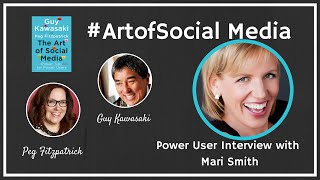
A ~30-minute YouTube Google Hangout (Jan 2015) with Peg Fitzpatrick and Guy Kawasaki interviewing Facebook expert Mari Smith. Main topics: how Facebook's complex news-feed algorithm (EdgeRank) dramatically reduces visibility (from ~15,000 possible items down to ~300), implications for organic reach and paid ads, friend vs follower limits (Dunbar number mentioned), and best practices for balancing personal profiles vs brand pages. They also discuss multi-platform workflows (Facebook as home base, Twitter scheduling and repeating tweets, Instagram cross-posting via settings or IFTTT), blogging/book publishing as authority-building, and practical tools (Hootsuite, Canva, WiseStamp, 22Social). Tone is conversational, practical, and tip-focused.
Chapters
Hi everybody, this is Peg Fitzpatrick and I am here for another art of social media power user hangout. And today we have one of our very, very favorite social media power users, Ms. Mari Smith. Say hello, Mari.
Hello. Hello. Greetings. Glad to be here.
And my co host, Mr. Guy Kawasaki.
Hello.
We are here today to talk to Mari. Mari has several books. This one is one of my favorites. As you can see by the post it notes, I color coded them for Mari's brand Color the New relationship Marketing. But Mari is best known as a Facebook expert and she literally does know everything there is to know about Facebook, which is a complicated, ever changing, vast amount of information to keep up with. So Guy and I are going to take turns and we are going to ask Mari tons of questions. So buckle up, stay tuned and let's get started.
Awesome.
Mr. Kawasaki.
Oh, okay. Let's get started. All right.
Ask me anything.
Yeah. So, Mari, if you buy into the theory that EdgeRank or whatever they call it now, you know only 6 or 10% or 5%, some low percentage of the people who have followed you or liked you, now see what you do, what's the ramifications? Well, first of all, do you believe that? And then second, what's the practical ramifications of that for someone who's trying to use social media not just to tell people about births, deaths, pregnancies and alcohol binges, but using it as a marketing platform?
Okay, so we're just going to dive right into the deep end. I actually shared your video, your interview, that little clip that you had, a message from Mark Zuckerberg about the hoodies. The hoodies? Yeah. Buy more hoodies and more colors. Okay, so yeah, absolutely. Because I know we got a 30 minute session here today and want to pack in as much like really lively discussion as possible. So it's interesting, Guy, I think that actually Facebook themselves don't call it EdgeRank. EdgeRank is a good short term that people remember. It's basically, it is a complex algorithm. It absolutely does exist. In fact, I think, I think that Facebook even have a patent on it. Well, they have a patent on the news feed format, the newsfeed, the concept, the algorithm. Get ready for this, folks. The algorithm has 100 over 100,000 points, weights, signals. It's extremely complex. So the thing is, of all the friends, the average number of friends back in 2007 and eight, nine maybe was about 150, 200, and then it went up 300, 500. And of course there's folks that have the full limit up to the 5,000. And then a couple years ago, when Facebook enabled that follow option, it started out as subscribe. It was similar to Twitter. You can follow people. It's not reciprocal. Those three components, you got friends, you got people you can follow, and you got pages that you've liked. And then there's groups, too. Now, on any given day, guess what? People, when they log into Facebook at their desktop or mobile, they could see anything up to 15,000 pieces of content. So the reason for the algorithm is that nobody wants to see 15,000 pieces of content. Facebook decides on our behalf and reduces it down to about 300. But some of the signals are like, who you interact with regularly, number of mutual friends, how recently the content was posted, even things like if you tend to interact with a lot of videos, you. You will see more videos in your feed from other people. So the algorithm's a good thing. But, Guy, I really do agree with you that it's become a bit of a pain in the. You know what? Because people are not seeing a lot of stuff, even from friends.
And is this algorithm, do any other services use it like this?
Because.
So if I follow a similar amount of people on Twitter and let's say I get 40,000 tweets a day because of this, I just make a decision. Maybe I should unfollow some people or I'll just.
Whatever.
But I don't understand. If I never interact with the Virgin America brand on Facebook, does that mean I'm unlikely to see their posts?
Correct, you'll never see them. The only workaround is in your feed. You can certainly go to Virgin America's fan page. You can also enable notifications now. I mean, there are similar tools on Facebook too, similar to Google and to Twitter, that you can make lists. And so I have a number of friend lists, but I also have a number of interest lists. I have one that's got maybe 100 different Facebook marketing sources I look at several times a day. It's one of the many ways that I keep on top of what's happening with Facebook. And I gotta tell you, though, as I'm looking through that, it's amazing how many posts are there with hardly any interaction with them because. Because everybody's in the same boat. Organic reach has plummeted on pages because Facebook does want us to pay for ads. But the thing that I'm with you, I'm telling your camp guy that it's unfortunate that the user is unable to see the different amounts of personal friend content. I came up with an idea last night. You Kind of got me thinking about this. With your video interview, who was it? Big Think or something like that. Okay, Big think that. What if instead of maxing out Facebook friends at 5000, that we all got a little more ruthless and said, you know what? Nobody on the planet can really genuinely know and be friends with and be intimate with 5,000 people. Well, there's the Dunbar, right? Really? Truly. Unless you're a memory expert. Well, you guys are familiar with the Dunbar 150. They've done a study, like, you know, years ago that we could only really be friends with about 150 people. Well, even if you doubled that and said 300, so the friend limit is now 300. And that everybody else would be a follower. So that they could see, you know, people could see, algorithms would be in place to see, you know, public content. But that of the people that you've chosen up to 300 to be mutual friends with, then they would see all your content. That would be nice, wouldn't it?
So 300 you think is a magic number. But I gotta tell you, for me, all I care about is my wife, Peggy, my daughter, and my dog. I only need four.
Wow. I ranked really high up there. Was that only with Jersey? You're not even including both of your dogs. What's up with that?
Only one dog?
Only the girls. Okay.
Does your dog have a Facebook presence?
No, but my pug has a Instagram.
Oh, yeah, your pug is very popular on Pinterest and Instagra. But Jersey is not me to segue. I'll have to even out next time when I visit Mari. I love to take pictures of Guy's pug because he's just so freaking cute. Back to Facebook. I have a question about how to manage a page and a profile, because I know you kind of have the same challenge. You have a professional page and then you're trying to balance your personal account, but in reality you have all these other followers and people. Before we knew all these changes were going to happen, we friended a lot of people on Facebook that maybe aren't truly friends. So how do you balance your content? Do you keep all your business stuff on your business page? Do you a little bit of your business stuff on your personal page, or do you keep them straight up separate?
Okay, so my ratio roughly is on my personal profile, it's about 90, 10. 90% personal and 10% business. And when I say personal, it doesn't mean that nobody cares what I had for breakfast. I do share about my cat, I must admit. I Don't say guy. I don't tell them that my cat rolled over, but I share interesting things about my cat. Get in here. And before we finish today, we'll get Ron. But yeah, so of a personal nature, I feel more comfortable my profile sharing, you know, things that are close to my values. Guy, you talked to you and I talked about this years ago that people looked at some of the things you share. They're very in alignment with your values. Well, I'm the same way in my personal profile. Things like nature and spirituality and personal growth and leadership, things like that. Whereas on my Facebook page, I would say 95% is Facebook marketing tips. Every time I try to even deviate from that and just do something even just like general social media, it just doesn't get quite the same response. So my audience are used to me sharing Facebook market tips over there. But the balance, see, I rarely ever share the same content across my profile, my page. And actually I think it's unfortunate when I see leaders out there that they've maxed out on their Facebook friends on their profile and they kind of shut their wall down. They say, you can't friend me here. Move over to my page. Or the leaders say, I don't use my profile anymore. I think that's short sighted because with the algorithm we were just talking about, the posts from personal profiles typically get more priority, more visibility in the news feed. Posts from pages get less visibility organically, just the paid ones. You know what I'm saying?
Yeah. Another good point that you bring up is that with your own page that people love to see Facebook content from you the most. So you kind of have to. Even though you can read tons of expert opinions and blog posts on what you should post on Facebook, a lot of it is finding out what your audience loves to see from you. Do you agree with that?
100%. You know, every year I choose a one word theme. That's kind of my mantra for the year. And in 2007 it was focus, follow one course until successful. And I was like a laser beam focused on establishing myself as a Facebook expert. I didn't even talk about anything else. I didn't, you know, I had other interests or I might have been involved in some other businesses or whatever, but I just, I didn't share about them online. That's all I talked about and taught and shared and wrote about was Facebook. I'm very, very passionate about it. It's not like I saw, oh my gosh, that's an opportunity I'm going to go for it. I just absolutely fell in love with the platform. You know, I'm still. I still love the platform. And Mark Zuckerberg, I think he's an absolute brilliant, visionary leader. At the same time, they definitely keep us on our toes. It's challenging. People ask me about what the future of Facebook is. I think they're still very, very stable for a long time to come, but they got to stay. Hey, you know what's coming online actually, guys, this year is the new Facebook at work. Facebook at work is going to be a whole separate platform. It's going to be like a combination of LinkedIn and Google Docs and Yammer or Salesforce Chatter. Seen that?
I did see that. What do you think about all the different apps that Facebook keeps putting out? So you have to have all these different Facebook things.
Good idea.
Or are they segmenting too much?
It kind of drives me crazy, to be honest. They are, you know, Peg, they are kind of segmenting. I'm just looking at my whole collection here. Paper. I downloaded paper and I just don't even use it. Mentions. I do quite like mentions for people that have that. It's not for everybody, but that is.
We love it. Guy and I both up. We changed. We switched back to iOS.
Oh, you did? Oh, you saw it.
You know, Mari, there's only like less than a thousand people who can use mentions, right?
No. Really?
Yeah.
Yeah. Wow. Wow.
800 people in the world have it.
Well, I saw the Oprah post from it. So the three of us and Oprah. Hey.
What else do you need in your Facebook feed?
I may be the only man with mentions.
Actually, Mark Cuban has mentions because he switched From Android to iOS too.
Oh, okay.
Well, I can't say I'm using the Groups app, I think. And the reason I think there's a lot of pushback and people. Oh, not another app. But one of the main reasons that Facebook does it is to speed up the main app if they pull an element out. Fortunately, they're not forcing us to use the Groups app to access our groups.
So, Mario, what's your one word mantra for 2015? Now that we know last year was focused.
2007 was focused on.
Oh, that is 2015.
2007 was focus. Last year was this year is partnership. I'm forming lots of different collaborative and strategic partnerships.
Yeah, I knew that, Mari, because I follow your Facebook page.
Thank you. That's awesome.
What's your 2015 mantra, Peggy?
Actually, mine was. Oh, shoot. I did have a one word, one that I forgot already because I'M in the middle of book marketing.
I'll have to think about is the seventh already.
I know right now that it's actually the seventh as opposed to the fifth when I thought it was the seventh.
Actually.
Let's talk about book marketing, Mari, because that's actually why I'm so not even knowing what date it is. You've published two different books, correct?
Yep.
Facebook marketing in less than an hour a day. Okay, we did two.
Yeah, I published some other books. I self published one years ago. But yeah, those are the two main ones, the new relationship marketing and then the Facebook marketing.
Do you feel that having, having a book helps with your success in social media, getting it out there in written form, or do you feel like that's a totally separate thing?
I do 100% do. I really do. Books is one thing. And having a body of work, being an authority. We were talking earlier about like responding your audience wants from you. You can actually train, if you will, your audience to, you know, I'm speaking to people who are just maybe starting out or switching careers or switching focus or something that you can, you can have your audience like really begin to come to you as the go to expert for, you know, fill in the blank, whatever it is you want it to be. And so having a book published, authoritative book, definitely will help you to get more interviews, more speaking engagements that kind of, hopefully you can further your credibility by doing a lot of speaking. And I've said this to people for years. I know that I definitely attribute my speaking aspect of my business definitely to my success and the longevity too of my career over the last, gosh, eight years as a Facebook expert. Just. But speaking doesn't have to be doing a TED Talk or being on a big major stage. It can be what we're doing right here, a simple hangout. It could be leading webinars, free webinars. It could be doing a local speaking engagement for your different clubs or chambers of commerce or things like that. Or just gathering a few people to gather and starting there, you know, so you know, and your speeches can be obviously around your subject matter of your book and then people can buy your book when you're done speaking.
How do you handle multiple platforms? You obviously are focused on Facebook, but then how do you bring in Instagram and Pinterest and Twitter and Google to your mix?
Yeah, guy, for years I would say to people, just pick two social network platforms, ideally both of which you're most passionate about, and that your audience is, the bulk of your audience is there and that you know, you can monetize your efforts. So I used to always say to people, you know, pick two out of the array that's, you know, out there. And then I started saying a few years ago that Facebook has to be one of them. And then you pick one or more. And so, you know, I choose to make Facebook kind of my home base, if you will. I'm equally as fond of Twitter. I've been on Twitter just as long and I love it. And it's a huge component of my content strategy. You know, I schedule. I do have help finding content for my tweets. We schedule using hootsuite every single day, seven days a week. I slow down a little on the weekends, but then with Instagram, I love Instagram and I've chosen to grow my following a little slower over there. Ariesmith. Somebody else has Mari Smith. How dare they over there on Instagram. I spoke to Instagram about it years ago, but, you know, the person's active, so I can't get it. But anyway, so I choose. The most personal content that you will find about me on the entire Internet is on my Instagram feed. It's just personal little. Maybe once a week. What I do have is I connect it up through my Facebook personal profile and Twitter. So every Instagram post is automatically going to Facebook and Twitter. I don't do a lot with Pinterest, but I do have the pin it button on my browser and I will periodically, if I see a good infographic, a good piece of content, I'll happily just pop that onto my Pinterest boards and I have that connected through my Facebook profile. Don't do a lot with LinkedIn. I used to schedule content there, but I just don't. It's always kind of on my list of eventually get to. And I was very, very active with Google. I fell madly in love with Google when it first came out a few years back. Was it 2011? It's amazing. Time of flying four years now. I had so much high hopes. In fact, people can find a blog post on my website where I actually talk about there might be one day where Google surpasses Facebook. But I kind of have to eat my words now because I don't think that's going to happen. I was very optimistic at the time.
Right now, the event page, people are freaking out going, what? But I have to agree with you. I think a lot of people did have similar. Well, I know guy definitely thought Google was going to take over the world. I don't know. I have to agree with you on that one, Mari.
Who knows? There's still hope.
There is still. It's Google. You can never throw things out when Google's in the mix, but sometimes Google does. So going back to using different social platforms, one thing that you do that's amazing is that you're really good with cross promoting them on your different bios. Can you share a little bit how you set up your profiles on social media to kind of work your different platforms together? I do that as well, but that is something that I think people struggle with.
Interesting. Yeah. Well, I mean, for example, we're doing a hangout here today, Google Hangout, which a technology I absolutely love. I think it's one of the best things to come out of Google. Really. The hangout came after Google and it's just awesome. I've had terrific success with it. Very stable. I love the desktop sharing element. So I actually use it as a teaching platform and will share slides and live teaching on Facebook. I stream through an app called 22Social. I'm sure some of you guys are familiar with that. So I could take the hangout and stream it through my Facebook page. I'll use that for many of my live free public webinars. So anytime I have one of those coming up, I'll always take the URL and I'll put that into my Twitter bio. So I'll swap out like my martysmith.com or I might actually leave that and then put the link the URL for signing up for the webinar. I'll put that into my bio. So I try to make it dynamic. Also, by the way, speaking of dynamic, I use for email signatures, I use Wisestamp Shout out to Wisestamp.com It's a wonderful extension that will add an HTML email signature to every email you send out. And now I pull in live my latest tweet, my latest Facebook post and usually have a banner or call to action with some kind of monetized link. You know, going to an affiliate link. Right now I'm promoting Social Media Marketing World, our friend Mike Stelzner conference in March. But usually I'm always thinking strategically. Exactly to your point, Peg, about you never know where the eyeballs are going to be. Some people are just die hard Twitter fans and they just rarely get to Facebook and I totally, you know, I'm fine with that. People can choose what works for them, but I don't want to miss out. I'm promoting something on Facebook. We want to obviously capture those folks on Twitter by the Way. Speaking of Twitter, I am a huge fan, like Guy, of repeating your tweets. In fact, Guy, don't you have a saying that if you see my tweets more than twice, you're on Twitter too much? Right?
Yes.
So I agree. I agree. I'm right there with you tomorrow.
For years, people thought that was the absolute wrong thing to do and stupid and spammy and, you know, all the evil. I was like the worst person in the world because I recommended that. It took years for people to come around to that thinking.
Was it 2008, Guy, when we found that? 2008, when you were talking about that. Mari, you want to talk. You do it in a different manner than Guy does, though. Guy has his blog, Holy cow, set up. So that automatically is sending out tweets, which. Who wouldn't use that if they didn't have. If they had that technology, that Guy's secret technology, a lot of people would use that. But, Mari, you do something more similar to I do, where you'll find popular content that you've tweeted and reshare it. Is that correct?
Yeah, absolutely. Yeah. What I do is in hootsuite, I just have a column set up that is my tweets reset. And I just looked by the retweet count. Anything with more than 10 retweets will get reposted, republished probably about two more times within the next 10 days, depending on the timeliness of it.
Do you use regular Twitter as well because you can't see images on hootsuite? That's one of the downfalls for me for hootsuite is that you can't see the images on the Twitter feed.
Oh, yeah. I don't use hootsuite as my actual platform to respond and read. We only use it as a scheduling tool. Quite honestly. I use regular Twitter. I love the Twitter interface. I think it's really. They done a beautiful job or latest iterations on it. I really enjoy it. The thing, you know what, actually shout out for Canva, obviously, I'm a huge fan of Canva. Let's all evangelize Canva.
There he goes. And he's gone.
He's off to make a graphic or something. It's so easy to use. And one of the things I love about it and tell all my clients and students is that it has the templates in there. So if you're looking to your point, Peg, about making an image for Twitter, that's a different dimension than it is a for Instagram, than it is for Facebook, unfortunately, it'd be lovely if it was this uniform size. But I think one. Since we're on this point, I think one of the image sizes that so many people still get wrong is the link preview for when you're sharing a post onto Facebook. And that is actually, if you go to Canva, it's the Facebook ad. They don't have it as a template preview, but it says Facebook ads, the same dimensions, 1200 by 6, 627. So people can create it over there.
But then the Facebook post, though, it's 960 by 79, 40. I'm sorry, by 788. Is the. Is the. I think it's the same aspect ratio, right? Yeah.
If you're doing an actual image post. Yeah, yeah. But then Twitter, like, even on Instagram, if I post something on Instagram, it will actually, you know, the preview anyway. You always can click on it and see. So I love all the.
You two chicks are like geeking out on the pixel dimensions of the optimal social media graphic. And like, I don't even know what the number is.
I mean, I live for that guy.
I just take square pictures and post them.
Okay, how'd that work out? Really good on Instagram. Really? It's perfect for Instagram. It actually used to be perfect on Facebook too, back in the day. And I was expecting them maybe to go back with it more with a Instagram integration when they bought Instagram, but they never. I don't think they're gonna do that.
Don't you wish they would just all have a meeting someplace and say, okay, from now on, let's all use, you know, square, or let's all use 1024-BY-THER. Right?
Exactly.
Life. So much better.
We're not right at our 12:30 mark, but we're getting super close. I wanted to ask Mari a question about blogging because I know you've had a blog for a long time and one of your focuses for this year, along with your partnership, was that you were going to try to blog more. So where did you get your blog? When did you start blogging? And then do you think that it's having a resurge because you're going to add it back into your mix for next year?
I think the blogging is a. Is a crucial strategy of pretty much every business and every marketer out there. I have struggled with that consistent blogging efforts over the years. To be perfectly honest, even though I have a backlog, I have a waiting list of people that want to guest blog for Me. And periodically we get there. It's just a systematic thing. I just don't have the systems solid enough. And actually another element of it is I'm such a control freak that I refuse to publish anything on my blog as of what. I thoroughly edited and checked it myself and has the Mari seal of approval. But over the years. Okay, so back in the day, guess what? 2007, I actually had a blog called whyfacebook.com and I blocked all about Facebook for marketing and fun and profits. And then it got so popular. You guess what? I think it was probably late 2007, early 2008, that when you searched on Google for Facebook, my blog came up before Facebook. I got letter from Facebook's lawyers saying, hey, you can't use our name in your domain. We give us it back. And at the time, I owned a lot. Of course, this was, you know, 20 domains with the word Facebook in it. So I had to give them all back and whatever, moved on. It was the best thing, whatever, you know, I'm glad that happened now.
I hope you at least got some hoodies for that.
No, they were. They were actually pretty fierce, but. But it's all good now. And that in 2007, I was traveling around an RV. We were talking about this just before we went live, and I had a blog. It's not live now, but I had a blog called Be Free, Go Mobile. And I'd blog all about the mobile lifestyle, and we had pictures from Alaska and all the different parks throughout the US and it was a lot of fun. People would log on and find out where are the world's Mari today? And I'd be talking about my travels as well as my Facebook.
So that's awesome.
Yeah, yeah. But. But now. Yeah, absolutely. I think that I've been saying this for years, and I think now, finally 2015, people are really getting it that when you build an audience on any social network, you're basically building something on rented land. Your site, your blog that's owned land, that's your site and your email list. So you want to be building an email list and having your own content platform, and then you use the social networks to, you know, obviously spread the word out and drive more traffic back to your site. It sounds obvious, but I think a lot of people don't have that in place. I agree. I'm sorry.
I keep coming and going. It's because my sound breaks up, and every time I quit and come back, the sound is better. That's why I've been coming in and Out. I like. You think someone at Google ever uses hangouts?
I mean, no.
So we are almost wrapping up. Guy, do you want to throw one more question out there that's not a five parter.
Well, a real simple one. So tell us the technique you use for going where you post to Instagram and it automatically tweets out. Because I don't think it knows how to do that.
Okay, I will. But before we wrap up, I just have to say that. Guy, both today and on the video that I saw that interview with the Think Big, you look really good. I don't know what you're doing these days, but.
Yes, you do.
I should. I thought you looked younger. You know, and I'm not trying to flatter you. This is the truth.
I got some new lighting here. I got these new lights. That's it. That's the key.
On the Big Think video, you had makeup because we did Bloomberg Television earlier in the day. So all the videos from that day. Guy got super glam with the chickies at.
I was trying to find a dry bar to get my hair blown.
I know, right?
Yeah.
Well, thank you.
You are welcome. Really. I did. I thought, my God, guy looks great these days.
It's the Botox.
Okay. So on your Instagram, basically, it's you go to your own profile and it's the little gear icon in the top, right. And you tap that, go into your settings. The settings is done through Instagram and then it's down below under Preferences and you hit Share Settings. Share settings. And so, yeah, you've got. I don't know if people can see that, but you got Facebook, Twitter, Tumblr, Flickr, FourSquare, and then three platforms that I can't even pronounce.
Another one downfall with doing it straight from Twitter, though, is that it won't do an image preview on Twitter.
Workaround with IFTT though, if that platform thingmajiggery.
Yeah, that's how I do it. That's how yours is set up, Guy. So it goes front to ifttt and the image goes with it.
Right.
Mari's gone from the princess to the queen.
I love Google effects. I must admit that's one of the things that's pretty cool about this.
Google Hangouts are the best.
Okay.
You know my last thing. I hope you liked our book. I've never really talked to you since we shipped the book, so I hope. I hope you're reading it or read it and enjoy it.
So. It's beautiful.
A lot of your wisdom in it.
Thank you. Thank you so much. Yeah, I appreciate that. I love that you two teamed up and created it. It's a beautiful balance and it's a great, great yin and yang. Great for power users as you say. Power tips. Fabulous. I highly recommend. I told my peeps about the webinar today so I hope they are tuning in and go get a copy of Guy and Peg's book. It's really, really well written and in fact pretty much all the Guy's books. I've always enjoyed his books over the years. I love his style of writing.
Your Enchantment book, you missed it all. So many good things to say about you.
Oh my gosh.
Okay, well we are going to wrap it up because we are going to keep it at the end. 30 minute mark. Thank you so much Mari for joining us. I will put some links to Mari's things. If you do not circle and follow and like her everywhere, you definitely should. Thank you so much for joining us for this art of social media power user hangout. Bye everybody.
Thank you. Thanks so much.
More from Guy


Cheryl Strauss Einhorn | The Human Edge: Smarter Decisions in the Age of AI | Talks at Google



Rachel Glennerster | Innovation and the Center for Global Development | Talks at Google

Rebecca Winthrop | Rethinking the Purpose of Education in the Age of AI | Talks at Google

Dr. Robert Wachter | A Giant Leap: How AI Is Transforming Healthcare... | Talks at Google



