The Art of Social Media Power Users featuring Kim Garst, Guy Kawasaki, and Peg Fitzpatrick
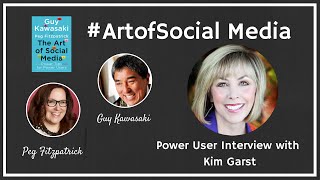
A recorded live hangout (Jan 5, 2015) featuring Peg Fitzpatrick, Guy Kawasaki, and guest Kim Garst discussing authenticity on social media, book marketing, and practical posting tactics. Kim emphasizes being yourself online, using varied "chum" content to attract an audience, and maintaining high posting frequency (especially on Facebook). The conversation covers tools and scheduling practices, responses to criticism, advice on organic vs. paid reach, and ends with a book pre-order plug and a limited-time Kindle giveaway.
Questions this video answers
January 5, 2015
Will the Real You Please Stand Up? (pre-order)
About four to six times per day
SocialOomph
Usually two to three days, sometimes up to a week; Facebook posts more on-the-fly than Twitter
Chapters
Hello, everybody. We are here for another art of Social media hangout today. Today our special guest is Kim Garst. Kim, I'm going to put Kim on briefly. Kim is a social media awesome superstar. She has a huge engaged following on Instagram, Facebook, Twitter, Google. She's everywhere. She is awesome. So say hello, Kim.
Hello. Hello. I'm so excited to be with you guys today.
And Kim has a super cute accent too because she's from down south. Kim, where are you from originally?
I'm originally from Virginia.
Yeah, you have such a cute accent. And of course, my co host, Mr. Guy Kawasaki is joining us from California.
Yes, the land of the free.
The land of the free and the.
Home of the overtaxed.
I mean free as free content.
Oh, got it, got it. So today we are going to talk to Kim. Kim has a new book out called Will the Real youl Please Stand Up? It's on pre order now. Maybe Kim will share her link. She's also doing a thunderclap like Guy and I did for the Art of Social Media. So if you want to help Kim get the word out on her book and see social media in action, which I just thought those were so fun because it gives people the opportunity to help you, which is definitely what people want to do with other people on social media. It's so fun to help other people succeed. So, Kim, why don't you tell us a little bit about yourself.
Well, thank you. Well, first I'd like to thank you for giving me the thunderclap idea because I grabbed that from you. So far we're getting a lot of people like you say, people do love to help and they love to share the word. A lot of people have been jumping on the thunderclap and if anybody else wants to welcome your help, obviously those of us who have wrote a book, as Peg knows and Guy knows, Guy's got a lot of experience with authoring books and marketing books. But you think when you write a book that that's the hard part, but that's not the hard part. It's not. It's the marketing. And it's kind of a different animal in the sense that it's one of those things. Will somebody, will they like it? It's not like you're marketing a product like a necklace or something else on social media. It's something, it's a little bit more of a. You feel like you're pushing or selling more so than you are traditional things that I've marketed online before. So it's a little bit of an Uncomfortable part of the process of marketing a book. But I've loved it. I'm enjoying it. I've loved getting to know you, Peg, and appreciate that you and Guy have me on today. So I'm here to just answer any questions I can and hopefully give as much value back to your audience as I can.
How about you start by giving us the gist of the book?
Okay, sure. Well, authenticity is kind of like a buzzword, and frankly, I dislike the word in the sense of a lot of people are like, well, just be authentic. The book is about authenticity, but in my opinion, it's a little bit. I've tried to stress the importance of. Of it from a personal standpoint and just being you. Whether you're an entrepreneur or whether you're a small business owner or Even a Fortune 500 company CEO, it all translates down to just being you on social media. I've tried to lay that concept out. A lot of people struggle with this. They don't know how to be themselves. That sounds ridiculous, but it's true. I think that's my number one. And Peg and you guys, probably both of you have heard this more times than not, is what do I say on social media? They get so wrapped up in trying to be something and do something that's acceptable that they forget to be themselves. The book is literally just about that. It's about being you and showing up and being authentic on social media because people buy from those they know like and trust. And if you can't showcase that piece of you, then you're going to struggle in the sales department.
What happens if the authentic you is not a nice, intelligent, outgoing person? What if you are a schmuck?
I actually talk about that in the book, Guy. And frankly, there are people who are attracted to those types of people, other people that are like that. So if you truly are that person, then you just have to be that person. I would. If you're just a smuck and nobody's going to buy from you, then you might temper it a little bit. But you can't hide who you are. People today on social media, they can sniff you out in a heartbeat. So I tell people, just be you and then attract. Whatever you attract is what you attract. If you attract other not so nice folks, then that's going to be your buyers, I suppose, unfortunately.
Well, fortunately for them, I guess. But there are groups of people that are just kind of not as nice people. They do congregate together just like the positive people do. So I guess all is not lost.
If you're, it's actually human nature. I tell people when you go to a social event, you gravitate to people that you know. You don't normally step out of your comfort zones and try to work the room. Meet as many people as you possibly can that you never knew before. I think social is great in the sense that it allows us to connect with people that are like minded. You may live in a space like maybe on your block and you may think, well, I don't know any of these people and I have nothing in common with any of these people. Yet you can go online and you can find people and connect with people that are similarly minded as you and you feel like you, you have friends that you wouldn't literally have next door to you kind of thing. But the flip side of that is that we, I think social, if there is a detraction from the advantages of social, is that the bad part is because we do kind of congregate together. Like you said, Peg, the positive people kind of congregate together. We've become a little intolerant. I think of people who don't have that same mindset that we do, you know, and you see it all the time. You know, that's why people don't talk about politics, they don't talk about religion because it's a hotbed. You know, nobody wants to step in and be talk about those things because they get slammed by somebody who doesn't agree with him. Yeah, you know, it's interesting.
I saw an interesting article this morning from Kid Rock who I'm not even a fan of, but he posted some op ed pieces somewhere and he straight up just said what he thought about everything. And I don't agree with his thoughts on things always, but wow, he just wrote it. It was just like, this is who I am, this is what I do. He cursed when he needed to. It was just like it was the epitome of authenticity because he literally just said, I don't, he said, I don't facetweet. He doesn't even know what any of the social media stuff is. He said, I'm going to say it's a bad thing. I've never said anything. He just looks at porn and looks at the news. That's all he does on the Internet. I was like, wow, that's like TMI to honest. But props to him for just saying what he's like. This is what the Internet is to me. I'm like a 43 year old dude. I don't care about face Tweeting.
It's so funny because my husband's not on social at all. At all. Not even LinkedIn.
He's.
He's not on. I heard him in a phone conversation the other day, and he was using terminology for one platform that was not right. He was tweeting on Facebook, dude, you just gave away that you are not social media literate at all.
I think that goes with all of our spouses, though I can speak for mine. And I believe Guys is not on as well. I think it tends to be like one person is on it, and then my husband, Rich, he doesn't even want to be on Instagram. He doesn't even want to be in any of my pictures anymore. I'm like, come on. Sometimes I just put it out there so people know there is a husband.
But somebody has to do the real work in the family.
Yeah, it's totally me. He's actually reading our book right now.
Guy.
Oh, yeah.
He found one instance of the art and science of social media.
Oh, really? As a typo. You should give him a free Kindle copy as a reward.
He'll enjoy that.
You know, it's funny that you mention Kid Rock, because somebody that's really authentic, I think, in our space is Jessica Northey. I mean, she just puts it out there, man. She doesn't. No filter. I love her because she'll. In fact, I interviewed her not long ago, and she said, you know, if I want to talk about farts, I'll talk about farts. And I'm like, I just think that's awesome. No filter. She just says whatever comes to mind and is truly authentic. Some of us, I think, have a little bit more reserve when it comes to what we say on social and how we engage. But those people who just shine and be who they are, I think those are the ones that ultimately are, you know, going to be more successful on social media.
I think Jessica has a nice balance of. I think the thing that we do, maybe, Kim, like, the reserved part, is maybe we don't say all of the things. It doesn't make you less authentic. But sometimes you don't share everything about your family. Like, there's a level and a layer that people don't always get where Guy shares a ton of things. He just went on vacation and shared a ton of pictures, but it's not his family pictures. Those are, like, appropriate pictures when you get to have millions of followers. I don't have millions yet, but I have a lot. Your family maybe shouldn't be in all of your pictures. A guy has 10 million followers. His kids don't need to be in his pictures, but they were still his authentic pictures from vacation. And Jessica, I think, does a great job of balancing that, too, showing her great stuff from her life. Now she goes to award shows and stuff, which is super fun.
Yeah, we live vicariously through her.
Jessica's awesome. Oh, shoot. I just had something. Oh, let's segue into social media posting, because I'm excited to talk to you, Kim, about how often you choose to post and what you choose to post on different social networks.
Well, I have a kind of I don't know if you call it unique philosophy. I don't know if it's unique in the sense that nobody else does it or that somebody else couldn't do it. Again, I think the best analogy I've had for the way that I post is one that I heard Josh Parkinson use not long ago. He was talking about using content and the things that you post on social as chum, because we're all fishermen. Essentially, it was a fishing analogy, and he was talking about using the content that you put out and the things that you post as basically chum to chum the waters. And then your marketing pieces are your bait, I'm sorry, your hooks. That's kind of my philosophy. I share a lot of content. That one, at first glance would say, well, that has nothing to do with her business, so why would she share that? But that's my chum. It's my attraction to my ideal client and forming relationships with people so that when they do want my product or service, that I will come top of mind because I've been engaging and sharing content with them. In my opinion, the content that I share isn't always about my product or my service. In fact, most of the time, it has nothing to do with my product or service. It's about connecting on a human level. And then again, whatever comes out the bottom or the top, whichever way you want to look at your funnel is, is what is a result of the content that I share. That's kind of my philosophy. I use a lot of different content. I have what I call content buckets, and once I identified what those buckets were, it was so much easier to develop content for those buckets.
We noticed that you tweet and post a lot. Do you get pushback from people saying, you're spamming me? I looked at my timeline and there's five of your posts. And how dare you interrupt up my perfect world with stuff that's not Ideally suited for me. You ever get that crap?
Very rarely. My unfollow rate is really low, I think compared to even. We've had a lot of clients that we kind of monitor, obviously from a social media management standpoint. And you see their unfollow rates, my unfollow rate is pretty low. And I think because my content is varied, it's not the same kind of content all the time, that there's something for everybody. And I don't get a lot of pushback, surprisingly, because I do, especially on Twitter. I share a lot of content on Twitter.
Yeah, we noticed.
Yeah, we do too. He's just giving you a hard time.
Actually, Guy, I would like to say that when I started, I learned a lot from. From your posting strategies.
What to do or what not to do?
No, what to do, what to do.
I was an early advocate for repeating tweets and high volume and pushing it out there. And let's just say there are a lot of digital agencies and so called social media experts who completely disagree with what I do.
Well, I am big on just watching the numbers. If I have content that I share, that's not getting any engagement. Unfortunately with Twitter, you can't see when somebody unfollows you based on a particular piece of content like you can on Facebook. But if a piece of content, if it's an inspirational quote or if it's a blog post or whatever it is, is getting no engagement, then I delete it from my. From my share queue. As long as I'm getting engagement on content, then I keep sharing it. A lot of what, Like I said, when I first started, I paid attention to those who were sharing a lot of content on Twitter because I didn't get Twitter, frankly, when I first started, I was like, who can use this? I could barely read a tweet before it refreshed and I was scrolling, I was trying to catch it. I just really dug in and I paid attention. One of the people I monitored and tried to reverse engineer what you were doing. One could say that my posting strategy has direct roots to your strategies.
Well, assuming your posting strategy works, I'm flattered.
Yes, Kim does. Both of yours does. The main thing is for people to do exactly what you did though, Kim, is to look at other people, see what works for other people, and then make it work for you. Do your own thing. I used to get a little pushed back because I've always tweeted a lot. Once I figured it out, like you, Kim, at the beginning I was like, what an What I would put a space, whatever. So once you got it down. I also was a high volume tweeter and I think people just gravitate. Once they learn how to use lists, people are fine. If they complain because people are tweeting too much, then they need to use lists and pick people that are lower volume and then check over on people's pages if they want to see certain things.
For the most part on Twitter, I am a huge advocate of lists. Obviously I couldn't do without them myself, but for the most part, people have a fairly small. Fairly small followings. In some cases, they may have 2, 300 followers. And if they're following somebody that's high volume, like you or me, then our content does. It kind of dominates their feed. With that said, they might want to just pop us into a list or unfollow us. I mean, that's kind of what.
Or enjoy all the great content.
Exactly.
I swear that the people who are negative and complain about what I do, if they got the same tweet, the same post, the same content from someone else, it would be fine. In fact, they would be happy. They would be thankful that they got the content. But the fact that they got four things from me somehow makes me a bad person because I had too much content. I just, I don't understand that. I mean, either content is good or not. What does it matter who it came from, right?
Agreed. And you know, honestly, there's always. I hate to be negative, but there's always going to be haters. It is what it is. I mean, you can't. I don't even. I used to stress over that. I used to, like, if somebody would say something bad, I'm like, oh my gosh, I got to stop tweeting so much. Or, oh my gosh, I got to stop doing whatever they said I shouldn't be doing, you know, but then I just said, you know, I'm here to serve more people than that person. And if it's one or two people, then next I'll just keep working on and serving those who want my content. If they don't, then move on and follow me.
The interesting thing is, though, the more followers that you get, Guy's in a unique position and you are too, when you have a lot of followers. It's kind of like a king of the hill thing with Guy. It's like people just like to try to. And it's mostly men, I think. It's like not a reverse sexist thing, but it's like a male thing. Where it's like a king of the hill, like you're at the top. So they just try to bat a little bit and just be like. And they want your attention. In a weird way, you have guy's followers make comments, and if guy comments or talks to them, they almost always flip it around and go, oh, my gosh, I'm such a huge fan. Thank you for responding to my comment. It's like, why don't you just say something nice then? Because, you know, they just, they wanted attention in any way and so they try it negatively, which doesn't make sense, but maybe try to be positive again. Pardon me?
Maybe it's that alpha male thing. I don't know.
It's like a king of the hill. That's what I always say. Guys, did you have king of the hill where you are? Kim?
Well, I don't.
You know, that was a game that we played when I was little. It was literally king of the hill. Maybe our neighborhood made it up, I don't know. But I was the littlest in my neighborhood, so I never got to the top.
They should just come to grips with the fact that I am king of the hill and deal with it.
You are, you are. There you go. They get 10 million followers, they can be king of the hill too. You're up in the.
You know, it's so funny because those that, you know, bash you for, you know, working hard and putting in the time and doing the work, I just say, guys, get busy and do the same thing. I mean, it's that simple. Social media is hard work. And those of us who dig in and just learn it and figure it out and engage and provide great content have. And I think anybody can do it. It's not like we're special or anything. It's just that we did the work.
And we did it every day, though. Yeah, that's exactly the thing. It's not enough to do it once because you wake up the next day and it's a new day. Unless you already planned out your whole everything. It's all starting over every day. Kim, when you do your social media, do you like, say, okay, Facebook for the week, I'm going to schedule everything out. Do you like to do things as you go? Do you use Sprout, Social hootsuite? What's your little mix?
Well, basically I use social oomph almost exclusively for Twitter and we have tried pretty much everything out there for management. I'm waiting for a one stop shop solution, but we do use social oomph. Quite a bit for Twitter, and we have started using it as well for Facebook, we were using the Facebook scheduler. But as it relates to how far out I schedule, usually it's a mix. Sometimes we're two or three days ahead, sometimes we're a week ahead. Sometimes it's literally on the fly. On the fly usually happens regardless because of just stuff that's current needs to be put out or stuff that's happening around here in the office. But it's a combination for us. We don't just schedule everything and be a month ahead. That never happens, frankly. We're either a few days ahead or maybe a week if we're really lucky.
Can I ask you a real tactical question? So you schedule a few days ahead, Right. So what happens if on that day there's some kind of national tragedy or accident or airplane crash or factory fire or whatever? What do you do.
As it relates to maybe not scheduling any content for that day or.
No. Do you go and say, well, on Sunday, I schedule something for Wednesday, and how was I to know on Wednesday there would be this airplane crash in Dallas?
Right.
Because I've taken heat in the past. I schedule out, you know, way in advance, and then people are attacking me because those. Those things that were scheduled out continue to tweet.
Yes.
And, you know, I really, like, in a sense, ESPN is still running NFL Football and Disney Channel is still running icarly, and, you know, all that. But, you know, the fact that I tweeted shows that I'm callous, inhuman, don't care, you know, blah, blah, blah. So what do you do?
I usually let my content continue to schedule. I mean, continue to go out and acknowledge the fact that something bad has happened. You know, I usually, like if, of course, when I said that I schedule a few days out, that's my Facebook content. Because that was the question. Specifically, Twitter is scheduled out way farther in advance than Facebook is. But I usually. Yeah, but I kind of have the same mindset, guy. I think life continues to move and people's consumption of content continues to happen, even though there is something major happening in the world that's a catastrophe of some sort. I don't think that people just stop and focus on just that particular thing. And I don't think because we share content that's not relevant to that particular life event at that moment makes us bad.
Well, you know, the hard thing to decide is, you know, what constitutes a tragedy that qualifies for stopping social media. Right.
So, you know, the reality is that tragedies happen Every day, every minute, literally. I mean, probably every minute that, you know, don't maybe hit the news. In fact, you could go into your Facebook newsfeed and you could probably come up with 10 tragedies in 10 minutes.
I hate the Facebook news feed. I tried to turn it off, but you can't. I don't mind the ads. I don't mind seeing a lot, but there's so much bad. That's why I liked Facebook, because you got away from the news. I'm just not a news consumer. It's just so harsh and negative. You know, so many bad things happened over the holidays that I was like, stop telling me. Facebook.
Yeah. And, you know, that's our news channel these days. That's where people consume news. It's either Facebook or it's Twitter. In fact, I think Twitter is probably, you know, news hits Twitter, as we know before, it hits many news channels.
It does.
In fact, if I want to know what's happening with the football game, then I'm watching. Or not watching.
Watching your phone.
Exactly. I look on Facebook.
Yeah. Guy, do you have a question you want to throw out there? We have, like, two more minutes.
Well, I would love to know some of the top two or three tips of Kim Garst.
Yeah. Facebook content. Kim has amazing, and I'm talking seriously amazing reach on Facebook and knowing that you're not even scheduling it in Facebook. Facebook is amazing.
Well, let me just talk about Facebook because just real quick, some Facebook strategies, because I got this question this morning and somebody said something about, well used to, you should just post once a day on Facebook. I'm here to tell you guys, if you're a small business or a business across the board and you're posting once a day with Facebook, it was bad before, but now with Facebook's algorithm changes, I can promise you your content is not going to be seen. My recommendation to you is to get busy and get committed to consistently posting on Facebook, probably at least four to six times a day is my recommendation. Everybody's like, oh, my gosh, how am I going to do that? I can barely post once a day. But if you want free reach on Facebook, you have to have content that's consistently getting out there and that people can engage with. If you don't want free reach, then post once a day and pay Facebook to show it to your fan base, because that's where you are.
I swear, many agencies like that because they want to make money. They don't care about the free organic stuff. They'd rather say, we spent half a million dollars and we got half a million likes. Hallelujah. Let's declare victory. Which just drive me crazy.
Who's seeing that content? But with that said, let's say for example, you are an agency and you're paying. You want to post once a day. It might be more cost effective to continue to pay once a day and pay to boost the post or pay to do a Facebook ad than it would be to create content consistently. What's your trade off either way? You either have to do the work and work hard to build a community organically or you're going to have to pay Facebook. I think ultimately, especially if you're first starting on Facebook, you're going to have to pay anyway to build your page.
These days you do, but it's really, really inexpensive. I have to say I started my Facebook page just maybe three months ago because I wasn't sure I wanted a page. I had my profile. But then going into the book marketing Facebook rules say you're not supposed to sell from your personal profile. And being respectful of the terms of service as you always should be for whatever platform it is, I decided to give it a try. And I have to say my page is doing amazing.
Literally, if you'll spend two to $3, $5 a day on Facebook advertising, you can do amazing things with just a very small budget on Facebook as relates to ads and get in front of your ideal prospect. I'm a big proponent of quality content. It doesn't always. In other words, don't try to push your product or service all the time. Be 80, 20 80% about what people care about outside of your product or service and then 20% a marketing message.
I swear the only thing agencies do that's organic is eat yogurt. I mean they don't. It drives me crazy what they do.
So true.
That's the stuff my boss does for the day.
Guys.
Kim, we are right at the half hour mark so I'm going to wrap it up. I just shared your Facebook post from today on Your blog with 17 Facebook post ideas to give people some ideas if they want to get going. I know you also have. I know you didn't mention it, but Kim has an amazing ebook on Facebook Domination. If you want to really get some great tips, Kim has a download on her blog that you can get with great ideas for how to be awesome on Facebook organically with or without yogurt. You can choose. I just want to remind you too, you can check out Kim's book is in pre order now, will the real you please stand up and say thank you to Kim Garst for showing up and being our power user of the day. And thank you to Mr. Kawasaki. Also, if you would stay tuned for one minute, we will be doing our giveaway live. I'm just going to do a brief pause so I can edit this video. Guy, do you want to do the giveaway?
Well, Kim, I just want to know. You did read our book, right?
Absolutely. In fact, look.
Good.
Thank you. I just want to make sure.
Yeah, I sent Kim a book or. Kim, did we send it from the publisher? One of those.
It came from the publisher and I have it on hand. In fact, I was looking through it this morning.
Thank you.
But here's the thing, guy. I already knew Kim and I have had conversations. I knew that Kim, you and Kim and I have the same mind as far as like, share a lot, give a lot, do a lot, and just work hard. We have the same. It's just a lot of work. That's what organic everything is. It's just work hard. And your social media, if you're passionate about it and you care about what you're posting, people respond to it. I would say all three of our social media practices in a nutshell. And then it's rinse and repeat every day.
Rinse and repeat.
The dry bar philosophy.
The dry bar philosophy. Kim, you get the rinse and repeat, right?
Oh, absolutely. I say that in fact all the time. Rinse and repeat.
I had that in the book, by the way. And the guy was like, what does that even mean? I'm like, you know, like your hair, you put the shampoo and you rinse and you pee. He was like, I don't know what you mean. And that's actually a marketing ploy to get people to use more shampoo, by the way, because you don't actually have to rinse and repeat, but it says on the bottle to rinse and repeat. So people do it.
Exactly. And since we are saying rinse and repeat, hopefully everybody out there will do it. Right?
Rinse and repeat. You do need to do it for ours, right?
Absolutely.
Thank you, Kim.
Thank you, guy. Appreciate being here, guys.
Yeah, thanks. Before we head off, though, Guy, we are doing a giveaway. Put the link in the event page. So this is a limited time offer for anybody who's watching. You can download a. We'll send you a link. Not today, but we're getting your email address to send you a Kindle copy of the Art of Social Media today. Sign up and then you will get the book within like a week. Is it Guy?
Yes. In one week.
In a week you will get a Kindle copy so you can learn and hopefully enjoy it. So thank you so much to everybody for watching. And we are going to tune in.
Thank you.
Thank you. Bye.
Thank you.
Bye. Bye.
More from Guy


Cheryl Strauss Einhorn | The Human Edge: Smarter Decisions in the Age of AI | Talks at Google



Rachel Glennerster | Innovation and the Center for Global Development | Talks at Google

Rebecca Winthrop | Rethinking the Purpose of Education in the Age of AI | Talks at Google

Dr. Robert Wachter | A Giant Leap: How AI Is Transforming Healthcare... | Talks at Google



