The Art of Social Media Power Users featuring Peter Shankman, Guy Kawasaki, and Peg Fitzpatrick
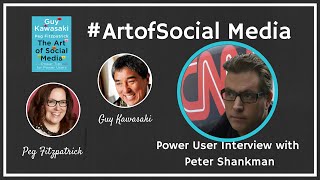
A recorded panel (The Art of Social Media) featuring Guy Kawasaki, Peg Fitzpatrick, and guest Peter Shankman discussing social media strategy, customer service, building audiences, and Shankman’s experiences founding HARO and writing books (including Zombie Loyalists). The conversation emphasizes treating customers better to drive revenue, platform choice driven by audience, handling trolls/haters, and anecdotes illustrating customer-service wins and failures.
Questions this video answers
Vocus (acquired in 2010).
$1,500 per ad.
Three ads per day (≈ $4,500–$5,000/day gross).
Chapters
Hi, this is Guy Kawasaki, and I'm here with Peg. What's your last name? Fitzpatrick. It's always good to know your co author's name. So I am in Silicon Valley, California, and Peg is in the social media capital of the world, Keene, New Hampshire. And we have Peter Schenkman with us. So this is the first in a series of the Art of Social Media. Vip. Big influencer, legendary maven, kind of interviews. And of course, who better to kick this off than the legendary maven? Big deal. Vip. Peter Shankman.
Couldn't get anyone else, could you?
Yeah. So, Peter. Peter and I first met each other when he was doing Help a Reporter out haro, which I love that idea. And we've subsequently become friends hanging out at south by Southwest, eating various forms of dead cow all the time. So, Peter, why don't you tell us a little bit about your background and we'll kick it off.
Yeah. What's my story? I've been since very early on. I was involved in the online world since the mid-80s. It's amazing how computers come in handy when you have no friends growing up. So I was on 300 baud modems, running bulletin boards, and turned it into a job as the first news editor at America Online.
You worked for America Online?
Dude, I was in keyword news. We launched the newsroom all the way back in the day. It was amazing. We covered the Democratic Republican conventions, we covered the Olympic park bombing. All that stuff in the mid-90s that everyone said. Someone said, I use AOL to download pictures of Pamela Anderson. Why the hell do we need a newsroom? And yeah, we had a great time with that. We were that little news icon. Then I launched a PR firm called the Geek Factory and launched a couple of failed ventures at Air Truductions, which let you choose your seatmate before you get on the airplane. So I had 30 really bad flights in a row, and then I sat next to Miss Texas. I figured it was her turn to have a bad flight, so I built that website, which, if I did it five years later, I would have backed it up into Facebook, but failed miserably with that.
After that, her writer said, you have to send a private jet.
Exactly. I'm only flying a G5. And then from that, Haro really sort of took over. So now I consult, I speak. I'm an angel investor in several companies. I write a bunch of books and go on TV a lot. It's fun.
Well, don't fly past HARO so fast. Tell us about HARO because I thought it was such a clever idea and tell us how it went down and, you know, the business model and all that kind of stuff.
I have a lot of friends who are reporters and they would call me, I would always talk to them. I talked to everyone. Unless you fake your own death and you're sitting next to me on a plane, unless you fake your own death, by the time we land, I'm going to know everything about you. So I was on a. I'd meet all these people and then reporters would call me and say, hey, you talk to everyone, you know, everyone. We need someone who knows about xyz, who could do this, who knows about this. And I just go through my Rolodex and I put people together and over time it started taking more and more of my day. And so I launched a Facebook group where I could just send people looking for stories. I could send the queries right to my friends who were sources. And we blew out of the Facebook group in about a month. And from there we went to the web and about a year, about 100,000 members in about a year. And it was an email newsletter that went out three times a day with a small little text ad at the top of each email. And we were sold out for months in advance and wound up. It just blew up beyond my wildest dreams and wound up selling the company to Vocus. In 2010 it was acquired. Very successful exit on my part and I consulted for them for a couple years. I made my earn out and then. So, yeah, so it's been an amazing ride. I've been very, very fortunate, very lucky to work with just brilliant people, do great things. I consider myself very, very lucky.
How much did that little ad cost?
By the time I sold arrow, it was $1,500 per ad and we were selling three ads a day. So it was a nice little business.
So you. So you're making five grand a day?
Pretty much, yeah.
And this is in your pajamas, not even awake.
I mean, I think by this point I was dressed. But when I started the company, it was actually called. The company itself was called Two Cats and a Cup of Coffee because when I'd set up the morning harrow, the only thing that was up at 5 o' clock in the morning with me was my two cats and my cup of coffee. Harrow was a fun venture. I had a good time with it.
All right, so tell us, what's your sort of key orientation, your key tips towards social media? We want to learn from you right now.
I focus tremendously on customer, on the customer experience, on customer engagement, on customer awareness. I think the one thing I've learned over the past 10 years, 15 years of working on my own, is that as a society, I see it says 18 plus on the bottom. Does that mean I can curse? Okay, good. Because I noticed that over the past 15 years, pretty much as a society, we, in any customer interaction, we pretty much expect to be treated like shit. It's not unexpected that we go to the airport, we go through security and have the anal probe, and our flight's pretty interesting.
What airport are you flying out of?
I got to avoid that one.
New work.
Buy me a drink First Air. Right. And then you get to your gate and the gate's been changed and you run across the airport, and then your flight's three hours late, and seat 15A is now seat 34. Bathroom or whatever, and you're miserable.
You need to start flying on Emirates.
Emirates is nice. Emirates. I will say upper class on Emirates is pretty amazed by. But if you ask people about the last time they had a great flight, they'll tell you, and you say, what made it so great? And when you really distill it down, what made it so great was they got to the airport, they got onto the plane, it left on time, it arrived on time, and they got off the plane. And so I'm always like, okay, so a great flight to you is because you gave them money to perform a service, and they performed exactly that service, no more, no less. And that's the greatest thing in the world for you. Okay.
What a concept. Yeah.
So if we expect to be treated like shit, I think one of the things that I've learned that I've parlayed into several of my books is the theme to several of my books is the concept that if we could treat our customers just one level above crap, it doesn't even have to be good. Just one level above crap, they will come back, treat them two or three levels above crap, and they will come back and bring many, many friends. And it's a pretty amazing experience how when you do that, you see radical payoffs almost instantaneously. And I'm talking about real revenue. I've done studies on this. Simple act of being nice can generate upwards of two times the revenue that you can get with a company that's not nice.
Amazing. So, Peter, you had an interesting experience with Time Warner Cable recently that you live, tweeted, and blogged about. Do you want to share that as a customer service example?
Yeah, that was a fun One, I'll.
Put the link in the event so people can look it up.
I wanted to see how long it would take to cancel Time Warner Cable. And so I live tweeted my experience with it. And it was on a Saturday night or Friday night or something, and, you know, it was me, Time Warner Cable, and a couple of glasses of Jack and Diet Coke. And what essentially happened was, you know, it took three people to do the cancellation. The first person and the second person. And the first person they finally transferred me to, all three of them, swearing that they would be the ones who would handle this. And the biggest problem there was not that it took 35 minutes, but it was that by the time the. By the time I had the third person, I had stated my story to the other two that I had already installed Verizon fios. The technicians had already come to the apartment, wired up the apartment. It was done. There was no possible way that they would get me to switch back at all. And yet they still were required by the rules of their customer service job to. To read me their best possible well, what if we give you half off? Basically, they wanted to take me down from $245 a month to something like 120. And I realized that I'd been paying $245 a month for cable and Internet and phone for probably 10 years. And all of a sudden, because I was threatening to quit, they wanted to drop by half. To me, that doesn't say, wow, what a nice person you are. To me, that says, ha, ha, we just made you. We made you pay double for the past 10 years, sucker. Don't tell me you're going to give me a discount because I'm leaving. Where was that discount to begin with? So it was a very frustrating experience. I will say Verizon fios rocks. I'm in love with it.
A big part of the problem is they have these customer service numbers which. Which are supposed to help you, but they do. It's like all that scripted. I had a similar experience with a bank that was like that. And it was just. They made a mistake in my account. I was super nice about it. I had all my facts together, and it was just horrible customer service across the board. They were like, we're sorry, we can't fix that. I was like, but I'm telling you what the mistake is. You're telling me you understand what it is. And you're like, sorry, I can't help you.
And that's the problem. You have these companies, you have these customers or customer service reps who are bound by the script and who have to work on the script. And it's so frustrating because, you know, if they just were allowed to think for themselves. Verizon is an example. Cell phone. I was in Dubai. I landed in Dubai and I picked up my. I turned on my phone because I had global roaming, and I turned on my. Which is like 20 bucks for every 100 megabytes, whatever. I turned on my phone, and before I'd even gotten off the plane, I got a text that I'd spent $300. I'm like, okay, this isn't all right. And so I called them, and I remember saying. I said, well, I don't understand. I have global roaming. He said, yes, you do, sir. Then why? Oh, because it doesn't work in Dubai. I said, well, it's not really global then. It's more like hemispherical roaming. I said, look, I said, I'm here for a week. Can you just hook me up, tell me what you want me to pay? I'll give you 500 bucks. I'll give you 1000 bucks for the week for data. And if they had said to me something like, hey, Peter, we understand that you're there for a week. We'll charge you X. Just try not to go over 2 gigabytes. I would have been like, oh, my God. Greatest people ever. Love you guys.
You rock.
This is awesome. I would have told the world about it. Instead, the person on the end of the phone was a customer service rep who had to go buy the script and couldn't let me do anything. And it was the most frustrating thing in the world. It was. So I went out and bought a SIM card, I went out and bought an unlocked phone, bought a SIM card, and now Verizon will never get a penny from me when I go international. And it was very poor forethought. They could look at my phone and see how many times I go overseas. They'd know they could make a fortune off of me. But now I have an international phone and a SIM card, they're never going to make a penny.
Well, you could build another level of bizarreness, which is your phone was a locked phone, right? So why did you have to buy another phone? Theoretically, shouldn't Verizon have sold you an unlocked phone? I mean, isn't that the whole purpose of a SIM card?
Unfortunately, we are the company that does not. Or we're the country that does not really understand cell phones. Every other country does it, right? Except us. So, yeah, I've had to do that many a time. It is the most frustrating thing, most frustrating thing in the world.
I know. I recently went on a world tour like that and I tried to get a SIM card in every country. And then you need a sim, the PIN code and you need this. And then like, oh my God, God forbid if you just get off a plane with a stock phone and you haven't unlocked it.
It's just ridiculous. It's beyond ridiculous. It really is.
You think Apple employees use their phones overseas so they've never experienced this? Or do you think the funny thing.
Is I have an Android and I.
Had an Android phone on that trip too, but I had a Nexus 6, which was a lot, thank God.
And you know, it just kills me because again, part of me also thinks it's a failure of fiduciary responsibility. If your fiduciary responsibilities to the shareholders, then it should be towards generating revenue for the next 25 years to create long term shareholders and long term prosperity gains. If you're only focused on the next quarter and your marketing and customer service budget is focused on keeping that customer for the next quarter and doing everything in your power to make it difficult for them to break a contract or anything like that and not focusing on saving them for the next quarter century, technically that's a violation of your fiduciary responsibility, which is to make as much money for the shareholders as possible. Because you're not thinking outwards of the next 25 years, you're thinking the next two weeks. And that's just frustrating as hell to me.
That is.
So tell us your approach to social media. What's your favorite platform? How do you use it?
Social media? Well, first of all, I'm a believer that it should be called social Udia. Too many people make it about me, me, me, me, me. I think the mute tool on both Facebook and the unfollow tool on Twitter are probably two of the. Or the unsubscribe tool on Facebook and the mute tool on Twitter are probably two of the most beneficial things ever created.
That should be the business model. You have to pay a penny for.
Each person to not have them talk to you. Right. I agree. It's like how you pay the phone company a dollar to not be listed in the phone book. I think for me, the immediacy of Twitter is still very beneficial. Is Twitter going to survive? Is Twitter going to be the platform of choice over the next 50 years? I have no idea. Very possibly not. I remember working at AOL and people Coming in and writing $10 million checks for five year ad campaigns. And that went well. I think that we are in a world where the platform that matters the most is the platform on mobile, and that we're finally starting to get a little smart about the fact that we don't want to. We no longer need to build sites and build services for computers, but build them for devices. Because we are doing more and more and more of everything that we do on devices, not on a laptop or a desktop. I mean, I'm having this conversation with you because I'm sitting at my desk and I want to be professional about it. But, you know, I'm sitting here with my iPad. I can do the same damn thing from my couch over there, you know, Only problem is I'd be leaning back and you'd see like 14 of my chins. So I chose.
And you fall asleep.
I fall asleep, right? Oh my God. I fell asleep during a podcast about four years ago. I'll never forget that. But yes, of course. No, I'm right here. But you know, it's that concept that. What's my favorite platform? It's wherever my audience is. I say this all the time. I'm sure my officemates are sick of hearing this, but having an audience is sort of a new thing for most of us. Having an audience is people get on Facebook, they get on Twitter, they get on Instagram. Follow me, follow me, follow me. The concept of having an audience is a privilege. It's not a right. We're not granted an inalienable right to life, liberty, the pursuit of happiness, and people who listen to our bad jokes. We're not granted the rights to have people pay attention to our stupid forwards and boring bullshit viral videos. We are given the right to try and be engaging. We're given the right to try and create content that our audience might want and like and want to share and want to be a part of. If we succeed, then we're given an audience. But having an audience is not a right, it's a privilege. And it's exactly like wearing a spandex for the majority of us, myself included. I don't have the right to wear spandex. I think I've met physically maybe seven people in the world who have the right to wear spandex at any given time. Most of us, when we run a race, we have the privilege of wearing spandex during the race. I know as soon as I finish a 10k or a marathon, five minutes later, someone's coming over to me. Sir, okay, it's been five minutes. You need to put on this big oversized T shirt now.
It's people from the Spandex Manufacturers of America Association. Please, Mr. Shagman.
Right. Stop hurting our brand. But no, it's the same thing with having an audience. And if I treat my audience well, if I give them information that's beneficial to their lives, that makes their lives better, they're going to continue to react by allowing me into their lives. And I think that too many people forget about that and they use all the tools available to them as mouthpieces without actually considering what their audience might like.
Well, how do you deal with trolls and people who are attacking you and that kind of stuff?
I'll be honest with you. I get pleasure out of knowing that I have trolls. My belief is if you don't have haters, you're not doing enough to change the status quo. I would hate to think that I woke up one day and didn't have any haters because it meant I wasn't doing anything. I remember when I first started HARO back in late 2007, I was invited to speak at a conference. And. And the conference was being sponsored by PR Newswire, and PR Newswire was at the time they had Profinet, and Profinet was. Haro was like this little upstart that was beating the crap out of Profnet because we were free. Why not? And so everyone's like, ooh, this would be a HARO Profnet fight. This is going to be awesome. Peter doesn't know what you're getting into. And I said, ok, I'm going to have fun with this. And I went into the speech and I started talking. And as I'm talking, I'm like, you know, I'm not really worried about Profnet. They have a good service, but I'm not afraid of them. I'm fine with it. And I start taking off my shirt to reveal that I'm wearing a bulletproof vest. I love having haters. I think that if I have haters, that means I'm making a statement. I'm saying something that people find interesting or find worthy of talking about. I would hate to find the end of my life. I didn't do anything that generated some controversy or level of discussion because what did I really do? How did I change anything?
So you support gun control then?
Probably. I just thought voting bulletproof. And the best thing about the bulletproof vest was I donated it to the troops afterwards, which was kind of cool, but that was a fun moment. No, I Think that. Look, when I ran Haro, I had tons of haters.
Why would people. Okay, other than that PR service, who could possibly hate you for doing Haro? You're helping journalists find sources, and you're helping sources find publicity. So where does the hate bubble up from?
Dude, you do the math. You could find haters for the Pope. I mean, there are haters from Mother Teresa. It doesn't matter how good you're trying to be, there will be someone out there who will figure out how to bug up his ass and figure out a reason not to like you. It's pretty amazing. I mean, it's just an amazing experience to watch. And again, I think that also comes back to knowing the customer. Perfect example. Last week, I'm walking into the office and. And this guy brushes past me, and I'm apparently not walking fast enough for him. In New York, and this is New York, I walk pretty fast, but apparently not going fast enough as he brushes by me, bumps my arm, and I go, excuse me. And he turns around and goes, yeah, F you. But of course, he's walking fast, and he's stopped by the light because there are trucks going across the street and he can't go. So, of course, I'm right behind him. I go, excuse me, sir, what if I want. You look like you're having a bad day. Can I buy you a cup of coffee? Seriously, can I buy you a cup of coffee? Maybe turning you into a happy day? Get the hell away from me. What's wrong with you? I literally scared the guy. We don't get people don't expect that. I love my haters because I love just talking to them. Let's face it, there's no better lover in the world than a former hater. You get someone on your side, you fix whatever problem they're having. I've reached out to. I remember there was some guy bitching a couple of years ago who I knew in the skydiving community. I was talking about how I was running around. I had to do four international trips for work, and he just went off. He was like, dude, you're bragging. You're always. And I realized I found out through a friend of his that he was actually pissed off because he couldn't get home for the holidays. He lived in California, and his family was, like, in Florida, and he couldn't get home. So I gave him some miles and gave him a ticket. And no one in the skydiving community could ever say shit about me right now without this guy stepping up and Just beating crap. Because he's now, like, my favorite. He's, like, the biggest fan in the world. So I just think that the world is, like I said, it's full of places where we expect to be treated like crap. Treating your customers one level of crap, treating them well, treating them like human beings. Going out of your way to just say hi, be nice, have a smile, is a game changer. That's the premise of my whole book.
This book. Your new book, Zombie Loyalist.
Yeah, Zombie Loyalist, the new one. First of all, you have no idea how thrilled I am that I managed to get the word Zombie Loyalists, that I actually managed to get Palgrave McMillan, a British company who's my publisher, to allow the word zombies in the COVID I just think that's such a win for me right there. What did it take? I think they said, no way in hell. And then I showed them the concept that a Zombie Loyalist is just someone who really, really loves their company. And I said, by the way, do you have any idea how much money the Walking Dead is bringing in? But, yeah, I'm excited about it. The whole premise of Zombie Loyalists is just case study after case study after case study of companies that just did that 1% better than everyone else and just made tons of money. My favorite stories in the book is a woman from in the 70s. She reached out to Tiffany. She mailed in her credit application to get a credit card from Tiffany, and they said no. And she was just starting out in the world. She was, like, 21. She had a good job. She was making, like. It's like $70 a week as a secretary. Think like the character from Mad Men, right? And she sends this letter to the CEO of Tiffany, and she's like, look, you know, I'm just starting out, but I have good credit. And a lot of my friends are getting married, and I'd like to buy them gifts, and I'd like to use your store to do it. And a CEO sent her back a letter, and all it said was, Dear Ms. So and so will open God bless. And then his name. And she's kept that letter. She's kept it framed for, like, 30 or 40 years. P.S. she wound up starting a very successful and selling very successful company, made millions, millions upon millions, and has probably spent well over a million dollars, if not more at Tiffany's and nowhere else, not one other jewelry store. All because the CEO took the time to respond personally. And what did that take him? What did that cost him? What percentage of his life did writing five words on a Piece of paper, take him and look at how much money it's resulted in. So, yeah, I'm excited about the book. It's just story after story after story of how to do that and why it's beneficial. It's going to be fun. It's a really fun one.
Are you working on another one? Every time I finish a book, somebody asks me, are you working on another one? You know what my answer is, Peter? I tell them, imagine that you are a woman and you just gave birth to a baby.
Exactly right.
And you just had your entire lower half of your body ripped to shreds. And somebody asks you, when are you going to start having sex again so you can get pregnant again?
So I have a 19 month old child, and I made just the number one worst mistake ever, which was that about a month after my kid was born, I was hanging out with my wife and we were having dinner with a couple of friends and they said, so was it a hard pregnancy? I said, no, it was easy.
Took five seconds.
My wife just shot me this look of death like you have no Clue, but you're 100% right.
Right.
I joke that my part in the entire nine months took four seconds right in the beginning.
And even that's an exaggeration.
Exactly. We appreciate your small contributions to the process.
Very small contributions. Yes. Extremely small contributions. I think that it's exactly like that. Am I working on another book? Yes. I have a couple of ideas, but right now I really want to. If I can turn the concept of zombie loyalists into a movement, I mean, just to make companies be nicer, how wonderful would that be? And here's the thing, you get CEOs. Oh, I don't have time to be nice. We're in the business of making money. Well, being nice makes you a shitload more money. Study after study after study that proves that not only in this book, but my last one, Nice Companies, finished first. We're talking 11 to 24% increases in revenue simply by the simple act of being nice and treating people like human beings. It's amazing.
So, Peter, let me ask you this. Why do you think people are so suspicious of niceness these days? People are suspicious if you are nice.
Yeah. I think it comes from two reasons. Number one, we're just now getting out of this mentality that's really in Both the last 30 years of eat your young and kill them, leave them dead. The Gordon Gekko mentality, as it were. Right. Green is good. And I think the biggest problem is that too many people mistakenly confuse Niceness with weakness. Al Capone had this great, great. He said, never confuse my being nice, my being weak. He goes, I am the nicest person you meet until you cross me. And then weak will not be something you remember about me. And it's so true. I mean, I am a nice, nice person, but God forbid I have one of the sharpest teams of lawyers in the world that you never want to meet. And if by that point, if I have to sic them on you, by that point, there's nothing that we can do. It's over. Sorry. But up until that point, I will do everything in my power to work with you to make it better, to fix the problem. But, yeah, it's like we expect that niceness equates to weakness. And so I think, especially in the finance world and things like that. So I think a lot of. And if you look at all the big companies out there, they're all run by essentially bankers, ex bankers. Major airlines are all run by hedge fund guys. Now, Southwest is different. Southwest is run by a humanist, which is one of the reasons they pride themselves on niceness. You know, it's just. It's a sad commentary that people believe nice equates to weak, but it really doesn't. Nice can equate to nice, and that can equate to revenue.
Which companies would you hold up as companies that get it?
Zappos, obviously. God forbid. We won't have one podcast in this country. We don't mention Zappos, but they're doing good stuff. I think that small chains we mentioned earlier. I was drinking from a five Guys burger place. They're wonderful. They go in, you can have anything you want. If they have it in the store, they'll put it on your burger. I'd like my burger with lettuce, tomato, in that chair. And they'll do it. Morton's Steakhouse, I love using as an example, not because they met me at the airport with a steak, but because when you called, they did. Oh, yeah, it's a great story. I jokingly sent out a tweet and said, hey, Morton's, I'm starving. Meet me at Newark airport in two hours when I land with a porterhouse. Ha ha ha. Not expecting. I show up at the airport and there's a tuxedo guy with a bag, Morton's bag.
I got to try this.
My husband's still waiting, Peter. But there has been no steak at the airport yet.
My next thing is dear Lamborghini. But the reason I mentioned Mortons is when you call them for a reservation. They always ask you, are you celebrating anything? Yeah, it's my assistant's birthday. Oh, what's her name? Her name's Megan. OK, great. We'll see you for two on Friday, 8 o', clock. You show up and you sit down and they bring over the menus, and the menus say Happy Birthday, Megan right on the top. And then what happens? Megan spends the next 45 minutes Instagramming the crap out of that. I can't get a drink. I believe that we're moving towards a place where the concept of friending, fanning, liking and following is going away. The most awkward thing in the world now is a friend request. Last time we friend requested someone in the real world was like second grade. So we're moving to a place where if I talk to Guy or if I talk to you, Peg, and we email back and forth, the network knows that, and so you become trusted. The more we interact, the more trusted we become. And when I land in Los Angeles or San Francisco and I'm hungry and I type in steakhouses, it's going to show me where Guy has eaten. If there's a steakhouse and Guy's a friend of mine and I trust him, it'll show me if the sentiment of his tweets or posts, whatever, were positive, it'll show me that, and I'll see that. Forget Yelp, forget TripAdvisor. It's going to come down to personal recommendations are within your network. I talk a lot about that in the book as well, because, you know, at the end of the day, it's not about advertising or marketing. It's going to be about customer service. Because if everything's a personal recommendation from everyone in your network, and the more you trust those people, the higher those recommendations are going to come. It has to start with customer service.
And the irony is, you know, companies will spend 5 million bucks on a Super bowl commercial, but they pay $10 an hour for customer service.
It kills me. It just freaking kills me. We did an event, we did something for a major airport on the east coast where we gave the employees permission to think on their own. And we worked with them for a mobile world where they could carry right on wipe off boards. And if a customer is on the phone, instead of being like, okay, I'll get off your phone before I serve you, they would say, we get it. You're on your phone, it's cool. Stay on your phone. Here, use this board to write on what you want to eat. We'll bring it to You. And they had discretion. They could say, you know what? That looks like a bad call. It looks like a tough call. Here's a free drink. And revenues went up by 6% and tips went up by 14. It's ridiculous.
So we're wrapping up at our 30 minutes now. So I'd like to say thank you to Mr. Shengman for coming and talking about zombie loyalists. You can check it out. It's on pre order right now on his website. He's got a super cool video.
I love his book video Zombielists with an S zombieloists dot com. And no matter how many copies you buy, I will send you lots of free gifts with them. I think for like 5,000. If you buy 5,000 books, you like rename my kid or something.
Awesome guy. Do you have anything you want to say to wrap up?
Well, you know, Peter and I go back a long way and it's been just terrific. Well, watching the success of Haro and we kind of ripped you off. You know, we did hassle.
I remember that.
Yeah. So we did help a socialist out, but it doesn't have 100,000 subscribers and we don't sell ads for 1500 three times a day. But that's our goal. So.
Keep believing and you can make your dreams happen, guys.
Maybe we'll give us a Morton's dinner certificate to everybody who subscribes or something.
Yeah.
Wow.
Thank you very much, Peter. I mean, good luck. I'll see you at south by Southwest.
I'll be there.
Yeah, we'll have more steak.
No question about it. Anytime we can have steak, we'll have steak.
And we'll shoot guns and we'll say that global warming doesn't exist and we'll.
The best anti Valentine's Day dinner ever. Thank you. As well.
Thank you.
Bye.
More from Guy


Cheryl Strauss Einhorn | The Human Edge: Smarter Decisions in the Age of AI | Talks at Google



Rachel Glennerster | Innovation and the Center for Global Development | Talks at Google

Rebecca Winthrop | Rethinking the Purpose of Education in the Age of AI | Talks at Google

Dr. Robert Wachter | A Giant Leap: How AI Is Transforming Healthcare... | Talks at Google



