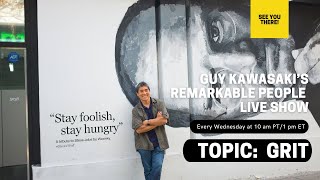
Guy Kawasaki discusses grit with insights from Angela Duckworth's research. Her hard rule: do something that requires practice, enjoy it, and quit only on a high note, never out of frustration. Grit often matters more than vision or intelligence for long-term success.
Chapters
Hola. Good morning, wherever you are. I'm Guy Kawasaki, and I am sitting in my studio in Santa Cruz, California, where it is freaking freezing cold. So even I may not go surfing today. It is really cold. And I had a. Believe it or not, I gave a talk this morning, had to be ready on the camera at 4:45am and I went to bed around midnight. So I. This may not be the longest episode of this talk. Northernmost Cogent. So Remarkable People podcast. This morning we released Angela Duckworth. Well, not the person we released her episode. Angela Duckworth is a professor at the University of Pennsylvania. She is also a MacArthur Award winner. So she's the second MacArthur Award winner that I've had on my podcast. Numero uno was Stephen Wolram of Physics. Angela Duckworth got her MacArthur Award for her work in the application of grit to education, I. E. Grit, meaning working hard, not taking no for an answer. So if you're into, let's just say, achieving things, and who would not be into achieving things? I mean, why else would you listen to remarkable people? Why else would you listen to this for that matter? Angela Duckworth is arguably one of the world's greatest experts on grit and determination and getting done. She has some great rules. She. She has in her family what she call. I also have allergies. The hot. The hard rule, which means that everybody in her family has to do something hard. That takes practice, and you have to enjoy it. That's the second part of the rule. And the third part of the rule is you cannot quit it or, you know, give it up unless you give it up on a high note, which is, in other words, if you're trying something and you're frustrated, you're not succeeding, you cannot give it up. You have to give it up or give something up when you're kind of bored with it, but you've done it and you've accomplished it, which is like, think about that. That's a great rule. So that's the Angela Duckworth rule of quitting is you have to quit on a high note. You cannot quit out of frustration and a low note. So I thought that was a great rule. So, you know, in my humble opinion, if you had to look at the qualities that make one successful, I would say that grit is number one. And it is followed by things like vision, passion, intelligence, all that kind of stuff. If you gave me two people, or if you gave me a choice between two people and one had grit and one had vision and passion and intelligence, I would pick the gritty person all day. I mean, I wouldn't say you take somebody absolutely stupid, but grit counts. And that's the story of my life. So you can start firing your questions about grit. One interesting question is just ask yourself, do you consider yourself a gritty person? Do you quit easily? Because as the saying goes, quitters never win. So let's see, you got any comments here? Because, man, I just. Well, when is it time to stop persevering and start to pivot? That is a great question, Jeff. And, well, for one thing, her rule about quitting is you quit something cold at the top of your game or at least at a positive state. Now, pivoting is different than quitting. And I think that is one of the most difficult questions for any entrepreneur to answer, because if you look for inspiration from authors and case studies, there's absolutely two conflicting kind of cases. So one is you persevered. You believed against all the negativity and all the naysaying, and you believed in it, and you just wouldn't give up. And one day, darkness turned into light, and you succeeded. The flip side of that is, you know that you were. You started as one thing, you started one kind of business. It didn't work, so you pivoted and it became successful. So the question is, should you gut it out despite all the negativity, or do you pivot and try something different? And both things can work. And therein lies a challenge in much of listening to quote unquote influencers and reading business books, which is kind of depends on who you talk to last. And the only way you're really going to know is looking backwards. I would say that if I were to guess, I'd say that people quit too early or they pivot too early. That would be my guess. Okay, see, let's see. What about questions here? Grit is courage and perseverance. Yep, it sure is. It's not giving up. If I am a quitter, I really don't know about surrendering. Well, that didn't make sense. Okay, so you're listening from Kuwait, in Malacca, in Bangladesh and Morocco. Wow. We're definitely out in Slovakia. We are definitely outside the US Of A. Here. Let's see. Let's bring up Lessi's question there. Here. I can do that. How do you think grit grid. You mean grit changes from childhood throughout adulthood? I. That's a good question. I think that greediness is something you can learn, so I think grittiness can increase. I guess you could make the case that you could be a gritty kid and get fat, dumb, and lazy in your old age. That seems to be my, the arc of my career. But I, I. Well, basically what I'm saying is I think that it is a learned attribute. I don't think you have to be, quote, born gritty. And if anything, I would think that the most important influence is your parents. That if your parents, you know, forced you to do things, not give up, made you do chores, all that kind of stuff, I would say that's probably the single biggest factor in greediness. And again, you know, Angela Duckworth, I didn't win a MacArthur Award for my thoughts about grit. So you have got to listen to this podcast today. It's really, really, huh. It's. It's challenging is what I say. And I don't mean challenging and it's hard to listen. I mean challenges challenging in the sense that it will challenge you to step up your game. And that's a very good outcome of podcasting. I'm scrolling through the text here so that I can see stuff here. Let's see. How about when you have lots of ideas to improve and motivate your team, but they are not open to change their culture? Well, you know, I guess there's so many things to unpack there. So maybe you recruited the wrong team, or maybe you don't have credibility, or maybe they believe in something more than you do. So, I mean, it's hard to answer that kind of question because there's so many possible explanations for what's going on. I could tell you with Steve Jobs case, man, it was like you were greedy or you feared for your life or at least your career. So it's not like we were sitting around the Macintosh division drinking white wine and sitting in our beanbag chairs with our Birkenstocks wondering about the meaning of life. Basically, Steve Jobs get said get done, and you had to get done or you're gone. So that simplifies life. If your industry is currently on hold due to Covid, do you carry on trying to try to move on again? You know, Carrie Lee, this is a hard question. I mean, it depends on which industry. It depends on how it's shut down. It depends on, you know, how you can turn lemons into lemonade, as the case may be. So I came across a really great example recently. Oh, okay. So the other night, I was on Clubhouse with someone or lots of people, and this entrepreneur from Kuwait comes on and he says, yeah, you know, when the pandemic. First, he's in the business of kind of think of VR, Verbo, slash Airbnb, but for business, like conference rooms and workspaces and stuff like that. Okay, so verbo, Airbnb for workspaces. So at first, when the pandemic started, it just crushed him because guess what? Everybody was sheltering in place. Nobody would go out to a place to work or rent or hold a conference. But then as the pandemic went on and on, come to find out, you know, companies would not let their employees come in because they were closed, but these employees still needed someplace to work, if for nothing else than to get out of their house and a change of pace. So what he noticed is that people started renting his spaces, you know, for hours at a time, just to work in better surroundings. And I would have never predicted that. I would have thought the pandemic would absolutely kill him. But he made lemons out of lemonade. Excuse me? He made lemonade out of lemons. So, I mean, that's an example of, you know, how do you look at it? Is there some way that the pandemic actually becomes a positive factor? And that's. That's the way you have to look at it. I think by definition, if you're an entrepreneur, you have to look at the glass as half full, otherwise you make yourself crazy. So, okay, is there a clear KPI for success? Well, I have a new theory about success, and I read about it in Viktor Frankl's book, Man's Search for Meaning, and basically he says that you do, you know, what you do, so let's take my case. So my case for podcasting, I think what he would say about podcasting is if you like or love podcasting and you want to interview people and get their remarkableness on audio and spread that around, if you do that really, really well, you know, you can achieve success, but success happens because you did it really well. Which is different than saying, I'm going to make a successful podcast, I am going to get this many subscribers, I'm going to get this much sales revenue, I'm going to get this much sponsorship. So I'm going to define success by subscribers and revenue. I think his attitude would be, you make a great podcast, and guess what? Revenue and sponsorship and subscribers will happen. So that's my new attitude with my podcast. So, see, I agree. Do you agree, Dr. Joe Dispenza, that it's possible to pull what you want toward you without taking action and by simply surrendering? I'm more on the grit side of things, but always interesting to get different respects. Perhaps depends on the type of person. Person. So this. I don't know who Joe Dispenza is, but he's saying that you don't take action and you simply surrender and the magic happens. It's got to be more to it than that because. Wow, I can't think of a case where that would happen. I mean, I guess if you're born into Donald Trump's family and then, you know, all of a sudden you can get appointments into the highest levels of US Government, maybe. But a good test would be, you also, are. Are you going to apply that to your family? I mean, basically, are you going to say your kids just be patient and surrender and good shit will happen? Boy, that's not how. What I would tell my kids. So I. There must be more to what that guy said than that. I can't believe somebody said that. But anyway, question. If you're facing a problem and want. And want. I guess you're saying want to quit as opposed to what to quit, what questions do you have to ask yourself to know if you have to continue or not? You have a great questions to have grit. Well, I, I think the existence of the desire to quit is not unusual. I mean, have we not all wanted to quit? Whether it's a job, podcast, writing a book, I could tell you, in fact, Angela talked about this in her podcast, that there were many, many times she wanted to stop writing the book that she wrote, Grit, and her husband continued to support her and force her to finish it. And I can absolutely relate to that. So I, I think it comes with grit that I, I can't tell you that. I believe grit is, you know, 24 by 7 by 365, 100. You're always gritty. I mean, even the gritty people give up, so. Or want to give up. So I think that's the test. And, you know, a really good test is not so much that you can keep going, but can you keep going when things are shady? That's the test. So what else? I'm thinking of grit in terms of all the great figures, creators, inventors in the world. The Wright brothers, Galileo, Gandhi, Steve Jobs, they gave their everything. Sometimes the bigger the change in human thinking seems, the grittier you have to be. Yeah, I would say that. You know, Stephanie. So Jonah Berger, who was last week's guest, sort of delineates this between pebbles and boulders. So some things for people are boulders, other things are pebbles. And so it definitely depends. So, you know, getting an anti vaxxer to get vaccinated is probably a Boulder. But you know, maybe getting an anti vaxxer to wash your hands, her hands or his hands, is a pebble. Now you might make the case that to get people started on the path, you, you ask them to move pebbles first and then pebbles will give you momentum to eventually move boulders. But yeah, there's definitely a difference between a pebble and a boulder. So I know that's true. Absolutely. In my life, yes. If you're showing true grit by, by going live on a little sleep and allergies, just reverse the bokeh. What? I understand the first part. Reverse the bokeh. Hey, my bokeh is built in here, watch this. So for those of you who don't know B O K E H, half the people in the world pronounce it bokeh and half the people in the world pronounce it bokeh is the concept of having, you know, depth of field and stuff behind you being out of focus. And I pursued, literally I pursued that, this fuzzy background for weeks to get it right. So let's see. My question is Roz, are you the Roslyn Jones from Apple? My question is, what are the one to two tips to be gritty without being a bull in a china shop? Gritty is getting done, but it does not mean stepping on people. Yeah, I, I'm, I, I, I never said step on people. I think greediness is a different quality. So you know, if you were to make a two by two matrix which all of the world can be explained in a two by two matrix, you know, there's gritty, not gritty and they're shitty, not shitty. And so you want to be in the gritty, not shitty corner. You don't want to be in the gritty, shitty corner where you're shitting on everybody. So, but I will tell you, I would rather have a greedy person who shits on everybody than a non greedy person who doesn't get done. So the second best corner is greedy and shitty. The first corner that you want is gritty, not shitty. But not gritty and not shitty is the worst corner and not gritty. I'm saying that all wrong. You get my point, right? I mean the key is grit wins. And ideally you'd be gritty and not shitty. But if you're not that, then I still think you should be gritty and shitty. I think I said that right. It's, you know, operating on four hours of sleep. So how can I measure my grittiness in a simple and effective way? If you're a man and you're married, you could ask your wife. How's that for an answer? Let's see. In my experience, I find that grit and passion often go together. True. Yep. For instance, if I'm interested in something, I will keep going and remain focused on it. But if it is uninteresting, I get bored and quit. Is that something that you find to be true? I would say yes, but there's a caveat, which is, do you find something uninteresting and therefore you quit? Is it really because it's uninteresting or because it's too hard? Or is it too hard and you're telling yourself it's uninteresting so you're not affecting your self image of being gritty. So I think the hard part of that is, are you. Are you really quitting for the right reason? So I guess here would be an example. So let's see. How can I. What could be a personal example here? So let's say I'm just not interested in skiing. So I, you know, I ski a little, but it just doesn't move my heart. And so I give up skiing. Okay. I mean, I think that's legitimate because that's exactly what I did. On the other hand, I love surfing, and I think surfing is harder than skiing. And it took me, I don't know, six years to become even a semi okay surfer. So I suppose if I kept skiing for six years, I would be a semi okay skier. But it just did not interest me. So now I think that. I think that supports your theory. But what I'm cautious of is that, you know, you have to be open to finding things that are difficult and interesting and not condemn things that are difficult as being uninteresting so that you can justify quitting. My mind is all twisted, but I think I said that right. Yeah. How would you explain grit to children that are home with me right now? Learning online. It's a concept which is always tough. No Jade Handy Free sales. Yeah. Because with children, it's a fine line between, you know, just like ramming stuff down their throat and I don't know. I don't know the answer to that question. But if you listen to Angela, she, you know, she talks about this, this the hard rule, which is again, that you have to do something that takes practice and you cannot quit on a low point and you have to like doing it. That's a good rule. So give your kid, you know, just find one thing in your kid's life that all three things, all three qualities Apply. Why do passionate people also keep failing? Yeah, Maria, if only the world were perfect and whenever you're passionate about something, you would succeed. I would say being passionate of something increases the probability that you'll succeed, but it certainly doesn't guarantee it. So, for example, I could never be a short border. So it doesn't matter how hard I try, I don't think there is a guarantee. It's a matter of increasing probability of success. What else here? Do you think understanding where to apply your grit is far more important than just having grit? Also, how do you know when you should keep grinding and when you must stop to save yourself? Okay, this answer to the second question is I don't know. I would say that if you had to air err in the direction of keep grinding too long, then thinking it's time to quit. So when you think it's time to quit, keep persevering some more, at some point, yes, you quit. But I don't know. I think people quit too early, not too late. Now, how to apply your grit? I don't know. Applying your grit. Again, we get into this very esoteric question about if you're having difficulty applying your grit, is it because A, you're not gritty, or B, you are truly uninterested, or C, you're uninterested because you're not getting immediate success? And that's the three things you have to ask yourself. I don't know how you get the answer to that, but that's something you have to ask yourself. What else has grit to do a lot with personal upbringing? Do you feel that your family and culture may help you in your case? Absolutely. I really think that grittiness is largely because of the socialization of how you're brought up. And again, listen to Angela Duckworth's episode of the podcast. Read her book called Grit. I would also say read a book called Mindset by. Oh, man, I am blanking out. God, I hate when I do this. I gotta look this up because Carol Dweck. Carol Dweck is her name. Carol Dweck. You want to read about grit and mindset? Those are the two books. Grit and Mindset, coincidentally, are the names of the two books. So, okay, a couple more questions because really, I am just gonna pass out here. Is there a different philosophy in different cultures? Do you experience grittiness in the same way? I. I think there is a difference applying to grit in different cultures. And listen, I consider myself American, not Japanese. But you know, when you, when you, when you hear these Stories. And I don't know if it's true. Like, I got Japanese DNA, but I don't know that much about Japanese culture. But you know when you hear these stories that if you want to be a sushi chef, for the first two years you're just cleaning the knives, and the second two years you're sharpening the knives, and the fifth year is when you can finally cut a piece of fish. I mean, that takes dedication and grit. And then, oh, if you, if you watch these, these YouTube videos about the living treasures of Japan, how they like spend. When they make a sword and it just like lap the iron over and pound it, and lap it over and pound it and just do it over and over and over, days and days, just to get really strong steel. I mean, that's grit. Not true to me. I have that grit, but that's grit. And I tell you, Jeff C's listening to this because some of my greediness drives him crazy, I think. But, you know, the, the, the sequence for our podcast is I do the recording. It comes in separate tracks, the guest track and my track. Jeff puts them together and it gives me the unedited combined track. And then I go and edit and I do things that just drive him crazy because I love to edit. I want to make every guess look as great as possible. So I take out all the UMS and the you nos and the US and the rights. And you'd be amazed in a one hour podcast, there are people who say, you know, 200 times, literally 200 times. So I like to take all of that out and I like to make it so that my guests, they're just like the most cogent, smooth interview ever. And that takes grit. I don't know any podcaster who spends hours and hours editing before giving it to sound design engineers. Of course Jeff would say that I over edit. He has to go and undo my editing. But that's another topic. What else? You lose everything. No contacts, contact lenses, or people. In the U.S. what five steps would you take to recover and point in the direction to become well off again? Well, that's. So you're telling me you arrive in the US Obviously we have a new president, so now you can arrive in the US and what first five steps would you take? I don't know about five steps, but let's face it, you got to get a job. And I am where I am because two generations ago, my, my grandparents came from Japan to pick sugar cane in Hawaii. So, you know, they didn't, they didn't come to Hawaii to pursue their passion because they had a passion for cutting down sugar cane. They basically made a huge sacrifice. So their passion was improving the life of their kids and the kids of their kids, which they absolutely did. So I mean, that's grit too. I mean, maybe one aspect of grit is to deprioritize your own personal well being for the well being of future members of your family. I'm going to take one more question. Okay. Because I want you to go and subscribe to the podcast, It's a remarkable people.com and learn about grit from Angela Duckworth. And Jeff, you took that question away before I saw it. Oh, who would you say is even more greedy than you? Well, margin, I can't say that on the scale of greediness. I'm like world class all American, you know, Tom Brady of grit. Okay, I'm really gritty, but so who's more gritty than me? I, you know, I, I don't know enough about many people's lifestyle and working habits to, to tell you who's more gritty or who's less gritty than me. It's not like I am hanging out with Tim Cook and I see him get up at 4:30 and start answering email. And you know, I don't know. For all I know he does that. For all I know he wakes up at 10 o'. Clock. I don't know. So I don't think it's a contest about who's the most gritty. I just saying that we all need to be gritty or more gritty. And I've never met someone who I would say is too gritty. I'll give you a good, a good sort of metaphor. So I think all Division 1 athletes have a great deal of grit. It's a non trivial task to be a Division 1 athlete. But I would tell you, and I learned this because I interviewed Tim Kendall for my podcast. Tim Kendall was a guy who figured out how to monetize Facebook. Seriously. And then he became president of Pinterest. But what I noticed about him and another person that I hired, they were both on the Stanford wrestling team. And I think that collegiate wrestling is proof of grittiness because first of all, it is truly one person against one person on that wrestling mat. Right? I mean it's, it's not a team sport. You don't get the coast behind, you know, some superstar who's carrying you. This is, it's just you and, and the other guy or the other gal and a referee. That's it. That is that's as simple as it gets. And, you know, at the end of a collegiate wrestling career, you don't go to the National Wrestling League where you get paid $5 million advance and a $50 million contract. There's no real path for professional Greco Roman wrestling. So if I were you, I would hire people who were wrestlers because, you know, they are gritty. I would. That's my. That's my management tip of the day. Hire people who were wrestlers because they, they, they never had a sport where they were thinking, oh, I'll get the NFL, NBA, mlb, kind of big bucks. Contract clearly was not for the money. It was for passion and grit. So with that, I think I'm gonna go. I'm either gonna go to sleep or I'm gonna go surf. It's so close. I don't think I'm gonna go surf. So it's remarkable, people. This week's guest was Angela Duckworth. Next week's guest is Lauren Coons. Lauren Coons is the president of a company called Pandora Bots. And in next week's episode, I actually interview a bot, a chain, a chat bot named Kooky. So it's Kooky and Guy and Lauren. Next week, Angela Duckworth, this week, I. E. Today. So if you want to learn about grit and what it takes to dent the Universe, go to remarkablepeople.com right now and get Angela Duckworth's episode. And I bid you a gritty goodbye. Have a great week. Bye.
More from Guy


Cheryl Strauss Einhorn | The Human Edge: Smarter Decisions in the Age of AI | Talks at Google



Rachel Glennerster | Innovation and the Center for Global Development | Talks at Google

Rebecca Winthrop | Rethinking the Purpose of Education in the Age of AI | Talks at Google

Dr. Robert Wachter | A Giant Leap: How AI Is Transforming Healthcare... | Talks at Google



