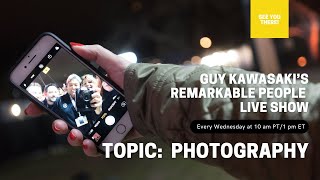
Guy Kawasaki talks photography with Rick Smolin, covering gear like the Sony A9, Fuji X100V, and iPhone 12. They discuss the Day in the Life series, how digital changed the business, and how Smolin sold sponsorships after publishers rejected his work.
Questions this video answers
January 21, 2021
Rick Smolin
Remarkable People
Sony Alpha A9 (A9), cited for ~40 frames per second
iPhone 12
Chapters
Good morning, everybody. Kind of an exciting day. Not only do we have a new episode of Remarkable People featuring Rick Smolin, ace photographer, but also Congratulations to number 46, Joe Biden and Kamala Harris. So I can't tell you how happy I am that there's a new administration and if there's a person who can bring America back together and make America great again, probably Joe Biden. So here we go. It's a great day. And up till 30 seconds ago, I was watching the inauguration and I have to tell you, I mean, Obviously there was JLo and, and Lady Gaga and Tom Garth Brooks, but the person who just blew me away was Amanda Gorman. So she is the 22 or 23 year old poet laureate. And now if anybody out there knows her and can connect me to her, please let me know because I would love to interview her for my podcast, Remarkable People, because clearly she's a remarkable person. And you know, if somebody said to me, okay, you can have any of the speakers, of course you'd want Kamala Harris or Joe Biden. But if somebody said you could have any of the other speakers, the non political speakers on remarkable podcasts, Remarkable people, who would you pick? I would pick Amanda Gorman. So if for all I know, Amanda Gorman's mom or dad is watching this right now. And please tell your daughter that I would like her to be on my show. So, yeah. Happy inauguration though. Jacob Martinez. Amen, baby. The pendejo is gone. So, yeah, so this week we shipped Rick Smolin. Rick Smolin and I go back many years, too many years. And he was a photographer of the New York Times, the National, the National Geographic. One of the first works he did was he went to the Australian outback two or three times over the course of about a year and photographed a woman who was rock, who was solo trekking across Australia. And that effort of hers became a book called Tracks and Tracks became a movie. So he discusses how that went down. Let's just say that their initial meeting didn't go too well because she basically kind of looked at him as kind of, you know, a photographer who was just trying to, I don't know, butt into her business and take pictures and make money or something like that. So that's a very interesting story. He has also interesting stories about how he created the Day in the Life series. One very important lesson, I think from his interview is that as an artist that is a photographer, he noticed that he had very little creative control. Basically, he would go on assignment for the New York Times or National Geographic and He would send back hundreds of pictures and then usually a photo editor in New York would pick the picture that fulfilled what that photo editor thought the story was about, which is not necessarily the picture that would have been the most powerful. And so because of that lack of control, he came up with this idea of doing the 24 hours books. So he, he was sitting, I think, in Thailand with a bunch of other journalists, photojournalists, and they came up with this idea that they would all go to Australia. And in 24 hours, I think it's about 150 of them, they would take pictures of whatever they wanted in Australia. And the book was the, you know, the Day in the life of Australia. And then there was Day in the life of Soviet Union, Day in the life of United States, you know, et cetera, et cetera. So it was the lack of create, the lack of control over his creative efforts that drove him to create the Day in the Life series. And then that led to many other books. Today he views himself not necessarily as a photographer, but, but really as a producer. I mean, someone who comes up with these great ideas and puts them all together. The photographer, the equipment, the publishing, all of that. I also have great respect for him because he basically changed the publishing model. The publishing model was you go to New York, you pitch your book, you hope you get accepted, you get advanced and you do it. And he changed that largely because he said 30 or 35 publishers rejected his Day in the Life idea, so he sold sponsorships instead. So if you think about it, you know, Kodak had a lot to gain, Apple had a lot to gain from sponsoring a book of photography. And so that completely changed the model. Most of his books, he's. He's making money going out the gate because of the sponsorship. So I love photography. I have to tell you, one of my favorite parts of the episode was where he was talking about his religious moment of discovering digital photography. At the time he was using Nikon and Leicas and he picked up a digital camera. And according to him, the advantage of a digital camera so great in terms of flexibility, immediate feedback, etc. Etc. Once he went digital, he's never gone back. And I know the feeling. So if you're interested in, you know, camera geekness, the. I asked him what's his go to camera right now? And he said the Sony Alpha 7 series. So I must admit that I don't use a Sony Alpha 7. I use a Sony. Let's see if we can get this in focus here. There. I use a Sony Alpha 9A9. And you might ask why if you're a camera geek. So I think the salient point of a Sony A9 is that it can shoot something like 40 frames per second. And the photography that I take is of my kids surfing. And so I, I don't necessarily shoot 40 frames per second, but I shoot a lot of frames because surfing is a very dynamic sport. And so it's not like you can take a still photo and then recompose and take a still photo and compose. You just have to hold down the shutter and pray. So now you may wonder, well, where's your lens, guy? Well, I use my A9 so much that I don't know, it got hair and schmutz all over the sensor or the lens. And so yesterday I sent my A9 and my telephoto lens to Sony for cleaning. And so that I would not be cameraless, they sent me another A9 to use while they cleaned it. So that's why there's no lens on this. But I have another 400 millimeter prime lens so I can whip that out. So let's see. So you know, one break the ice question is what kind of camera do you use? I'm interested. You know, is it Sony, is it Nikon, is it Canon? What do you use? Put, put the, the answer in the comments and I hope my Sony brethren are out there. So now let's see guy, your cam autofocus trying to hard is behind you and the lights behind. Yeah, I just switched to this camera, so what could I do? I could turn off those lights, see, maybe the autofocus. Yeah, it's trying really hard, isn't it? Maybe it's trying too hard. I have to admit that yesterday in the same box from Sony with the A9 came an A7C and so I usually use an A6100 but today I'm using an A7C and I set it to pre auto focus. So maybe that was a mistake. So I will try to stay really still but look at how good I'm going to do the opposite of what I just said. So here, watch how quickly this focuses and then I come back. That's pretty good, man. Yeah. Well Juan Pablo, I could make it fixed focus but then yeah, I mean there is that theory. I could put it manual focus and then just set it to focus on this plane. I could do that. But then what happens when I move? I don't know. I have to play with this. But maybe pre autofocus is not the right thing to Do. Okay, so let's look at the camera. Canon 60i Fuji X100V. I'll show you. One second. Okay, if we're gonna geek out on cameras we just gotta go for it, right? So I have a Sony. Excuse me, Sony. I have a Hero 8 which I use for in water surfing and I also like pigs. Pig Fitzpatrick. I have a Fuji 100, what is it? 100xv 100x100v and I just love this for street photography. Fixed lens, you know, beautiful bokeh. So, so my three go to cameras are. It's mostly an A9 world for me. Okay. And then when I'm in the water and I want to take action shots, I use a Hero 8 not a Hero 9 yet because I don't know, I'm a late adapt adopter and when I just casually shooting pictures I use us. Let's see here. I use this Fuji X100V but honestly I don't have it here. Most of the pictures I take are with my iPhone 12 so that's where I am. Okay, what model do you use to take pictures of? San Jose Sharks game, Elliot? Usually at the San Jose Sharks game I just use an iPhone because it's just too much hassle to carry a camera in. I haven't been to a Sharks game for quite a while. So let's see. Any other questions? What about mobile phone cameras? Thoughts? Pixel, iPhone, Samsung. Yeah, Elliot, I use an iPhone 12. Basically I buy whatever the most recent iPhone is. I just buy that phone. So. Oh, let's see. Yeah, Pig Fitzpatrick. IPhone 12. I hear you. Oh okay. So what are the questions? So anyway, Rick Smolin. It's about photography. It's about create control of your creativity, your creative works. It's about creating new business models. It's about, you know, one way to change the world and dent the universe is to document it with photography. If you're into photography and creative arts, you will love Rick Smolin. You would also love last week's which was Julia Cameron because Julia Cameron, author of the Artist's Way is just a remarkably innovative, creative, inspiring person. So Julia Cameron last week Rick Smolin this week. So. So yeah, I gotta figure out in a sense this autofocus is almost too good because whenever I move, it moves with me. That's very interesting. I will ask Sony what to do. I understand the theory of making it manual focus and just fixing it at the plane of my face but I don't know what I just. Okay, so. So we got a lot of answers. Yeah, let's See, I'm looking at answers here, Julie. Okay, here is a great question from Juan Pablo Garcia. Will you put that up, Jeff? That is funny. Do you really have to buy iPhones after those lifetime push for Apple? Steve approves this? Well, Juan, Juan Pablo Steve is dead. So I don't know. But yes, just like anybody else, I stand in line and I pay full retail. Actually I know an Apple employee, so I got an Apple employee discount. But basically, yes, I, I buy the same phone the same way for almost the same price as just about anybody else. I don't think Tim Cook even knows who I am. So yeah, I'm just a regular old schmo standing in line. Well, there's no more lines at the Apple store. You pre order and you go outside and you get it delivered. So yeah, that's me, baby. On the other hand, freaking Sony really takes great care of me, man. I love Sony. Okay, you're from France. Let's see, let's put Richard there who came with the idea for shot on iPhone campaign, got featured by it made me feel good. What a genius marketing idea. You know Richard, that was after my time. I have no idea. I too love that program because it just shows the diversity of creativity that can be done with a phone by quote unquote, you know, not professional photographers. So yeah, I love that idea too. But I have no idea that happened after me. So it wasn't my brilliant idea. But it is a brilliant idea. So yeah, see a lot of people are saying they, they dump their cameras and they're just using an iPhone. That, that, that. I understand that logic. I mean man, iPhones are so good and especially portrait when you can get the bouquet on an iPhone. I mean but I love pressing a shutter. What can I say? Yep, bud Leo dumped his cameras too. Yeah. So let's see what else we're going to talk about. Ask some questions because if you don't have questions, I'm gonna go surfing, man. It's. It's like a really cloudless day. Pretty good tide, nice slow moving, one to two footers. Life is good right now and as soon as this ends, I'm gonna go surfing. So still rocking iPhone 11. My Nikon D7100, they never let me down. Yeah, it's amazing. It's amazing how good cameras are. So no phone can do what a nice icon. Nikon can do astrophotography for starters. That's true. You know, total geek out on cameras here. So see what Nikon I have here with me. I have, oh I have the best Nikon I have. So this is. Let's see, get this focused here. This is my D800. Look, the depth of field is so precise. The Nikon is in focus, but D800 is not in focus. How do I get that in focus? Well, that is a really shallow depth of field. So anyway, this is my Nikon and it has. This is a 14 millimeter lens. It's actually. If you could see it. Let's see, this is hard to do. There. It's a fisheye. So. But I have to admit, I hardly ever use this camera anymore because by the time you go through, like your, your A9 Sony or your Fuji or your GoPro or your iPhone, like my Nikon, D800 is number five on the list. That's just checking. You know, one of the beauties of this D800IS.IS it's going to be hard to focus too. So see this? So it has two slots. So you can put an SD card in it and then you can put this. What the hell is this thing called? This thing, this, this big card here. So you can put both of these in and then the way the Nikon works, you can either save to the SD card and then this card or this card can act as a backup. Although the A9 also has two slots for two memory cards. So they also can function that way that they can either work in parallel or work serially so that you fill up one card, then fill up the next. Or the cards are mirroring each other so that if one card goes bad, you always have another image. So, Richard, you once said you can either make something or sell it. How about managerial roles? Managing people, not selling per se tag? I would say at the early stages of a startup, which is what I kind of focus on really, it comes down to someone's making it and someone's selling it. Now, as the company gets larger and larger, someone has to manage it. I understand that, but at the start, you either making it or selling it. And then I would say in life as a person, which is not a company, the two general rules are making it and selling it. So if you can make it or sell it, you probably can figure out how to manage it. It would be my logic. So let's see. Wait, what was that question? What was your first camera? Oh, Maybe a brownie. That's how old I am. That's hard to say. My first good camera was probably a Contacts C O N T A X. Which what a super camera. That was the contacts back then. Film Camera is kind of what the Fuji X100V is today. I mean it, you know, this kind of format, like 23, 24 millimeter lens, great for street photography, pocketable for big pockets. Anyway. So, okay, what else? Any advice to. To surf and shoot your surfing kids while you surf? Yeah. Well, Juan Pablo, first of all, my kids are so much better surfers than I am that we never surf at the same break anymore. So I can't surf and photograph them at their break because if I try to surf or swim and photograph them while they surf at their break, I would drown. They never come to where I surf because it's too boring for them. So this is my Hero 8. And I either I put in my teeth and I paddle like that until I stand up and then I, you know, shoot or believe it or not, my boards have a little fitting where you can. It's the same plug that's used for fins, except it has an adapter so that you can use the, you know, this, this part, the bottom part. The bottom part here. So I'll show you. One of the Beauties of the Hero 8, by the way, is that it has the little brackets built in. So these. Man, it's hard to do this. This is why I'm not. I Justino Marquis Brownlee, because I can't do this freaking. So you see that thing that's fuzzy out there? That's the two little there, that little prong. Those two little prongs, they are built into the camera. They used to be that you had to get a frame around the camera that had those two things. But now in the Hero 8 and beyond, they're built in. And, and so this thing attaches to a plug in the surfboard and then you screw the camera onto that and then your surfboard has a camera in the nose, which is quite convenient. So what other questions here? What lens is on the Sony right now? Right now? Right now on the Sony is a cap. So my go to lens. My go to lens is really a. Is it. I think it's a. I think it's an. It's a 100 400, I think. Or is it 8400? But anyway, it's a, it's a telephoto lens because most of the time I'm shooting surfing. Now I do have a 400 millimeter 2.8 prime, but that thing is so big and so heavy that I only use that for like really special events. But on a day to day basis, This is a 28 millimeter 2.8 that I like and the lens that is shooting. The camera that I'm on right now is a 55. So I'm usually going between 28, 35 and 55, because still I use it mostly for people. So my next camera will be mirrorless for sure. Absolutely. Shay. It's so much lighter and noise free. Yeah, let's. Yeah, let me look the lens for this live. Turn this light on. There is. It is 1.8. 1.855. That's very interesting. Look at my. So that's. This is with the overhead light on and this is with the overlight. Overhead light off. So my lighting right now is. I have a ring light on my face. I have two GVM lights, both pointed to the ceiling, so the light is bouncing down. And then I usually have this on because. I don't know, I just. I just love bokeh, really. But someone said that those lights are making the autofocus go wacky because it doesn't know what to focus on. So maybe the solution is I should change the focus to center and so it won't look on the sides. It'll only look in the middle and keep my face in focus. I will have to try that. But I don't like to try that in the middle of a live session. So. Okay. Do you print your photos, Anna? I very seldom print photos. Like, I would say that in the entire 2020. Think about this. Literally in all of 2020, I printed one photo. Literally one photo. And that one photo was of my wife. And I printed it for her for her Christmas present. It's a beautiful picture of her. That's the only photo I printed in all of 2020. So. Love this question. Quality of image or composition? What's more important to you? Well, it seems to me that composition is a subset of what makes an image high quality. So I don't think those two things are necessarily mutually exclusive. Although maybe you're saying what's more important than the resolution and color or the composition? And again, I, you know, I think it's. I don't know. I don't know how you separate the two. I mean, I guess you could say. Well, if you use a food analogy, is it the presentation of the food or the taste? Again, I think it's both. So what can I say? What else? What events in general are your favorite to shoot? Not including family stuff? Share. I only shoot family stuff. Really? It's my kids surfing. It's my friend surfing, you know? Well, we don't have parties anymore, but you know, those kind of things. People, shots of family. I'm not really a landscape photographer. I'm not really a nature photographer. I love surfing. So see what photo comes to mind when you think of good, great photos you have taken the one of my wife. I mean, like I said, I shot probably, I don't know, 10,000 photos in 2020 and I printed one. So that was the one. She's looking off. It's. She doesn't even know I'm taking the picture. It's the back of her and she's looking off into the sunset and her glasses on her head and so her glasses have caught the shade of the sun. It's a. You have to be there. So, yeah, that's my favorite photo of 2020. So. So. Let's see. Guy, I watch lots of web meetings. I think your image quality, besides shaking focus, is the best one ever. Yeah. By next Wednesday, trust me, this focus will no longer be so sensitive. I will figure this out. I'll ask Sony how to do this right, because I'm not doing it right. I don't know if it's the. The zone is too wide or that I have pre autofocus on. Pre autofocus for you of those of you who are not familiar with the term, with most digital cameras, the camera focuses when you press the shutter halfway down. But if you think about it, you know, you can't do that with a video conference because, you know, I'm not going to sit there with my finger holding this thing halfway down while I try to video conference. So you set it to pre autofocus. Pre autofocus means it's always trying to focus, which is what it's trying to do. That's why it's always moving around. Because I'm moving around and it's always shifting. So. Yeah. Do you ever shoot for Apple when you work there, Shay? I worked for Apple so long ago. It was before cameras. Well before digital cameras. Actually. That's not true. There was quick take one hundreds, but. But. So that was one of my first. That was my first digital camera for sure. Quick take 100. But no, Apple never asked me to take photos. So. All right, says scroll down for new comments here. Have you surfed in Sri Lanka? I haven't been to Sri Lanka, so I surfed in India at. What is that city called? What is the city on the ocean? That is like the ocean vacation. I want to say Doha, but that Doha is in Qatar. What is that called? Anyway, somebody Indian will know. So. Alrighty. So remember Remarkable People this week, Rick Smolin, creator of the Day in the Life series, photographer, producer, artists and business model. Creator last week was Julia Cameron. She is the author of the Artist's Way. And now she's written a book about listening. So millions, literally 5 million people have bought the Artist's Way. So if you're one of them, you will love that episode. And incidentally, we sent her a remarkable tablet. Remarkable is the company that sponsors the Remarkable People podcast. Duh. And she, I think, is using it. So the way, the way she writes is she writes out long. The way she used to write. She writes out longhand, believe it or not, goes to the FedEx store, photocopies that, and sends one copy to an editor. So with Remarkable, the tablet, she could write a remarkable tablet. It looks like this. So this is a remarkable tablet. This is a remarkable tablet. And. And this is the remarkable tablet pencil. And when you write on this surface, it really feels quite analog, quite like a pencil. And so you write on it, and then this pencil, believe it or not, never has to be charged, which already beats the Apple pencil. And then when you want to erase, I don't know how they do it, but. But you just flip it around and you start erasing with this end and it erases the notes you took. And when you get a remarkable tablet, you create an account. And so as soon as you write on the tablet, it syncs to the cloud. So now you've captured all your notes in one place, it also works the other way. So let's suppose that you want to critique a PDF, a document. So you, you, you get your PDF on your computer, you drag it to the remarkable app on the computer. The remarkable app syncs the remarkable tablet. So anything you put in the remarkable app on the computer will go to the tablet, and anything you put on the tablet will go to the computer. So this way, this is how you upload PDFs to your remarkable tablet. And it's also a way that you never have to worry about finding, you know, which legal tablet did I take notes in. Forgot that legal tablet. I lost that legal tablet. Or you started multiple legal tablets. I used to have about four legal tablets running at the same time, but now everything is in the remarkable tablet. And worst case, even if I lose the tablet, they're still in the remarkable app in the cloud. So. And it now, is it as flexible as an iPad? No, but that's the whole point. I mean, you know, the temptation with an iPad is, okay, so you're taking notes, you're Writing with an iPad, hopefully your pencils charge. And then you get notifications. You know, there's a LinkedIn notification, email came in, text message came in. Ah, you check your email, there's a link to YouTube videos. You click on add link and now you're watching the YouTube video that YouTube suggests more videos and pretty soon you're totally off track. Whereas with the remarkable tablet, you're there to take notes. So that, that's, you know, depending on how you want to look at it, good news or bad news, I think it's good news. It forces you to focus. So that's it. Remember Rick Smolin this morning? If you're into photography and creativity and book publishing, you got to listen to that last week Julia Cameron about creativity and next week, who do we have next week? I think next week I am going to look. Pig's probably going to answer it before I can. Next week. Oh, next week is Jonah Berger. And Jonah Berger is a professor at Wharton in marketing and he's going to talk about influence and persuasion. Think of him as kind of a up and coming Bob Cialdini. So that's what's happening next week. So anyway, congratulations to Joe Biden, Kamala Harris, congratulations to America. It's a great day and I hope you all have a great day and thank you very, very much. Remember, remember, vaccines are coming. But wash your hands, don't go into crowded places. Don't be a dumbass, wear a mask. Well, that's a rhyme. And man, when you can get vaccinated, get vaccinated. I'm 66, I am waiting for that. Call Kaiser. Call me baby, I'll be there. Thank you. Have a great week. Bye.
More from Guy


Cheryl Strauss Einhorn | The Human Edge: Smarter Decisions in the Age of AI | Talks at Google



Rachel Glennerster | Innovation and the Center for Global Development | Talks at Google

Rebecca Winthrop | Rethinking the Purpose of Education in the Age of AI | Talks at Google

Dr. Robert Wachter | A Giant Leap: How AI Is Transforming Healthcare... | Talks at Google



