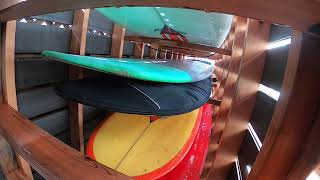
Guy Kawasaki gives a first-person video tour of his custom-built surfboard shed, nicknamed "Versailles." He describes the shed’s storage system (six sliding tracks for boards, five cross pieces), explains construction choices (clips on top, screws on sides), and provides measurements and capacity details (interior ~26 inches wide; overall 14 ft long, 7 ft high, 3 ft wide). He also mentions a 2 ft opening for hanging wetsuits and ventilation design (≈3/4 inch side gaps).
Questions this video answers
6
5
Approximately 26 inches wide; 26 inches is the widest board Guy has.
14 ft long, 7 ft high, 3 ft wide.
2 ft opening.
Chapters
Now I want to show you my shed. I call it Versailles because it is the world's best surfing shed made with tracks. So we have 1, 2, 3, 4, 5, 6 places where we can slide boards in. It is approximately 26 inches inches wide inside, 26 inches being the widest board I have, which is this board. So we have a lot of width. This means that you can put multiple boards. So this is a long board and a long board. This is a long board and a short board. This is a long board and a long board. And this is a long board. And up here we have a short board and a long board. And this is my favorite board. This is called Moby Dick one. So this is the inside and inside we have, we have five of these things, the cross pieces, so that no matter what size board I put in, it won't fall through. Five may be a little bit of overkill, but what the hell. So five of these things treks on the outside, tracks on the top, treks on the side, and then back here we put a two foot opening. And the reason why there's a two foot opening is so we can hang wetsuits here. And this part I'm not too worried about people stealing wetsuits. So we just left it open. And you know, as you can see, if you have a 10 foot board, be really hard to get this 10 foot board and try to steal it through a 2ft hole. Say that again. It'd be, it'd be really hard to take a 10 foot board and try to pull it out through a two foot hole. So I'm not worried. They want to steal the old stinky wetsuits, God bless them. And then we put trucks on the bottom here too so that people can stand in here. If like my kids are trying to put the board in and it's too big for them to do by themselves. So one kid could stand over there, one kid stand over here and you're good to go. Now the top, we use the clips on the top, you can see that clip right over there. So we use the clip on the top to get the boards tighter. Not the surfboards, the Trex boards. And the reason why we want it tighter on the roof is because less water gets through. And I'm not concerned about waterproofness in general because after all that, after all we're talking about surfboards. So surfboards get wet, duh. So what do we care? But I didn't want exactly dripping all the time down here. So it's tighter with the clips on the sides. We didn't use the clips. We went straight in with screws. And that is harder to do because this was, believe it or not, built by one person working by himself, not me. And so, you know, with one person working, if you had the clips, it's much easier to align, but without the clips, like we did, it's harder to align. So you have to figure out a way to do that anyway. So why tight on the top? Why not make it tight on the side? And the reason why we didn't make it tight on the side is two. One is I wanted cross flow ventilation so the boards, you know, can breathe and dry. And the second reason is when you back off from here, I didn't want this shed, which is 12ft. Excuse me, it's 14ft long, 7ft high and 3ft wide. I thought that if the boards were completely tight, like the roof, it would look like this one big monolithic monstrosity box, but with a bigger gap. This gap is about three quarters of an inch. It looks less voluminous, if you will. So that is a quick tour of my project to use tracks to make a surfboard shed. And like I said, I call it Versailles. Best surfboard shed ever.