When the Elephants Dance | Tess Uriza Holthe | Talks at Google
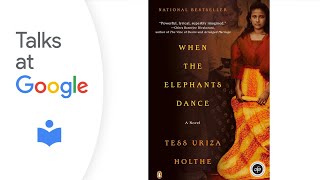
Tess Uriza Holthe reads from her debut novel set during the last week of World War II in the Philippines, where civilians hiding in a cellar tell mythical tales to survive. She traces the book's origins to her San Francisco Filipino-American upbringing and family storytelling, and describes how a writing class led to an agent and a Random House deal.
Chapters
Thanks so much for coming. Today's Authors at Google event, I have the pleasure of introducing Tess Uriza Holta. Tess is a San Francisco native and her latest work is the 5:45 to Cannes. Today she'll be discussing her first novel, when the Elephants Dance, which has been chosen as this year's selection for the Mountain View Reads Together program. You can learn more about this program@mvreads.org when the elephant's dance has been praised by the New York Times as a formidable first novel worthy of a Verdi opera, and the San Francisco Chronicle calls it a powerful tale of the Philippine Islands and a testament to the resilience and courage of the Filipino people. Please join me in welcoming Tess Uriza Holta.
Hi. Thank you. It's great to be here. In order to understand how this book came about and how I became a writer, I thought I'd describe the household that I was raised in. The house I grew up in, San Francisco's Bernal Heights, was a fascinating world without rules or structure that I often went weeks absent from elementary school without my mother's permission. On any given night, at any given hour, 2am 4am you could visit our household and see a thriving mix of at least 25 people or more. Our house was the hub for friends and relatives newly emigrated from the Philippines. Sometimes our living room sofa was someone's temporary home. It was also filled with my five cousins on my dad's side and my eight from my mom's, my three siblings, my grandparents, my grandfather's US Navy veterans group, and later my brother Danny's Vietnam army boot camp buddies. These people came to visit or look on at one of our four mahjong tables, inevitably going on each night. And in the midst of this swarming melee was my mother, the socialite, and my father with his happy, indulgent smiles. It seemed, as a child like one big perpetual slumber party going on in our house, especially if my cousins were allowed to stay or one of the mahjong players brought a child my age. There were Catholic school nuns, Catholic priests, war veterans, liars and a couple of cheats, women who tried to flirt with my father when my mother wasn't paying attention. And in our house, though I didn't know it at the time, our house was a smoky gambler's den filled with fascinating characters. It was a house full of braggarts and heroes, blowhards and feisty women. It was a house full of storytellers and storytelling. Once I'd even witnessed a knife fight, which broke out in front of our house. And my father, cooking in the kitchen, ran down with his machete and broke up the knife fight. But my father was the biggest storyteller of them all. He would tell mythical tales about dwarves in the forest and mystical amulets and heroes and witches that could separate themselves from the lower halves of their bodies at night and terrorize the islanders As a result, I had nightmares. He also told me stories about being held overnight by some men when he was a boy of 12 on the islands, and about how my grandfather's boat once sunk. It was only as an adult that I realized he was talking about the Pacific theater of World War II, and that being captured by Japanese soldiers is what he meant by being held over, where he was literally captured along with his neighbors and hung by his thumbs until a Japanese commander saw that he was a boy and asked that he be cut down from his ties. And the boat that my grandfather that sunk turned out to be the USS Black Hawk during the Battle of Midway in the Marianas Islands, and which he survived by only holding onto pieces of the ship for six hours until a passing freighter came by to pick him up. Still, even in the midst of all the storytelling in my household, I had no idea that I would later want to become a writer. I graduated from high school and immediately went to UC Davis under their pre med program under Biological Sciences. And my class schedule consisted of cross country running, drama, Greek tragedy, and I think, art history, and one science class. After a year of a schedule like that, I actually dropped out and went to Golden Gate University. And it wasn't until I got my accounting degree, because my choices growing up were doctor, lawyer, or accountant, that I decided to take a writing class at the Book Passage in Corta Madera. And our first exercise was to write about a myth in the family. And it was like asking me to write about my childhood. I sat down to my computer and I wrote feverishly, six days a week for a year and a half. And it wasn't until I actually had something I called a manuscript that we took it to the Maui Writers Conference. And to my surprise, I found an agent. And she read the manuscript overnight and then two weeks later sold the book to Random House. So much to my surprise, I became a writer. And I found that I really loved sitting down at the computer each day. And that was the reason why I couldn't finish any biological science classes or accounting homework without stopping in the middle and just reading novels and not wanting to even do my homework. When the Elephants Dance is about the last week of World War II in the Philippines, as MacArthur is about to return and make good on his promise to return from Australia to liberate the Philippines from the Japanese occupation. And the title, when the Elephants Dance, was a saying during World War II. When the elephants dance, the chickens must be careful. And that meant when two superpowers were fighting, that the chickens, the civilians, needed to get out of the way. I thought I'd read a little bit of the first portion of it. And then the story is about a group of civilians that hide in a cellar during the war, and they tell mythical tales to survive. So I thought I'd read you the opening and then one of the mythical tales that the civilians tell one another. Papa explains the war like this. When the elephants dance, the chickens must be careful. The great beasts as they circle one another, shaking the trees and trumpeting loudly, are the Americanos and the Japanese as they fight in our Philippine islands. We are the small chickens. I think of baby chicks I can hold in the palm of my hand, flapping wings that are not yet grown, and I am frightened. Papa is sick. His malaria has returned double strong and his face is the color of dishwater. He sweats in his sleep, but shakes beneath the woven blankets. When he talks, there is phlegm and a quaking in his voice that is hard to listen to. As eldest son, I have been given the duty of food trader for the day. I go in search of rice, beans, comotes, papaya, pineapple, canned tomatoes, carnation milk, quinine for the malaria. Anything I can find, even the foul, smearing durian fruit with its spiked shell would be a blessing. Pork would be a miracle. We are all very thin, like skeletons since the Japanese army chased the Americanos away three years ago. A kilo of rice now costs 50 centavos, more than four times the original price. The Japanese have created new money, but it is no good. We call it Mickey Mouse money. We trade for everything. These work, food, medicine. I carry my baskets of cigarettes to barter with. I worked 12 evenings in Manila to earn these, serving coffee and whiskey to the families on Dewey Boulevard who had been allowed to remain in their mansions and villas. These families were the ones who stood in the streets and waved white flags for the Japanese Imperial army when they first arrived. I would walk 20 km south each day from our hometown of Santa Maria in Bulacan Province to work these houses in Manila. I kept watch as the men smoked and played mahjong on the stone and marbled verandas. Their tables faced Manila Bay, her violet sunsets and the Streets lined with coconut palms. At the end of each evening, I would go to see the hostess, Dona Alfonso. Her face white like a geisha's from too much talcum. She sat in her spacious parlor beneath a row of matching ceiling fans. The blades were made of straw and shaped like spades. Each night she lifted opal ringed fingers and counted three packs of Lucky Strikes, one for every four hours that I worked. She paid me in cigarettes, and I made certain the cups were always full. My brother Roderick accompanies me in my search for food. He is two years younger, and today is his 10th birthday. We must be careful not to step on the dead. And the Japanese soldiers must be avoided at all costs. The first is Mamba's request, the second, Papa's order. Pay attention. I grab Roderick by a shirt and point to a man lying face down. He frowns. It is impossible. They're everywhere. The stench is terrible in this heat. It rises like steam from a bowl of bad stew. I try to breathe through my mouth. Mrs. Del Rosario has been staring at the sky for three days. Her skin has rotted and the animals have taken their share. Her robe is thrown open and her right leg is pointed in a strange direction. I try not to look. When we pass, Roderick becomes glued to his spot. He was a favorite of hers. Don't look. We must go. I nudge him. He turns to me. His eyes are angry and red. He looks away. The blue flies cover the bodies like death veils. They land on our faces, bringing kisses from the dead. We swat them away quickly. Early this morning, before light, we heard the rumble of tanks and saw many Americano soldiers in green uniforms and heavy boots marching in the dark. Papa said that their destination would be the Paco railroad station, an area well guarded by the enemy. Ever since General MacArthur's voice was heard on this radio saying that he will return, all citizens have taken to hiding in their cellars. No one leaves their homes unless it is an emergency. It is best to stay hidden from the Japanese soldiers. Their tempers are short. Now that the Americanos have reappeared, they are quick to slap us on the face or grab a fistful of our hair. Everyone is under the suspicion of being MacArthur. There are barricades and checkpoints every two kilometers. At these spots, the Japanese stand with bayonets and their special police, the Kempeitai. There are Filipinos that stand with them, called macapiles. It is short for Macabayan Filipino, which means our fellow countrymen. The Makapili are Japanese sympathizers. They are pro Asian and do not want the Americanos to come back. They help the Kempetai hunt for gorillas. Papa calls the Makapilik cowards because they hide behind cloth masks. One finger from them and a Filipino could be sentenced to death. They would turn in their own countrymen without hesitations. The Japanese soldiers have poisoned our minds against one another. Americano bombers fly in a V shape above. We watch their silver underbellies ripe with sweet strength. This way, I tell my brother. V for victory. Go, Joe. Roderick shouts with fists raised. Quiet, I tell him. We hurry, crouching low to the ground, ready to dive. The ground shakes and the sky rumbles from their passing. My head spins from our quick movements. I steady myself against a tree. Roderick is the same way. We've grown much weaker in the last month from from lack of food. There is no food to be found. Any supply trucks are ambushed by the gorillas. It was better when we had the cow. At least we had milk. Papa worked so hard not to slaughter her, only to have someone steal her when we slept. We must not move so fast. Stay close, I tell Roderick. Papa said to stay away from the city, he protests. I know. I keep moving and he follows as always. Papa told us not to go. It's okay, I tell him. From behind comes the sounds of tanks approaching. We stop arguing and jump into a banana grove. Five Americano tanks, followed by 50 soldiers on foot. We come out of our hiding place. A few of the soldiers look our way. Tommy guns, I breathe. And carbines, roderick adds, shooting the trees with imaginary bullets. But where are the big guns that have been shaking the house already in Manila? Come, let's follow behind. Roderick stares at me. My stomach twists from hunger. Already my brow is dripping with sweat from the heat and the dust is caught in my throat. I take my palm and swipe it across my eyes. We have to find food. Papa's sickness is getting worse. Do you want to go back? Why don't you go back? I leave him standing with his arms crossed. He follows. Why do they not bury her? Who? I ask, looking at the scattered bodies, for it is difficult to see who the faces once belonged to. Mrs. Del Rosario. For what? She is gone, I hope. Someone buries me, Roderick says. I look at my brother. Do not say that. Make the sign of the cross. He does so. His blue shirt is too large. The collar falls over his shoulder and I can see his skin stretched over the bones. Alejandro. He holds my gaze. Yes. Will that happen to us? After six hours we have covered 20km and reached the outer part of Manila. The tanks and soldiers have long ago moved on ahead of us. We stay to the east side of the city. The scattered sounds of rifle fire in the distance greet us. Another kilometer and we pass Nichols Fields and Fort McKinley. There is smoke everywhere. Our eyes sting and we pull our shirt collars over our mouths. There's a barricade before us. A group of Japanese soldiers stand with bayonets. I told you, roderick says, and brushes an angry hand through his hair. He kicks the dirt. My stomach rumbles and twists. I look behind us. We shall go around the other way, past Haran Street. But even as I say this, the soldiers motion for us to come forward. So that's the first part of the story. This young boy is foraging for food, and while his family's waiting for him, he gets accosted by these soldiers. And while they're waiting, in order not to worry, they tell this first mythical tale, and I'll just read a few so that you can kind of tell the rhythm of it. It's called A Cure for Happiness. If I am to tell the story of the church that sank into the ground, we must first begin with the village of Blanca Negros, west of the Chico River Valley Mountain province. There are secrets in that town, so much anger building underneath the perfect exteriors, the perfect faces like streams of water crisscrossing in the ground beneath smooth polished floors and sowing discord in the houses above. So much restlessness hidden by the white virgin beaches, the rich soil and rows of sugar cane. We lived in the most beautiful place on earth, and yet it was just a facade. The people were not happy. This was the town that I grew up in. I lived with my father in the upper room of a decaying house held together by chicken wire, in some places bamboo and rattan, and others. It belonged to my aunt, a strange woman who in many ways resembled the house itself. Our room was nothing more than a small crawl space to keep one's old boxes and throwaway items, and that is what we were, Father and me, throwaway items. We lived in that room under a great obligation to my aunt, Father's younger sister, and she reminded us of this at every opportunity. Below us, my aunt and uncle occupied one room with her teenage daughter, Rosalie. In the other room, my aunt's in laws occupied a corner with Rosalie's brother, Julio, and Eduardo. I never met my mother and sister. They both died of dengue fever the year I was born. That same year Father was diagnosed with tuberculosis and I with polio. My earliest memory is of my hands raw from working endless days in the sun, Whether it be in the cane fields, the fishing boats, or scrubbing floors in the wealthier homes. I was never a child. My only escape was to watch Esmeralda Cortez. She was a great beauty by any standards, and not just that of our little town of Blanca Negros. I once heard a man from Cavite say she was like a ripe plum waiting to be picked. He said that her coloring was at the peak of perfection and that to wait would be a sin because she would soon begin to fade. Her skin was taut, not too soft, not too tough. He explained to select her any earlier would have been a disgrace any later and one would miss such an opportune moment. She was ready, he said, that's one of the tales they tell. And it's about this woman who's a faith healer and the whole village comes to her for their problems and she becomes more of like a therapist to everybody. So thank you for having me. Do you have any questions? Okay. Oh, sorry. Could you wait for the mic? Okay. Thank you so much for the reading. I have two questions. I wanted to know if you weave in San Francisco into the narrative at all. I know you talk about it's from these boys perspective, but I haven't read the larger book. And then secondly, can you talk about your second book? Sure. Do I weave in the narrative from San Francisco? No, it's based in Manila and it stays for the most part in there as the battle rages on. But I. The second book, which is called the 545 decan, has a little bit of San Francisco. It starts with American millionaire who suffers from bipolarity and he takes this impulsive trip to Europe trying to figure out his marriage and falls under the wrong crowd. So a little bit of San Francisco, but not much. I think she had a question. I know you've talked about six different. Different mythical stories in here. Were these shared with you by your family or did you research them or how did you go about finding them? The stories? Yes. I grew up in this household where most of the people who visited us were there during World War II, including my father and my grandfather. And so I had so many firsthand accounts for a huge part of my life. And then later on I researched World War II, just every book I could get my hand on and just kind of immersed myself and gained the same perspective of the war from just reading some history books. So, yeah.
More from Guy


Cheryl Strauss Einhorn | The Human Edge: Smarter Decisions in the Age of AI | Talks at Google



Rachel Glennerster | Innovation and the Center for Global Development | Talks at Google

Rebecca Winthrop | Rethinking the Purpose of Education in the Age of AI | Talks at Google

Dr. Robert Wachter | A Giant Leap: How AI Is Transforming Healthcare... | Talks at Google



